
PLEASURES OF LIFE
A Falconer Goes Home
And discovers what, exactly, is in a name
By Woody Faulkner
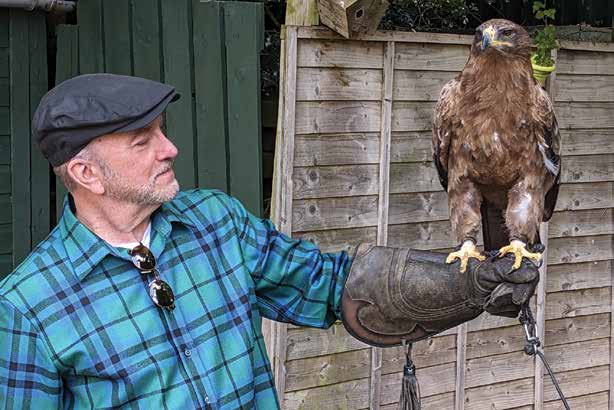
I can scarcely believe that I am here, standing on my ancestral ground with a majestic gold eagle on my arm.
Her massive talons grip my gloved arm. A bit heavy at 7 pounds, her feathered, muscular torso, noble head and sharp talons are all on display as if to say, “Watch yourself!” Out of all the raptors used in falconry, the eagle is the largest. Emitting loud squawks, she lets me know that I need to pay strict attention to her. She is 50 years old, which is very old for an eagle. In the wild, they live to a max of around 35 years. On this gorgeous golden girl’s upcoming birthday, Barry, our Scottish falconer, is going to present her with a whole rabbit “. . . in pless of eh berrrrth-dey kehk!”
I long imagined re-enacting the regal hunting sport that gave my family its surname, Falconer/Faulkner. So, in July, John, my spouse, and I set out for Edinburgh ( or “Edinbruh,” as the Scots say), Scotland and Dalhousie Castle, where Falconry Scotland’s Ultimate Experience is located. Barry and son Jackson introduce us to numerous birds of prey on site, including owls, hawks, falcons, eagles, a raven and a crow. We even meet the sister of the owl known for playing Hedwig, of Harry Potter fame! Taking turns with other guests, we “fly” the owls and hawks. Duke is a large owl so named because he swaggers like John Wayne when he walks. Bojangles is a hawk who wears a bell, and Lizzie is a small, white, talkative owl. Each flies from a perch at the falconer’s signal to our arm, lured by fresh chunks of chicken. Just before each one of these birds lights upon my left arm, its broad wings open widely, it tucks its tail down, while its talons thrust forward to grasp its perch. Then it gracefully folds its wings. I can barely feel little Lizzie landing, but Duke and Bojangles land with a goodly thud that makes my arm dip a bit. Their close proximity to me doesn’t invoke fear, rather admiration and oneness with the bird. The leather gauntlet provides protection from the otherwise deadly talons. After eating the raw chicken greedily, the bird sits patiently on my arm waiting for a command from Barry. Finally, we get to hold a bird of our choice. My pick? The large golden eagle.
Growing up in rural Vance County, N.C., surrounded by other Faulkner families, I was vaguely aware that our surname derives from the Medieval practice of falconry, but my interest was piqued when I seriously began to research my family name. Finding a wealth of information about my 9th great-grandfather and his family’s arrival in 1665 at Hog Pen Neck, a British colony of Maryland, aboard the ship Agreement, I was able to trace our line of Faulkners as far back as 13th-century Scotland.
The first forebears of our name was Ranulphus of Lunkyir, who was appointed Scottish Falconer in 1211 by the third king of Scotland, William the Lion (1165-1214). Lunkyir then changed his name to Ranulphus le Falconer. And so it was that we found ourselves on an unusually sunny day in Scotland traveling north from Edinburgh into the foothill region in which Scottish Kings and their falconers hunted. Hiring a driver for the day, we set out to visit an ancestral seat of the Falconer/Keith clan called Inglismaldie Castle (a small estate on a large tract of land). No longer occupied, the house had been the seat of the Lairds of Halkerton (Hawk-town and the Falconer/Keiths) from 1636 to the 1960s.
Arriving at the castle, I walk up to the front door and boldly knock three times with the round iron knocker as if to say to the ghosts within, “Open up, a Faulkner is here.” Alas, no answer.
Gazing up at the crest above the door, its motto catches my attention, “Quae Amissa Salva,” (“What is lost, has been saved”). After some quick googling of the phrase, we ultimately discover that this refers to Clan Keith (our relatives by marriage) and the Scottish Crown Jewels they saved from Cromwell’s armies in 1652.
On the way back from Inglismaldie, we make several stops to take in the spectacular coastal scenery perfect for falconry. Arriving at the ruin of Arbroath Abbey, founded by William I in 1178 and dedicated to his friend Thomas Becket, we first explore the visitor center. There, I read that King William is buried among the ruins — an unexpected jackpot! Walking down what would have been the nave of the cathedral, leading to the high altar, there on the bare ground, I spy a large, red, flat stone: the tomb of William I! Here lies the monarch who granted a long line of Falconers their family name 900 years earlier!
Experiencing falconry in the land that gave me my name was immensely enjoyable and satiated my curiosity, leaving me full of gratitude. In Scotland, I found a safe — and sacred — place to explore what gave my family the wings to soar.