
WANDERING BILLY
The Belle of the Wrecking Ball
The corner of Bellemeade and Elm faces demolition again
By Billy Ingram
“To put it rather bluntly, I am not the type who wants to go back to the land; I am the type who wants to go back to the hotel.” — Fran Lebowitz
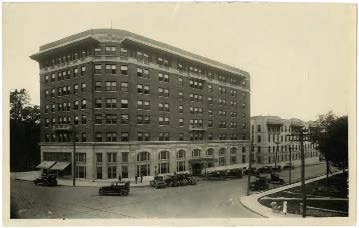
Could it be that, twice in one lifetime, I’ll be there to witness the destruction of a massive structure on the southwest corner of North Elm and Bellemeade? The city plans to soon demolish the seven-story parking deck erected there in 1989. It’s worth noting that 70 years before that date, on this very spot in 1919, one of the most distinguished establishments in the Southeast debuted to tremendous fanfare: the O.Henry Hotel, which, for decades, exemplified Greensboro’s exacting sense of luxury and refinement, distinguished by its cosmopolitan vision for the future.
Greensboro has a long history of hospitality going back to stagecoach days when, 200 years ago, George Albright kept an inn on East Market Street with plenty of hay in the barn for the horses. Nor was the hair those nags shed wasted since it was stuffed right into the inn’s mattresses.
The city’s first upscale hotel was the Benbow House, originally located where the Woolworth’s/International Civil Rights Center & Museum is today. In May of 1871, it was declared to be the finest in North Carolina by its first lodger, Governor Zebulon B. Vance. Demand led to other rooms for rent on South Elm: McAdoo House, Hotel Huffine, Guilford Hotel and the Hotel Clegg, all richly appointed and refined architecturally in full view of the train station with a tendency towards inopportune tinderboxing.
The landscape changed dramatically in 1919 with the debut of the thoroughly modern, eight-story O.Henry Hotel, the largest in the state. Its construction and completion was funded through community stock subscriptions. Designed to be a full-service facility that rivaled any in New York City, it featured 200 luxurious rooms with private baths (another 100 were added later), plus a pharmacy, newsstand, gift shop, ballroom, beauty salon, Merle Norman Studio, and formal dining room, all encircling a striking two-story lobby with a cascade of a dozen or more columns adorned in dark oak paneling with marble footings rising upward then rounding at the ceiling in dramatic fashion. Under foot, an enormous expanse of mosaic tile flooring was accented with sumptuous carpeting, everything warmly lit from above by sleek, minimalistic, blown-glass chandeliers.
Homages to the hotel’s namesake abounded, including a library devoted to O.Henry and illustrations from his stories decorating hallways where guests could leave their shoes outside the door for shining or clothing for overnight dry cleaning. Valet parking was available and, because liquor was illegal to purchase in Greensboro until 1952, a bellhop named “Snag” was happy to procure someone’s preferred libations.
The immediate success of the stately O.Henry led to the 1927 construction of a much taller, world-class hotel a few blocks away. Standing statuesquely on the corner of Davie and East Market streets, the 13-story King Cotton Hotel was the height of Art Deco splendor. First Lady Eleanor Roosevelt whistle-stopped there in 1942 and it’s where movie star Joan Crawford glammed up in 1957 before christening a local Pepsi bottling plant.
The O.Henry lost no luster, remaining the preferred place to play and stay during the 1930s and ’40s for celebrities such as F. Scott and Zelda Fitzgerald, as well as Big Band stars Guy Lombardo and Benny Goodman. Local radio legends Bob Poole and Willie began broadcasting their WBIG morning show in the mid-1950s from a studio tucked under the hotel’s main floor, which was part of a mall with a barber shop, cigarette stand and coffee shop. The sub-floor was also home to the Merchants and Manufacturers (M&M) Club, basically a glorified pool hall, card room and day-drinking barroom for local businessmen.
I was a frequent visitor to the O.Henry on Saturday mornings in the late-1960s, searching for the latest comic books from its newsstand, positioned to the left of the Elm Street entrance. Selecting a four-color DC from the comic rack, I’d march over to the front desk to pay. Even under diminished circumstances, I could appreciate the hotel’s impressive atmosphere, a grande dame retaining an air of sophistication rapidly vanishing from the world outside her doors.
By the late-1960s, winos and degenerates were populating the nearby King Cotton Hotel, drunkenly tossing their empties out of windows, glass shattering on the sidewalk below or atop unsuspecting pedestrians. In 1971, I was among the throng of thousands who gathered on an unseasonably warm October Sunday morning to witness the King Cotton’s erasure from the skyline by way of a newly refined controlled demolition method that is now commonplace — dethroned by a series of carefully choreographed explosions that, in mere moments, leveled the building into its own footprint.
Around that same time, the O.Henry was purchased and was being operated (unsuccessfully) by a hotel chain out of Tulsa, Okla., who, in the spring of 1975, shut it down. But, a few months later, the chain allowed it to be converted into a residential complex populated by recently divorced men and, in the absence of any such institutions, a sort of assisted living facility, without any staffing to support even a small influx of displaced senior citizens.
Inevitable, perhaps, that one of those elderly residents would doze off with a lit cigarette, igniting an early morning blaze on January 15, 1976, sending thick, black smoke bellowing down the fifth floor hallway, creating zero visibility conditions for disoriented tenants needing to be rescued by firefighters. One hysterical man clinging to a minute window ledge outside his room was yanked to safety via ladder truck. All 56 occupants were displaced after the Fire Department declared the building unsafe.
Repairs were made, but the O.Henry Hotel never fully recovered; a nearly deserted downtown Greensboro was no longer a desirable destination.
Photos taken while awaiting the executioner in 1979 highlight the stripped, bare lobby and a dining room with plaster peeling away and draperies hanging resolutely crisp and neat alongside windows gleaming in the sunlight. The lobby’s geometrically playful tile flooring remained as vivid as when it welcomed the first guests eight decades hence with the marble front counter and elaborate light fixtures still intact. It was the sinking of a Titanic.
With so little going on in the area during that time, a parking lot of that size in that spot was totally unnecessary. But eventually it became essential, especially after the Steven Tanger Center for the Performing Arts appeared across the street. Was it theater-goers’ extra wear and tear that wore and tore this concrete structure to such an extent that it will now cost millions to remove and replace? That sound you hear is your taxes going up.
Expecting an O.Henry ending? If you insist. On Tuesday afternoons I work — more like hang out — in a comic shop. Affixed to one wall is the O.Henry Hotel’s actual comic book rack, likely installed in the 1940s, featuring a header illustrated with cowboys and funny animal characters, and lettering proclaiming, “DELL comics are GOOD comics.” The very metal frame I pulled 12-centers from as a preteen more than half a century ago.
With a nod to the late Paul Harvey, “And now you know . . . the rest of the story.” And how old I am.