
BIRDWATCH
Early Nesters
Winter suits great horned owls
By Susan Campbell
It is mid-winter across the Old North State: a time of cold temperatures, wet weather and hints of the longer days to come. Despite the seemingly inhospitable conditions, there is a group of birds already preparing to raise new families: owls. Of the three species that are regulars in our area — great horned, barred and eastern screech-owl — great horned owls are the first of the year to breed.
Being nocturnal creatures, owls are not as appreciated or as well understood as other raptors. Though owls are known for their impressive ability to locate and catch prey under the cover of darkness using their phenomenal hearing and night vision, few people are acquainted with their natural history. Great horneds are adapted to breed very early, well ahead of their cousins, the hawks, when rodents are plentiful and nesting locations are unoccupied by other species.
Great horned owls, whose name originates from ear-like feather tufts on the top of their heads, are one of the most common owls in North America. They can be found in a variety of habitats across the continent. This species is considered the top avian predator in most ecosystems with individuals preying on assorted small mammals and birds, including other owls. Great horneds are even capable of displacing eagles if they are so inclined. These birds are non-migratory, and individuals associate with the same mate year-round on an established territory. In our area, they are found in open agricultural fields, mixed grassy and wooded areas like golf courses, and in both pine stands and hardwood forests. Until late fall, when they begin their distinctive hooting, they tend to go unnoticed.
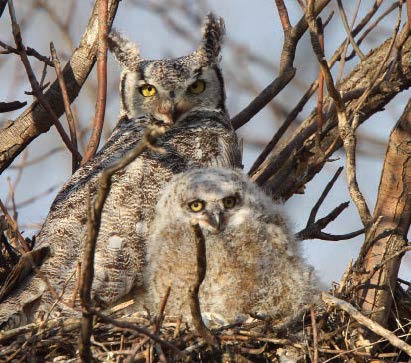
Pairs of great horneds begin courtship calling or “dueting” around Thanksgiving. The four-hoot reply of the female is somewhat higher pitched than the hooting of the male. Mates typically strengthen their bond by the end of December. In January they will choose a nest site, usually a nest built by another species such as a red-tailed hawk, crow or even gray squirrels. They make few improvements other than perhaps lining their nest with some of their soft body feathers. The female lays one to five eggs, and then both adults share incubation duties for the next month. When the young hatch, they are covered in thick downy feathers but must be continuously brooded by the parents for the first two weeks, until they are large enough to thermoregulate independently.
Even though the temperatures are chilly, nights are long and mean more hours for the parents to hunt food for their ravenous offspring. At eight weeks, the youngsters begin to make short flights away from the nest, though they are closely watched and fed by their parents for several more weeks. Like the adults, the immature owls have gray, brown and black striped plumage, which is effective camouflage against the nest or vegetation during daylight hours.
Although hearing a great horned owl calling at night in winter is not terribly unusual, seeing one during daylight is a special treat — no matter what.