
BIRDWATCH
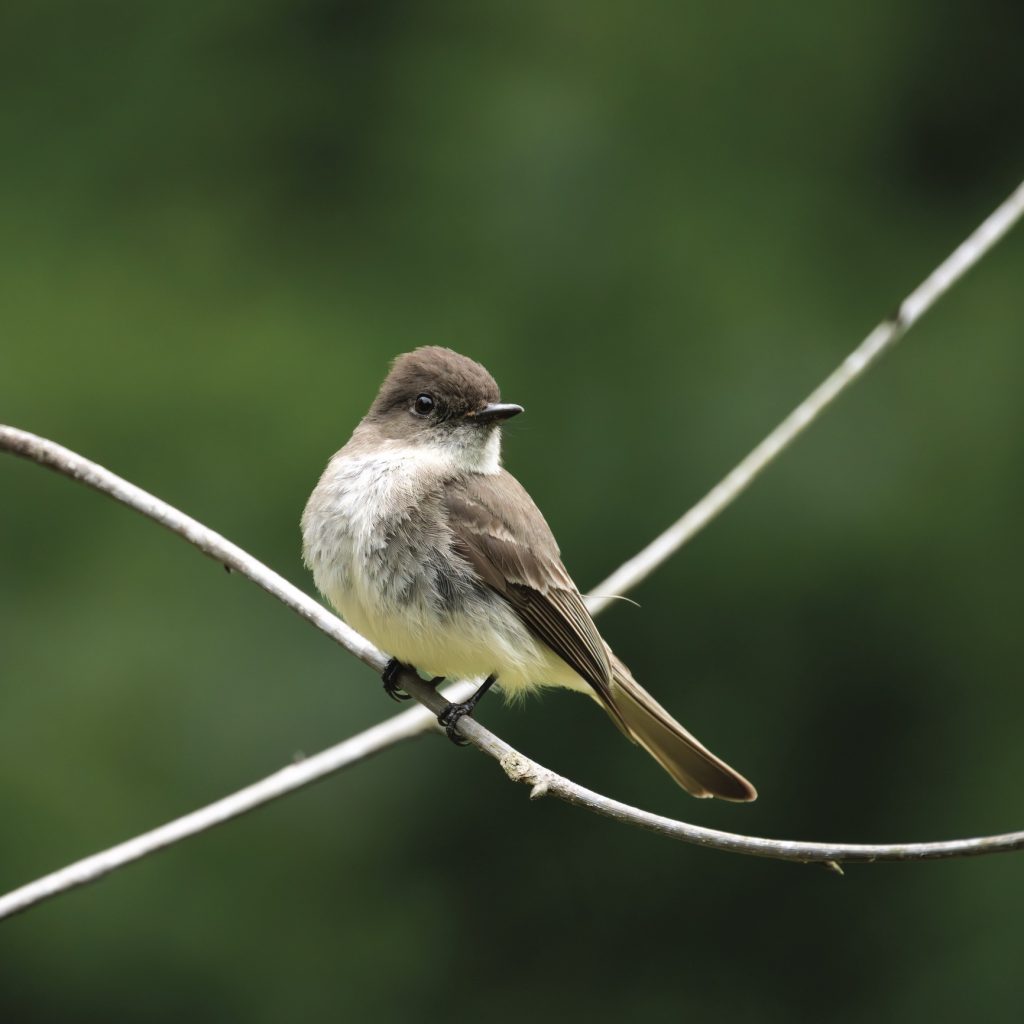
Heard But Not Seen
Eastern phoebes tuck their nests away
By Susan Campbell
Eastern phoebes are small black-and-white birds that can be easily overlooked — if it wasn’t for their loud voices. Repeated “fee-bee, fee-bee” calls can be heard around wet areas all over our state. The farther west one travels through the Piedmont and into the foothills of North Carolina, calling males become more and more evident. From March through June, males declare their territory from elevated perches adjacent to ponds and streams. Even on warm winter days, these little birds can be heard loudly chirping or even singing a phrase or two.
Phoebes have an extensive range in the U.S., from the East Coast to the Rockies, and up and across central Canada. In the winter they can be found in Southern states from the Carolinas over to Texas down into Mexico and northern Central America. They are exclusively insectivorous, feeding on beetles, dragonflies, moths — any bugs that will fit down the hatch. Although they do not typically take advantage of feeders, I have seen one that did manage to negotiate a suet cage one winter. Because their feet are weak, they’re not capable of clinging, so this bird actually perfected a hovering technique as it fed in spurts.
Originally eastern phoebes utilized ledges on cliff faces for nesting. We do not know much about their habits in such locations since few are found breeding in those places now. Things have changed a lot for these birds as humans have altered their landscape.
While phoebes can be easy to locate as a result of their loud calls, in our area their nests may not be. Although they are good-sized open cup structures, they will be tucked into out-of-the-way locations. Typically, they will be on a ledge high up on a girder under a bridge or associated with a culvert. They may also be up in the corner of a porch or other protected flat spot. Grasses and thin branches are woven and glued together with mud to form the nest; therefore it’s critical that the location be close to water.
The affinity eastern phoebes have for nesting on man-made structures in our area may indicate that these are safer than more traditional locations. Climbing snakes are not uncommon in the Sandhills. Black rat snakes and corn snakes are not as active on buildings as they are on bridges and other water control structures. The phoebes may be adapting their behavior in response to these predators and others less likely to be found so close to human activity.
If you have, or have had, phoebes on your property in summer, I’d like to hear about it. I continue to record locations and details on nesting substrate for the species in the Sandhills. The variety of locations that these little birds choose has been very curious. Light boxes and fixtures, gazebos, porch support posts and more have been used, if they are covered by at least a slight overhang. Not only is water a necessity for phoebes in summer, but they require mature trees for perching and foraging as well. Keep an ear out and perhaps you will find one of these adaptable birds nearby — and be sure to let me know!