
BIRDWATCH
Surprise Sightings
The rarest of hummingbirds
By Susan Campbell
If you happen to look out the window and see a flash of white at your hummingbird feeder or flowers, you may not be imagining things. Typically, late summer is when I receive a report or two from hosts who have glimpsed a rare pale-colored hummingbird. Birds in unusual plumage tend to be noticed and, given the network of bird enthusiasts I am familiar with, reports of unusual hummingbirds find their way to my phone or computer pretty quickly.
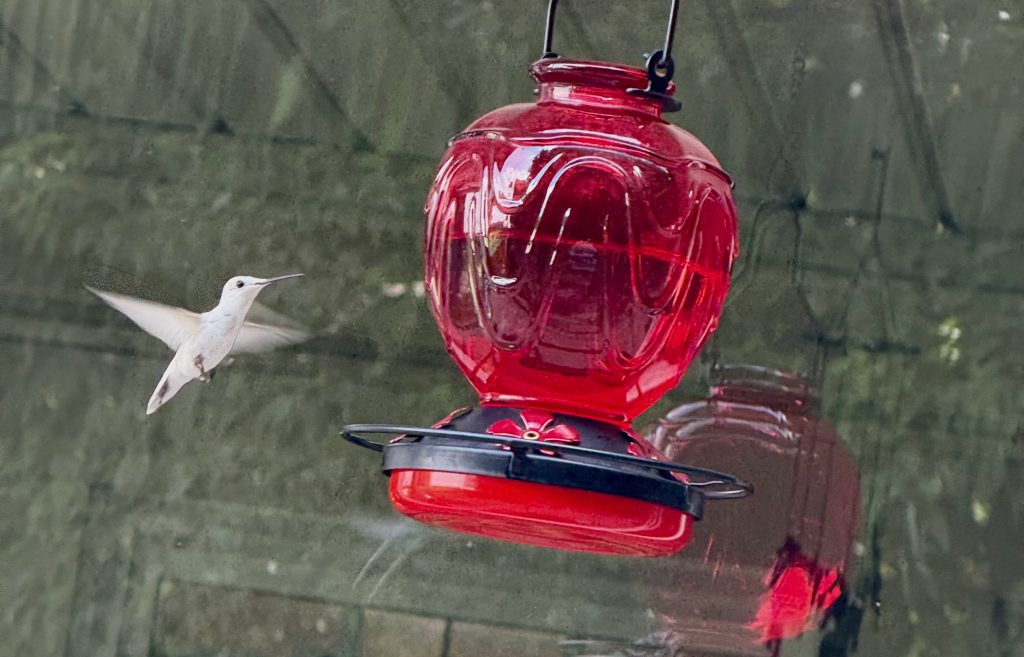
White hummingbirds include both leucistic (pale individuals) as well as true albinos (completely lacking pigment). Gray or tan hummers are more likely than full albinos. Light-colored individuals have normal, dark-colored soft parts such as dark eyes, feet and bills. Albinos, on the other hand, are very rare. These snow-white birds sport pink eyes, feet and bills, and have been documented fewer than 10 times in North Carolina. To date, only three have been banded and studied closely in our state.

It isn’t unusual for people to think they are seeing a moth rather than a hummingbird when they encounter a white individual, not realizing that these beautiful creatures are even possible. In fact, we know very little about white hummingbirds. Opportunities to study these unique individuals are few and far between. What we do know is that they tend to appear in July or August as young of the year and do not survive into their second season. White feathers are very brittle and likely cannot withstand the stress of rapid wing beats and long-distance migration. Another very curious characteristic is that all these eye-catching birds have been females. So, it’s likely that this trait is genetically sex linked.
The first white hummer I managed to band was a creamy bird in Taylortown, near Pinehurst, over 20 years ago. She was an aggressive individual that roamed the neighborhood terrorizing the other ruby-throateds. The first true albino I documented was in Apex, and that individual was even more aggressive; chasing all the other birds that made the mistake of entering her airspace. To have a chance of studying a white hummer, I must get word of it quickly before the bird heads out on fall migration. I have missed more than one by less than a day.
Just recently I heard about a white hummer in the Triangle area. Excited, I followed up and received permission to try to band the bird. She was mixed in with dozens of other hummingbirds using feeders and flowers on a rural property outside Chapel Hill. Although it took two tries, I was able to get her in-hand. This beautiful hummer was very pale, but had some gray in the tail as well as some tan marbling on the back. Her eyes, bill and feet were still the expected black color.
I hope to hear about another of these tiny marvels before all of the hummingbirds in central North Carolina have headed south. Each one is so unique.