
BIRDWATCH
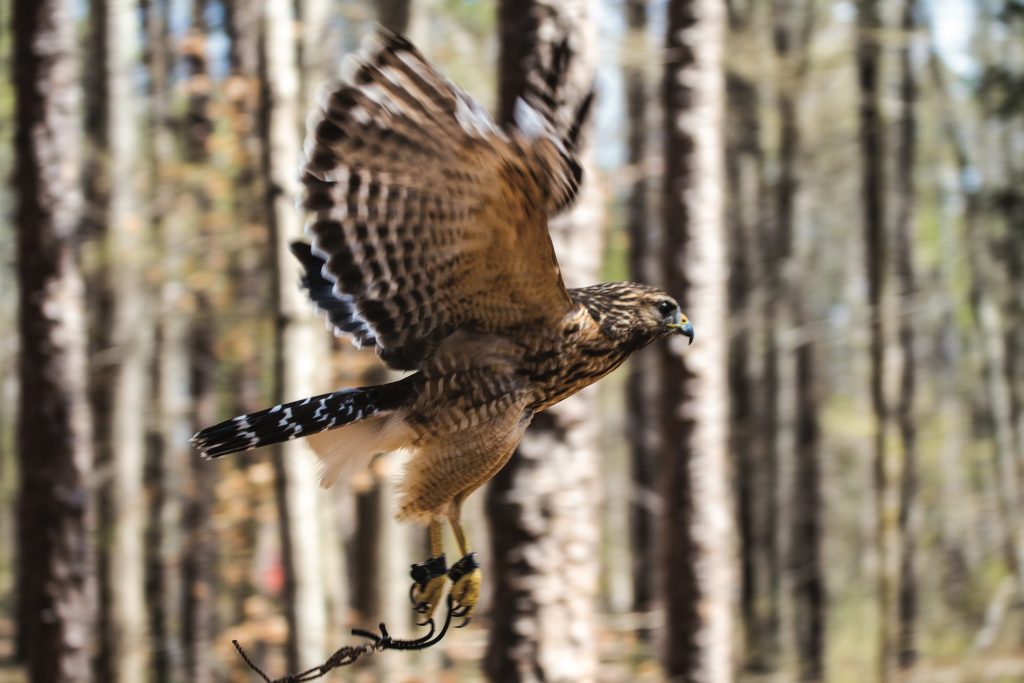
Watching Big Red
A glimpse of a magnificent hawk
By Susan Campbell
Now that the leaves are off the trees, certain wildlife is a lot easier to spot. Without the cover of dense vegetation, birds in particular are more obvious, and larger birds, such as hawks, can be truly eye-catching. Of these, the largest is the red-tailed hawk. Just about everyone has at least glimpsed one of these magnificent individuals on a large branch of a dead tree, a fencepost or a power pole.
Red-tailed hawks are the largest species in the genus Buteo that breeds in the eastern United States. Although they are not a common sight, they can be found across North Carolina year-round. In the winter, red-taileds may be joined by migrants from points north. These big hawks are found in any type of open habitat — from mountain balds to open parkland, agricultural fields and more.
Identifying adult birds is not too difficult if you can get a good view of their namesake reddish tails. Otherwise, the species has a dark brown back, a streaked bellyband and a pale breast with a dark head. Juvenile birds will not sport the colorful tail, but they will still have dark streaks on the belly and a dark head. Both have long, wide wings that they tend to hold in a slight “V,” or dihedral, when soaring. Being birds that hunt by sight, they spend a lot of time either perched from an elevated vantage point or soaring at great heights looking for prey.
Red-taileds catch mainly mammals but are not very picky eaters. They will grab anything, from mice to rabbits. Sometimes they will eat a snake and even catch a bird or two. Also, they may take advantage of carrion.
Breeding for these birds is a major undertaking. Red-taileds require a sturdy nest each spring. It will be several feet across and at least a couple of feet deep in order to keep the young family safe. The adults will frequently reuse a nest from a prior season (if nesting was successful there), adding a few new sticks to the exterior as well as strips of bark and dried vegetation to the cup. Typically, the nest is in the very top of a large tree, although they may use a rock ledge or even a man-made structure such as a billboard or stadium lighting. Brood size is typically one to five young that hatch following three to four weeks of incubation. It will be another nine weeks or so before they are ready to leave the nest.
There is a famous red-tailed pair that has been raising a new family on the Cornell University campus for 10 years. The nest site, located adjacent to buildings I frequented for classes during my undergrad days, is equipped with the most high-tech spyware on the market. It is under surveillance from the time the pair return in early spring through fledging of the year’s youngsters via a Cornell Lab of Ornithology webcam. The female, not surprisingly dubbed “Big Red,” has raised numerous youngsters with the assistance of two different mates over the past decade. “Arthur” succeeded “Ezra” as her mate a couple of years ago. Each year these birds have produced one or more successful youngsters under the sharp watch of lab researchers, as well as to the delight of local birders. Tune in to the webcam in early March, when the pair are expected to return for the 2026 breeding season. I promise that it will be educational, fun — and very addictive.