
Birdwatch
Carolina Newcomer
A summer visitor from down South
By Susan Campbell
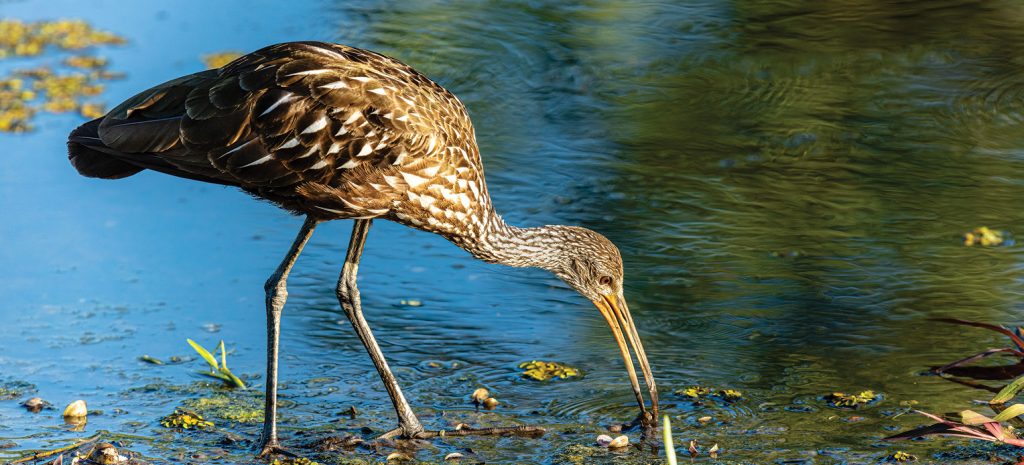
The limpkin is not a familiar bird to many in our area, but this good-sized wader isn’t a complete stranger to North Carolina. Over the years there have been plenty of sightings, and there is a good chance there will be plenty more — so much so that the species may be breeding here before much longer.
Although we hear a lot about birds that are in trouble — those disappearing from their usual haunts as a result of habitat loss, climate change, predation by invasive species, etc. — there are some that are actually becoming more widespread. Slowly but surely, the limpkin is one of these.
Limpkins, native to the subtropical region of the Americas, are wading birds that eat a variety of aquatic invertebrates. They are brown with white spangles and blotches, long legs and, most importantly, a relatively long decurved bill. Appearing a lot like a heron or ibis, they are actually more closely related to rails, those secretive smaller birds found lurking in marshy habitat. Their slightly offset bills are specialized for extracting the bodies of apple snails from their twisty shells, but they are equipped to get into a variety of mussels and clams as well. It is thought that the bird’s name originates from its halting gait as well as an odd running style when pursued.
Here in the U.S., limpkins were once confined to the wetter parts of Florida as well as the coastal marshes of the Gulf Coast states. Over the past few decades, however, they have been spotted farther north in Georgia and southern South Carolina. Given that they now even breed in a few locations “south of the border,” it’s no wonder that individuals have been spotted here in our state. The first was reported along the North Carolina coast (no surprise) in 1975, but in more recent years, they have been found in the Piedmont, too. There have also been a handful of sightings in our western counties. I saw my first N.C. limpkin during the summer of 1998 in a marshy water hazard at a golf course community close to New Bern.
The expansion of this species can be connected to multiple factors. First, invasive mollusks such as Asiatic clams and apple snails have become more abundant in freshwater systems across the Southeast in recent years. That spread of a ready food source, coupled with warmer winters, has provided additional habitat for limpkins. Furthermore, increasingly frequent and prolonged drought within their historic range has resulted in more birds roaming northward in search of the wet habitat they require.
With the summer of 2026 likely to be a dry one in the Southeast, it is very likely some limpkins will arrive here in the weeks ahead. A number of individuals showed up late in the summer of 2023 and persisted well into the fall. If you happen to be out at any of the larger reservoirs, or even along a creek or near a retention pond, keep an eye out — you just might spot one of these unusual creatures on the prowl for a meal or a new summer hangout. OH
Susan Campbell would love to receive your wildlife sightings and photos. She can be contacted by email at susan@ncaves.com.