
Home Grown
Another Piece of Poundcake Please
No judgment here
By Cynthia Adams
The path wending through pine, oaks and scrubby cedars from my grandmother’s house to her neighbor Mildred’s was worn smooth by heavy usage. My grandmother — “Miz Pat” to others and Mama Patty to family — would wrap a freshly baked pound cake, cookies or pie in a fresh tea towel and set off for a visit.
The shortcut spared them the hazards of walking along a narrow asphalt road and creeping along the verge. In the warm months, farmers on combines and tractors dominated the former dirt road my grandmother had entreated Gov. Terry Sanford to pave in the 1960s. Once paved, she was overjoyed, convinced that her one-woman letter-writing campaign was successful.
More curious, still, given such activism had taken root in her. For Mama Patty never once drove on a public road.
My father mopped tears of laughter from his eyes, telling us kids how she once rammed my grandfather’s lumbering, black Plymouth straight through the sturdy wall of the barn as he watched helplessly on, snuffing out all desire to become licensed. She swiftly sold the Plymouth to her preacher.
Alternating their visits, Mama Patty and Mildred would wait until Mildred’s young daughters had caught the school bus before trekking through the woods for a cup of coffee and chat.
Mildred and Mama Patty shared their bounty. They also shared the happinesses and pains of their many neighbors.
Typically, they were first to prepare meals for the bereaved. The first to help when there was hardship in Goose Creek, a farming community and namesake of the nearby creek, which threaded past fields of soybeans, tall corn, cotton, wheat and alfalfa.
Spring and summers, with planting, gathering and harvesting, presented little idle time. In the colder months, the fallow fields that lay outside their houses grew brown, as stalks crumpled along the rows. Even then, the resilient pair of women seldom rested, helping each other preserve something with every passing season. Come autumn, there would be vegetables and fruit to can, sauerkraut to prepare in a stone churn as the cabbage came in, and hominy made from corn in the same washhouse with a heat-fired basin where my grandmother had long ago made lye soap.
Baking was never-ending. Mama Patty’s kitchen was heavily imbued with the honeyed perfume of butter, vanilla and sugar. The white-enamel GE oven barely cooled before she began peeling knotty Granny Smith apples picked from the orchard and rolling out another pastry.
She was a substantially sized woman who preferred simple housedresses and aprons, along with navy slip-on Keds. Mama Patty kept her short, tightly curled hair dyed blackish-blue by her hairdresser daughter at Franklin’s Beauty Shop in Monroe. Her glasses would be Warby Parker-hip today, but they were owlish at the time, magnifying lively, black eyes. She never left home without a fresh hankie and a pearl-handled pocketknife in an apron pocket alongside a tube of Revlon — her sole concession to vanity.
Mildred, at least 20 years younger than my grandmother, preferred capris and blouses, favoring white Keds that were kept spotless. She, too, wore her brown hair cropped short and little makeup on her tanned face. While not a conventional beauty, Mildred had an expressive, open face with deep dimples. Indigo-blue eyes, crinkled by her constant smile and quick laughter, made her deeply attractive.
She was too young to have weathered the hardships Mama Patty had survived — the loss of a child, the premature death of a spouse, the ravages of cancer and the pangs of a cozy nest emptying. She was inclined towards a sunny, empathetic nature.
Mildred’s modesty, like her baking, even rivaled my grandmother’s.
They had instantly adored one another, although Mama Patty was more serious in nature.
Both women were Baptists, albeit one was a Primitive Baptist and the other, a Missionary Baptist. I loved it best when the two argued religion. I’d sit in the child’s rocking chair in the kitchen, near my grandmother’s Kennedy Rocker, and eavesdrop.
They discussed predestination and the particulars of the afterlife. Primitive Baptists, a Calvinistic tradition, grew out of the many Scots-Irish who settled in the South. Theologically, they accepted predestination, unlike Missionary Baptists, who emphasized free will and evangelism.
“Miss Pat, if I believed as you do, I don’t know what I’d do,” Mildred, a Missionary Baptist, would murmur, a smile curling her lip. “I probably would never sleep another wink.”
Mama Patty would gently counter as they argued the “doctrines of grace.” Their voices would always be even as they graciously disagreed. And so, it would go: pondering, parrying.
The two would proceed in this way, hearing each other out. It was a powerful life lesson in what neighborly love actually meant.
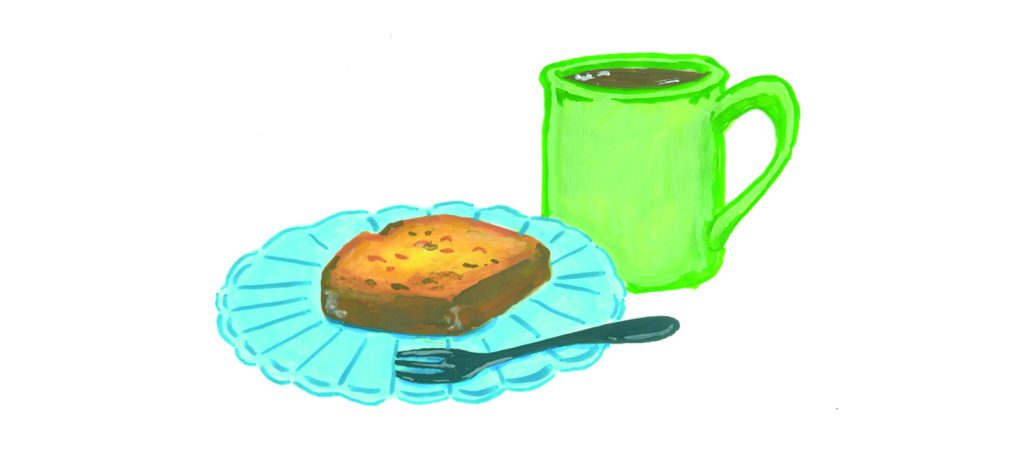
Eventually, one or the other, usually my grandmother, would announce, “Let’s have some poundcake!” and the give-and-take would end.
Mildred would pour strong coffee from the well-worn percolator on the stove as my grandmother served.
It was years before I understood that, ideologically and politically, these women were poles apart. My grandparents were FDR standard bearers; educated and bonded over a love of stringed instruments. My grandfather became an educator and community leader.
Mildred and her husband, Hughlan, were none of those things. Yet nothing but goodwill had passed between them all.
I think of their ongoing kitchen table diplomacy as remarkable in a world where people seldom seek to bridge differences. Such neighborliness, such kind and generous acts of spirit, rarely make headlines or inspire television programs (except for Steve Hartman’s Kindness 101).
And yet, Miz Pat and Mildred forged a lifetime of pleasures while discussing life’s mysteries. The two remained devoted neighbors until their respective ends.
As my grandmother lay dying, Mildred’s warm hand sought hers, and they clasped.
Now, I, too, seek such a path through a dense wood, in search of such connection. Especially when we believe in divergent things.
And I imagine a Ted Talk, featuring Miz Pat and Mildred, two masters of communication, explaining how such wondrous things can commence with the simplest of gestures.
They can begin with a poundcake. OH
Cynthia Adams is a contributing editor to O.Henry magazine. Email her at inklyadams@aol.com.