
LIFE'S FUNNY
Volunteers Needed
Identifying de-vine intervention
By Maria Johnson
I stoop in the dew and get to work, left hand sorting, plucking and tossing the intruders from our vegetable garden.
Don’t ask me why someone who strongly favors her right hand for all other pursuits always weeds with her left hand.
All I know is, my south paw is more sensitive to plants. It’s the hand that caresses leaves and blossoms. It’s also the hand that gauges, with a slight tug, if I can uproot a weed with one yank or if I need to wrap the stalk around my fingers for more leverage.
Is my left hand the gateway to my loosey-goosey right brain, cross-wired hemispheres being what they are? Is that why I enjoy weeding so much? Because it connects me to another brain space?
For my mom, that activity was ironing, the rote chore that allowed her to enter the zen zone, a place where her hands did necessary work while her mind moseyed.
I did not inherit her need to press fabric from rumpled foothills into starched flatlands.
But I do respect, and have my own version of, making things visibly better and finding oneself by getting lost in the mundane.
When I need to get grounded, and think fresh thoughts, you’ll find me literally down in the weeds.
There’s always a bumper crop around our raised beds where, in summer, we intentionally grow tomatoes, peppers, basil, oregano, green beans, eggplant, parsley and leeks.
Unintentionally, we provide a nursery for crabgrass, mock strawberry, knotweed, wild violets and clover.
I cringe as I type “wild violets and clover.” How could I discard them? They sound so Simon & Garfunkel.
Then I remind myself of the truest definition of a weed: Something that grows where and when you don’t want it.
I’ll see you in the cover-crop days of winter, clover. For now, you’re out of here. You, too, tiny pines and oaks and maples. Go make a grove elsewhere.
Here, I tell myself, in order to bring order, and to practice the “culture” in agriculture, I must be a ruthless editor.
And that, of course, is the moment I see an odd interloper.
It peeks, broad-leafed and hearty, from a clump of daylilies in the flower border around the garden.
Squash? Is that you?
We tried growing yellow squash in one of the raised beds a few summers ago. Soon enough, the squash bugs moved in and we, being averse to pesticides and herbicides, let them sap the sunshine from our stir-fried dreams.
Is this a descendant of those ill-fated plants, or a bird-borne volunteer that found a fertile niche in the shelter of the lilies?
I study the outlier, consider yanking it from its safe harbor, and decide to let it be.
Why? Curiosity maybe. What will you become, oh bold and fuzzy one?
A few days pass. The volunteer grows quickly. Already it has bounded over a patch of struggling dianthus and jumped the low barrier that keeps Bermuda grass out of the garden.
Once again, I come close to pulling it out of the ground, but the truth is, I like a vine with chutzpah.
I hold off.
A week later, the vine has advanced a couple of feet on the diagonal. Its goal: to cut the corner of the garden to the sunniest spot in the yard.
In 2020, when we built the raised beds as a COVID project, both to occupy our stay-at-home time and to feed ourselves should broken supply chains threaten our arugula consumption, we did a sun study.
We took pictures of our yard at various times of day, from the same vantage point, and compared the pictures to see which area stayed sunniest the longest.
We built the beds as close as possible to that spot, avoiding a grassy drainage path that, during thunderstorms, concentrates rain water into an overland river.
But this headstrong vine does not care about drainage; it is racing toward maximum sunlight, as if it has a copy of our sun study.
“Follow me,” the volunteer seems to be saying, “I shall lead you to brighter days.”
Baloop. Over the other corner of the Bermuda grass barrier.
Baloop. Over a clump of phlox in the border, into the open yard,
We let it go. Jeff even mows around it.
I am reminded of children. They might not take the path you thought they would, but, when they are full of vigor and confidence, there is indescribable pleasure in standing back and letting them become whatever they will be.
This is why I garden: for lessons and metaphors writ small, in the dirt.
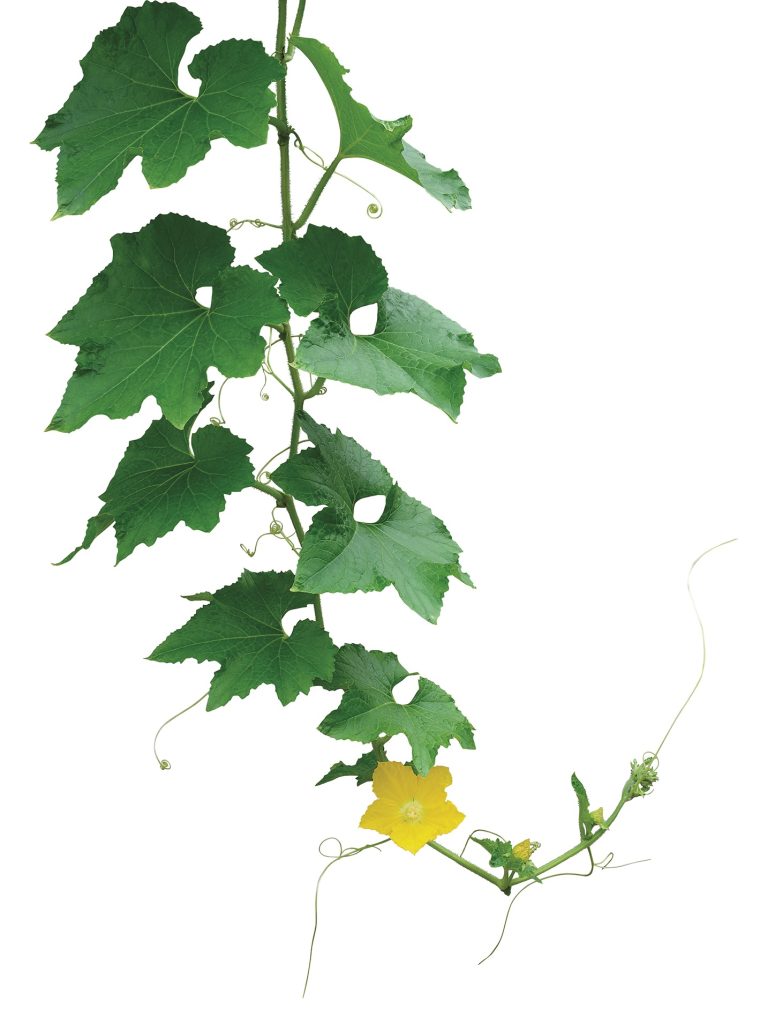
Overnight, it seems, the vine marches on, popping open more green umbrellas, large five-lobed leaves, as solar energy collectors.
It’s now 15 feet away from its starting point. I joke, with uneasy ha-has, about how it’s coming for the house.
I part the hairy leaves and look for evidence of squash. I see lots of bright yellow blossoms, some with bulbous bases, and lots of woody curlycues.
I cave to artificial intelligence, take a few pics with my phone, and ask Google to identify the plant.
My hopes for yellow squash are squashed. But my hopes for jack-o’-lanterns are lit.
This is field pumpkin.
We leave for a week’s vacation, informing our house sitter that, yes, we know about the runaway vine and, we think it’s harmless, but, you know, call 911 if you hear a window slide open in the middle of the night.
We return to a new development. The vine has decided to divide and conquer. One branch has made a U-turn and is charging for the garden gate.
The other fork is running up the grassy swale.
Both offshoots lead the way with closed, green blossoms that sprout tendrils like catfish whiskers.
We are in the homestretch of summer, the giant leaves are showing their age. They are mottled with mildew. Bugs have chewed some of their edges into brown lace. The main trunk of the vine, woody and pale, has been bored in places. Many of the blossoms, including the ones pregnant with fruit bulbs, have been snipped clean off, probably by the family of rabbits that live under the knockout roses and drive our hound nuts.
She has caught at least four bunnies this summer, and we have scolded her each time. Now, we look the other way.
Ruthless editing.
One tiny, round green fruit survives at this writing.
We make it a straw bed and surround the vine with plastic rabbit fence.
We are won over by the vine’s will to survive, its ruthless pursuit of light and life.