
Life’s Funny
Once Upon a Time
An adult finds a secret garden in children’s books
By Maria Johnson
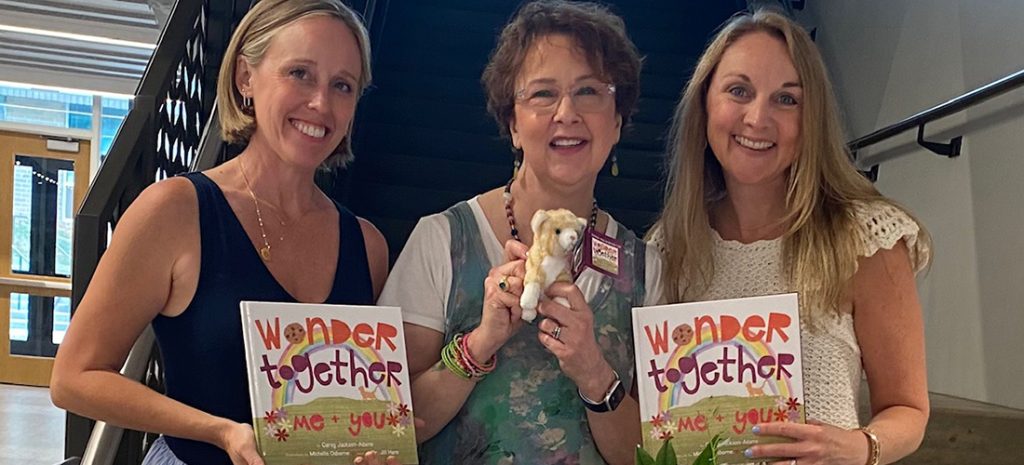
Left to Right: Michelle Osborne, Cary Jackson-Adams, Jill Hare
Sometimes, when I’m looking for a soft and easy peace on a sleepless night, I’ll crook a finger and hook the spine of a children’s book, sweet shelved reminders of my boys’ younger years.
Maybe I’ll sink into the touching and funny Charlotte’s Web by the great E.B. White.
Or loll in the witty wordplay of Where the Sidewalk Ends by Shel Silverstein.
Or delight in A Child’s Calendar by John Updike, who was acclaimed — as in, he won two Pulitzer Prizes — for his serious adult fiction but clearly enjoyed tickling himself and his readers with simple reflections on every month of the year.
Here’s how he begins his ode to August:
The sprinkler twirls.
The summer wanes.
The pavement wears popsicle stains.
Popsicle stains. Can’t you just see the red blotches on asphalt? He ends with this:
The trees are bored
With being green.
Some people leave the local scene
And go to seaside
Bungalows
And take off nearly
All their clothes.
The verse is paired with an illustration of a bare-butt, pale-cheeked child on the beach. Every time I see that, I smile because, you know, butts.
I felt so validated when I read recently that another of my favorite writers, Ann Patchett, recommended reading young-adult books — the non-upsetting kind— if you want to fall asleep and stay asleep.
You bet your sweet Life of Pi.
And I’ll go even further down the literary food chain. I’ve been known to seek the soothing, mantra-like effect of word and rhythm in a toddler’s board book. And I swear on a stack of Dr. Seuss, if you say one word against the brilliant Margaret Wise Brown, author of Goodnight Moon, I will barge into your great green room and personally pop your red balloon.
So I surprised myself the first time I watched the YouTube video of Wonder Together: You & Me, the singalong version of a children’s story published a few months ago by three Greensboro Day School teachers.
One of them, lower-school music teacher Jill Hare, performs the song over a tinkly keyboard tune. She sings the lyrics that upper-school art teacher Carey Jackson-Adams originally wrote as a poem. Illustrations by lower-school art teacher Michelle Osborne flash in the background.
Have you ever counted all the drops in the sea?
Or climbed to the top of a redwood tree?
Have you seen the sky after a cool summer rain?
Or felt the roar of a mighty freight train?
Have you ever tasted a sun-sweetened fruit?
Or pet a new kitten, all fuzzy and cute?
Have you felt someone’s love when they hug you so tight?
Or smelled cookies baking and just wanted a bite?
My grown-up brain had questions — I mean who, really, has ever climbed to the top of a redwood tree? And shouldn’t it be “petted” a new kitten? — but at the same time, my kid brain smelled those cookies and cradled that fuzzy kitten.
I felt the pinpricks of tiny claws, the cool wetness of a small, pink nose, and the rasp of a sandpaper tongue licking my hand. I heard a scratchy little mew.
I felt myself smile and relax. It was just a whisker of relief, but it was as real as the spray of white bristles on a kitten’s face.
What the Responsible Adult Heck?
These teachers were onto something. A few conversations later, the story of the book emerged.
It started about two years ago, when Jackson-Adams, a veteran art teacher, woke up thinking about the sights, sounds, smells and feelings that surround us every day — a veritable banquet of beauty.
She doesn’t think of herself as a writer, but she picked up a pencil and jotted down some small wonders.
“With so many weird things going on in our world, people arguing, so much negativity and divisiveness everywhere, I think it’s important for everybody to take a deep breath,” she says. “Smell the roses, walk your dog, pet a cozy, little kitten, smell cookies baking and, you know, just take time to be grateful.”
As she wrote, a cadence emerged. She showed the words to her friend, Hare, an experienced composer.
A few months later, Hare shared a couple of tunes that she thought would hook the 4-to-8-year-old crowd. She suggested that their mutual friend, Osborne, illustrate the poem and that they turn it into a book.
“Kids do best when they’re engaged with multiple senses,” Hare says. “So having something visual to pair with the tune helps their longterm memory and overall engagement.”
Hare was recalling the book-song combos — especially Sandra Boynton’s works — that she’d shared with her daughters, now 16 and 18.
“I just gave Boynton’s book Ooo, Baby Baby! to my oldest for her high school graduation,” says Hare, 49. “Children’s books, good ones, often seem simple but can have a very personal and deep meaning.”
Osborne, 43, was a fan of Sandra Boynton, too. She smiles at the thought of Your Personal Penguin; she used to sing the book’s companion song — by Davy Jones, formerly of The Monkees — to her daughter.
She still entertains her daughter, now 19, with silly songs. “She doesn’t enjoy it as much as she used to,” Osborne admits with a laugh.
The artwork and messages in children’s books always impressed Jackson-Adams, 63. Her childhood favorites included Homer Price by Robert McCloskey, A Pickle for a Nickel by Lilian Moore and The Tar Beach by Faith Ringgold.
“There’s a lightness about them, you know?” she says.
Osborne created eye-catching illustrations for Wonder Together with watercolors and paper collages. She dug out wallpaper sample books, given to her by an interior designer friend, and started snipping. She used her orange cat, Daniel, as a model for the kitten page.
Jackson-Adams’ niece, the graphic designer Anna Landewe of Saugerties, N.Y., joined the team, contributing her layout and design skills, along with guidance on how to line up an International Standard Book Number (ISBN) and other book-selling minutiae.
To market the book and music, Osborne created an Instagram page and website for the group, who call themselves The Wonder Collective. She included free, downloadable coloring pages and matching games.
As much as the book leans on technology and social media, the GDS teachers hope the upshot will be more screen-free interactions between adults and children — and between children and the real world.
“In my early days of teaching, we didn’t have screens,” says Osborne. “Kids might have played Nintendo or whatever when they got home, but it wasn’t as . . . ”
Jackson-Adams finishes the thought: “Every day, all day.”
So far, the project hasn’t turned a profit for the creators, who paid production costs out of their own pockets. But they have been rewarded in other ways. The day school’s first and second graders performed the song at their end-of-year concert for their families.
“I just sat there crying the whole time,” says Jackson-Adams.
“There were lots of people crying,” says Osborne.
I wondered how that must’ve sounded, an auditorium illuminated by little voices asking people if they had noticed other small things in life, too.
“Their young voices perfectly captured the essence of the song,” says Hare. OH
Maria Johnson is a contributing editor of O.Henry. Email her at ohenrymaria@gmail.com.