
NC SURROUND AROUND
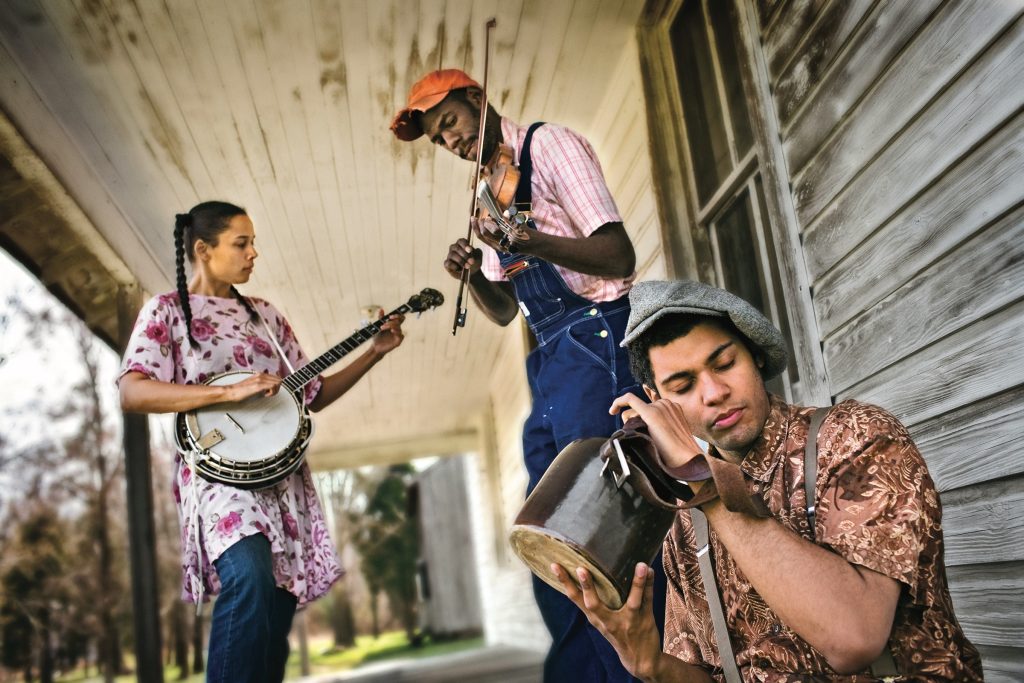
Dropping In
Return of the Carolina Chocolate Drops
By Tom Maxwell
It all started in April 2005, at the first “Black Banjo: Then and Now Gathering.” The event, held at Appalachian State University in Boone, was part scholarly pursuit and part throwdown, featuring four days of “lectures, jams, workshops, down home frolics, and performances” with a view to bringing the “funky, plunky instrument” back home to Black America. Dom Flemons, a 23-year-old student at Northern Arizona University, attended.
“I was the young person at the event,” Flemons says. He had been playing banjo for a few years already, busking on street corners and devouring records by the Memphis Jug Band and Dave Van Ronk, as well as ’20s songster music of people like Gus Cannon and Henry Thomas.
So, like many young people who fall in love with old music, most of Dom’s musical heroes were dead — even if their music was very much alive. But in Boone he was about to enter the musical land of the living.
“When I met Joe Thompson, a light bulb went off in my head,” Flemons says. “I heard him playing at the opening ceremony for the Black Banjo Gathering, and all of a sudden I understood the music that connected people like Henry Thomas to Gus Cannon. When I heard Joe’s music, I heard that flavor of fiddle and banjo music that these guys were referencing, playing and living next to generationally. And that inspired me to move out to North Carolina. I sold everything I owned, packed up my car, took Route 66 east and headed for North Carolina to be near the music.”
Thompson, born in 1918, had been playing African American string band music for 80 years by the time Dom Flemons heard him perform at the Black Banjo Gathering. An Orange County native, Thompson joined his family on fiddle (after studying his father’s old-time technique, which was handed down by his own father, a former enslaved person) playing square dances, parties and dances after corn shucking or tobacco stripping. Joe considered quitting music after his cousin and musical partner, Odell Thompson, died in the ’90s, but picked it back up basically by popular demand. Even a stroke in 2001 couldn’t slow him down. “I got to sit with Joe and play music,” Flemons remembers, “and it was a powerful experience just to be in his presence. I knew that I was connected to the tradition from there. It’s something beyond just music. It’s a feeling as well and, if you’re deep in the culture, you understand the nuances of that feeling.”
Two years after his performance at the first Black Banjo Gathering, Joe Thompson became a National Endowment for the Arts National Heritage Fellow. He also started mentoring Dom Flemons’ new band. Local musicians Rhiannon Giddens and Justin Robinson also saw Thompson at the Black Banjo Gathering and had been playing music at his Mebane house for several months by the time Dom, newly graduated from college, moved to North Carolina. The three youngsters decided to form a band of their own. “These are the years leading into Obama being elected,” Flemons says, “and culturally, people were ready for a Black string band. They could handle it.”
Flemons, Giddens and Robinson called their band the Carolina Chocolate Drops. “With the combination of all three of the original members of the trio, we created a sound that was very authentic and raw, but also landed right,” Flemons says. “We always had a rock solid rhythm. I leaned 100 percent into that, because being a fan of the Grateful Dead, I understand that give and take with the audience.”
All traditions, an accomplished jazz musician once observed, meet at the root. In their career, the Carolina Chocolate Drops were seamlessly able to blend Civil War-era Black string band music, ’60s folk-rock, jazz and hip hop. It’s no surprise — but still an absolute delight — that the band covered Blu Cantrell’s 2001 R&B Top 40 hit “Hit ’Em Up Style (Oops!)” on their Grammy-winning album Genuine Negro Jig.
“I was a fan of Old Crow Medicine Show,” Flemons says, “so I always thought about fast old-time as being a genre. Fast old-time is something that people have always enjoyed, and it was becoming very popular at that time. When we were arranging songs with the Carolina Chocolate Drops, they would usually do a Joe Thompson number. I came up with the jug and took a combination of what I thought about with traditional jug bands, as well as people like Charles Mingus, and applied that to ‘Georgia Buck.’ That gave us a unique sound from a traditional old-time string band.”
The Carolina Chocolate Drops went on to have a stellar career, releasing five albums, opening for luminaries like Taj Mahal and Bob Dylan, making numerous television appearances, and performing several times at the Grand Ol’ Opry. But as all fiery combinations do, they burned bright, then out. Robinson left in 2011; Flemons followed suit two years later. By 2014, the group functionally disbanded. Until now.
“Rhiannon wants us to do this festival she’s putting together, Biscuits & Banjos,” Flemons says. The festival will be held in Durham April 25 – 27 and will feature not only a reunited Carolina Chocolate Drops, but also solo appearances by Flemons and Giddens. Rounding out the stellar lineup are legacy acts like Taj Mahal, promising newcomers Infinity Song, Tar Heel native Shirlette Ammons and many more. In the tradition of the Black Banjo Gathering — and countless others since time immemorial — there will be artist talks, workshops, a biscuit bake-off (Giddens is a self-described “avid biscuit baker”) and a community square dance.”
Indeed, all American musical traditions do meet at the root. Blues, jazz, rock-and-roll — and a sizable chunk of country music — owe their very existence to African American musical idioms and cultural expressions. We are all the better for it, and when you combine this history with Southern food and an old-school hootenanny, life gets very good indeed. And North Carolina is one of the few places in America where something like this could happen.
“North Carolina is such a wellspring of culture in general,” Flemons says, “and I believe that it has done a lot of things right when it comes to expressing the culture of the state. I think it’s something in the way that the land is structured and the way people are raised. Because a lot of times they have this particular connection to the land, and a foot in both the country and the city. The Carolina Chocolate Drops did school shows in almost every city and town in North Carolina, so I got to see everything from Edenton all the way up to Asheville and Black Mountain and Hot Springs. Every part of North Carolina has something beautiful and unique, and the music reflects that.”