
O.HENRY ENDING
Farm to Fable
A handmade bench sings its story
By John Adamcik
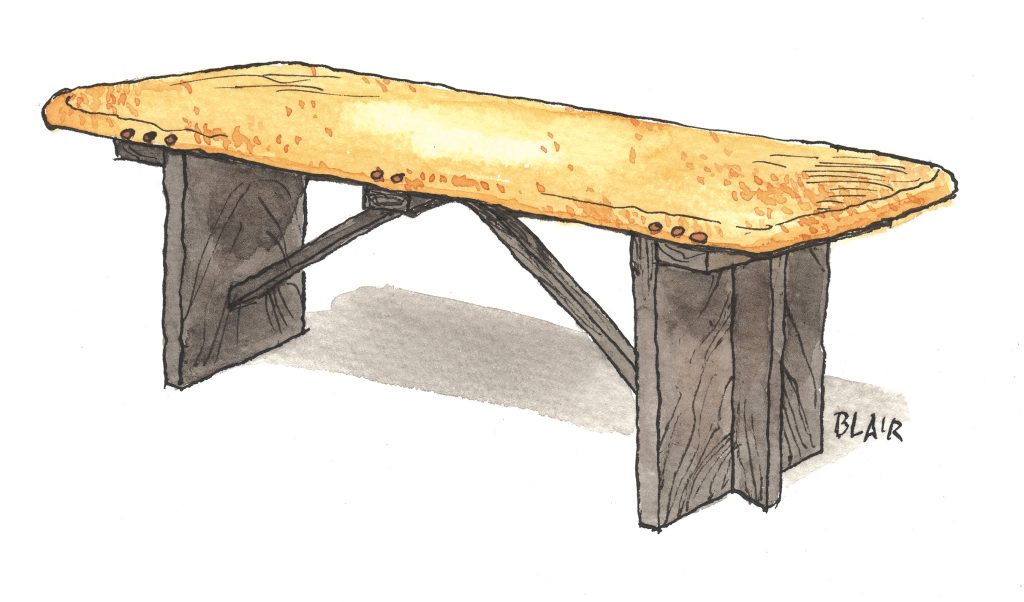
Our family’s kitchen bench sings. Farm songs, mostly. Warm and friendly tunes, passed down through generations.
Some might think it’s the old wood and nails, creaking in protest after decades of heavy use.
Or North Carolina heat and humidity working on the wood Grandpa chose when he built the plank bench for his family of 11 to use in their Michigan farmhouse.
I know better. It’s what’s inside the bench that makes it serenade.
My mother was an upholsterer. When I was young, she’d pay me to remove fabric from heirloom sofas, loveseats and armchairs. By 10, I’d learned how to pull rusty staples and tacks from a frame without damaging the antique, hand-carved wood. I could look at a piece in Mom’s shop and tell you whether the innards were foam, straw or horsehair.
Just as I can tell you what’s in almost any upholstered furniture, I know what’s in our family’s bench.
It’s stuffed with memories from family gatherings, where Grandma kept court at the dining room table. Her encouraging smile remains in my mind’s eye, a reminder of her unconditional love for all of us in her family. There’s residue from orange Kool-Aid she kept in the fridge for frequent visits by us grandkids. Dregs of the beer Dad and my uncles drank, the kind advertised on TV during Detroit Tigers games in the ’70s. Smoke from cigars the guys enjoyed while playing pinochle in the living room (once the farm granary, before the grandparents moved the family there in the 1940s).
There are echoes of laughter and prayers. Grandpa’s jokes, told in half-Polish/half-English. Silhouettes of the tornado of 1951. An undecipherable howl from an uncle struck by lightning as a boy (he lived). A soft groan of shock from another uncle when he got skunked as a youth.
My grandparents were humble people whose lives reflected their faith, love of family and commitment to our mid-Michigan community. The city’s main employer — Dow Chemical, at the time the world’s largest single chemical plant — emerged in the 1800s to mine and transform the area’s subterranean salt deposits into useful components. Grandpa worked there. Dad and my uncles, too. Salt of the Earth, some said. The area. The people. My grandparents.
The bench is packed with testimonies of their farm life.
Early in Mom’s career she lovingly reupholstered the bench for Grandma with embossed, golden polyvinyl chloride fabric jokingly advertised as the shed “hyde” of a mythical creature (but which came from a factory much like our town’s). Ornamental brass tacks still hold the fabric on the bench’s scuffed brown paint.
When Mom moved to Florida years later, she grew as an artisan. Her skill and work ethic built a client list of the retired, the wealthy and the famous. When a fashion model’s Siesta Key home was featured in a national design magazine, Mom’s work filled every page of that spread.
My wife and I inherited the bench. I’m keeping it “as-is.” No repainting or recovering it. My kids can do that someday, if they want.
Mom stays with us now. She enjoys sitting on the bench, visiting with family and friends or keeping watch on the stove. The bench sings to her more than anyone.
I understand, because I know the song.