
SAZERAC
Unsolicited Advice

This February, we’re shooing away Cupid because we are already fully committed. And before you go and shack up with someone, it might be wise to take inventory of the little habits that follow your potential mate as surely as his or her shadow. Because, no, you can’t change them — really, you can’t. The question you should be asking yourself: Can you live with them? Or without him or her? Here is a short list of deal-or-no-deal habits to consider:
1. Close talking, as in nose-to-nose. At first, it’s like, “Oh wow, they just can’t get close enough to me!” But that can escalate into “I can’t breathe.”
2. Leaving the toilet seat up — or down, depending on how you found it. Not a big deal until you get up at 3 a.m. to use the bathroom and either baptize the seat or fall into the cold basin water. Try getting back to sleep after that.
3. Talking with a mouthful of food. They’re so excited to talk to you! How sweet. Or perhaps Mama never taught them manners. Either way, bolus — aka chewed up food — upon your brow? Eeew.
4. Passing gas at the dinner table. Actually, no question about it — deal breaker. Run.
Come to think of it, we might recommend sticking with the single life.
Seen & Heard
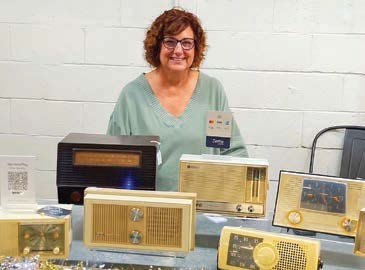
I happened across Taja Mahaffey while she was standing behind her booth at the Greensboro Farmers Curb Market, surrounded by Zenith, General Electric, Westinghouse and Sylvania solid-state radios from the 1960s and earlier. As these appliances harken from an era even before stereo broadcasting, I had to ask, “Why?”
“I was in a thrift shop one day and bought a vintage radio. I just thought how neat it would be to bring it back to life,” she explains. “I found a Bluetooth speaker kit that I could insert into it, tried it and it worked.”
That was around nine months ago and Mahaffey, who resides in Summerfield but lived in Greensboro most of her life, has been scouring estate sales and flea markets ever since. She searches high and low for those vanishing examples of mid-century American ingenuity, often colorful, futuristically designed, with molded-plastic packaging.
“I’ve probably adapted 50 or more,” she says. “It just depends on when I can find what I’m looking for in good shape and at a good price.” Mahaffey, under the name Songbird Designs, also offers her groovy gadgets for sale at Main Street Market & Gallery in Randleman, where these whimsical looking Bluetooth receivers come with a USB chord for recharging.
I’m especially enamored with her idea of taking those modular clock radios your (great-) grandmother had bedside or on the kitchen counter, then reimagining them as devices tuned in to your tunes today — not to mention the convenience of a built-in timepiece for the few of us remaining who remember how to read an analog clock!
Just One Thing
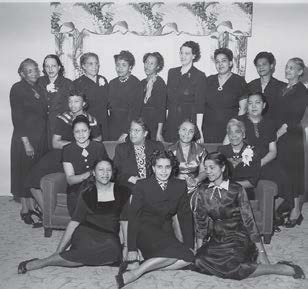
What a range of age among the members gathered in the 1950s meeting of the Alpha Art Club, the Triad’s oldest-known African American women’s club. One hundred years later, the club is still going strong, celebrating their centennial with a photo exhibit at the High Point Museum, including an hour-long video of members’ sharing their time in the club. Rishaunda Moses, immediate past president, reflected recently that the club’s founding members initially “would get together to socialize, have tea, make doilies or just chat.” She went on to tell The High Point Enterprise that the club transitioned in the mid- to late-1920s to promote civic betterment. The club has persevered through the Great Depression, World War II, the Civil Rights Movement and a global pandemic and will continue moving forward with its mission: “lifting others up.” Today, that work comes in the form of supporting the NAACP, offering a mentoring program called the Legacy Foundation and providing scholarships. Info: highpointmuseum.org.
Piano Man
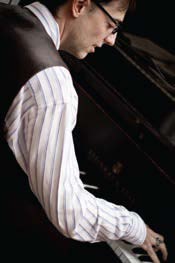
Musician Mark Hartman is in the air so often his Facebook persona is “Mark on a Plane.”
The New York-based pianist and composer conducts, arranges and composes for theater and concerts worldwide.
“I have to say, I love tiny airports. They make me so happy!” Hartman’s award-winning career spans both on and off-Broadway hits, and international theater as well.
When he taxis into our little PTI, however, he’s probably thinking about things he’s missed about home. Having grown up in Arcadia, between Lexington and Winston-Salem, his stomach is often rumbling at the thought of ‘cue.
Specifically, “Speedy’s in Lexington.”
Even in the air, you’ll likely see Hartman with a pencil in hand. Pencils are a talisman.
“I am oddly superstitious about pencils. If I start a musical marking in my score with a specific pencil, I will keep it and use it all the way through opening.”
To the delight of his friends — and strangers alike — he made a rare Triad appearance recently. At the invitation of the Anne Griffith Fine Art Museum at Red Oak Brewery (before stops in Saratoga, N.Y., and then to Guthrie Theater in Minneapolis), Hartman chatted to the crowd as he played from memory, hardly glancing at the keyboard. Few realized he had only recently laid his father, Wayne, to rest, who was a catalyst for his musical awakening. During childhood, Hartman “plunked around on musical toys,” including a toy piano at his grandparents’ house, where he discovered early on he could repeat melodies and songs he had heard by Elvis Presley, Nat King Cole and Helen Reddy.
As a youngster, he performed in various churches, encouraged by his minister father. By high school, Hartman was already playing for musicals and theater productions. His favorite North Davidson High School teacher, Sherri Raeford, took him to his first college theater performance (Chicago at Catawba College).
“I got into musical theater originally because it appealed to my love of music, lyrics and storytelling.” But, as his career has propelled forward, he says, “The thing I love most is connecting with another artist — in hopefully great material — to make something personal and individual and more satisfying than either of us could do on our own.”
He lists Leonard Bernstein, Fats Waller, Joni Mitchell, Stephen Sondheim and Leonard Cohen as a few of his influences. Throughout his own career he has appeared with cabaret greats such as Lorna Luft, Chita Rivera and Jennifer Holliday.
“Many things set Mark aside as a high school student,” says Raeford. “One was that he was a walking encyclopedia when it came to his knowledge of musicals and musical theater.” But for the intimate gathering of art and music lovers at a museum in Whitsett, Hartman slipped into what he loves, after weeks of coping with the loss of a parent.
Launching into a musical reverie over three hours long, teasing out 40 or more songs, he wove them together in a casual, cabaret style.
He smiles gently at the mention of Cohen’s “Hallelujah,” insisting “it is not a sad song.” In Hartman’s hands, it was reinvented, the plaintive words inexplicably transformed.
Those present received a master class in the power of music to extend beyond entertainment, to heal.
Sage Gardener
Although I don’t currently brew beer, I’ve had experience in beer making since my dad donned a yellow rain suit and a Nor’wester rain hat to uncap the bottles of home-brew that were exploding in our basement, which, by the way, sent a wonderful aroma up through our heating vents. I made beer in college when it was more exciting because it was a federal offense, using canned Blue Ribbon malt and, I shudder to think of it — bread yeast to get things going. (Let’s not bring up the subject of yeast infections some females blamed on my beer.) Later, in grad school, an English-beer-loving friend and I graduated to ordering malt extract and hops extract, both imported from the U.K. It was with the extract, which turned the beer into the equivalent of IPA, that my love affair with hops began.
Fast forward a half-century later and I’m finally contemplating planting hops in my garden this spring. The always helpful N.C. State Extension Service had a good piece stating that 80 small farms were growing hops successfully in the state. If they can do it, I decided, so can I. I’ve been wanting to grow hops since I learned the species name, Humulus lupus, meaning “small wolf,” referring to the plant’s tendency to strangle other plants as a wolf does a sheep. In other interesting tidbits, I learned that hops grow on “bines,” not vines. (A bine twists around something, and always in a clockwise direction, whereas a vine grows in tendrils, in various directions.) I was told I could expect growth of up to 12 inches a day. It went on to mention how hops will grow up almost anything, reaching heights of up to 25 feet. While sipping on a mug of Old Speckled Hen, I envisioned a tangle of hops that would give the wisteria at the back of my property some competition.


Stephanie Montell writes on the morebeer.com platform that “Growing hops at home is easy if you know the tricks of the trade.” She points out that it’s the female flower (like another plant I know) that are all-important. It seems that only the female plant is able to produce the actual hop “cones.” She went on to warn gardeners not to plant hops near electrical power lines to avoid what I’ll term kudzuification.
Loamy, well-drained soil. Check. Lots of manure. Check. One hundred and twenty frost-free days. Check. Plant in early spring, no later than May. Can’t wait and probably won’t.
Hops grow from rhizomes, which I need to mail order. N.C. State suggests which varieties will thrive most anywhere in the state. First year? Not much growth while the plant establishes its room system. “Instead, look forward to the second year when hops are full grown and produce healthy crops of fragrant flowers,” she says.
But here’s what’s going to be tough. Beginners, she says, “have a tendency of letting every shoot grow and climb. Although this is understandable, leave only selected shoots and trim the weaker ones at ground level . . . to force the strength of the root into the hardier shoots.” Whatever. My wife does something similar with our tomato plants and it drives me nuts. But a side-by-side experiment demonstrated she knew what she was talking about.
Finally I learn that all but 4% of hops are grown in the Pacific Northwest, where, I am told, one acre can produce enough dried hop cones for 135 to 800 barrels of beer. I have a quarter-acre under cultivation, so that means I need to limit my annual brewing to between 34 and 200 barrels. I can hoppily manage that.