Chaos Theory

CHAOS THEORY

Pirou-what?

Toeing my way into ballet

By Cassie Bustamante

For the last year and a half, my youngest, Wilder, has been learning how to bop with the beat in a weekly dance class. I signed him up for Dance Project’s “Little Rhythms” after a friend casually mentioned that her son had been going and enjoyed it. My own glory days of ballet and tap, which I took until I hit middle school, twirled around in my head. No, I wasn’t the most graceful, but dance is about so much more than that. Plus, to be honest, when I learned that there was no commitment to a recital — you could opt in or opt out — I was stoked. I’d sashayed down that path once before with my daughter and had zero desire to be a “Dance Mom.”

And yet, here I am among other parents, sitting on a bench just outside a mirrored studio while our kiddos move and groove, doing their best to follow their instructor’s lead. Occasionally, I peer in and catch a glimpse of my kindergartener. Is he doing the correct moves? No. But is he having fun? One hundred percent, yes. His cobalt Nikes are flying off the beat and he’s struggling to get the steps right, but his blue eyes reflect the absolute joy he’s finding in movement.

As class progresses week after week and the recital approaches, the question of the performance arrises.

“I just want to watch,” he replies assuredly.

Then, with just a couple of weeks until curtain call, costumes arrive. I haven’t ordered one for Wilder, but, as it turns out, one happens to be there with his name on it.

It could be, perhaps, that he just wants the thrill of dressing up in something fun, but I can see a thought flicker across his little face — he is reconsidering. If we are going to commit to this show, I want utter certainty.

“You know, it means you’ll be dancing on stage in front of the audience. I’ve seen your moves and I know you are a fantastic dancer,” I say, “but I want you to do it because you want to. Are you sure?” He is.

The day arrives and he seems to have absolutely zero pre-show jitters. Frankly, I am in awe. My own heart races as I recall my own dance recital nerves.

Backstage, I kiss him good-bye and leave him in the capable hands of a dance parent volunteer. I take my seat in the audience, surrounded by my parents, my husband, Chris, and my daughter, Emmy.

Finally, Wilder’s class enters from stage right as the backdrop glows in Aladdin-blue. A beat drops as the song starts: You know it’s Will Smith and DJ Khaled! With a little guidance from their teacher, the kids spend the next minute and 20 seconds strutting their stuff to “Friend Like Me.” As the crowd erupts in cheers, I wipe a tear from my eye because seeing my child doing something he loves has made me so uncontainably happy.

As the show comes to an end and all performers return to stage for their final bows, Wilder leads his class out and continues to freestyle until the very end. I know, with certainty, that we’ll be back for dance class in the fall.

So once again, I find myself on that bench, peering in the window of that studio space. Just next to it is a blackboard with neon chalk writing that catches my eye: “Sign up for adult classes!” I glance back through the window. Wilder’s elbows and feet are all over, but his smile stays put. And I think, Why not me?

Back at home, I log onto my computer and register for “Absolute Beginner Adult Ballet.” Sure, I’ve got experience, but that was 40 years ago. At my very first class, I slide peachy-pink ballet slippers onto my feet and find my place along the barre with several other women of all ages. At 46, I still lack grace and coordination, but, as I’ve learned from Wilder, talent is not a prerequisite for enjoyment. The music starts — a piano cover of ABBA’s “Super Trouper” — and I plié, tendu and jeté. Turns out, I am not a dance mom. I am a dancing mom. 

Chaos Theory

CHAOS THEORY

Partners in Grime

A bit of a fixer-upper

By Cassie Bustamante

The summer I turned 7, my family moved from small-town Upstate New York to Wilbraham, a small-town in Western Massachusetts. Picture quaint, 200-year-old homes, churches surrounded by old, stone walls and even a very old, red schoolhouse-turned abode. Everywhere you looked, the streets bubbled over with New England charm. But our new house? Not so much. It bubbled over with ick.

My mother and I made the trek across states together, leaving my father behind to cheer on my older brother, Dana, who was playing in a little league tournament. I hadn’t yet seen any photos of the new digs, but I’ve always thrived on change and the opportunity to meet new people. And, this time, we were moving to be closer to family. We’d be in the same town as both sets of grandparents and close to all sorts of cousins, aunts and uncles.

In fact, Wilbraham was the town where my parents met as high school students with backyards abutting one another. Back then, my dad wore his white-blonde hair in a 1970s swoop that cascaded in front of his eyes, suiting his shy personality. My mom, a petite brunette with a Farrah Fawcett ’do, was gregarious and often teacher’s pet. Come to think of it, a lot like me. It wasn’t until they both enrolled at Springfield College in the fall of 1974 that sparks flew.

All along the drive, I chattered away excitedly, driving Mom bonkers. The anticipation came to a jarring halt when we pulled into a driveway. This could not be it. I prayed that this was some kind of joke and, surely, Mom was about to shout, “Gotcha!” In front of me stood a dilapidated, brown 1964 Colonial with red shutters — the worst color combination known to man — and an attached two-car garage. The paint was blistered and peeling, rot everywhere. This was it? I wept.

When my brother arrived a week later, he had the same reaction. In fact, he packed a suitcase and said he was going to ride his bike back to New York and live with friends. I wondered how he’d manage the suitcase while pedaling, but I never witnessed that level of stunt mastery because he stayed.

Beyond the front door, the family room featured the inevitable ’60s faux-bois paneled walls and linoleum flooring that vaguely resembled bricks. The tacky residue left behind by a rug adhesive attracted the fur of our golden retriever, Butterscotch. In fact, every surface seemed sticky and dirty.

But it was as if Mom and Dad could see into a crystal ball, which magically showed them something I couldn’t see — the spark of potential underneath all that grime. They rolled up their sleeves and got to work. In sections, they replaced wooden siding along with rotten windows. They repainted the exterior a soft gray and gave it new barn-red shutters, a color combo that still remains in place today, according to my Google search, almost 40 years later. I recall many days spent outside, flipping over rocks in search of salamanders, while Dad sat atop the house with his cousins, hammering down a new roof.

Grampa, Dad’s dad, was a self-made entrepreneur who owned a wholesale hardware company, and thus understood the world of home renovation. He’d appear from time to time to “help” Dad with weekend warrior projects. But not until he’d sat on the porch munching on a donut and sipping coffee, followed by playing basketball with me and my brother in the driveway. And then, “Oh, would you look at that? I’ve got to go if I am going to make my tee time!” Maybe he took it too easy, but we all look back on those moments with laughter. Cancer took his life way too soon just a couple years later when he was just 59.

On weekends when repairs weren’t being made, Bob Vila’s voice rang through the kitchen while I ate my grilled peanut butter sandwich, This Old House playing on our wooden console television set in the nearby family room. YouTube and TikTok were still decades away from being created, kids. My parents had to learn about DIY through reading books and checking the Sunday paper’s TV schedule to make sure they didn’t miss their favorite DIY shows.

Mom, an avid gardener who knew just what would thrive where, planted flowers aplenty to create a lush and vibrant yard. Lilac bushes lined our white picket fence. Just outside the back door, an herb garden’s fragrance wafted through our kitchen window all summer long. We teasingly called it the “Herb”— with a hard “H” — garden, naming it after the endearing, out-of-shape man in one of Mom’s Jane Fonda exercise videos.

My parents poured everything — blood, sweat, tears and what little money they had — into making that hideous monstrosity a jewel of the neighborhood. As a 6-year-old, I hadn’t understood the possibility, but as a 46-year-old I’ve learned something about compromise and seeking out hidden potential.

Over the 21 years that my husband, Chris, and I have been married, we’ve bought a few well-worn homes. And every one, we’ve made our own with paint and — like my parents — blood, sweat, tears and all the money we could muster. When we arrived in Greensboro in January 2019, the 1960s Starmount Forest ranch home we moved into was far from a looker, but it ticked the boxes for a family of five. Though our new house was not nearly as neglected as my childhood home in New England, my own kids felt a little like I had the day I arrived in Wilbraham with my mom. The magic simply wasn’t there. But, thanks to my parents, I’ve realized that magic is something you create through a combination of creativity, hard work and collaboration that includes the kids. And as the months have turned into years, we’ve turned a house into a home, one that our two older kiddos will look forward to returning to next fall when they’re both away at college. That is, until they have their own fixer upper to make their own.

Chaos Theory

CHAOS THEORY

Tanked

A terrible, horrible, no good, very bad day

By Cassie Bustamante

One of my favorite childhood books is Judith Viorst’s Alexander and the Terrible, Horrible, No Good, Very Bad Day. If you’ve read it, you know that poor Alexander has one of those days where everything goes wrong. And — spoiler alert — it doesn’t even have a happy ending. But what it does have is an assurance to kids far and wide that everyone has days like that. Everyone.

Chris, my husband, is away for work, so I’m on my own for a few days with our three kiddos. I pick up Wilder, 5, from his after-school program and we head home for the evening. Shortly after we walk in the door, he comes to me, his blue eyes looking sad and guilty, his cheeks slightly flushed.

“I know you got a text from the school today, Mom,” he grumbles.

A text from his teacher? I check my phone to see if I’ve missed it. Nope. “Why would the school message me?” I ask him.

He looks at his feet, kicking the carpet. “My card was flipped from green to yellow,” he mumbles. In kindergarten-speak, his behavior went from good to “you’ve been warned.”

“Oh, no,” I say. “What happened?”

“I talked when I wasn’t supposed to,” he replies. Welp, he’s definitely my kid. I can’t tell you how many classes I got kicked out of for disruptive chatter.

“Hey, it’s OK,” I say, hugging him. “You made a mistake and you learned from it. I’m sure it won’t happen again.” Though, if he’s like me, it will most definitely happen again. (My math teacher once called me the “Mayor of Math Class” because I had to greet everyone before taking my seat. What some deem disruptive, I call friendly.)

After dinner, I head to his room to snag dinosaur PJs from his bottom drawer. And that’s when I see it.

In the small aquarium sitting atop his dresser, Bluey — his cobalt beta named not for the hilarious Australian cartoon dog, but for his color — is vertical in the tank, pouty-face up, tail down.

Tap, tap, tap. I rap on the plexiglass side. Nothing. His little pectoral fins don’t make a flutter.

I take a deep breath, preparing myself to make Wilder’s no-good, very bad day even worse by letting him know the fish he’s loved for over a year is no longer.

“Hey, bud,” I say, “I’ve got some bad news.”

“I know,” he answers, suddenly awash with shame. “You got the text.”

I stifle the giggle trying to escape from my lips. Laughing while delivering the news that my son’s first pet has died is not exactly the kind of exemplary behavior I’ve read about in parenting books. Of course, I’ve never claimed to be an exemplary parent.

“No.” I pause. “Bluey died.”

He perks up, the corners of his little mouth even start to turn upwards. Is that a smile forming? This is not the reaction I was expecting.

He trots down the hall to his room, where his sister, Emmy, is ready to help me scoop out Bluey and send him off to a burial at sea, aka the commode.

Wilder stands on his bed and peers into the tank, where Emmy’s fishing around. She finally nabs him and Wilder asks, “Can I see him?”

Emmy holds out her hand, the limp, lifeless beta sitting in her palm.

Shocking both his big sis and me, he raises his hands in triumph. “I have been waiting for this day!” he shouts.

“What?!” I say, startled. “I thought you’d be sad.”

He peers at me sheepishly, then fakes a short-lived whimper. “Well, I am a little sad,” he says. Then his face lights up. “But now I can get a new fish — a glow-in-the-dark fish!”

While I’m relieved that this moment isn’t another page in Wilder’s own tale of woe, I can’t help but pull good ol’ Alexander off the bookshelf as our bedtime story that night.

Because I want him to know, “Some days are like that.”

Even for a fish.

Chaos Theory

CHAOS THEORY

Traipsing Around the City of Love . . .

In a tres platonic way

By Cassie Bustamante

Google the most romantic city in the world and I guarantee you that Paris shows up at the top. Known as the “City of Love” and the “City of Lights,” its cobblestone streets abound with cozy corner cafés where couples can canoodle while sipping café au lait and munching on flakey croissants. And, of course, there are the scintillating lights of the Eiffel Tower, where close friends of mine got engaged. Ambient music abounds, thanks to street buskers. Everything about Gay Paree heightens one’s senses, creating a feeling of magic and wonder — similar, indeed, to the feeling of falling in love.

On our 21st wedding anniversary last September, my husband Chris and I head to RDU, but I’m the only one of us who will be boarding that JetBlue. From Raleigh, I fly to Boston, where I meet up with one of my very best friends, Chandra, and together we soar over the Atlantic, fulfilling a dream both of us have had for ages, landing at Charles de Gaulle Airport. Why Paris? To experience the art, architecture, cuisine and culture with the funniest human I know.

And Chris? We all know that Khalil Gibran quote: “If you love somebody, let them go, for if they return, they were always yours. If they don’t, they never were.” I’ll return. Chris knows it.

He and I have spent years in this dance, but usually it’s me who is left behind tending to children, home and dogs — sometimes chickens — while Chris travels for work. But all of those nights I spent single-parenting have led me to this one great adventure. Chris selflessly books two rooms at the charming Hotel Relais du Louvre, admittedly thanks to points he’s accrued. And that’s how my best friend and I find ourselves celebrating the greatest platonic love there is in the most romantic spot on the globe.

Like me, Chandra is a pun-loving gal whose passions include wordsmithing, traveling, Taylor Swift, exploring new restaurants and foods, reading, memes, and basking in glorious memories of our ’80s childhoods. We’ve only been friends for five years, but when you know, you know. When she visited London a few years ago, she brought me back a ceramic jewelry dish with a sheep that reads, “Ewe are amazing.” Upon my opening it, her eyes filled as she exclaimed, “It’s a pun!” She just gets me.

We are not exactly culture vultures, determined like some are to pack into a short week every iconic tourist stop while honoring the grand dame of European culture. After all, who are we trying to impress? We quickly realize we are just a couple of Americans who will inevitably be labeled innocents abroad, so who cares? For instance, one day I pause outside a restaurant called Les Éditeurs and shout, “C’est moi!” Chandra snaps my pic. So what if we’re not exactly sophisticated connoisseurs of Parisian haute culture. But pop culture? We’ve got that in spades, so on another afternoon we also pay homage to the Emily in Paris Savoir office, posing outside the building’s door as if we were Lily Collins — minus the over-the-top fashion choices — on our way to work where we’ll create a silly hashtag that’s sure to solve a brand’s dilemma.

After we’ve dropped our bags at our hotel, stomachs rumbling, we wander to the closest corner, where the Café des Arts awaits. We take one look at the menu and, naturellement, decide upon le café and savory crêpes. Having won the prestigious French award (c’est du sarcasme) at my small high school, I attempt to revive the almost 30-year-slumbering skill to order. When our meals arrive, we hungrily dig in, our forks stretching the melty, gooey cheese while bits of ham tumble onto the plate. My French has not come back as smoothly as I’d hoped and when we ask our waiter to divide our check in half, I notice that he’s taken the liberty to add a couple euros to each. Garçon, my math has not escaped me. He all but rolls his French eyes at us when I protest.

Turns out, he is the only Frenchman to attempt to take advantage of our American-ness. Every other server and shop attendant we encounter appreciates my attempts to parle Français. And when I blunder, I shrug and say, “J’ai essayé,” (“I tried.”) That little three-word French phrase becomes the anthem to our trip, so much that when we stumble upon a Parisian tattoo parlor, we contemplate burning the memory into our flesh forever.

Over the course of the next week, we meander through surrounding arrondissements, shopping in St. Germain, Champs-Elysées, Le Marais and the Latin Quarter — with a stop at the renowned bookstore Shakespeare and Company — picking up souvenirs for our families. Both of us writers, we reverentially stroll by cafés once frequented by Ernest Hemingway, Gertrude Stein and F. Scott Fitzgerald.

We walk through the impeccably landscaped Luxembourg gardens and take a day trip to see Giverny, where Monet’s impressive grounds explode in vibrant colors, even in autumn. We pore over art at the Louvre and the Musée d’Orsay. We dare to be silly. Inside the walls of the Louvre, Chandra spies a painting of a naked woman holding a white rag that appears to be dirty. She leans over and whispers, “That one’s called Self Tanner.” We erupt in giggles.

We dine on buttery, smooth escargot, fromage of all sorts, beef bourguignon so tender it falls apart at the touch of a fork, so many croissants we should grow tired of them — but never do. In one establishment, Chandra tells me she has to go to the ladies room and says to me, “Oui, oui — oh, my first French pun!” And more than once, we indulge in our mutually favorite flavor of gelato, pistachio. A little nutty, a little sweet and a touch salty, just like us.

As a gift to ourselves, we hire a professional photographer, who spends a couple of hours with us one damp and gray morning. And while I’m certain that the photos will be atrocious, thanks to disgusting weather, when we receive the proofs, all I see is our gleeful joy at spending time together. We’re lucky it was in Paris, but it could have been in Ottawa, Canada, one of the most boring cities in the world, according to Smarter Travel. No matter what, I’ll always return to the most romantic place I know — my life at home with Chris.

Chaos Theory

CHAOS THEORY

Going for Baroque

And finding the audacity to do it

By Cassie Bustamante

While I think that the best guiding light in life is trusting your own intuition, I’m always looking to others to show me what’s possible. When I was a child, Miss Piggy was my idol. Strong, ambitious, witty, fashionable and — though some may say it was just lipstick on a pig — she was beautiful. My mom even stitched an image of her that adorned my bedroom wall and read, “My beauty is my curse.” No, she wasn’t a traditional looker, but she held her own with confidence.

When I started dipping my brush into the DIY world, I discovered designer Dorothy Draper. And I might be the first person to compare her to a Muppet, but Draper seemed to march with certainty to her own beat, too. Though Draper died in 1969, five years before Miss Piggy’s snout ever graced American television sets, I am sure she’d have been a fan. They’re both what kids today would call “extra.”

Born into wealth in 1889 New York, Draper drew from a world of historic design styles that she had at her fingertips and unapologetically made her own. Her iconic style, which she coined “Modern Baroque,” features bold color, audacious mixing of loud patterns and plaster architectural flourishes rarely repeated today. Everything was over the top — and yet it worked.

Draper once pronounced, “I believe in doing the thing you feel is right. If it looks right, it is right.” Her trademark aesthetic prevailed because she trusted her intuition. Blazing a trail for others, she became the very first commercial interior designer. Her work can still be appreciated today at some elaborate and expansive hotels that remain almost exactly as she designed them.

Last year, I was invited as a media guest — among a couple hundred attendees total — to the Dorothy Draper Design Weekend held annually at The Greenbrier, the iconic resort in White Sulphur Springs, West Virginia, just a few hours north of Greensboro. Draper took on the design of The Greenbrier in 1946. And, in the late 1950s, “Mr. Color,” Carleton Varney, joined her company, became her protegé and eventually bought Dorothy Draper Design Co. in the late ’60s. He passed away in 2022, but his sons, Sebastian and Nicholas, are keeping the brand’s — and their father’s — legacy alive. In fact, the company celebrates its centennial anniversary this year.

As someone who had long admired Draper’s work, especially her iconic España chest, I was thrilled to take in her daring design with my own two eyes.

My guest room enveloped me in greens: minty walls, a tonal checkered carpet, a green-and-pink quilt featuring roses and — my favorite part — emerald Francie & Grover fabric, named after Carleton Varney’s dogs.

For the first official weekend event, I hopped on a shuttle over to the on-site upholstery workshop, where seamstresses and upholsterers worked on vintage hotel furnishings and whipped up draperies. Bolts upon bolts of fabric lined large tables as well as the walls, organized by color. High upon a shelf, I spied a tattered Easter Bunny head, once part of a costume. I asked one of the upholsterers about it and he said it had come to the shop years ago for repairs, but a new costume was ordered instead. So instead of ending up at the local dump, there sat the shell of a rabbit head, staring blankly at the workers. Draper did once say, “I always love a controversial item. It makes people talk.”

The rest of the weekend was a whirl of creative, hands-on activity. Rudy Saunders, the company’s design director, led a session on pattern mixing. The hotel’s florist taught an arrangement workshop. We toured the entire property. As someone who actually prefers warm neutrals, I was in awe of the on-site chapel, an archaic structure of white with rustic wooden beams, flooring and pews. Its spartan features allowed the vibrant stained-glass windows to, well, shine. Second to that, I was floored by — wait for it — the Victorian writing room. Dark, moody walls paired with a vibrant red carpet, a convex Federal mirror above an elaborately carved marble fireplace? A girl could write in there.

And North Carolina author Joy Callaway agrees. In fact, she was inspired by the hotel itself to pen The Grand Design, a historical-fictional novel about Draper’s life and work at The Greenbrier. Callaway, who has written several novels, both romance and historical fiction, gave a talk over the weekend about her book and what fuels her creativity. Like Draper did for so many decorators, Callaway did for me — I could catch a glimmer of my own future in her.

I don’t have a crystal ball to know what lies ahead, of course. But I can look to the trailblazers who have climbed to the summit, turned around and shone their torch on the path ahead for me and others. And I know, with certainty, that I can trust my inner voice. Like Draper — and with the confidence of a certain refined swine — I will keep doing the thing that I feel is right. 

Chaos Theory

CHAOS THEORY

Speaking of Traditions...

There’s no place like Greensboro

By Cassie Bustamante

In the age of streamable television and movies, some of my favorite childhood traditions have become a thing of the ’80s past: Saturday morning cartoons, singing commercial jingles on repeat with my brother — Who’s that kid with the Oreo cookie? — and annual movie marathons. Thanks to it being my father’s favorite festive film, our family always watched A Christmas Story during its 24-hour run on TNT. And for the longest time, the 1939 film The Wizard of Oz was an American Thanksgiving tradition more sacred than green bean casserole.

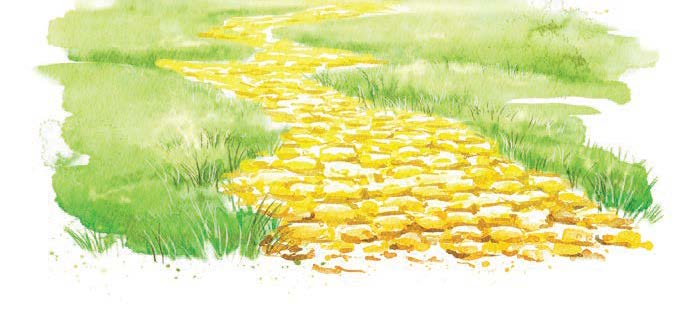
While I’m thrilled my three kids will never know the horror of “bagel bangs” and double-layered neon socks, it saddens me that some of these timeless treasures weren’t so timeless after all. But when we moved to Greensboro almost six years ago, I discovered that our little Emerald City had a November tradition of its own: the Community Theatre of Greensboro’s annual production of The Wizard of Oz.

Last year, our family, minus Sawyer, the oldest — an actual adult who claims musicals aren’t “his thing” — decided to partake in this community custom.

The day before our ticketed show, a Sunday matinee, 5-year-old Wilder and I are in the kitchen with roasted-potato-and-fennel soup simmering on the stovetop. Meanwhile, Chris, my husband, busies himself outside with leaf cleanup. “Alexa, play ‘Ding-Dong the Witch is Dead’ from The Wizard of Oz,” I command.

She does as told. (Modern technology can be a good thing, too!) The melody, paired with squeaky, studio-altered munchkin voices, echoes throughout the kitchen. Wilder moves his little body to the music, but stops for a moment. A dimpled hand shoots to his mouth as he giggles at the chipmunk-esque sounds emanating from the speaker. After that song, Alexa continues with other tunes from the “Merry Old Land of Oz,” but Wilder is not into hearing what Dorothy or Glinda have to say. Nope, he only wants the music of his new fav singing group: The Munchkins.

The next morning, he wakes and asks immediately, “Is today the day? Are we going to The Wizard of Oz?” As the day progresses, the question becomes, “How many more minutes?”

Finally, it’s almost showtime. We park downtown and skip to the Carolina Theatre, where families pile in. I see little girls dressed up as Dorothy and sparkling shoes on feet of all sizes. I’ve donned my black “Bad Witch” sweater as a nod to poor, misunderstood Elphaba. (Hey, I’ve seen Wicked, too!) Wilder, meanwhile, wears his ruby red Nikes.

We find our seats in the center of the balcony. Wilder struggles to see, but doesn’t care for the feel of the plastic booster seat. I’m already a little concerned the show won’t hold his attention and now I’m worried he’ll be uncomfortable, too. “Do you want to sit on my lap?” I offer.

He snuggles in and anxiously awaits the start of the show. The music begins, the curtain opens and we see Dorothy and Toto — and yes, a real dog is cast in the role!

Wilder sits on the edge of his seat, aka my knees. He’s utterly enthralled. Next to me, my daughter, Emmy, and I exchange occasional smiling glances. Almost three hours pass and not once has he taken his eyes off the stage — minus an intermission potty break — unless it’s been to hide his face from the Wicked Witch of the West and her entourage of flying monkeys.

I’m hot and sweaty, regretting the wool sweater I’ve worn, unaware that I’d be holding a human-sized space heater in my lap throughout the show, but I don’t care. Like those traditions I once thought timeless, these moments of borderline uncomfortable — but golden — closeness will similarly prove fleeting.

At the final curtain call, Wilder stands and cheers, whooping and hollering for the cast, especially the Tin Man. The Community Theatre’s executive director enters the stage to make some closing announcements, but our family takes that opportunity to beeline for the door before the crowd pours out. We can still hear her voice outside the theatre when she reminds the audience about next summer’s production of The Lion King Jr.

With his clammy little hand in mine, I drag Wilder hurriedly behind me, trying to catch up with Chris and Emmy. “Wait! Wait!” he shouts. “Can we see The Lion King?”

And just like that, it seems that a new-to-us tradition is born: Community Theatre productions.

“Of course we can,” I answer. While I am a parent who admittedly relies on YouTube and other digitally created content to entertain my children so I can accomplish tasks — or find a moment of peace, even — nothing can compare to the experience of real humans singing and dancing right in front of you. And while I don’t know how long his love of live theater will last, I plan to enjoy it while I can. Because this is the stuff of his own childhood memories.

Chaos Theory

CHAOS THEORY

A Haunting Tale

Yes, ghosts are real. Unless you’re my kid who’s going to bed — then no

By Cassie Bustamante

“Ghosts aren’t real,” I tell my 5-year-old, Wilder, as I tuck him in for the night, regretting that I let him watch Scooby-Doo. I don’t actually believe what I am saying, but parents will say whatever they have to to get their kids to just go to sleep. Just ask Adam Mansbach, author of the infamous Go the F*** to Sleep.

But back to the matter at hand. “Ghosts are very real,” I tell my husband, Chris, once Wilder is asleep. He doesn’t agree — and always sleeps like a champ. “Don’t worry. If I die first, I’ll prove it to you,” I say. “I can’t wait to haunt you!” (Actually, yes, I can.)

Do I have proof? No, but I have stories.

When I was a teen growing up in a small town in western Massachusetts, my godmother, Aunt Debbie — my mom’s sister, younger by just a year — would take me on weekend shopping trips, east to Boston or west to Stockbridge. She didn’t have kids of her own so she treated me like her daughter, buying me dangling jewelry she called “baubles.” We’d jam to the tunes of Gloria Estefan and Steve Winwood, and she’d regale me with stories from her life, which seemed much more dazzling and whimsical than my family’s boring white-picket-fence, suburban existence. What I didn’t understand at the time was that those seemingly exhilarating moments were part of her ups. She never shared the downs of her bipolar disorder with me.

Debbie was somewhat of a widow. She’d lost her husband, Michael, to ALS, but they’d been separated at the time of his diagnosis, remaining legally married for insurance purposes. As his illness progressed, despite each having new significant others, their friendship became stronger than ever.

Immediately after his funeral, friends would drop in to share memories, drinks and laughs. But then she threw a party akin to the wild ones they threw when Michael was alive, certainly not your typical post-burial get-together.

On one particular godmother-and-goddaughter weekend as we’re on our way to the Berkshires, she spills the details. “I had a cake made with his face on it and put candles in his eyes,” she says. Already, I’m intrigued and we’re both giggling over the absurdity of it all. After all, this was 1995 and face cakes weren’t really a thing yet. “We turned off the lights and had a seance. One of his friends said, ‘Debbie, you shouldn’t do this! He’d be so mad!’”

That night, she continues, a vicious storm passed through, knocking out power and tossing a tree onto her little Honda sedan, which was parked in the driveway. Coincidence? Maybe, but there’s more.

Pictures fell off a stable living room shelf.

“The alarm by the hall closet kept turning on when I would walk by,” Debbie says. Not just any hall closet, but the place where she stored Michael’s suits, soon to be passed on to his younger brother. “I said, ‘OK, Michael. I get it — you’re telling me something!’” she says as we cruise down the highway. “I decided to rifle through the pockets and discovered a watch he didn’t want his brother to have.” And, as soon as she retrieved it, the alarm was silent.

On the morning of April 2, 1996, just as I was getting ready for school, my mom received a call. Her sister had taken her own life — just shy of her 40th birthday — the night before. Though tragic, it wasn’t a complete surprise, although we’d hoped things were turning around for her. She’d found a new love, bought a house with him and was, it appeared, happy. But you never know the demons someone battles.

In the months that followed Debbie’s passing, I looked for signs of her presence everywhere. I watched for lights to flicker or alarms to sound seemingly on their own. I played the Mary Chapin Carpenter cassettes that I inherited from her collection, hoping a message might come through. But no visitations followed and I decided she was finally resting in peace.

Ten years later to the day Debbie died, it is April 1, 2006.

I’m in Maryland visiting my parents with my first baby, 8-month-old Sawyer, who has slept solidly through the night since he was 6 weeks old. At midnight on the nose, something startles me awake: a noise over the baby monitor.

But Sawyer isn’t crying. In fact, he’s cooing and chatting away happily, as if talking to someone. And in that moment, I know exactly who: Debbie, who always loved babies, but never had her own. Debbie, who loved me like a daughter and would have loved this baby as if he were her own grandchild. Paralyzed by this realization — and slightly terrified, if I am being honest — I decide not to go to him. He babbles. He gurgles. He coos. And, as if lulled by an unsung lullaby, he drifts to sleep. I, of course, check on him later and find him snoozing peacefully, the corners of his mouth forming a sweet smile behind his pacifier.

So while I tell a little white lie to Wilder because I’m ready to go to bed myself, I do, in fact, think ghosts are real. And perhaps one day, hopefully 50 years from now if I am lucky, Chris will be telling our grown children and grandkids about the little ways I’m letting him know I’m still around. No matter what, I’ll make a believer out of him yet.

Chaos Theory

CHAOS THEORY

A Trance Encounter...

With a self-proclaimed Tori Amos “stalkeress”

By Cassie Bustamante

When one of my favorite musical acts from my teen years announced a nearby tour stop last year, I quickly snagged two tickets. Tori Amos, piano virtuoso and singer-songwriter known for her powerful, thought-provoking ballads, released her solo debut album, Little Earthquakes, in 1992. It served as the soundtrack to my high school career, which began the very same year. Track two, “Girl,” expressed how I felt as I grappled with who I wanted to be: She’s been everybody else’s girl, maybe one day she’ll be her own.

The last time I saw Amos perform live was during her 1996 tour, when my friends and I caught her — and “a lite sneeze” (IYKYN) — at Springfield Symphony Hall in Massachusetts. Now, almost 30 years later, I step into Charlotte’s Ovens Auditorium — a fitting name on a sweltering June day — for Amos’ 2023 Oceans to Oceans Tour.

Dressed like something straight out of My So Called Life, my concert cohort, Chandra, wears a babydoll frock with Doc Martens, while I’ve donned a long bohemian dress with Birks. Chandra, who accompanied me to Nashville for the Eras Tour, peers at the concert-goers around us. “Much different crowd from our Taylor Swift experience, huh?”

She’s right. The fans are “mature” — and I suddenly feel well aware of my own age — and there’s a lot less pastel and glitter, more goth and grunge.

After finding our seats, three men around our age sit to the left of Chandra. One, wearing a pride bracelet, explains that he’s been a fan for years. “Little Earthquakes helped me find the strength to get out of an abusive relationship when I was in my 20s,” he says.

Looking around the auditorium, I wonder how many of us have been pulled through crises by Amos’ lyrics.

To my right, two seats remain unoccupied through the opening act’s set. But after the band exits the stage, two women plop down, visibly tipsy.

The taller of the two, a natural redhead like Amos, turns to us, bright blue eyes glistening with excitement — or maybe it’s booze — and shouts, “I can’t believe we’re here! I love Tori!”

She asks our names and we return the question. “Funny you should ask because I know my name and it’s not the one my mom gave me. She named me Jennifer, middle name Kelly — Jennifer Kelly! I mean, how ’80s can you get?” She leans in a little too closely to me. “This is the face of a Laura, isn’t it? I know I am a Laura.”

We nod politely, turning back to our own conversation, but Jennifer Kelly is not having it. “I am such a fan. Actually, I am a stalkeress.” My eyes widen in horror — not even at the stalking, but at the proud shameless admission. Oblivious, Jennifer Kelly continues, “Yeah, I found her house in Ireland and roamed around her property. I didn’t see her, but I was there!”

We try to disengage, but Jennifer Kelly is at this concert to be heard.

“I am going to warn you right now, I know all of the words and I plan to sing along loudly. And I trance dance.”

Trance dance?

Finally, the lights go down and Amos takes the stage. For such a vocal powerhouse, she’s much more petite at 59 than I remember.

Without so much as a word, she sits down at her piano and plays a long prelude, soon recognizable as “A Sorta Fairytale,” a fan favorite.

While I fully expect Jennifer Kelly to sing loudly, I don’t anticipate what happens next. She talks to her friend. Nonstop. Throughout the entire song — and the next few.

But, as Amos begins tapping the piano keys for her fifth song, Jennifer Kelly suddenly slumps her head, swaying it from side to side. Her hand grabs her friend’s knee.

Seconds later, her mouth is running again.

“Um, you can’t be in a trance one moment and then talking the next,” Chandra mutters in my ear. Trance dancing — which I google from my seat — by definition, is a spiritual experience that requires one to escape from themselves for a moment and move in a state of half-consciousness. Got that, Jennifer Kelly?

It’s clearly an act, one that goes on through the remainder of the concert. We do our best to focus on who we came here for, but it seems we’ve inadvertently bought tickets to the Jennifer Kelly show.

Just before the encore performance, Jennifer Kelly and her pal exit. I breathe a sigh of relief as Amos begins singing “Cornflake Girl.” In a crowd of hundreds, it feels like Chandra and I have the last two songs all to ourselves.

Exiting the auditorium, I laugh and say, “We have a lot to talk about in the Uber ride back!”

And then we see them, standing outside.

“Keep walking,” I whisper as I accidentally make eye contact with Jennifer Kelly.

“Girls!” she shrieks as if we’re old friends. “Sooooo . . . what did you think of the show?”

“Tori was fabulous,” I say as I hustle past. Then, under my breath, “What we could hear of her anyhow.”

We pile into our Uber, Jennifer Kelly a red-headed glimmer in the rearview mirror.

While Chandra and I recap the absurdity of our Tori Amos concert experience, I can’t help but feel grateful that her music comforted me while I figured out who I was. Some people, it seems, are still searching for that identity. And it isn’t Jennifer Kelly. But it might be Laura.

Chaos Theory

CHAOS THEORY

By Cassie Bustamante

When I imagine heaven — or whatever awaits me on the other side — I envision a cozy room with a roaring fire, a lush, rose-colored velvet chair to sink into, next to which sits a side table holding a steaming cuppa. And surrounding me? Warm-toned wooden walls lined with shelves upon shelves of all the books I didn’t have time to read in my time on Earth. Currently, my TBR — “to be read” — list most definitely exceeds the amount of minutes I have left in this lifetime, and quite possibly the next, too.

And that pile of books grows larger by the minute. Every week brings exciting releases, offering new opportunities to escape into fictional worlds, delve into the minds of intriguing people or learn about places and times past. How on earth am I supposed to keep up with that while also working, running a household and keeping my kids alive at the same time? Therein lies the dilemma.

When overwhelm strikes, I have to step not back, but closer. Don’t look at the big picture, because it’s scary as hell. Instead, focus on one small part. After all, how do you eat an elephant? Well, frankly, I am a pescatarian, so I wouldn’t know. But I’ve heard it’s one bite at a time.

To celebrate our reading issue, here are a few of the nibbles I’ve taken over the last year that have stood out.

A few years back, I read Daisy Jones & the Six and loved it so much that I was ready to consume everything by Taylor Jenkins Reid. And yet, I didn’t. But if you want to know the trick to starting a book faster, it’s borrowing — versus buying — because you’re obligated to return it. Thankfully, a friend loaned me her copy of
Seven Husbands of Evelyn Hugo. When I finished it, I didn’t want to return it. While the title may leave you doubtful, it’s a beautiful love story with so many facets of human emotion. Did I cry? Yes. But do I weep at the end of most books that enrapture me? Also yes. After every great book comes a period of mourning.

Colleen Hoover is some sort of magical unicorn who writes more books in a year than I get haircuts! Granted, I only go to the salon two to three times annually. Just like my stylist — hi, Caitlin! — she hasn’t yet let me down. (Even when I got bangs.) With so much hype around Verity, I had to read it and, boy, was it a gripping page-turner! While many of Hoover’s books are considered romantic, this thrilling tale was dark and unputdownable. By the last page, I had to pick my jaw up off the floor. For fans of Verity, or books that, if made into movies, would be in the film noir genre, also check out Push by Ashley Audrain.

When it comes to nonfiction, especially memoirs, I prefer the audio versions. Why? Nothing beats hearing the tone and emotion delivered directly by the author. Plus, I can multitask, strolling my neighborhood with my dogs at the same time. (Note: If you see a woman power-walking through Starmount, earbuds in, laughing hysterically or with tears streaming down her face, stop and introduce yourself to me!)

Two memoirs that had me walking more miles than I needed are Harrison Scott Key’s How to Stay Married: The Most Insane Love Story Ever Told and Jeanette McCurdy’s I’m Glad My Mom Died. Key’s book shares a comedic and intimate look at his wife’s infidelity and the marital journey that followed. I found myself in hysterics and relaying quotes to my husband, Chris, who looked at me quizzically. A story of cheating that’s hilarious? But yes.

By opening a window into her vulnerability and letting out the innermost secrets of her heart, McCurdy shares the darkest corners of her life, the areas most prefer to keep locked behind a closed door. And I will always appreciate a memoir that’s written with honesty, no matter how hard or heartbreaking.

What’s next on my TBR? I’m not totally sure. But I think I’ll snag a novel from my living room bookshelves, sink into our worn brown leather sofa and read by the soft glow of a sconce, my dogs comfortably nestled by my feet. Maybe, just maybe, heaven is a place on Earth after all.

Chaos Theory

Chaos Theory

Outfoxed

A tale of rescue

By Cassie Bustamante

Before we had kids, I’d stop for any stray dog I saw. Once, with a friend, I rescued a flea-covered female dog who’d clearly had puppies and been left to fend for herself in a field. That dog, Gracie, went on to become my friend’s most loyal pal, seeing her through moves and devastating breakups. The last time I brought home a stray dog, my husband, Chris, looked out the window at the unfamiliar animal, then pointedly at me, my pregnant belly carrying our first child protruding, and said, “You’ve got to stop bringing home strays.”

And while I did, I still do what I can when I see an animal, especially a domestic one that’s possibly someone’s beloved pet, in need.

So one Sunday morning in June, the spring sun already shining through the green grass, turning its blades a glowing shade of chartreuse, I’m out for a leisurely stroll with my two rescue dogs, Catcher and Snowball. The neighborhood is quiet outside, but the smell of bacon wafts through the air. Almost home, where my own breakfast and French press await, I spy something unusual.

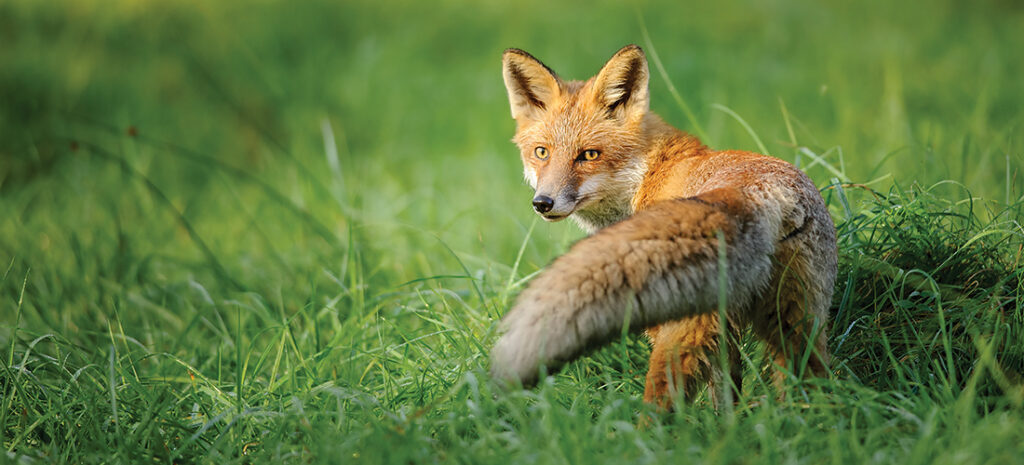
In the front yard of a stately brick house in Wedgewood, a neighborhood that runs adjacent to my own, Starmount Forest, an orange fox, shoulders hunched, and a fluffy black cat are having a standoff. The fox bares its teeth and stares, eyes narrowed, at the feline, whose back is arched.

I watch as they continue to hold eye contact. This is someone’s beloved pet, I think. My wild imagination takes off and I picture a family with small children, dressed in their Sunday best on their way to church, opening their front door to find their precious kitty mangled and left for dead.

My thoughts break when suddenly the cat lunges for the fox. For a moment my worries subside. I should’ve known a cat would be able to fend for itself. After all, are they not domesticated relatives of the king of the jungle, the lion?

The fox backs far enough off that the cat turns to walk away victoriously. And that’s when the fox makes his move. But he isn’t the only one to make a move.

“Hey!” I shout from about 40 feet away. “Leave the cat alone!” As if the fox, is going to say, “Oh, sorry! Right, I don’t know what I was thinking. Toodles.” Instead, the fox shifts its head in the direction of me and my entourage of dogs. Uh-oh.

And yes, I should’ve thought, This animal is a rabid beast — just get you and your dogs home safely. But, nope, I couldn’t get the image of a heartbroken family mourning their beloved cat out of my mind.

My dogs, who’ve been by my side, watching all of this unfold, peer up at me with worried eyes as I yank their leashes and hustle-walk toward home, still a quarter of a mile away.

I pick up my pace, the sound of my sneakers slapping the pavement almost matching my racing heart. Glancing over my shoulder, I keep an eye on the fox’s proximity. He seems cocky but intent, skulking behind us in a quick, yet not rushed, trot. All he has to do is sprint and we’ll become his Sunday breakfast.

Just then, a white pickup truck appears around the bend in the road. Oh, thank God! I think. But the truck passes me. However, when I look behind me, I see that the driver has parked between me and the fox, creating a literal roadblock for the wild animal.

This time, I don’t stick around to see what happens next. Catcher, Snowball and I take our chance to hightail it home to safety. To my hero on a white horse — or, rather, in a white armored pickup truck — whoever you are and wherever you are, thank you. Sometimes, as it turns out, the rescuer needs a bit of rescuing, too.  OH

Cassie Bustamante is editor of O.Henry magazine.