THE KIDS ARE ALRIGHT
Home
The Kids Are Alright
High school cool kids conquer all, even Carnegie Hall
By Billy Ingram
Photographs by Bert VanderVeen and Becky VanderVeen
Not long ago while attending my high school reunion, discussions with former (resisting using the word “old”) classmates inevitably circled back to how fortunate we were to have had an abundance of high-caliber teachers at Page, back in what is euphemistically referred to as “the day.” There was Jean Newman, an English teacher who instilled in me a love for creative writing. Without her encouragement, you wouldn’t be rolling your grapes over these words right now. Elizabeth Bell’s art class taught fundamental artistic methodologies and rendering techniques that, a decade later, proved crucial for a career in the arts that didn’t exist when I graduated high school. So many influencers . . .
There’s an infamous malapropism uttered on the 2000 campaign trail by the world champion of the slipped lip, George W. Bush: “Rarely is the question asked, is our children learning?” Recalling that quotation a quarter of a century later prompted me to pondering . . . is our kids learning today?
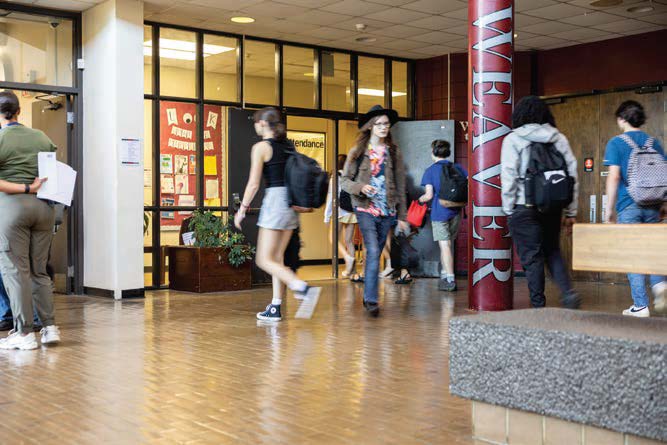
To quell that query, I made an appointment to see Principal Whitney Sluder at Weaver Academy for Performing & Visual Arts and Advanced Technology (granted it’s not your typical high school). Welcoming its first students in 1978, Weaver Academy (originally Weaver Education Center) offers an opportunity for public high schoolers to explore multiple artistic avenues and grow proficient in specialized, in-demand skills that typical schools don’t usually have room or resources to tackle.

“Generally speaking, we are an open campus downtown and I love our location,” Principal Sluder tells me as I’m ushered into her office. “We can walk everywhere. The art scene is very much present downtown, which I love. That’s grown even in the last 15 years since I was here as a student.”
Principal Sluder graciously leads me on a tour of this buzzing hive and, honestly, if I hadn’t seen it with my own eyes, I might not have believed it. I see kids running to class. No one is YouTubing on their iPhones. Every classroom we dropped in on, students are fully engaged, wide-eyed and awake, displaying an obvious yearning for learning. Did I inadvertently overlook a Red Bull concession in the lobby? Turns out, populating a learning environment with young people who actively want to be present, smaller class sizes and teachers just as enthusiastic as the students leads to wondrous results.
Weaver’s curriculum is divided into two distinct disciplines. PVA (Performing and Visual Arts) students attend Weaver for the entire school day, where, in addition to their chosen creative focus, they also study traditional academics like math and science. CTE (Career and Technical Education) attendees are bussed in part-time from their districted high schools to master more conventional skills like culinary arts, carpentry, drafting and diesel technology.
I’m introduced first to Masonry instructor Dean Lamperski, who is busy teaching proper methods for framing homes using cinder blocks. “It’s the biggest thing now in the industry,” he explains about an increasingly popular approach that mitigates damage caused by severe storms. He likens it to construction in Florida, “where you build houses out of block then put whatever exterior material you want on it.”
Rounding the hall, James Adkins is teaching Construction Technology and Carpentry in a cavernous workshop that opens up to the outdoors. Previously a general contractor, Adkins’ teaching toolbox is packed with practical knowhow. “I got into commercial construction, ran my own business for 15 years, then I retired. That did not go well at all.” His wife, a school counselor at the time, suggested he look into teaching “because I was lost. That was 17 years ago and I’ve loved every minute.”
Masonry, carpentry and HVAC students graduate with an NCCER (National Center for Construction Education and Research) certification. “We also do OSHA 10 certification,” Adkins points out. “So they can leave here and go into the GAP [Guilford Apprenticeship Partners] program or go straight into the workforce.” Plus, he says, a lot of his graduates head to Guilford Technical Community College or East Carolina University to study construction management. Of his charges this year, “All of mine are high flyers. Almost all of them have a plan for what they’re going to do next. These last few years, I’ve been very impressed, I could leave them alone and they’ll just keep on working.”
Each year Adkins’ students assemble two tiny houses, one for Tiny House Greensboro and another, funded by GCS CTE, is assembled atop a trailer. These projects involve substantial collaboration between other Weaver curricula. For instance, “Drafting is involved in the design,” Adkins says. “Our trailer is built by Kevin Crutchfield’s Diesel Technology class. It goes over to Collision Repair, where they’ll paint it, and then we frame the house upon it. Heating and Air will do the HVAC units.”
“We used to build an entire house,” Principal Sluder explains as we walk further. “We haven’t done that for quite some time. It’s hard to move a large house — that takes a lot of time and permits. The kids get excited about the tiny houses because everywhere you turn, there’s a TV show about it or they see them in their communities.” Internships over the summer between 11th and 12th grade are made available so that when Weaver students graduate, they can enter a high demand field at a greater rate of pay, thanks to certifications and years of experience already behind them.
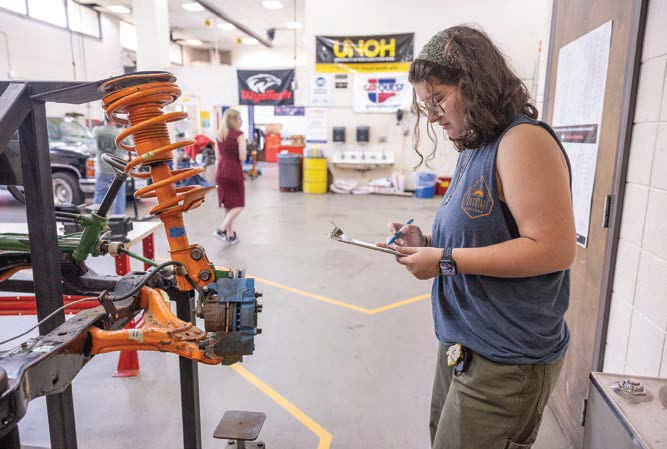
Traversing the hallways, Principal Sluder greets each passing student by name, stopping to ask how studies are going before we enter another enormous workspace, this one overseen by Ray Dove. Dove has been teaching Automotive Repair at Weaver for almost two decades. His domain consists of a fully equipped vehicular maintenance facility spilling out onto a garden-sized salvage yard with cars and trucks in various degrees of disassembly.
“We’ve got some cars sitting out here now that, when I’m finished with the instruction,” Dove explains, “and we’ve kind of worn them out, I’ll give them to Mr. Del Vecchio so he can use them in Collision Repair, taking doors off or maybe doing window glass installation.” The automotive program at Weaver is ASE Education Foundation accredited, and these students, too, finish their education earning multiple certifications.
In what serves as an occasional cafeteria, Chef Marion Osborne teaches Culinary Arts and Hospitality in the Guilford County School System’s only fully equipped commercial kitchen for students. After college, Osborne began working in restaurants and hotels with an eye towards becoming a chef, deciding instead that what he really wanted to do was to teach. Chalking blackboards as a Language Arts instructor during the day, he says, “I went to culinary school at night then went back to working in restaurants. Then, through a fluke, this job opened up and I got very lucky.” That was 17 years ago. “There’s not another school I would teach in.”
Osborne grew up in a small coal-mining town in Southwestern Virginia, where, he says, “I was cooking all the time.” His first restaurant position was as a pastry chef “and I got hooked. I worked at the Ritz-Carlton Hotel in Atlanta with one of the greatest pastry chefs in the world, Jacques Torres.” Here at Weaver, his pupils are baking and broiling for three rigorous hours. “It’s a program designed to train people to work in the restaurant industry — it’s commercial cooking.” Culinary grads can transition to a fine-dining establishment, but, Osborne notes, the more motivated “will go to either Guilford Tech, Johnson & Wales University or the Culinary Institute of America. We’ve had students go to all three because they want that associate’s degree. It sets them up for more success.”
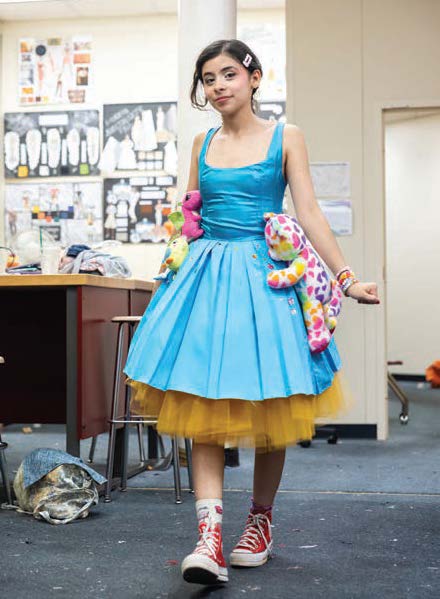
Located above Weaver’s circular lobby, PVA students are abuzz in the theater preparing for the upcoming spring musical, The Prom, adjusting lighting, rehearsing dance numbers and testing digital backdrops where graphics will serve as the set, no need for canvas-and-paint mise-en-scènes.
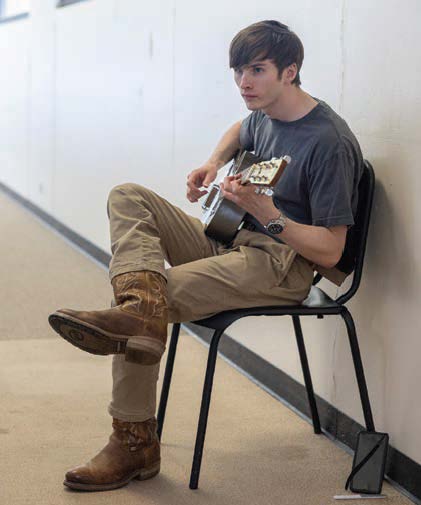
Growing up in Pennsylvania, Theater department head Keith Taylor maintained a lifelong desire to mentor. “I acted in high school and in college,” he says. “That’s where I caught ‘the bug,’ but I always knew I wanted to work with students.” He taught theater elsewhere for 20 years before his son, who was attending UNCG’s Theatre Education program, steered him towards Weaver. That was 18 years ago. “I love it here. I tell people there’s no place like it really.”
PVA applicants face a more rigorous road to acceptance as opposed to CTE hopefuls, who merely sign up for courses at their districted schools.
“We have a three-part audition,” Taylor explains about sliding into a theater-side slot. “They come with a memorized monologue to show us what they can do.” That is followed by a quasi-cold reading with unfamiliar dialogue. “We call it a lukewarm reading because we send them out of the room with a script and one of our current students. So they get to practice and play with it a little bit.” When applicants return to the room, he quips, “Then I just mess with them. I’m like, ‘Do it like it’s the best day of your life.’ ‘Now do the script like it’s the worst day your life.’ We see if they’ll take direction, make choices and take chances.” The third hurdle is an interview. “We just talk about why you want to be at Weaver and what your life goals are and how do you see theater fitting into it. So it’s a long day.” Many arrive already experienced in local productions. “So we get a lot of kids that come in and have some chops and kind of know what they’re doing. And a lot of them with beautiful singing voices, too. I’m blown away.”
The skills these drama students acquire have practical applications across a number of more conventional disciplines. Carpentry, painting, event sound and lights, front of house, ticket sales, audio recording, and video editing are de rigueur. “When COVID hit, so many folks left the business, especially in tech,” Taylor says. “We always tell our kids you can get jobs in tech, and a lot of students find real jobs in construction. If you can build scenery, they’re hungry for you.”
Over almost two decades, Taylor has witnessed his students attain success in the business. Isaac Powell comes to mind. “He was Tony in West Side Story on Broadway and he’s done a lot of HBO, Netflix. He was in American Horror Story. Grayson Frazier works for Saturday Night Live in hair and makeup and did Aladdin.” Jonathan Cobrda wowed audiences in Frankenstein: A New Musical off-Broadway.
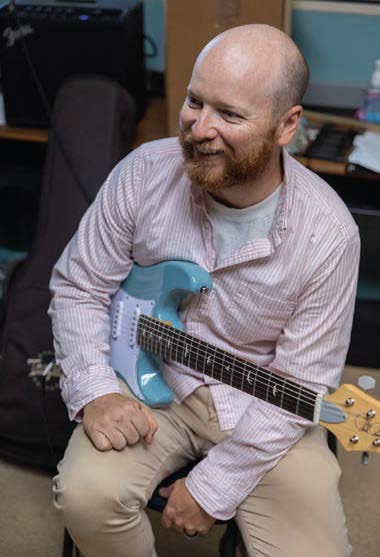
Howie Ledford teaches one of only four music production programs in the state at Weaver. A 2012 grad, sound designer Matt Yocum just this year won his second Grammy (for the Kendrick Lamar Not Like Us video) and scored a second Golden Reel Award. In 2024, he took home an Emmy for Best Sound Editing on HBO’s The Last of Us.
Music alumni Smith Carlson is a Los Angeles based Grammy-winning, multiple platinum-selling songwriter, producer and music engineer known for his work with Lil Jon, Beyoncé and Taylor Swift. “He’s constantly asking, ‘What do you need? What can I give you equipment-wise, money?’” Principal Sluder declares. “We have two Grammy winners, an Emmy winner and a Tony winner. So all we need is an Oscar and we have an EGOT. We’re very proud of that. Students who leave here really do attribute much of their success to their high school experiences and the opportunities they have at a place like this.”
An airy, mirrored rehearsal studio is where Donna Brotherton, conductor of the award-winning Weaver Academy Chorale, leads her young vocalizers in a rendition of “John the Revelator.” Her bona fides are a mile long, including a master’s degree in Music Education. She’s been at Weaver since 2005.
Brotherton’s love of music began as a toddler in Fairfax, Va. “We had a piano and my parents showed me how to play and it just went on from there. Piano lessons, clarinet lessons, violin lessons, voice lessons, singing in shows, in operas, theater classes, everything.” During her high school days, she was first-chair bass clarinet for Virginia’s All-State Band for two years. “Teaching has turned out to be a complete delight in my life, I love it so much.” Seems to be a common thread at Weaver. That and loyalty to purpose.
Last summer, the Weaver Chorale was selected by WorldStrides to be a part of its National Youth Choir for a concert at Carnegie Hall. In addition to being part of that grouping, the Chorale was asked to return to Carnegie Hall to perform a 15-minute solo set of songs the students and teacher selected and prepared. “It was amazing. The kids were ecstatic,” Brotherton says. For most vocalists, that experience is an unattainable dream. “We got to see a Broadway show. We got to do a workshop with one of the musical directors of Wicked. And then our own special solo performance. It was absolutely thrilling — they were in tears.”

“I’ve had a lot of really successful students over the years,” Brotherton says about Weaver’s warblers and tech whizzes. “It’s an honor, and students know about what our graduates are doing and they want to do that, too. It’s a joy every day,” she insists. “I would do this job if they didn’t pay me.” (Given the current trajectory of education funding, be careful what you wish for.)
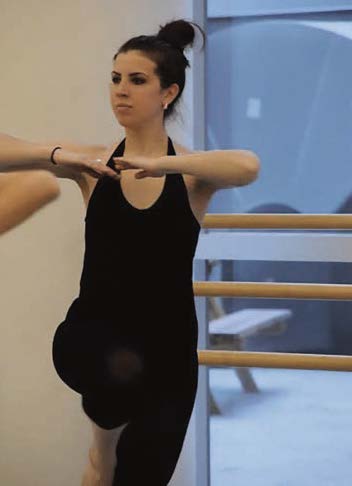
Sluder herself is an alumni of Weaver’s dance program. “It’s a unique perspective being an administrator here,” says Prinicipal Sluder. Her title was preceded by “Vice” until 2023, and, before that, she was the academy’s dance instructor. “It’s a humbling opportunity every day when I walk through the doors that I don’t take lightly. It really is a pleasure to serve our students and families on a daily basis in a place that really built me.” In moments when she feels overwhelmed by admin distractions, she comes back to her why: “I know what brings me joy and it’s the students.” She may venture into the dance studio to join in a routine or drop in on Brotherton’s class. “She’ll say, ‘OK, we’re going to stop practicing sight reading for a minute and we’re going to sing for Ms. Sluder.’ Sometimes I’ll sing with them and it’s just really special. I get rejuvenated then get right back to it.”
Long after my tour through Weaver, I think back to something Mr. Adkins offhandedly remarked when we were trekking through his carpentry cave: “It’s been challenging, but I’m thinking I’m leaving things better than I found them.” I suspect it’s more significant than that.
One of my guilty pleasures is that 1996 Tinsel Town tearjerker, Mr. Holland’s Opus. The film focuses on a recalcitrant high school music teacher with a dream to conduct the symphony he rather selfishly spent the better part of his adult life composing. In the end, the titular character, portrayed by Richard Dreyfus, finally figures out what teaching is all about, but only after several decades worth of former students surreptitiously take the stage, instruments at the ready to lift his notes above the sheet. He should have realized far earlier that an educator’s true legacy is manifested quietly inside those impressionable creative cortexes he’s helped cultivate, carefully or unconsciously, by way of an enthusiastic commitment to passing along knowledge and wisdom.
On a daily basis, opuses are writ, note-by-note, by Weaver Academy’s staff and educators. Everyone I met is intently invested, personally and professionally, in best possible outcomes, whether they’re played out on the stage, under the hood of a car or by sturdy hands wielding hammers.