
WANDERING BILLY
The Patriots Are Coming
Pursed lips and drum licks put the Greene in Greensboro
By Billy Ingram
“I have to prosecute a war with almost insurmountable difficulties. I cannot contemplate my own situation without the greatest degree of anxiety.” — Nathanael Greene before the Battle of Guilford Courthouse
One hundred and thirty-eight years ago, Guilford Courthouse National Military Park was consecrated on 50 untended acres purchased for $700 by Judge David Schenck. It has since expanded into what is now a 250-acre homage to those resolute Patriots who fought and died on March 15, 1781, in a pivotal exchange of cannonballs, lead balls and bayonets, reassuring America’s forthcoming victory in the Revolutionary War.
Ever hear that phrase, “We lost the battle but won the war?” The Battle of Guilford Courthouse is a perfect example. While the British effectively defeated General Nathanael Greene’s Continental Army, in doing so, the Red Coats were left so depleted that Greene’s dogged nemesis, British General Charles Cornwallis, had no choice but to, after another ill-fated fracas, surrender to George Washington at Yorktown.
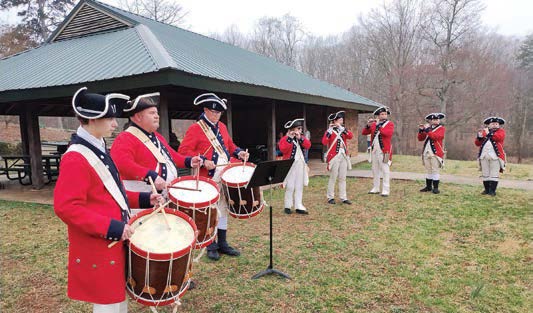
To commemorate that crucial turning point in our nation’s founding, the Guilford Courthouse Fife & Drum Corps was formed 28 years ago by park ranger Stephen Ware, in part to provide a historical soundtrack for increasingly popular Revolutionary War reenactments. While Ware retired in 2019 and Mike Nelson now leads the group, I met up with Chip Cook, a member since 2021, wondering what inspired his and others’ participation in such an anachronistic undertaking.
“If you travel in the northeast — in Connecticut, Rhode Island and Massachusetts — every little town has a fife and drum corps,” which Cook likens to the lure of joining a community band and the Boy Scouts at the same time. “So there are adults and kids involved in it.” There are currently about 10 active members of GCFDC but new recruits are encouraged. “We have members as young as 15, folks from all walks of life. A couple of members from the 82nd Airborne [Division] Band recently joined and they love to perform with us occasionally.”
A drum and fife corps was strategically imperative in times of war before radio messaging. “The commanders depended upon the music not for comfort, although that was helpful, too, but for communication,” Cook explains. When the call went out to, for instance, assemble the unit, or begin marching, reposition a column, prepare to fire or even retreat, the drum and fife corps transmitted those orders by way of melodic themes, known as duty calls, that troops were trained to recognize. On a clear day, they could be heard up to a mile away.
“There was a gentleman’s agreement that you didn’t shoot the musicians. They were considered noncombatants on the field,” Cook explains, noting that the corps might be leading the procession early on but well before the muskets plumed and bullets flew, drummers and fifers, made up mostly of old men and young boys, were repositioned to the rear of the fray. (After a musician reached the age of 17 they were expected to join in the fighting.)
To quickly identify and assemble instrumentalists when their service was required, “they traditionally wore opposite colors from their infantry regiment, so we wear a red coat with blue trim,” Cook says.
On the 244th anniversary of the Battle of Guilford Courthouse this last March a reenactment took place at Country Park, kicked off with members of the Tryon Palace Fife and Drum Corps as well as Cook’s ensemble. Set against a backdrop of soldiers and horses echoing an impending clashing of combatants, it was an impressive performance, considering the vast repertoire of duty calls memorized and executed in unison with crystal clarity.
“A lot of folks think this is run by the National Park Service. It’s not,” Cook tells me about these annual time tunnelings back to 1781. “It’s an arrangement with the City of Greensboro and the different groups that have participated in these reenactments for many, many years.” A surreal sight, tented encampments erected alongside the lake where, tucked into the woods above, reenactors on both sides would bivouac overnight. “They have a little market in the middle, which is kind of funny because you go through there and everyone’s dressed [for the period] and you pull out your debit card to pay, very much an anachronism there.”
Last summer, the Guilford Courthouse Fife & Drum Corps opened for a performance of Horn in the West, the decades-long running Revolutionary War outdoor drama centered around the exploits of Daniel Boone, on a night when one of the Frontiersman’s descendants was sitting in the audience. In January, they spent a weekend demonstrating their specialized skills at Cowpens National Battlefield in South Carolina. This month, our fluted troupe is bound for Colonial Williamsburg’s Drummer’s Call, a celebration of 18th-century military music also featuring an assemblage of groups from Yorktown, Northern Virginia, Maryland, New Jersey and Pennsylvania. “We’re all volunteers, so we’re spending our own money to do this,” Cook notes. The Corp also participates in grave-marking ceremonies with the Sons of the American Revolution, “and we’ll be in High Point for their Memorial Day event this year.”
Chip Cook himself is a descendant of a Revolutionary War light infantry soldier, Jacob Idol, who resided in Davidson County when he enlisted in 1781. Captured by Tories and remanded to the British at Guilford Courthouse, he escaped following that conflagration, then took part in routing the so-called loyalist Tories at Raft Swamp in Robeson County, the last battle of the war fought in the state of North Carolina.
A century later, no one in 1887 Greensborough had any definitive recollection as to exactly where that decisive Revolutionary War conflict happened when Judge David Schenck began mapping and snapping up the first 50 acres of forest and untamed underbrush. He relied on hand-scrawled maps and written recollections to pinpoint the precise location where warfare waged 106 years earlier. The nonprofit Guilford Battleground Company Schenck founded to oversee the project, one that continues fostering his vision today, gifted the by-then cultivated park to the federal government in 1917. The organization then continued over the decades to purchase and donate adjoining properties as they became available, greatly expanding this verdant sanctuary that pumps millions of dollars into our economy.
In hindsight, Schenck should have acquired a lot more land than he did. Although it’s possible that Cornwallis’ attempt to smother democracy in its cradle potentially spilled over into Country Park’s footprint, just in the last few years historians have discovered that major skirmishes took place where the Brassfield Shopping Center parking lot sits. Alas, you won’t get that tract for $10 or $20 an acre like you could in 1887.