
WANDERING BILLY
Who Killed TV’s Superman?
A chance encounter may have revealed the answer
By Billy Ingram
“In the future, everyone will be famous for fifteen minutes.”
— Andy Warhol
Life’s stopwatch began ticking off my 15-minute strut across its proscenium in 2002, upon the release of my first book, TVparty! Television’s Untold Tales, a look at classic TV shows produced during that medium’s messy adolescence. In January of 2003, my publisher had positioned me at The Hollywood Show, a twice-yearly weekend event in North Hollywood, where former 1960s child actors such as Butch Patrick (Eddie Munster) and Jody Whittaker (Family Affair) as well as assorted soap opera and ’80s sitcom luminaries gathered to meet fans and sign autographs.
There was only one celebrity in attendance I was interested in meeting, so I made a beeline to Noel Neill. One of TV’s first single, working “gals,” thanks to afternoon reruns of The Adventures of Superman throughout the ’60s, Noel Neill’s portrayal of that “pesky reporter from the Daily Planet,” Lois Lane, became enshrined in Boomer minds, legendary like Lucy and Ethel. I presented her with my book, opened to the sordid story surrounding the death of George Reeves, who portrayed her Superman in the television series. Illustrated with a screen capture of her star-crossed co-star, Neill gazed at the photo wistfully for a moment then sighed softy, “Oh, George . . .”
Months later, I was confronted with a possible answer to one of Tinsel Town’s most enduring mysteries: Was George Reeves’ death a suicide or murder?
Almost every aspect and detail of the following story is contradicted by someone or other so buckle up: At 1:15 a.m. on June 16, 1959, Reeves, his fiancé, Lenore (Leonore) Lemmon, and two guests were drinking heavily at the actor’s home before he went upstairs to sleep. Moments later, the partiers told police a shot rang out and Reeves was dead, sprawled on his bed naked with a bullet hole through his right temple. Faster than a speeding bullet, Reeves’ death was ruled a suicide.
Lemmon offered no explanation as to why police weren’t called until around 45 minutes after the incident. Following an autopsy, LAPD Chief Parker stated he “was satisfied with the verdict” of suicide. So, why were two detectives still rummaging around in Reeves’ bedroom looking for yet more bullet holes? The two they found embedded in the wall were explained away by Lemmon as earlier recklessness on her and Reeves’ part. And Lemmon had fled to New York, never to return.
Exactly how many stray slugs were dislodged from that room is anyone’s guess, but Noel Neill once revealed, “I had a friend whose husband was later hired to repair the drywall in George’s bedroom. He said the place was riddled with bullet holes.”
Lemmon’s account (one of them, anyway) proved perplexing: After a night of drinking with Reeves and others, she was alone downstairs when, around 1 a.m., two tipsy guests arrived. Their revelry prompted Reeves to awaken and storm angrily downstairs. After everyone apologized, Reeves returned to his bedroom. That’s when Lemmon maintains that she quipped, “He’s going upstairs to shoot himself . . . he’s opening the drawer to get the gun.” When the shot was heard, Lemmon remarked casually, “See there, I told you; he’s shot himself.” Subsequently, she told police she was “only kidding” and, years later, claimed none of that happened.
No secret, Reeves was depressed about being typecast in 1959, but, in recent weeks, he’d signed on for a movie in Spain. Plus, Kellogg’s had secured him, with a hefty raise, for another season of The Adventures of Superman in 1960, even agreeing to let him direct several episodes.
If not suicide, who would want George Reeves dead? He’d recently ended a seven-year affair with Toni Mannix, the wife of Eddie Mannix, a very powerful MGM executive known as “The Fixer,” whose mob and political ties could disappear any problem. Toni had purchased Reeves’ house, car and clothes for him, and was left devastated when their relationship came to a halt in 1958. Lemmon claimed the jilted lover was ringing up Reeves repeatedly, day and night, for months before his death. Had Eddie Mannix ordered a hit to avenge his wife? He certainly could have and was considered the most likely suspect, excluding suicide.
Reportedly, one of those guests that night confessed to a close friend that, after the shooting, Lemmon ran from upstairs saying, “Tell them I was down here, tell them I was down here!” A neighbor approaching Reeves’ front door that fateful hour hesitated when, observing through a window, he saw the couple engaging in a heated argument moments before hearing a single gunshot.
I discovered this just a few weeks ago. In 2021, Lee Saylor published, Wild Woman: Lenore Lemmon, extrapolating from two 1989 phone interviews he conducted with Lemmon mere months before her death. Through impressive research, the portrait he paints of the socialite after Reeves’ death was of a woman who returned to nightclubbing before becoming a reclusive alcoholic.
This portrayal was significant because it corroborated a backstory told to me in 2003, again in Los Angeles when I was promoting TVparty!, this time at Bookstar in Studio City. Regaling an audience with stories from the anthology, I noticed, from the corner of my eye, a woman feigning interest in whatever publications she was picking over but clearly intently listening after I began speaking about Reeves’ demise.
The bookworms dispersed and an attractive woman in her 30s, with a “black sheep of the family but still in somewhat good graces” vibe, emerged from the stacks. “I knew Lenore Lemmon in New York,” she told me. “I used to stay up late nights drinking in her penthouse, listening to her talk.” As I recall, she told me that her family lived in the same building as Ms. Lemmon and, over time, the young woman gained Lemmon’s confidence and ultimately became a drinking buddy.
She related to me that Lemmon had become a recluse, burying disappointments beneath bottles of bourbon and cartons of cigarettes. During one or more of their midnight meanderings, Lemmon confessed to being responsible for George Reeves’ death, but never elaborated. This person only approached me because she happened to be in the shop and heard me talking about her one-time acquaintance.
Very convincing, but could I believe her? It wasn’t common knowledge in 2003 that Lemmon had spent a decade or so in an alcoholic haze prior to passing. Saylor’s book depicts the Lemmon described to me in that bookstore encounter.
Mystery solved? Hardly. Without knowing the identity of the woman I met at Bookstar, there’s no way to verify her (or my) tale of Lemmon’s late-night, late-in-life confession. I’m convinced the unidentified woman would have gone public if she was attempting to insert herself into this narrative. Nor am I; a more opportune time to reveal a story like this would have been in 2003 when I began writing and appearing on shows for VH1.
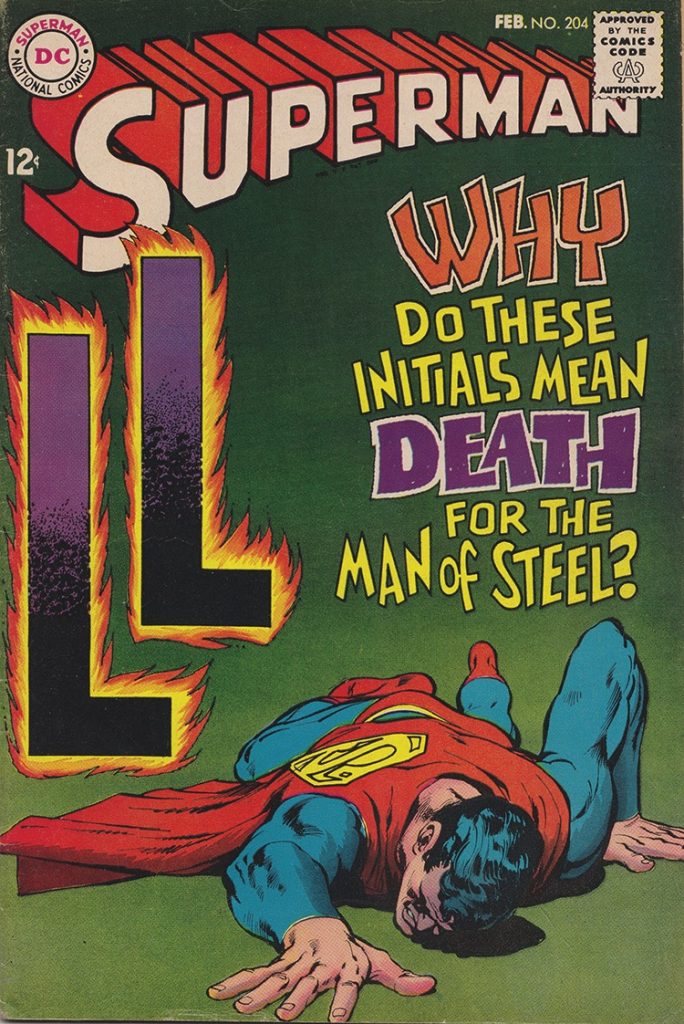
Great Caesar’s ghost! Yet another ultimately unsatisfying layer of intrigue surrounding one of Hollywood’s most enduring mysteries. On the other hand, applying Occam’s Razor, naturally Lenore Lemmon would be the most likely culprit, considering that, in the comics, Clark/Supes was plagued in myriad ways by individuals with double “L” initials: Lois Lane, Lana Lang, Lori Lemaris, Lex Luthor. Lady Luck, it seems, was not on his side.