WANDERING BILLY
Picture This
Mac Barnett’s illustrated children’s books draw on connections between generations
By Billy Ingram
“There are perhaps no days of our childhood we lived so fully as those we spent with a favorite book.”
— Marcel Proust
Is there a beloved storybook you fondly recall being read to you as a child? For me, it was Pat the Bunny by Dorothy Kunhardt. Credited with being the very first interactive book, it offered tots a “touch and feel” experience in lieu of a narrative. Bound with white plastic ribbing, each turn of its pages reminded toddlers of everyday experiences, like feeling Daddy’s stubble (a schmear of sandpaper), inhaling the scent of wild flowers, playing peek-a-boo with a patch of cloth and patting an upright, bunny-shaped fluff of faux fur.
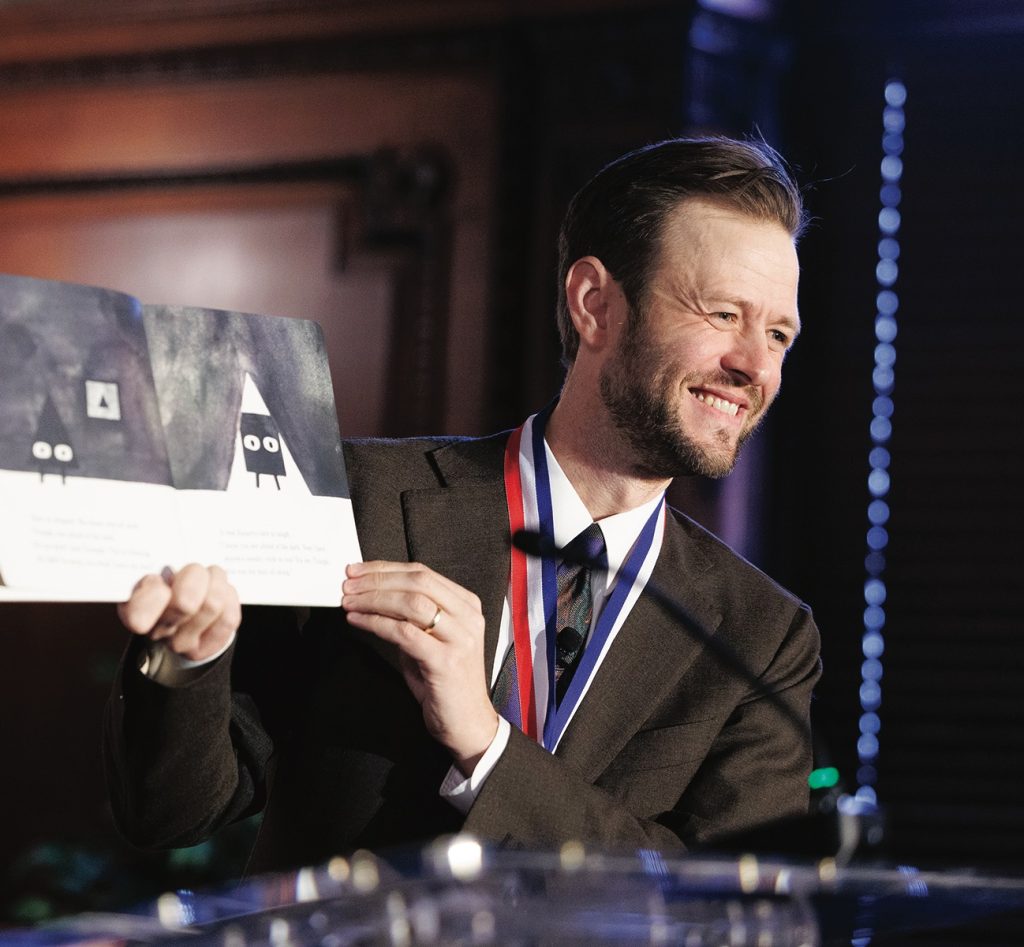
For lovers of children’s pictorial storybooks, there’s something really special happening this month. Out of 380 proposals submitted by cities around the nation, Greensboro was one of only five boroughs selected to host the Library of Congress’ National Ambassador for Young People’s Literature, Mac Barnett. The ninth to hold this title, he will be presenting Behold, The Picture Book! Let’s Celebrate Stories We Can Feel, Hear, and See, his tribute to the colorful legacy of children’s literature.
Barnett has authored 62 books for youngsters (he estimates) and has received two Caldecott Honors, three New York Times/New York Public Library Best Illustrated Awards, three E.B. White Read Aloud Awards — the accolades go on and on. Now in its second season on Apple TV+, he’s the co-creator, with illustrator Jon Klassen, of Shape Island, an animated series based on their New York Times-bestselling graphic novels for toddlers, The Shapes Trilogy, cloud-seeding infantile imaginations while simultaneously encouraging critical-thinking skills.
Barnett’s The First Cat in Space series, in collaboration with illustrator Shawn Harris, is rendered in a sparkling, modern style with a subtle hat tip to comic artist Jack Kirby’s square-fingered, forced perspective. “Shawn and I have been friends since we were 6 years old,” the author reveals. “And now Shawn is one of the finest children’s illustrators working today. When I was a kid, I loved comic strips like Calvin and Hobbes and Garfield.” Admittedly intimidated by the superhero genre, he says, “Shawn read all that stuff and he would explain to me a run of Spider-Man or what was happening to Superman and I would get it all filtered through him.” No dust on these jackets, infectiously fusing a Calvin-ism whimsy with 1980s Marvel super-heroic showmanship, the resulting outta-sight escapades of this far-out feline are what The New York Times proclaims “hilarious.”
For early readers eager for enigmatic entertainment, Barnett’s Brixton Brothers whodunnits serve as a mod nod to circa 1960s Hardy Boys mysteries. School Library Journal declares Brixton Brothers’ premiere volume, The Case of the Case of Mistaken Identity, “one of the funniest and most promising series openers in years.” The author’s attraction to those juvenile novels written long ago is rooted in the macabre. “As a kid, I was terrified of being kidnapped,” he quips, “and the Hardy Boys get kidnapped like three times per book.”
Barnett was especially fascinated by the sleuthing siblings’ escape strategy after being tied up. “They would flex their muscles, the bad guys would leave the room; then, they would relax their muscles and the ropes would just fall to the ground,” he recalls. “And I was like, this is what I am going to do when I get kidnapped.” To test this technique, in second grade he convinced Harris to secure him with a jump rope using knots Harris had learned in the Boy Scouts. “I relaxed and, of course, the ropes just stayed there. And I realized the Hardy Boys worked out a lot harder than I did at age 7.” This eventually formed the genesis for his Brixton Brothers’ exploits “about a kid who tries and fails to be a Hardy Boy.”
There is unambiguous, statistical information that reading to children has a lifelong educational impact. “The picture book is one of the great American art forms,” Barnett insists. “And reading out loud to kids is an intergenerational, artistic experience — an adult and a kid coming together over artwork, experiencing it, having feelings about it, and then, hopefully, talking to each other about whether they like it, what they think it means.”
According to Barnett, the first illustrated storybook for kids was Wanda Gag’s Millions of Cats in 1928. “There were books for children before that, primarily though, they were illustrated nursery rhymes, Bible stories, folk tales.” Gag pioneered the use of text and pictures in tandem to tell a story.
“The first book that I really remember living inside of was In the Night Kitchen.” Barnett discovered the absurdist dreamworld of Maurice Sendak as a youngster in the early 1980s. “It just made perfect sense to me. This is what it’s like inside my brain, that recognition of a kindred consciousness. And you read it as an adult and you’re like, this is such a wild experimental text.”
If offered the opportunity, I think just about anyone would write a children’s book. What advice can Barnett offer? “You’ve got to learn how picture books work,” he contends. “This is a way of telling stories in a very specific way. It’s easy to write a picture book, it’s very difficult to write a great picture book. And the first step is to learn the history of the art form to really understand how stories are told this way.”
Here’s an opportunity to do just that. The free event, Behold, The Picture Book! Let’s Celebrate Stories We Can Feel, Hear, and See, will be held at 10 a.m, Saturday, October 25, in N.C. A&T State University’s Harrison Auditorium. While he’s in the ’Boro for two days, Barnett will also host programs at area schools, where every student will receive one of his endlessly engaging picture books donated by Candlewick Press (as will the young ones attending the Harris Auditorium celebration, courtesy of Greensboro Bound).
“Greenboro just had an incredible proposal,” Barnett says about the selection process coordinated between The Library of Congress and Every Child a Reader, a literacy charity. “They were looking for communities with strong libraries and bookstores to make sure that these events were of value to the community. A big part of this is talking to adults about why kids’ books matter, why they are real literature and how to make sure that kids have good books to read.” He believes that, for Greensboro, “it’s just a great opportunity to talk to educators, families and even kids about the value of children’s literature in a young person’s life.”
Award-winning American (and sometimes) children’s author Emilie Buchwald (Gildaen: The Heroic Adventures of a Most Unusual Rabbit) once observed, “Children are made readers on the laps of their parents.” True, it’s never too soon to fold back colorful covers and expose spongy youngsters to worlds of wonder and limitless curiosity. Or just to pet the fluffy cartoon bunny.
For information about the free public event, visit greensborobound.com. Registration is strongly encouraged.