
WANDERING BILLY
Seas the Moment
Andy Zimmerman heads windward with a new documentary
By Billy Ingram
“That’s what sailing is, a dance, and your partner is the sea. And with the sea you never take liberties. You ask her, you don’t tell her.” ― Michael Morpurgo
Andy Zimmerman has performed a Herculean feat in transforming the downtown area south of the railroad tracks around Elm Street. What was once a losing hand of forgotten, abandoned buildings languishing for untold decades is today a royal flush of vibrant hubs where you’ll now find SouthEnd Brewing, transform GSO, Fainting Goat Spirits and Forge Greensboro among other former eyesores he’s renovated elsewhere.
I met with Zimmerman to explore his latest effort on the largely unfinished but impressive second floor of yet another recovery mission, the original Blue Bell jeans plant on South Elm and Gate City Boulevard (rechristened Old Greensborough Gateway Center). The hat he’s wearing today is not that of downtown developer but executive producer. He’s been working on an upcoming documentary entitled Mavericks & Multihulls, a tribute to the multihull legends of seafaring, those amazing young men and their sailing machines.
That’s not a non sequitur. The company Zimmerman founded and retired from before arriving in Greensboro a couple decades ago, Wilderness Systems, was a leader in the production and design of kayaks, “probably the No. 3 manufacturer in the world,” he notes. “Certainly No. 1 as it relates to brand. Between the companies that I owned and started, we made over a million kayaks.”
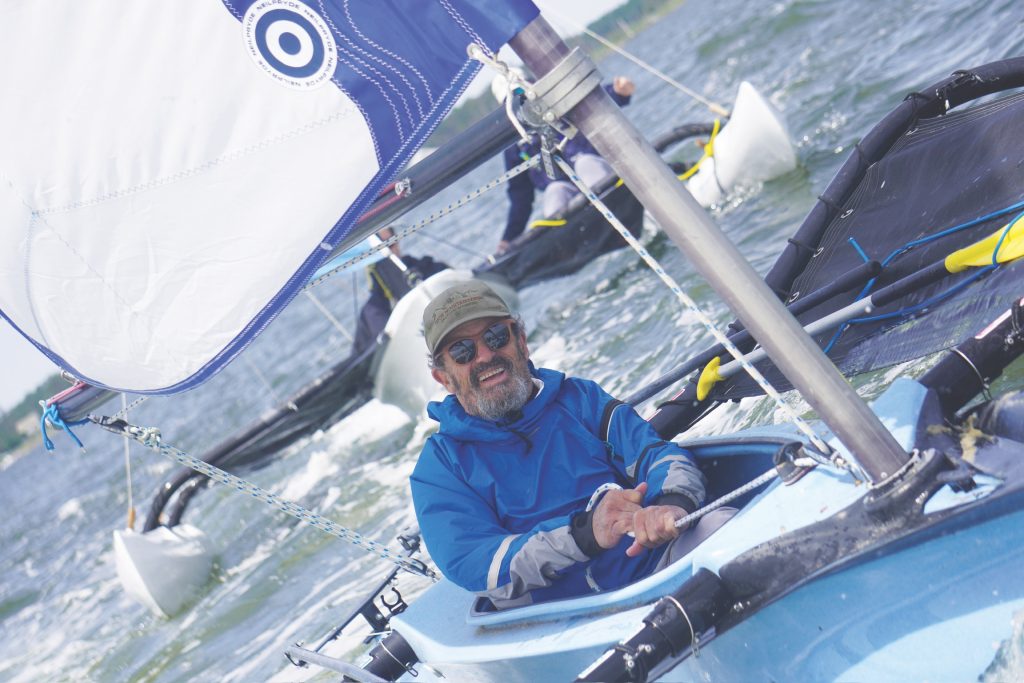
Under the WindRider label, Wilderness Systems fabricated more trimarans, a variation on the catamaran, than anyone anywhere. “The catamaran, as one of the designers likes to put it, is kind of a condo on the water — it’s commodious.”
“The trimaran has three hulls, the main hull, which is where you live,” Zimmerman points out for those who know little about watercrafts, aka me, “and then the two outriggers. You can call them training wheels,” making them faster and more stable than most other boats.
WindRider also manufactured hydrofoil sailboats, the cool, sleek models where the hull rises up out of the water at top speeds. “For me, it was a manufacturing accomplishment of a lifetime,” Zimmerman remarks about the difficulty of the build, which required some 800 components. The America’s Cup speedsters, he notes, “have trimmer ends, they’re doing 50 plus miles an hour in hydrofoils. The other boats we made money on, but the hydrofoil? No. It was the joy of creating.”
Questing for the creative is what led to his collaboration with Jim Brown, multihull sailing pioneer and high seas adventurer, as well as the impetus of this documentary. Mavericks & Multihulls chronicles the extraordinary lives of six sailing-world superstars, the aforementioned Brown, Woody Brown (no relation), Rudy Choy, Arthur Piver, James Wharram and Dick Newick.
Besides a shared connection with wind, waves and salty spray, Zimmerman points out that every one of the watermen spotlighted in this film was an extreme risk taker. “I met Jim [Brown] and was immediately attracted to his way of life,” he says. “Jim built a boat in his backyard. He took his two kids and his wife in Santa Cruz and said, ‘I don’t like the druggie scene here. I don’t like the Vietnam scene here. I wonder when the world’s going to blow up?’ And he said, ‘We’re getting on a boat.’” Brown and his family sailed the seas for three and a half years. “Went to Central America, South America and homeschooled his kids. Then came back when his wife said, ‘OK, I’m ready to get off the boat.’”
United Kingdom subject James Wharram was polyamorous, and some would call that alone off-the-charts bravery. “He’d have two, three women on his boat, they switched nights, they’d sleep together. This was back in the ’60s. Peace, love and waterbeds,” says Zimmerman. But the ultimate waterbed? “He turned people on to living on the water and adventure, traveling.”
While Wharram was all wild wanderlust — and just plain lust — Dick Newick was all about speed. “If he could take a pound out of the boat, he’d do it to make it go faster.”
Woody Brown, on the other hand, was a self proclaimed nature boy. “‘I want to be out in nature,’ he said,” quotes Zimmerman. “‘I don’t want motors, I want to sail.’” In that pursuit, he devised the first modern catamaran. “He reinvented the fin. He was a big surfer, too,” legendary, in fact. Living to the ripe age of 96, in his later years residing in Hawaii, Brown was a pioneer in chartering catamarans, taking groups of 40 or 50 people out on short oceanic sunset-viewing voyages.
Zimmerman recruited local filmmakers Michael Frierson and Kevin Wells, both with impressive documentary bona fides, to translate these stories to the big screen. To begin with, they conducted multiple interviews with Jim Brown, dating back to 2015. Many others who are passionate about sailing are featured, including Steve Callahan, who survived 76 days adrift in the Atlantic, and multihull designer and Mainer John Marples.
Frierson and Wells were busy editing when I spoke with them. “There’s an immense amount of footage shot by [Canadian cinematographer ] Scott Brown [again, no relation to Jim or Woody Brown]. That’s the primary source material from the current period,” Frierson says. In addition, Jim Brown contributed thousands of photographs along with 250 hours of footage he’d lensed over the decades.
The Mariners’ Museum and Park in Norfolk, the largest maritime museum in the country, made available their archives of motion-picture reels dating back to the dawn of the 20th century. “The footage is in every format known to man,” Wells notes. “Super 8, 16 mm film, DV cam video. So dealing with all the different resolutions has been challenging.”
Documentary filmmaking is like assembling pieces of a puzzle, or maintaining that fine line between devil and the deep blue sea, a rewarding yet daunting task crafting a narrative from random clips and pics shot by a multitude of unrelated individuals. “You’re finding the story out of all this,” Wells says about the challenging process to achieve an even keel. “You know there’s a story there — there’s probably a hundred stories there — but where is your focus? That part has been a lot of fun.”
What surprised Frierson and Wells most after diving into Mavericks & Multihulls (mavericksandmultihulls.com)? “That these guys were fairly accomplished carpenters,” Frierson replies. “They’re building their own boats and sailing them to Tahiti before GPS . . . The sense of self-reliance and guts that they had is just amazing.”
Wells concurs. “I think that’s representative of what a lot of these people think. They’re doing things, that to me, are extraordinary, but they think it’s very ordinary. Building these contraptions and sailing off with their family in the middle of the ocean is still crazy to me.”
“Jim Brown is 92. He lives life so large and he’s writing a book,” Zimmerman remarks with obvious admiration for the film’s unlikely leading man. “He just wants to stay busy and engaged in life. And I’m not sure I know anybody more engaged in life than Jim.” Legally blind now, Jim Brown can no longer navigate, but he’ll never fully surrender his life aquatic. With his own hands, no surprise, he’s constructed a tiny house on top of a trimaran, one manufactured by Zimmerman’s former company. “So he can keep his boat right there on the water at his house in Tidewater, VA. And he goes and stays in that when it’s not too hot or too cold.”
As for Zimmerman’s future, his mainsail is set for steering into the calm blue yonder. “I’ve got one big project left in me.” After that, his licked finger is in the wind. “I wouldn’t mind living on a boat. I’m a minimalist now. It goes back to the overwhelming sensation I had as a young man when I realized that freedom is actually available. I frickin’ love it!”