
WANDERING BILLY
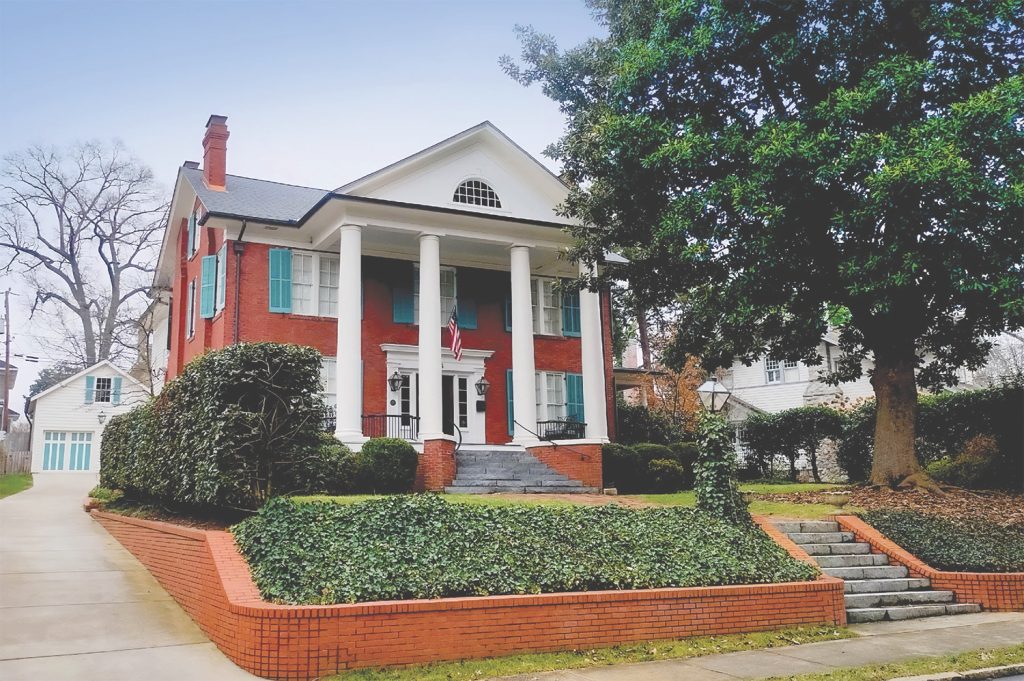
A Multi-Storied House
If these walls could talk . . . occasionally, they do
By Billy Ingram
“How cruelly sweet are the echoes that start, when memory plays an old tune on the heart!” – Eliza Cook
Rarely do time, temperature and opportunity coalesce to create conditions rife for recapturing carefree memories of sunshiny, youthful afternoons. In this instance, it’s an unplanned springtime saunter through Fisher Park — a frequent footpath in my teenage meanderings when hoofing it from Latham Park to First Presbyterian or onward Downtown, sketchbook and graphite at hand for rendering fascinations like that bulbous Weeping Willow billowing at the entrance (long since withered away), those cobblestone arches crossing creeks, masonry stairways and hardwood hickory trees.
Only once did I attempt drawing any of the surrounding houses, and that was 106 Fisher Park Circle, a majestic, two-story Neoclassical Revival with inviting slate steps that lead to a grand portico canopied by a tympanum accented with a whimsical lunette window that, even then, I suspected had witnessed its share of illustrious people and familial felicity. This graceful home is a centerpiece of Greensboro’s very first residential development, one that broke ground in the 1890s then grew exponentially throughout the Roaring ’20s.
If every picture is worth a thousand words, then, surely, every vintage home has potential to inspire an entire novel. In theory, one could select randomly any period property and undoubtedly uncover countless intriguing untold — or untoward — tales, walls eagerly awaiting listening ears. That recent midday wandering into wistfulness led to wondering: Why not honor 106 Fisher Park Circle for this “novel” experiment?
Knowing little more than that 106 had been dubbed “R. D. Douglas House,” I began researching in my own library of local lore. Tucked into unread recesses was a nondescript paperback inscribed to my mother on her birthday in 2005 entitled The Best 90 Years of My Life, written and self-published two years earlier by Robert Dick Douglas Jr. Born in 1912, the author’s chronicle commences with recollections of growing up with his three siblings at . . . 106 Fisher Park Circle. In his opening paragraph, Douglas Jr. describes the stately five-bedroom manor his parents had built back in 1906: “The house was high above the street and had four large cement two-story columns in the front. On the north side of the house was a concrete driveway leading from the street up the hill to a red wooden barn at the back of the lot.”
That barn originally housed a horse that pulled the family’s four-wheeled carriage. Before long, the Douglases were motoring in touring cars (with Eisenglass curtains, no less) east down North Park Drive to arrive at 480 Church St., where the children’s great-grandmother lived in the estate known as Dunleith. The striking three-story mansion had been built around 1858 by her husband, N.C. Supreme Court Justice Robert P. Dick. One of the nation’s earliest examples of Italianate architecture, it was briefly requisitioned for Union Headquarters as the Civil War drew to a close. Descending into disrepair, that elegant dwelling was demolished in the late 1960s. More recently, the former Aycock neighborhood was renamed Dunleath (close enough, right?) in its honor.
In the 1910s, public transportation was incredibly convenient for citizens of the newly-named Gate City. “We had electric trolleys running on rails in the street and getting electric power from overhead trolley wires,” Douglas Jr. writes. “Streetcars ran from downtown out North Elm Street to about where Wendover crosses now. Later, they went all the way out to Sunset Drive where you could walk to the Greensboro Country Club.”
Douglas Jr.’s youth revolved around the single Catholic Church in town, St. Benedict, within easy walking distance. “Father Vincent was a great golfer and a member of the Greensboro Country Club,” he writes. “I think a lot of anti-Catholic prejudice was dispelled by his charm and golfing ability.” The Parish’s Sunday School was taught by the Sisters of Charity, who established St. Leo’s, Greensboro’s first hospital in 1906.
As an Eagle Scout, Douglas Jr. spent a summer hunting big game alongside Serengeti natives, about which he wrote a book, Three Boy Scouts in Africa: On Safari with Martin Johnson, published by Putman. He followed that up with a second memoir published one year later in 1929 about bear hunting on Kodiak Island, A Boy Scout in the Grizzly Country. He later returned to Alaska, exploring steaming volcanos, graduated Georgetown Law School and, by 1941, was rounding up Axis collaborators as an FBI agent. In 1945, he resettled with his wife and toddler son in Greensboro to specialize in labor law. Multiple cases he argued were heard before the Supreme Court. Douglas Jr. passed away in 2015 at age 103, remarkable in itself. The Best 90 Years of My Life was republished in 2007 by Vantage Press but remains elusive to locate.
In 1936, 106 Fisher Park Circle welcomed Dr. Luther L. Gobbel, the same year he was appointed president of Greensboro College, where, two years later, he presided over the school’s centennial commencement. My mother was an undergrad there during his tenure, her 1945 sophomore yearbook fronted by an appropriately placid portrait of Gobbel as an archetypical, armchair-seated academic doyen projecting an air of professorial steadfastness.
Gobbel relocated around 1941, when this Fisher Park landmark was purchased by Dr. Samuel F. Ravenel, founder of one of North Carolina’s first pediatric practices in 1925, positioned on the third floor of the Jefferson Standard Building.
In 1948, Ravenel rallied city leaders to raise $100,000 (roughly $1,350,000 today) in just 12 days. The funds were needed to convert a former rec hall on the recently-vacated Army Air Corps base, located off Bessemer, into an emergency, M.A.S.H.-like triage infirmary where he and new associate, Dr. Jean McAlister (pioneer female physician), risked their lives combating — and promptly conquering — a polio outbreak crippling Guilford County’s children by the hundreds.
“Dr. Jean” was our beloved family pediatrician in the ’60s. When she was away, it was Dr. Ravenel’s stethoscope pressed to our chests in their modest, rectangular office suite on East Northwood Street (improbably still standing among Cone’s expansions). What those well-healed patients’ parents likely didn’t know was that Dr. Ravenel spent spare hours at Children’s Home Society charitably attending to some 9,000 infants that would otherwise have gone untreated. Revered across every community, his 51-year devotion to the health and wellbeing of Greensboro’s most vulnerable ended tragically with a 1976 car accident.
A mere three chapters in, if we do indeed have elements necessary for an intriguing historical novel, it’s going to need a satisfying wrap-up. Turns out my old pal, Bill Baites, along with Stephen Dull, restored this gem to shine anew while residing there in the 2000s, undertaking a million-dollar renovation recognized with a Preservation Greensboro Award for excellence in 2006. I had no idea!
Then again, many casual readers crave conclusions couched in cloying profundity. The epitaph engraved on Dr. Jean McAlister’s monument at Green Hill Cemetery could decisively serve as a suitable swan song for those selfless souls once resting their heads at 106 Fisher Park Circle:
Good and faithful servant of God
Well done
Rest from thy loved employ
The Battle fought, the victory won
Enter thy Master’s joy.