Simple Life
About Time
By Jim Dodson
A while back, my beloved wristwatch of many years mysteriously disappeared.
On one level, the loss wasn’t such a big a deal. It was, after all, an inexpensive wristwatch – some might even say cheap – a Timex “Expedition” model that set me back only about fifty bucks during a two-for-one Black Friday sale at Belk department store many years back.
At that time I kept one Expedition and gave the other to my college-boy son, who as it happens had just broken the fine Swiss Army watch I’d owned for several years but passed along to him for safe keeping.
My history of watch-ownership, you see, is a fairly checkered affair, littered with various costly broken or missing timepieces, beginning with the beautiful engraved Seiko chronometer my parents gave me for college graduation that somehow abandoned my wrist on a pilgrimage across Europe, never to be seen again. Over the next few decades it was followed by a succession of fine watches including several Swiss Army numbers I either managed to break or lose in ever creative ways.
Then there was the perilous close call that happened on a beautiful Saturday morning at London’s famous Portobello Road marketplace when I happened across a vendor of antique watches who showed me a beautiful, fully-restored “wartime” Rolex bearing the emblem of the U.S Eighth Army Air Corps in which my old man served during the war. It was an exquisite watch and a bargain at only one hundred quid or so.
In a rare burst of common sense, however, recalling my history of unintentionally losing or destroying innocent timepieces, I concluded in the nick of time that the Rolex of my dreams might well have survived a world war but probably wouldn’t last long on the arm of yours truly. And so, reluctantly, I passed it up.
That’s why the first Timex Expedition I happened upon over a decade ago was such nice discovery: simple, handsome, rugged, reliable and – best of all — cheap to replace when the inevitable happened. As the company’s famous slogan promised: “It takes a licking and keeps on ticking.”
It was also a nostalgic window into my childhood, conjuring memories of the iconic Timex TV spots I always found so entertaining during which John Cameron Swayze – former news broadcaster and game show panelist — subjected Timex watches to various creative “torture tests” like being sent over Niagara Falls in a barrel, attached to the churning blades of a speeding boat motor, put through a washing machine or worn by slugger Mickey Mantle in batting practice.
Once upon a time, Timex was the flagship of American-made affordable watches. Such colorful theatrics made it America’s bestselling watch brand in the dawning space age before digital everything, bargain-priced between $9.95 and $16.99.
The first Timex Expedition I purchased lasted five years but vanished during a research trip to Africa. While wading across a shallow river where crocodiles were rumored to circulate, the pin holding the watch to the strap slipped out of the socket and I found only a bare arm by the other side of the river. Picturing the wily old croc from Peter Pan with the clock ticking in his stomach, I chose not to go back and hunt for my lost Expedition on the river’s bottom.
Back home in America, I set off one afternoon to various shops and department store looking for the same model, figuring that any watch that gave me such loyal service for less than fifty bucks a year was a small price to pay for being on time.
At Belk, I was dismayed to learn the store no longer carries Timex. “I think it’s gone a little down-market,” was how the watch counter clerk politely termed it with a gentle sniff, offering to show me several higher-priced Bulovas and Seiko models, also something called a Fossil watch that looked like something that would require platform heels and a pair of glittery oversized Elton John eyeglasses to complete the ensemble. The only watch that even remotely resembled my beloved lost Expedition was a handsome but pricey Citizen timepiece three times the price tag, though with a ten-year warranty.
I thanked the clerk for her time and said I had my heart set on another Timex Expedition.
“You might try Wal-Mart,” she said.
So I did, discouraged to think how far mighty Timex must have fallen. But even Wal-Mart was a no-go. The clerk there said a drug store was probably my best option. If that failed, I pictured America’s formerly favorite wrist watch being sold from suitcases on the street corner by vendors with heavy foreign accents.
By now you are probably saying to yourself, “What a silly waste of time – all this hoo-ha over a cheap wrist watch!” And you may well be right.
But on the other hand, a modestly-priced, rugged-looking watch that can take a licking and keep on ticking strikes me as something of true value in a world where nothing is all that permanent, regardless of the price.
Besides, who knows when I might get washed over Niagara Falls in a barrel, hauled by a speeding motorboat or accidentally put through the wash cycle?
In time, I found an excellent source for my beloved Expedition watches: the Timex company itself, which hosts an impressive selection of Expedition models and even fancier watches for aging Timex –ers like me.
Soon I had a new Expedition strapped to my wrist, an updated “indiglo” model featuring a nifty illuminated face that will come in handy if I ever find myself trapped in a dark cave miles below the earth or invading space aliens knock out the nation’s electrical grid and plunge America into complete and total darkness.
Who knows what sort of monkey business may happen in time?
In the meantime, it’s times like these — a killer pandemic, civil unrest, sweeping social change, not to mention a world economy struggling to get off its knees – that really make you take time to think.
According to some, it’s either later than we think – or not time for a change just yet.
Ancient sages advised that time is our most precious commodity, something that flies but a sin to waste, a fleeting resource, tomorrow’s memory, something that heals all wounds and sometimes wounds all heels.
Time stays, we go – or so said H.L. Mencken.
It’s possible, Emerson countered, to kill time without injuring eternity.
The Book of Ecclesiastes insists that there is a time in heaven for everything, but my late grandmother Taylor – who knew her Bible cold — used to tell me “Sugar pie, someone is always waiting beneath a clock.”
What she meant was that time – at the end of the day — is highly personal, all about the here and now.
Someone is always waiting beneath an unseen clock for a baby to be born or an elder to pass on, a first date to arrive, the train to leave the station, the weather to change, spring to return, a new life to begin.
Tomorrow is simply an unspent yesterday, an abstract concept for something that’s gone the instant it arrives, whereas real time is always here and now, which explains why we fragile human beings felt the need to come up with so many mechanical devises – Stonehenge, sun dials, planting cycles, moon phases, hourglasses, various kinds of calendars, latitude and longitude, and every sort of time-keeping piece from ancient Babylonian water clocks to modern Tag Heuer chronometers – simply to measure our days and mark our passages through the veil of existence.
Some years back, I developed the habit of removing my wristwatch whenever I was doing something I draw true pleasure from – working in my garden, taking a swim, dining with friends or even playing golf. I would unstrap my watch and toss it in a pocket, a symbolic act of suspending time or at least removing my spirit for a blissful moment from the gravitational pull of a world that would have me doing more responsible and important things with my time.
The older I’ve gotten – time being an excellent source of wisdom – I’ve come to believe the most valuable use of time is whatever our heart chooses to make of it.
With the passage of time, alas, I’ve evidently also become a bit more forgetful.
Not long ago, when restrictions on staying in place due to the Coronavirus began to ease a bit, I transferred my golf clubs to a small canvas “walking” bag I hadn’t used since last summer and set off to play nine holes in the fading afternoon light.
Somewhere near the end of the round, I lost a golf ball and opened the side pouch hoping there might be another ball inside.
There wasn’t.
But I found my missing Expedition watch.
It was a lovely surprise to suddenly have it back. I strapped it to my wrist for the walk home in a beautiful summer dusk, almost hearing Grandma Taylor speaking to me from the shadows of the evening trees.
If you’ve lost something of value, best to quit looking for it, sugar pie, and give it time. It will find its way back to you.
This struck me as a useful thought for the challenging times we are living through.
In a world that is waiting for things we value to return, to begin again or change for the better, it’s nice to have a pair of Expedition watches to tell me what time it really is – or isn’t.
Simple Life
The Definition of Home
By Jim Dodson
Not long ago I realized that this is our fourth summer in the old Corry house, the charming midcentury bungalow my wife and I purchased in October of 2016, two doors from the house where I grew up. As a kid, the Corry boys were my pals, their mom my mother’s closest friend on the block, and their house my favorite in the neighborhood.
In an older neighborhood where many homes for sale never even reach the marketplace, it seemed almost providential that the Corry place sat for several months until a certain couple happened along who understood what a hidden gem it was. Big Al Corry was one of the city’s top home builders who built the house for his wife, Mama Merle, and their four kids. He considered it to be his dream home, a handsome green bungalow that looked more like California than suburban Carolina. He even gave it an appropriate nickname – “Casa Verde.”
The only problem with it – at least in the minds of many younger house-hunters who toured its rooms — was the passage of time and changing tastes. The Corry house was essentially frozen in time, built the year “I Love Lucy” debuted and the first color TV sets went on sale in the Year of Our Lord, 1951.
“This house was just waiting for you two to come along and realize what a jewel it is,” said Cookie, the real estate agent, who laughed out loud when she learned of my boyhood connection to the place.
All it needed was some TLC and thoughtful updating inside and out.
Inside, we pulled up (pink) shag carpeting and pulled down a classic lacquered room partition straight from the Donna Reed era. That opened up the living room, prompting us to polish the beautiful hardwood floors we found beneath and ponder what to do about the original hand-cut paneling that was unique but made the room darker than we liked. The solution was a simple coat of elegant linen-colored paint that unified the rooms and invited the light throughout the house.
Since I’ve never warmed up to gas fireplaces – too many years feeding a big woodstove in Maine, I suppose — we had the gas fixtures removed from the house’s two fireplaces and made them wood-burning again, as they were when the house was built. A good fire, as they say in the North Country, warms you twice.
Another casualty of early updating was the foyer’s wildly exotic wallpaper, a tableau of tropical scenes depicting jungle foliage, plumed creatures and birds of paradise that looked like Carmen Miranda’s erotic dream. When a designer pal learned that we painted over original wallpaper by legendary Greensboro designer Otto Zenke, she was horrified – pointing out that we could have covered the cost of a complete bathroom reno job had we cared enough to take the time to steam the wallpaper off the wall. We didn’t.
Happily, the fact that our house had “good bones”, in the parlance of shelter rehab gurus, meant that other “big stuff” – heating and cooling systems, plumbing and electrical, the roof, the roomy attic and vast basement, and the large capacity emergency generator outside – were all in good shape owing to the house’s original owners and a grown son named Chris who served as caretaker for his widowed mom for many years. Much of the work was cosmetic in nature.
Not counting the peculiar toilet in the basement, both bathrooms were original and could certainly benefit from a makeover somewhere down the road, but for the time being they were perfectly serviceable, not only of high quality workmanship but even kind of retro chic. We decided we could live with them a while.
The cozy den (where once I played a million board games with the Corry boys) underwent a facelift that made it even cozier with the addition of bookshelves and a refinished cabinet topped by a beautiful slab of polished white oak.
The three bedrooms simply needed their own fresh coats of paint to spruce them up. Ditto the recently updated kitchen, which featured new directional lighting and granite countertops and just needed brighter paint and breakfast nook shelving to make it strikingly fresh and new.
A new house always brings surprises. Especially a new old house.
In our case, a nice surprise turned out to be the large screened porch that spans the rear of the house, a rustic space that reminded me of old fashioned porches you find on mountain lake houses or at summer camps. My initial thought was to remove it entirely and create an expanded outdoor entertaining area, but my intuitive bride suggested that we simply “live” with the porch for our first winter “Just to see how we feel in the spring.”
As the warm weather arrived, she suggested we move our antique farm table out to the porch and use the space for a dinner party with friends. We painted the brick floor a rich woodland green, strung up some Italian lighting and moved several comfortable wicker chairs and a nifty couch we picked up for a song at a local consignment store to the porch. A painted antique buffet completed the update, and the result was nothing short of transformative.
What’s old was suddenly new, surprising us and delighting our dinner guests by turning out to be the most popular and versatile room in the house. Until Covid-19 shut down such affairs until further notice, our “porch suppers” regularly ran from early spring to late autumn. “Don’t ever change that porch. It’s like stepping back to my childhood at summer camp,” one friend insisted.
Even so, we made plans to eventually replace the screens and winterize the space with oversized windows that would make it a four-seasons affair.
In the meantime, the peculiar little room that leads from the dining room to the porch, a former patio with its own outdoor fireplace that Big Al Corry enclosed at the rear of the carport not long before he passed away, became the home library I’ve always wanted, a quiet retreat for 800 books and their owner.
The larger transformation happened out of doors.
Back when we were originally house-hunting, I had my heart on finding ten acres in the rolling countryside outside the city limits, someplace I could re-create the hilltop house and garden that I built with my own hands on a forested hill in Maine, a process that involved clearing several acres of a coastal forest of birch and hemlock, rebuilding the stone walls of an 18th century farmstead, and creating a faux English estate garden and arboretum over two full decades.
My ruthlessly pragmatic wife had other ideas, however. “If you have that kind of land again, dear boy, you will never come in the house. One day I’ll simply find you face down somewhere out in the flower beds.”
“Exactly!” I came back joyously. “Can’t think of a better way to go! You can just plant me on the spot with a nice little brass plaque and a quote from William Wordsworth to remember me by!”
She didn’t buy it. Nor, alas, my vision of a new and improved redneck English estate garden in the country.
Instead, within days of our taking possession of Casa Verde, I pulled down an ancient pergola in back that became a simple brick terrace, liberated a magnificent elderly maple from being strangled to death by English Ivy, and basically removed a small jungle of shrubs and dying trees from all sides of the property.
Over the next three years, I planted 20 flowering trees, bunkered the place with lush hydrangeas and a variety of ornamental grasses and several kinds of water-frugal sages. Out back, I created half of an Asian-themed garden and put in an ambitious perennial border along the sunny east side of the property.
By this spring – the one we all missed due to a worldwide pandemic – my gardens hit their stride, bursting into bloom under skies that were reportedly clearer than they’d been since the days I knew Casa Verde as a kid.
If there is any such thing as a silver lining to this strangely altered time of life, at a moment when thousands are losing loved-ones to a killer virus while many others are losing the roofs over their heads due to lost jobs, it may simply be the importance of embracing a renewed definition of home as any place the soul finds peace and the heart feels grateful to be in the midst of a storm.
For as old William Wordsworth himself reminds us in his famous Ode to Immortality, life is subject to change without notice. “Thanks to the human heart by which we live,” he advised, “Thanks to its tenderness, its joys, and fears.”
Matter of fact, I was thinking of the wily old bard a couple weeks ago after our fancy German dishwasher unexpectedly blew up and flooded the kitchen. Casa Verde’s once-lovely kitchen now sits thoroughly gutted by an abatement team that removed every cabinet and appliance in order to scrape out decades of asbestos subflooring from the 1950s.
And so, for the unforeseeable future, we are living like true redneck royalty on the big old porch that fondly reminds our friends of their beloved summer camps. The dogs seem to be thoroughly enjoying the crisis, it must be said, having a regular busman’s holiday amid stacked-up cabinets, cook books and half a ton of gourmet cooking paraphernalia. For her part, the estate’s lady wife is bravely soldiering through the crisis with excellent wine and visions of the new appliances and shiny hardwood floors to come.
As for me, I’m simply grateful to be a few steps closer to my backyard garden, where there is always another task waiting, and a gardener’s job is never finished.
Which reminds me, I’d better get on to that new perennial border so she’ll have the perfect spot for a nice brass plaque cast with a snippet of Wordsworth when she finds me face down in the peonies.
During these months of restricted movement and staying in place due to Covid-19, garden nurseries and home supply retailers report booming sales. Jim Dodson’s account of an old house finding a new lease on life seems appropriate for these times. This story was adapted from Spring 2020 Seasons Magazine.
High Browsing
What the Deuce?
by Nancy Oakley

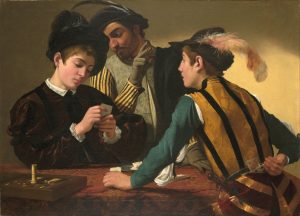
Play the hand you’re dealt, the old saying goes. But sometimes the deck is stacked against you, as Italian Baroque master Caravaggio suggests in his iconic painting, The Cardsharps. Now in the collection of the Kimbell Art Museum in Fort Worth, Texas, the canvas depicts what appears to be three guys just hangin’ out for a round of primero (an early Italian version of poker). Look again. Caravaggio’s dramatic use of light and contrasting shadow — chiaroscuro for all you arty types — and

exquisite detail reveal far more. The young lad on the left ponders his hand; if he were a modern-day bloke, the bars of “Luck Be a Lady” would be thrumming through his head. His rosy complexion and velvet-and-lace finery suggest someone not yet wise to the ways of the world, unlike the other two wise guys in the painting. The one opposite sports the traces of a mustache, an insouciant feathered cap and flashy doublet with a dagger hanging from its belt; his left hand is poised to knock over the game board precariously perched on the table’s edge — a convenient distraction affording him the opportunity to slip those cards behind his back into the deck. The older fellow casts an eye on the oblivious young man’s hand, signaling its contents with two fingers, one of which is barely visible through the hole in his glove . . . the easier to mark cards, dontcha know. Something is about to go down, and it ain’t gonna be pretty!

So powerful is Caravaggio’s painting, it has inspired several riffs, from Georges de la Tour’s Cheat with the Ace of Diamonds to Cassius Marcellus Coolidge’s infamously kitschy Friend in Need, featuring a pack of dogs playing — and cheating at — poker. You could even argue the poker scene from The Sting is a live-action variation of the trope, with Lady Luck ever constant to roguish Paul Newman. And who could blame her?
Poet’s Corner

Shaken and Stir Crazy
Simple Life
Last Days of the Yard King
By Jim Dodson
That July I owned the neighborhood. Or at least my block in Starmount Forest.
It was 1968. I was 15, towing an aging Lawnboy push mower behind a well-traveled Schwinn Deluxe Racer with chrome-plated fenders and dual side baskets. My mother called me Jimmy the Yard King.
Actually, I had several jobs that summer. One was mowing half a dozen lawns up and down our street for five bucks a yard. Another was planting Christmas trees at a farm overlooking Lake Jeanette. I also snagged a weekend job as an usher at the newly opened Terrace Theater, one in which I was required to wear a tangerine orange double knit sports jacket that matched the theater’s innovative “rocking chair” seats. My job was to keep kids from violently rocking their brains out and disturbing other customers by banging their knees.
That summer I also had my first job teaching guitar on Saturday afternoons at Mr. Weinstein’s music shop, another glorious five-dollar-per-hour gig.
I was rolling in dough. Or thought I was. My mom joked that she might someday ask Jimmy the Yard King for a loan. But I was saving up for either a new Alvarez guitar like Graham Nash played or a new Chevy Camaro, whichever came first.
That year, 1968, has been called the “Year that Shattered America.”
Looking back, it was the year we both began to lose our innocence.
Being a son of the newspaper world, I paid close attention to the news, read the paper daily and never missed Uncle Walter’s CBS evening newscast.
For the first time, television news brought the horrors of the war in Southeast Asia home to 56 million American TV sets. On my birthday that February, in Time Magazine, I saw the iconic photograph of a South Vietnamese general publicly executing a Viet Cong prisoner. That photo shocked Americans, stoked the anti-war movement and sharply turned millions of everyday citizens against the war. One month later, the Mai Lai massacre that killed 500 civilians, though the atrocity wasn’t revealed and investigated for another year. These events finished off public support for the undeclared war.
That spring I taught myself how to play every song on the Beatles’ Sgt. Pepper’s Lonely Harts Club Band and started performing around town with my buddy Craig Corry who lived two doors away on Dogwood Drive. We wound up placing third in the City’s Teenage Talent Show that next fall and made an appearance on Lee Kinard’s “Good Morning Show,” our first and last moment in the spotlight.
On a breezy afternoon that April, I was playing golf with my dad when we heard that Martin Luther King had been assassinated In Memphis. We watched riots break out in Detroit and coverage of the Poor People’s March on Washington. Commentators wondered if America was coming apart at the seams, heading for revolution in the streets.
Barely a week after he announced that he wouldn’t run for re-election, President Johnson signed the historic Civil Rights Act. The musical Hair opened on Broadway featuring live naked people on stage singing about the “Age of Aquarius, An anthem for a dawning age of peace, tolerance and brotherhood. I started growing my own hair long that summer.
On the plus side of the summer America was going to hell in a hand basket, I took Ginny Silkworth to the Cinema Theater to see Franco Zefferelli’s Romeo and Juliet. Since this was a first date for us both, my dad had to drive us to the theater under strict orders not to say anything embarrassing. Because of that movie, I fell in love with the language of Shakespeare and, in a way, with Ginny Silkworth, too.
She hailed from somewhere up north and had the Yankee accent and direct manner to prove it, a deep thinker with a warm and horsy laugh. After the movie, as we waited for my old man to pick us up, Ginny wondered what I planned to do with my life. She was always asking questions like that.
I mentioned that I hoped to write spy novels and adventure books, travel to the ends of the Earth, compose country music songs, mow lawns and possibly move to either Nashville or England. She punched me on the arm and gave her horsy up-north laugh, pointing out that she intended to keep tabs on me to see if I did any of the above.
“If you want,” she suddenly declared, direct as ever and completely out of the blue, “you can kiss me.”
So I did. Another first.
In fact, Ginny and I stayed in touch for decades. She went on to become a gifted school teacher in Philadelphia and lived a very full and rewarding life, passing away from breast cancer a few years back. I still miss her, my Shakespearean first date, my first kiss, her warm and wonderful up-north laugh.
That same summer Robert Kennedy was gunned down after winning the California presidential primary. My mom had a thing for Bobby Kennedy. We watched his funeral train together and she cried. My dad was a half-hearted Nixon guy. My mom used to joke that she did her patriotic duty by cancelling out his vote every four years at the polls.
By July I was deep into my lawn mowing life, guitar-playing, writing bad country music songs and reading spy novels, trying to forget what was going on in America. I hated the usher job at the terrace so much that I handed in my elegant orange usher’s jacket in early August, blaming my family’s annual beach trip to the Hannover Seaside Club at Wrightsville Beach.
We’d gone there every year for half a dozen years, though this would be our final time. I loved the Seaside’s simple unfancy dining room, its cool wooden floors and big porches where I could sit for hours in a real rocking chair reading Graham Greene’s The Heart of the Matter or John LeCarre’s The Spy who came in from the Cold, picturing myself mowing a lawn in some far-flung, sun-mused outpost of the British Empire, a spy in short-pants and boat shoes, enjoying a gin and tonic with some sultry blond who looked like Tuesday Weld or at least Ginny Silkworth.
That week a family from Southern Ohio showed up at the Seaside Club. A pretty girl named Sandy was reading Edward Abbey’s Desert Solitaire, bare feet tucked up in the rocker just down the porch. We struck up a conversation and took a walk to the end of Bobby Mercer’s pier. Sandy told me that we human beings were destroying the natural world, killing the oceans with our garbage and fighting an unwinnable war. She told me she was going to become an “environmental activist” like her aunt who was presently attending the Democratic Party Convention in Chicago as a delegate from Ohio.
The Seaside Club didn’t have a TV set, so there was no way to see what was happening up in Chicago. We heard, however, that there were police riots and lots of injuries at the convention after Chicago’s mayor turned the police loose on protesters and Students for a Democratic Society who attempted to crash the party.
For the rest of the week we were pretty much inseparable. Sandy was a year older and half a head taller than me. She was no Tuesday Weld or Ginny Silkworth but I liked her a lot. She was crazy about books and movies.
The Graduate was playing at the Crest Theater in Wrightsville Beach. She suggested that we go see it. This was the year that the Motion Picture Association of America instituted its film rating service, serving as a guideline for parents anxious about a movie’s questionable content. I secretly worried about getting in. You were supposed to be at least 16 but the old lady working the box office took one look at Sandy, then me, and let us in for a buck and a quarter each.
The night before Sandy’s family headed home to Ohio, we talked until midnight while seated on a stack of canvas rafts stacked beneath the Seaside Club. I don’t remember what we talked about, probably her plan to save the world or mine to travel it. We promised to keep in touch.
My family was staying through the Labor Day weekend. The next evening, I gigged a huge flounder in the tidal flats off Bald Head Island and wondered if I would ever hear from Sandy again. She actually wrote me a couple times and I wrote her back. Some years later an F5 tornado flattened her hometown of Xenia, Ohio, killing hundreds of people and leaving 10,000 homeless. I never heard from Sandy again. I like to think she’s somewhere out there in the world doing her best to save the planet.
Back home, with school starting, I still had a few weeks of decent lawn-mowing income to count on, plus teaching guitar for Mr. Weinstein. That summer had clearly changed me. By then I knew all the dogs in the neighborhood, for example, those which were friendly and those that weren’t. I also knew the friendlier and better-looking moms, too. When you’re 15 and have begun dating smart and pretty girls, you notice such things.
Looking back from half a century, however, I realize how deceptively simple my life was that extraordinary summer safely removed from the anti-war protests, the burning cities, the murder of visionary politicians and Civil Rights leaders, the raised fists at the summer Olympics, Nixon winning the White House, O.J. winning the Heisman. Without realizing it at the time, these things changed me as well.
The singer Mary Chapin Carpenter has a poignant song about that fevered summer in the changing life of America. It’s called “Stones in the Road.” Every time I play it – which is fairly often these days – I think of that faraway year when America and I both lost our innocence.
“And stones in the road, flew out beneath our bicycle tires…Worlds removed from all those fires as we raced each other home…”
I rode my bike everywhere that summer, pretty much for the last time.
I mowed lawns, ate my first Big Mac, kissed Ginny Silkworth and had something awakened in me by a spirited girl named Sandy. I taught myself to play every song on “Revolver” and went to Scout camp for the final time, did the Mile Swim twice, finished off my Life Scout award, and built a nature walk at my elementary school for my Eagle project.
The Yard King’s days came to an end.
Since then, one thing I’ve learned is that history may not repeat but itself but certainly rhymes like a Mary Chapin song.
“And the stones in the road, leave a mark from whence they came / A thousand points of light or shame – baby, I don’t know.”
This edition of Simple Life first appeared in August 2018.
Simply Summer
Seven local chefs serve up easy-to-prepare courses for seasonal eating
By Maria Johnson
Feeling the heat of summer? It’s a good time to head for the kitchen and KISS:
Keep It Small and Simple.
Because gatherings this time of year are likely to be modest and trips to the store less frequent, we asked local chefs to contribute summer recipes with eight or fewer ingredients. We were feeling generous, so we spotted them the salt and pepper.
Whether you’re slaking a single appetite or schlepping your family’s chow to a well-spaced picnic, these recipes are easy to assemble and can be scaled up or down. Several of our hometown pros went off-menu to create new dishes for O.Henry readers, so don’t be surprised if these courses taste as good as something you’d get in a restaurant — and remember the chefs’ generosity in these customer-starved times.
Pasta Perfect
Pastabilities
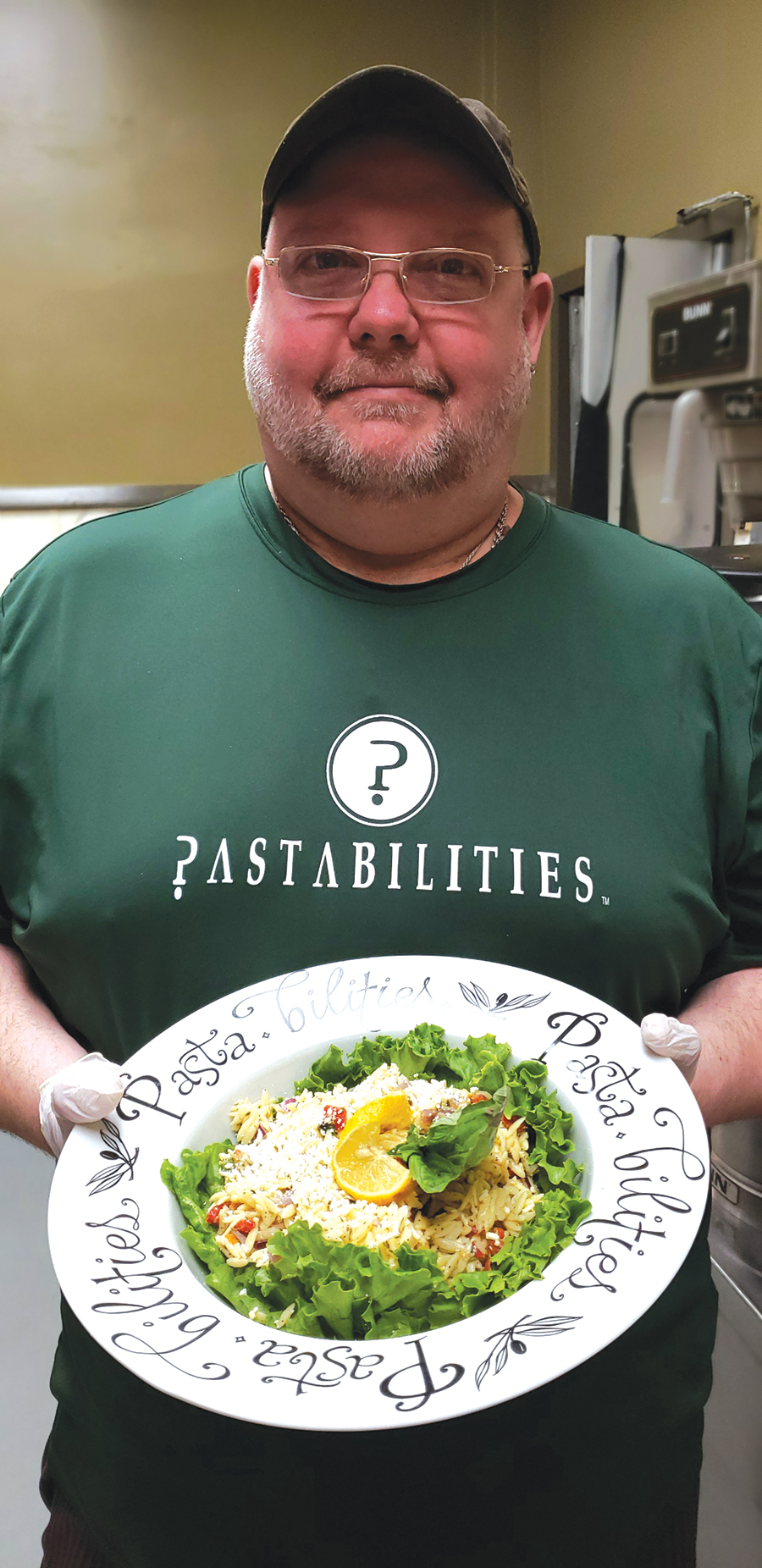
Cindy Essa, noodler-in-chief at Pastabilities, collaborated with
Chef Jason Dingman (picture right), a 20-year veteran of the restaurant, to come up with this light and refreshing orzo salad. It’s a knockout with fresh basil and tomatoes, but dried basil and sun-dried tomatoes work just fine. This versatile salad may be served as a meal — add chicken, fish, shrimp or any protein and spoon over your favorite greens — or as a side dish or light lunch.
Mediterranean Orzo Salad
Servings: meal for two or side dish for four.
1 3/4 cups uncooked orzo pasta, prepped according to directions and cooled
3/4 cup finely chopped sun-dried tomatoes (or 1 1/2 cups diced fresh tomatoes or halved cherry tomatoes)
1/2 cup crumbled feta cheese
1/4 cup finely-diced red onion
1/4 cup toasted pine nuts
1/4 cup chopped fresh basil (or 2 teaspoons dried basil)
1 tablespoon fresh minced garlic
4 tablespoons extra virgin olive oil
Sea salt and fresh ground pepper to taste
Gently combine all the above ingredients in a medium size bowl and chill for two hours.
Salad Days
The Well Cafe and Juice Bar

Jessika Olsen (below, left) of The Well Cafe and Juice Bar in downtown Greensboro incorporated some pantry staples with fresh leafy greens and green beans to create this filling salad. She added a sweet, tart, earthy dressing to create a symphony of summerflavors. She and cafe co-owner Veronika Olsen (below, right), her identical twin sister, give four-thumbs-up to this salad. They recommend serving it with a fresh baguette slathered in the cafe’s roasted red pepper Romesco sauce.

Fresh Spring Salad
Servings: 2
14 ounces marinated artichoke hearts. Drained and quartered.
Mixed spring lettuce (or arugula, Jessika’s favorite)
About a cup of green beans, trimmed and blanched
1 can cannellini beans, drained
Dressing:
1/4 cup olive oil
1 1/2 tablespoons lemon juice
2 teaspoons whole grain mustard
2 teaspoons maple syrup (or honey)
To make the dressing, combine the olive oil, lemon juice, mustard and maple syrup. Layer the lettuce, green beans and artichokes on serving plates. Spoon over the cannellini beans. Drizzle dressing on top of salad and serve.
Instead of blanching the green beans, you could sear them with reserved oil from artichoke hearts, salt, pepper and a squeeze of lemon.
Soup’s On!
Reto’s Kitchen

Caterer Reto Biaggi, who operates Reto’s Kitchen, jumped at the chance to make a simple summer soup. This tomato-based recipe is made in a standard size kitchen blender, which warms the soup so you don’t have to use your stove. A touch of tarragon gives away Reto’s upbringing in France, where the seasonal duo are often paired. A whirred slice of bread thickens and adds creaminess to the soup. Reto says that fresh tarragon is better, but dried will work, too. Likewise, fresh tomatoes at the height of the season are wonderful, but a can of peeled whole tomatoes will suffice.

Tarragon Tomato Soup
Servings: 2
1/4 cup extra-virgin olive oil
1 clove garlic
1/2 cup onion, roughly chopped
1 1/2 teaspoon tarragon, preferably fresh
1/2 teaspoon red pepper flakes
1 slice white bread, crusts removed, torn into rough 1/2-inch pieces
1 can peeled whole tomatoes packed in juice (28-ounce) or 3 large fresh tomatoes
1 cup water
1/2 teaspoon salt
1/4 teaspoon pepper
Combine olive oil, garlic, onion, tarragon, red pepper flakes, bread, tomatoes with their juice, and water in the jar of a high-powered blender.
Turn blender onto low speed and slowly increase speed to maximum.
Blend 4–6 minutes, until soup is warm and smooth.
Season to taste with salt and pepper. Blend.
Bottom’s Up!

GIA
When we asked Nino Giaimo — the proprietor of GIA: Drink. Eat. Listen. — if he could gin up a cocktail for us, he turned to his beverage director Dan Lis (right), who designed a drink for Nino’s father, Sal, co-owner of the GIA Distillery in the town of Madison, north of Greensboro. The drink is based on the distillery’s aged FJW Solera Style American whiskey, which is available in local ABC stores. Dan reports that Sal takes his drinks straight up, so this one is served with no ice, gently stirred. The smoky whiskey balances the blanc vermouth. The gin adds a subtle spice, and the drink is rounded by house-made coffee-and-cocoa bitters. Readers can substitute coffee-and-cocoa bitters made by the Crude brand. Lemon peel lends a touch of brightness.
Sal’s Choice
Servings: 1
1 1/2 ounce FJW Solera Style aged American whiskey
3/4 ounce Dolin blanc vermouth
1/2 ounce Ransom Old Tom gin
2 dashes house-made coffee-and-cocoa bitters
Combine, stir and garnish with a lemon peel.
Burger Bliss
Big Burger Spot

Fine dining veteran Jesse Mitchell has been showing his chops ever since he signed on with Greensboro-based Big Burger Spot in 2013. Mitchell, who worked at Green Valley Grill for eight years, is behind the restaurant’s popular slow braised short rib sandwich and the pot roast cheddar melt. BBS owner Guy Bradley challenged Mitchell to create a burger with an entirely different flavor profile for O.Henry readers, and Mitchell delivered this gem.
Le Fromage Burger
Servings: 1
8 ounces fresh ground chuck
3 strips thick-cut applewood smoked bacon, fried
2 ounces Boursin brand garlic-and-herb cheese
2 ounces onion jam
1 ounce mixed greens
Salt and pepper
Brioche bun
Form ground chuck into 5-inch diameter patty. Salt and pepper both sides. Cook over high heat on grill or skillet until desired temperature is achieved. Medium is recommended.
For onion jam, julienne one whole red onion and place in sauce pan. Add 1/2 cup apple cider vinegar, 1/4 cup brown sugar and 1/2 teaspoon salt, 1/2 teaspoon pepper. Bring to boil ten minutes, then reduce heat and simmer for an hour.
Butter brioche bun and toast in skillet. Remove toasted bun and spread Boursin cheese on bottom bun. Place grilled burger on top of cheese, then add bacon and mixed greens. Spread onion jam on top bun and complete the burger.
Smoothie Sailing
Manny’s Universal Cafe
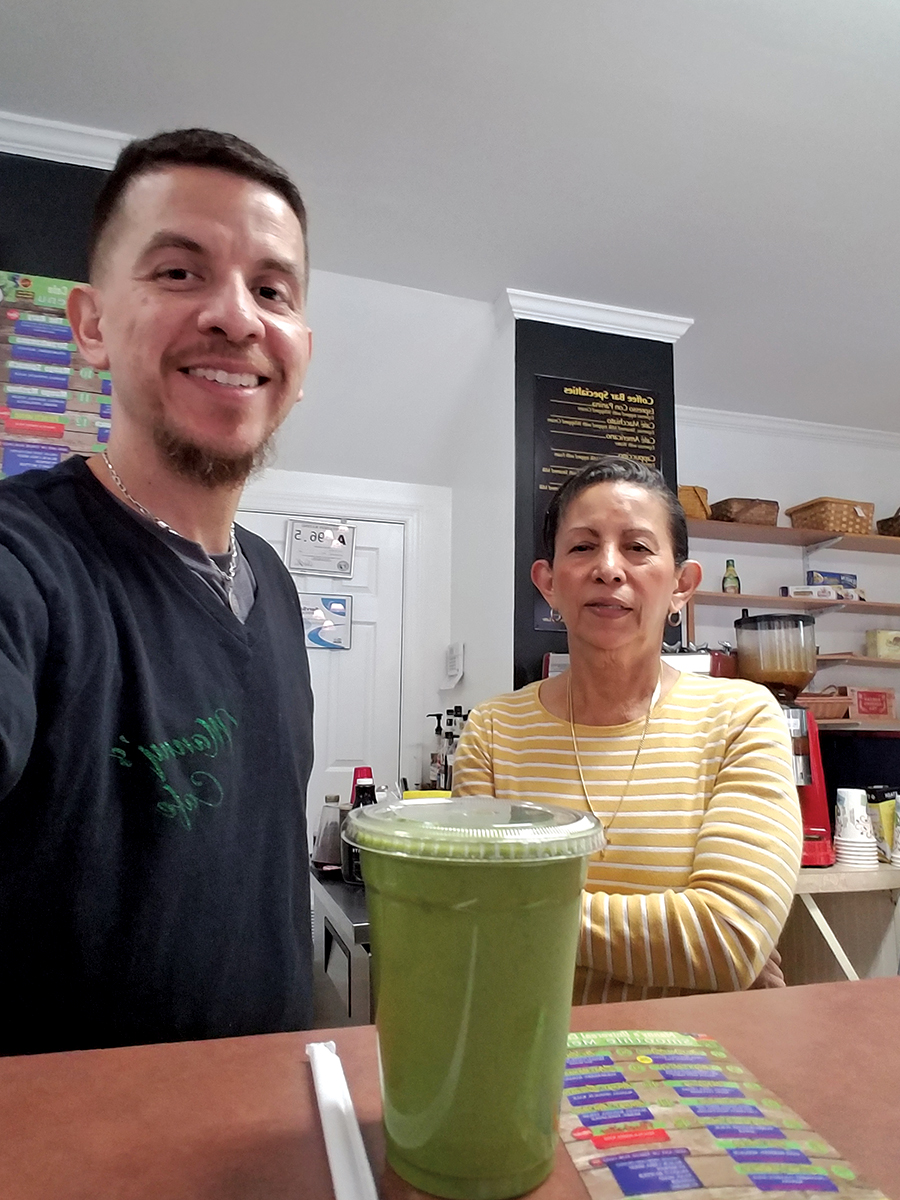
The smoothie menu at Manny’s Universal Cafe, in the heart of downtown Greensboro’s South End, is extensive and creative, ripe with selections such as Mango Mashup, Pomegranate Punch and Goji Power. But owner Manny Polanco and his mother Margarita Delgado, the maker of menu magic, still wanted to create a new drink for the pages of O.Henry. A few pulses later, Kiwi WE Strong was born. “We like it because it has vitamins, protein and antioxidants — perfect to help us stay ready and strong to get through these times of adjustments. We have to stay healthy,” says Manny. If that doesn’t make you want to quaff a kiwi, nothing will.
Kiwi WE Strong
Servings: 1
2 hands-full fresh spinach
2 fresh kale leaves
1 gala or Granny Smith apple, peeled and cored
2 kiwis, peeled
1/2 frozen, peeled banana
2 tablespoons peanut butter, thinned with 1 tablespoon water
1 teaspoon lemon
1/4 teaspoon turmeric
1 cup of ice
In a standard kitchen blender add spinach and kale first, then other ingredients. Start blender at medium speed, finish at high speed. You’re done when your smoothie is . . . smooth.
Keep Pounding!
Pound by Legacy Cakes
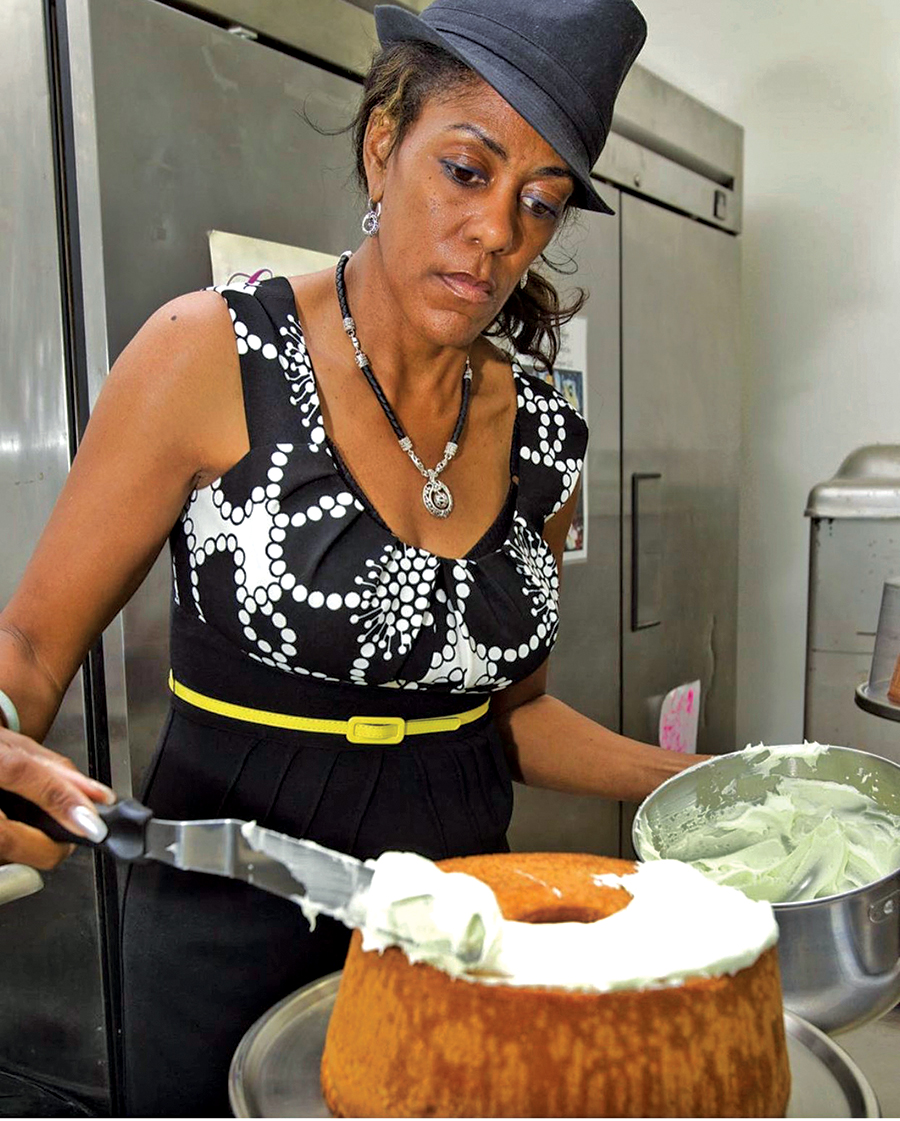
If you’re looking for a cheap hit of aromatherapy, walk into the bakery called Pound by Legacy Cakes for a whiff of happiness. Visual yays won’t be far behind, as you take in more than a dozen glazed and frosted pound cakes that are baked daily in a riot of colors and flavors: caramel, strawberry, chocolate, pineapple, apple-walnut and the ever-popular banana split. Founded by Pleasant Garden native Margaret Elaine Gladney, the bakery — which opened last year in an inconspicuous space on Spring Garden Street near Holden Road — is a sweet memorial to Elaine’s late mother and master baker Margaret Shoffner Gladney. The family offers this recipe for their vanilla pound cake, a customer favorite that’s “simple, delicious and one of the best comfort foods,” according to Margaret, who runs the bakery with help from sons Brandon and Anthony Tankard.
Glazed Vanilla Bundt Cake
16 tablespoons (two sticks) unsalted butter
2 cups sugar
1 teaspoon salt
1/4 teaspoon baking powder
4 eggs
3 cups all purpose flour
2 cups milk
2 tablespoons vanilla extract
Mix the butter and sugar together then add salt and the baking powder. Add the eggs next, mixing them in one at a time. Add flour and milk alternately. Once this mixture is thoroughly blended, add vanilla extract and beat until batter is smooth. Grease a 10-inch bundt baking pan and pour in batter. Bake at 350 degrees for approximately one hour. You can use a toothpick or small knife to check to see if the cake is done. Once baked, flip the cake onto cooling rack and let cool before glazing.
Glaze Ingredients:
2 tablespoons milk or water
1 teaspoon vanilla extract
1/4 cup confectioners’ sugar (powdered sugar)
Add ingredients into a small bowl and hand stir until consistency is creamy or at desired thickness. Pour over cake.

Simple Life
The Stolen Flower Child
Love, loss and living things
By Jim Dodson
On the 50th anniversary of Earth Day, a clear spring morning in my tiny corner of the planet, I was out early planting a fig tree in the side garden — my primary hideout even before a killer virus came to town — when I witnessed an enchanting scene of discovery.
An elegant gray-haired woman and a toddler on wobbly legs came slowly down the street hand in hand. The woman was about my age. I guessed the little dude might be her grandson.
They paused at the edge of my garden. The woman pointed to a birdbath and a pair of busy bird feeders hanging over flowering shrub roses. Several finches were at the feeder and two cardinals were taking morning dips in the birdbath. Bees were circulating through blooming sage. Spring was alive and buzzing.
The little dude dropped the woman’s hand and wobbled straight into the garden for a closer look at the action.
The woman followed close behind, keeping a maternal hand ready to catch him if he fell. The birds didn’t appear the slightest bit perturbed by the pair’s intrusion, and neither was the gardener — for what good is a garden if living creatures don’t pay a visit, be it birds, bees or boys?
Indeed, at one point, the little guy tripped and tumbled over. He didn’t cry, however. He pushed himself back to his feet and giggled, holding out a fistful of my good garden dirt to share with his companion.
She made a delighted show of accepting his special Earth Day gift. Together they examined something in the palm of her hand, perhaps a big wiggly earthworm. My garden is full of them.
How wise she was to encourage this new citizen of the Earth to get dirty in a garden. Once upon a time, when people lived much closer to the soil, Nature was regarded as an essential teacher of the young, a maternal presence used in the service of myths, legends and fairy tales to convey important lessons about survival in a wild and unforgiving world. Perhaps the handsome older woman knew this. Perhaps, given the enchantment of the moment, she actually was Little Dude’s fairy grandmother.
In any case, as I watched this tender scene unfold, leaning on a shovel in my side yard, two thoughts came to mind.
One was a line from a poem that I had commited to memory decades ago, “The Stolen Child” by Irish poet William Butler Yeats
Come away, O human child!
To the waters and the wild
With a faery, hand in hand,
For the world’s more full of weeping than you can understand.
The other was a powerful flashback to the enchanted young woman who introduced me to this poem and changed my life, 50 years ago to the day.
* * *
Her name was Kristin.
We grew up attending the same church and sang together in the youth choir, but she never really looked my way because she was a year older and several lifetimes wiser, a beautiful cheerleader who became a wise and spirited flower child.
During the autumn of my junior year in high school, however, she turned to me after choir practice and wondered if I might give her a ride home. On the way home, she informed me that she’d ditched her college boyfriend and wondered, with a teasing laugh, if we should begin dating. I had a new Chevy Camaro from money I saved up from mowing lawns and teaching guitar. I thought she just liked my car.
What she saw in me at that moment is still hard to say. I was such a straight arrow kid, an Eagle Scout who grew up camping and fishing and was more at home in the woods than the city. Once upon a time, I’d even briefly been a member of the local chapter of Young Republicans and shaken Richard Nixon’s hand, though I didn’t dare let this out until our second or third date.
“That’s OK,” she said with a laugh, “I think the universe sent me to wake you up and save you from the Republicans.”
Perhaps it was our shared passion for the outdoors that created such a powerful bond. She loved to hunt for wildflowers and visit public gardens where she could sit and read poetry or study her lines for a play. She even walked golf courses with me doing the same. Yeats and Walt Whitman were her favorite poets. Because of her, I fancied Yeats and Whitman too.
I was 17 on the first Earth Day, April 22, 1970, though I cannot tell you much about the rally we attended in a public park after school that Wednesday. There was a good crowd, lots of posters and energy, a bevy of passionate speakers warning about the dangers of air and water pollution to future generations. Someone had hauled a rusted heap to the rally site, as I recall, and protesters took turns gleefully bashing the gas-guzzler with a sledgehammer — or maybe this was a subsequent protest we attended together. In any case, I was grateful we’d parked my almost-new Camaro well away from the scene.
I recently learned from the earthday.org website that the first Earth Day protest “inspired 20 million Americans” — at the time, 10 percent of the total population of the United States — to take to the streets, parks and auditoriums “to demonstrate against the impacts of 150 years of industrial development that had left a growing legacy of serious human health impacts.”
The site goes on to note that the first Earth Day led to some significant steps by year’s end: the creation of the United States Environmental Protection Agency and the passage of other environmental firsts including the National Environmental Education Act, the Occupational Safety and Health Act, and the Clean Air Act. Ironically, Richard Nixon signed these pieces of legislation into law. He deserved a handshake for this.
“Two years later,” the website adds, “Congress passed the Clean Water Act, followed by the Endangered Species Act — laws that protected millions of men, women and children from disease and death as well as hundreds of species from extinction.”
In 1990, 200 million people in 141 countries mobilized to make recycling and alternative energy sources primary objectives of Earth Day activism. “Today,” the site concludes, “Earth Day is widely recognized as the largest secular observance in the world, marked by more than a billion people every year as a day of action to change human behavior.” And create a sustainable planet. For me, the best part of that first local rally was when Kristin read Yeats’ “The Stolen Child,” a poem that appeared in his first poetry collection in 1889. The theme plays off loss of childlike innocence against the unmentioned backdrop of a world being turned upside down by the social upheavals of Britain’s Industrial Revolution. Yeats grew up in beautiful County Sligo where folklore and legends of fairies stealing children were commonplace, a subject that deeply interested the poet for much of his career.
In the end, the innocent child is lured away from the familiar comforts of home to a world far removed from the one he knows and loves — stolen away, in the end, to a place that is both wild but also faintly sinister.
On some level, the message is an allegorical plea not to abandon the beauty and challenges of real world, seduced by an illusionary longing to leave troubles behind. Over the year and a half we were together, Kristin opened my eyes about so many things in this world — poetry, art, music, the power of an open mind and the spiritual connectedness of every living creature.
Whenever we debated politics — I was still something of a half-hearted Republican — she joked that she might end up becoming my Maud Gonne, the 23-year-old English heiress and ardent Irish Nationalist Yeats met in 1889 and proposed to — without success — at least three times. She became the poet’s unrequited love and lifelong haunting. In a way, Kristin became mine — or at least my Stolen Flower Child.
We agreed to part when she went off to college in the mountains. The separation was my suggestion. I had a cool Camaro and a silly notion that I needed “space” to date around “before I settled down.” The decision was one I soon came to regret.
Two years later, we got back together. For three October weekends in a row, I drove six hours across the state to reconnect with my first love. She was soon to graduate with degrees in social work and drama, and was being considered for an understudy role in London. I was trying to decide between becoming an English teacher or a journalist. She helped convince me that writing was my proper path.
On Sunday night, October 25, 1973, we parted having made a plan to go to England together someday soon and see what life would yield. Kristin went to the steak house where she worked as weekend hostess and I drove six hours back to school. Later that evening, three young teenagers entered the restaurant to rob patrons, held a gun to the head of the hostess and pulled the trigger.
* * *
As I watched the wise fairy grandmother and Little Dude resume their walk down the block, hand in dirty hand, I went back to planting my young fig tree, marveling how quickly half a century had passed. I also wondered, on this important day in the life of the planet, what sort of world Little Dude would soon inherit.
Ironically, just days before, a gutted Environmental Protection Agency removed the last regulations on air and water pollution in America, part of a systematic dismantling of the sweeping gains in environmental protection that had taken place over half a century, at a time when the vast majority of scientists warn the Earth is facing perilous consequences due to climate inaction. Among other things, the coronavirus pandemic has been traced to human encroachment into formerly wild places where Ebola, SARS and other killer viruses were born. Experts also warn that the world’s population of insects — the basis of our own food chain — is nearly half what it was the year of the first Earth Day.
As for me, it took almost two decades to speak of my own personal tragedy. A final golf trip with my father to England and Scotland when he was dying allowed me to finally open up about that dark October. It proved to be my second great awakening.
Today, I understand that the world is indeed full of sorrows, but thanks to the gifts my stolen flower child gave me, I understand that the power of love is the real magic of life on this planet, not to mention the importance of keeping an open mind while celebrating the spiritual connectedness of every living creature.
I sometimes feel her presence — keeping an eye on my progress, I suspect — especially when I’m in the garden. OH
Contact Editor Jim Dodson at jim@thepilot.com.
Short Stories
***Given the unusual circumstances currently facing all events and their organizations, anyone planning to attend any program, gathering or competition should check in advance to make certain it will happen as scheduled.

Tiny Trees
Since its gift shop reopened in May, we’d like to think Paul J. Ciener Botanical Garden (215 South Main Street, Kernersville) is going forward with regularly scheduled lectures and programs. As of this writing, its discussion, “Bonsai for Fun,” is still on the books for June 11 at 6 p.m. PJCBG’s garden manager Josh Williams will present the ins and outs of cultivating, caring for and training the petite plants, and will answer any questions you may have. Have a bonny bonsai of your own? Bring it in! To register: (336) 996-7888 or cienerbotanicalgarden.org.

Picture This
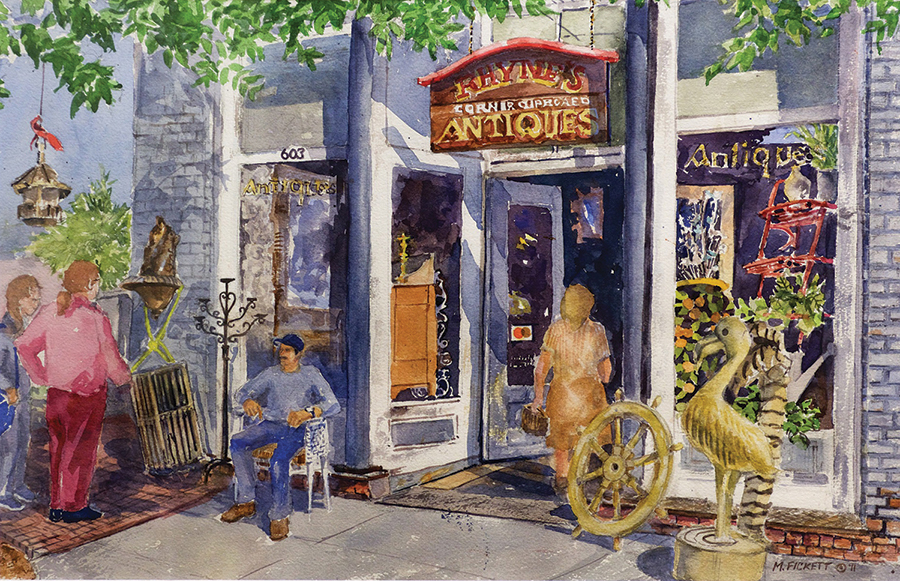
A show and sale of work by the late Greensboro streetscape artist Maggie Fickett is ongoing, online, at greensboroart.org, the website of Center for Visual Artists. For more info on the show, Maggie Fickett: Living in Plein Air, go to ohenrymag.com/sazerac/ and scroll down to the department called “High Browsing.” While you’re at it, sign up for The Sazerac, an email newsletter that’ll land in your inbox every Friday at 5:30 p.m. and help you kick off the weekend with a smile.

Long Ago and Farro-way
If you’ve been dreaming of the Green Valley Grill’s blue crab-and-spinach dip, flatbreads, and one of our faves, the salmon and farro salad for the last couple of months, dream no more! Wipe the drool from your chin, go online to the restaurant’s website, place a to-go order for lunch or dinner, and pick it up in the parking lot (622 Green Valley Road). It’s a big deal, because unlike many Gate City eateries, GVG is employee-owned and therefore shuttered its doors for the duration of the corona calamity. But starting Mother’s Day with a selection of family-sized meals, it cranked up again, implementing a drive-through system with military precision. And who knows? By the time you read this, the popular hangout may have reinstituted on-site dining. Either way — and especially if you go for the salmon — it’s a fin-fin situation. Info: greenvalleygrill.com.

Market Mania
Though many places came to a screeching halt in the last couple of months, the Piedmont Triad Farmers Market (2914 Sandy Ridge Road, Colfax) has soldiered on. As summer approaches, it’s gathering steam starting June 6, when it hosts “Ask a Master Gardener,” featuring a representative from the Guilford County Cooperative Extension who will be on hand to offer advice about growing stuff. June 13 sees “Touch a Truck,” encouraging kids to explore construction equipment — sanitized, we hope — such as fire trucks, dump trucks, cranes and just about anything with an engine and big wheels. On June 19, a case of the blues has never been so welcome, as the Market presents Blueberry Day. (Do we see a cobbler in your future?) Winding up the month on the June 20, you can again get the, er, dirt from a Master Gardener but the main attraction is the Market’s annual Crawfish Boil. Come early for your 5-pound stash of either live crawdaddies or if you prefer, cooked up with Cajun spices. It’s summer y’all! Let the sunshine in and laissez les bons temps rouler! Info: ncagr.gov.