
Healing Lands
A once tired farmland is now a thriving home to family and flock
By Cassie Bustamante • Photographs by Amy Freeman
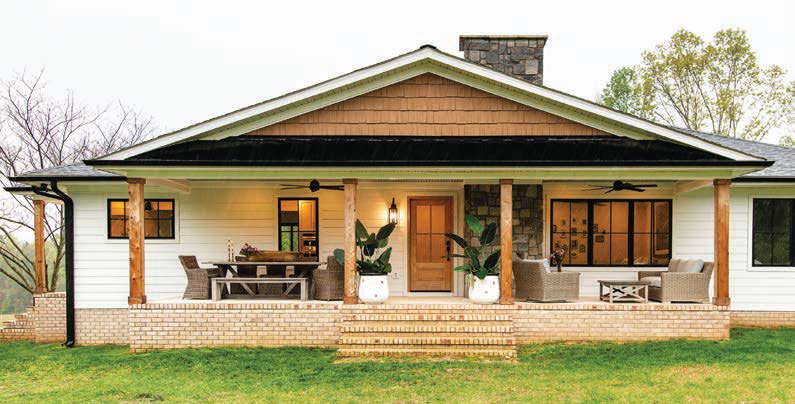
At the end of a long, gravel drive, where two golden-white Great Pyrenees greet visitors as soon as they hear the crunch of tires, sits a modest, 1,800-square-foot, 1950s rancher. Ashlynn Roth, her husband, Tim, and their two young children, ages 6 and 8, have been settling into their Whitsett farm over the last month. Beyond their sliding-glass back door, Dorper sheep with their young lambs roam freely on a vast, grassy pasture, bleating loudly in response to the sound of Ashlynn’s voice. In front of the home is a movable henhouse, where chickens produce plentiful eggs. But just a few short years ago, none of this existed here — not even the house. Years of tobacco and corn farming had taken its toll, leaving behind unserviceable, rock-hard soil. The Roths, however, had a vision: Heal the land and create a homestead.
Ashlynn is a petite blonde with sparkling brown eyes. Her hair is styled in long, loose curls that frame her round face. She’s been known to don a glittery evening gown and even participated in pageants at one point in her life, earning the title of Miss Thomasville in 2003. It’s easy to imagine her as a beauty queen and it’s no wonder she’s the face of Tupelo Honey Farms, a regenerative farm in Whitsett. But, she’s quick to tell you, she’s also a serious, full-time farmer. “No way,” people respond. “Oh, yes,” she says. And she’s got the dirt under her fingernails to prove it.
Farming is hard, gritty work, she admits, but not as grueling, she discoverd, as being an executive in the human resources software field. “When I was a VP in corporate America,” she says, “that was a challenge.” Her days were spent kissing her babes’ heads then dashing out the door to catch early morning flights as a new, nursing mother. As soon as her plane landed, she was making a run for a bathroom to pump breast milk, dashing off to meetings with clients, then rushing back home just to see her young family, however briefly, before doing it all again the next day. Tim was also collecting frequent flyer miles as a medical-device salesman with a focus on dialysis care. “We would pass each other in the air sometimes,” says Ashlynn.
Ashlynn and Tim had known one another since they were teenagers, but romance didn’t blossom until much later. She was living in Atlanta after graduating from UNCG, but coming back to the area frequently because her mother, her “best friend,” had fallen ill. Tim, too, had left the area after growing up here, landing in San Francisco, but his father had suffered some small strokes. Since his job allows for him to live anywhere, he traded Golden Gate City for The Gate City to take care of his father and his father’s own regenerative cattle farm.
They began running into each other at Cone Health, where Ashlynn was frequently visiting her mom. Tim, who was there on business, reached out to Ashlynn, thoughtfully bringing her magazines and then asking her to have lunch with him. “He asked me out five different times!” she says, but dating was the last thing on her mind.

When her mother was moved to Duke Hospital, where a diagnosis of a rare form of cancer was pronounced, flowers arrived one day for her mother — from Tim. “And my mom goes, ‘I think you should go on a date with him.’”
She took the advice. In her mom’s hospital room, she prepped for the date, a casual outing to watch the Durham Bulls play ball. After the game, they wandered into a bar and munched on a charcuterie board featuring sheeps’ cheese. A portent of things to come? “You’re going to laugh at this,” she says. The provisions — and the company — were welcome, but as she tucked into the sheeps’ cheese, her mouth began to itch: “Now, sheep are my favorite thing, but I can’t eat the sheeps’ cheese!”
Weeks turned into months and, before she knew it, Ashlynn couldn’t imagine a future without Tim in it. Though she swore she’d never move back to Greensboro and only wanted to live in big, thriving metropolises, she finally packed her bags and left Atlanta behind to begin creating a life together.
Her mom, though still ill, was feeling better. And Tim’s father was back to working his own farm, giving the couple the chance to leave Greensboro behind again. Over the next decade, they zig-zagged across the country, living as far as Houston, Texas, and Cleveland, Ohio. They also married and welcomed their two children. Sadly, Ashlynn’s mother passed away when her first-born was just 5 months old.
Eventually, with an infant and toddler at home, Ashlynn made the decision to quit her job, allowing the family the chance to live almost anywhere in the world. “We chose Greensboro.”
The family settled into an expansive Irving Park home, and just months later, Veeva, a cloud-computing company, offered her a remote job. “It’s for people going through clinical trials,” she says. Having tried to get her mother into a clinical trial, it was something that tugged at her. It seemed too good to be true, so she went back to work and hit the ground running in her new role.
And then in 2020, during the pandemic, she woke up one morning feeling dizzy and as if she were moving even though she wasn’t. “I felt like I was flipping,” she says. “And day after day kept going by and it never went away.”


MRIs and all sorts of testing on her inner ear and vestibular system resulted in no concrete answers or solutions. “They couldn’t figure out what was wrong with me.” She recalls being told by doctors, “We think you might have MdDS [Mal de Débarquement Syndrome] — we don’t know — but here are some eye exercises. Good luck!” (MdDS is a rare vestibular disorder that makes you feel like you’re moving when you’re still.)
After two-and-a-half years of feeling like she was constantly riding ocean waves, Ashlynn decided it was time to be her own advocate. She began searching for answers on Instagram and discovered Alicia Wolf, aka @thedizzycook, whose account touts itself for its “delicious anti-inflammatory recipes for brain health.”
“Her symptoms sounded just like mine,” Ashlynn says. So, she reached out. Wolf immediately got back to her and recommended Dr. Shin Beh in Texas, who, according to Wolf, was one of only a handful of neurologists in the country who studied dizziness at the time. In turn, Ashlynn reached out to Dr. Beh and begged him to take her virtually since dizziness was making travel a challenge. He accepted her as a new patient and had her almost immediately diagnosed with vestibular migraines and MdDS. “And I just busted out crying because I was like, finally, I know what this is.”
While these afflictions are not curable, they are treatable. Ashlynn, who soldiered on in her demanding job, implemented a wholistic approach in the kitchen, creating recipes from Wolf’s cookbook. She took prescription medication and doctor-recommended supplements. All the while, she kept reflecting that Dr. Beh had also advised lowering her stress levels. The people who most often get diagnosed with MdDs were just like her. “He said, ‘It’s women that are hustlers, go-getters like you, A-type personalities — they’re always on,’” she recalls. “And he was like, ‘We have got to get your mind calmed down.’”
Her response? “I know how to handle stress.” But she didn’t know how to slow down. These days, women are told we can do it all — have a career, have a family, have a side hustle. No one, however, tells you it’s not sustainable to do it all at the same time.
Once again, a new company came calling, this time for a role as a VP, a title she’d longed for. “This was just such a step up in my career and more money,” she says, “So I was like, I’ve gotta do this.” She took the job and once again found herself on the move nonstop for work.
As if her plate weren’t full enough already, she and Tim, both with farming in their blood, had decided to look for farm acreage. Tim came upon what he thought was the perfect piece of real estate and drove Ashlynn out to it. When they arrived, she gasped. “What in the world?” she recalls saying. “This is my great-grandfather’s land!” The Whitsett property had once belonged to her great-grandfather and remained in the hands of distant relatives. Her grandparents, now in their 90s, live right across the street. The couple not only put in an offer on the 15 acres marked for sale, but reached out to the owners of bordering pieces of land to try to cobble back together the bulk of what had once been her great-grandfather’s. “They were like, ‘We’re not giving you a deal even though you’re family,’” recalls Ashlynn. “And I am like, ‘Well, I am not asking for a deal.’”

They got the land. “And it was rough looking,” says Ashlynn. Between working in demanding careers and raising kids, the couple drove out to Whitsett every chance they got to clean it up and make it once again suitable for farming.
But after the Roths closed their deal, Tim’s father fell ill and they once again took over his cattle farm, just over 10 minutes from their land. They’d previously taken over property ownership, but Tim’s dad still lived there and operated it until he needed to move to a longterm care facility. “So now we’re taking care of that, too.”
Even with the hustle of shuffling from Greensboro to their Whitsett land and the cattle farm, Ashlynn says the time spent outside working in the dirt provided a peace she hadn’t felt in years. It offered a chance to get out of her mind and into her body, and renew her sense of wonder. Nearby, a large flock of birds pecks at the ground. A single bluebird stands out against the rest; he takes off and settles on a nearby tree branch. Ashlynn stares in awe.
The answer was clear: quit her high-paying corporate job and focus full-time on farming. “I sat my husband on the steps . . . and I said, ‘I can’t do this anymore. I am about to lose my mind.’”
He was going to say no, she just knew it. “We were standing right out here and it looked like crap — it looked awful, trash everywhere,” she recalls. He looked into her eyes with understanding: “OK,” he said.
Ashlynn immediately got to work, spending her days dropping her kids off at school then driving out to Whitsett. Eventually, after several laborious months of clearing out dead trees and enlarging pastures, the land was ready for animals. On weekends, when Tim wasn’t visiting hospitals for work, the entire family pitched in.
Taking a page from Tim’s father’s regenerative farm, the first animals to roam Tupelo Honey Farms were pigs because “pigs are amazing for regeneration.” In regenerative farming, land is not cultivated. Instead, animals graze — and are moved from pasture to pasture — to restore its natural ecosystem. “Now there is green grass coming out up there, so lush,” says Ashlynn. “I get so emotional about it.”
Of course, her grandfather, who’d once farmed this land and lived just across the street, didn’t see it her way. According to Ashlynn, he told her animals should be raised in a massive barn. While the two lovingly butted heads for a bit, she says, he eventually came around, saying to her, “Just because you’re doing it different, doesn’t mean it’s wrong.”
Not only was the land healing, but so was she. Three months into being a full-time farmer, Ashlynn was able to go off her medication. Dizzy days are not a thing of the past, but they’re no longer a regular occurrence. Being in nature, watching clouds pass by and grounding — a wellness practice that involves direct contact with the land’s surface — is what’s helped her. “I put my bare feet right on the Earth.”


And finally, after a few years of back-and-forth from Irving Park to Whitsett, she is able to step right out her front door and sink her toes into her own farmland. Staying true to their belief in sustainable practices, the couple opted to move an entire 1950s rancher from Greensboro to the property. Turns out, their Irving Park neighbor and good friend, Robert Kleinman, is the owner and director of real estate and development for PARC companies. PARC was about to demo a couple of houses to build an apartment complex. “We were like, ‘Hey man, can we grab one of those houses?’” she recalls with a laugh.
Loaded onto a trailer, the house made its voyage. A drive that normally takes Ashlynn around 20 minutes took the driver hauling the house hours to complete. When it finally arrived at the farm, Ashlynn wept as she thought, “Oh my gosh, we’re saving a house!”

The house, even before its maiden voyage, was in disrepair, so they ripped it down to the studs, salvaging everything they could, including original hardwood flooring. Like the land it now rested on, Ashlynn says, “It hadn’t been loved on in a while.”
Now, the brick exterior has been painted white and a porch has been added, complete with the traditional Southern “haint blue” ceiling. To complement that, Ashlynn’s selected copper light fixtures from Charleston, one of her favorite cities. A warm-toned wooden door beckons guests inside, where Ashlynn’s done all of the design work.
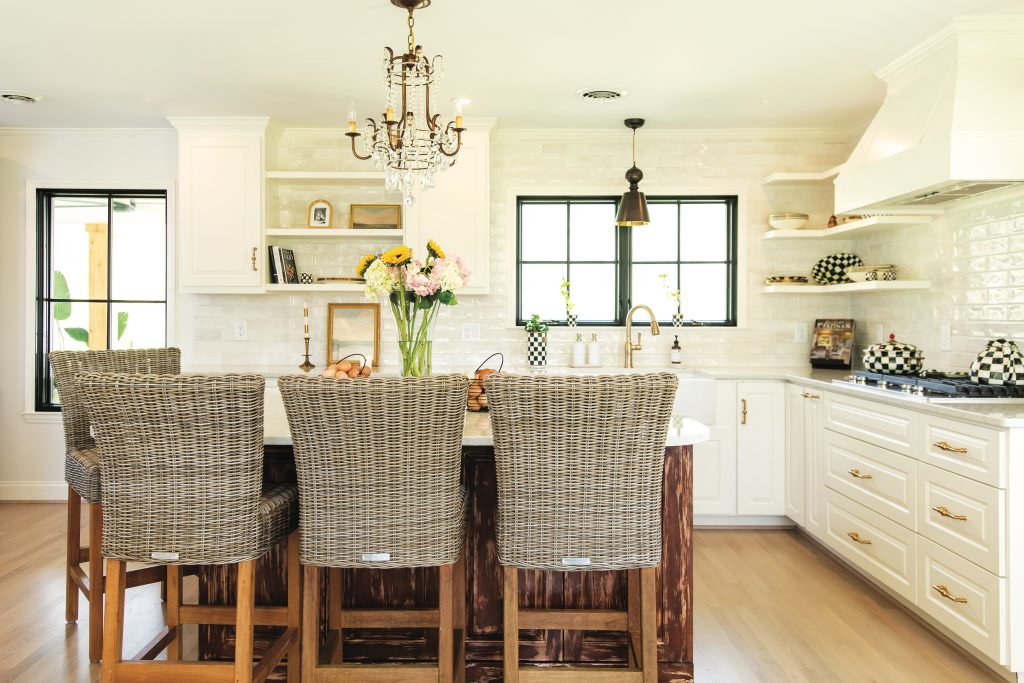
This once dilapidated and dark home is now light and bright, with French-European appeal. Above the new kitchen island hangs a stunning crystal chandelier she scored at Red Collection. In fact, much of her lighting, which she calls “jewelry for the house,” has come from there.
Whites, wood tones and gold embellishments carry throughout the home, but her kids’ spaces each have a splash of color: French blue in her son’s room and Sherwin-Williams Malted Milk, a soft and earthy pink, in her daughter’s room.
At less than a quarter of the size of the family’s former home, Ashlynn admits, “It’s a whole lifestyle change.”
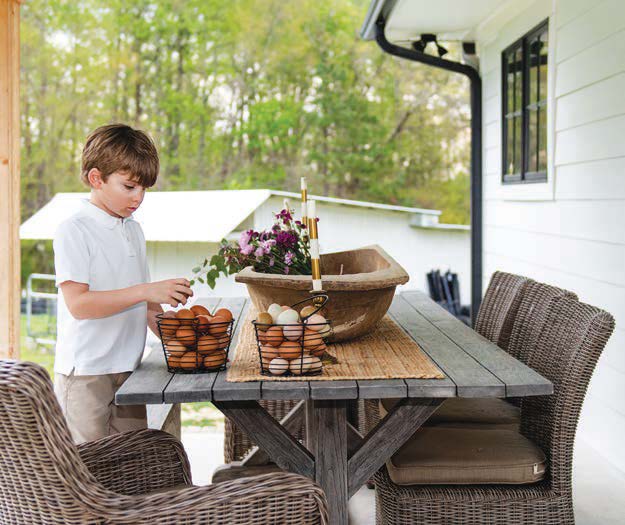
The space Ashlynn calls “the hangout area” features comfortable chairs the family can snuggle in to watch the sunrise while sheep graze on the back pasture. The sheep run to Ashlynn whenever they hear her nearby. In the front yard, chickens peck the ground near their mobile henhouse, which gets moved every day to different grass.
In the backyard, she imagines a stamped concrete patio and string lights swagged over tables and chairs. Beyond the patio, lush kitchen gardens. And she hopes to teach others how to implement regenerative practices in their own backyards by eventually leading workshops right there. After all, she notes, that’s the mission. Tupelo Honey Farms’ tagline is “nourishing the community while healing the land.”
Ashlynn, it seems, still doesn’t know any other speed but “go!” Since starting the farm, she’s also expanded into making nontoxic candles and tallow skincare, and creating floral arrangements using local flower farms’ stems. And, most recently, she opened a brick-and-mortar location on Bessemer Avenue in Fisher Park called Bloom & Nectar, a “farm-to-fork market and bloomery,” where customers can shop her products and meat as well as goods from other local farms.
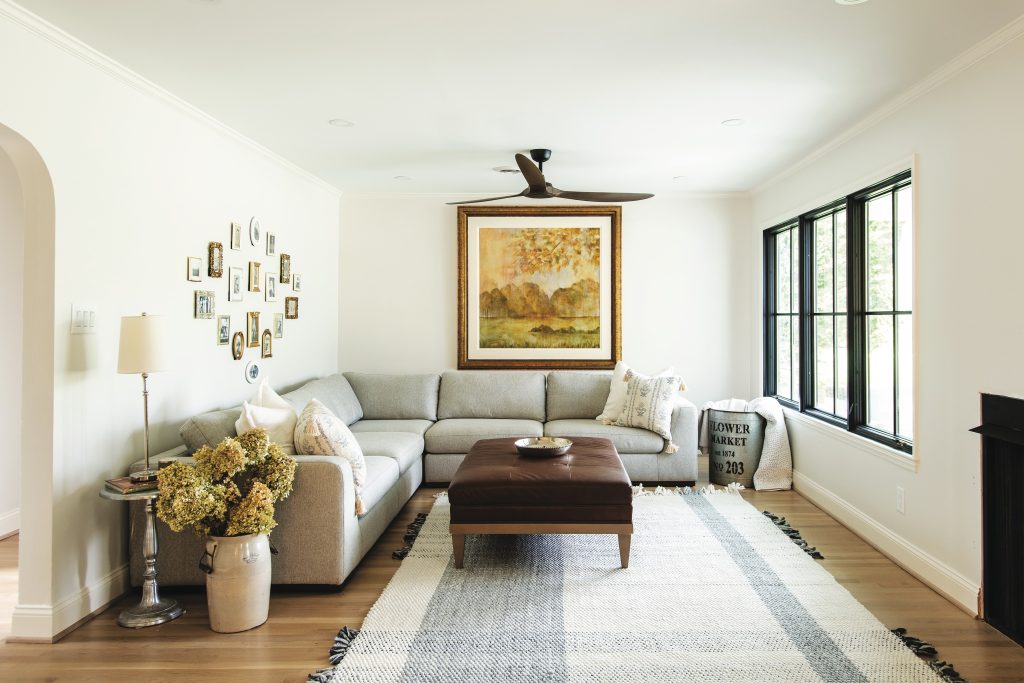
Standing in the living room where black-and-white family photos dating back through four generations hang, Ashlynn muses, “This is about a legacy, right?” They’re building on what her great-grandfather started. And doing it their way.
Looking out at the property toward the road, Ashlynn has a vision for what is yet to be. She pictures pecan trees lining the gravel lane. And, yes, she’d harvest their nuts. “And sell them. I would do it all.”
Of course, she quips, “My husband is like, ‘Woah, slow down!’”