
A More Beautiful Greensboro
The Greensboro Council of Garden Clubs continues planting for the future
By Ross Howell Jr. – Photographs by Lynn Donovan
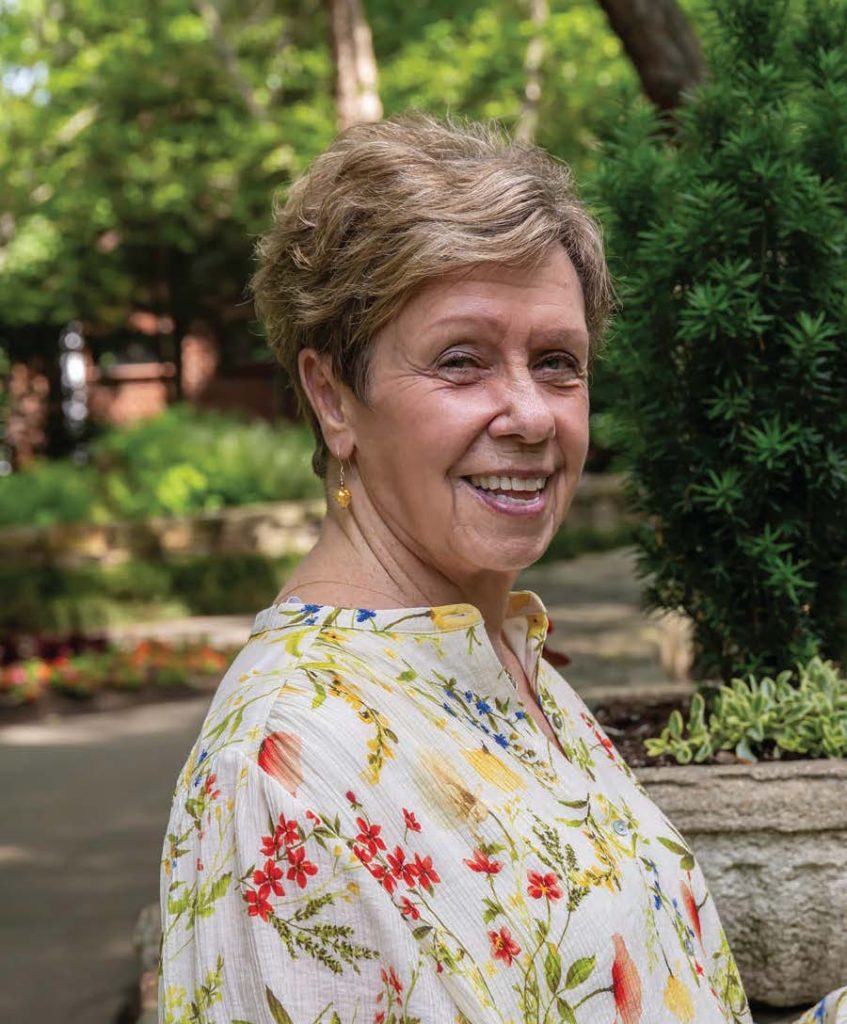
Gail Hill is proud that the Greensboro Council of Garden Clubs, where she now serves as a trustee, has been active in our community for 95 years. Not a bad run for a local civic group.
But because of changing family structure and lifestyles, Hill is concerned about its future.
Soft-spoken as Hill is, you’d probably never predict that she would have one day become president of the Garden Club of North Carolina.
But she did. And she’s played a key role in the GCGC’s longevity.
“I grew up on a tobacco farm in southern Guilford County,” Hill says.
Her grandmother “could poke a stick in the ground and it would grow,” she tells me. And her father inherited his mother’s green thumb.
“Dad was always out working in the garden, propagating some flower or other he’d started from seed,” she says.
While she enjoyed farm life, Hill spent enough time pulling suckers from tobacco plants to know that she didn’t want to marry a farmer.
So she married a businessman — her husband, Wayne, now retired. They moved around a good bit regionally for his career.
And Hill found herself becoming more involved in garden club leadership.
Back in 2005, Hill — along with the council historian and council secretary — compiled an award-winning history of the Greensboro Council of Garden Clubs to commemorate its 75th anniversary.
She was especially drawn to the history of the council, because her father — the man who’d inherited the green thumb — served in the U.S. Army Air Forces in WWII. He had been stationed where the Greensboro Council of Garden Clubs had been very active — the O.R.D. (Overseas Replacement Depot), where troops trained, awaiting orders to ship out to war.
While Hill was working on the council history, she was also serving as council president pro tem and director of District 5, the South Atlantic Region of the National Garden Clubs — comprising Kentucky, North Carolina, South Carolina, Virginia and West Virginia.
She was elected president of the Garden Club of North Carolina in 2015.
“I served two terms as president,” Hill says. “It was a lot of work and travel.”
Hill explains that, as president of the state garden club, she was responsible for eight geographical districts. Her duties included personal visits to each of those districts once a year.
Think of it. Our state comprises 100 counties reaching from the mountains to the sea.
“So I saw a lot of North Carolina,” Hill says with a wry smile. “But everywhere you went, the people were so enthusiastic.”
“It was wonderful,” she adds.
But times change.
In 1930, there were 11 neighborhood garden clubs that met together to create a citywide council with the objective of creating “A More Beautiful Greensboro.” While there are several neighborhood garden clubs today, there are just three clubs that participate in council meetings.
Hill believes that even neighborhood garden club memberships have fallen. The traditional model of afternoon meetings during the work week just isn’t practical. In most young families today, both husband and wife are often working, and if the couple have children, they must devote big chunks of time to their kids’ activities as well.
“We encourage young people just starting garden clubs to have meetings at night, have them on weekends,” Hill says.
These days, there are two types of fundraising programs that are the GCGC’s staples.
First, there are the ever-popular spring garden tours.
This May, the council’s “2025 Garden Tour” included home gardens in Irving Park, Fisher Park, Westerwood, Sunset Hills, Starmount Forest and Hamilton Forest, along with a tour of the hospice garden at Beacon Place on Summit Avenue.
“This fall, we’ll be finalizing our plans for the spring 2026 tour,” Hill says.
The second staple is a day of public educational seminars — one program in fall and one in spring — held at the Greensboro Science Center.
In March, the “Spring Gardening Seminar 2025” was held in the Sail Room at the Greensboro Science Center. Presentations included “Edible Landscapes” by Jeanne Aller, Master Gardener; “Flower Designs for Your Lifestyle” by Clark Goodin, owner and floral designer of Plants & Answers in Greensboro; and “Favorite NC Plants” by horticulturist Mike Trivette of Statesville.
Plans for the “Fall Gardening Seminar 2025” are currently underway.
Hill believes that educational opportunities hosted by the council are essential to the future of garden clubs.

“When we have these seminars, we have lots of young people come,” she says. “We can see that they love to plant and they love to grow flowers,” Hill adds. And often, she tells me, she signs up new members.
She reflects for a moment.
“A lot of us older members are just aging out,” Hill says.
“In the spring, my husband and I like to ride down Dogwood Drive to see the blossoms,” she continues. “And I think about the Greensboro Council and the Jaycees.”
Some of those trees were planted in 1954 during “Operation Dogwood,” a joint effort by the GCGC, the Jaycees and neighborhood garden clubs to plant 10,000 dogwoods throughout the city.
“Now the trees are too old,” Hill says. “We need to plant new seedlings.”
Then she smiles.
“The council is a wonderful organization,” Hill says. “It’s done itself proud.”
Greensboro Council of Garden Clubs
The lovely urban environment we take for granted has been shaped by years of dedication and selfless hours of service by generations of GCGC members. Noted here are a few of the markers in a timeline of achievement. Unmentioned are the sustaining funds provided to landmarks like Blandwood and the Greensboro Science Center; gifts to parks, gardens, schools and museums; and scholarships and community programs for young gardeners and gardeners who are young at heart.
1930 GCGC founded, Mrs. Charles (Anne) Hagan named president
1930-1932 First civic planting, Japanese cherry trees on E. Bessemer Avenue
1934-1935 Assisted development of Latham Park
1942 Called for “adequately housed farm produce market,” 12,000 people petition city
1943-1944 Gift to Red Cross for blood plasma at O.R.D. (overseas replacement depot)
1945 Planted 8,000 pansies on O.R.D. hospital grounds
1950 First home and garden tour
1954 “Operation Dogwood,” 10,000 dogwood seedlings planted in neighborhoods
1955 Planted 12 acres, Lindley Park Anniversary Garden (now Greensboro Arboretum)
1960 Planted Coliseum Memorial Court and purchased fountain
1967 Began sustained funding for City Beautiful (now Greensboro Beautiful)
1968 One of the founding sponsors of Greensboro Beautiful
1971 First Christmas tree display at Friendly Center auditorium
1971-1972 500 rose bushes planted in Anniversary Garden
1974 Major gift for creation of Bicentennial Garden
1980 Purchased sundial for Bicentennial Garden
1983 Major gift to Greensboro Beautiful for arboretum landscaping plans
2001 Construction and landscaping completed for GCGC building, Lawndale Drive
From “The Greenboro Council of Garden Clubs, Inc. History 1930-2005,” Gail Hill, president and Inez Ryals, historian.