Lessons in Husbandry
In Pleasant Garden, Drew and Lacey Grimm are perpetual students and teachers
By Cassie Bustamante • Photographs by John Gessner
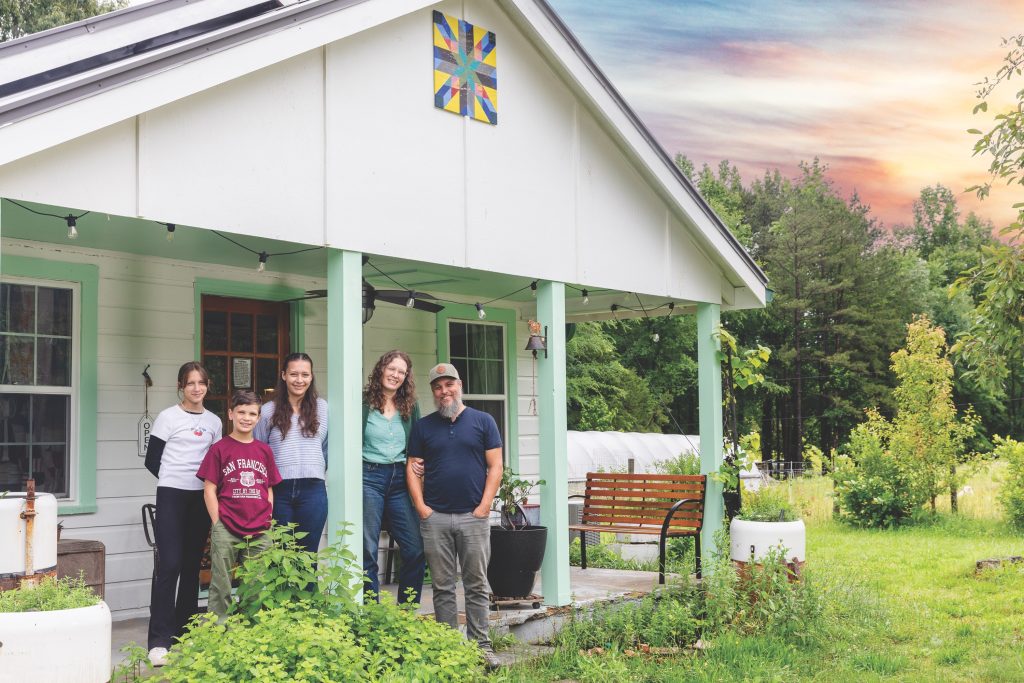
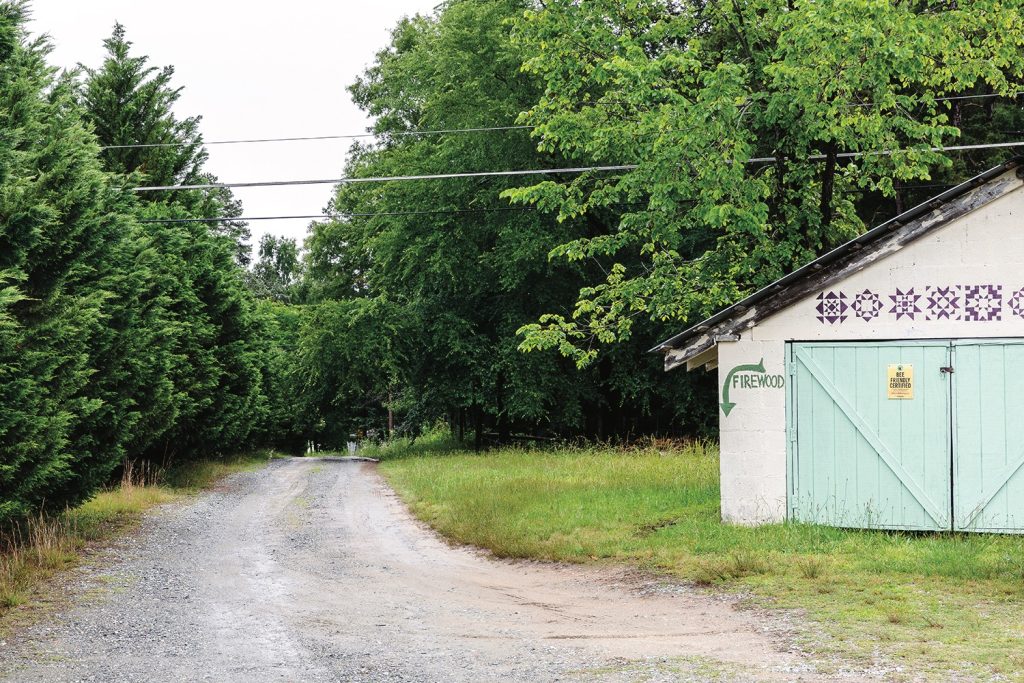
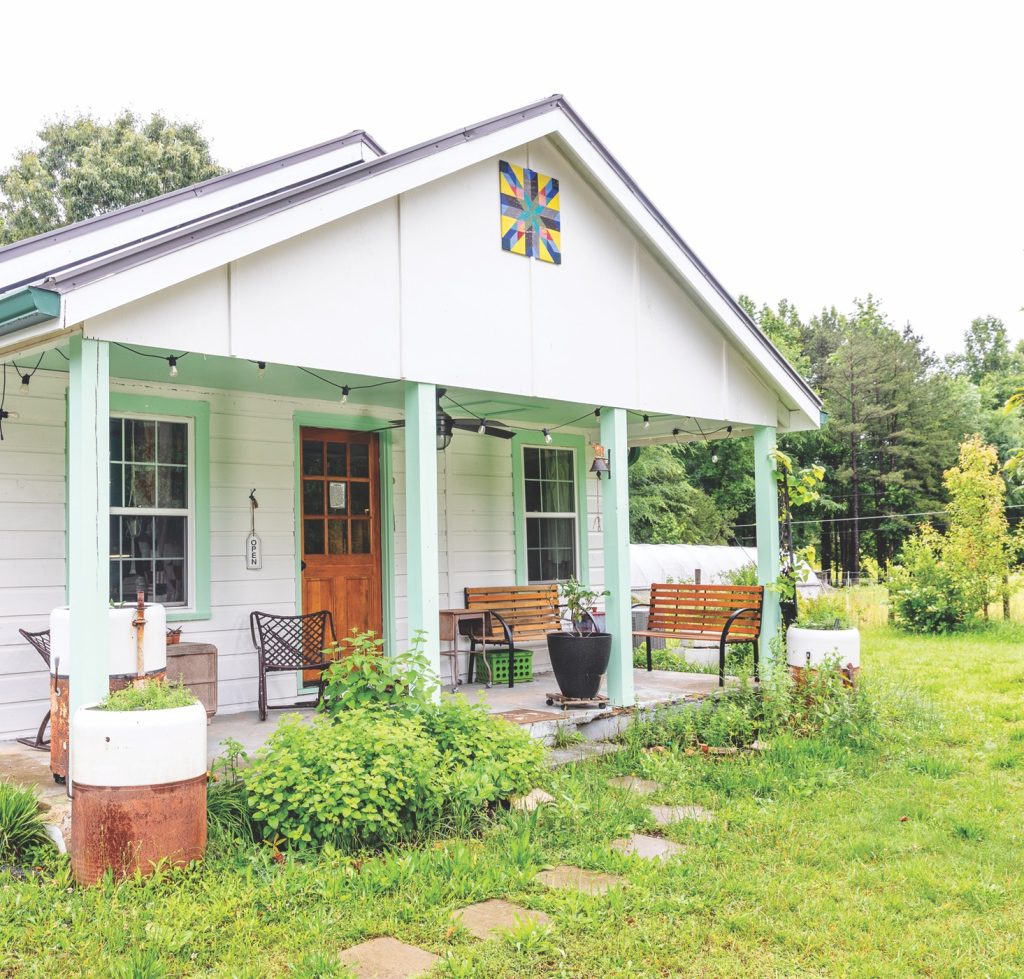
About a half-mile from Hagan-Stone Park sits “The Schoolhouse,” a rustic, tiny home with a vibrant barn quilt hanging above its front door. A vintage roadside marquee sign that has been lettered with “Happy” greets passing cars, its arrow pointing directly to the house. Upon entering, it’s easy to imagine something straight out of Little House on the Prairie — a blackboard at the back and benches where children would sit, lunch pails tucked under the seats. “If you don’t tell people it wasn’t a schoolhouse, they’d think it was,” says Lacey Grimm, who owns the property with her husband Drew.
Keep following the gravel drive past The Schoolhouse and you’ll reach the family homestead, where Drew and Lacey are raising and homeschooling their four children: Naomi, 20; Leviah, 16; Eliza, 14; and Abraham, 9. Drew and Lacey have been the kids’ educators from the start. In fact, when they first moved to Greensboro two decades ago, they began their first farmstead — a small, “urban farm” near Four Seasons Mall, where they had bees, chickens and a yard overtaken by garden. They called that little project “Schoolhouse Farm” because they were homeschooling, but also because Lacey had a blog called “Life Is a Schoolhouse,” where she imparted the lessons they’d learned through homesteading.
In 2012, seeking more land and farming opportunity, the family moved into their Pleasant Garden “foreclosure in the woods,” as Lacey calls it. Plus, she says, their family is Jewish and “a lot of the Jewish tradition is agricultural,” and much of their faith’s ancient approach to husbandry is rooted in sustainability. “You can’t do it if you don’t have a farm,” she notes. So, taking the Schoolhouse Farm name with them to the new place — a 10-acre plot with a ranch that needed a total overhaul — they dug in.
“It’s not what the dream was — the old farmhouse — but now that we have this,” says Lacey, waving her hand around The Schoolhouse, “it sort of scratches that itch.”
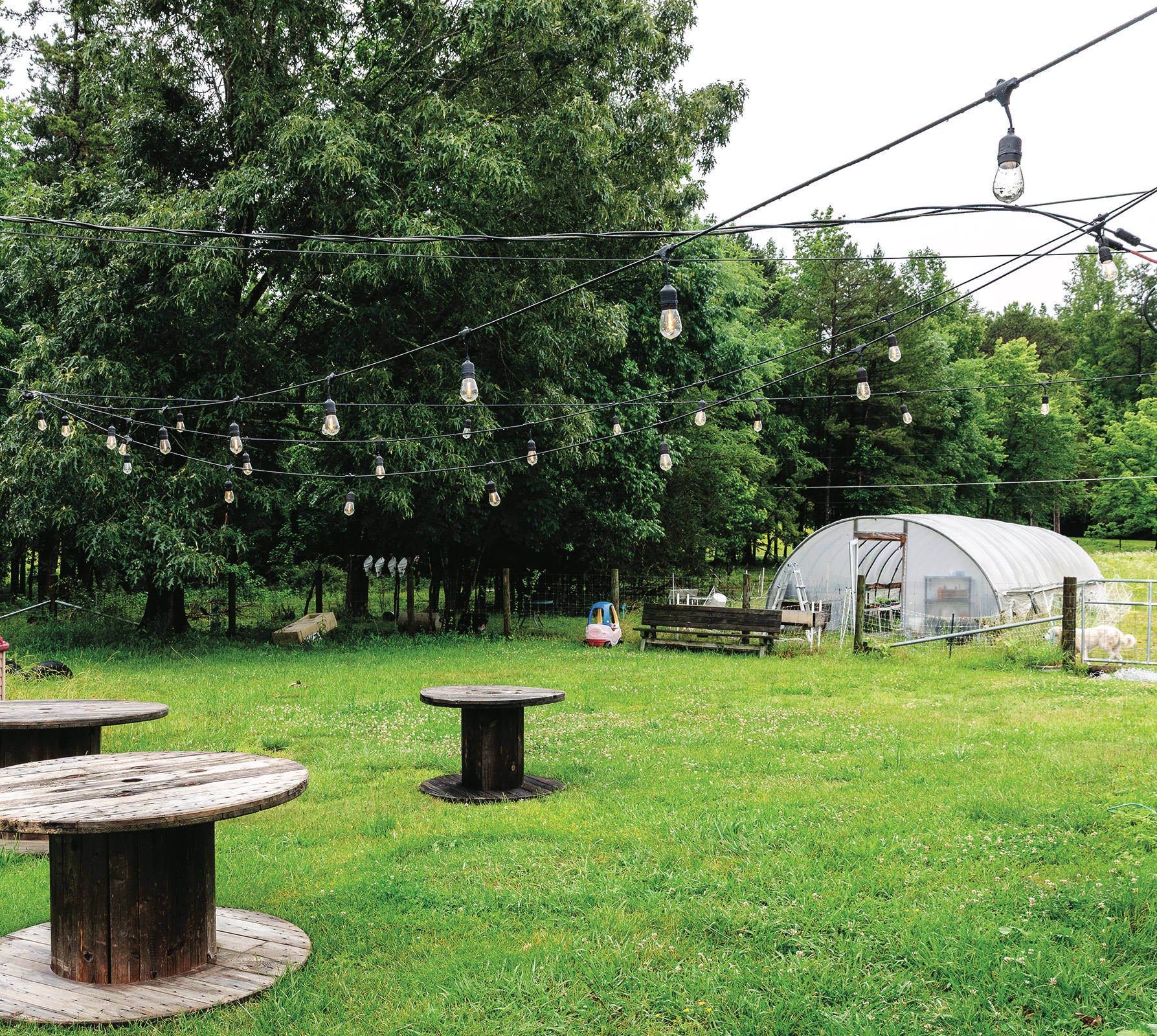
But don’t let the name fool you. What the Grimms have hatched is much more than a schoolhouse. And you won’t find reading, writing and arithmetic within these walls. Instead, you’ll find a place that this pair of homegrown, serial entrepreneurs cultivated with care, a hive of free enterprise built around their own fascination in modern homesteading and farming. The Schoolhouse, appropriately, has grown into a community space, where like-minded people congregate to learn about how the Grimm family is embodying the latest in the back-to-the-Earth movement.
“I feel like we’ve got a dream life compared to most people,” says Drew. “A lot of days, we don’t have to leave the homestead. We have everything.”
But this little one-room building on the ’stead wasn’t theirs for the itch-scratching until 2018. When they moved into their house, the 900-square-foot home and its surrounding 5 acres wasn’t on the market and was being rented. As luck would have it, a “For Sale” sign eventually went up. The Grimms imagined what they could do with that added acreage.

“Where are we going to come up with $100,000!” Lacey recalls wondering, their primary income coming from her sales of dōTERRA essential oils and related products. But within two days, the owner came down significantly on the price and, Lacey quips, “It turns out people will give you loans really easily on the internet.” Before they knew it, $50,000 cash was in their hands, enough to make the purchase. And, Drew notes, he’d just sold a business, so they’d be able to pay back the loan almost immediately without worrying about exorbitant interest rates.
As soon as their names were on the deed, the Grimms pushed up their sleeves and got to work. The home had seen better days. “I can’t believe anyone was living here,” says Lacey.
“We took it down to the dirt floors and rebuilt it,” says Drew, a baseball cap resting atop his long, gray-and-brown hair, his full beard a mix of the same. He sits in a wooden cricket chair that echoes the 1940s era of The Schoolhouse.
In the process of gutting the home, they learned a little about its history and ties to the land. Their next-door neighbor, an elderly gentleman well into his 80s now, regaled the couple with tales of the home’s construction. The lumber, he told them, was all sourced from trees on the property itself, and he and his father sawed, hammered and built it from the ground up. Of course, he also claims that when he was a small child, he was lowered down to dig the nearby well. “Like any good country man, I am not sure how much of it is tall tale,” Drew says, chuckling. “But it is kind of cool to have that connection to the house and to the land — and to the old guy!”
Knowing the building’s past, they set their eyes on the future, picturing a place where they could bring people together. “If we are going to have a community space, it’s got to be ‘The Schoolhouse,’” Drew recalls saying.
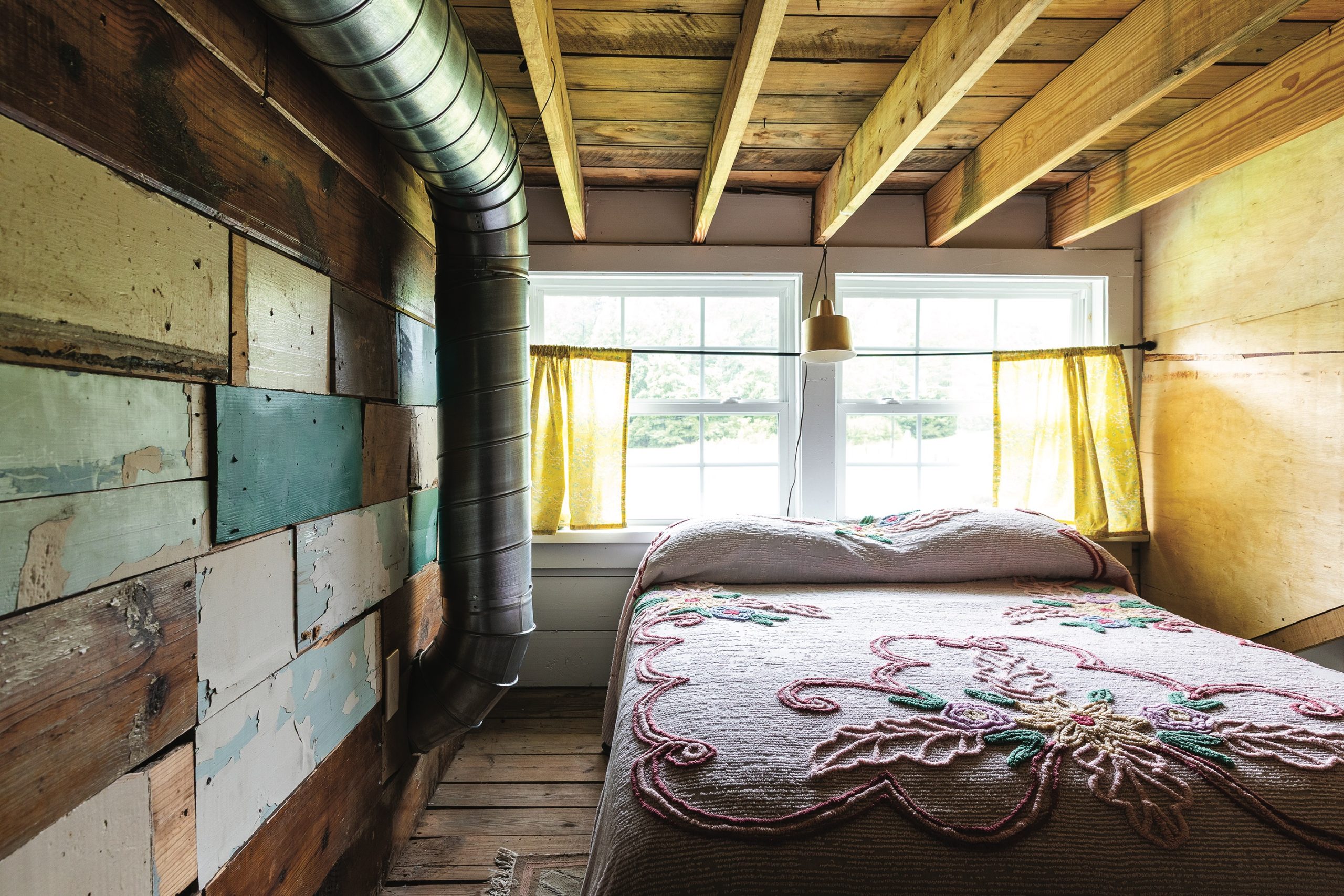
For Lacey, that meant getting down to the nitty-gritty details. She insisted Drew move the front door over, only about 3 feet, so it would be centered on the facade. The kitchen was rearranged so that the sink sat underneath a window, where sunlight streams in. The ceilings were torn down, exposing the original wood and beams, but a loft was added to create sleeping space.
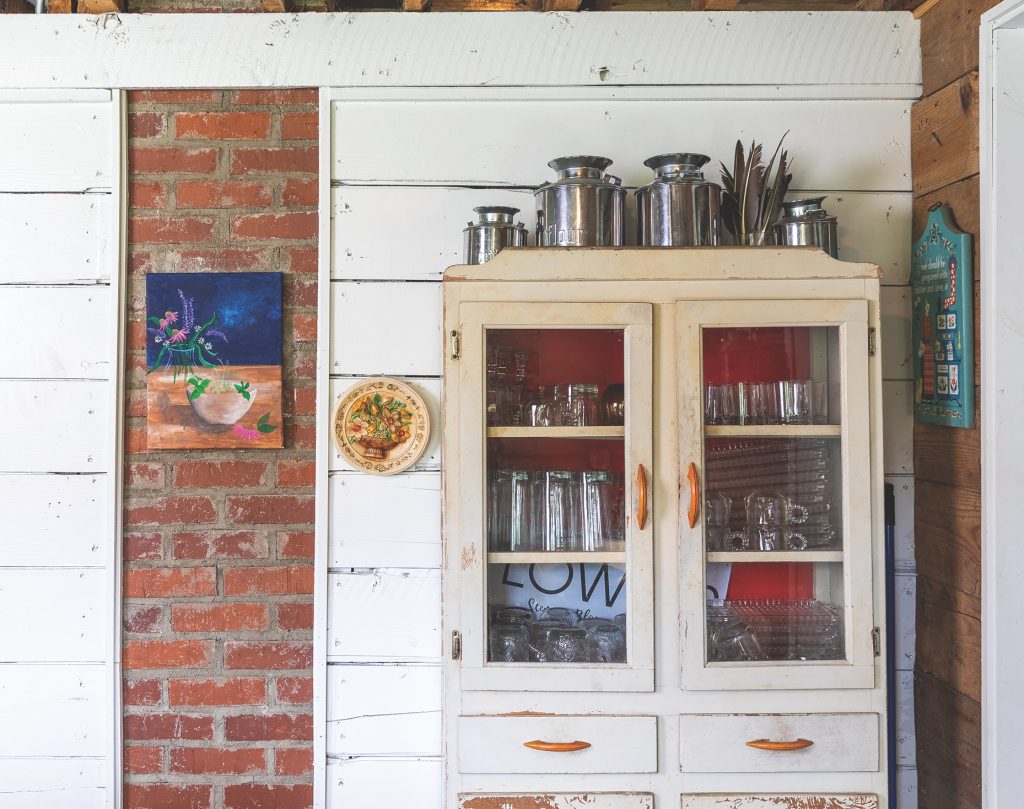
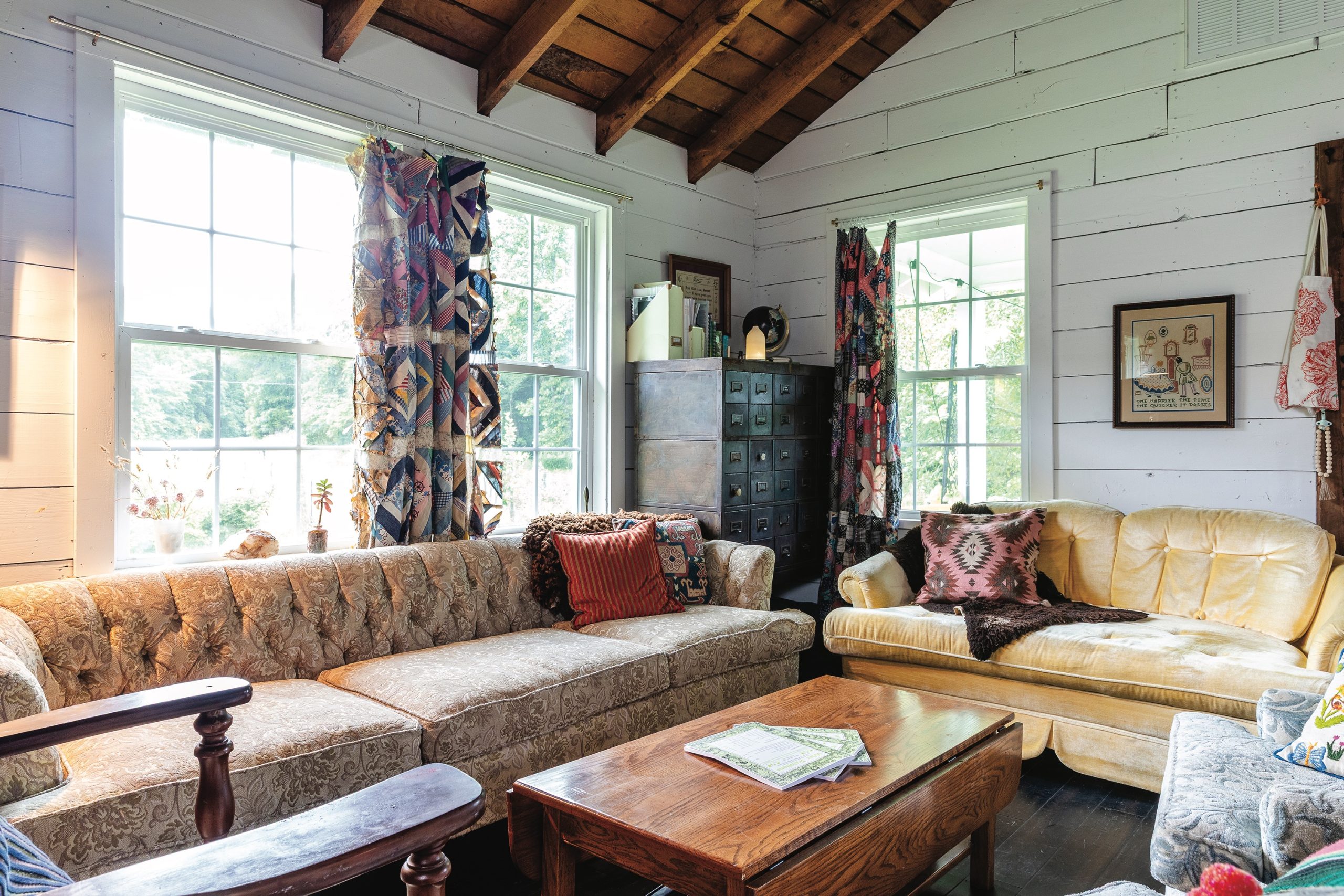
As for the decor? “She is a thrift master,” Drew says proudly of his wife. Nearby, Lacey, her sandy brown waves cascading past her shoulders, sinks onto a mustard-yellow, vintage velvet sofa. As it turns out, she helped her mom stock a vintage store before her kids were born and has an eye for pieces with history. The kitchen island? It came out of an N.C. State lab. The retro brown refrigerator, “Oh, it was just in our garage,” says Lacey.
Although Lacey claims she was just “hodgepodging together” The Schoolhouse furnishings, the overall look is cohesive and homey. Guests often tell her they feel as if they’ve been here before. “It’s a familiar feeling,” she says.
“I get a little choked up because it’s like, you know, you have a vision and it slowly, over time, becomes more than you could have expected it to,” says Lacey wistfully. “And now we have a schoolhouse.”
What was once barely livable is now a place of gathering, community and education. Lacey points to a painting on the wall. She decoarated the canvas in a recent workshop she cohosted here with artist Rebecca Dudley, who owns Triad Mobile Art Academy. The participants painted flowering medicinal herbs while also learning about them from Lacey and noshing on local wines and cheeses. The Grimms have also hosted a tasting with a local chocolatier as well as a four-course, farm-to-table Valentine’s dining experience led by their friend and chef Steve Hollingsworth.
“For the food club group, we had a trout dinner,” adds Drew, where Ty Walker, owner of Smoke in Chimneys, a sustainable fish hatchery in Southwest Virginia, cooked trout three ways.
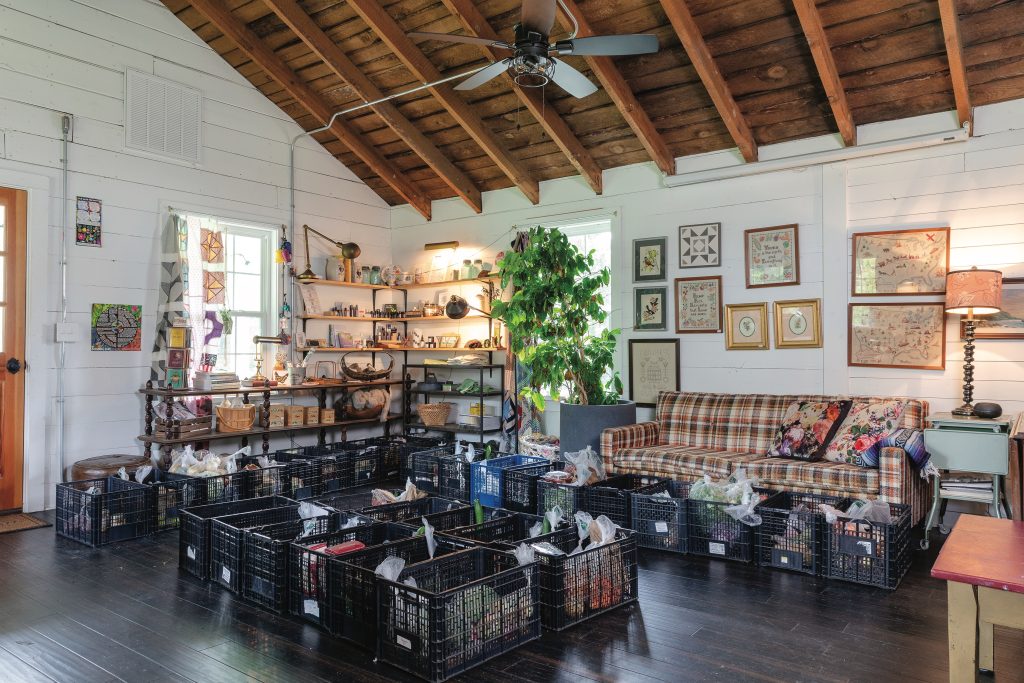
Food club? Lacey explains that The Schoolhouse food club, which they call ComFoo for “community food,” is “sort of like a Costco situation.” Members order goods curated by the Grimms from farmers, keeping it as local as possible, including tough-to-find-so-close goods such as Cape Hatteras salt and rice from Wilmington.

Once every other week, food club orders are ready for pickup and The Schoolhouse bustles with life. Their members, Lacey says, have all gotten to know each other. They come for the food, but stay for the conversation and connection. And, each time, the Grimms welcome one or two producers to offer samples and education about their goods.
“We’ve always been passionate about the teaching aspect,” says Drew. Drew, Lacey notes proudly, recently became certified by the Savory Institute as a regenerative agriculture educator. With this under his belt, he’s able to help others make their own pastures more productive while remaining sustainable.
Plus, Lacey notes with a laugh, others can learn by “skipping some expensive mistakes” they’ve made. Mistakes such as goats.
On their original 10 acres, excited to try their hand at livestock, the Grimms brought in goats. Do they still have those goats. “No!” They answer emphatically and in unison. Goats, the Houdini of livestock, often hop fences and escape. Or, notes Lacey, their goats would get stuck in the fence multiple times in one day and they’d spend their time untangling horns and hooves.
They said goodbye to goats and brought in sheep next. “And we didn’t even have a dog, so we were just human herding these sheep,” Lacey says. That, too, got to be too much for them. Step one, she notes, is getting a sheepdog, which they’ve since done. “Maybe we will get more sheep eventually,” she muses.
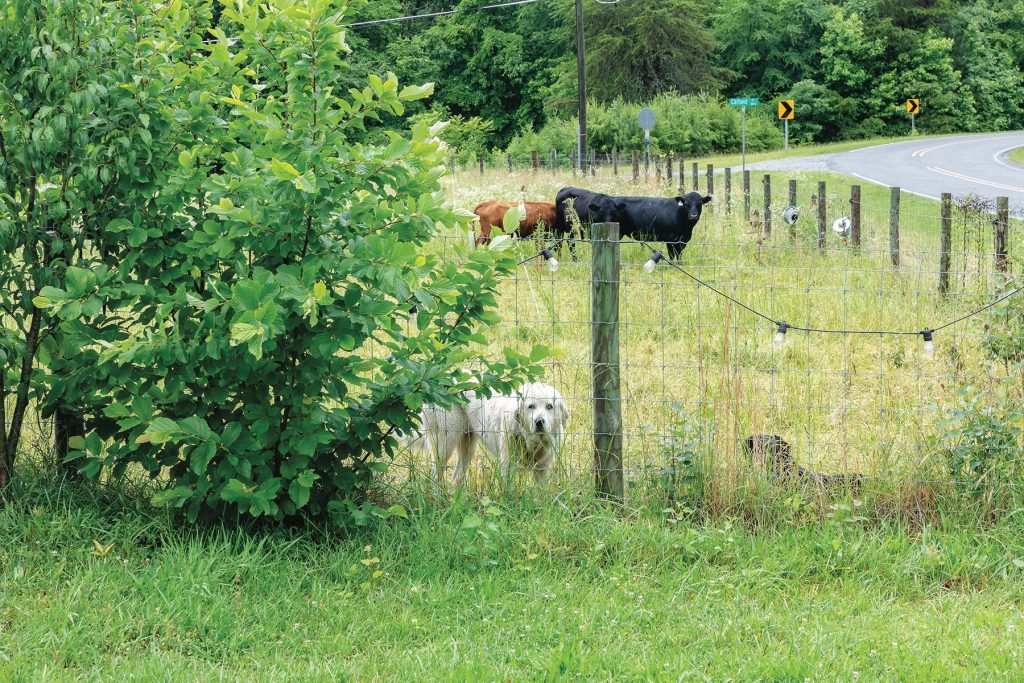
The Grimms finally landed on cows and own two breeds: Dexter, a small variety, which Lacey feels is safer around kids; and Swiss Linebacker, a heritage dairy breed. Comparing the bovine’s disposition to their previous livestock, Lacey says, “Their vibe is just much slower and more easygoing.” Currently, the couple has five cows “and two on the way, any day now!”
With cows being the endgame livestock for them, Drew is currently in training to become a shochet, a Jewish butcher who has been specially trained and licensed to slaughter animals and birds in accordance with the laws of shechita and can certify kosher meats. His hope? “To be able to provide the Jewish community with sustainable, high-quality food.”
Still, educating others in their ways of life remains their focus. A nursery, says Lacey, “feels like a good idea to me.” Would she sell her plants? Absolutely, but they’d come with a side of education.
“She wants to talk,” adds Drew, grinning widely. “She’s a plant lady.”
“I can’t just sell you a plant,” says Lacey. “Come here and I will tell you all about this plant.”
Her light blue eyes glint as a memory crosses her mind. “Have you ever been to John C. Campbell Folk School?” she wonders aloud. “I went for basket weaving and I just fawn over the catalog every time it comes,” Lacey says. “So I would just love to have a space where that is happening all the time — like classes and workshops.”
As for if and when that will come to fruition? Lacey says that with young ones still at home, she’s in no hurry. “There is space for that down the road,” she says. And she could mean that quite literally.