KUYATHI
Kuyathi
A potter spins her story in a backyard studio
By Cassie Bustamante
Photography by Amy Freeman
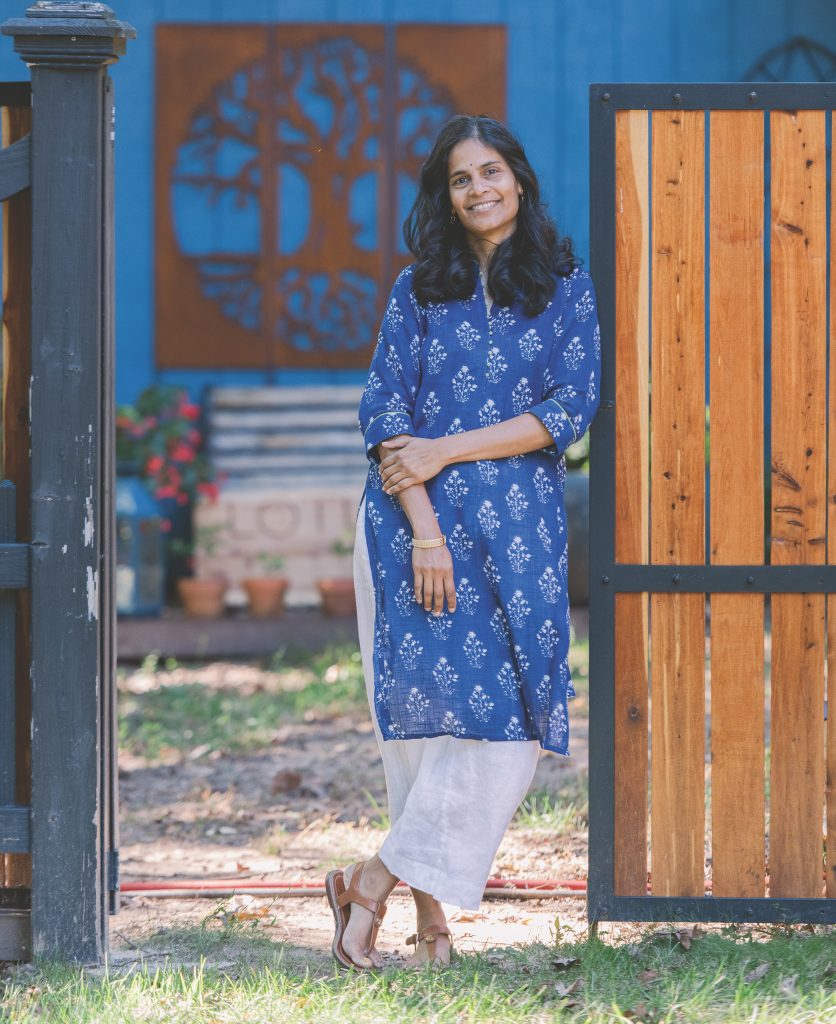
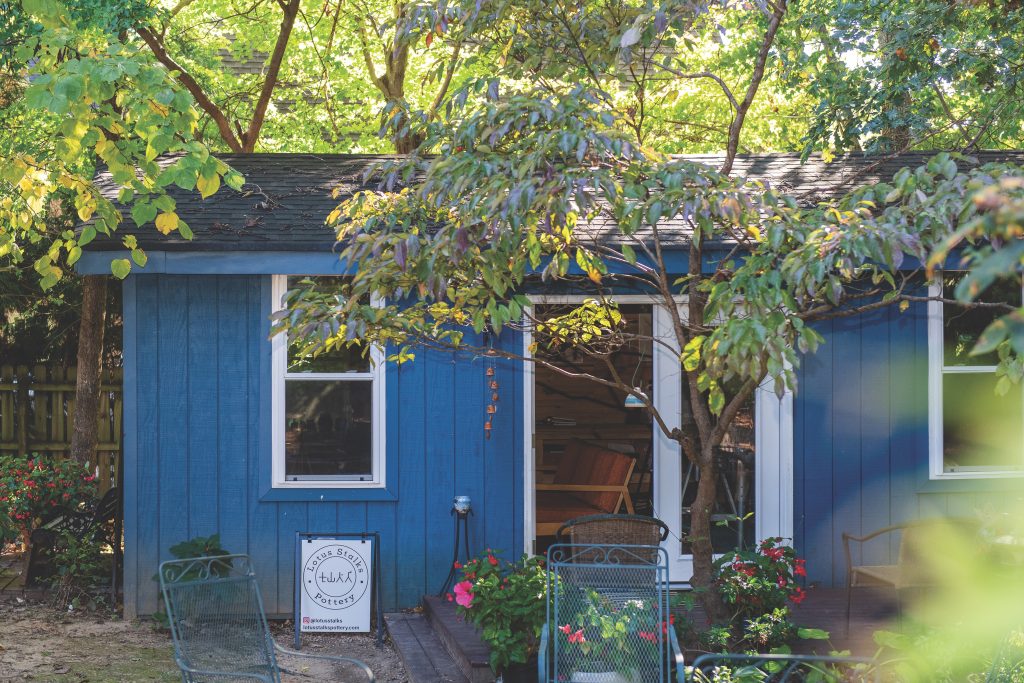
Mrunalini Ranganathan sits on a rust-orange loveseat in her backyard pottery studio, where golden afternoon sunlight casts tree-shaped shadows onto its blue exterior. Her name, she notes, is difficult for American English speakers to pronounce, so she often tells people to simply call her Miru. Her native Indian language derives from one of the longest surviving classical languages in the world, Tamil, which she uses in the center of her Lotus Stalks Pottery logo. “The four letters in the middle, they spell out ‘kuyathi,’” says Miru, “and I am so proud that I come from a civilization that had a word to say ‘female potter.’”
And the name Lotus Stalks Pottery? That comes from her own name. “Mrunal is one stalk. Mrunalini makes it plural, meaning a bunch of lotus stalks,” she explains.
While “kuyathi” has ancient origins, Miru, 49, has only been behind the pottery wheel for 13 years. Glancing around her studio, its shelves lined with stunning and intricately detailed earthenware, you wouldn’t know it. Born in Southern India where the highly structured class system regulates who can do what, she never imagined she’d ever have the opportunity to dip her hands into wet clay, let alone become a potter. “I don’t belong to the potter family,” she notes, “and in India, as you know, the caste system is so well defined. Sadly, you look down upon [potters].”
Her parents were both highly educated, as was her sister, who’s 14 years her senior and the one who came up with the name Mrunalini. Miru followed suit, never questioning her place and eventually working in the field of science as a lab manager and research biologist. “You go into school, you finish your schooling, then you go into college, become a professional of some sort,” says Miru. “If you’re a woman, of course, get married, have children and that’s it — your life is done.”
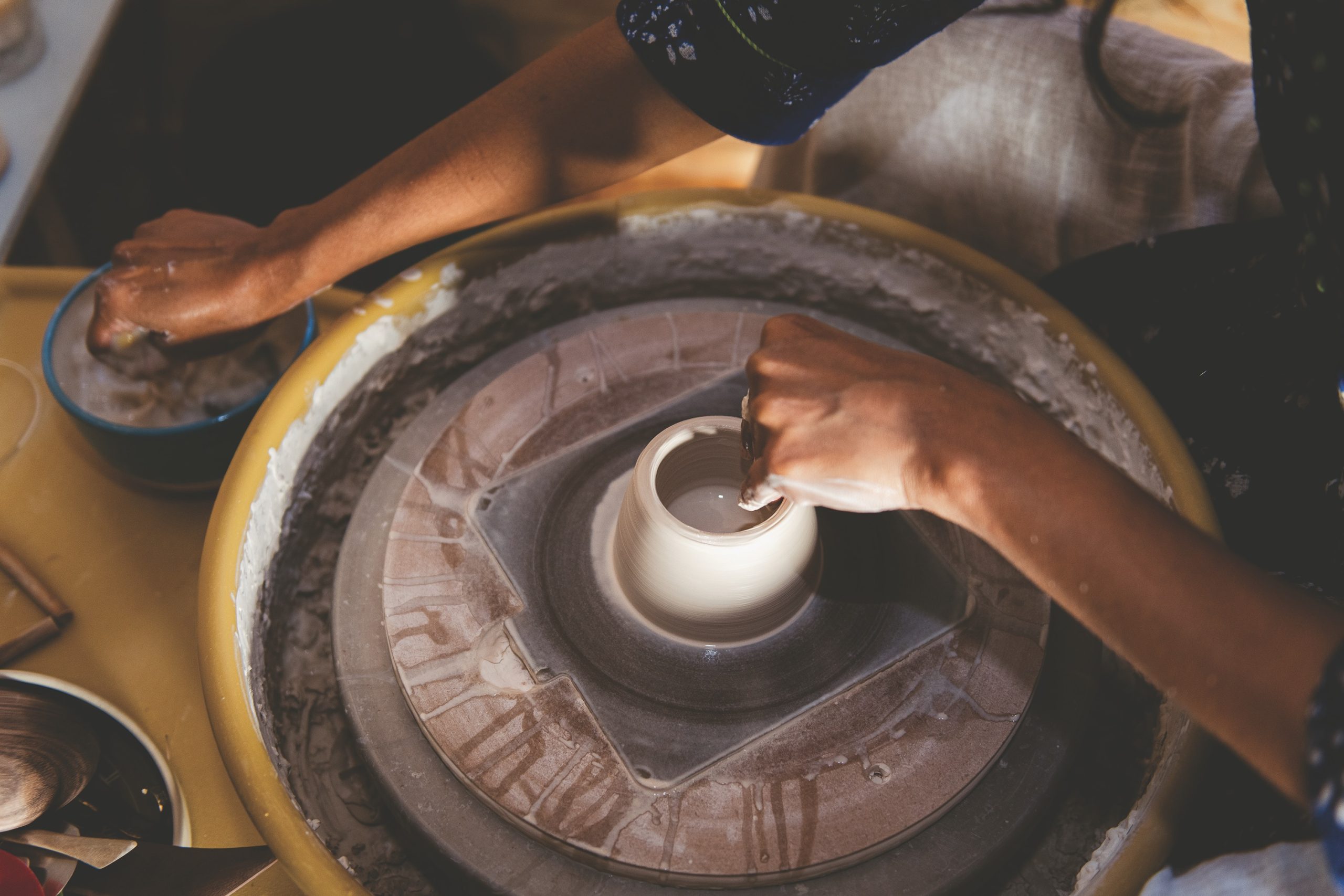
Even though it felt out of reach, she recalls, “I was always fascinated by the potter’s wheel.” In India, it is wooden and as large as as a bull cart wheel, with spokes and a hole in the outer rim. The potter inserts a big stick to spin it as fast as possible, then throws the clay and yields two pots before it’s slowed to a stop. “I would be like, oh . . . my . . . God.”
While becoming an artist wasn’t their wish for their daughter, Miru’s parents nurtured her interest and enrolled her in art classes from third to fifth grade, only stopping when her father retired and the family relocated. Her mother also influenced her interest in gardening, which is evident in the natural oasis surrounding her studio. “I was always following her around and around the house, talking to flowers and buds and wondering who was going to open up tomorrow,” she recalls. In fact, she often scratched her creative itch by pressing flowers and making greeting cards.
Eventually, art fell to the wayside as Miru followed the expected path. She holds a master’s in biology from Duquesne University, is married to an infectious disease doctor, Balaji Desai, and has two children. Mahinda graduated from Grimsley earlier this year, where he was on the drum line, and just started his first year at the University of Washington in Seattle. Sanga is in her sophomore year at Grimsley and plays on the girls varsity soccer team.

But before calling the Triad home, the family bounced around — from Balaji’s residency at the University of Pittsburgh Medical Center to his fellowship at SUNY Upstate Medical University. “The cold north,” Miru quips of Syracuse, N.Y. “People are cold, the place is cold.” It was a stark difference to the hottest part of India. Plus, throughout her husband’s career development — residency, fellowship, preparing for his four United States Medical Licensing Examinations (USMLE), submitting applications and going through rounds of interviews — Miru continued working to support the young family. “It was a lot,” she says.
After two years in Syracuse, Balaji was ready to pursue work with a practice and settle. The family had one major requirement for their future hometown: The sunshine had to be plentiful. Thankfully, Balaji landed with a practice in Danville, Va. Narrowing their search to within a 45-minute radius of Balaji’s new job, the family discovered Greensboro, which featured another checklist item, a Montessori school. The Gate City, she notes, “took us by surprise.”
In September 2012, after eight moves since immigrating to the U.S., the family finally put down roots in a brick, traditional home in Summerfield. Miru, done, at last, with what she calls a “rat race,” was able to catch her breath. “I suddenly felt like, now I really can step into what I have been missing in this life,” she says.
And that was art — to be exact, an art form that dates back to at least 28,000 B.C. “Clay is probably the oldest material that was used by humankind across the globe and still is relevant,” Miru muses. “How many things can you say that about?”
She registered for her first pottery class in October 2012, an evening class at Art Alliance. Turns out, mornings were better for her family’s lifestyle and she soon swapped to a Thursday morning class, where she found more than clay and creativity — she found community. To this day, her Thursday morning crew remains a circle of friends. “It’s like an alma mater for me, Art Alliance.”
Her first teacher, L.T. Hoisington, who has been an Art Alliance instructor for almost 20 years, is one of the most gentle souls she’s encountered. Plus, she notes, he is the only person of non-Indian origin who calls her by her first name, challenging because of the way the “R” rolls and is immediately followed by a cupped-tongue “U” sound. “He took time to practice it.” She also studied under Leanne Pizio, known locally for her vibrant, folk-art style pieces.
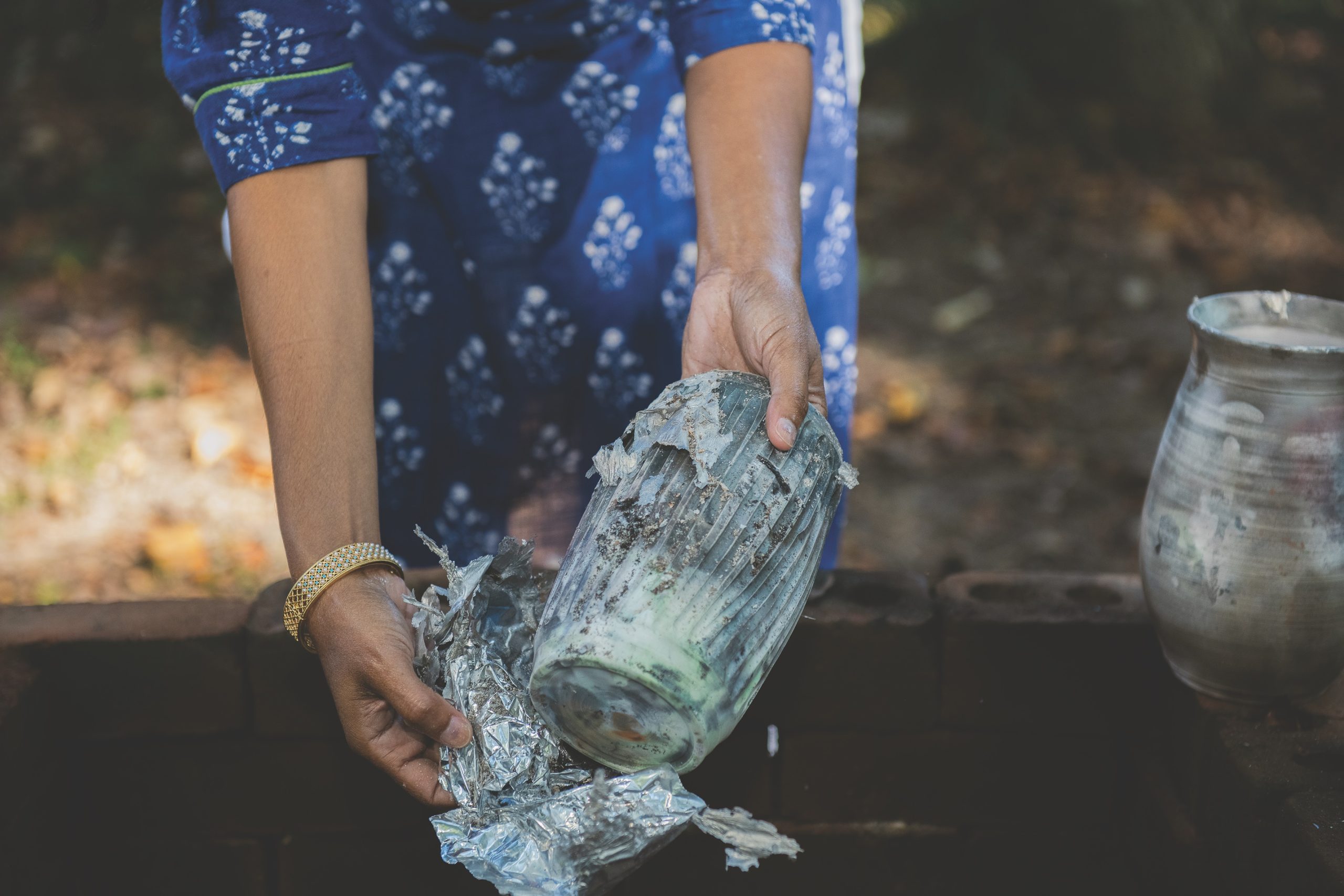
An Art Alliance comrade — “Fireman Bob, that’s what we called him” — taught Miru how to fire pots at home over a fire pit. His nickname, she notes, comes from his job as a fireman, not his technique. As soon as he demonstrated his process, she knew, “I have found what talks to me.” Now, a couple of metal barrels dot her own backyard.
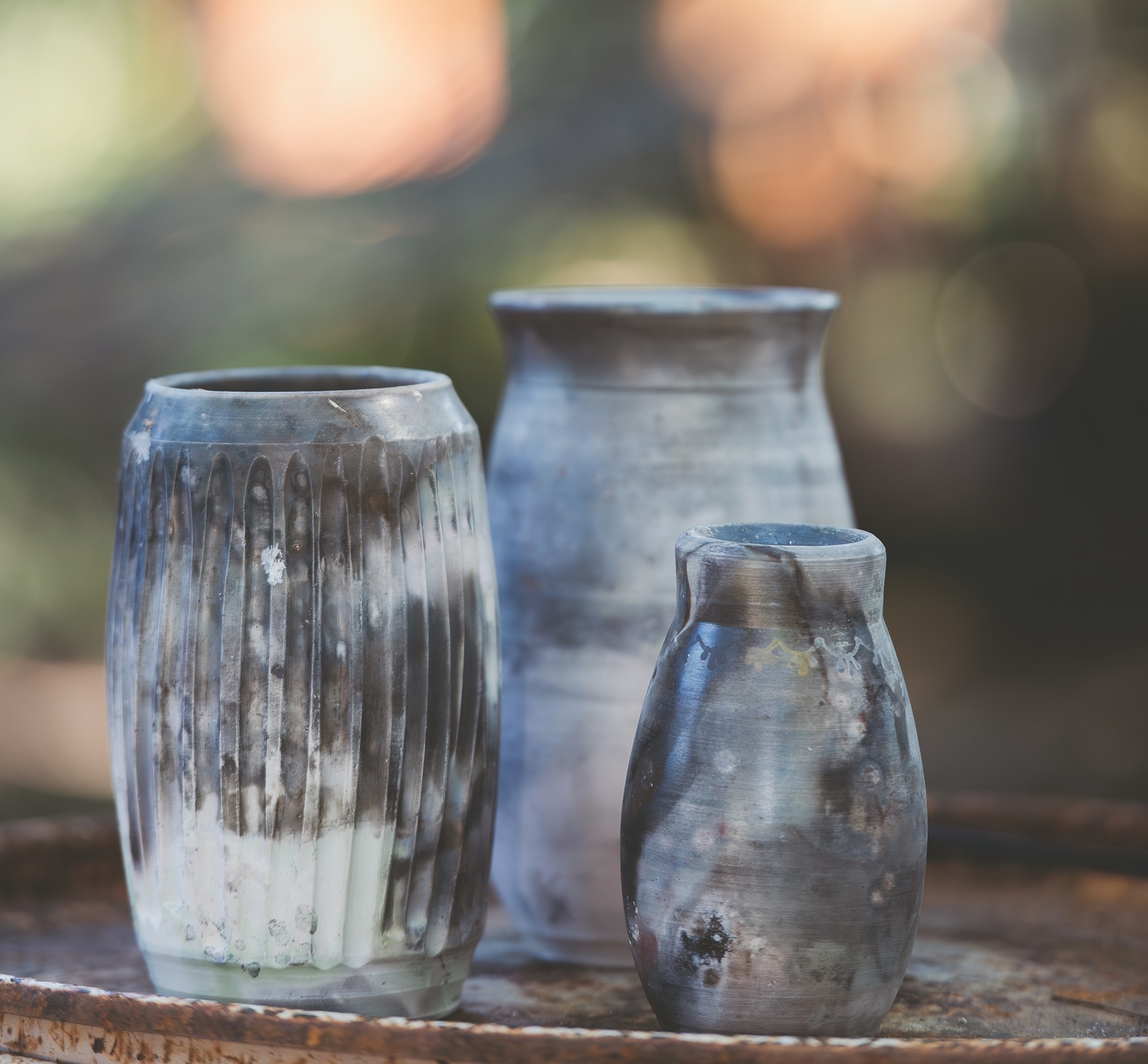
On the shelves inside her studio sit the very pots she fired that day, which she’ll never sell. “They are so near and dear to me.” The pit-firing process is a delicate balance compared to the kiln and Miru says of all the pieces she puts over an open flame, about 70% survive. The finished look is worth the risk, earthy and unique, mottled in dark, ashen colors.
Seeing his wife blossom in her newfound passion, Balaji had been persistently asking if she wanted her own wheel, almost from the beginning. Her response never changed: “No, not yet. I don’t think I can throw well enough.”
Four years in, he stopped asking, surprising her with her own wheel. The family added a small, backyard shed to house it, which allowed her to shape and prepare pieces for firing right at home.
But the real turning point came in 2018, when Art Alliance launched a short-lived independent study program. An artist was given a time frame, a mentor and a material budget to focus on a singular concept. Miru had recently discovered terra sigillata, a thin, clay solution not to be confused with glaze, and centered her independent study around it. Patrick Rowe, “a kind-hearted, genuine human who wants you to succeed,” served as her mentor. That four-month program gave her the confidence to set off in her own artistic direction.
Her second surprise came in December 2019 when Balaji gave his wife a kiln for Christmas. She recalls squealing with joy, but it was short lived because, two days later, her father suffered a heart attack. Miru rushed to India, but didn’t make it in time to say good-bye. When she returned home, the kiln sat in their garage while she sat on the couch. “I would be blank,” she says.

She gave herself time to grieve and process her loss, slowly tiptoeing her way back to clay at home rather than in a class setting, skipping out on registering for the first time in seven years. And, of course, that spring, COVID happened. That kiln she’d gotten for Christmas made its way to the small backyard shed, where she put it to use beginning in the summer of 2020. “I would have gone crazy otherwise,” she quips.
Clay has become the antidote to nights “when I can’t sleep — perimenopause!” That’s when she fantasizes about her pottery, creating pieces in her mind before she gets to the wheel. “Sometimes it works, sometimes there is something else going on inside my head and the energy that is flowing through my hands is like, mmm-nnnn, not going to work there.”
Other things can go wrong, too. But, she says, “I have learned to take failures as learning experiences to better that process and see if I can make something even better.”
Case in point, Balaji put in a request for a bird bath — a large bird bath. After all, the couple enjoys backyard birdwatching and gardening. It took Miru a week just to cut all of the pieces. When it came time to flip it, she needed her husband’s help, but before she could get out the words, “Don’t do it like this,” he did it just like that, and, crrrrrrrrck.
Now the pieces sit in a large bucket, waiting.
With her kiln and new-found techniques, it wasn’t long before her backyard shed began to feel a little cramped. COVID still rampant, the couple decided to hire immigrant workers, who, she says, “were having a very tough time,” to frame the skeleton of what now serves as her studio. It sits adjacent to the original shed, where her kiln remains.
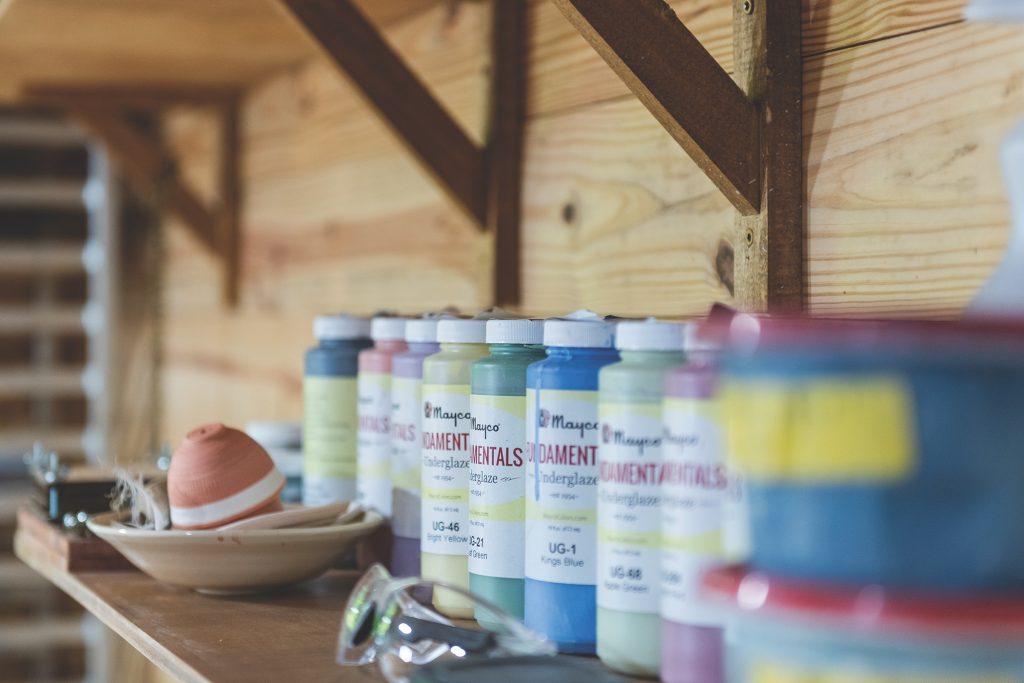
Once the studio’s shell was in place, the family of four worked together when they had spare time, installing flooring, shiplap walls, a wooden ceiling and shelving, and, of course, painting the blue exterior. From start to finish, it took them two-and-a-half years, working around the kids’ practice schedules and work schedules.
Miru sourced every part of her studio with the intention of keeping it as local as possible. Antique porcelain lampshades that hang pendant-style from the ceiling were collected over time and taken to a local craftsman, who sandblasted and painted them. The planks used for the ceiling and walls still emit the soft, earthy scent of pine. “This is not Home Depot or Lowe’s,” Miru says, waving her hand toward her walls. “This is from two guys who sell lumber that is discarded because it’s crooked or not up to the mark or something.”
On one wall, framed winter woodland photos of wild animals stand out in snowy contrast against the warmth of knotty pine. “All from Yellowstone,” says Miru. Turns out the motor home parked in their driveway rolls out west almost every year. “We’re avid Yellowstoners,” she says.
The photographer? Balaji. “He has an eye, I should say,” Miru says proudly of her husband. “You might think I am the artistic kind, but I stop with the surface of the clay.”
In fact, Balaji is responsible for the studio design. He’s selected the furnishings and decor, including a blue, vintage typewriter and a couple old, metal-and-wood schoolhouse chairs. He even artfully arranges Miru’s pottery to show off her collections to shoppers.
When Miru has peddled her wares at local art shows, such as ArtStock and Art in the Arboretum, Balaji has been the one to curate her setup. But, she notes, it’s a family affair. “It takes the whole village” when it comes to packing, unpacking, popping up a tent and manning the booth all day.
While she has plans to participate in this month’s Made 4 Market at the Greensboro Farmers Curb Market and Creative Clay Works at Revolution Mill, she says that doing shows has become “an energy sucker.” She’s more than happy to open her backyard studio doors and welcome people to “just come over, take a look, feel it, pick it up, look at it, fall in love.” Earlier this year, she even hosted her very first Mother’s Day sale.
Since stepping into that first Art Alliance class, much has changed. She’s grown much more confident, but admits that self doubt can still creep in at times. When it does, she reminds herself to trust her instincts: “Make it for yourself,” she tells herself. “You’re not doing this for others.”
And she’s shifted away from taking classes. “Maybe one or two workshops with certain potters, but, other than that, it has just been me practicing and trying to bring out my own style.”
These days, her pottery is the culmination of everything she’s learned as well as where she comes from, combining kiln firing, terra sigillata, pit firing and, often times, a slip-trailed pattern.
“What makes me the happiest is adding texture,” she says, dressed in a deep indigo block-print dress, flecked in a raspberry-colored pattern that mimics the designs she meticulously creates by hand. The slip-trail process itself can take hours, coaxing cream-cheese-consistency clay out of a squeeze bottle’s tiny tip. The lengthy process reminds her of the ancient Indian art of henna, still used today.
But clay has taught her patience. She’s learned to go with the flow. “Don’t control it — let it control you.” And don’t ever sit at your wheel frustrated. “Don’t put that energy into your clay. Then it won’t work for you — you’re making it sad.”