
LIFE'S FUNNY
My Two Cents
The changing nature of cool
By Maria Johnson
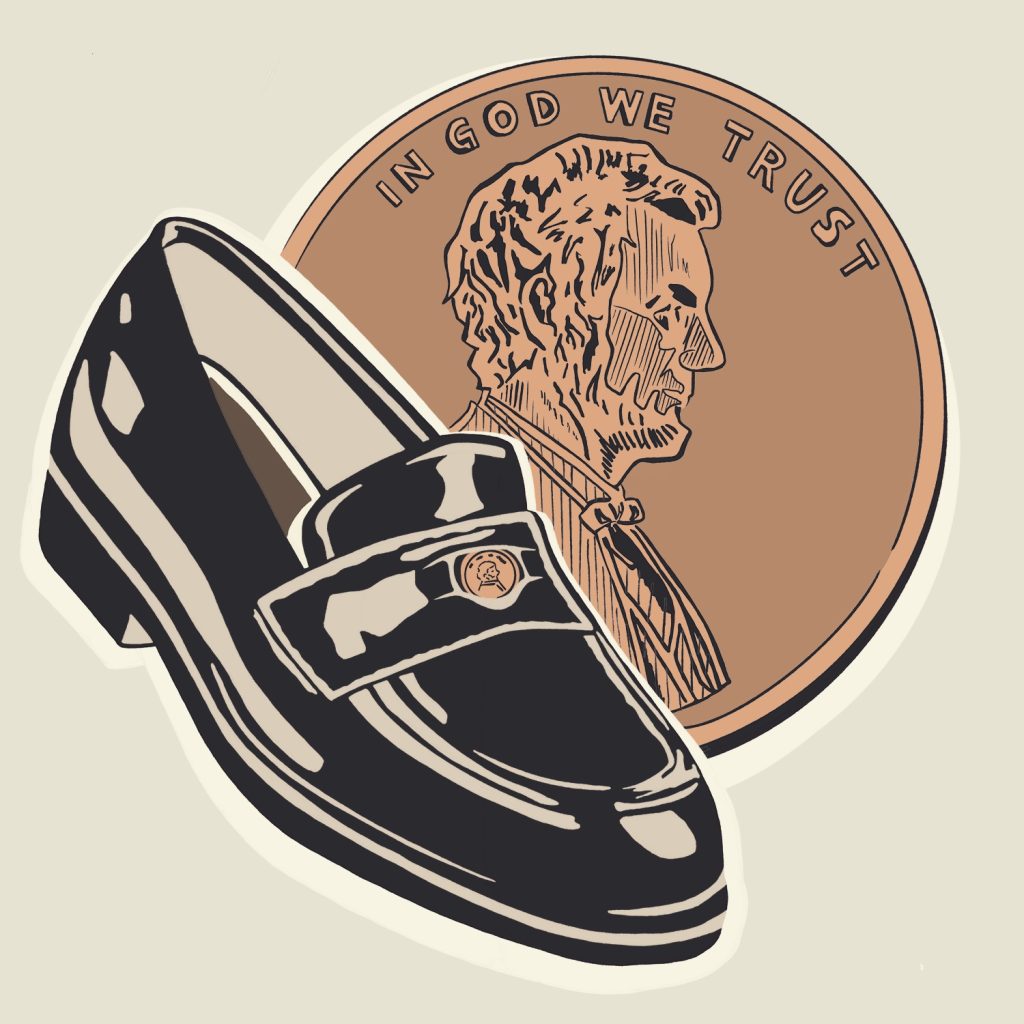
I really wanted those penny loafers.
They were displayed near the oxfords in the children’s shoe store where my mom took us for “good shoes” when I was growing up.
The place smelled like new leather and Sunday school. Stiff and uncomfortable, in both cases.
Which brings us back to the loafers.
I had flat feet, and someone — maybe my mom, maybe a doctor — decided that I needed to wear “orthopedic shoes,” which meant lace-up oxfords with built-in arch support.
They might as well have said, “Shoes that are ugly as all get-out, not to mention uncool,” because they were both.
I was around kindergarten age, old enough to have a budding idea of what was considered desirable outside of my family. Orthopedic shoes from Howard Curry Shoes in Lexington, Kentucky, were not on the list.
The only good thing about that store, in my mind, was The Talking Tree.
You don’t know about The Talking Tree?
Well, on the right wall as you walked in, there was a sculpted tree with a human face, like the trees in The Wizard of Oz, only this one was smiling.
Near The Talking Tree, there was a small wooden bridge that you walked over. It was all very storybook-y. The most enchanting thing was that when you walked out with your new shoes, The Talking Tree would call you by name, saying something like, “Enjoy your pretty new shoes, Maria.”
Even in my 5-year-old mind, as I carried out my dorky shoes, I’d be thinking, “Yeah, right.”
Which means I believed in The Talking Tree somewhat, even though I thought it was full of sap.
It took me a few years to figure out that The Talking Tree never called my name on the way in, only on the way out, after my mom had dropped a wad on my supposedly pretty shoes.
I remember the first time The Talking Tree bade me farewell, and I turned and waved at the sales lady who was talking into a microphone at the counter behind me.
Busted.
Never again did I think seriously about owning a pair of real-deal penny loafers until recently, when I read a glowing review of some “affordable Italian penny loafers,” which is a little like saying an “affordable Italian sports car”.
Something in me was rekindled.
I had to have penny loafers. Not the pricey Italian model, mind you. Rather, a supple (sorry, Bass Weejuns) and reasonably priced version. With actual pennies stuck in the slots because, to go all Honest Abe on you, I’m mourning the penny.
Unless you’ve been living under a Coinstar machine, you probably know that the U.S. penny went out of production last November. I get why. It cost 4 cents to make a 1-cent piece of currency.
But like many people, I have pockets full of memories associated with pennies, which were made with 95 percent copper when I was a kid.
That’s why they weathered to a green patina.
That’s why some people used them to “fix” a glitchy lightbulb or replace a blown fuse. Don’t ask these people for snapshots to document the practices; their photographs likely burned in house fires.
In my own childhood home, one electrical outlet was fried by a child — there were only two of us, and neither will cop to this — who wondered what would happen if you stuck a penny, vertically, into an outlet, as if you were playing the slots in Vegas.
Answer: ZZZZZTTT!!!
I can only surmise that whoever tried this dangerous (in retrospect) stunt was gripping the penny with a pair of rubber-handled pliers, or only one of us would be left with any credible deniability.
A more common practice of the time was putting pennies on railroad tracks, waiting for a train to go by, then marveling that a locomotive weighing more than 100 tons, could flatten a penny into a faceless disc.
This, too, was treacherous, not only because it brought kids into close proximity with diesel locomotives, but because apparently — and I learned this only recently — a train’s fast-moving wheels can spit out a penny as a deadly projectile.
On a lighter, less lethal note, pennies had wholesome uses, too.
We could toss a penny into a public fountain and make a wish.
We could pick up a found penny — something I still do without thinking — for good luck, especially if it were heads-up.
We could slip a couple of new pennies into our loafers. Looking at you, Talking Tree.
We could feed a penny into a bubble-headed candy machine, twist the crank and get a handful of awful chewing gum or those godforsaken Boston Baked Beans.
Sensible people collected pennies. My maternal grandmother was a well-known penny pincher who turned loose only for a good cause. She tied a couple of pennies into the corners of handkerchiefs for my mom and my aunt to take to Sunday school as their offering during the Great Depression.
Later, when I was a kid, my grandmother coached us to be on the lookout for what she called “wheat pennies,” which had two wheat stalks, pictured like parentheses, on the backside.
The proper name was Lincoln wheat pennies. They were made from 1901 to 1958, and my grandmother seemed to think they were valuable post-production.
She was somewhat correct.
Today, a 1933-D (“D” for the Denver mint) wheat penny is worth more than $2.
A 1931-S (“S” for the San Francisco mint) is worth more than $40.
Put that in your loafers and stroll it.
Pennies also became an emblem: a symbol for the least among us that nevertheless held worth, especially when amassed.
This principle was foundational to the most basic form of childhood fundraising: Dump a coffee can full of coins on the floor and get to sorting.
It took forever to assemble a decent chunk of change in paper wrappers. But it added up. That was the beauty of the penny. It was little, but it mattered. A lot of them mattered a lot.
On May 7, Sanctuary House, a Greensboro nonprofit serving people who experience mental health issues, will hold a weekday lunchtime event called Mile of Pennies.
Why pennies? Because Abe Lincoln, who is pictured on every cent, suffered from depression. He certainly wasn’t the last president to struggle with mental health problems, but he was open about it, referring to his melancholy as his “black dog.”
Plastic cup by plastic cup, event organizers will hand out a mile’s worth of pennies — 84,480 to be exact — and invite people to use the coins to create designs and messages on the steps, pavers, sidewalks and stone walls around the group’s “clubhouse” at 518 N. Elm St.
The goal — other than providing a place for people to be artistic, eat a food-truck lunch, and enjoy live music — is to get folks talking about mental health; about 1 in 5 people will experience a diagnosable mental health challenge in any given year, according to Terri Jackson, Sanctuary House’s chief philanthropy officer.
She stresses that every person, every conversation and every donation matters.
There’s that idea again: The power of one.
It’s a reassuring message, a different kind of cool, some 60 years after my first crush on penny loafers. Incidentally, my feet aren’t as flat as they used to be, thanks partly to decades of exercise in supportive, lace-up tennis shoes. That’s why I’m willing to spend some shoe leather tracking down the right pair of loafers, size 8 or 8.5, if you happen to trip over a pair.
I can hear the tinny voice of The Talking Tree now.
“Enjoy your pretty shoes, Maria.”
I will.
I think I’ve finally grown into them.