Sazerac May 2026

SAZERAC

JOI DE VIVRE

What would Mama do?: The other day, I stood next to my mom and realized we’re the same height. Five feet and four inches. Mama, who once towered over little Joi, now struggles to meet me eye to eye while scolding me about getting my car tags renewed. We’re a lot alike these days — but not when it comes to boring obligations such as car maintenance. If you asked her about me, she’d say, “she’s my mini me,” even though we’re the same height, weight, width and shoe size — there’s not much “mini” left in me. Growing up, I would follow her everywhere, like a duckling to a duck. To the bathroom so she could braid my hair, the kitchen for some seasoned pretzels and even to the front porch to water her half-dead flowers — my grandma’s green thumb skipped a generation. Nowadays, since we don’t live under the same roof, instead of following her around the house, I try to follow her thought process. “What would Mama do?” enters my head any time I’m stuck in a sticky situation. No, Mama wouldn’t scream in a fit of rage because Nelly, my greedy cat, scarfed down my hamburger when I wasn’t looking — yet again. She would simply make another one — I may have inherited my mother’s looks but I did not gain her patience. One day when I’m older, I hope to be half as wise as her so that I don’t have to search my brain and wonder “what would Mama do?” I can simply just do it.
Window on the Past

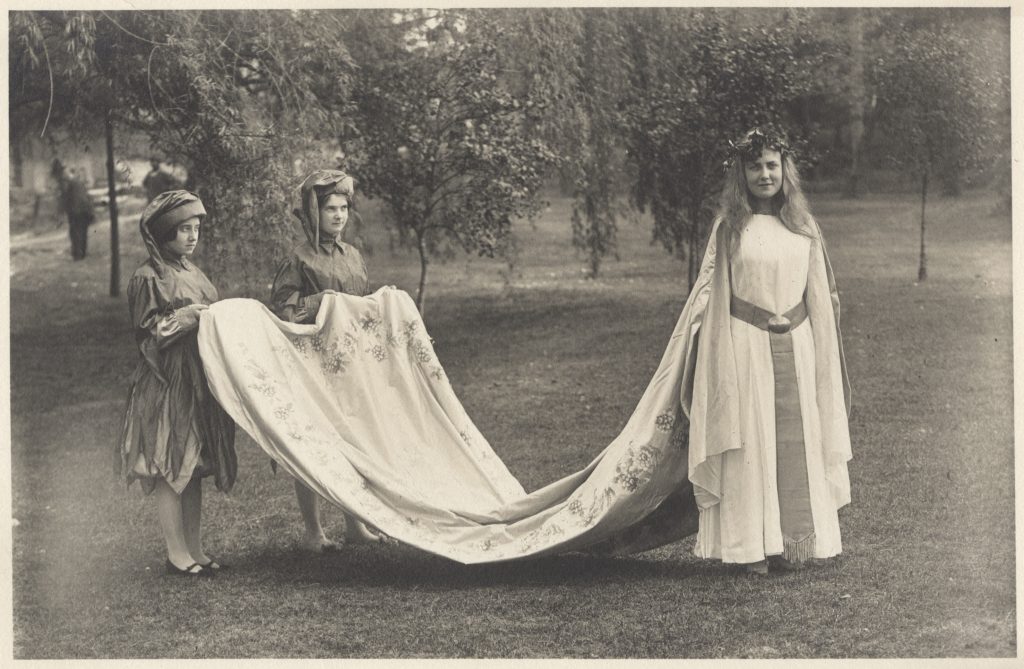
An extravagant pageant, lively games and a crown fit for a queen. In 1912, being May Day queen at State Normal and Industrial College (now UNCG) was the highest honor and typically bestowed upon a senior elected by her peers. Only the noblest, bravest warriors were tasked with protecting her court train from the dangers of the freshly cut grass blades.
Unsolicited Advice

When it comes to wordplay, we love figures of speech as much as the next person. “Shoot for the stars” and “go the extra mile” are a couple we keep in our arsenal anytime we need to spice up a conversation. They can be motivational and used to cheer one up when down in the dumps. While some bring good intentions, others can be misunderstood because of their fragmentation. No one likes a half-baked quote shoved down their throat — but we will gladly scarf down a gooey, half-baked cookie. Whether it’s to inspire or just for some good, playful writing, we’d bet our bottom dollar you don’t know the whole shebang. So, if you know someone in a blue funk and they’re in need of some encouraging words, here are some apt idioms you can roll out to bring their spirits up.

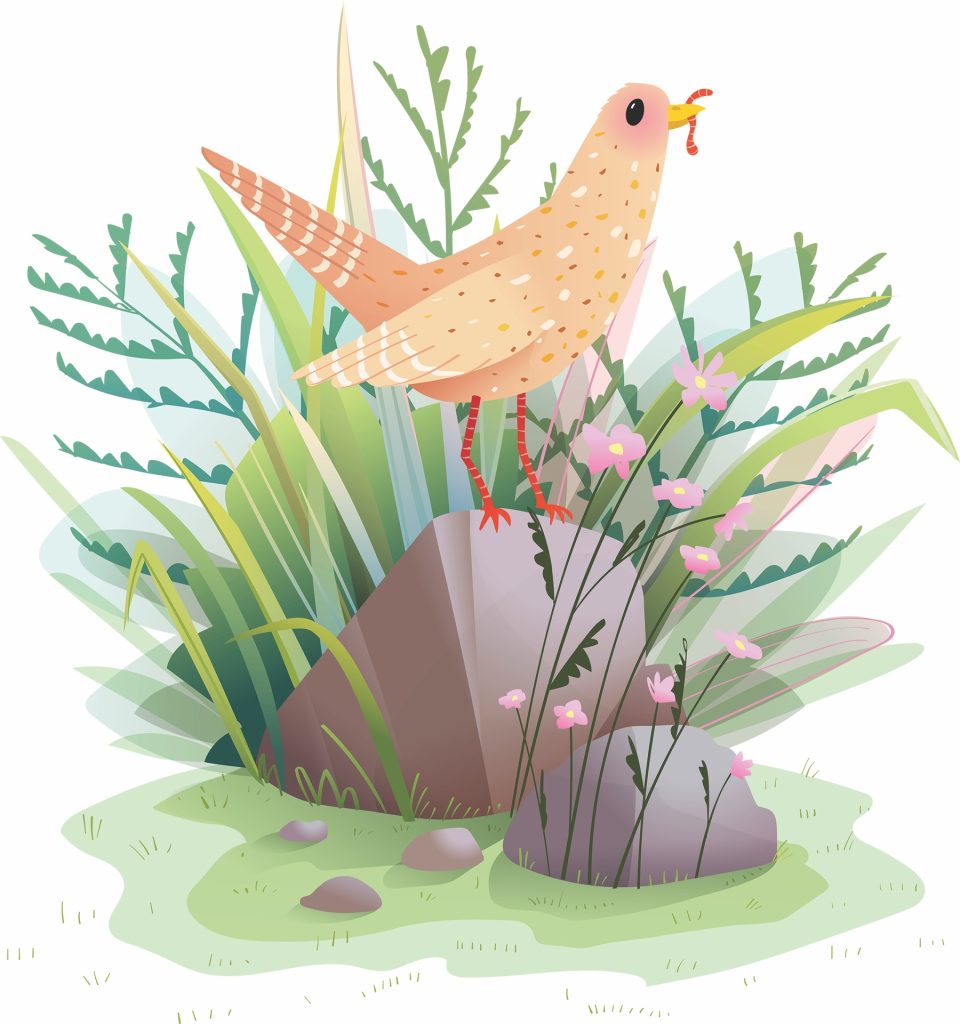
Some say “the early bird catches the worm,” which implies that the sooner you chase the opportunity, the better advantage you will have over others. While agreeable, it could be argued that waiting could also be a better bet. The full phrase “the early bird catches the worm, but the second mouse gets the cheese,” implies that an opportunity could be disguised as bait. Granted, worms and cheese may not be your snack of choice, it’s still a good reminder that the first opportunities could come with higher risks and sometimes second place can put you ahead of the game. So before you chase, stop and assess whether you’re about to be rewarded or about to bite the bait.

If starting a new hobby consists of finding something you’re interested in, getting really engaged in it and then letting it go then don’t worry about being called a quitter. It takes a lot of courage to start something new, but it takes a lot more courage to quit when something isn’t working out for you. Our bag of idioms tells us that a Jack of all trades is a master of none, though oftentimes better than a master of one. Being a master of none isn’t always bad. It means you possess knowledge across multiple fields. For example, a hotdog expert couldn’t tell you squat about how to make a good burger but, with the extra knowledge you have, you’ll be able to whip up — or better yet, flip up — something juicy and savory.

As a child you were probably taught to suppress your curiosity and to keep your questions at bay. But, in a world of “follow the leader,” we could use more curious thinkers. Innovators and their inventions all started with a thirst for knowledge. Sure, people say “Curiosity killed the cat,” but the full, often overlooked version of the idiom is “Curiosity killed the cat, but satisfaction brought it back.” Follow your nose, ask questions and impress your inner child with your inquisitiveness — but use caution, you don’t have eight more lives to spare.   

Our 2026 Essay Contest

Sun’s out, pen’s out. It’s time for our annual writing contest and this time we want you to think back on all those “How I spent my summer vacation” assignments of your elementary school youth. Whether it’s about a vacay or a staycay, we want an essay. Tell us about a true tale as remembered by you about a trip to the beach or about the time you took a week off to meditate for hours a day wearing nothing but your socks and a bedsheet. As always, there are ground rules:

Submit no more than 600 words in conventional form — a PDF, Google document, or a word or pages file works well. Please no secret code that requires a decoder ring. We’ve misplaced said ring. Email entries to cassie@ohenrymag.com.

One entry per writer.

Deadline to enter is September 30, 2026.

Top three winners will be contacted via email, awarded a monetary prize and their essay printed in a forthcoming issue of O.Henry.
Art to Heart

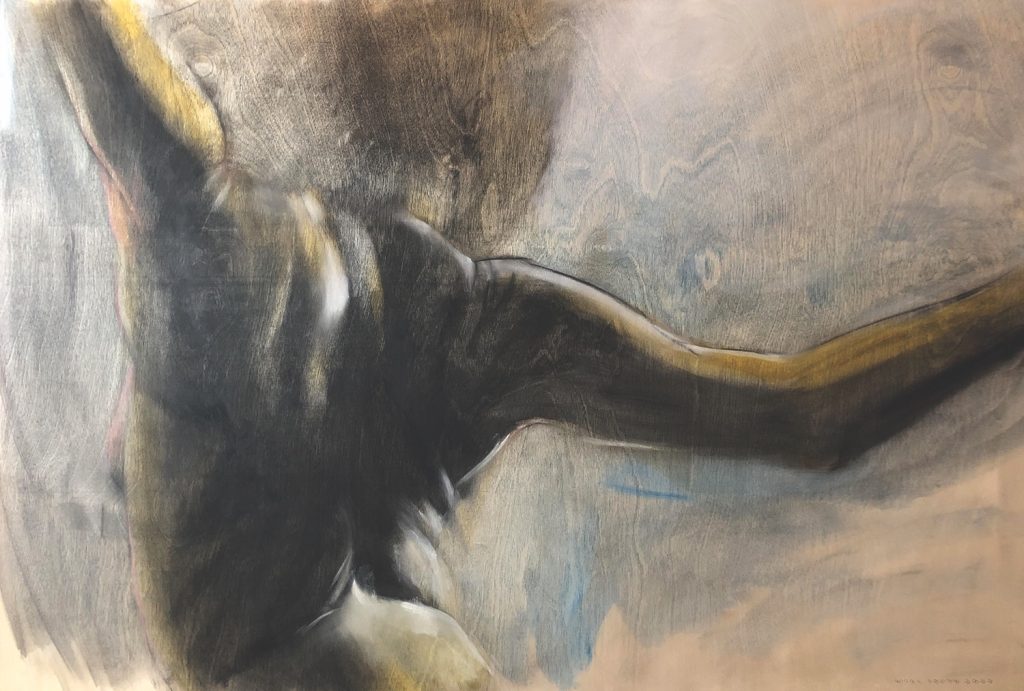
For some, disorder and mayhem may stifle their artistic abilities, but, for art historian and artist Will South, chaos serves as a muse for his paintings. “So, it all started with the pandemic,” says South. “Then, next thing you know, the pieces became directly inspired by a lot of the troubles in the world.” After his 2020 retirement from serving as chief curator for the Dayton Art Institute in Ohio, he moved to Greensboro. South saw the pandemonium that resulted from the COVID-19 pandemic and, like many creatives at the time, decided to dust his palette off and paint, which led him to fill canvas after canvas, until he created the collection for his present exhibit, Catastrophic Times: Paintings by Will South. South uses his art to speak for the people who can’t speak for themselves and says that making images is his way of engaging with the world. “Now, we have these other conflicts going around, so I started painting things that were directly related to them.” What started out as a reaction to a tumultuous time evolved into a response to the larger issues that arose after — like, he says, the murder of innocent African Americans through police brutality. Though South most recently uses his art to reflect on current events, he has also been known to dig into the past. He is the author of many books, including Henry Ossawa Tanner: Artist in the Lion’s Den, which explains and seeks to correct the myths surrounding 19th-century artist Henry Ossawa Tanner, who was the first African American artist to reach international acclaim. He hopes that by sharing his own art with the world, it will gently move the needle toward global equality and encourage kindness toward those going through troubled times. “When you see something in life, you cannot unsee it,” South says.

You can find Catastrophic Times: Paintings by Will South in Gallery 1250 at Revolution Mill, on display through June 26, and hear directly from South a 2 p.m., Saturday, May 16. Info: revolutionmillgreensboro.com.

Tiny Tale

TINY TALE

Memorial Day

A flag for the forgotten

By James Celano

Teddy got tired of throwing stones at a tree and called out: “Ya wanna go get some flags?” Without answering, I started through the woods towards the cemetery. It was the Saturday after Memorial Day. Janet said it was going to rain cats and dogs on Sunday. Sisters always say things like that. Teddy and I would have just said it was going to rain a lot. However you said it, the flags were going to get all wet and would probably get thrown out. So why not let us kids have some? After all, people take down Halloween and Christmas decorations, so what’s the difference? That’s the way we saw it, but the caretaker didn’t. The year before, he had ambushed us in his pickup. “What are you boys doing with those flags?”

“We thought it’d be OK to take them now,” I said.

“Yeah, well, it’s not. Put them in the truck.”

Teddy held up a blue flag with a cool insignia, a real prize. “Can I keep this one?”

“Put it in the truck!”

Our Lady of Mercy was a big woman, a little over 60 acres. Freight trains ran just beyond her left side. Grandmom said the trains carried the souls of the dead away. Sometimes in bed at night, I could hear the trains rumbling over the tracks and wondered where all those souls were going. Maybe one way was to heaven and the other way was to hell.

The gate at the south end was locked, but a section of chain-link fence torn away from a post was just wide enough for our skinny bodies to squeeze through. Red, white and blue waved all over the land of free flags. Teddy and I began running all over the place, snatching up stars-and-stripes and being careful not to step on any graves. No kid needs that kind of bad luck. Neither of us found one of those blue flags with the cool insignia, and, boy, did we ever look. Teddy still simmered a little over the one he lost.

The south end was also where the little kids were buried. Tall trees, growing just outside the fence, shaded small plots on either side of the gate. It was the creepiest part of the cemetery, so we never left without giving it a good going-over. Since the only legitimate way into the cemetery was the north gate, the kids lay at the far end of anyone else’s sympathy. But in our own way, in the way we marveled at their brief life and sudden death, we, at least, mourned them.

One shiny granite slab jumped out.

Gabriela “Gabby” Minelski

Born: February 2, 1960

Died: April 25, 1962 

“Hey Teddy, check this out. This little girl just died.”

Except for the new kid’s, the stones looked neglected and sad. It didn’t look like anyone ever visited. No flowers, no flags. But a kid wouldn’t want flowers. Better to leave a toy. But there weren’t any toys either. Someone would probably swipe them. Probably one of us.

Out of nowhere, a picture of Gabby down there in the dark popped into my head, her hair mussed and knotted, and her eyes full of ants. I have a good imagination . . . too good, and sometimes the pictures in my head give me the jeebies.

“Our Angel” was all one stone said, and this:

Born: November 9, 1952

Died: November 12, 1952

“Jeez,” I said, “this kid only lived three days.”

A layer of fuzzy moss that Teddy said looked like green hair covered the top of “Our Angel’s” gravestone, and smack-dab in the middle was a black acorn. That one threw us for a loop. It couldn’t have fallen from a tree without bouncing off and onto the ground. Maybe a squirrel stashed it there for later and forgot about it. He might have spent half the winter wondering, “Now, where did I leave that acorn?”

I told you I have a good imagination. “Someday that imagination of yours is gonna get you in trouble,” my mother told me, but so far, so good.

Another grave had two names, a boy and a girl, born one day, dead two weeks later. Teddy wondered if they were in the same coffin, or if one was on top of the other. “It would be better if they were in the same coffin,” I said. “Their mom and dad could save some money that way.”

“It’d be better if they were in the same coffin, anyway,” Teddy said. “Then they could play together in heaven.”

It was OK for Teddy to say that, being only 7 years old and all. Of course, if they weren’t baptized, the dead kids couldn’t get into heaven. Limbo was the best they could do. I didn’t like to think about that. It didn’t seem fair. It wasn’t their fault, after all. But, even though limbo wasn’t as good as heaven, it was a heck of a sight better than purgatory or hell.

One small grave lay at the far end, separate from the rest. Henry Liddle — 4 years old. Maybe Henry was one of those quiet kids who preferred his own company. A crouching angel with sad eyes and a chipped nose prayed over Henry. The stone was a little cockeyed, as if the angel’s grief had become too big a burden and knocked the whole thing out of kilter. The granite on Henry’s marker was stained with green moss, too.

“Well, I got my flags,” I said, turning my back on little Henry. “I’m getting outta here.” It was when I reached the hole in the fence that I saw Teddy crouching behind the angel with the chipped nose. “C’mon,” I yelled back, “I don’t want that guy to catch us again.”

On the way home, I asked Teddy how many flags he had.

“Five.”

“I thought you got six, like me?”

“Nah,” he said, “I only took five.”

Poem May 2026

POEM

FLOATING

A hawk drifted over as I backstroked

through the neighborhood pool.

It glided more effortlessly

than I’d imagined possible,

circling and diving on the breeze

without thrash or beat of wing,

so I puffed up my chest

and floated awhile, wondering

if he’d spy me and swoop down

to make a meal of my laziness.

Maple seeds helicoptered

into the depressions

between ripples, bobbing expectantly.

Drowned, fat caterpillars

littered the blue between lanes.

There are graveyards

where the bones rest

less tranquil than that afternoon,

but I ripped it into lines,

and still I am ripping it into lines,

looking for sad, explosive meaning,

proof that I skimmed

that particular magnificence

and didn’t go under.

— Ross White

O.Henry Ending

O.HENRY ENDING

Spice Relief

Handling jalapeño pain

By Walt Pilcher

I may not be a cultural cuisine aficionado, but I have a nose for Mexican food.

Smoky scents from carne asada or grilled chicken in citrus and spices. The earthy heat of roasted jalapeños or chipotles. Mildly nutty corn or wheat tortillas. The savory sizzle of refried beans. Rice sautéed with onions and garlic. Zesty cilantro and lime. Stale cerveza (beer). Uniquely familiar aromas. I’ll know I’ve stepped into a taqueria even if there’s no telltale mariachi music. And with good reason.

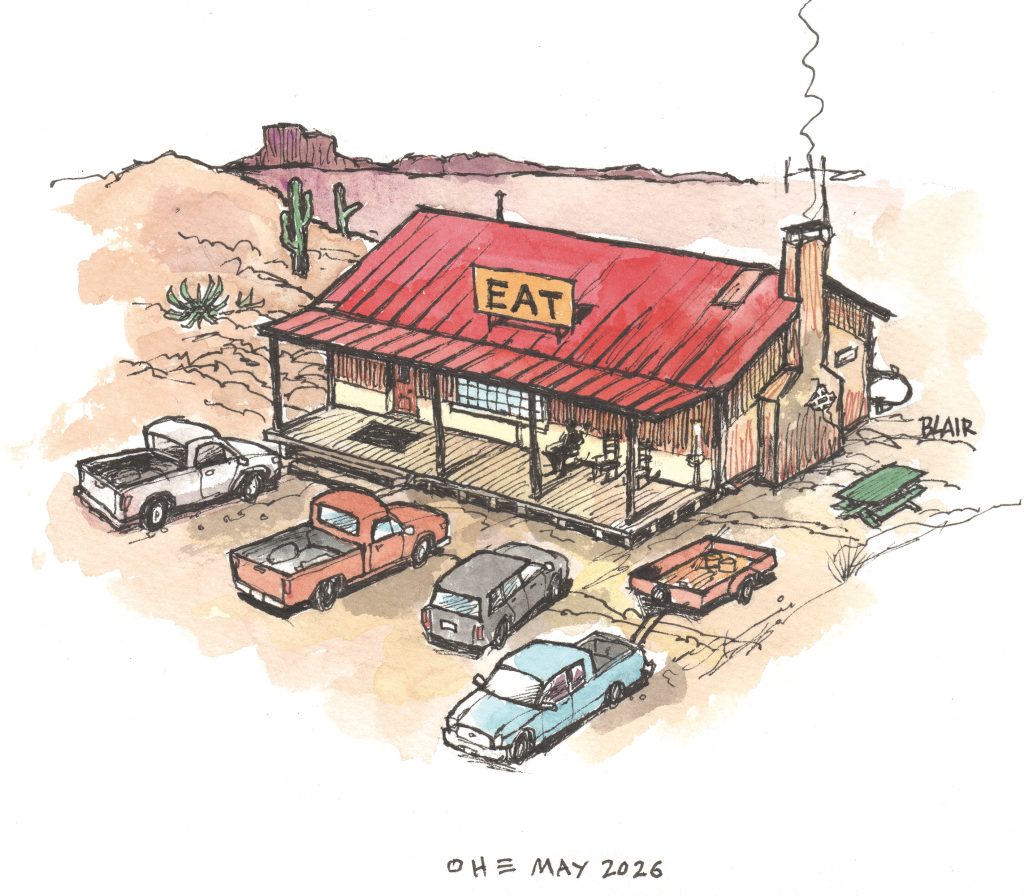
Return with me now to the summer of 1965, where I am about to experience both a startling cultural trauma and a culinary revelation of world-class magnitude. My new wife, Carol, and I are driving cross-country to California for grad school and work. Late one evening, we stop for dinner in lonesome Wagon Mound, New Mexico, population 695. Not much is there except the iconic butte the town is named for and what appears to be the only restaurant, a Mexican establishment, the name of which, as far as we can tell, is the single word on a neon sign: “EAT.” We are starving.  

We place our orders. Carol wisely chooses a cheeseburger, but I must show off my machismo and try something adventurous, a spicy Mexican dish with a baffling name now lost to memory. The food comes and it smells good. As Carol savors the first bite of her burger and I am just about to dig into my mystery meal, I notice the kitchen staff surreptitiously peering out as if to see how the gringo (me) will react to what they have prepared. Undaunted, I fork a mouthful.  

¡Madre mía! First my lips burn. Then my tongue does a Mexican “hot” dance. My nose runs. Soon my throat is a tunnel of fire. Gulping my icy Coke does nothing to relieve the pain. I dare not look at the kitchen staff lest they reap satisfaction from their little joke. Quickly, in an almost involuntary reaction as when one claps a protective hand on a fresh wound, I grab the tortilla that accompanies my meal and slap it on the flames. Amazingly, the pain stops! ¡Qué sorpresa! The gringo has prevailed!

I do not leave a generous tip.

But maybe I should have. It turns out tortillas and other wheat-based foods contain starch and sometimes a bit of fat, both of which can help absorb capsaicin, the compound that causes the burning sensation. A possible contributing factor is that wheat contains traces of humulene and myrcene, terpene compounds that fool the brain into not feeling the topical discomfort. Flour tortillas, bread, dinner rolls, pita and all sorts of grainy foods seem to extinguish the fire. Foods made from hops, like beer and sauces, are richer in the terpenes and potentially have even more of this soothing effect. Science aside, I only know when I touched the tortilla to my lips, the pain went away. Knowing wheat-based foods are an antidote for spice pain has proven quite useful to me and to friends with whom I’ve shared this knowledge during travels worldwide and in the wide range of ethnic eateries here at home.  

Whenever I inhale the distinctive aromas of Mexican cuisine, my thoughts return to Wagon Mound and the prank-turned-epiphany that changed my life. How pleasurable eating spicy food has become since that transformative experience. And now I know why beer washes down Mexican so well.

I have not gone back to Wagon Mound other than in my mind. I wonder if the EAT restaurant is still there. Has it become a chain? I have seen other EAT signs in my travels, so maybe.

If it has, I hope the staff is still pranking the gringos. 

Life’s Funny

LIFE'S FUNNY

My Two Cents

The changing nature of cool

By Maria Johnson

I really wanted those penny loafers.

They were displayed near the oxfords in the children’s shoe store where my mom took us for “good shoes” when I was growing up.

The place smelled like new leather and Sunday school. Stiff and uncomfortable, in both cases.

Which brings us back to the loafers.

I had flat feet, and someone — maybe my mom, maybe a doctor — decided that I needed to wear “orthopedic shoes,” which meant lace-up oxfords with built-in arch support.

They might as well have said, “Shoes that are ugly as all get-out, not to mention uncool,” because they were both.

I was around kindergarten age, old enough to have a budding idea of what was considered desirable outside of my family. Orthopedic shoes from Howard Curry Shoes in Lexington, Kentucky, were not on the list.

The only good thing about that store, in my mind, was The Talking Tree.

You don’t know about The Talking Tree?

Well, on the right wall as you walked in, there was a sculpted tree with a human face, like the trees in The Wizard of Oz, only this one was smiling.

Near The Talking Tree, there was a small wooden bridge that you walked over. It was all very storybook-y. The most enchanting thing was that when you walked out with your new shoes, The Talking Tree would call you by name, saying something like, “Enjoy your pretty new shoes, Maria.”

Even in my 5-year-old mind, as I carried out my dorky shoes, I’d be thinking, “Yeah, right.”

Which means I believed in The Talking Tree somewhat, even though I thought it was full of sap.

It took me a few years to figure out that The Talking Tree never called my name on the way in, only on the way out, after my mom had dropped a wad on my supposedly pretty shoes.

I remember the first time The Talking Tree bade me farewell, and I turned and waved at the sales lady who was talking into a microphone at the counter behind me.

Busted.

Never again did I think seriously about owning a pair of real-deal penny loafers until recently, when I read a glowing review of some “affordable Italian penny loafers,” which is a little like saying an “affordable Italian sports car”.

Something in me was rekindled.

I had to have penny loafers. Not the pricey Italian model, mind you. Rather, a supple (sorry, Bass Weejuns) and reasonably priced version. With actual pennies stuck in the slots because, to go all Honest Abe on you, I’m mourning the penny.

Unless you’ve been living under a Coinstar machine, you probably know that the U.S. penny went out of production last November. I get why. It cost 4 cents to make a 1-cent piece of currency.

But like many people, I have pockets full of memories associated with pennies, which were made with 95 percent copper when I was a kid.

That’s why they weathered to a green patina.

That’s why some people used them to “fix” a glitchy lightbulb or replace a blown fuse. Don’t ask these people for snapshots to document the practices; their photographs likely burned in house fires.

In my own childhood home, one electrical outlet was fried by a child — there were only two of us, and neither will cop to this — who wondered what would happen if you stuck a penny, vertically, into an outlet, as if you were playing the slots in Vegas.

Answer: ZZZZZTTT!!!

I can only surmise that whoever tried this dangerous (in retrospect) stunt was gripping the penny with a pair of rubber-handled pliers, or only one of us would be left with any credible deniability.

A more common practice of the time was putting pennies on railroad tracks, waiting for a train to go by, then marveling that a locomotive weighing more than 100 tons, could flatten a penny into a faceless disc.

This, too, was treacherous, not only because it brought kids into close proximity with diesel locomotives, but because apparently — and I learned this only recently — a train’s fast-moving wheels can spit out a penny as a deadly projectile.

On a lighter, less lethal note, pennies had wholesome uses, too.

We could toss a penny into a public fountain and make a wish.

We could pick up a found penny — something I still do without thinking — for good luck, especially if it were heads-up.

We could slip a couple of new pennies into our loafers. Looking at you, Talking Tree.

We could feed a penny into a bubble-headed candy machine, twist the crank and get a handful of awful chewing gum or those godforsaken Boston Baked Beans.

Sensible people collected pennies. My maternal grandmother was a well-known penny pincher who turned loose only for a good cause. She tied a couple of pennies into the corners of handkerchiefs for my mom and my aunt to take to Sunday school as their offering during the Great Depression.

Later, when I was a kid, my grandmother coached us to be on the lookout for what she called “wheat pennies,” which had two wheat stalks, pictured like parentheses, on the backside.

The proper name was Lincoln wheat pennies. They were made from 1901 to 1958, and my grandmother seemed to think they were valuable post-production.

She was somewhat correct.

Today, a 1933-D (“D” for the Denver mint) wheat penny is worth more than $2.

A 1931-S (“S” for the San Francisco mint) is worth more than $40.

Put that in your loafers and stroll it.

Pennies also became an emblem: a symbol for the least among us that nevertheless held worth, especially when amassed.

This principle was foundational to the most basic form of childhood fundraising: Dump a coffee can full of coins on the floor and get to sorting.

It took forever to assemble a decent chunk of change in paper wrappers. But it added up. That was the beauty of the penny. It was little, but it mattered. A lot of them mattered a lot.

On May 7, Sanctuary House, a Greensboro nonprofit serving people who experience mental health issues, will hold a weekday lunchtime event called Mile of Pennies.

Why pennies? Because Abe Lincoln, who is pictured on every cent, suffered from depression. He certainly wasn’t the last president to struggle with mental health problems, but he was open about it, referring to his melancholy as his “black dog.”

Plastic cup by plastic cup, event organizers will hand out a mile’s worth of pennies — 84,480 to be exact — and invite people to use the coins to create designs and messages on the steps, pavers, sidewalks and stone walls around the group’s “clubhouse” at 518 N. Elm St.

The goal — other than providing a place for people to be artistic, eat a food-truck lunch, and enjoy live music — is to get folks talking about mental health; about 1 in 5 people will experience a diagnosable mental health challenge in any given year, according to Terri Jackson, Sanctuary House’s chief philanthropy officer.

She stresses that every person, every conversation and every donation matters.

There’s that idea again: The power of one.

It’s a reassuring message, a different kind of cool, some 60 years after my first crush on penny loafers. Incidentally, my feet aren’t as flat as they used to be, thanks partly to decades of exercise in supportive, lace-up tennis shoes. That’s why I’m willing to spend some shoe leather tracking down the right pair of loafers, size 8 or 8.5, if you happen to trip over a pair.

I can hear the tinny voice of The Talking Tree now.

“Enjoy your pretty shoes, Maria.”

I will.

I think I’ve finally grown into them.

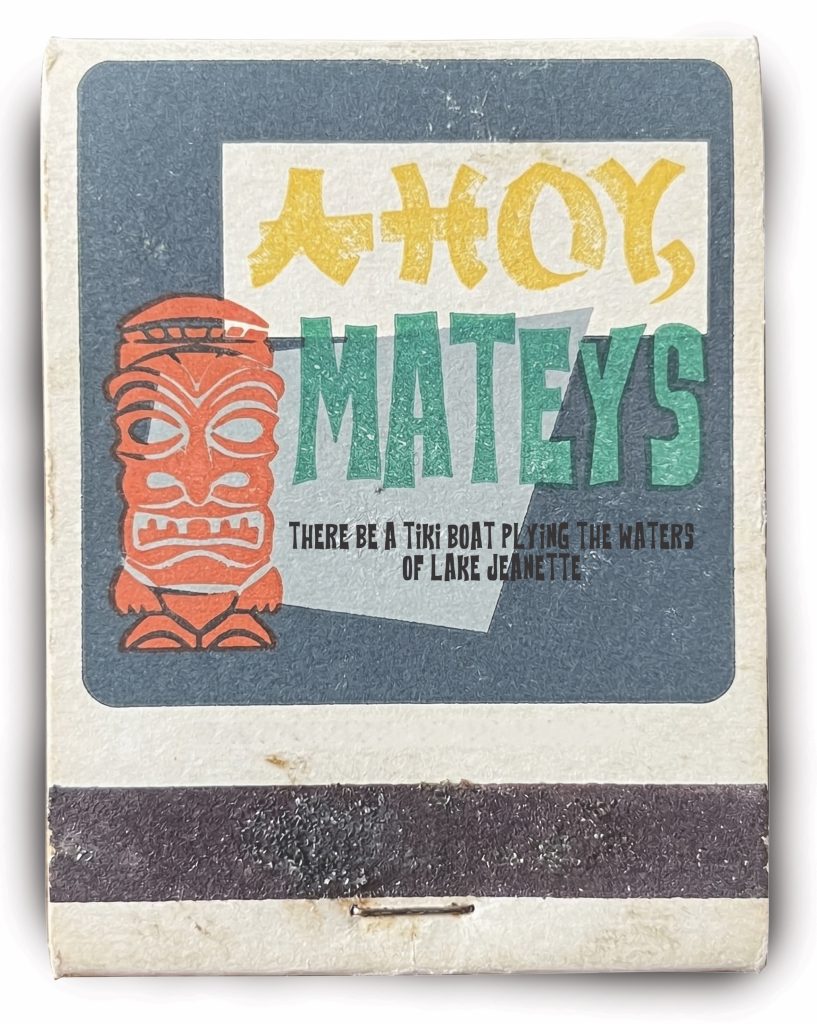
Ahoy Mateys

AHOY, MATEYS

Ahoy, Mateys

By Maria Johnson

Photographs by Bert VanderVeen

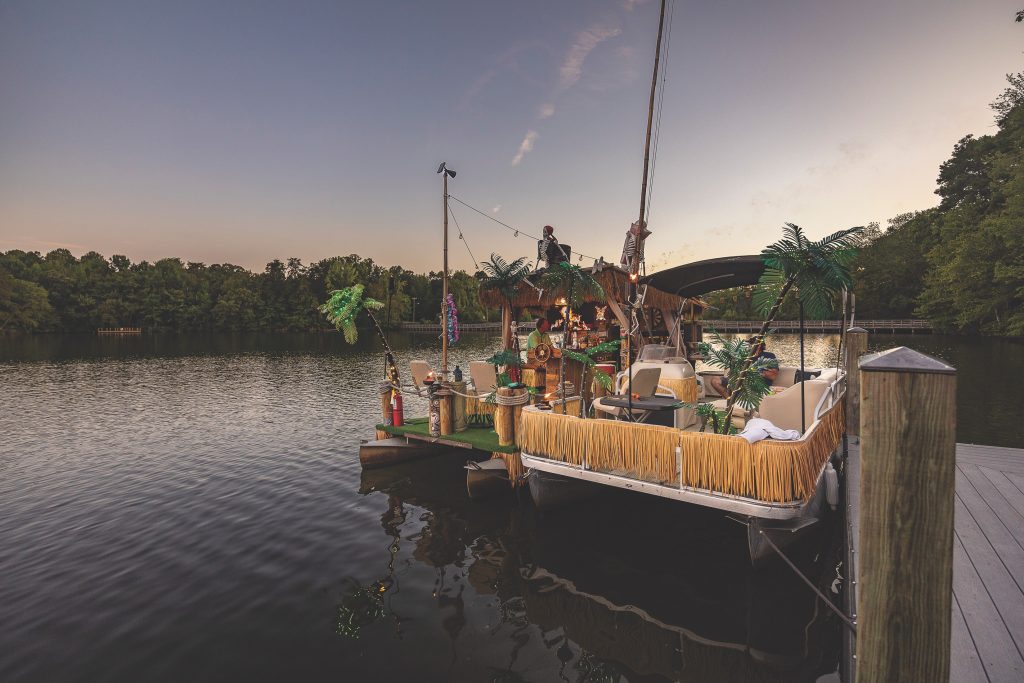
On many a fair-weather evening, as the sun paints the sky around Lake Jeanette with neon pinks and purples, you can make a sport of watching cars on Bass Chapel Road as they slow down on the low-slung bridge near the marina.

Heads swivel as drivers stare at a curious vessel that bobs on the lake’s rippled surface. Red brake lights flash as motorists try to stay in their lanes while making sense of their water-borne fever dreams.

Before they reach the other shore, most passers-by give in to the delirium. They honk. They wave. They smile at the floating fantasy that Jess Washburn and his crew have cobbled together over the past few years.

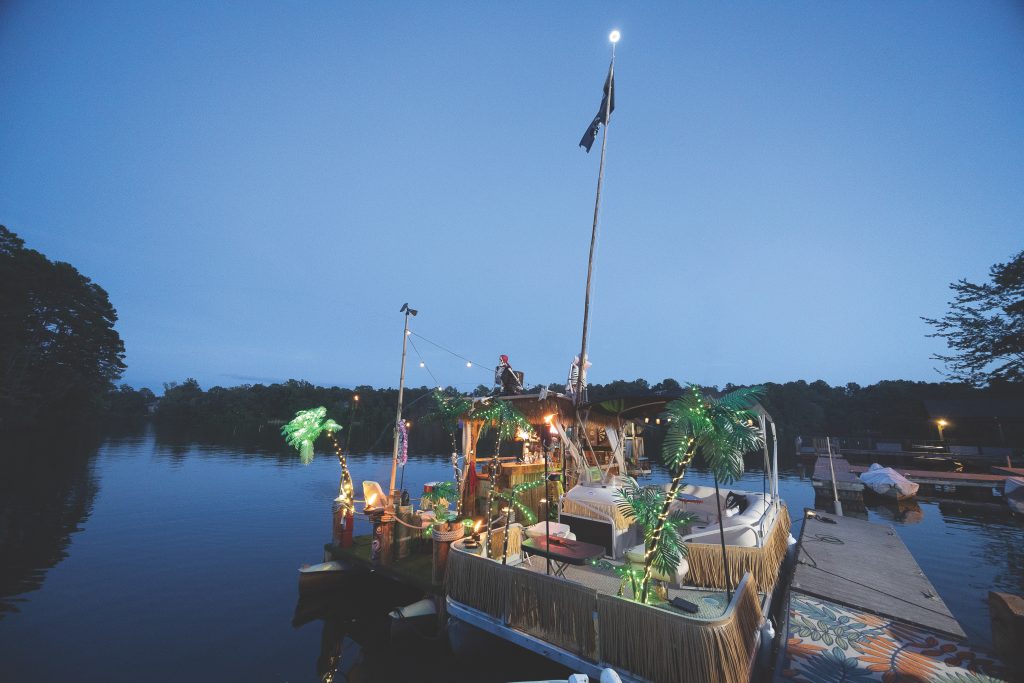
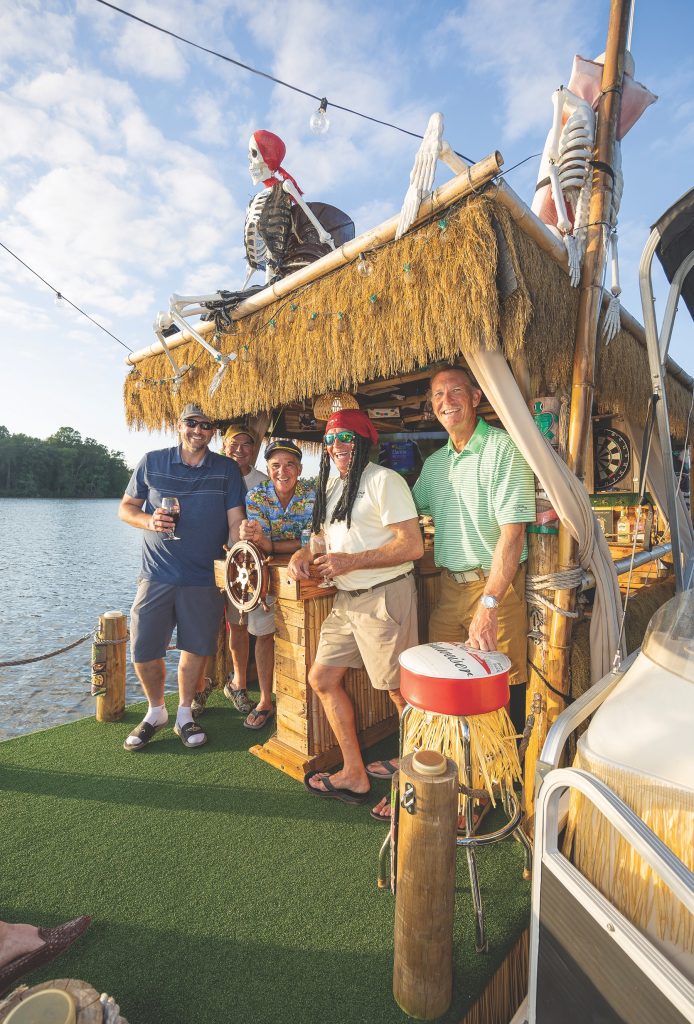
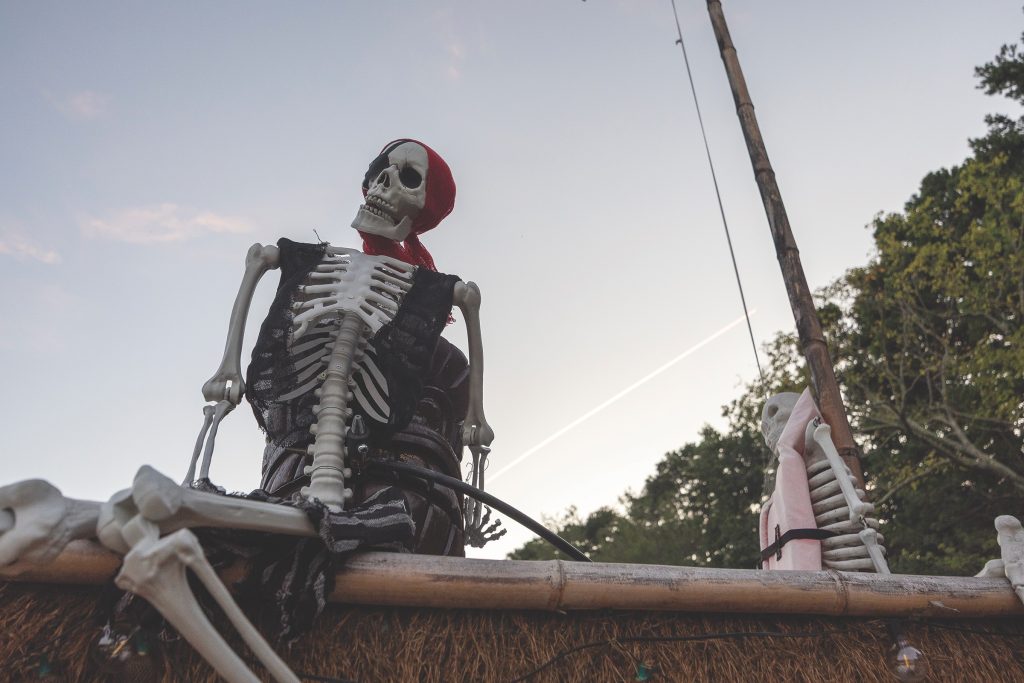
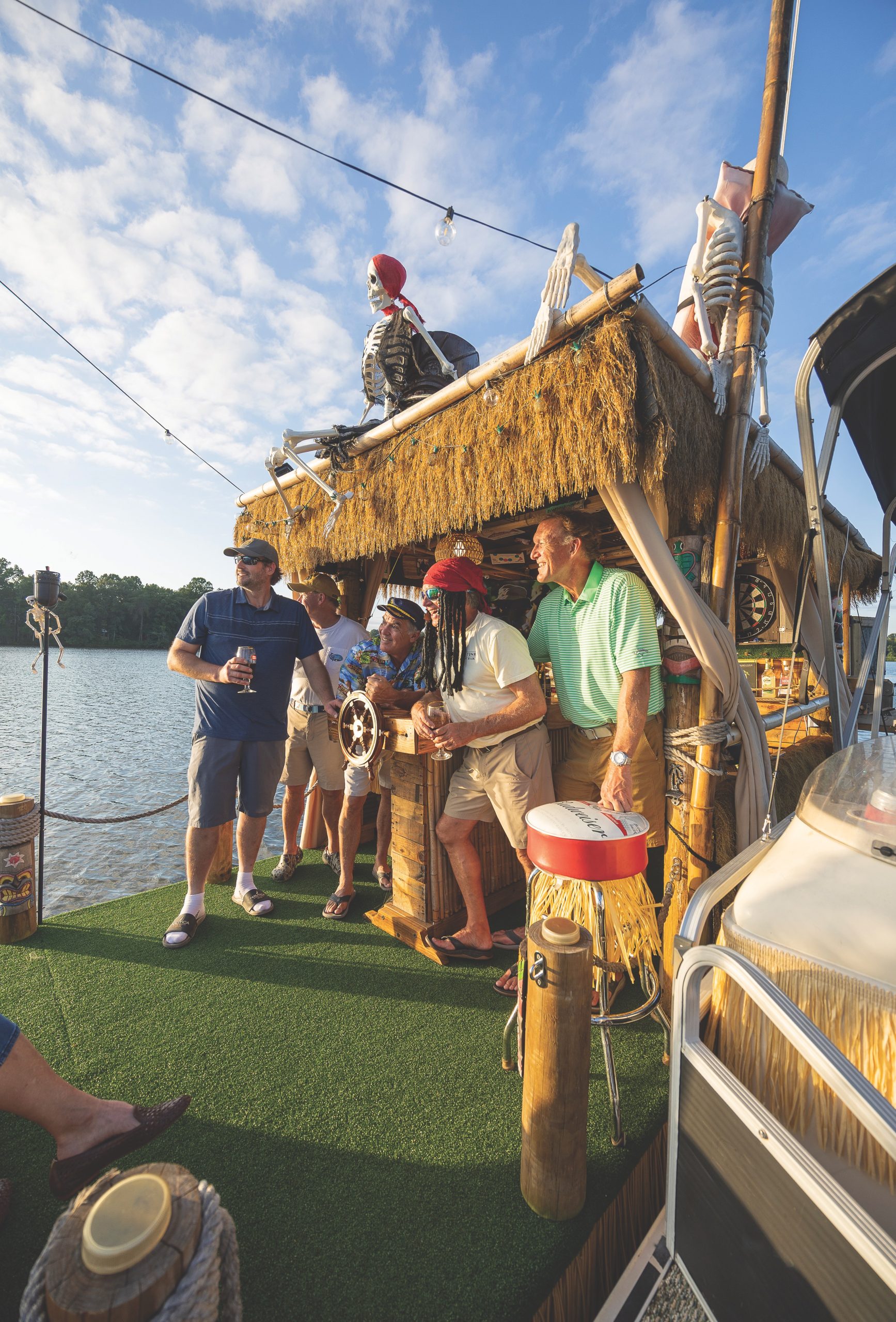
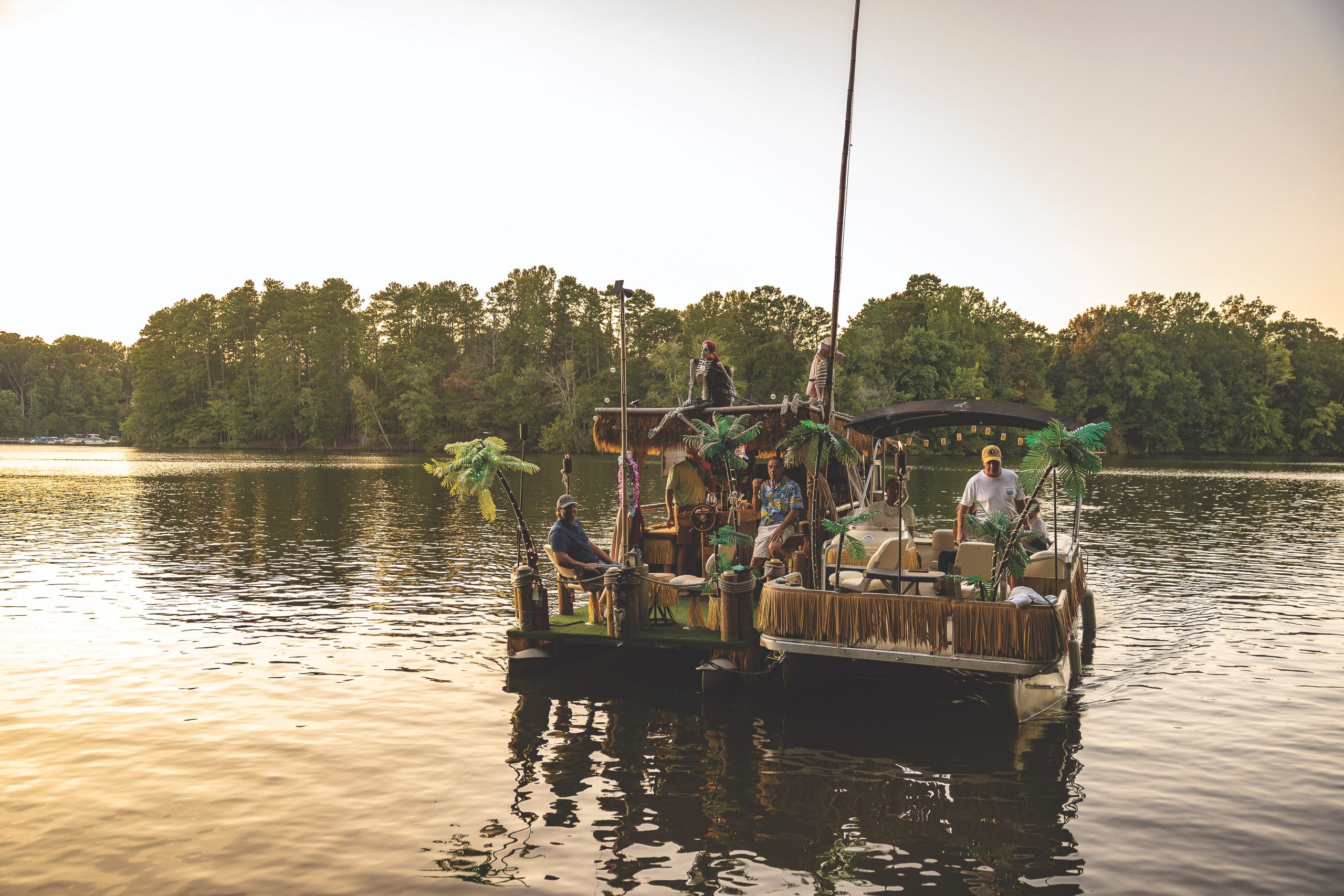
Built on the frame of a disabled pontoon boat that’s tied to a motorized sister craft, their creation is basically a freshwater tiki bar with sandy-toed touches: torches ablaze; a carnival’s worth of multicolored LED lights; a tin roof; faux potted palms; plastic skeletons in swabby garb; grass-skirt fringes fluttering in the breeze; a glowing, 40-inch flatscreen TV; a mind-the-wake-and-take-your-best-shot dart board; and a seriously tall but not-seriously-plumb bamboo flagpole draped with a couple of Jolly Rogers that threaten absolutely no one.

The overall effect is Gilligan’s Island meets Pirates of the Caribbean meets Cheers.

“After a long day at work, when I’m kinda stressed out, I get out there, and I can immediately relax,” says Captain Washburn. “I know I’m gonna see my friends, and I know I’m gonna get a good laugh.”

When he’s not combing the internet for pirate-adjacent accessories, Washburn works as a salesman for Greensboro-based Morrisette Packaging. He also buys and develops older industrial buildings, and perhaps most important to his nautical dreams, he owns Lake Jeanette itself.

Eight years ago, his company, Lenoir Warehouse Group, bought the 270-acre lake in North Greensboro, along with nearby Buffalo Lake, which covers a meager 105 acres by comparison.

Cone Mills Corp. created both reservoirs — Buffalo in 1922, Jeanette in 1943, according to a state inventory of dams — to provide water for its White Oak plant, which wove denim for the U.S. military among other customers.

Eventually, Cone sold its holdings to International Textile Group, which decided to shed the private lakes, by then surrounded by pricey homes.

Washburn had lived on Buffalo Lake for eight years. He was afraid an outside investment group might buy and develop what had been his duck-filled backyard.

So the perpetually tanned outdoorsman, who literally looks at life through the aquamarine lenses of his Maui Jim sunglasses, jumped on the urban watering holes.

He already had a pontoon boat docked at Lake Jeanette, where he enjoyed fishing and taking friends on cocktail-hour cruises.

His imagination churned with what could be moored even closer to home.

“I wanted a tiki boat on Buffalo Lake for the longest time,” says Washburn, who was inspired by the tiki-themed water taxis that slosh tourists on booze cruises up and down Taylor’s Creek near Beaufort, N.C.

Alas, Washburn’s modest lakefront dock wouldn’t support such a dream on Buffalo Lake.

Lake Jeanette, with its well-concealed marina, was a better fit. But tearing down a perfectly good pontoon boat to make a floating tiki bar did not make sense, even to a repressed pirate.

Five years passed.

Arggg.

Then a friend made Washburn an irresistible offer: Washburn could have the friend’s dilapidated pontoon boat in Virginia if he would make the trip to retrieve it.

Washburn huddled with four friends, who all loved hunting, fishing and spending time on the water.

Rodney Hazel, a real estate agent who had been Washburn’s pal since they were students at Chapel Hill, was gung-ho.

So was Todd McCurry, a textile company executive.

Ditto medical device salesman Ben McAlhany.

The crew towed the junker boat to the Greensboro home of master carpenter Kevin Crowder and turned his backyard into a boatyard.

They commissioned Crowder to create a pirate’s den in the spirit of Peter Pan’s nemesis, Captain Hook, which is to say, a youthful idea of a slightly dangerous good time.

But first, Crowder ripped off the rotting deck and replaced it with inch-thick, marine-grade plywood. He added floats under the frame for stability.

Above deck, he built in a cabin big enough to house a bar with bench seating, plus a small galley where an outboard motor would have been.

As the watercraft took shape, the crew and their mates dragged in building supplies, some donated, some discounted.

Washburn got his hands on some sheet metal for the roof and walls. He wangled some AstroTurf, left over from a Wake Forest University lacrosse field, for the deck.

McCurry rustled up some outdoor fabric for seat cushions.

Hazel donated a large bell that he found in a store in Ocracoke.

Washburn salvaged pine pallets that would become the boat’s shiplap siding and freestanding bar. He also bought a solar-powered generator to provide electricity for the mini-refrigerator-and-freezer that had once occupied his son’s dorm room. He found pre-lit, solar-powered palm trees online.
McAlhany contributed a gas grill in the interest of keeping the crew stoked with hamburgers and fajitas.

“We’d get out there every night and say, ‘This would be cool. Let’s try this.’ People would come by and say, ‘Oh, I’ve got just the thing for you,’ and they’d send a little something,” Washburn says.

The crew briefly considered adding a hot tub to the party barge, but nixed the plan because of the required maintenance.

They hauled the mostly-finished boat to Lake Jeanette in the spring of 2023. The most treacherous part of the voyage was the traffic circle on Bass Chapel Road.

“We had a real old, kind of a sketchy trailer, and it was rocking back and forth. We went about 5 miles an hour. People behind us were not too happy,” Washburn says through a Cheshire Cat grin.

The crew breathed a sigh of relief when the boat reached the marina, eased into the water and stayed on the surface.

“We weren’t real sure it was going to float because we had a lot of weight on it,” Washburn remembers.

The boat gained weight, in the form of decor, as more friends came aboard.

Mic Cardone handed over a deluxe dartboard with its own cabinet.

Mark Ruffin donated an autographed snapshot of Jerry Garcia, the late leader of psychedelic rock band The Grateful Dead. Ruffin’s brother had been an attorney for Garcia.

Kelly Harrill chipped in a wall-mounted TV that streams internet-based shows via cell phone hotspots.

“It was a community effort,” says Washburn.

At night, as bats pin-wheeled over the water, he hung out on the boat and surfed the web, ordering skeletons, string lights, pirate flags and grass skirts.

“Everything is from Amazon,” he says.

These days, crew members — minus McAlhany, who recently moved to South Carolina — take the tiki boat out as often as five nights a week.

They sip adult beverages, puff cigars and watch deer, ducks and a pair of bald eagles that nest along one of the lake’s coves.

They fish for bass, crappie and perch. Washburn is proud that the lake supports a diversity of marine life.

A few years ago, he asked the Coastal Dynamics Design Lab, based at N.C. State, to study the health of Lake Jeanette, which spills over a dam and eventually into Lake Townsend, a source of drinking water for Greensboro.

“They were amazed at how pristine Lake Jeanette was,” he says.

The crew also likes to stargaze, keeping watch for constellations and shooting stars, as well as Starlink, the satellite communication system, which appears as several fast-moving lights in a row.

“It’s really nice at night. It’s beautiful,” McCurry says quietly.

Sometimes, the vibe on the boat is philosophical. More often, it’s social.

Crew members gather on board to watch golf, NASCAR and football. In the fall, when it’s nippy, they pull the curtains around the cabin, fire up propane heaters, and toast the night away.“

Rain, snow, sleet, hail — we’re gonna say, ‘Yes!,’” says Hazel.

“The rain sounds good on the roof,” Washburn pipes up.

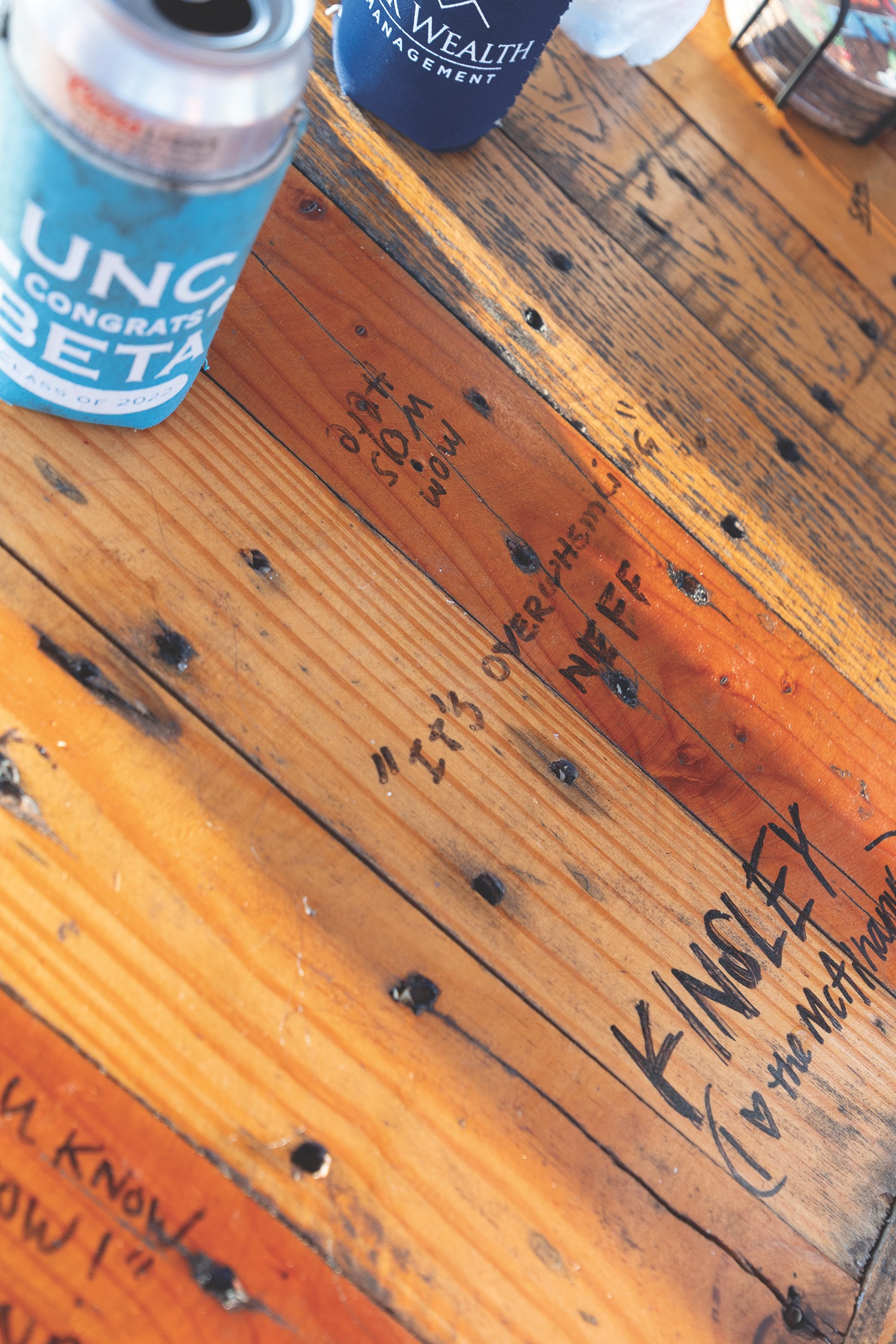
Side-by-side, the tiki boat and its sister vessel can float a party of 16 passengers. Guests leave their graffiti-like marks, with Sharpies, on the tiki boat’s wooden surfaces:

“Let’s have a painkiller party on the U.S.S. Washburn.”

“Go for the flip. Just do it!!”

“Let’s Have One More!”

A barrel stuffed with pirate costumes stands ready for anyone who wants to harrr it up. When the crew gets rowdy, they open a valve to shoot a water cannon. Another water stream appears to emanate from the pelvis of a skeleton that sits on the cabin roof, his legs dangling over the edge.

“Our kids come home and say, ‘Where was this when I lived at home?’” says Hazel.

Short answer: When the younger kids move out, the older kids take over.

Washburn doesn’t deny there’s a strong current of adolescence running through his 61-year-old veins.

“I grew up building forts and treehouses,” he says, reflecting on his childhood in High Point. “Maybe I have a little immature kid in me.”

His playfulness is a hit with other boaters and with revelers at the lakeside gazebo. They wave the tiki boat over for pics.

“It’s an Instagram moment,” says Hazel, who favors a photo-ready skipper’s hat when he’s aboard.

Soon, people might have more selfie opps.

Washburn is considering building a second tiki boat for Buffalo Lake if he can get a larger dock.

Also, his crew is agitating for inclusion in the annual Greensboro Christmas parade.

That would require a trailer big enough to get the boat downtown and then pull the craft through the streets.

Then there’s the issue of Santa.

Would he ride with naughty pirates?

And what would he wear?

Black beard?

Blue beard?

White beard?

Washburn ponders.

His imagination scans the horizon for what could be.

“Yeah, a white beard,” he muses. “Maybe we dress him as Hawaiian Santa. We don’t want all the kids crying. No sword. But maybe . . . ”

Chocolate coins wrapped in gold foil? Santa could toss them from a treasure chest.

“Yeah,” Washburn enthuses. “YEAH!”

Ho-ho-harrrrr. 

Unsung Heroes?

UNSUNG HEROES?

Unsung Heroes?

Searching for valiant ancestry at the Battle of Guilford Courthouse

By Billy Ingram     Illustration by Harry Blair

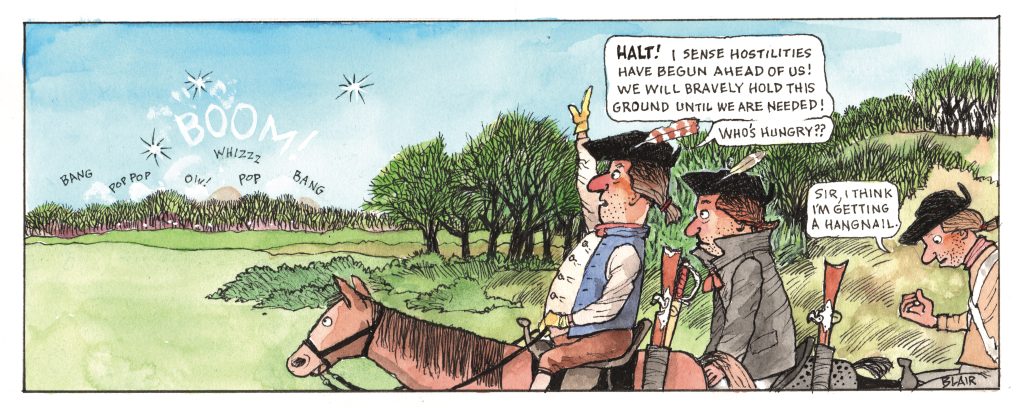
Looking back on the “Spirit of ’76,” it’s important to consider how, almost five years later, the outcome of the Revolutionary War was ultimately decided following a cataclysmic clash of opposing foes “fighting like demons” in a hail of bullets and thrusting bayonets at the Battle of Guilford Courthouse.

This year we recognize our nation’s Semiquincentennial and, while the celebration isn’t bombarding us with the patriotic fervor that accompanied the 1976 Bicentennial two-year bacchanalia of red, white and blue infecting every corner of society, we can take pride that this region played a seminal role in securing our independence from the King of England.

On a Saturday morning in March 2026, Revolutionary War buffs packed into a theater located inside Guilford Courthouse National Military Park’s visitors center. They’ve gathered for the First Annual Descendants of Battle of Guilford Courthouse Veterans Symposium, where ancestors of that conflagration take to the stage, regaling the audience with examples of their forefathers’ acts of bravery. One speaker, John Forbis, a former mayor of Greensboro, proudly traces his lineage back to Captain Arthur Forbis of the Carolina Militia, mortally wounded after refusing to relent to the enemy. A stone monument was dedicated to his heroism at the Military Park in 1887. Eric Wilson shares the valorous record of his maternal fourth great grandfather, who fought courageously here as a member of the Virginia militia

Kevin Graham, former president of the Lower Cape Fear chapter of the Sons of the American Revolution, speaks of his ancestor, Zachariah Jacobs, a free-born person of color (indigenous and African American) who also fought gallantly at Guilford and exhibited outstanding combat prowess years earlier at the Battle of Brier Creek and other consequential confrontations. Jacobs was one of an estimated 44 Black men and women who took up arms against British tyranny at Guilford Courthouse.

Yes, oftentimes, wives, with children in tow, followed along after their husbands and furnished crucial behind-the-lines support. Their fortitude under fire can’t easily be dismissed.

A little further into the park, with a massive granite obelisk dedicated in 1910 to Peter Francisco for a backdrop, a ceremony brimming with dignitaries honors the man known alternatively as “Francisco the Giant” and the Revolution’s “One Man Army.” A 6-foot-6 hulk of a man whose legend is Bunyanesque, almost Asgardian in Yank mythology. He is remembered as a fearsome warlord who swung his mighty 5-foot broadsword (gifted to him by General George Washington, natch), carving his way through walls of human flesh. A movie is in the works where Hollywood will undoubtedly portray Francisco extracting that sword from a stone.

Still, who would want to contest, as Francisco descendant Travis Bowman states succinctly to the assembled on that Saturday, that “250 years later, every American continues to benefit from his sacrifice and we owe a lasting debt of gratitude for the freedom secured through his bravery.”

Honestly, I never found the history behind our nation’s founding to be all that inspiring, nothing more than, at least for me, pointless memorization of a litany of names and dates that perpetually pushed my snooze button. However, hearing these heartfelt testimonials from proud Americans with such courageous kinfolk piqued my interest.

I’m attending these tributes with my brother Hank and his lovely wife, Hope, she being authentic DAR (Daughters of the American Revolution). Hank has become something of an amateur genealogist lately and I am totally impressed that he has actually uncovered the names of two bloodline associations of our own to the Battle of Guilford Courthouse that I am certain will burnish our family’s long tradition of military service. Fighting on both sides of the Civil War, in both World Wars, up to and including a recently retired Naval officer, many of their formal military portraits as cadets and commanders are hanging prominently around my home. I’m imagining the possibility of being invited to speak at next year’s gathering of patriots.

I spend the remainder of the day at nearby Country Park, where reenactors have pitched neatly packed rows of white linen tents and teepees made from hemp. Throughout the camp, simply-clothed reenactors spend waking hours outside toiling at various tasks then sleeping inside at night. The scent of rice bread baking in a clay oven wafts through the air, served piping hot with marmalade schmears. Campfires billow under boiling caldrons while lines are being cast for catfish. The dedication to period correctness and determination on the part of the participants for recreating life precisely as it was in 1781 is impressive, their time tunneling lasting an entire weekend, as if perfectly content to live out the rest of their lives in the modest manner of their humble ancestors. I shudder to think.

Following an Earth-and-ear shattering battlefield recreation animated by cannon blasts and powder flumes, I return to the 21st century and delve into my relatives’ activity surrounding March 15, 1781, the Battle of Guilford Courthouse. Within minutes, I realize there will be no hereditary accolades, no patriotic prawn or bragging rights; potential speaking engagements are clearly out of the question.

Under orders on that fateful date, Great Grandfather four times over on Dad’s side, 31-year-old Lt. Colonel William Goldston, and some 150 North Carolina militiamen were dispatched on horseback. Traveling from Chatham County toward Guilford Courthouse, they were to deliver critical firepower for Continental forces. Arriving at Holt’s Mill in Orange County, the detachment detected reverberations of cannon fire echoing from their destination some miles ahead. Who knows what went through their heads, but they didn’t run toward the cannons.

In fact, Goldston’s garrison swung into (in)action, pitching tents and camping in place for a few days. Maybe fishing for largemouth bass, bagging a buck or two, who knows, but those fairweather warriors were well away by the time Cornwallis and his ragtag regiment came marching unopposed towards Chatham. No record exists of any resistance or subsequent sabotage on old Grandad’s behalf to impede the Redcoats’ furtherance.
It gets far worse.

Days later on March 23, Cornwallis’ troops trudged into Chatham County for a few days respite at Ramsey’s Mill while the general retired to the home of Major Mial Scurlock, where my mother’s great-great-great-great granny, Sarah Scurlock, curtsied deeply, practically prostrate, one imagines, welcoming the British Lord to his new temporary headquarters. There, in my ancestors’ home, he most certainly formulated plans for annihilating rebellious rabble after resupplying in Wilmington.

Hardly paragons of American patriotism as I had anticipated, at least where Guilford Courthouse was concerned. In all fairness, Granddad Goldston did distinguish himself in a number of earlier skirmishes and successfully routed Redcoats from Raft Swamp in September of 1781, North Carolina’s last battle of the war. And Scurlock’s namesake, Mial Scurlock, an uncle many times removed (somewhat of a scourge according to recollections), fought and died at the Alamo in 1836. Alongside John Wayne, one supposes. So there’s that.

Perhaps Grandad Goldston and his civilian militia were wise in surmising, with another 20 miles ahead to Guilford Courthouse, they were too late to be of much help. Or not.

Directly after the battle ceased, the rain began and wouldn’t stop for casualties or the mortally wounded. Both forces dispersed, shivering in the cold, damp days of late winter. Granted, small details stayed behind, tasked with burying the 180 or so dead — but could do nothing for the estimated 600 wounded Colonists and British Loyalists alike left littering a war-ravaged, damp and dreary landscape. No bandages, medicines or shelter for those felled by 3/4-inch lead musket balls that grew larger passing through the human body before pancaking and spinning, creating gaping exit wounds. A smallpox outbreak vastly worsened conditions. Over the ensuing weeks, huddled haphazardly across the adjacent Hoskins Farmstead for what scant comfort could be extended by overwhelmed and ill-equipped Quakers, everyone watched helplessly as lifelong friends perished in the worst weather conditions possible, lifeless legionaries sinking inexorably into wet, red, Carolina clay.

Not long ago, I found myself waiting for the green at the intersection of New Garden and Battleground. On the southeast corner (the wooded area) rests the restored living quarters of the aforementioned Hoskins Farmstead, precisely where it stood in 1781, overtaken by Lord Cornwallis for choreographing his opening salvos in the Battle of Guilford Courthouse. The clapboard cabin sits alongside a less-traveled but spirituous spur of the Great Wagon Road, where, in 1778, Scotch-Irish Presbyterians Joseph and Hannah Hoskins settled, seeking a peaceful existence away from the horrors of war waging in the north. Just three years later, they’d find themselves in a literal crossfire of clashing cultures, left burdened with an immeasurable number of casualties and scores of corpses being consumed by deforested beasts foraging for food.

Standing on the very patch of land where blood, sweat and torrents of tears watered our tenacious tree of liberty, where war’s inevitable carnage and catastrophic consequences became mournfully necessary for the precarious establishment of our nation, I’m in awe of those fearless men and women of yesteryear who made it possible. Although my ancestors regrettably failed to contribute to this great cause on that fateful day, we salute those who fought, as well as those who sacrificed everything, so that 13 former colonies could emerge as united states. 

The Lost Battle That Won the War

As our nation celebrates 250 years since John Hancock swept his John Hancock across the Declaration of Independence in 1776, what better time to remind ourselves that declaration and realization arrive on different tracks, aspiration and actualization on divergent timetables. The momentary exuberance of ’76 was followed by five years of merciless bloodletting, the Revolutionary War being a civil war pitting neighbor against neighbor, brother against brother. North Carolina, in particular, had one of the highest concentrations of Loyalists who sided with the British. Revolutionaries were a distinct minority here.

For insight into how the war affected the Piedmont region, I turned to Robert Bemis, heritage trades interpretive specialist for the State of North Carolina, an immersive historian with a wealth of local knowledge about the Revolutionary War. Year round, Bemis and his team are deployed to our state’s many historic sites to demonstrate skills — blacksmithing, woodworking, brickmaking — that 17th- through 19th-century settlers mastered for surviving. “I do it all,” he says. “The joke in the family is, Joe takes great photographs, I do everything else.” (Robert’s brother, Joe, is a well-respected wartime history photo-illustrator you may recall reading about in O.Henry.)

The Battle of Guilford Courthouse is the very definition of a pyrrhic victory (for the Brits), a winning battle that can result in losing the war. I asked Robert Bemis if the Revolutionary War was mostly a series of losses for the Colonists that ultimately led to victory? “Sort of. The war was a series of defeats. You can make almost a direct correlation between the American Revolution and the French in the Iberian Peninsula during the Napoleonic Wars.” Goldurn, I’m in the intellectual weeds already . . .

“To put it in modern parlance with a great analogy,” Bemis references Red Dawn, the 1984 Patrick Swayze movie where Russians invade a small Colorado town — now I’m in familiar territory. Wolverines! “Very similar situation, where you have an overwhelming force of much better troops, but they’re fighting on somebody’s home territory. It’s a matter of logistics and supply lines.” While the English were well-rooted with bases in major cities, Lt. General Charles Cornwallis’ army, “was 2,100 dudes out in the middle of North Carolina prior to significant roadways. These were professional soldiers, but they’re concerned with basic survival. Where am I going to procure food? What do I need to cut down as far as firewood? How am I going to make the brush into shelter?”

On the Colonists’ side, Major General Nathanael Greene’s Continental Army was growing in strength and numbers while circuitously cat-and-mousing Cornwallis across the state in 1781, finally amassing around a decade old settlement known as Guilford County. “Guilford County had a literal courthouse,” Bemis says, explaining how the battle gained its name. “It was the seat of the county, a fairly small building. Whenever there was any kind of legal issue, [folks] would go to Guilford Courthouse.” Having scouted the area during an earlier stopover, Greene reasoned the untamed, hilly thickets could prove a strategic advantage, provided he could lure Cornwallis in.

On the afternoon of March 15, 1781, the British swept towards Greene’s three-tiered defensive position, spread out over highest ground alongside New Garden Road, where his militia rained volleys of musket fire down on the Redcoats. “The 23rd Welsh Fusliers,” Bemis remarks about Cornwallis’ superior conscripts attacking an entrenched army twice its size, “these were crème de la crème-quality troops who had been battle tested before. They were excellent fighters.” The first line of militiamen disintegrated quickly, many fleeing back to their homes rather than counter such an onslaught. Redcoats let out cheers advancing, victory seemingly in their white gloved grasp.

The second line of skirmish had gunmen positioned behind the ranks to discourage desertion. They were far more effective. The tide turned decisively for the Continentals after William Washington’s cavalry launched an unanticipated assault from the right flank, fronted by the dreaded Peter Francisco, this being the site of arguably the warrior’s most fabled feat. With one leg bayoneted to a horse, Francisco brought down his fearsome broadsword on an attacker so forcefully, so swiftly, that the Brit got split lengthwise from his crown on down.

When it became apparent that the Patriots would apparently prevail, swarming ever closer to capturing Cornwallis and his officers, the British general did the unthinkable. He wheeled forward heavy artillery cannons loaded with grapeshot, ordering gunners to train their muzzles on the center of the melee where soldiers on both sides were engaged in ferocious close combat. In firing so indiscriminately, Cornwallis slaughtered his own men along with opposing forces, winning the field of battle after two-and-a-half grueling hours but suffering devastating consequences.

British forces never fully recovered from the ruinous butchering wrought upon them on that fateful afternoon at Guilford, leading to Cornwallis surrendering at Yorktown in the fall, less than seven months later. It’s why, 250 years later, the memory of Guilford Courthouse Battleground, the scene where an estimated 80 Patriots died and 185 were wounded, is now a national landmark.

Birdwatch

BIRDWATCH

A Fascinating Little Bird

The trickery of the killdeer

By Susan Campbell

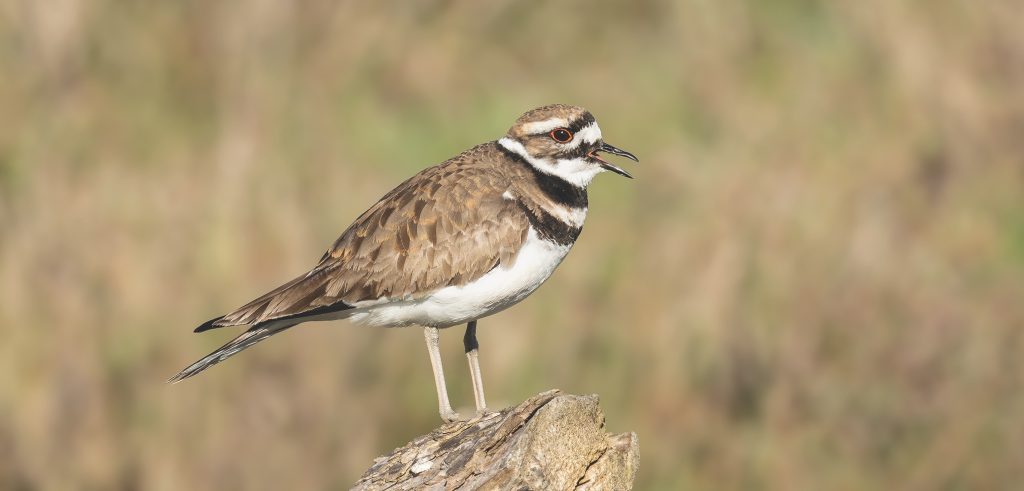
The killdeer is a small, brown-and-white shorebird that breeds in the Sandhills and Piedmont of North Carolina. The species can be found here year-round in the right habitat — and it need not be all that wet. Widespread in North America, most of the killdeer population lives away from the water’s edge. In fact, for egg laying, the drier the spot, the better. In truth, our sandy soil is not unlike the beaches where one would expect to find a shorebird.

This robin-sized bird gets its name from its call: a loud “kill-deer, kill-deer,” which can be heard day or night. During migration, individuals frequently vocalize on the wing, high in the air. In early spring adults will circle above their territory calling incessantly.

On the ground, killdeer are a challenge to spot. They blend in well with the dark ground, hidden against the mottled surface of a tilled field or a gravel covering. Killdeer employ a “run-and-stop” foraging strategy searching for insect prey on the ground. As they run, they may stir up insects, which will be gobbled up as the birds come to a quick halt. Although they live in close proximity to humans, killdeer are quite shy and more likely to run than fly if approached. When alarmed, they frequently use a quick head bob or two, likely a strategy to make the birds appear larger than they are.

During the winter months, flocks of killdeer concentrate in open, insect-rich habitat such as ball fields, golf courses or harvested croplands. Come spring, pairs will search out drier substrates, preferring sandy or rocky areas for nesting. They may even use flat, gravel rooftops. The female merely scrapes a slight depression where she lays four to six speckled eggs that blend in with the surroundings. She will sit perfectly still on her nest and incubate the eggs for three to four weeks. If disturbed by a potential predator, the female killdeer will employ distraction displays to draw the intruder away from the eggs, going so far as to feign a broken wing. The mother bird will call loudly and with her tail spread — to be as noticeable as possible — limp along dragging a wing on the ground. This “broken wing act” can be very convincing, giving the predator the idea that following the female will result in an easy meal. Once away from the nest, the killdeer will fly off, not returning to the eggs until she is convinced the coast is clear. Should distractions by the adults not be effective, the pair will find a new nesting location and begin again. A very determined nester, killdeer are capable of producing up to three broods in a summer.

When the eggs hatch, it will be a synchronous affair. As soon as they have dried off, the downy, long-legged young will immediately follow their mother away from the nest to a safer, more protected area nearby. They will follow her, being fed and brooded along the way, for several weeks. Once they are fully feathered, the young will have learned not only how to escape danger but how and where to find food.

So, if you hear a “kill-deer” over the next couple of months, stop and look closely. You may be rewarded with a peek into the summer life of this fascinating little bird.

Chaos Theory

CHAOS THEORY

Long Live . . .

All the magic and body art

By Cassie Bustamante

My mom wears a black-green, wide-leg jumpsuit, accented with a gold belt. She’s 70, but you’d never know it. Her hazel eyes smile in my direction. It’s a look I’ve seen through many softball games, high school drama productions and even at the birth of my oldest. She’s always cheered me on, and today is no different as I prepare to take the podium to introduce our two authors at our O.Henry Magazine Author Series.

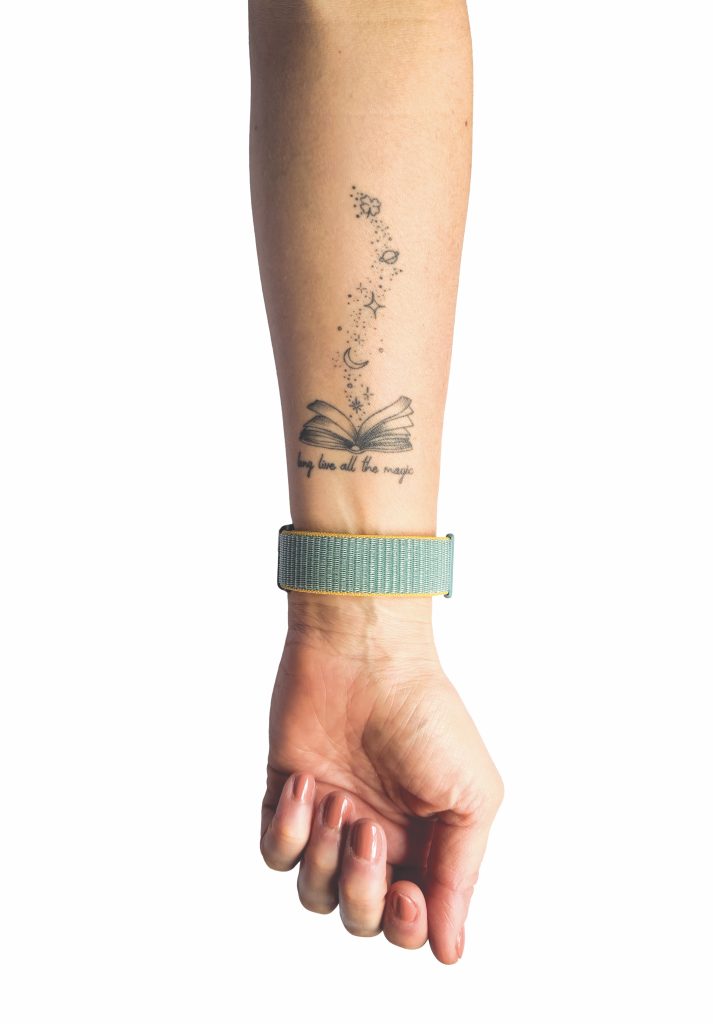
As soon as I see her, I comment on her outfit. “Mom,” I say, “You look fabulous! I almost wore a sleeveless jumpsuit, too, but was afraid the tattoo on my arm would be too aggressive.” Instead, I’d opted for a black dress with sheer long sleeves, the whole thing glimmering with gold stars and my tattoo tucked away.

“Well, it’s one of those you can just wash off, right?” my mom asks.

“Uh, no,” I say. “It’s real. Emmy and I did it together this summer.”

“Oh,” Mom replies, her voice suddenly many octaves higher. I can tell she’s horrified that my 18-year-old daughter and I got inked together.

Mom and I have always bonded over books, passing them back and forth between us. Body art, not so much.

And this isn’t her first rodeo, nor mine. When I decided to get myself a tattoo for my 19th birthday, my mom retorted, “It’s your body, do what you want.”

That, followed by, “But remember, it’s going to be there forever.”

Forever, got it. To the tattoo parlor I went, returning home with a small daisy on my inner right ankle.

A few years later, I added another small-ish tattoo on my lower back — a graphic sun to pay homage to my zodiac sign, Leo. Yes, I fell victim to what was soon dubbed the “tramp stamp,” but, according to TikTok, they’re making a comeback. And, to be honest, I always forget it’s there until someone sees it and mentions it.

Almost 25 years later, when Emmy says to me that she’d like to get a tattoo, I jump on board.

“I want a new one, too! Can I come?” I ask. “What are you thinking?”

We spend the next couple of months deciding on designs. Emmy selects a small paper airplane followed by a trail of sparkling stars to put on her wrist. I find a design I like, but personalize it a bit to fit me. It’s an open book, a trail of stars, the moon and Saturn escaping its pages. At the very top, I add a four-leaf clover to honor my late business partner and friend who owned Sweet Clover, a vintage home store, with me. And below the book, it reads, “long live all the magic.”

While that quote is a line from my favorite Taylor Swift song, it’s also about writing my stories. May the memories and moments I capture live long after I am gone for my own kids to treasure. Or laugh at. Whichever, as long as it brings them joy.

We schedule an appointment with Taylor (yes, that’s her name!) at Dogwood Ink Tattoo. Emmy’s best friend, Kiah, joins us and in less than 90 minutes, we’re out of there, all with fresh body art on our forearms.

A few weeks later, it dawns on me that I don’t quite know why Emmy went with the paper airplane so I ask her about it.

“Remember when we went to the Eras concert, Mom?”

“Of course,” I say. How could I forget taking my only daughter to Taylor Swift’s epic show.

“Our bonus song was ‘Out of the Woods,’” she says, then quotes the song. “You know, ‘Two paper airplanes flying.’”

Wow, her tattoo is to commemorate a special moment with me? I feel myself choking up, grateful that Emmy and I, like my mom and I have books, have music. And now tattoos that, yes, Mom, will be there forever.

Suddenly, I wish I’d gotten a paper airplane, too.

I look down at my own right wrist, free of designs. Maybe one day. 

The Greener Way

THE GREENER WAY

The Greener Way

The Downtown Greenway paves the way for pedestrians, pedalers, plant lovers and pollinators

By Cassie Bustamante     Portrait Photograph by Bert Vanderveen

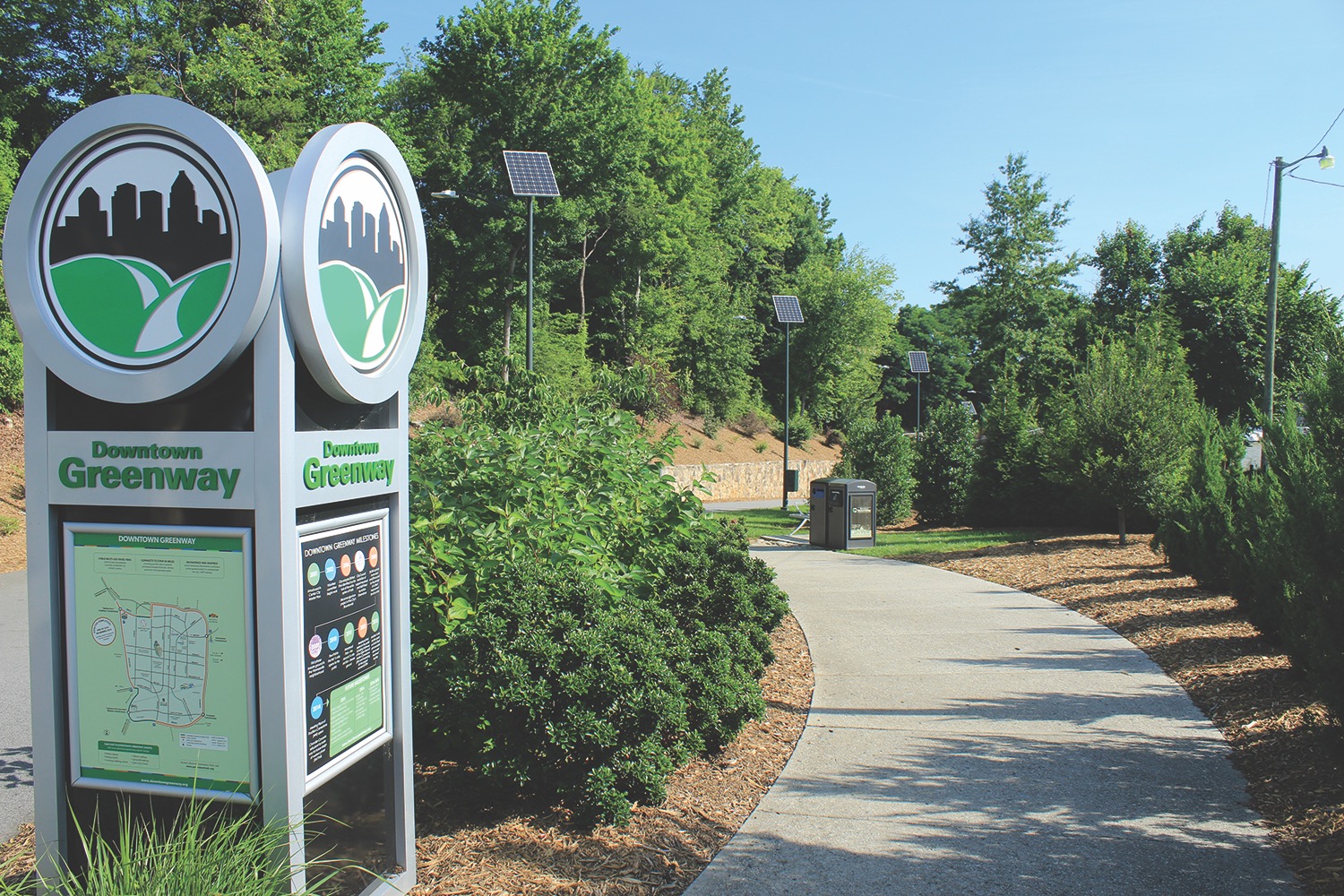
Greensboro’s Downtown Greenway is coming full circle this month. Literally. After a quarter century of planning, meetings, compromises, digging, planting and construction, Trip Brown is thrilled that his exercise-fanatic wife, Christine, can finally hike the completed, long-awaited, 4-mile trail that loops around Greensboro’s center city, reflecting that what goes around comes around: “One time, one of our major supporters said, ‘Look, what are you all waiting on? Just put the asphalt down and be done with it.’” But that wasn’t good enough for Brown, who spearheaded the Greenway volunteer committee, and others involved who wanted so much more.

“Well, guess what?” he continues. “The asphalt is almost like a minor part of it. Now you get the beautiful green and all the planting and everything.”

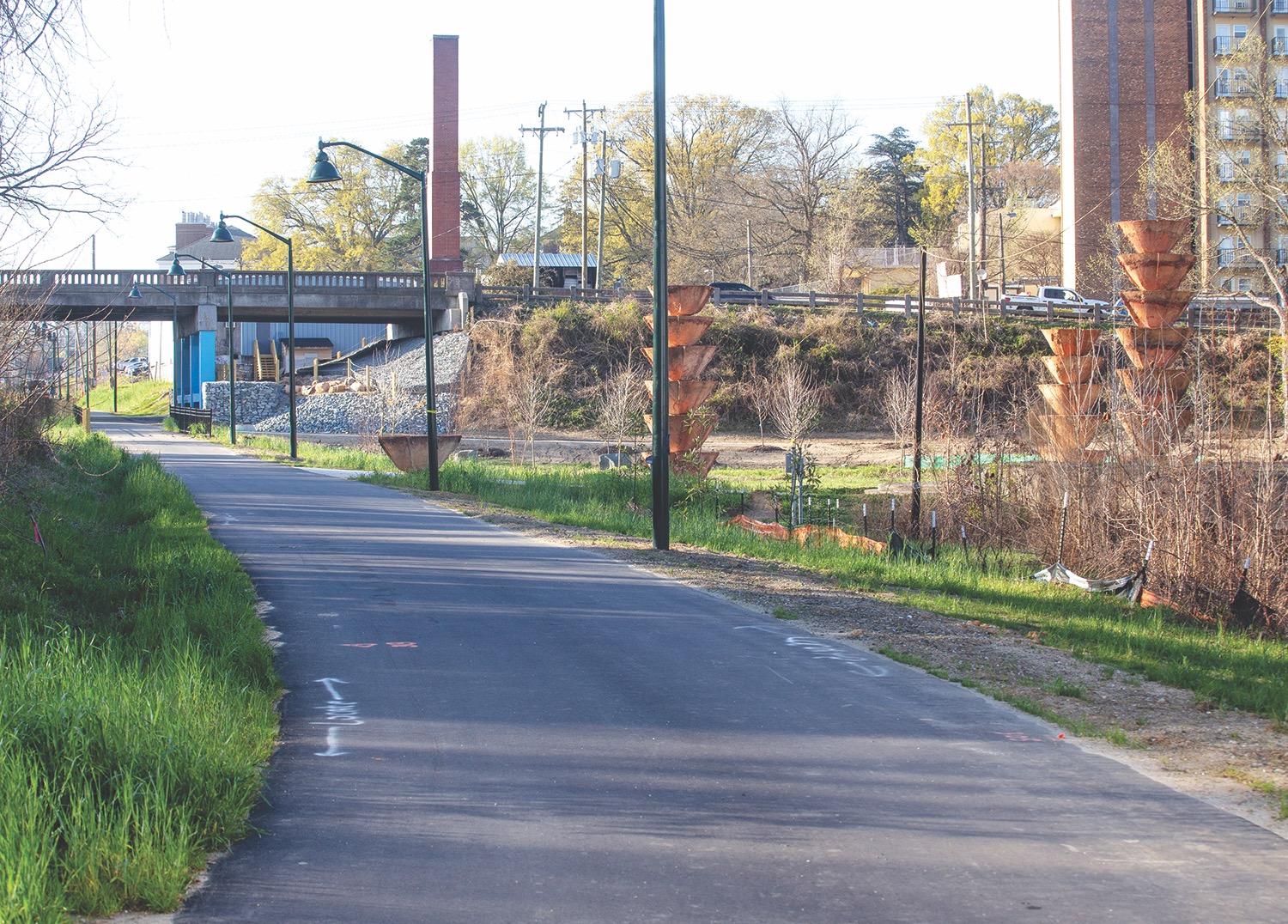
For the board chair of Brown Investment Properties, “everything” ultimately included more than 35 public art installations that explore Greensboro’s culture and history, from textiles to civil rights. Plus, a please-pick-the-fruit orchard, 187 bio retention cells and gabion baskets (more about them later), restored stream beds, and countless features that, together, are a thoughtful invitation to move your body while engaging in a thriving, sustainable ecosystem that squarely puts the “green” in both this innovative greenway and Greensboro.

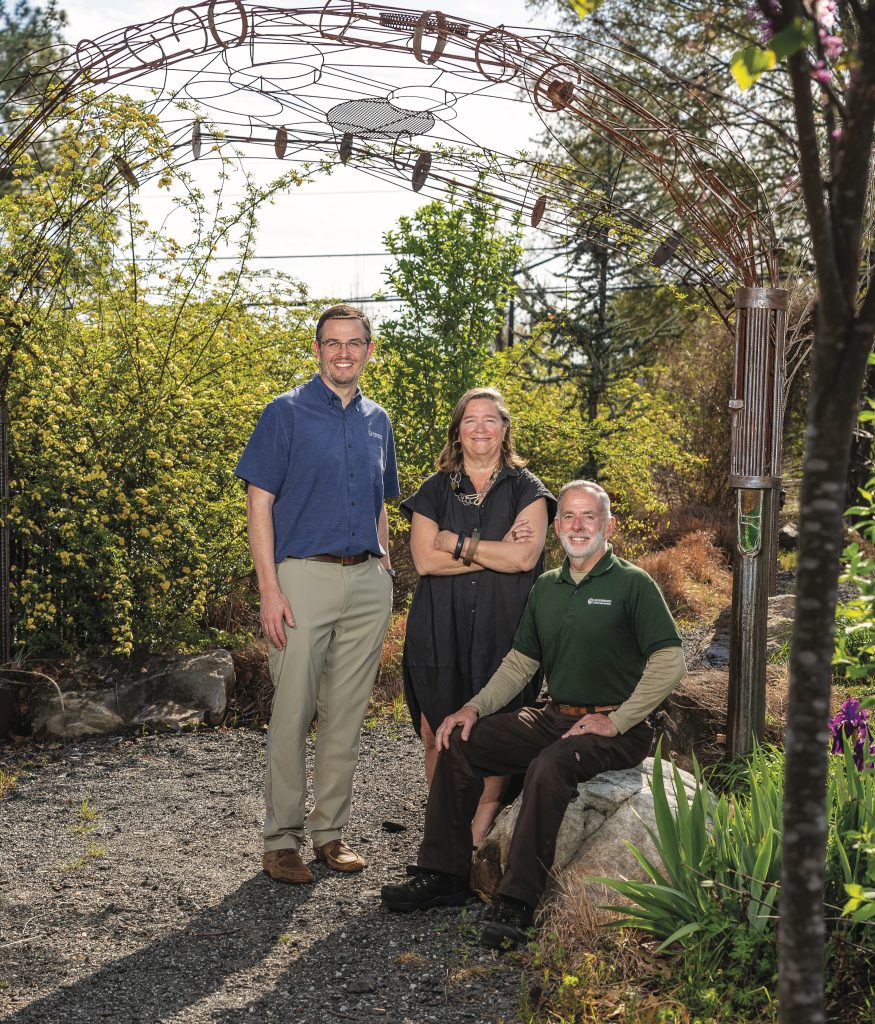
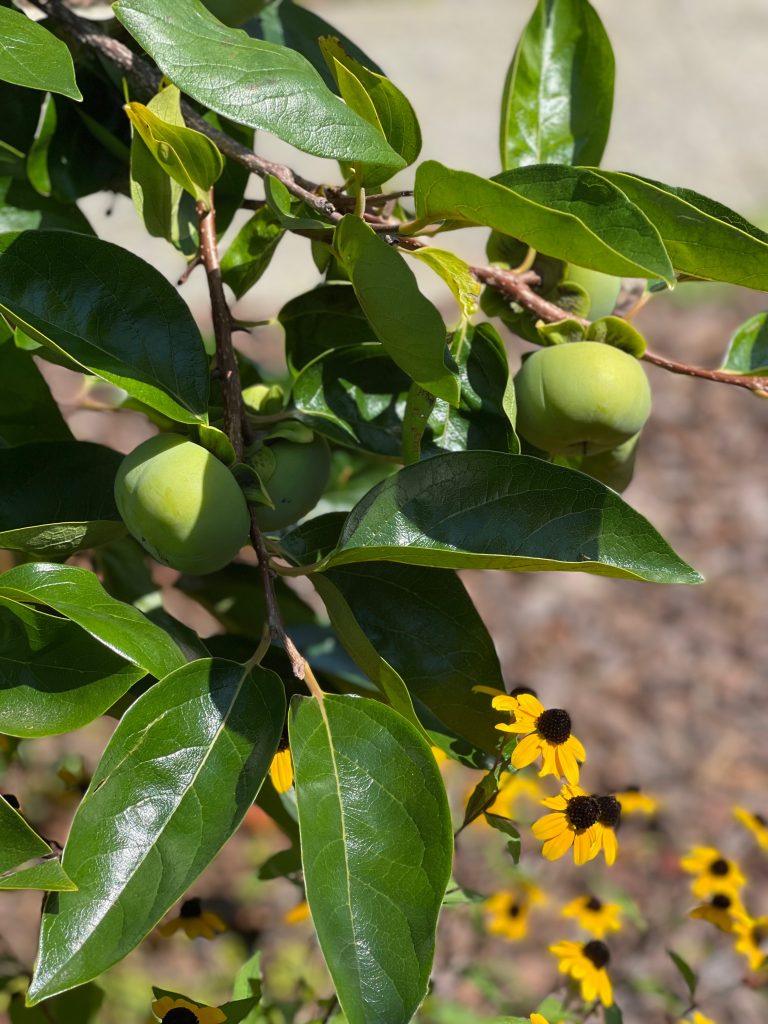
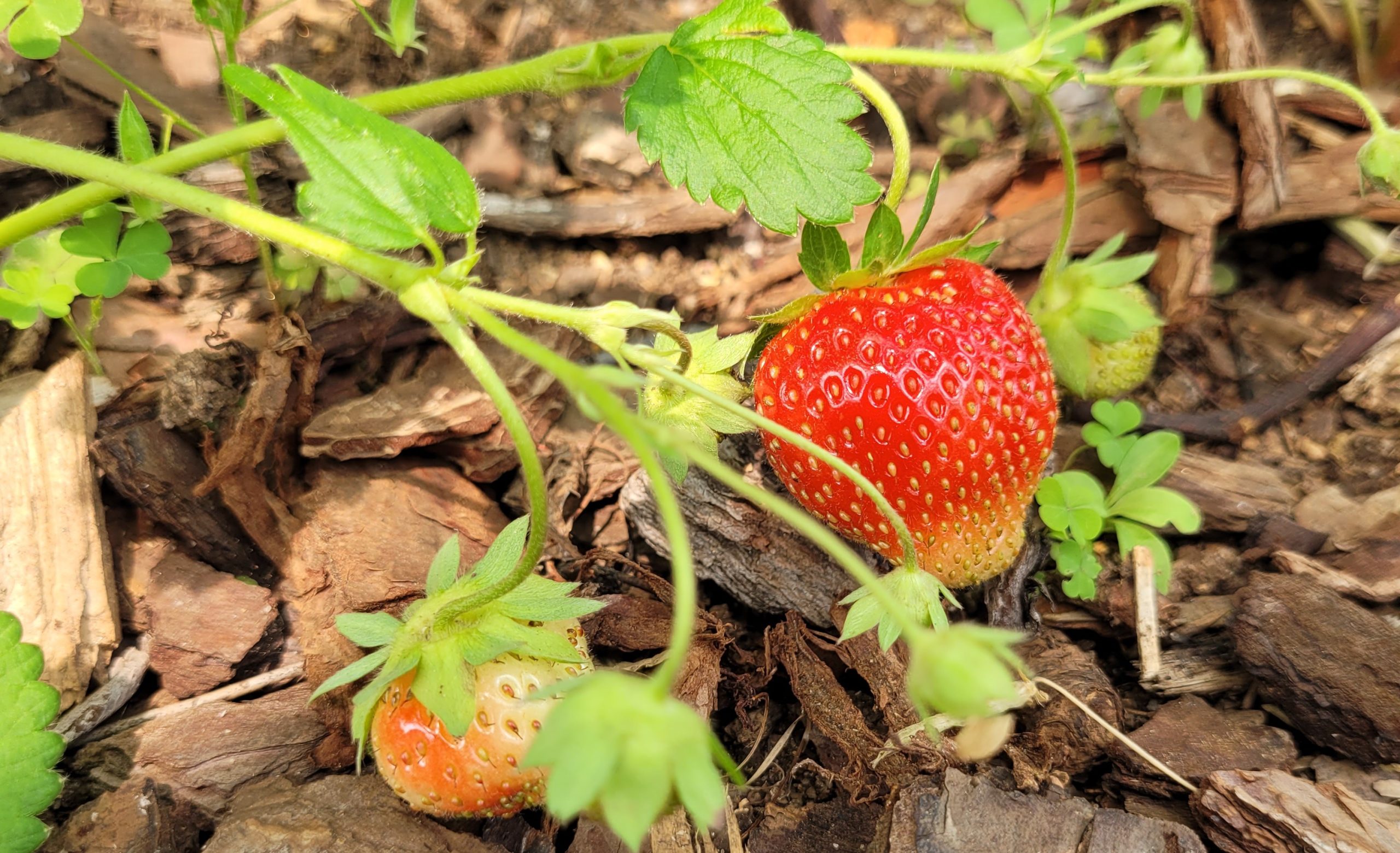
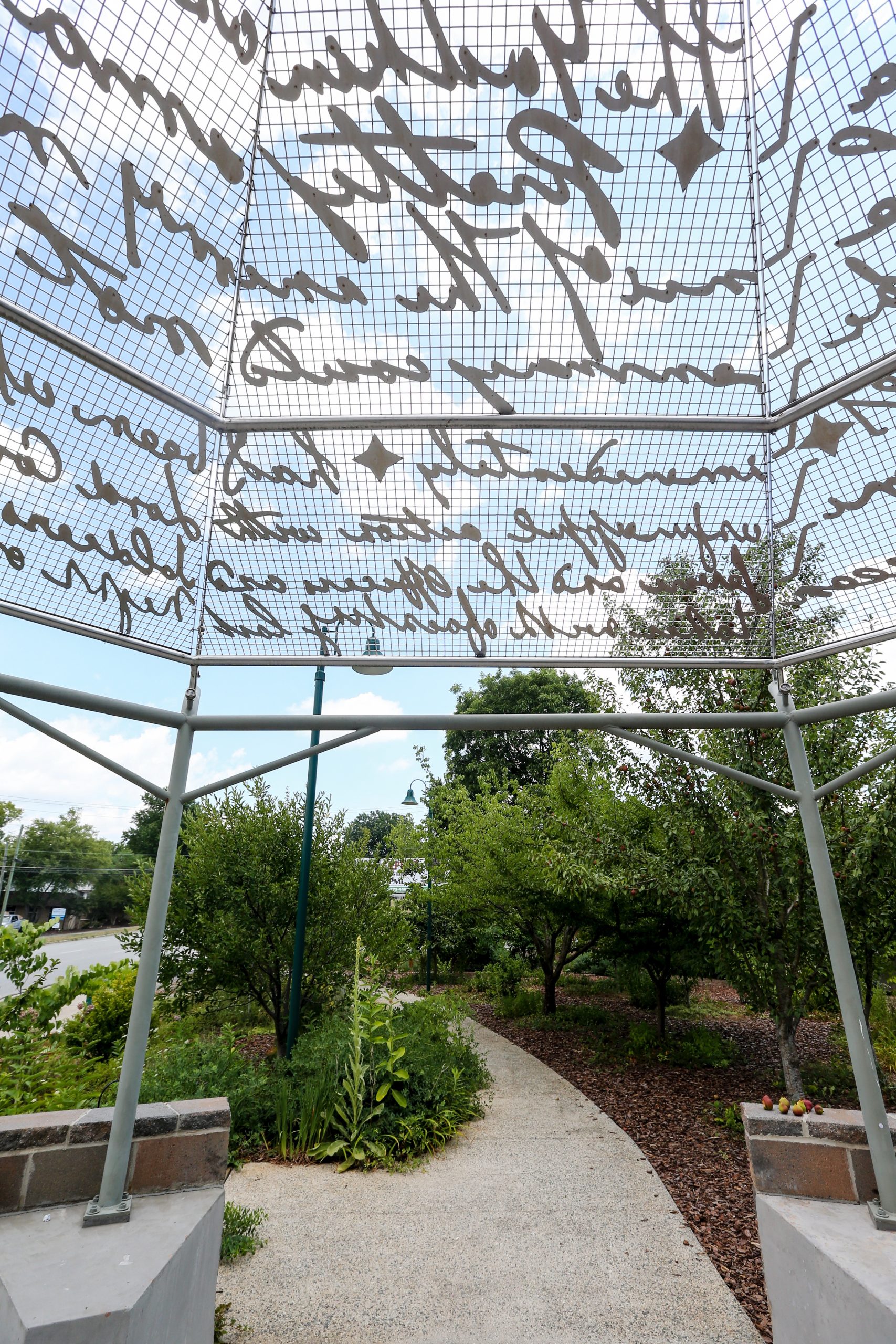
I begin my walk around on an early spring day at Greenway’s Meeting Place, one of many public art installations found along the trail. Hints of pink are emerging on early blueberry bush blooms. Nearby, fig and other fruit trees are just starting to come back to life after their winter’s nap. Soon, strawberries will be shooting up from the earth. If, later in the year, you’re out on a stroll and pass by this orchard, you’re welcome to help yourself to the plump, juicy figs beckoning from easy-to-reach branches. “You’ve got to come early though,” says Franklin Bowman, Downtown Greenway’s crew supervisor and one of my guides, “or they’ll be gone.”

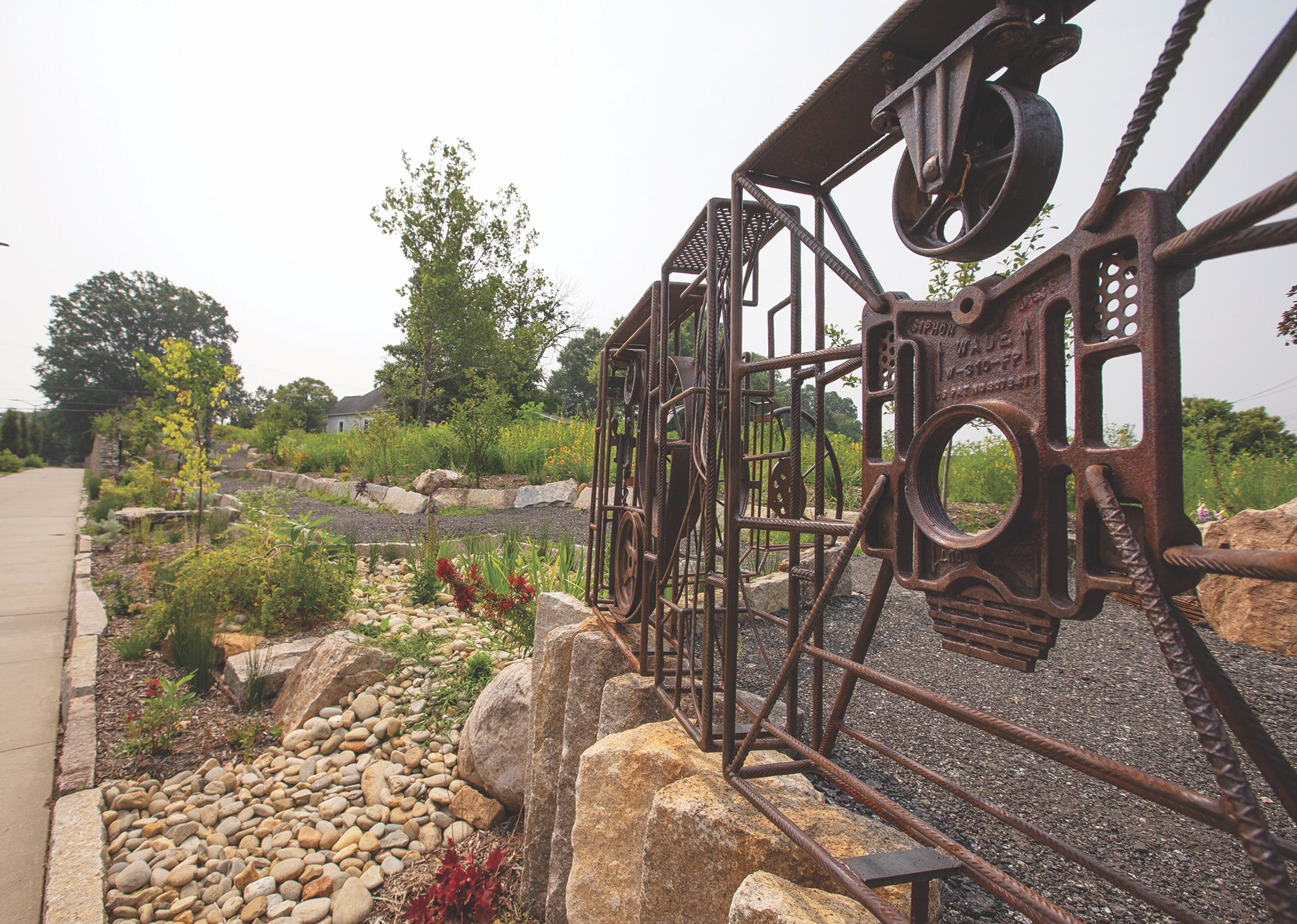
“We recommend, you know, save some for others,” chimes in Matt Hicks, the City of Greensboro’s botanical gardens superintendent, who oversees the crews that maintain the city’s four botanical gardens, four municipal cemeteries, landscaped areas of LeBauer and Center City parks, and, of course, the Downtown Greenway. The orchard is just one of many ways the Greenway aims to foster sustainability. I continue walking just a few yards away to High Grove and discover art created from found metal pieces, such as a pulley, and asphalt-milling paths bordered by granite curbing taken from the city’s former guttering system.

Hicks, who graduated with a degree in horticultural science from N.C. State, points out just how rare it is for a city’s downtown to have so much lush green compared to concrete gray. “[The Greenway is] preserving those natural areas that aren’t often seen in an urban environment.”

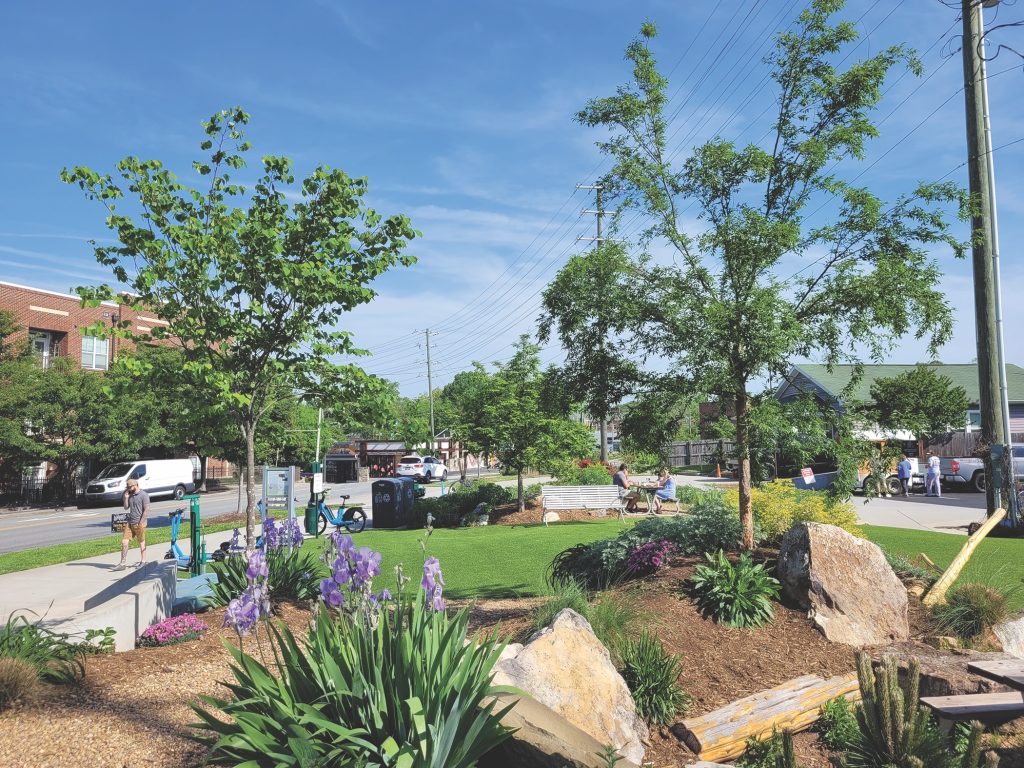
When High Grove is in full bloom come late spring and summer, its pollinators and herbs will be a feast for the senses, lush with greens, reds, pinks, purples and yellows — every color of the rainbow, says Bowman. Take a deep breath in as you jog by and you might just catch the scent of rosemary. Perhaps you’ll stop and grab a sprig for that potato salad you’re bringing to your neighbor’s cookout.

On the opposite side of the sidewalk, several “rectangular gardens” line Smith Street. What, exactly, are those?

“I’ve been waiting for four years for someone to ask me that,” quips Bowman.

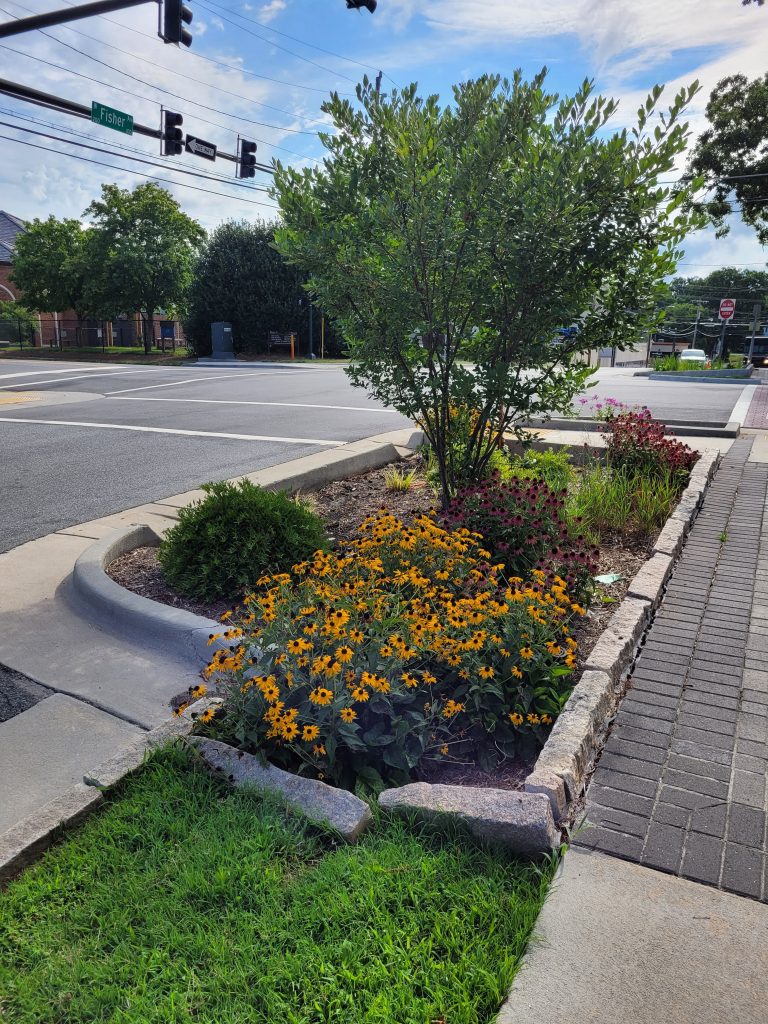
He explains how these shallow, landscaping depressions, aka bioretention cells, work. Each cell is planted with trees and plants and, when storm water rushes in from the street, “Mother Nature takes control,” filtering the water back into the ground and turning contaminated and often polluted storm water into water almost clean enough to drink.

“That’s a big deal,” he adds. “And I hope you put a little thing in your magazine about that because Greensboro should be really proud of that in my opinion.”

In total, there are 187 bioretention cells filtering water for our city’s inhabitants and, according to Downtown Greenway project manager Dabney Sanders, they are “the maintenance crew’s worst nightmare — so high maintenance, but so important environmentally.” Because storm water often carries with it debris, the bio cells often need attention.

Picking up a cup here, a cigarette butt there, Bowman says, “We spend a couple hours, three hours every day, picking up litter.” His small but mighty team consists of three full-timers and two rosters. He side-eyes Hicks, quipping, “I’m hoping my supervisor will give me three more rosters. I want that on record, please.”

Hicks, without missing a beat, says, “We’re looking at actually looking for volunteers.” Between gardening and trash cleanup, there’s always plenty of work to be found.

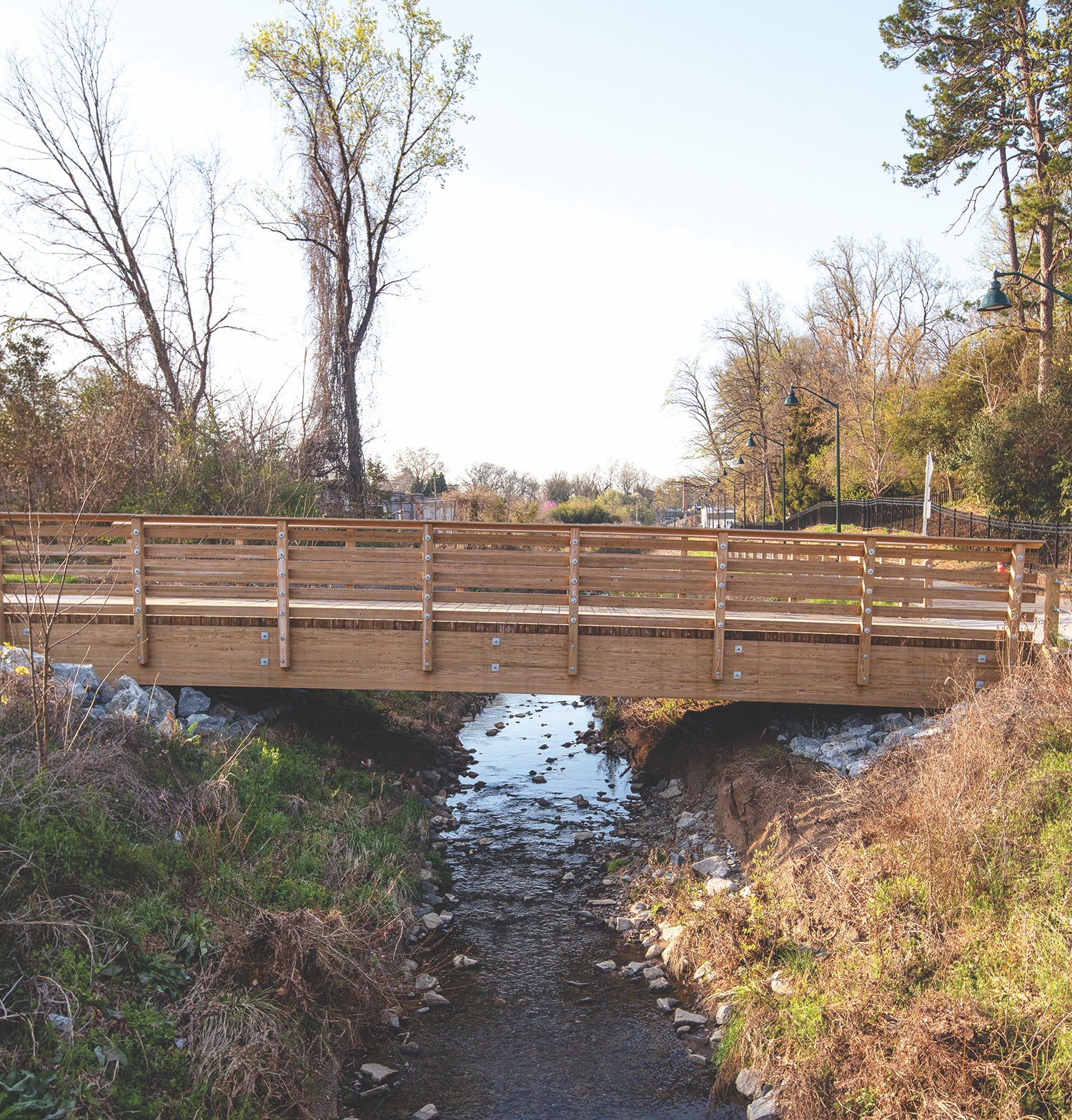
Heading south along the Western Branch towards Market Street from Smith, we pass the College Branch Stream, where volunteers often work to keep the water and its surrounding banks clean. Plus, crews have worked doggedly to restore it structurally, returning the water to its natural flow — so flora and fauna in the stream bed aren’t flushed away — and eliminating further erosion. Grasses blow in the cool spring breeze and young, freshly-planted trees will soon mature and offer shade. “There’s been a great blue heron hanging out there,” notes Sanders about her last four visits to the Western Branch. “It’s really neat to see that.”

An art installation nearby, created by UNC alumni Thomas Sayre, pays homage to the stream. Cairn’s Course, as it’s called, was created by using earth cast molds dug into the land adjacent to the stream, forming “stones” that were stacked like cairns often spotted on wooded hiking trails. Terrazzo stepping stones in that area depict the types of aquatic life you might find in the College Branch Stream.

Continuing south, the Friendly Avenue underpass becomes more visible. Bowman mentions that he put the bottles up. What bottles? “Wine bottles, and messages in the bottles.”

Sure enough, embedded in the underpass wall are gabion baskets — durable, wire-mesh structures, often filled with rocks and used as retaining walls — housing numerous bottles. Hicks says it was a way for the Greenway to honor donors who gave a certain dollar amount. They “had the opportunity to put a message on a metal tag that went in a wine bottle” and now the bottles collectively front the pass-through. What is it they say? One man’s empty is another man’s art.

“You ever been to Morehead at Five Points?” Bowman asks. Just after crossing Spring Garden is the garden that is Sanders’ personal favorite, according to Bowman, and it’s a bit off the beaten path, full of trees and vegetation. “It makes you think you ought to be somewhere else. Not just a hop, skip to downtown.”

Also along the Morehead stretch, you’ll find the Greenway’s first sustainability-minded project, solar-powered lighting. You might say it was a light bulb moment, turned on by a 2011 Federal Energy Block Grant. “It was the first solar-powered lighting the city had ever done,” says Sanders. Those initial lights were replaced two years ago with new, improved technology and functionality. Now, the lights have a bit of sensitivity to them; while they’re usually pretty dim, as foot traffic approaches, their light brightens.

Not only do solar-powered lights conserve energy, but they do less harm to the animal kingdom as well. The City of Greensboro annually partners with the T. Gilbert Pearson Audubon Society’s “Lights Out for Birds” program in both spring and fall. The initiative requests that residents turn off nonessential lights that can disorient migrating birds. You get the added bonuses of energy conservation and less light pollution.

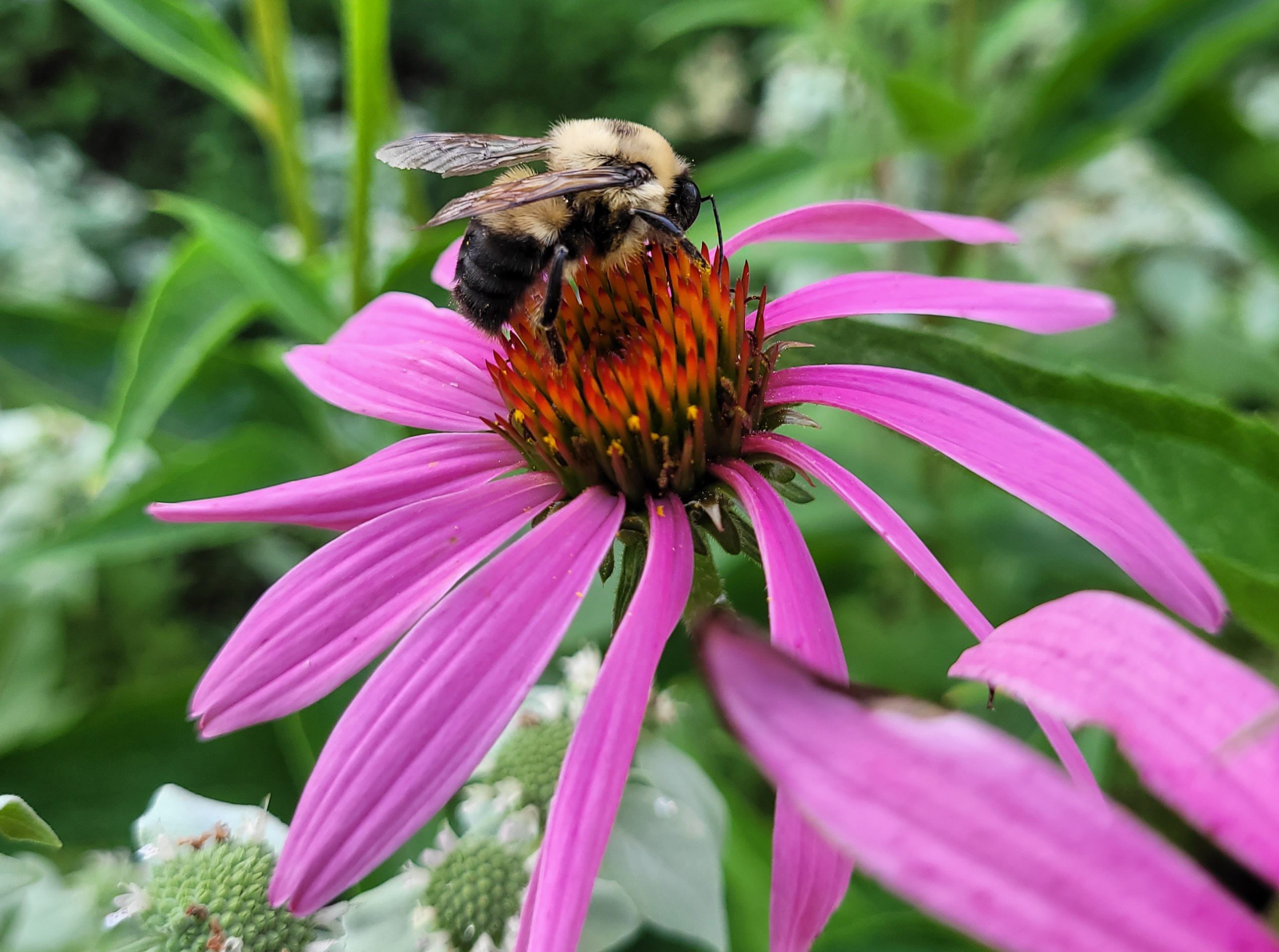
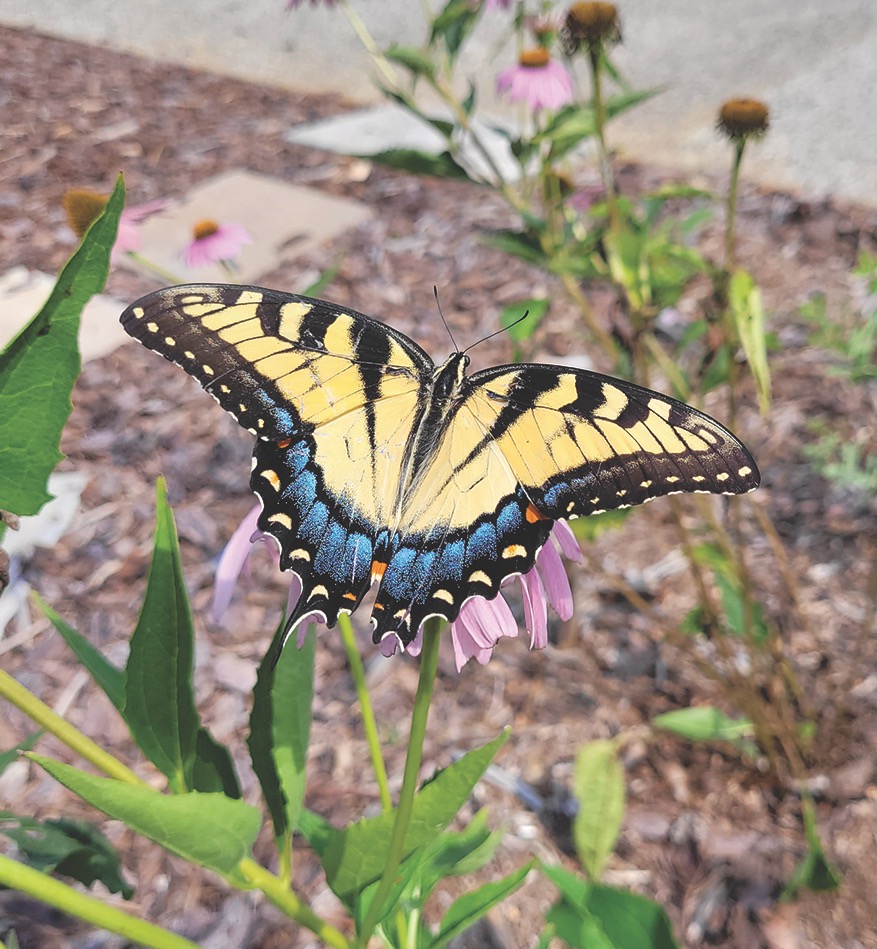
As the loop wraps around the south side of the city and turns north along Eastern Way, the Greenway’s pollinator garden comes into view. On this early spring day, it’s quiet, green shoots just emerging from hibernation. This garden, planted in Woven Works Park, uses the environmentally-friendly method of sheet mulching, where layers upon layers of leaf mulch and organic material kill unwanted weeds and grasses without damaging soil quality.

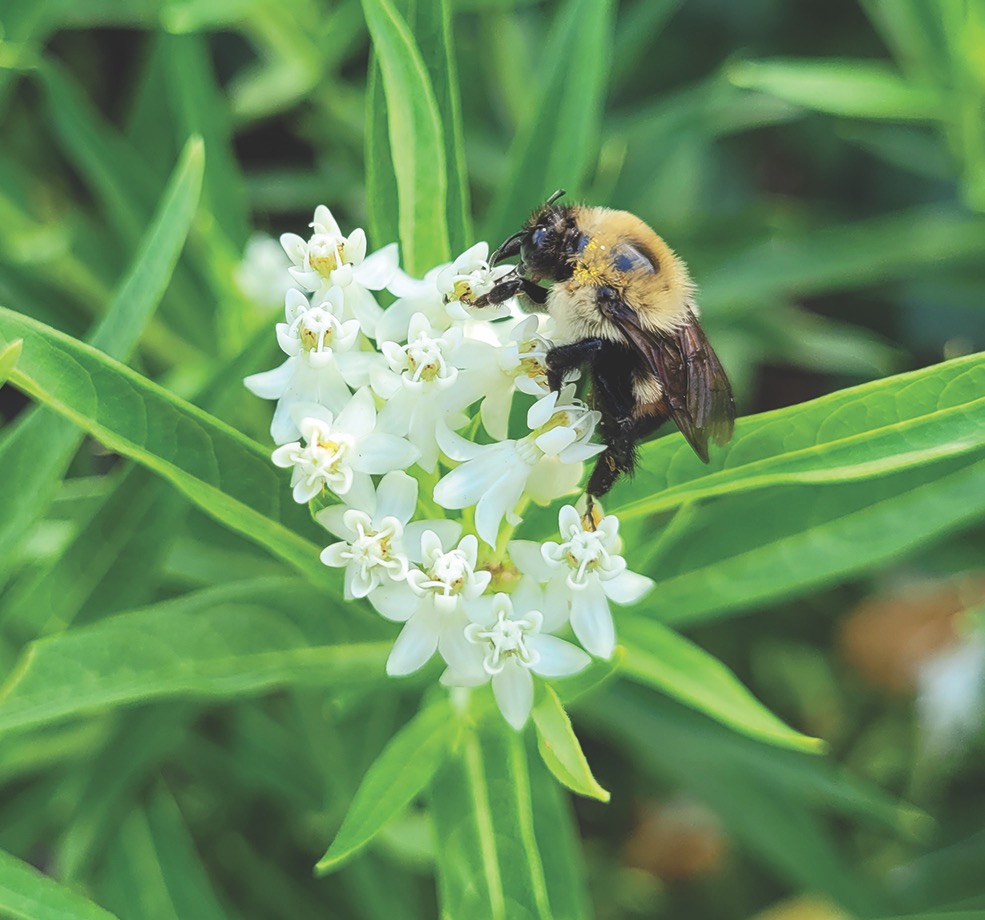
Soon, it will be buzzing with activity as bees and butterflies flutter through. “I did see monarchs last year,” notes Bowman. “And that’s a big deal if you keep up with that.” Monarch butterfly populations have been on the decline for several years but, in 2025, experienced a bit of a rebound. “I hope they come back,” he adds.

In the last of the gardens, LoFi park, permaculture gardeners David Mudd and Justin Vettel, who also designed High Grove, once again took a sustainable approach with their planting style and materials. “That’s kind of in their DNA,” says Hicks.

Of course, as it sits right in front of local brewery Joymongers, he quips, “It has become essentially Joymongers’ front yard.” With kids often running amok while nearby parents sip craft beer, the grass they’d originally planted took a beating. But never mind. Now, it’s all turf and planted beds.

Sanders would love to see even more gardens pop up because they’ve really resonated with nearby residents and greenway walkers alike and provided the Downtown Greenway plentiful opportunities for the community to learn and work together. “It’s just a real nice way to physically get people engaged with it.”

In fact, on May 4, you can attend a pollinator gardening workshop at Woven Works, perhaps drawing monarchs to your own yard. (This is one of numerous programs the Downtown Greenway offers for free.) Through both visibility and education, Sanders says that she wants the Greenway to serve as an example of what’s possible for the environment. “You don’t really see those actual environmental benefits in the short term. It’s super long term.”

Finally, you can get a taste of what’s been thoughtfully cultivated over the last 25 years. So, go ahead, venture out and enjoy the fruits of the city’s labor. After all, berry season is near.

Paving the Way

When Action Greensboro, a nonprofit that serves as the city’s primary economic and community development group, was formed in 2001 and Susan Schwartz was named executive director, the Greenway wasn’t even yet on the organization’s radar. “We had five or six areas that we were focused on,” recalls Schwartz, who now serves as executive director of the Cemala Foundation, “and one was Center City revitalization.” (The Cemala Foundation was founded in 1986 by Martha and Ceasar Cone II, former Cone Mills president and chairman, as a means to continue supporting their community long after their own deaths.)

Action Greensboro enlisted Cooper Carry, an Atlanta-based architecture firm “with a focus on connecting people to place,” to come up with a master plan — a grand plan that included the creation of Center City Park and relocating the home base of the city’s minor league baseball team, the Greensboro Grasshoppers, from Yanceyville Street to Bellemeade.

On a visit to Greensboro, former firm principal Richard Flierl toured downtown with city employees, who, Schwartz says, just happened to know about an old, overgrown, hidden underpass and bridge, where a road had once ended. They showed it to Flierl. A seed was planted in his mind and he envisioned what could grow into a connective, biped loop encircling the city’s downtown. Businesses would swarm and the path itself would connect it to hundreds of miles of trail, making Greensboro a central hub.

Flierl left Cooper Carry during the project, but, Schwartz says, “He really did give us a great foundation for how we could be telling Greensboro’s story and, at the same time, adding the public art.”

Still, it took a while for that little seed to germinate. Action Greensboro formed a volunteer committee, spearheaded by Brown Investment Properties board chair Trip Brown. In 2003, Brown, with community leaders Walker Sanders, president of the Community Foundation of Greater Greensboro, and Skip Moore, then president of the Weaver Foundation, traveled to Norfolk Southern Railroad headquarters in Roanoke. There, they initiated a railroad corridor negotiation that would end up taking 16 years.

Then, in 2004, the Cone Health Foundation pledged $500,000 to fertilize that fledgling seed. Soon, a preliminary design was revealed to the public and the city council adopted it.

Roots firmly taking shape in the ground, the Downtown Greenway brought on Dabney Sanders as its project manager in 2007. She’d previously been working as an Action Greensboro special projects consultant.

“She had this interest in plants and trees . . . and both of us like public art,” recalls Schwartz. “It’s just a little marriage made in heaven.”

In 2008, The Cemala Foundation pledged the Downtown Greenway its first significant gift: $1.5 million. Three more pledges, each at $1 million, rolled in from the Bryan Foundation, the Weaver foundation and the Cone Health Foundation.

Finally, eight years after its inception, that little seed broke ground in 2009.

Of course, all along, organizers knew a nice side effect could be eliminating some automobile emissions as people used it to walk to work. In fact, Brown recalls being interviewed for a local news station when the first phase was just about to open. He touted it to the reporter as “an alternate means of transportation for work.” Lo and behold, a man came walking the path toward the camera crew. “In a couple minutes, he was there,” recalls Brown, “so they went over and asked him what he was doing on the Greenway, and he said, ‘Well, I’m walking to work.’”

Brown lets out a chuckle. “I am still wondering if somebody set that up,” he quips. “It was too perfect.”

But, somewhere in that planning, as Sanders and her team worked with consultants on the design details, the idea of sustainability blossomed. “It quickly rose to the top as a real opportunity we had here in this very urban environment,” she says.

“We think about that a lot now,” she adds.

“It came on early enough that we could really think about it the whole way through,” says Schwartz.

There’s no doubt that the Downtown Greenway contributed to the center-city momentum that drew new businesses to downtown, especially those adjacent to the Greenway, including The Greenway at Fisher Park and The Greenway at Stadium Park luxury apartment buildings, Joymongers Brewing and restaurants such as Machete and Sage Mule. Deep Roots Market relocated to its current spot on North Eugene, adjacent to the Greenway. Plans are underway to connect the Greenway to the Atlantic & Yadkin Greenway, with an expected completion by Summer 2029.

But, in the end, the Downtown Greenway grew into something more than anyone could have imagined.

Of course, Sanders quips, “We gotta quit saying it’s the end. It’s really the beginning.”  OH