
A Portrait of O. Henry
A Portrait of O. Henry
The mysterious master of short stories and tall tales
By Cynthia Adams
By the time he arrived in New York City in 1902, writer William Sydney Porter was in his 40s and had effectively disappeared into his identity as O. Henry. Living in a Gramercy Park apartment, he was grinding pieces as fast as he could produce them, committed to writing a short story weekly from 1903 to 1906.
One biographer, David Stuart, said he wrote his opus, “The Gift of the Magi,” in a few feverish hours as The New York Sunday World’s Christmas edition waited on press. (To further burnish the legend, he was said to have written “Magi” at Pete’s Tavern near his apartment.) Porter produced nearly 400 short stories by 1910.
He sought anonymity, refusing to allow publications to print his photo. He haunted the city by night, including the Bowery and Hell’s Kitchen. And he drank.
During a rare 1909 New York Times interview at home before his death, he suggested the writer describe him as a “healthy butcher.” The writer duly noted his full head of hair. But Porter, in the last stages of cirrhosis, was a dying man.
He reported earning $750 for a short story in the same interview. However, he also shaved five years off his age, saying he was born “in Greensborough” in 1867.
It was a common pattern for the chameleon-like author, having successfully hidden his three years in an Ohio Penitentiary for embezzlement by changing his name. Incarceration, The New Yorker once observed in a piece about Porter, “is the secret he spent the rest of his life trying to hide — even from his daughter.”
By the early 1900s, Marquis Who’s Who in America described him as “a cowboy, sheep herder, merchant, miner, druggist, and extensive traveler.” (He denied being a miner.)
The truth was remarkable enough: Porter was, in fact, a trained pharmacist, sketch artist, ranch hand, editor, bank teller, short-story writer — and, definitively, inmate.
In the fall of 1916, a full six years after his death, The New York Times outed the secret of his incarceration.
Undeterred, in 1918, the Twilight Club, later known as the Society of Arts and Letters, in New York established a national writing prize in his honor. It continues today.
One of Porter’s closest friends from Greensboro, Professor C. Alphonso Smith (buried in Green Hill Cemetery), soon published his biography.
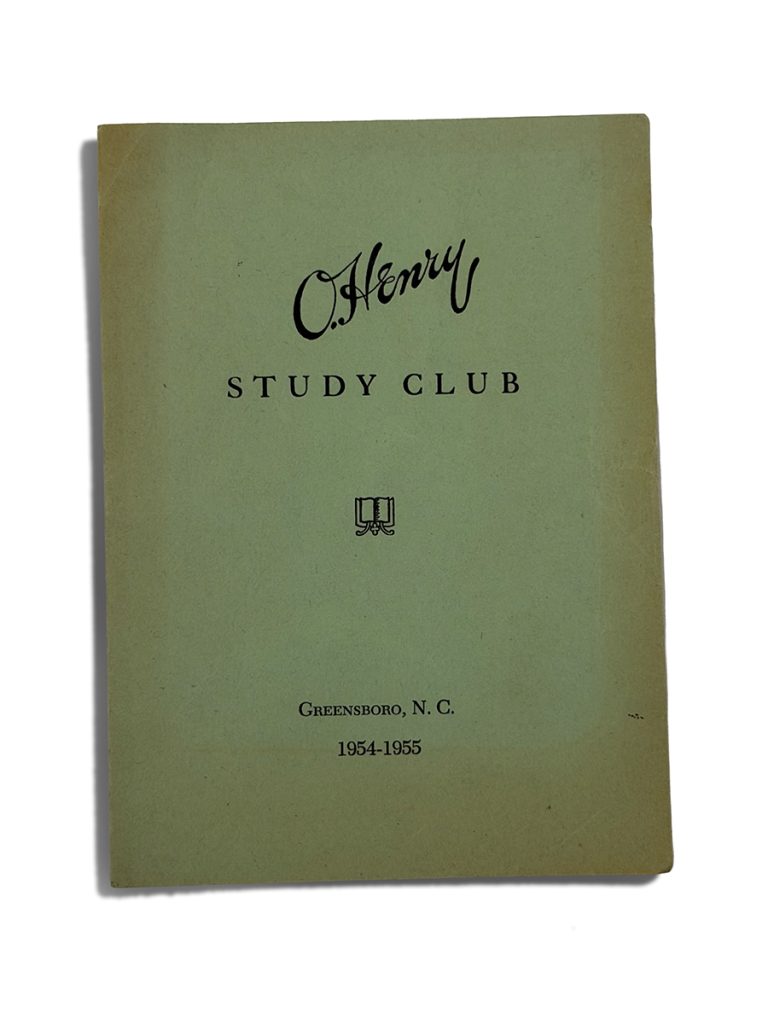
By 1923, a group of well-heeled women met in the home of Mrs. W. Justice to organize the O. Henry Study Club. Initially limited to 24 members, it was later expanded to 35, given its popularity.
In 1925, the club awarded its first O. Henry Short Story Prize, according to a club history by Mary L. Herbert archived at the Greensboro History Museum. A collection of club minutes and programs resides at the Greensboro History Museum.
“When Greensboro had only one senior high school, we established an award for the best short story written by a member of the senior class,” the historian noted. The first-place winner received cash or a government bond and a leather-bound set of O. Henry’s books.
Our magazine’s founding editor, Jim Dodson, won the O. Henry prize in 1970 as a Grimsley High School student. “It was a set of O. Henry books — still have them — and a sweet little certificate,” he recalls. A high school athlete at the time, he adds, “Very embarrassing, instant loss of cred with my buddies.”
According to archives at UNCG, the O. Henry Study Club continued into the 1990s, surviving longer than Porter’s 48 years. Recently, Greensboro resident Teresa Moore discovered a tranche of programs from the 1930s–50s belonging to her great-aunt, founding member Mrs. W. E. (Mary) Blair, depicting member names and duties.
By 1948, the O. Henry Study Club paid an $18.75 government bond to the first-place winner, and $10 to the second-place winner. Payouts were recorded from 1948–1965, when first place had risen to $25. (The writing contest was later overseen by UNCG’s literary magazine.)
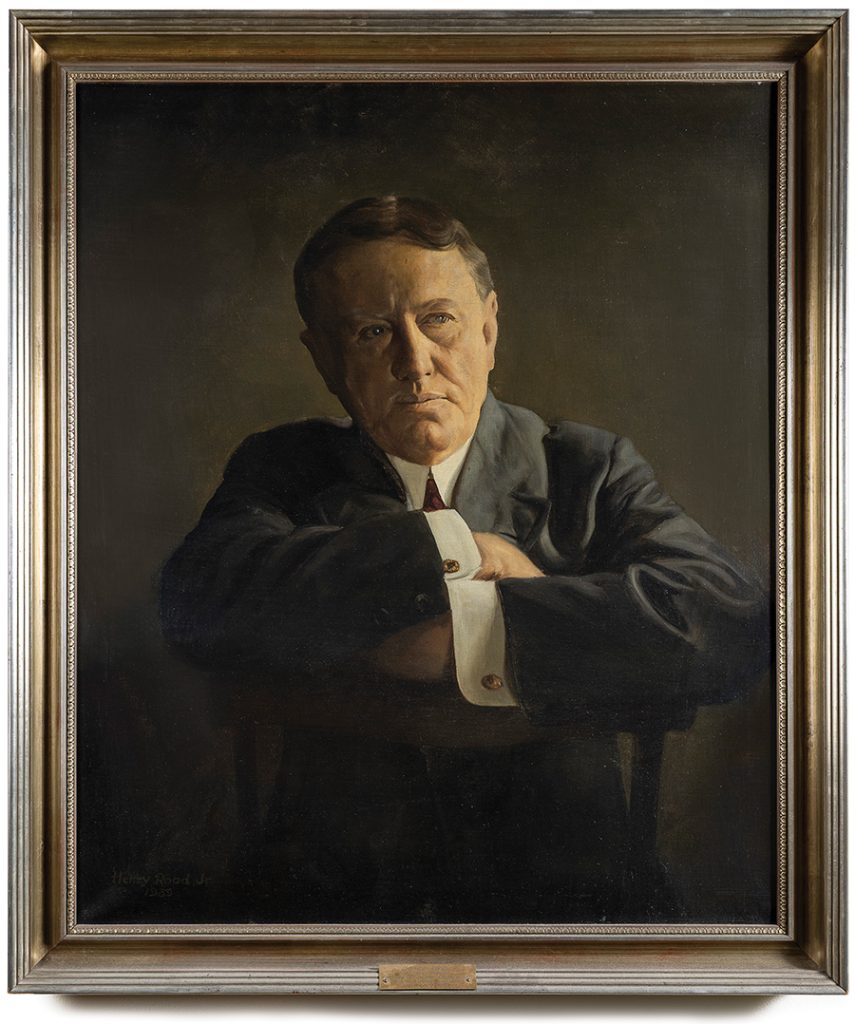
Approaching the O. Henry Study Club’s 25th anniversary in 1939, Nellie Rowe, head of the Greensboro Public Library and an O. Henry Study Club member, proposed something ambitious. An original portrait of Greensboro’s native son O. Henry should be presented to the library.
The club raised $500 from its members, equivalent to nearly $12,000 today, commissioning artist Henry Rood Jr.
The club planned the unveiling for September 27, 1939. Mrs. Henry P. (Ada) Foust, invited The Saturday Review from New York, using her finest monogrammed stationery. The Review sent regrets but requested a print of the portrait for publication.
O. Henry’s oil portrait was hung in the library, which occupied the first floor of what is now the Greensboro History Museum. Today it hangs in the Greensboro Public Library downtown.
Surprisingly, the pen name on this magazine’s masthead, created in 2011, was not the only pen name Porter adopted.
Former O.Henry contributing editor Jim Schlosser, who has researched Porter extensively, mentions his use of S. H. Peters and Sydney Porter.
The writer says Porter also considered James L. Bliss, T. B. Down, Howard Clark and Olivier Henry.
While on the lam in New Orleans, he had also flirted with the name Shirley Worth, his older brother’s first and middle names, filing newspaper assignments as Worth.
“A newspaper once wrote and asked me what the ‘O’ stands for,” Porter once said. “I replied, ‘O’ stands for Olivier, the French for Oliver. And several of my stories accordingly appeared in that paper under the name Olivier Henry.”
Only as inmate #30664 at the Ohio State Penitentiary did Porter settle on O. Henry.
The year before his death, Porter told The New York Times reporter, “It was during these New Orleans days that I adopted my pen name of O. Henry. I said to a friend: ‘I’m going to send out some stuff. I don’t know if it amounts to much, so I want to get a literary alias. Help me pick out a good one.’ He suggested that we get a newspaper and pick a name from the first list of notables that we found in it. In the society columns we found the account of a fashionable ball. ‘Here we have our notables,’ said he. We looked down the list and my eye lighted on the name Henry. ‘That’ll do for a last name,’ said I. ‘Now for a first name. I want something short. None of your three-syllable names for me.’ ‘Why don’t you use a plain initial letter, then?’ asked my friend. ‘Good,’ said I, “O” is about the easiest letter written, and “O” it is.’”
Austin, Texas, where he had worked, married and became a father, went unmentioned. It was the place where he had faced the death of a son and wife, plus ruin and conviction for embezzlement. It is also the home of the O. Henry Museum, housed in Porter’s former residence.
He produced as many as 14 short stories in 39 months of imprisonment. Some characters were modeled after friends and inmates. Jimmy Valentine in “A Retrieved Reformation” was based on another drug clerk in the prison hospital who was a “notorious safe blower,” according to a 1916 news story.
Twelve of his “best known stories belong to that period,” noted a posthumous article. The New Yorker piece noted that “bankers, millionaires and politicians . . . are the true grifters” and that Porter sided with “the marginalized and the downtrodden.”
To his close friend Smith, “O. Henry was the composite smile of Greensboro.”
Yet “The Gift of the Magi” differed: “Life is made up of sobs, sniffles, and smiles, with sniffles predominating.” Porter wrote those words at 43.
After his death, the writer’s popularity was undiminished, even as his secret was exposed.
Porter’s childhood friend wished to set the record straight. “Professor C. Alphonso Smith of the University of Virginia has decided to publish the complete story of O. Henry’s trial and imprisonment,” The New York Times reported in 1916.
The Times said listening to convicts “from Arizona, Texas, and the Indian Territory” informed his popular works, “turning a stumbling block into a stepping stone . . .”
In an improbable twist to his personal story, prison was where “he passed from journalism to literature.”
Smith’s biography devotedly compared Porter to Rudyard Kipling, Bret Harte and Guy de Maupassant, saying he had been hailed as “the Homer of the Tenderloin” in New York. He corresponded lifelong with Porter.
Smith had previously declared, “Unarguably, the greatest living master of the short story” was none other than Will Porter of Greensboro.
“Even in 1953, the final year of Stalin’s dictatorship, the Soviets printed almost a quarter of a million O. Henry books.” A century later, O. Henry’s popularity in Russia endures.
Porter’s last two stories were for Cosmopolitan magazine. The first, “Let Me Feel Your Pulse,” is eerily sentient and published on June 5, 1910 — the day he died. The final one, “The Dream,” was found on his desk, incomplete but with an outline. (It was published posthumously in September that year.)
He told the publisher he wanted to write something straightforward, completely different. A condemned man approaching death imagines a different life.
“Murray had dreamed the wrong dream,” he wrote.
With the story stopped mid-sentence, he was taken to the Polyclinic Hospital, where he checked in under a false name. Perhaps America’s greatest short story writer, O. Henry died alone two days later.
“About the only chance for the truth to be told,” he wrote another publisher that same year, “is in fiction.” OH