
ARCHITECTURAL DETAILS WE CANNOT RESIST
ARCHITECTURAL DETAILS
WE CANNOT RESIST
(Hint: Porches rock our worlds)
By Cynthia Adams • Photographs by Bert and Becky VanderVeen
My dad stood on the brakes whenever he spied a house featuring grand, white columns and a generous porch sweeping across the front, his dusty pickup sputtering to a stop. He stopped, fully fixated, before puttering on, often headed to an antiques auction.
“Just beautiful,” he’d sigh, shaking his head in awe.
He most admired “grand old gals,” as he called the finest homes with slate roofs, copper gutters, working shutters and Juliet balconies. He would loop through historic neighborhoods, excitedly pointing and teaching me to recognize and value those details, too. Years later, I learned he had dismantled and salvaged materials from a ramshackle house to build our first family home just before my birth, proving just how much of a house guy he was — or, at least, proving his thrifty resourcefulness.
As for me, I was captivated by the interior details of homes. What treasures were to be found inside?
And I was anything but practical.
With sparkling glass door knobs and a staircase to nowhere, even cobwebbing, cracking plaster and a dining-room floor that listed so much it gave you vertigo didn’t discourage my desire for a dodgy Westerwood home. It also possessed gorgeous molding (if an unfortunate, teensy fireplace) and a butler’s pantry — and a surprisingly serviceable floor plan featuring nooks and crannies galore. It quickly won the hearts of two neophyte homebuyers.
Old house lovers get it.
Perhaps it takes preservationists and architectural buffs to fathom the irrational, deep affection historic homes and buildings inspire. And most can quickly tell you what particular details make their pulse quicken with pleasure — and why. They have an internal catalog of favorite things — from window details to arches. According to home blogs, they are particularly smitten by original details, especially French doors with mullions, substantial moldings and casings, ceiling details and medallions, and wall paneling.
So, I began asking some of my favorite old-house lovers, many of whom just so happen to have preservation credentials, to share some of their favorite architectural details up and down Greensboro’s streets and avenues.
Take Katherine Rowe, who lives in a classic brick two-story in the leafy and grand neighborhood of Sunset Hills and discovered a passion for historic homes while coming of age in Salisbury, where there is a thriving preservation movement.
Proof? She served as an officer of Preservation Greensboro’s Board of Directors and dedicated 21 years volunteering with its Architectural Salvage program.
Rowe currently serves as a commissioner with the Historic Preservation Commission of Greensboro (HPCG). Two years ago, she helped judge the Community Appearance Awards of Winston-Salem and Forsyth County. Vocationally, she also does “small remodels and design work.”
Architecture is a topic she delightedly calls “fun!”
If you ask what her favorite architectural detail is, Rowe hesitates to narrow it to one. Soon, she’s tripping over things she finds riveting. Firstly, she mentions the purple glass exterior sconces and cast concrete door surround at the old Masonic Temple on West Market Street “because they are so much themselves; bold, colorful. Meant to look a bit imposing, but they’re just adorable.”
Rowe has difficulty choosing a single architectural detail that most delights. Then she discusses the elaborate cast-concrete Art Deco molding around windows “at 100 S. Eugene, next to the sheriff’s office, which are delightful because they are such a surprise. Detailed. A lot of work, and I appreciate the thought behind those windows, both from the architect and the guy who made them.”
Later she emails a list of admired architectural details around town, noting:
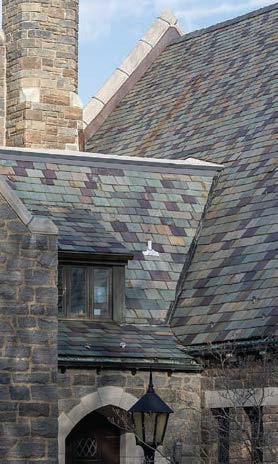
The miles of slate roof at Holy Trinity; graceful, symmetrical classical architecture at Temple Emanuel; arches and garages doors at the now defunct Central Fire Station on North Greene; robust arches at a private residence at 703 Fifth Ave. in Dunleath; the restored Gatekeeper’s Cottage (originally part of Green Hill Cemetery, now Carolina Home Partners) on Wharton Street; public spaces that are inspirational, such as War Memorial Stadium and East White Oak Community Center.
“There’s lots of good public architecture, right?” Rowe notes. “Charles Hartmann was responsible for much of it,” she adds, ticking off his greatest hits: “Grimsley High, Dudley High, the original Jefferson-Pilot building with Thomas Jefferson bust and Country Club Condos on Elm Street.”
On a personal note, she sends an email later, saying she was initially drawn to her home’s long sunroom with its three walls of windows and red quarry tile floor. “It reminded me of my great-grandmother’s sunroom in Albemarle; hers had jalousie windows, tropical barkcloth upholstery and bright, floral houseplants. Charming and cheerful to a child.”
Now that their sunroom is insulated, she and her husband, Jeri, spend weekend afternoons there reading or watching television. “And I bring in pots of geraniums and clover to overwinter on tables set up in front of two of the window walls. Which seems a bit full circle, don’t you think?”
Fellow volunteer, writer and preservationist David Arneke has also served with HPCG. Like Rowe, he has been an officer of Preservation Greensboro. He currently serves on the nonprofit Preservation Greensboro Development Fund.
Since 2017, he has written and edited piedmonthistorichomes.com, which serves as a comprehensive guide to “the most historic, notable and distinctive 18th-, 19th- and early- to mid-20th-century homes now for sale in North Carolina’s Piedmont Triad region.”
Notably, Arneke knows about succumbing to old house charms. For many years, he has lived in a circa 1900 College Hill home with Betty Work. Lured by certain charming architectural details when he first saw their future house, one distinction eclipsed all others.
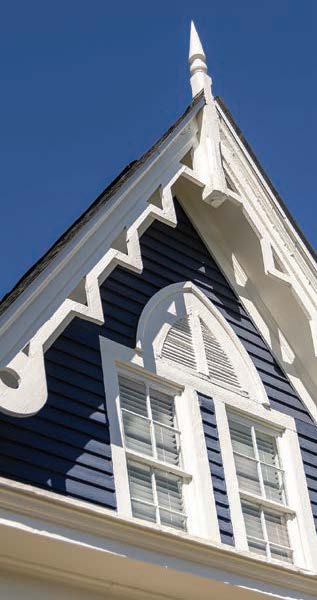
“The feature that really grabbed us was the scalloped frieze boards that go all the way around the house. They were hard to even see when we bought the house because the entire exterior was painted beige — every last detail.” According to a November 1997 Greensboro News & Record interview, the couple took three years deliberating the perfect exterior paint colors.
“Also, inside the house, the back stairs,” he adds. “Neither of us had ever lived in a house with stairs in the front and in the back. Such a novelty for us.”
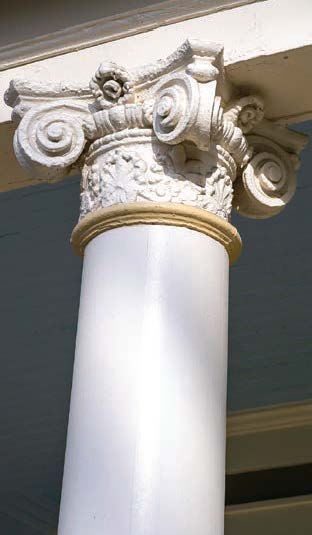
Having long chronicled features of older homes, he admires the columns on the Bumpas-Troy House, saying their size and prominence “make them grand and spectacular and unlike anything else in the neighborhood.” He muses, “It must have been quite a sight when it was built in 1847, out in the woods beyond the edge of town with no other houses around it.”
Arneke discusses a Dunleath home, which turns out to be the same one that Rowe had mentioned, notable for its “wonderfully distinctive front porch. I don’t remember seeing another one like it in Greensboro.”
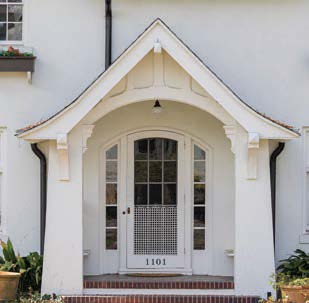
Arneke recalls a striking historic feature of a Fisher Park house.
“The swooping roofline on 1101 Virginia Ave. . . . The whole house is remarkable, but that roofline, along with the portico, give it a whimsical look that you just don’t see very often. I get the feeling someone had fun designing that house.”
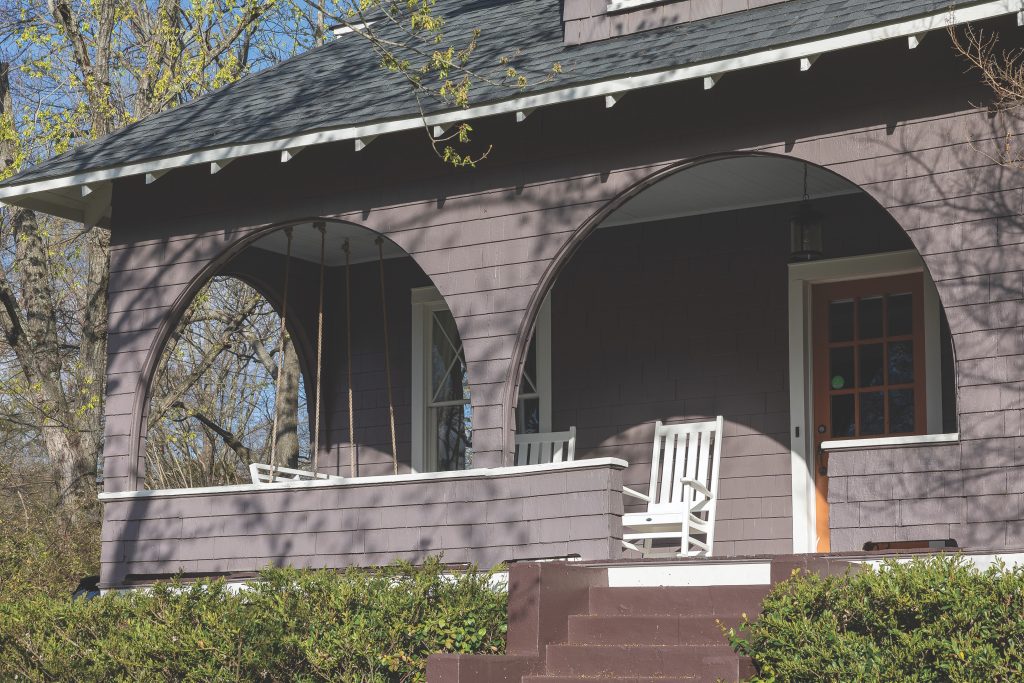
Fellow preservationist Deborah Kaufman, who lives in Sedgefield and now serves as an at-large commissioner on HPCG, says, “I absolutely love the front porches of older homes. They always make me nostalgic, especially if there’s a porch swing. I’m reminded of my childhood at my great-grandparents’ house.”
She qualifies details.
“Brick porch flooring and wrought iron rails just don’t give me the same warm feeling as those creaky wooden floors and white railings.”
Even Greensboro City planner and preservationist Mike Cowhig, a Fisher Park resident, agrees with Arneke and Kaufman on the topic of porches, particularly when it comes to what’s directly under foot. In a word, Cowhig finds the commonplace touchingly affecting — and often overlooked.
“There’s nothing like a well-preserved set of wood front porch steps and a tongue-and-groove porch floor,” he says.
“Because they are exposed to the weather, [wooden] steps are often replaced with masonry steps, so they are increasingly rare. The treads are usually bullnose with a rounded edge like stair treads. Victorian era steps can have very decorative hand railings.”
As for historic tongue-and-groove porch floors? A yawping hole opened like a sinkhole in that Westerwood’s tongue-and-groove porch — just as I stepped out for the mail during our first week of residence.
Said porch’s beguiling Chippendale-style railings were rotting and much of the German siding cladding the entire house was also rotten. Only the concrete steps were not.
The next house that captivated us sold itself within minutes, even lacking a requisite front porch. But inside, it had handmade doors, brass knobs and gorgeous, deep windows (with wavy glass in the muntins!) offering a park view. Built in 1926 by former Greensboro mayor Ralph Lewis, we considered it “modern.” Sadly, the gorgeous slate roof was developing leaks, eventually requiring replacement a few years ago. As did the heating, air conditioning and rotting Tuscan columns at the front entry and side porch.
But those windows with wavy glass? They survived, and they still slay me.
I was willing to overlook almost anything for its many sets of French doors (three!) and remarkably — how to express this to a saner person? — calming energy. Laugh if you want, but the plaster walls inside our old house feel like a safe, sheltering place.
Especially so if you forget the resident ghost.