Doodad

Where Have You Been, Emmylou?

Emmylou Harris returns to her roots


Above all else, Bill Kennedy knew a good promotional opportunity when he saw one. Already a seasoned concert promoter and venue operator, by 1976 he had become a fan of rapidly rising country-folk-bluegrass star Emmylou Harris. A fledgling sports and entertainment complex, Piedmont Sports Arena, had recently opened on Wendover Avenue, and Kennedy and the owner agreed to book the singer that April.

She would have likely drawn well anyway, but Kennedy had an additional dual hook. For one, the concert date was close to Harris’ 29th birthday on April 2; for another, she had a local tie-in, having attended UNCG in 1965–67 on a drama scholarship. Kennedy approached the Greensboro Chamber of Commerce about declaring it “Emmylou Harris Day” and billed the show as a “welcome back” party.

The concert lived up to its billing, drawing a couple of thousand delirious fans. Not even a group of Moonies, protesting outside because the venue served alcohol, could dampen the evening.

During her stint at UNCG, Harris had racked up stage roles in Shakespeare’s The Tempest and a children’s theater production of The Dancing Donkey. She also performed in a group called The Emerald City with UNC grad Mike Williams, when she wasn’t singing solo at her regular gig: a small club on Tate Street called the Red Door. The pay was $10 a night plus all the beer you could drink.

She would transfer to Boston University, choosing music over theater. Ultimately she wound up in the Greenwich Village coffeehouse circuit and soon afterward the burgeoning Washington, D.C., bluegrass scene, where fate and Gram Parsons, who discovered her singing in a Georgetown club, intervened.

Forty-three years on, with 25 albums and 13 Grammy awards to her credit, Harris has not since performed in Greensboro. But January 24 will serve as another welcome back when the singer takes the stage at UNCG’s Memorial Hall (formerly Aycock Auditorium) as part of the University Concert and Lecture Series — across the street and ten million miles from the Red Door.

(Full disclosure — Bill Kennedy and the author were co-founders of ESP Magazine in 1988. When Kennedy died in May 2016, the author wrote his obituary for the News & Record and officiated at his funeral.) — Ogi Overman

Birdwatch

Keep Your Eye on the Sparrows

Dark-eyed Juncos return to these parts in cold weather


By Susan Campbell

“The snowbirds are back!” No, not the thin-blooded retirees — you won’t see them until spring. But you will see the little black-and-white, sparrowlike birds that appear under feeders when the mercury dips here in central North Carolina. They can be found in flocks, several dozen strong in places. And, in spite of what you might think, they are far from dependent on birdseed in winter.

Dark-eyed juncos are a diverse and widely distributed species, with six populations recognized across the United States, Canada and Mexico. Some have white wing bars, others sport reddish backs, and the birds in the high elevations of the Rockies are recognized by the extensive pinkish feathering on their flanks. Our eastern birds are known as “slate-colored juncos” for their dark-brown to gray feathering. As with most migrant songbirds, their migratory behavior is based on food availability, not weather. Flocks will fly southward, stopping where they find abundant grasses and forbs. They will continue  traveling once the food plants have been stripped of seed.

Dark-eyed juncos can be found throughout North America at different times of the year. During the breeding season, juncos are found at high elevation across the boreal forests nesting in thick evergreens. Our familiar slate-colored variety breeds as close as the high elevations of the Appalachians. You can find them easily around Blowing Rock and Boone year round. Watch for male juncos advertising their territories up high in fir or spruce trees. They will utter sharp chips and may string together a series of rapid call notes that sounds like the noise emitted by a “phaser” of Star Trek fame.

In winter, flocks congregate in open and brushy habitats. Juncos are distinguished from other sparrows by their clean markings: dark heads with small, pale, conical bills, pale bellies and white outer tail feathers. Females have a browner wash and less of a demarcation between belly and breast than males. They hop around and feed on small seeds close to ground level. Some individuals can be quite tame once they become familiar with a specific place and particular people. Juncos do communicate frequently, using sharp trills to keep the flock together. They will not hesitate to dive for deep cover when alarmed.

So the next time you come upon a flock along the roadside or notice juncos under your feeder, take a close look. These little birds will only be with us a few months, until day length begins to increase and they head back to the boreal forests from whence they came.  OH

Susan would love to hear from you.  Send wildlife sightings and photos to susan@ncaves.com.

Hungry for the Holidays

Karen Robbins brings French flair to her Greek and Italian culinary heritage – a portal into a rich multicultural world
 

By Cynthia Adams   

Photographs by Bert VanderVeen

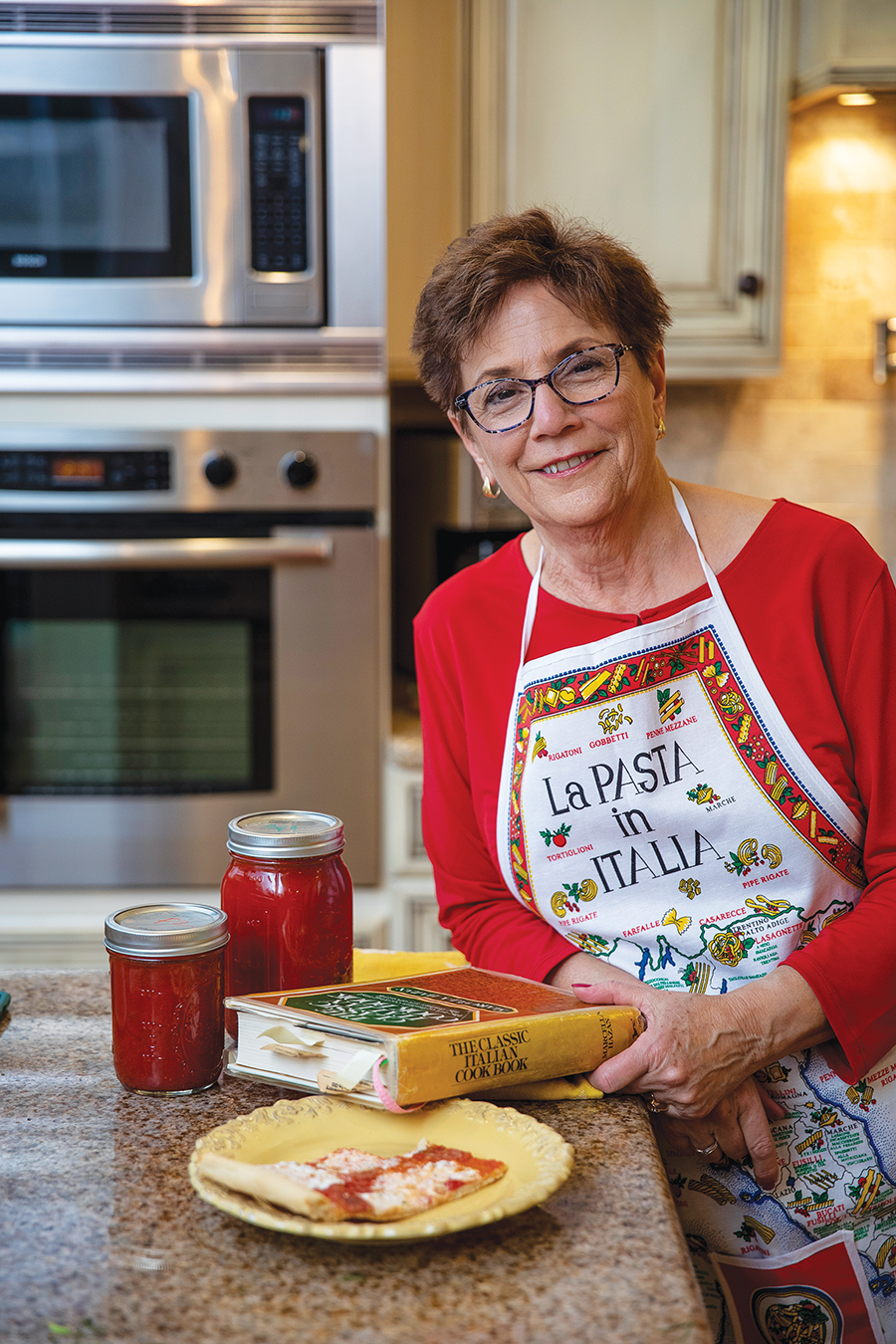
If the dogeared, heavily notated copy of Mastering the Art of French Cooking on Karen Robbins’ quartz counter doesn’t snag your attention, then the wafting aroma of sugar caramelizing with butter will. Knees have buckled at less. Luckily, there is a pot of fortifying coffee and a counter to lean into.

Welcome to Robbins’ kitchen, sporting a recent refresh, with the accent on functionality, which pleases the resident chef — the nifty pot filler addition isn’t just for looks. Neither is the new Wolf range nor the additional wall oven.

Delectable, magical things happen here. And it isn’t yet the holiday. She was baking for her mahjong club, which meets every Thursday evening.

Robbins smiles slyly. The baker and holiday enthusiast slides over a dish of toasty blueberry-and-peach “cutie pies” and plump peach scones. She waits.

Triple yum, I mumble impolitely, dribbling crumbs. Robbins’ eyes dance.

Long before Iron Chef, there was ubiquitous French Chef — Julia Child. Child’s televised programs initiated this Greek-Italian woman into French cooking.

(Robbins calls Child, “the Great One.”)
The two well-used volumes of Mastering the Art of French Cooking, which somebody gave her long ago, are key references.

“The recipes are long but very clear,” she says, thumbing through. There are many scribbles. “Sometimes I slightly alter or tweak Julia’s recipes, but her foundation is usually intact.”

In 2009, Robbins saw the popular film Julie & Julia. She related to the young blogger, Julie, who began cooking Child’s recipes and posting about it.

She recently rewatched the film.

“I loved it as much as I did the first time. Afterward, I got teary. I always liked to cook. But I remembered how much she, Julia, had meant and how I got started.”

She recalls early trials.

“I made her pastries with custard filling.” At the time, it was challenging. Now, “not so hard anymore.”

Robbins moved on to Child’s gigot à l’Anglaise (leg of lamb in red wine). Then the duck à l’orange.

Classics.

“Her lamb recipe has simple ingredients. I marinate and sliver all the pieces,” she explains. For caneton à l’orange, seasoning and trussing a whole duck was a bit more challenging, “but now, you can buy duck breasts versus the entire duck.” She grins.

“Simple ingredients.”

Not so simple a process.

But Robbins is not averse to simplification or improving the Great One’s process. Or variations.

Robbins’ eyes dart toward the window where she keeps basil and rosemary in boxes.

What for dinner?

“Yesterday, I made a filling of spanakopita and pesto and baked it as a crustless dish. Blended two cultures,” she smiles. “People liked it.”

Her husband has a saying whenever he truly loves something. “He says, ‘I’d pay for that,’” she laughs.

Robbins loves baking, saying it’s more exacting. “But cooking can be more creative.”

With the holidays here, Robbins is tickled just contemplating the meals and baking she will turn out of double ovens installed for this very purpose. She much favors the Wolf range’s convection oven for baking.

On this baking day, Robbins is all Zen-like and humming. She moves through her kitchen, her warm brown eyes shining as she runs through the flavor profiles for her holiday preparations.

“I can taste food in my head,” she says. “Not wines, but food.”

When Robbins, a former NYC speech therapist, retired and came South with her husband, Paul, they plunged headlong into retirement. Her husband is out playing golf on a golden morning. Their white Volvo sports the license plate “PAR 3”. She also golfs, but not when she can cook.

Baking, cooking and entertaining, three of her fundamental pleasures, just happened to have made her the hit of the Newcomer’s Club.

She enjoys a large, hydrangea-filled yard that backs up to an open country field. But the kitchen, which opens to a screened porch, is the beating heart of the traditional home.

The Mediterranean aspect traces to her family influences.

The gourmet kitchen already had furniture-style cabinetry but Robbins finally got the pot filler she always wanted, adding the Wolf gas range top and an additional wall oven for good measure. She already had a generously sized walk-in pantry, one that she has filled with canned tomatoes, “put up” herself.

Food has long been important in her family. With an Italian father and a Greek mother, how could food not be central to family life? Her parents, childhood friends, eloped when pressured not to marry outside the faith. Outsiders were called “goombahs” — pejorative slang for Italians. Friends but not family, Robbins clarifies.

Her Catholic father and Greek Orthodox mother had respective, entrenched traditions, especially when it came to food. “My mother learned to cook Italian,” Robbins explains. “What she made, she made well. But she wasn’t experimental.”

But her daughter discovered she was. Baking is an exact science, she stresses. But cooking isn’t.

It relaxed her.

Although Robbins had a serious career, she would look forward to cooking after work. Entertaining became her outlet. She did the whole bit, “from soup to nuts.”

Even the hardest effort was happiness-making. As for what is difficult now, Robbins pauses.

“The more involved things are probably”— and she breaks off to page through her sauce-bespattered French cookbook. “Hmm.”

“Some of the things are just not so hard anymore,” she muses. Duck, for instance: “I remember making it and the stove was billowing with smoke because of all the fat.”

A good friend who lectures on art history and culture aboard the Silversea cruise line invited her along on a cruise that ended in Nice, France. There, Robbins says she had one of the five most memorable meals of her life.

She inquired into a restaurant in walking distance of the hotel. “I went and ordered their duck. It was with peaches,” she says, pausing to conjure up the memory. “Oh my God, it was divine. And so, I got ahold of some duck breast and made my version with peaches, because this is the world of peaches. That was fun.”

In Mykonos, she enjoyed another memorable dish while awaiting the ferry — tomato pancakes cooked over a Bunsen burner. The pancakes “were insanely good.” Robbins worked until she reconstructed the recipe.

With sparkling brown eyes that widen as she recalls the experience, Robbins enthuses about the culinary surprises that travel brings.

“Food opens you to another avenue of the culture.”

In 2017, she and her husband took a week of cooking classes in the medieval Italian village of Castro dei Volsci in a gristmill before a cruise departing from Rome.

“I asked Paul, do you love me? He said, ‘Yes, of course.’ I said, how much in dollars, exactly?” She chuckles. “The cooking classes weren’t cheap.”

She learned to make proper risotto. “Even Paul got into making pizza, appetizers and desserts.”

Robbins views food as a portal into a rich, multicultural world — one she eagerly walks through. But coming South, the holidays required the eager cook to adapt to regional tastes. She was shocked to discover ham on Southern Thanksgiving menus. “It wasn’t something you ate for Thanksgiving in the North. If you didn’t like turkey, you did chicken. You only had ham at Christmas!”
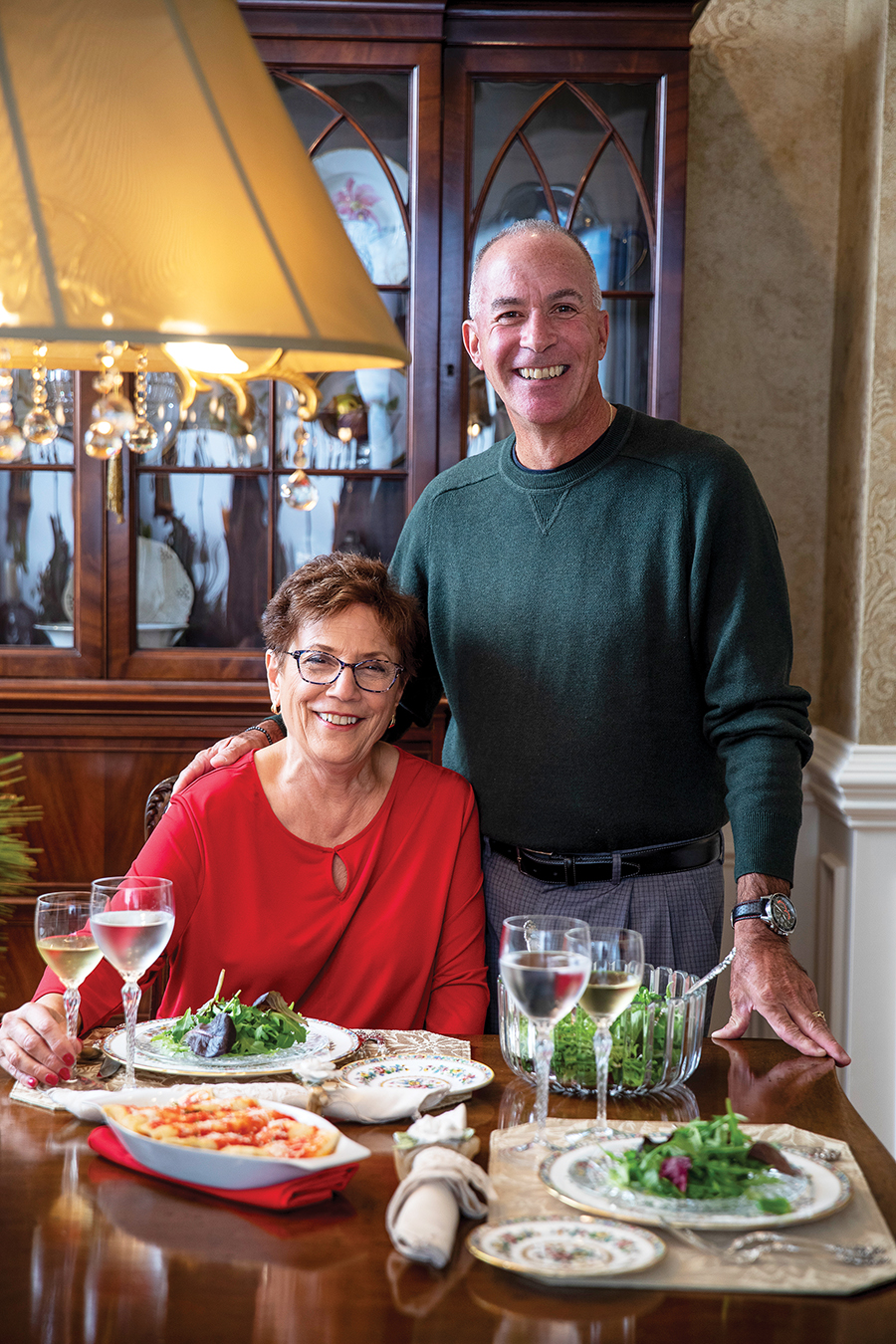
Robbins baked and transported favorites to relatives outside the South. “I used to cook and take the food north,” she recalls. She even mastered a coconut custard pie originally requiring a three-day process. She simplified it to two.

Recently, Robbins adapted a Giada De Laurentiis recipe called “Thanksgiving for two.”

The experimental dish? “Ravioli made with Chinese dim sum stuffed with ground turkey, herbs and cranberry sauce.” It was close enough to pasta to satisfy her Italian taste buds.

“I grew up thinking everybody had pasta as their main meal at Christmas,” she confesses. “My mother made lasagna. Then we had roast beef. But we had fish Christmas Eve.”

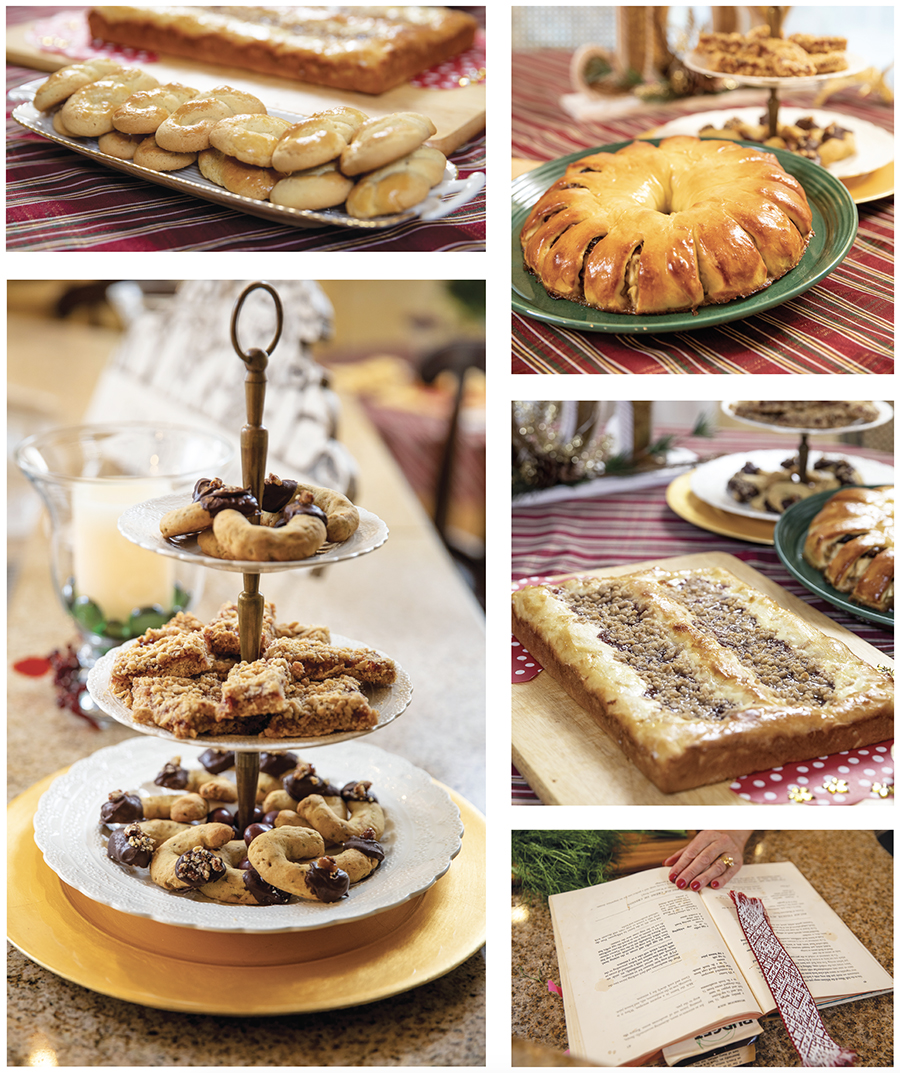
For her Christmas meal, Robbins will make fresh homemade ricotta and manicotti using crepes instead of dried pasta.

For Christmas morning, she will bake a festive wreath cake with cream cheese and jam, adapted from an old Gourmet magazine. The recipe is butter-stained.

“It’s not hard if you’re going to bake — make a dough and roll it out.” She pauses. “It’s not level one,” she admits.

But neither is a Southern staple, she claims.

“I’ve never made a biscuit,” Robbins giggles. “That scares me!”

Yet, she bakes breads, biscotti and every manner of dessert, including pistachio cookies, which are beloved when she serves them to a large circle of friends she made in the Newcomer’s Club.

“All the men wanted the recipe — that I should give it to their wives!”

Some traditions are sacred. But . . . “Christmas almost needs to be tamed,” she notes. “My husband is very helpful. He helps with the gifts. There were a lot of Christmases when we moved here and we had to go up North. I was cooking. Packing. Buying and wrapping. I was so exhausted. It wasn’t fun.”

Their daughter and her family now live in North Carolina. When they arrive in Summerfield on Christmas morning, delectables await.

Robbins mentions shortcuts the Barefoot Contessa advocates, like not making all menu items from scratch.

Some recipes are so dear to her they are nearly perfect.

Others still require innovation; things she makes a lot because “it’s a test kitchen,” she smiles.

Robbins offers to get back to me on her five favorite culinary hits of all time. Things that Paul would pay for, she laughs.

Her brow knits.

And as she plots dinner, staples are at the ready. “I have fresh oregano, basil and thyme,” she says.

And a pantry stocked with freshly canned tomatoes.

For Robbins, with the rapidly approaching holidays, nothing says Christmas more than opening the taps to that pot filler for boiling noodles and revving up the sauce for fabulous, savory pasta-bilities.  OH

For Karen Robbins’ recipes, please visit O.Henry magazines facebook page

Drinking with Writers

The Long Road to Overnight Success

From poet to publisher, Emily Smith makes her mark with Lookout Books


By Wiley Cash     Photographs by Mallory Cash

I first met Emily Smith in September 2010 at the annual conference of the Southern Independent Booksellers’ Alliance in Charleston, South Carolina. She was there with a Spartanburg publisher called Hub City Books, which was releasing a poetry collection by Ron Rash. Emily had designed the collection’s cover. A year later, I saw Emily again, but this time I saw her photograph online: She was attending an awards dinner in New York City, where a book she had published was a finalist for the National Book Award in fiction. A lot had happened in the intervening year.

The book Emily had published was Binocular Vision: New and Selected Stories, by Edith Pearlman, a short story writer in her 70s who had long been a favorite of the literati, while never breaking through to a larger, critical audience. Pearlman’s book was the first to be released by Lookout Books, a publishing imprint housed in the Publishing Laboratory inside the University of North Carolina Wilmington’s creative writing department. Emily, along with editor emeritus Ben George, published Pearlman’s book as Lookout’s first release. The book would go on to be nominated for a number of prizes, and it would later win the National Book Critics Circle Award. It was quite the debut for a small press. Publishers Weekly called it a “knockout start,” and Ron Charles of The Washington Post praised Lookout’s release as “one of the most auspicious publishing launches in history.”

There are centuries-old publishing houses in New York City that would kill for a single season’s title to receive the acclaim that Binocular Vision received, but there are simply too many bottles and not enough lightning. Or perhaps there is only one Emily Smith, and her journey from advertising executive to publisher of acclaimed books is perhaps as rare as the aforementioned glass-encased lightning.

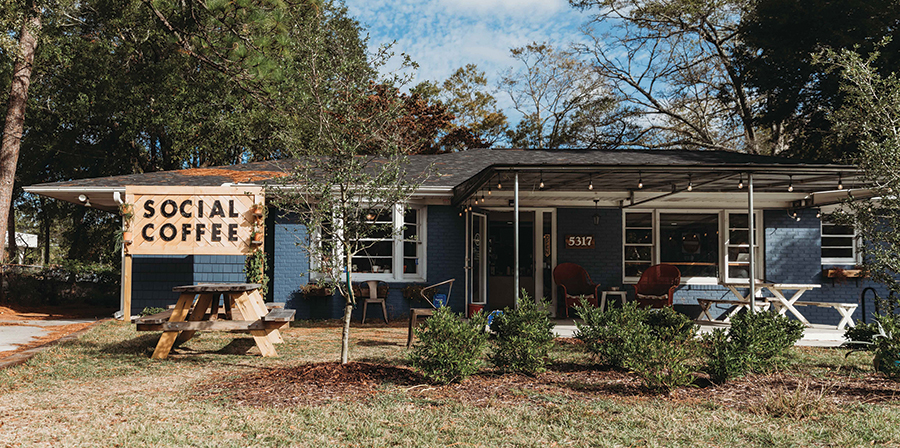
In early November, Emily took a break from promoting the most recent Lookout title, This Is My Body: A Memoir of Religious and Romantic Obsession, by Cameron Dezen Hammon, to sit down with me over coffee at Social Coffee and Supply Co. on Wrightsville Avenue in Wilmington. It was a cool fall morning, and Emily and I found seats by the bright windows just inside the front door. Our conversation turned toward the first time we met in Charleston back in the fall of 2010.

“I’d gotten to know the folks at Hub City because I was their inaugural writer-in-residence,” she says. “I went there as a poet, but part of the residency had me working 20 hours per week for the press.”

“What were you doing before that?” I ask.

“I’d been a graduate student at UNC Wilmington,” she says, “and I’d worked in the Publishing Laboratory here, which I now run.”

But her experience in design and marketing, as well as her ability to network and build relationships, predates her time as a graduate student in Wilmington and writer-in-residence in Spartanburg. After finishing her undergraduate degree at Davidson, Emily spent several years in advertising at J. Walter Thompson in Atlanta. “We worked with big clients,” she says. “Ford Motor Company, 20th Century Fox, Domino’s Pizza. But I burned out. I knew it wasn’t what I wanted to do.”

She left Atlanta and returned to Davidson, where she worked in the Advancement office, forging relationships with alumni and the community, and raising money for the university. But something was steering her toward writing, and she enrolled as a poetry student in the MFA program at UNC Wilmington. After finishing her degree and serving as the writer-in-residence at Hub City in Spartanburg, she returned to Wilmington as the interim director of the Publishing Laboratory in 2007.

In her role as interim director, Emily found a distributor to ensure that the Publishing Lab’s titles were sold beyond the campus and outside of Wilmington. When a national search began for the permanent director, Emily decided to apply. “I thought, it would be silly not to try for this after doing this job for a year,” she says. She got the job and forged a dynamic partnership with Ben George, who at the time served as editor of Ecotone, the university’s national literary magazine. The two joined forces to found Lookout Books, which they envisioned as a literary imprint dedicated to publishing women, debut writers, and overlooked work by established authors.

“Ben came to UNCW with a reputation as a meticulous, thoughtful editor,” Emily says. “And I knew the other side of the business. I had an advertising and marketing background. I knew the design part from working at Hub City. I knew how to work as a small press and handle distribution.”

After the success of Edith Pearlman’s Binocular Vision, Lookout Books quickly garnered national attention, and the press has consistently delivered critically acclaimed and award-winning books by both established and debut authors.

I ask Emily about the press’s current release, This Is My Body, by Cameron Dezen Hammon. “It’s the story of someone who grew up culturally Jewish and then converted to evangelical Christianity post-9/11,” she says. “9/11 was a time in which everyone and everything felt spiritual, and Cameron was caught up in it. She converted and moved with her musician boyfriend to Houston, where they performed music at an evangelical church.” The longer she stayed in the church the more she found herself caught up in a misogynistic culture that limited her to a gender role that defined both her faith and spiritual talents. “It’s a story of seeking something and discovering something else,” Emily says.

I cannot help but think about Emily doing the same, setting out on a search that took her from advertising executive in Atlanta to graduate student in Wilmington to writer-in-residence in Spartanburg and back to Wilmington, where she would publish titles that would make Lookout Books an overnight literary sensation.  OH

Wiley Cash lives in Wilmington with his wife and their two daughters. His latest novel, The Last Ballad, is available wherever books are sold.

The Omnivorous Reader

Fight the Good Fight and Keep the Faith

The political saga of a father and son


By D.G. Martin

Anyone who wants to master North Carolina political history must try to understand how Kerr Scott, elected North Carolina’s governor in 1948, could be both a liberal and a segregationist. Two books that can help are The Political Career of W. Kerr Scott: The Squire from Haw River, by retired University of Florida professor Julian Pleasants; and The Rise and Fall of the Branchhead Boys, by former News & Observer political reporter and columnist Rob Christensen.

Pleasants chronicles the exceptional life of Kerr Scott, who was governor from 1949 until 1953 and U.S. senator from 1954 until his death in 1958. 

Scott, a dairy farmer from Alamance County, won election as commissioner of agriculture in 1936. In 1948, after using that office as a launching pad, he resigned and mounted a campaign for governor. He beat the favored candidate of the conservative wing of the party in the Democratic primary, which in those days was tantamount to election.

Once in office, Scott pushed programs of road paving, public school improvement and expansion of government services. Hard-working and hard-headed, plain and direct spoken, he appointed women and African-Americans to government positions.

Future governors Terry Sanford and Jim Hunt were inspired by his success. Hunt said, “If not for Kerr Scott I would never have run for governor. My family viewed Scott as our political savior . . . He improved our roads, our schools, and our health care.”

Scott’s commitment to common people, fair treatment for African-Americans, skepticism and antagonism toward banks, utilities and big business, and a pro-labor platform earned him a liberal reputation that was praised in the national media. In 1949, he appointed Frank Porter Graham, the popular and liberal president of the University of North Carolina, to fill a vacant seat in U.S. Senate. When Graham lost to conservative Willis Smith in the next election, Scott resolved to run against Smith in 1954 to avenge Graham’s loss and reassert the power of the liberal wing of the party. When Smith died in office and Governor William Umstead appointed Alton Lennon, a conservative, to the seat, Scott ran against him in 1954 and won.

In the Senate, his liberalism did not extend to racial desegregation. He joined with other Southerners in Congress to fight against civil rights legislation. He signed the infamous 1956 Southern Manifesto, which urged resistance to the Supreme Court’s Brown v. Board of Education decision requiring the elimination of school segregation. 

Scott died in office in 1958, leaving open the question of whether he would have won re-election in 1960.

Missing from Pleasants’ excellent book is the story of the entire Scott family and its role in North Carolina political life. Christensen takes up that task. He follows the Alamance County farm family beginning with Kerr Scott’s grandfather, Henderson, and his father, “Farmer Bob.” Both were active in statewide farmers’ organizations.

Christensen’s important contribution to the Scott family saga is his account of the political career of Kerr’s son, Bob. Born in 1929, Bob grew up on Kerr’s dairy farm. Like his father, he became active in farm organizations and worked in political campaigns, including Terry Sanford’s 1960 successful race for governor. By 1964, at age 35, he was ready to mount a statewide campaign for lieutenant governor. But two senior Democrats, state Sen. John Jordan and House Speaker Clifton Blue, were already running. Christensen writes, “In some ways Scott had broken into the line.”

Nevertheless, with the help of powerful county political machines, he won a squeaker victory in a primary runoff over Blue. 

Bob Scott used his new office to run for the next one, giving hundreds of speeches each year, and he won the 1968 Democratic nomination over conservative Mel Broughton and African-American dentist Reginald Hawkins.

The results of the 1968 presidential contest in North Carolina marked what Christensen calls “the breakup of the Democratic Party.” Richard Nixon won; George Wallace was second; and Hubert Humphrey was third. Nevertheless, in the governor’s race, Scott faced and beat Republican Jim Gardner. 

Mountains of bitter controversies in the areas of race, labor, student unrest and higher education administration were to confront Bob Scott after he became governor of North Carolina in 1969. As governor, Scott followed his father’s tradition of inviting friends to “possum dinners” with the main possum course accompanied with “barbecued spareribs, black-eyed peas, collard greens, bean soup with pig tails, corn bread, and persimmon pudding.”

Christensen writes, “Scott may not have been the populist of his father, but he brought a common-man approach to Raleigh.”

But times had changed. College campuses were erupting. Black anger was spilling into the streets. Historian Martha Blondi wrote that 1969 marked the “high water mark of the black student movement.” Christensen writes, “During his first six months in office, Scott called out the National Guard nine times to deal with civil unrest.”

In March, he sent more than 100 highway patrolmen to Chapel Hill to break a food worker strike and force the reopening of the student cafeteria, overruling the actions of UNC’s president, William Friday, and the chancellor, Carlyle Sitterson. This action and similar strong measures against student-led disorders earned Scott praise by television commentator Jesse Helms and many others in the white community, “but he got different reviews from the black community.” 

Although he appointed the first black District and Superior Court judges, his pace of minority hiring and appointments was roundly criticized.

Increased desegregation of public schools resulted in more disruption. Speaking about the 1971–72 school year, Scott said, “Many schools were plagued by unrest, tension, hostility, fear, disturbances, disruptions, hooliganisms, violence and destruction.”

In response to disturbances relating to school desegregation in 1971, Scott sent highway patrolmen and National Guard troops to Wilmington. Conflict there led to arrests, trials and prison sentences for the group of protesters who became known as the Wilmington Ten.

Bob Scott’s stormy relations with President Friday continued as Scott “decided to undertake the reorganization of higher education as his political swansong.” His proposal to bring all 16 four-year institutions under one 32-person board was adopted by the legislature. Scott expected the new organization would eliminate or minimize Friday’s role. But Friday became president of the reorganized 16-campus system and led it until 1986.

Summing up Bob Scott’s time in office, Christensen writes that his legacy is “far murkier” than his father’s, in part because the state was “less rural, less poor, more Republican, and more torn by societal dissent, whether civil rights, Vietnam, or the counterculture.”

Both Terry Sanford and Jim Hunt acknowledged their connection to Kerr Scott. But Bob Scott never bonded with either of them. The breach with Hunt became a public battle when Bob Scott challenged the incumbent Gov. Hunt in the 1980 Democratic primary. Scott was angry because Hunt had not supported his ambition to be appointed president of the community college system. Scott lost the primary to Hunt by a humiliating 70–29 percent margin.

Ironically, in 1983, when the community college presidency opened up again, Bob Scott won the job and served with distinction until his retirement in 1995.

Bob Scott died in 2009 and was buried at the Hawfields Presbyterian Church near the graves of his father and grandfather. Kerr Scott’s tombstone reads, “I Have Fought a Good Fight . . . I Have Kept the Faith.” Bob’s reads, “He Also Fought a Good Fight and Kept the Faith.” OH

D.G. Martin hosts North Carolina Bookwatch Sunday at 11 a.m. and Tuesday at 5 p.m. on UNC-TV. The program also airs on the North Carolina Channel Tuesday at 8 p.m. To view prior programs go to http://video.unctv.org/show/nc-bookwatch/episodes/.

Scuppernong Bookshelf

Holidays Are Not Just for Children

Some Surprising Books for Adults


Compiled by Brian Lampkin

Book people can be difficult. They pretty much acquire the books they need with no regard for the impending holiday season, so you’re left with nothing literary to get them to show how much you care about their reading life. Below are a few holiday-related books that just might be off the radar of a well-read book lover. Or perhaps there’s a forgotten gem or two to reinspire an old love.

Rock Crystal, Adalbert Stifter (Author), Marianne Moore (Translator), Elizabeth Mayer (Translator), W. H. Auden (Introduction) (NY Review of Books, $12.95). Seemingly the simplest of stories — a passing anecdote of village life — Rock Crystal opens up into a tale of almost unendurable suspense. This jewel-like novella by the writer that Thomas Mann praised as “one of the most extraordinary, the most enigmatic, the most secretly daring and the most strangely gripping narrators in world literature” is among the most unusual, moving and memorable of Christmas stories.

Pretty Paper, by Willie Nelson with Dave Ritz (Blue Rider, $23). For over 50 years, Willie Nelson has wondered about the life story of the legless man who sold wrapping paper to customers on the street in front of a downtown department store in Fort Worth. This seller of “pretty paper” inspired Willie’s classic Christmas song, and now, with a leap of imagination, the singer/songwriter tells the tale of Tom Winthrop. I too thought this was a book on holiday-themed rolling papers.

Yuletide in Dixie: Slavery, Christmas, and Southern Memory, by Robert E. May (University of Virginia, $34.95). We don’t get to shut off our brains or ignore history just because it’s the holiday season. How did enslaved African Americans in the Old South really experience Christmas? Did Christmastime provide slaves with a lengthy and jubilant respite from labor and the whip, as is generally assumed, or is the story far more complex and troubling? In this provocative, revisionist and sometimes chilling account, Robert E. May chides the conventional wisdom for simplifying black perspectives, uncritically accepting Southern white literary tropes about the holiday, and overlooking evidence not only that countless Southern whites passed Christmases fearful that their slaves would revolt but also that slavery’s most punitive features persisted at holiday time.

Holidays On Ice, by David Sedaris (Back Bay, $12.99). Sedaris’ recent sold-out appearance at the Carolina Theatre reminds us all that he’s a much-loved institution in North Carolina. This 2010 update has six new pieces and is written especially for those left quite queasy about the syrupy emotions of the holiday season.

Hercule Poirot’s Christmas, by Agatha Christie (William Morrow, $29.99). Every year it’s impossible to find the right book for Aunt June or Uncle Beasley. But 2019, is different. They love English mysteries, they love the classics, they have even forgiven you for last year’s debacle of the gift of the adult coloring book. Who knew that they made “adult” coloring books? Agatha is never a misstep.

How to Spell Chanukah . . . and Other Holiday Dilemmas:18 Writers Celebrate 8 Nights of Lights, essays by Jonathan Tropper, Jennifer Gilmore, Steve Almond, Joanna Smith Rakoff, Adam Langer and others. (Algonquin, $13.95). Whether your Chanukahs were spent singing “I have a Little Dreidel” or playing the “Maoz Tzur” on the piano, whether your family tradition included a Christmas tree or a Chanukah bush, whether the fights among your siblings over who would light the menorah candles rivaled the battles of the Maccabees, or even if you haven’t a clue who the Maccabees were, this little book proves there are as many ways to celebrate Chanukah as there are ways to spell it.

You Better Not Cry: Stories for Christmas, by Augusten Burroughs (Picador, $16). At 8 years old, Augusten Burroughs profoundly misunderstood the meaning of Christmas. Now proving himself once more “a master of making tragedy funny” (The Miami Herald), he shows how the holidays can bring out the worst in us and sometimes, just sometimes, the very best. From the author described in USA Today as “one of the most compelling and screamingly funny voices of the new century,” comes a book about surviving the holiday we love to hate, and hate to love.

Sex Position Coloring Book: Playtime for Couples (Hollan Publishing, $15.95). Who knew indeed.   OH

Brian Lampkin is one of the proprietors of Scuppernong Books.

O.Henry Ending

Matchless

Low mileage, one owner, gently used


By Bill Fields

My ’66 Mustang needs a paint job, and the wheels are wobbly on my ’62 Ferrari. But compared with my ’63 Vauxhall Estate Car, whose windows are broken and back hatch is missing, the first two vehicles are looking good.

Now, I’m not really a car collector. I’m not even a real collector of these 1:64 scale miniatures that had so many of us hoping we had 49 cents in our pocket — approximately two visits from the tooth fairy — for a purchase years ago. My dozen were rescued from the corner of a closet where they had been garaged for a long time.

Lots of things shout “child of the ’60s,” but does any toy do it better than a Matchbox car?

As the advertising copy said: “For boys and girls of all ages . . . built of pressure die-cast metal by English craftsmen . . . nothing to assemble, ready to use . . . colorful nontoxic baked enamel finish, authentic in every detail.”

I’m glad I never snacked on my vehicles, just in case, but the Matchbox Series did have a lot going for it. Detroit might not have ever been usurped as a car capital if its workmanship had been as fine as that in the toys manufactured in England by Lesney Products.

Although small enough to fit in a child’s hand, some of the models consisted of more than 100 parts. They were finely assembled, with details that mirrored the real thing. Automakers on both sides of the Atlantic, happy with the publicity, shared specifications with the toy company that allowed for great authenticity in the replicas.

As a kid who loved small things — a pocket magnetic checkers set, tiny stapler, mini-football helmet pencil sharpener, miniature golf — Matchbox cars were right in my wheelhouse.

Lesney began after World War II in London, a collaboration of friends and military veterans Leslie Smith and Rodney Smith, who used syllables from each of their first names as the company moniker. Toys weren’t the focus of the die-cast business until another man, Jack Odell, joined the original partners.

The Matchbox brand sprouted from Odell’s initial Lilliputian design — a brass steamroller he built in 1952 for his daughter that met her school’s edict that students couldn’t bring toys larger than a matchbox. Odell and Leslie Smith started producing their line of vehicles in 1953, Rodney Smith having sold out to his partners two years earlier. Their first design was a miniature gilded coach for the coronation of Queen Elizabeth II, a hot seller that was followed by a bulldozer, fire engine and, in 1954, Lesney’s first car, an MG.

Lesney was producing more than a million vehicles a week by the early 1960s as Matchbox cars were being sold in great numbers all over the world. “We produce more Rolls-Royces in a single day,” Odell told The New York Times, “than the Rolls-Royce company has made in its entire history.”

My fanciest Matchbox model is a ’64 Lincoln Continental, sea-foam green, whose trunk was just big enough to hold a piece of candy corn. I like my oldest model, a ’61 gray and red “Bedford Tipper” truck that I probably was given before I was old enough to really bang it around, which could explain why it looks as if it just came off the lot.

I was well-equipped for emergency response, owning a ’62 ambulance, ’65 wrecker and ’66 firetruck, its removable plastic ladder on the roof and ready to rescue someone trapped on the second story. There are versions of the Dodge Wreck Truck that make them a rare and valuable collectible because of a manufacturing quirk, but mine is run-of-the-mill and a little sad, its tow hook gone. I’ll blame the snapped-off part on my nephews, who were playing with my little cars on visits to their grandparents about the time I was getting my driver’s license.

New generation, same old fun. OH

Southern Pines native Bill Fields, who writes about golf and other things, moved north in 1986 but hasn’t lost his accent.

Wandering Billy

Jigsaws, Jiggers and Great Red Eye Gravy

December’s gifts to the Gate City


By Billy Ingram

“I want my home to be that kind of place — a place of sustenance, a place of invitation, a place of welcome.” — Mary DeMuth

Searching for something to give that proverbial guy or gal who has everything? Why must they vex us every year with their very existence?!? Whoever that inscrutable individual might be in your life, they surely don’t have these two locally sourced items.

The first is hot off the presses, the other freshly uncasked.

Strolling aimlessly around the Tate Street Festival last fall, I ran across artist Susan Wells Vaughan displaying her collection of fanciful greeting cards and 1,000-piece puzzles based on her dioramic pastiches of historic North Carolina municipalities. Vaughan limits her subject matter to places she’s lived, showcasing her knowledge about the people and history of the region. Naturally, her initial paintings were confined to the Outer Banks where she’s been residing for the last 30 years. “Nobody else was doing it,” Vaughan notes. “People were painting dunes and the birds; I wanted to do something different. And I love architecture.”

Lithographs of her representational paintings of Manteo, the town of Duck and Kill Devil Hills were selling all up and down the coast, business brisk as the afternoon breeze. When the recession hit, sales floundered. “I have these big prints that cost quite a bit to matte and frame,” Vaughan says. “I guess people didn’t want to spend money on something they didn’t really need.” Harking back to her childhood when her grandmother introduced her to jigsaw puzzles, Vaughan says she had an “aha” moment. “I imagined her saying, ‘Make puzzles!’” At first handling manufacturing through Chinese sources, the artist teamed with Heritage Puzzles, which also features jigsawed versions of William Mangum’s Rockwellian cityscapes.

A Greensboro native, Vaughan turned her artistic eye on her hometown this year for her latest creation. In the top left corner of her colorful collage you’ll spot Yum Yum Better Ice Cream, the Minerva statue at UNCG just below. Scattered throughout are Amtrak’s Carolinian, Bennett College water tower, Jefferson Standard whatever-it’s-called-now building, the statue of the Greensboro Four, a bust of Edward R. Murrow, West Market Street Methodist, and Blandwood, to name some of the delightful highlights Vaughan incorporates into her vision of our city.

Give a close look at the puzzle’s bottom right corner where she pays tribute to one of O.Henry magazine’s own: “Not many people know Harry Blair designed the Greensboro logo,” Vaughan says. In the late 1960s, Blair was teaching commercial art at Page. “I decided to give that a try,” she recalls of that pivotal moment from her high school days. “Harry was so cool, he played records, told us stories. He created an environment that made you feel relaxed. That’s the greatest thing an art teacher can do, in my opinion.” Inspired, she decided on a career in the arts.

Susan Wells Vaughan’s creations can be found in the Greensboro History Museum’s gift shop, Blandwood, Scuppernong Books and online at Heritagepuzzles.com. According to neurologists, assembling jigsaw puzzles is especially effective at improving short-term memory. No more wandering into a room only to forget why you’re there. You have a puzzle to finish!

***

Mitchell Nicks and Tom Bruce have introduced a new spirit into the season, Gordian Knot Reserve Rum. A French-trained cuisinier well-regarded in Greensboro and beyond, you may recognize Mitchell Nicks as head chef of the former Tessa Farm to Fork and Muse restaurants. Applying his exemplary culinary palate to this challenge, “It’s not like adding basil or spices to food because alcohol is such a pure medium,” Nicks says. “We knew we wanted a certain regality to it, like you’ll find in a cognac or a scotch.”

After a worldwide search for raw materials, they began importing aged rums from the mother countries — Barbados, Trinidad and Jamaica. A protracted experimentation phase testing multiple flavor combinations followed, out of necessity requiring considerable imbibing until the field was narrowed to 52 iterations. “When Mitchell got it down to three there was one that stood out,” fellow entrepreneur Tom Bruce says of a flavor profile with hints of toasted hazelnut, caramel, butterscotch, pepper and cinnamon. A veritable rainbow of flavors emerge naturally from the oak casks used during the aging process: “A lot of people say this drinks like a bourbon,” Mitchell says, “That’s because of the weightier ‘mouth feel’ we have.”

Judged a favorite at both the Miami and Charleston Rum Festivals, Gordian Knot Reserve Rum can be found on the drink menu at popular dining spots like Tripps, Coast and the High Point Country Club, as well as your neighborhood ABC store. Sample it this season in your eggnog, hot toddy, and buttered-rum recipes. Or simply place a bottle by the bedside and allow the festivities to wash right past you (as you drink responsibly, of course).

***

Eye mentioned Coast, a casual upscale seafood restaurant in High Point garnering rave reviews after opening just a few weeks ago on Samet Drive. Years ago one of its chefs, Nathan Stringer, watched as I made red-eye gravy for grits. I couldn’t believe an unabashed country boy like him had never encountered red-eye gravy before but that seems to be the case with most of these modern-day, digitally distracted whippersnappers. At Nathan’s suggestion, Coast is now offering red-eye gravy ladled over their sumptuous shrimp and grits.

I learned the recipe for red-eye when I was a kid. Dad and I were the only family members up early in the mornings, so he taught me to make breakfast the way his mother taught him. For red-eye gravy Dad-style: Remove the pan from the stove after frying country ham, preserving the caramelized remnants on the bottom of the pan. Add a little more coffee than you have drippings, whisk it together with a fork. You’re done. It might take a few attempts to get the balance right, but how can you beat the taste of salt cured ham with coffee? Like Jerry Lee Lewis once said, “If God made anything better, he kep’ it for himself!”

***

Visiting relatives over the holidays? After a decade away, a nightclub that rocked the 1990s and early-2000s, Flat Iron, is sizzling again. Perched in that strategic location on Summit and Church, it’s much like you remember with subtle changes rendering it less dive-y, more lively. Under the auspices of Common Grounds’ Dusty Keene, Flat Iron hosts a broad range of top-tier local musicians and touring bands. My fave local party band Corporate Fandango will undoubtedly blow everyone away, as they do, on December 7th. On the 20th, Dusty has booked an event called Ace’s Basement Reunion Show for those who frequented that rough-and-tumble hardcore venue located underneath a sketchy motel on what was then High Point Road. On December 28th, Jake HaldenVang from NBC’s The Voice takes the stage. At press time, there’s no way to know whether HaldenVang won that contest or not. “Wouldn’t it be crazy,” Keene asked, “if he wins and then plays here right after?”  OH

Billy Eye sincerely wishes everyone reading this a fantastic holiday season filled with light, love and just a dash of selfish overindulgence!

Life of Jane

An Old-Fashioned Holiday

Nothing like bourbon and bitters to foster peace on Earth, goodwill toward all


By Jane Borden

When I order an Old Fashioned at a fancy cocktail lounge, I sometimes receive straight bourbon with a dash of bitters in it and a sliver of orange peel hanging perilously off the glass. That is not an Old Fashioned. That is straight bourbon with bitters in it and a sliver of orange peel hanging perilously off the glass. And that will make me breathe fire. Even the original Old Fashioned recipe, dating to 1806, included sugar and water. Anyway, it’s not 1806 anymore. 

Why do fancy bars insist on making everything as intense and extreme as possible? Drinking is not the X Games. Or, at least, it hasn’t been since freshman year at Carolina. One should not need a helmet and kneepads to enter a bar. And you’ll be no safer drinking beer at these establishments. Their wide selections range from double-hops IPAs that are 13 percent alcohol to triple-hops IPAs served with a punch in the face. 

God forbid you respond to that glass of bitters-spiked whiskey by asking for a cherry or a splash of OJ or anything to help you forget you’re drinking poison and probably shouldn’t. For if you do, the bartender will give you a look suggesting that instead of imbibing in his establishment, you should be ruminating over the reasons you are a Gap-clothes-wearing, eggnog-latte-drinking, scented-candle-burning basic-ass bitch.

Oh yeah?! Well!!! Guess what?! The Gap makes quality, affordable clothes.

My point is I don’t want to be shamed by people on cultural high horses — which, let’s be honest, is why Conservatives hate Liberals, so maybe if Liberals would stop calling Conservatives “bad people,” then Conservatives would stop trying to punish Liberals and instead listen to them. *Cough* Where was I? Whiskey. The great unifier! Let’s all come together in the name of the Old Fashioned. In the spirit of that message, fine, if you want to call straight bourbon with a dash of bitters an Old Fashioned, then you’re welcome in my tent too. But only if you also recognize these three recipes as canon. 

THE BOB BORDEN HOLIDAY MAKER

Obviously I made up that title. My father would never name a drink that. Nevertheless, this cocktail, when drunk, will make any day a jolly holiday. Dad doesn’t remember exactly when he developed the recipe, but it was sometime in Greensboro, after he and Mom married but before I was born, so it was probably . . . let’s just say he doesn’t know.

“Old Fashioneds ought to be strong, sweet and redolent of bitters,” he says. In his case, they are also made with precision and love.

Ingredients

2 oz. + bourbon (Makers Mark or Woodford, if possible, but George Dickel  Tennessee whiskey is always invited

2 oz. + soda water (i.e. the same amount as the bourbon)

4–5 dashes Angostura bitters (yes, that’s a lot)

1 cured orange slice* (“I like a bite of orange with a sip,” Dad suggests.)

1 maraschino cherry (“Preferably with the stem, so you can fish it out,“ he says.)

4 tsp. orange syrup*

1 tsp. maraschino-cherry syrup from the jar

* See below for recipe

Orange-syrup recipe (in his own words)

“The selection of oranges is more critical than one would think. I like to pick pretty ones. Thin-skinned if I can find them and without blemishes. Big oranges. I use navel so I don’t have to fiddle with the seeds.”

“I wash them with my hands and a little soap.”

“Then, slice them from pole to pole, not around the equator. I think they look prettier that way.”

“Put the oranges in a pot and add simple syrup (equal parts sugar and water) to cover them.”

“Boil on low heat for 30–45 minutes — and cover the pot — because it takes the bitterness out of the peel.”

“Spoon slices and syrup into jars and refrigerate. I have several frozen jars of orange syrup that I thaw out when I want to use.”

“I’m blowing this out of proportion. After all it’s nothing but a drink.” (Editorial note: Oh yeah? Ask any of his neighbors or friends.)

Directions

Fill an Old Fashioned glass with ice

Add all ingredients

Spread joy

THE MUDDLER

If you don’t have the time or bandwidth to cure orange slices in advance, consider this lesser version of the Bob Borden Holiday Maker, which I developed during my days as an amateur (and at one point professional) bartender, by which I mean, my 30s.

Ingredients

1 thick, half-moon orange slice

1 maraschino cherry (I prefer the fancy, dark-purple variety)

1 sugar cube

3 dashes Angostura bitters

2 oz. + bourbon

Directions 

Place orange, cherry, sugar cube, bitters and a splash of the bourbon in a cocktail shaker.

Muddle vigorously for longer than seems necessary. You want the sugar to dissolve, and you want to get not only juice from the orange but also oil from the rind. Sing a song to pass the time. 

Add remaining bourbon — plus a little more because you’re in training for New Year’s Eve — and fill 3/4 full with ice. 

Shake vigorously for longer than seems necessary. You want much of that ice to melt, since you are not adding additional water or soda. Turn the shaking into choreography for the song you‘re singing.

Strain shaker into a rocks glass on top of one of those square, oversized, casually effete ice cubes. 

Garnish with another cherry and orange slice. 

No reason to stop singing and dancing now.

POOR MAN’S OLD FASHIONED

This drink’s name derives from the ease of making it, not the price tag. When you’re surprised by thirsty guests, if you have these nonperishable ingredients on hand, you’ll always have an Old Fashioned–inspired option at the ready. Also, though, if you drink too many, you will wind up poor.

Ingredients

2 oz. bourbon 

1/2 oz. any triple sec or orange liqueur

1/2 oz. Cherry Heering (a dark liqueur that’s made with the fruit skins and must, giving it a deeper color and flavor than that of Luxardo Maraschino liqueur).

Directions 

Add water if you like or soda or ice or tell your friends to make it themselves: You’re busy singing and dancing.  OH

Jane Borden won’t be able to return to her native Greensboro for Christmas this year so she’ll spread Bob Borden Holiday Makers all over Los Angeles.


Illustration by Meridith Martens