
BRAKE FOR ESTATE SALES

Brake for Estate Sales
More than a junking junket
By Cynthia Adams • Photographs by Amy Freeman
Garage sales are familiar ground — few rules and no commitment. Slow the car, rubberneck, and cruise on past if you notice more trash than treasures. Estate sales, however, are a different matter altogether.
Catnip, too, for admirers of antiques, collectibles and all things vintage. “There is a whole community,” says Sarah Ferrell, owner of Working Decor. “A community of shoppers! A big friend group.”
But what about those of us on the outside looking in, those who love the quirky and fascinating pre-used and well-loved items? Perhaps you’ve seen signs for an estate sale at an intriguing home and wanted to join the line of antique hunters, but felt out of your league.
Ferrell says not to worry. You don’t need deep pockets, nor even a driving reason, to steer your car straight towards a sale. Allow Ferrell’s considerable experience to guide you.
Don’t be intimidated. “People who hold estate sales are thrilled to see people coming through the door,” she reminds us. A good estate sale can refine your eye. Or at least, entertain.
Southerners lean towards the look of collected homes, writes Patricia Shannon in Southern Living. Plus, sales give us license to be snoopy. “Southerners, as a whole, are big fans of any kind of sale that sees us sifting through someone else’s personal belongings.”
Ferrell grew up “with people who went flea marketing or antiquing. It is in our culture to go junking.” She muses, “I really think it’s a very Southern thing.”
Prepare. Often, virtual previews of the estate’s offerings let you prescreen items of interest. Know before you go by checking estatesales.net, says Ferrell. Entering a zip code reveals upcoming sales with much of the inventory. “You can see pictures. And get a clear idea of what you want to do for the day.”
She speaks from experience that finds can surface in unlikely places. Antiquing in Ferrell’s family remains a professional calling.
For years, Ferrell’s father, Gene Crowder, and his late brother, Bill, helmed Crowder Designs, a Triad design business. Clients relied upon their instincts.
“They definitely had a huge stash of antiques to sell to clients,” recalls Ferrell. Gene has sustained a following for his antique chandelier and lighting restoration business, which continued after his brother died in 2021. Later, she spent eight years at a traditional estate sale company, where she learned to organize, evaluate and sell. Called in to assist after the death of a prominent community figure six years ago, Ferrell undertook her first solo liquidation, and Working Decor was born.
Very often, she now goes directly to collectors in her database, rather than holding a public sale.
Be mindful of the rules, as they can vary by estate sale. The stated rules are typically on the company’s website or at the entry point. Register upon arrival, as numbers are often issued before admittance, and hold your place in line. People who shop for businesses, or “pickers,” are commonplace, but so are casual collectors.
There’s a reason for the adage, “one man’s trash is another man’s treasure.” Oddities at sales may shock, excite, or entertain. But Ferrell empathizes with families selling loved ones’ possessions. “Things should be dispersed in a mindful way.”

Do not rush the door or line. There is a protocol, says Martha Stewart Living’s “9 Tips for Estate Sales,” which published last summer. Writer Wendy Rose Gould stresses that estate sales occur in the previous owner’s home. Be respectful, she says.
Don’t hesitate to look in other towns and cities. Larry Richardson, a close friend of the Ferrells, often rises predawn in search of treasures, most recently schlepping all the way to Charlotte’s affluent Myers Park. He seconds Gould: “It’s so helpful if everyone honors the process.”
He has scored vintage Louis Vuitton luggage and even a garaged Mercedes in like-new condition.
Educate and focus your eye. “I think original artwork is timeless,” Ferrell says. But focus on a niche. She often buys colorful art books.
Ferrell is still amazed by the wide variety of things people amass. (She mentions her own affection for vintage medical objects, including a physician’s cabinet and a skull used in teaching dentistry.) She repurposed the workbench to use as a table.
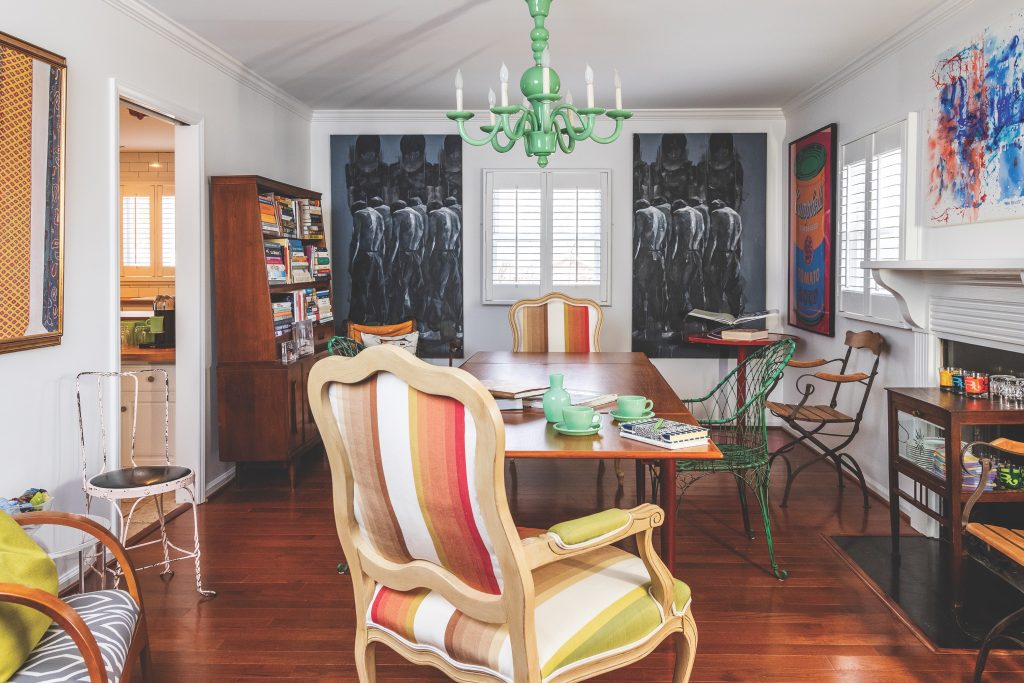
“I have such eclectic tastes,” Ferrell admits. But she knows exactly what she likes. When she sees rare, chunky pieces of glass art, her heart beats faster. Ditto for all things green, she says, with favorite pieces of their personal collection in the kitchen.
Think about complementing what you have with affordable finds. “An effortless way to decorate is to look for coffee table books. They are extremely expensive new, but at estate sales, they are cheap. You can look for them by color or style,” she says.
Ferrell also has a soft spot for what she calls “orphaned” chairs from a former set, usually bargain-priced. “Don’t sleep on an orphaned chair!” Mismatched is more visually interesting
Pricing. As for pricing, even estate sale prices may be negotiable. “Sometimes you can negotiate,” says Ferrell. It may be a no, but if you never ask, it is a no. Sometimes, too, “the first day is full price and later days are discounted.” Cash does not always rule, but it may help secure a deal.
Be realistic about whether you have room for the acquisition. “If I bring something in . . . something goes out.” Unless it is something rare, which, in her collector’s parlance, is a “unicorn.”
For Ferrell, it was a green glass chandelier (which she recognized from when it appeared in this magazine in July 2024). Sold to the homeowner by her father, it recently resurfaced at Carriage House, a local antique store. Ferrell found the coveted (albeit broken) light once again, restoring it with her father’s help.
With persistence, “You can find that one unicorn piece you’ve been looking for.”
Appearances can deceive. “Don’t underestimate a sale by the way a house looks on the outside,” Ferrell advises. “I found some wonderful, rare things in an unexpected house. Sometimes you find a treasure.” Do not overlook the garage and outbuildings.
“One of my most prized finds is an old wooden workbench complete with splashes of paint and hammer marks.”
Don’t be reluctant just to browse around. However, don’t shun the occasional “reality check,” offers Ferrell. It is valuable to see prevailing prices. Professional estate sales can help shoppers “become more realistic about what their [own] items are worth.”
Estate sales are opportunities to upcycle items that might otherwise wind up in the landfill. “People don’t think about the sustainability aspect with an estate sale,” Ferrell adds, noting the ever-cyclical nature of tastes. “You can get the 1950s version versus the reproduction.”
Find your tribe. Ferrell enjoys that estate sales unify many for a shared experience and “bring together the most widely eclectic people . . . all in different fields.” Here, she has made friends and connections.
She points out yet another reason to be an estate sale goer, even if you leave empty-handed. At estate sales, you glimpse the inner worlds of fellow collectors. “It’s a wonderful way to see some wonderful homes,” says Ferrell.
Go forth confidently in the direction of the estate sale sign’s arrows. You may just find your unicorn.


The Trend Cycle — and Upcycle
Among those who never fail to hit the brakes for an estate sale? Then you are possibly a reseller or someone passionate about upcycling, says the former owner of a vintage store.
Long-time estate sale fans like Kevin and Kim Gunther report that reselling helps tame their collecting addiction. It also allows them to indulge in one of their favorite pastimes, that age-old thrill of the hunt.
Part-time resellers with full-time jobs, the Gunthers completely understand the impulse to scrutinize every sale and hit the road. For some years, they have spent their free time seeking inventory for three antique booths (at Blue Horseshoe in Ramseur, Blue Octopus in Eden and Main St. Market & Gallery in Randleman). Estate sales are their prime hunting ground.
They happily report that their first date was at an auction.
“Cheap date,” they say in unison. “Free popcorn and cheap Cokes!” Later, as a married couple, the tradition continues. They remain passionate about each other and their favorite shared hobby. Kevin admits they recently “hit an estate sale on our way out of town to go celebrate our anniversary.”
They’ve figured out a way to monetize their, well, mutual addiction, while spending scarce free time together.
He is fixated on sourcing vintage records.
“I only buy what I like, hoping other people will like it, too. I have tunnel vision,” he says.
Kim looks elsewhere. “I love furniture. Primitive. A certain look. If it is 100 or 50 years old, that does not matter to me. I buy the look.” She searches for shelves and hutches, which are practical. “People who collect need places to show off their treasures.”
Of course, not everything on offer excites. It may not hit the mark or look current. Trends are meant to be broken — and will be. So don’t discount a special find if it bucks current trends, Sarah Ferrell suggests. Once disparaged as “brown furniture,” unpainted pieces in original condition are back in style.
“Oh, it’s coming back,” Ferrell declares. “Which thrills me to death . . . I am tired of people painting things, especially pretty pieces that should not be.”
Having logged many estate sales miles in their pursuits, the Gunthers have lugged home many acquisitions, sometimes those that counter trends.
The Gunthers agree with Ferrell. Given time, the trend will turn in your favor, they predict, and that is the beauty of upcycling at work.