Simple Life

About Time

By Jim Dodson

A while back, my beloved wristwatch of many years mysteriously disappeared.

On one level, the loss wasn’t such a big a deal. It was, after all, an inexpensive wristwatch – some might even say cheap – a Timex “Expedition” model that set me back only about fifty bucks during a two-for-one Black Friday sale at Belk department store many years back.

At that time I kept one Expedition and gave the other to my college-boy son, who as it happens had just broken the fine Swiss Army watch I’d owned for several years but passed along to him for safe keeping.

My history of watch-ownership, you see, is a fairly checkered affair, littered with various costly broken or missing timepieces, beginning with the beautiful engraved Seiko chronometer my parents gave me for college graduation that somehow abandoned my wrist on a pilgrimage across Europe, never to be seen again. Over the next few decades it was followed by a succession of fine watches including several Swiss Army numbers I either managed to break or lose in ever creative ways.

Then there was the perilous close call that happened on a beautiful Saturday morning at London’s famous Portobello Road marketplace when I happened across a vendor of antique watches who showed me a beautiful, fully-restored “wartime” Rolex bearing the emblem of the U.S Eighth Army Air Corps in which my old man served during the war. It was an exquisite watch and a bargain at only one hundred quid or so.

In a rare burst of common sense, however, recalling my history of unintentionally losing or destroying innocent timepieces, I concluded in the nick of time that the Rolex of my dreams might well have survived a world war but probably wouldn’t last long on the arm of yours truly. And so, reluctantly, I passed it up.

That’s why the first Timex Expedition I happened upon over a decade ago was such nice discovery: simple, handsome, rugged, reliable and – best of all — cheap to replace when the inevitable happened. As the company’s famous slogan promised: “It takes a licking and keeps on ticking.”

It was also a nostalgic window into my childhood, conjuring memories of the iconic Timex TV spots I always found so entertaining during which John Cameron Swayze – former news broadcaster and game show panelist — subjected Timex watches to various creative “torture tests” like being sent over Niagara Falls in a barrel, attached to the churning blades of a speeding boat motor, put through a washing machine or worn by slugger Mickey Mantle in batting practice.

Once upon a time, Timex was the flagship of American-made affordable watches. Such colorful theatrics made it America’s bestselling watch brand in the dawning space age before digital everything, bargain-priced between $9.95 and $16.99.

The first Timex Expedition I purchased lasted five years but vanished during a research trip to Africa. While wading across a shallow river where crocodiles were rumored to circulate, the pin holding the watch to the strap slipped out of the socket and I found only a bare arm by the other side of the river. Picturing the wily old croc from Peter Pan with the clock ticking in his stomach, I chose not to go back and hunt for my lost Expedition on the river’s bottom.

Back home in America, I set off one afternoon to various shops and department store looking for the same model, figuring that any watch that gave me such loyal service for less than fifty bucks a year was a small price to pay for being on time.

At Belk, I was dismayed to learn the store no longer carries Timex. “I think it’s gone a little down-market,” was how the watch counter clerk politely termed it with a gentle sniff, offering to show me several higher-priced Bulovas and Seiko models, also something called a Fossil watch that looked like something that would require platform heels and a pair of glittery oversized Elton John eyeglasses to complete the ensemble. The only watch that even remotely resembled my beloved lost Expedition was a handsome but pricey Citizen timepiece three times the price tag, though with a ten-year warranty.

I thanked the clerk for her time and said I had my heart set on another Timex Expedition.

“You might try Wal-Mart,” she said.

So I did, discouraged to think how far mighty Timex must have fallen. But even Wal-Mart was a no-go. The clerk there said a drug store was probably my best option. If that failed, I pictured America’s formerly favorite wrist watch being sold from suitcases on the street corner by vendors with heavy foreign accents.

By now you are probably saying to yourself, “What a silly waste of time – all this hoo-ha over a cheap wrist watch!” And you may well be right.

But on the other hand, a modestly-priced, rugged-looking watch that can take a licking and keep on ticking strikes me as something of true value in a world where nothing is all that permanent, regardless of the price.

Besides, who knows when I might get washed over Niagara Falls in a barrel, hauled by a speeding motorboat or accidentally put through the wash cycle?

In time, I found an excellent source for my beloved Expedition watches: the Timex company itself, which hosts an impressive selection of Expedition models and even fancier watches for aging Timex –ers like me.

Soon I had a new Expedition strapped to my wrist, an updated “indiglo” model featuring a nifty illuminated face that will come in handy if I ever find myself trapped in a dark cave miles below the earth or invading space aliens knock out the nation’s electrical grid and plunge America into complete and total darkness.

Who knows what sort of monkey business may happen in time?

In the meantime, it’s times like these — a killer pandemic, civil unrest, sweeping social change, not to mention a world economy struggling to get off its knees – that really make you take time to think.

According to some, it’s either later than we think – or not time for a change just yet.

Ancient sages advised that time is our most precious commodity, something that flies but a sin to waste, a fleeting resource, tomorrow’s memory, something that heals all wounds and sometimes wounds all heels.

Time stays, we go – or so said H.L. Mencken.

It’s possible, Emerson countered, to kill time without injuring eternity.

The Book of Ecclesiastes insists that there is a time in heaven for everything, but my late grandmother Taylor – who knew her Bible cold — used to tell me “Sugar pie, someone is always waiting beneath a clock.”

What she meant was that time – at the end of the day — is highly personal, all about the here and now.

Someone is always waiting beneath an unseen clock for a baby to be born or an elder to pass on, a first date to arrive, the train to leave the station, the weather to change, spring to return, a new life to begin.

Tomorrow is simply an unspent yesterday, an abstract concept for something that’s gone the instant it arrives, whereas real time is always here and now, which explains why we fragile human beings felt the need to come up with so many mechanical devises – Stonehenge, sun dials, planting cycles, moon phases, hourglasses, various kinds of calendars, latitude and longitude, and every sort of time-keeping piece from ancient Babylonian water clocks to modern Tag Heuer chronometers – simply to measure our days and mark our passages through the veil of existence.

Some years back, I developed the habit of removing my wristwatch whenever I was doing something I draw true pleasure from – working in my garden, taking a swim, dining with friends or even playing golf. I would unstrap my watch and toss it in a pocket, a symbolic act of suspending time or at least removing my spirit for a blissful moment from the gravitational pull of a world that would have me doing more responsible and important things with my time.

The older I’ve gotten – time being an excellent source of wisdom – I’ve come to believe the most valuable use of time is whatever our heart chooses to make of it.

With the passage of time, alas, I’ve evidently also become a bit more forgetful.

Not long ago, when restrictions on staying in place due to the Coronavirus began to ease a bit, I transferred my golf clubs to a small canvas “walking” bag I hadn’t used since last summer and set off to play nine holes in the fading afternoon light.

Somewhere near the end of the round, I lost a golf ball and opened the side pouch hoping there might be another ball inside.

There wasn’t.

But I found my missing Expedition watch.

It was a lovely surprise to suddenly have it back. I strapped it to my wrist for the walk home in a beautiful summer dusk, almost hearing Grandma Taylor speaking to me from the shadows of the evening trees.

If you’ve lost something of value, best to quit looking for it, sugar pie, and give it time. It will find its way back to you.

This struck me as a useful thought for the challenging times we are living through.

In a world that is waiting for things we value to return, to begin again or change for the better, it’s nice to have a pair of Expedition watches to tell me what time it really is – or isn’t.

 

Simple Life

The Definition of Home

By Jim Dodson


Not long ago I realized that this is our fourth summer in the old Corry house, the charming midcentury bungalow my wife and I purchased in October of 2016, two doors from the house where I grew up. As a kid, the Corry boys were my pals, their mom my mother’s closest friend on the block, and their house my favorite in the neighborhood.

In an older neighborhood where many homes for sale never even reach the marketplace, it seemed almost providential that the Corry place sat for several months until a certain couple happened along who understood what a hidden gem it was. Big Al Corry was one of the city’s top home builders who built the house for his wife, Mama Merle, and their four kids. He considered it to be his dream home, a handsome green bungalow that looked more like California than suburban Carolina. He even gave it an appropriate nickname – “Casa Verde.”

The only problem with it – at least in the minds of many younger house-hunters who toured its rooms — was the passage of time and changing tastes. The Corry house was essentially frozen in time, built the year “I Love Lucy” debuted and the first color TV sets went on sale in the Year of Our Lord, 1951.

“This house was just waiting for you two to come along and realize what a jewel it is,” said Cookie, the real estate agent, who laughed out loud when she learned of my boyhood connection to the place.

All it needed was some TLC and thoughtful updating inside and out.

Inside, we pulled up (pink) shag carpeting and pulled down a classic lacquered room partition straight from the Donna Reed era. That opened up the living room, prompting us to polish the beautiful hardwood floors we found beneath and ponder what to do about the original hand-cut paneling that was unique but made the room darker than we liked. The solution was a simple coat of elegant linen-colored paint that unified the rooms and invited the light throughout the house.

Since I’ve never warmed up to gas fireplaces – too many years feeding a big woodstove in Maine, I suppose — we had the gas fixtures removed from the house’s two fireplaces and made them wood-burning again, as they were when the house was built. A good fire, as they say in the North Country, warms you twice.

Another casualty of early updating was the foyer’s wildly exotic wallpaper, a tableau of tropical scenes depicting jungle foliage, plumed creatures and birds of paradise that looked like Carmen Miranda’s erotic dream. When a designer pal learned that we painted over original wallpaper by legendary Greensboro designer Otto Zenke, she was horrified – pointing out that we could have covered the cost of a complete bathroom reno job had we cared enough to take the time to steam the wallpaper off the wall. We didn’t.

Happily, the fact that our house had “good bones”, in the parlance of shelter rehab gurus, meant that other “big stuff” – heating and cooling systems, plumbing and electrical, the roof, the roomy attic and vast basement, and the large capacity emergency generator outside – were all in good shape owing to the house’s original owners and a grown son named Chris who served as caretaker for his widowed mom for many years. Much of the work was cosmetic in nature.

Not counting the peculiar toilet in the basement, both bathrooms were original and could certainly benefit from a makeover somewhere down the road, but for the time being they were perfectly serviceable, not only of high quality workmanship but even kind of retro chic. We decided we could live with them a while.

The cozy den (where once I played a million board games with the Corry boys) underwent a facelift that made it even cozier with the addition of bookshelves and a refinished cabinet topped by a beautiful slab of polished white oak.

The three bedrooms simply needed their own fresh coats of paint to spruce them up. Ditto the recently updated kitchen, which featured new directional lighting and granite countertops and just needed brighter paint and breakfast nook shelving to make it strikingly fresh and new.

A new house always brings surprises. Especially a new old house.

In our case, a nice surprise turned out to be the large screened porch that spans the rear of the house, a rustic space that reminded me of old fashioned porches you find on mountain lake houses or at summer camps. My initial thought was to remove it entirely and create an expanded outdoor entertaining area, but my intuitive bride suggested that we simply “live” with the porch for our first winter “Just to see how we feel in the spring.”

As the warm weather arrived, she suggested we move our antique farm table out to the porch and use the space for a dinner party with friends. We painted the brick floor a rich woodland green, strung up some Italian lighting and moved several comfortable wicker chairs and a nifty couch we picked up for a song at a local consignment store to the porch. A painted antique buffet completed the update, and the result was nothing short of transformative.

What’s old was suddenly new, surprising us and delighting our dinner guests by turning out to be the most popular and versatile room in the house. Until Covid-19 shut down such affairs until further notice, our “porch suppers” regularly ran from early spring to late autumn. “Don’t ever change that porch. It’s like stepping back to my childhood at summer camp,” one friend insisted.

Even so, we made plans to eventually replace the screens and winterize the space with oversized windows that would make it a four-seasons affair.

In the meantime, the peculiar little room that leads from the dining room to the porch, a former patio with its own outdoor fireplace that Big Al Corry enclosed at the rear of the carport not long before he passed away, became the home library I’ve always wanted, a quiet retreat for 800 books and their owner.

The larger transformation happened out of doors.

Back when we were originally house-hunting, I had my heart on finding ten acres in the rolling countryside outside the city limits, someplace I could re-create the hilltop house and garden that I built with my own hands on a forested hill in Maine, a process that involved clearing several acres of a coastal forest of birch and hemlock, rebuilding the stone walls of an 18th century farmstead, and creating a faux English estate garden and arboretum over two full decades.

My ruthlessly pragmatic wife had other ideas, however. “If you have that kind of land again, dear boy, you will never come in the house. One day I’ll simply find you face down somewhere out in the flower beds.”

“Exactly!” I came back joyously. “Can’t think of a better way to go! You can just plant me on the spot with a nice little brass plaque and a quote from William Wordsworth to remember me by!”

She didn’t buy it. Nor, alas, my vision of a new and improved redneck English estate garden in the country.

Instead, within days of our taking possession of Casa Verde, I pulled down an ancient pergola in back that became a simple brick terrace, liberated a magnificent elderly maple from being strangled to death by English Ivy, and basically removed a small jungle of shrubs and dying trees from all sides of the property.

Over the next three years, I planted 20 flowering trees, bunkered the place with lush hydrangeas and a variety of ornamental grasses and several kinds of water-frugal sages. Out back, I created half of an Asian-themed garden and put in an ambitious perennial border along the sunny east side of the property.

By this spring – the one we all missed due to a worldwide pandemic – my gardens hit their stride, bursting into bloom under skies that were reportedly clearer than they’d been since the days I knew Casa Verde as a kid.

If there is any such thing as a silver lining to this strangely altered time of life, at a moment when thousands are losing loved-ones to a killer virus while many others are losing the roofs over their heads due to lost jobs, it may simply be the importance of embracing a renewed definition of home as any place the soul finds peace and the heart feels grateful to be in the midst of a storm.

For as old William Wordsworth himself reminds us in his famous Ode to Immortality, life is subject to change without notice. “Thanks to the human heart by which we live,” he advised, “Thanks to its tenderness, its joys, and fears.”

Matter of fact, I was thinking of the wily old bard a couple weeks ago after our fancy German dishwasher unexpectedly blew up and flooded the kitchen. Casa Verde’s once-lovely kitchen now sits thoroughly gutted by an abatement team that removed every cabinet and appliance in order to scrape out decades of asbestos subflooring from the 1950s.

And so, for the unforeseeable future, we are living like true redneck royalty on the big old porch that fondly reminds our friends of their beloved summer camps. The dogs seem to be thoroughly enjoying the crisis, it must be said, having a regular busman’s holiday amid stacked-up cabinets, cook books and half a ton of gourmet cooking paraphernalia. For her part, the estate’s lady wife is bravely soldiering through the crisis with excellent wine and visions of the new appliances and shiny hardwood floors to come.

As for me, I’m simply grateful to be a few steps closer to my backyard garden, where there is always another task waiting, and a gardener’s job is never finished.

Which reminds me, I’d better get on to that new perennial border so she’ll have the perfect spot for a nice brass plaque cast with a snippet of Wordsworth when she finds me face down in the peonies.

During these months of restricted movement and staying in place due to Covid-19, garden nurseries and home supply retailers report booming sales. Jim Dodson’s account of an old house finding a new lease on life seems appropriate for these times. This story was adapted from Spring 2020 Seasons Magazine.

High Browsing

What the Deuce?

by Nancy Oakley

Caravaggio, “The Cardsharps”

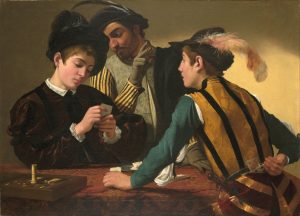
Play the hand you’re dealt, the old saying goes. But sometimes the deck is stacked against you, as Italian Baroque master Caravaggio suggests in his iconic painting, The Cardsharps. Now in the collection of the Kimbell Art Museum in Fort Worth, Texas, the canvas depicts what appears to be three guys just hangin’ out for a round of primero (an early Italian version of poker). Look again. Caravaggio’s dramatic use of light and contrasting shadow — chiaroscuro for all you arty types — and

Georges de la Tour, “Cheat with the Ace of Diamonds”

exquisite detail reveal far more. The young lad on the left ponders his hand; if he were a modern-day bloke, the bars of “Luck Be a Lady” would be thrumming through his head. His rosy complexion and velvet-and-lace finery suggest someone not yet wise to the ways of the world, unlike the other two wise guys in the painting. The one opposite sports the traces of a mustache, an insouciant feathered cap and flashy doublet with a dagger hanging from its belt; his left hand is poised to knock over the game board precariously perched on the table’s edge — a convenient distraction affording him the opportunity to slip those cards behind his back into the deck. The older fellow casts an eye on the oblivious young man’s hand, signaling its contents with two fingers, one of which is barely visible through the hole in his glove . . . the easier to mark cards, dontcha know. Something is about to go down, and it ain’t gonna be pretty!

Marcellus Coolidge, “Friend in Need”

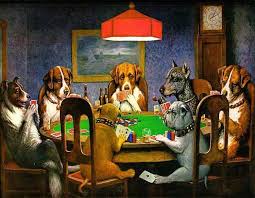
So powerful is Caravaggio’s painting, it has inspired several riffs, from Georges de la Tour’s Cheat with the Ace of Diamonds to Cassius Marcellus Coolidge’s infamously kitschy Friend in Need, featuring a pack of dogs playing — and cheating at — poker. You could even argue the poker scene from The Sting is a live-action variation of the trope, with Lady Luck ever constant to roguish Paul Newman. And who could blame her?


Shaken and Stir Crazy

Will to Drink

by David Bailey

Will Porter, I’m convinced, would love this magazine, and not only for its superb poetry and fiction and the inside scoop on his native Greensboro. No, I can think of three other topics that would interest him – our incisive coverage of wine, spirits and beer. O.Henry loved all three to excess and led what came to be known as a drinking life – just as his father did and grandfather before him. The stories about his taste in, and capacity for, all things alcoholic are legion and have been well-documented in David Stewart’s poignant O.Henry: A Biography of William Sydney Porter. In fact, Stewart’s primary theme is how the short-story master created a “surrogate character, the author known as O.Henry…so that William Sydney Porter could live in the shadows of New York and slowly drink himself to death.”

Yes, it’s a grim storyline, and Stuart relentlessly draws it out, but I don’t think I’ve ever read about anyone who had as much fun as O.Henry did as he pickled his liver. Stuart, however, doesn’t answer a basic question I keep asking. Would today’s drinkers recognize the brews he quaffed? As I read the book I kept asking myself, “What would O.Henry drink?”

O.Henry’s “love of liquor,” Stuart says, began in Texas, where the 20-year-old Porter signed on as a ranch hand down by the Rio Grande, hoping fresh air and hard work would improve his health. What it did for sure was give him a powerful thirst, which he would periodically quench in Cotulla, where he and the other cowboys “stopped at the saloon for a little liquid refreshment.” Lager, rather than ale, would most likely have been on tap as Germans had been immigrating to Texas—and setting up breweries—since the 1840s. But there’s an even bigger reason why they would have been drinking lager in the 1880s. It had been officially judged nonintoxicating.

Porter, born in 1862, was 3 when the Civil War ended. Along with a maelstrom of other social changes, the end of the Civil War brought about a radical change in what Americans drank: “Lager beer replaced whiskey as the national beverage of the working man,” says Iain Gately, in Drink: A Cultural History of Alcohol. The primary reason was that the Union commanders, staging much of the war from the wharves and railheads of St. Louis, “banned intoxicants from camp and field, leaving lager — officially nonintoxicating — as the troops’ choice of drink,” writes Maureen Ogle in Ambitious Brew: The Story of American Beer. Whoa, there! Did she say “nonintoxicating”? Yes, as she explains earlier in the book, lawyers—in a number of precedent-setting court cases brought against saloons that served German-style lager on Sundays — had produced a parade of expert witnesses who testified, among other things, “that, when consumed in moderate quantities, lager could not and did not intoxicate.” One expert testified “he had watched men imbibe as many as sixty glasses of lager without any evidence of intoxication.”

So the troops came home from the war loving lager, while the more potent English ale came increasingly to be considered “a rank broth with the taste and texture of muddy water,” according to Ogle.

In 1884, Porter gave up ranching, moved to Austin and returned to what he’d done in Greensboro, clerking in a drugstore. Hating the work, he spent his evenings carousing with other bachelors and his weekends sharing kegs of beer with his buddies on fishing trips.

After courting some of Austin’s fairest beauties, Porter, at 25, eloped with Athol Estes. The next two years were “undoubtedly the two happiest years of Will Porter’s life,” says Stuart, but the birth of their daughter, Margaret, was followed by the mother’s collapse and a diagnosis of tuberculosis, a disease that ultimately took her life. Though Porter doted on his daughter and was, according to Stuart, a good husband, “sometimes Will came home in a highly liquefied condition.” After going to work for the First National Bank of Austin, “Will Porter continued to enjoy the companionship of his old friends of bachelorhood and liked to stop off at a saloon.” When he came staggering home, “sometimes [Athol] lay on the floor and screamed at him,” Stuart continues.

As humiliating as that might have been, it did not stop Porter’s drinking, which slowly became intertwined with his budding career as a writer: “You can’t write a story that’s got life in it by sitting at a work table and thinking,” O.Henry told a New York Times reporter. “You got to get out in the streets, into the crowds, talk with people, and feel the rush and throb of real life.” It was an argument O.Henry used throughout his career to justify his heavy drinking. “How much of it all was for pure research, and how much for entertainment of a lonely writer was another of the questions that O.Henry never answered,” Stuart concludes.

Before serving three years for embezzling funds from the bank, Porter jumped bail and fled to New Orleans, where he discovered a new love — the Sazerac cocktail, which competed for his affections with the mint julep. The Sazerac, made with rye whiskey or cognac, is amped up with absinthe. Even France made absinthe illegal because of its narcotic effects. Add sugar, a lemon peel and some orange bitter, and you’re ready to dance with the green fairy, as some have described the experience.

Years later in New York City, O.Henry would enjoy “long liquid lunches of the publishing trade,” Stuart says, where he’d “order Sazerac cocktails before a meal and was known to consume a number of them.” Fish and white wine followed, then red wine with the meat, “and perhaps some champagne with dessert and fruit, and then a brandy or two.” And that was lunch, mind you.

Evenings often consisted of “O.Henry’s favorite pursuits, which were drinking, dining and observing the people of the city, especially young women.” In some of New York’s sleaziest saloons, where Stuart says the profits came more from larceny than lager, beer would have been the beverage of choice. But for our high-living author, not just any beer would do. O.Henry favored Pilsner, a Bohemian lager that had originated in the town of Budweis in the Puls region of Bohemia and had stolen the show at the 1873 Vienna Exposition.

Determined to come up with an American version, Busch and others had worked to produce a beer as light, as bright and as sparkling as the Bohemian Pilsner. But beer made with American protein-rich, “six-row” barley proved heavy and thick—until corn and/or rice were added. For instance, Busch’s brew master added eight pounds of rice to his mash for every five bushels of barley. Using Saaz hops, Bohemian yeast, beechwood strips in the aging, Budweiser was born, sparkling and light. The King of Beers (rather than the Beer of Kings) originally sold at a premium, just the sort of beer that a big spender like O.Henry would have gone for.

Asked by a reporter once whether he was Bohemian by “nature or extraction,” obviously referring to the author’s Bohemian lifestyle, O.Henry quipped, “By extraction. Never like to drain kegs. Prefer the bottles.” O.Henry was letting the reporter know that keg beer that could be had for five cents a mug was below his notice. “Writing is my business,” he once said, explaining it’s the only way he could afford Pilsner. Although it might seem to the modern reader that O.Henry was using Pilsner as a synonym for beer, he was really referring to the price of the Bohemian brew—about a dollar a bottle then or $17 in today’s dough.

That’s not to say he didn’t like his whiskey: A friend noted after O.Henry’s death that “O.Henry drank and drank hard. He was a two-bottle man.” Stuart writes that one bartender could always tell “when O.Henry was going back to his digs for a long session of writing, because the writer asked that a bottle of Scotch be sent to the room.”

But his muse eventually became his nemesis. By 1906, at the age of 44, O.Henry “found himself too often unable to concentrate long enough to turn out a story,” Stuart says. Although he promised to change his ways after marrying Sara Lindsay Coleman and even spent some time drying out at the Battery Park Hotel in Asheville, he backslid. After months of trying to reform her husband, Sara observed, “No one could manage that man. He was a law unto himself and had a deep dislike for anything that resembled nagging or fussing.” Once his wife moved back to North Carolina in 1909 to live with her mother, O.Henry returned to his old haunts. “He had to be in the streets…dancing with the bar girls in the tourist traps and boozing with the hoi polloi in the saloons,” Stuart says. “This was his chosen life.”

Of course O.Henry knew where this life would lead. Only months before his death on June 3, 1910, at the age of 47, his doctor found his heart enlarged, his kidneys shot and his liver in a sad state. The doctor asked what on earth he had been doing. “I know I smoke too much, keep late hours, and drink too much,” O.Henry admitted. Then, unable to resist one of his classic twists, he added, “but that’s about all.”

This story first appeared in O.Henry magazine in August 2012. David Bailey’s first “real” beer was in a pub in Oxford, England, while hitchhiking across Europe. The beer was warm and bitter. “I’ve never looked back,” he says.

Simple Life

Last Days of the Yard King

By Jim Dodson


That July I owned the neighborhood. Or at least my block in Starmount Forest.

It was 1968. I was 15, towing an aging Lawnboy push mower behind a well-traveled Schwinn Deluxe Racer with chrome-plated fenders and dual side baskets. My mother called me Jimmy the Yard King.

Actually, I had several jobs that summer. One was mowing half a dozen lawns up and down our street for five bucks a yard. Another was planting Christmas trees at a farm overlooking Lake Jeanette. I also snagged a weekend job as an usher at the newly opened Terrace Theater, one in which I was required to wear a tangerine orange double knit sports jacket that matched the theater’s innovative “rocking chair” seats. My job was to keep kids from violently rocking their brains out and disturbing other customers by banging their knees.

That summer I also had my first job teaching guitar on Saturday afternoons at Mr. Weinstein’s music shop, another glorious five-dollar-per-hour gig.

I was rolling in dough. Or thought I was. My mom joked that she might someday ask Jimmy the Yard King for a loan. But I was saving up for either a new Alvarez guitar like Graham Nash played or a new Chevy Camaro, whichever came first.

That year, 1968, has been called the “Year that Shattered America.”

Looking back, it was the year we both began to lose our innocence.

Being a son of the newspaper world, I paid close attention to the news, read the paper daily and never missed Uncle Walter’s CBS evening newscast.

For the first time, television news brought the horrors of the war in Southeast Asia home to 56 million American TV sets. On my birthday that February, in Time Magazine, I saw the iconic photograph of a South Vietnamese general publicly executing a Viet Cong prisoner. That photo shocked Americans, stoked the anti-war movement and sharply turned millions of everyday citizens against the war. One month later, the Mai Lai massacre that killed 500 civilians, though the atrocity wasn’t revealed and investigated for another year. These events finished off public support for the undeclared war.

That spring I taught myself how to play every song on the Beatles’ Sgt. Pepper’s Lonely Harts Club Band and started performing around town with my buddy Craig Corry who lived two doors away on Dogwood Drive. We wound up placing third in the City’s Teenage Talent Show that next fall and made an appearance on Lee Kinard’s “Good Morning Show,” our first and last moment in the spotlight.

On a breezy afternoon that April, I was playing golf with my dad when we heard that Martin Luther King had been assassinated In Memphis. We watched riots break out in Detroit and coverage of the Poor People’s March on Washington. Commentators wondered if America was coming apart at the seams, heading for revolution in the streets.

Barely a week after he announced that he wouldn’t run for re-election, President Johnson signed the historic Civil Rights Act. The musical Hair opened on Broadway featuring live naked people on stage singing about the “Age of Aquarius, An anthem for a dawning age of peace, tolerance and brotherhood. I started growing my own hair long that summer.

On the plus side of the summer America was going to hell in a hand basket, I took Ginny Silkworth to the Cinema Theater to see Franco Zefferelli’s Romeo and Juliet. Since this was a first date for us both, my dad had to drive us to the theater under strict orders not to say anything embarrassing. Because of that movie, I fell in love with the language of Shakespeare and, in a way, with Ginny Silkworth, too.

She hailed from somewhere up north and had the Yankee accent and direct manner to prove it, a deep thinker with a warm and horsy laugh. After the movie, as we waited for my old man to pick us up, Ginny wondered what I planned to do with my life. She was always asking questions like that.

I mentioned that I hoped to write spy novels and adventure books, travel to the ends of the Earth, compose country music songs, mow lawns and possibly move to either Nashville or England. She punched me on the arm and gave her horsy up-north laugh, pointing out that she intended to keep tabs on me to see if I did any of the above.

“If you want,” she suddenly declared, direct as ever and completely out of the blue, “you can kiss me.”

So I did. Another first.

In fact, Ginny and I stayed in touch for decades. She went on to become a gifted school teacher in Philadelphia and lived a very full and rewarding life, passing away from breast cancer a few years back. I still miss her, my Shakespearean first date, my first kiss, her warm and wonderful up-north laugh.

That same summer Robert Kennedy was gunned down after winning the California presidential primary. My mom had a thing for Bobby Kennedy. We watched his funeral train together and she cried. My dad was a half-hearted Nixon guy. My mom used to joke that she did her patriotic duty by cancelling out his vote every four years at the polls.

By July I was deep into my lawn mowing life, guitar-playing, writing bad country music songs and reading spy novels, trying to forget what was going on in America. I hated the usher job at the terrace so much that I handed in my elegant orange usher’s jacket in early August, blaming my family’s annual beach trip to the Hannover Seaside Club at Wrightsville Beach.

We’d gone there every year for half a dozen years, though this would be our final time. I loved the Seaside’s simple unfancy dining room, its cool wooden floors and big porches where I could sit for hours in a real rocking chair reading Graham Greene’s The Heart of the Matter or John LeCarre’s The Spy who came in from the Cold, picturing myself mowing a lawn in some far-flung, sun-mused outpost of the British Empire, a spy in short-pants and boat shoes, enjoying a gin and tonic with some sultry blond who looked like Tuesday Weld or at least Ginny Silkworth.

That week a family from Southern Ohio showed up at the Seaside Club. A pretty girl named Sandy was reading Edward Abbey’s Desert Solitaire, bare feet tucked up in the rocker just down the porch. We struck up a conversation and took a walk to the end of Bobby Mercer’s pier. Sandy told me that we human beings were destroying the natural world, killing the oceans with our garbage and fighting an unwinnable war. She told me she was going to become an “environmental activist” like her aunt who was presently attending the Democratic Party Convention in Chicago as a delegate from Ohio.

The Seaside Club didn’t have a TV set, so there was no way to see what was happening up in Chicago. We heard, however, that there were police riots and lots of injuries at the convention after Chicago’s mayor turned the police loose on protesters and Students for a Democratic Society who attempted to crash the party.

For the rest of the week we were pretty much inseparable. Sandy was a year older and half a head taller than me. She was no Tuesday Weld or Ginny Silkworth but I liked her a lot. She was crazy about books and movies.

The Graduate was playing at the Crest Theater in Wrightsville Beach. She suggested that we go see it. This was the year that the Motion Picture Association of America instituted its film rating service, serving as a guideline for parents anxious about a movie’s questionable content. I secretly worried about getting in. You were supposed to be at least 16 but the old lady working the box office took one look at Sandy, then me, and let us in for a buck and a quarter each.

The night before Sandy’s family headed home to Ohio, we talked until midnight while seated on a stack of canvas rafts stacked beneath the Seaside Club. I don’t remember what we talked about, probably her plan to save the world or mine to travel it. We promised to keep in touch.

My family was staying through the Labor Day weekend. The next evening, I gigged a huge flounder in the tidal flats off Bald Head Island and wondered if I would ever hear from Sandy again. She actually wrote me a couple times and I wrote her back. Some years later an F5 tornado flattened her hometown of Xenia, Ohio, killing hundreds of people and leaving 10,000 homeless. I never heard from Sandy again. I like to think she’s somewhere out there in the world doing her best to save the planet.

Back home, with school starting, I still had a few weeks of decent lawn-mowing income to count on, plus teaching guitar for Mr. Weinstein. That summer had clearly changed me. By then I knew all the dogs in the neighborhood, for example, those which were friendly and those that weren’t. I also knew the friendlier and better-looking moms, too. When you’re 15 and have begun dating smart and pretty girls, you notice such things.

Looking back from half a century, however, I realize how deceptively simple my life was that extraordinary summer safely removed from the anti-war protests, the burning cities, the murder of visionary politicians and Civil Rights leaders, the raised fists at the summer Olympics, Nixon winning the White House, O.J. winning the Heisman. Without realizing it at the time, these things changed me as well.

The singer Mary Chapin Carpenter has a poignant song about that fevered summer in the changing life of America. It’s called “Stones in the Road.” Every time I play it – which is fairly often these days – I think of that faraway year when America and I both lost our innocence.

“And stones in the road, flew out beneath our bicycle tires…Worlds removed from all those fires as we raced each other home…”

I rode my bike everywhere that summer, pretty much for the last time.

I mowed lawns, ate my first Big Mac, kissed Ginny Silkworth and had something awakened in me by a spirited girl named Sandy. I taught myself to play every song on “Revolver” and went to Scout camp for the final time, did the Mile Swim twice, finished off my Life Scout award, and built a nature walk at my elementary school for my Eagle project.

The Yard King’s days came to an end.

Since then, one thing I’ve learned is that history may not repeat but itself but certainly rhymes like a Mary Chapin song.

“And the stones in the road, leave a mark from whence they came / A thousand points of light or shame – baby, I don’t know.”


This edition of Simple Life first appeared in August 2018.

Eye on GSO

Beep Beep!

Our Covid Park Side Game

by Cynthia Adams


In recent months, the usually subdued Latham Park isn’t.

Turns out, one of the positives of a state- and city-wide lock down is seeing the park brimming with Frisbee tossing fans, picnicking families, children and teens.

Latham is among the city’s first parks; it is the namesake of J.E. Latham and only exists because the land was considered too wet to build when he donated it to the City.

But Latham’s wetlands do make for an excellent park, one which is interconnected via the Greenway with Greensboro’s other parks.

It is, however, deceptively dry much of the time. But Buffalo Creek bisects Latham Park; during heavy rains it swells beyond the banks and when rains are extreme, it approximates a river.

As the rain gauge fills, even the tennis courts adjacent to the creek disappear beneath the floodwater. Somehow, trucks jacked up on tractor tires soon make their appearance as if on cue, the drivers plowing through the rising waters that soon begin to rage. Then local TV trucks with antennae mounted on their rooftop follow, appearing along the creek as predictably as the police barricades blocking traffic onto Cridland and Latham Roads.

When the flood footage, almost always featuring park benches and exercise equipment burbling below water makes the evening news, kind friends call to ask if we are safe and dry at our park side home.

And so, our life is attuned to the ebb and swell of nature. But now, Latham (which has flooded several times during May with 9.5 inches of rain and counting) is experiencing a different sort of flood—bipeds.

Humans seeking respite from their four walls.

Our park has been transformed in a dramatic way. The paths are overrun with walkers, runners, cyclists and sun-seeking citizens.

And chance encounters with new characters like one we call “Beep Beep.”

I don’t actually know Beep’s real name. This I do know: He’s a social extrovert astride a road bike who favors cotton t-shirts and shorts; one with a zeal for cycling. Beep is so named because he announces himself on the park path (marked at different points with signs that say, “Give a yell or ring a bell!”) –signs which he takes seriously.

He hollers out, “Beep beep!” at the top of his lungs as he makes his way through the park.

The affable cyclist whizzes by, a Road Runner on two wheels, with a two-syllable anthem. (Was Road Runner the reference, we wondered?)

At first, we startled at his approach while walking our dogs—one is a still-skittish rescue who jumps at a falling leaf. We took to standing back in wonder as he Paul Revered his way along the concrete pathway, knees pumping like pistons.

We would pull the two dogs back and respectfully watch his energetic and vocal passing.

“Beep beep!” he would greet amiably without slowing.

At first merely observing this, and then over days anticipating it, my husband returned the greeting one afternoon as Beep appeared on the horizon.

“Beep beep!” my husband replied in friendly salute.

The cyclist looked surprised, but wheeled away in silence. Only after he was well beyond us did he resume his usual shout out. His was not, we learned, a call and response effort.

The next afternoon, noting the anticipated hour, Beep and his bike appeared on the dot, weaving through walkers, wheels flashing. Again, my husband attempted a friendly exchange, shouting at his approach: “Hey, beep beep!” He waved for good measure.

Beep’s head snapped towards him. He stared momentarily before shouting, “Airborne!”

“Huh!” my husband said, staring at his retreating figure. Sure enough, Beep was wearing an Airborne t-shirt.
Thereon, Beep continued his ride but now hollered at intervals, “Airborne!” We stood and watched, momentarily speechless.

“Well,” my husband muttered to the ground. Intrigued yet deflated by Beep’s reaction, we continued our walk. What did this mean?

On the third day that week, I glimpsed Beep on the horizon and began waving enthusiastically as if we were long lost friends at airport baggage. I couldn’t help myself.

“Hey! Beep beep!”

Beep whizzed past, looking through me as I waved. I dropped my arm sheepishly. Only when safely beyond us he shouted his new anthem, “Airborne!”

This all seems freighted with meaning. But what?

Perhaps we’re too needy; with no entertaining, no happy hours with pals, no friends joining along on park jaunts, we had jumped at a chance connection with a stranger in the park.

Perhaps we’ve been socially distancing way too long.

If you’re reading this Beep Beep, please let us know.


The Simple Life

The Great Road Wagon

by Jim Dodson


I call her The Pearl.

She’s a 1996 vintage Buick Roadmaster Grand Estate station wagon – a true American land yacht with fake wood siding and a ride that is like driving in your living room.

I purchased her a decade ago more out of simple nostalgia than anything else, thinking how fun it would be to cruise around town in a classic Roadmaster wagon just like the one my old man had when I was a kid.

After complaining in a newspaper column that our kids kept sneaking off to college with a succession of our family Subarus and Volvos, I half-joked that maybe the trick was to find a vintage gas-guzzler no self-respecting Millennial would wish to be seen riding in – much less driving.

A woman who read my column promptly phoned.

“Mr. Dodson, I’m here to make your dreams come true,” she said.
Her father was pushing 90 and had recently terrified her mother on a short outing to lunch from their senior living community, winding up lost and 60 miles out in the country.

“He loves this car. It’s really his baby. But he’s starting to run red lights and stop signs and I’m afraid he might kill somebody in it.” She added that a vintage car collector on the west coast had made her an offer, but if I wished to take it for a test spin, I could go over to the garage where she’d had it towed, hook up the battery and take her for a test ride.

“I had to tell my father his beloved Roadmaster was worn out – a little white lie, I’m afraid. There’s actually nothing wrong with the car save for a few dents here or there. That car took my sisters and I off to college and moved us several times when we were single.”

The mechanic at the garage pointed out that this particular model was the last true production station wagon made by Detroit – the end of a noble line of historic Roadmasters that stretched back to the Great Depression. Buick was ditching its big road wagons for something called a Sports Utility Vehicle.

“If Buick still made that car,” he added, “the company wouldn’t be in the trouble it’s in today.” He also said that if I chose not to buy that car, he would.

An hour later, I drove it home.

My only miscalculation was that our two youngest millennial in residence that summer actually loved my new land yacht and wanted to drive it around town – or even better, take it off to college.

One of them unhelpfully pointed out that the Roadmaster station wagon was listed as No. 6 on the “Top Ten List of Best Cars for the Apocalypse.” He seemed deeply impressed.

“That may be,” I told him, “But hopefully spring will be here before The End is near. Behold my new gardening wagon.”

The family millennials laughed. The younger one wondered if I’d given “her” a proper name.

The perfect name, in fact, suddenly came to me.

“I think I’ll call her the Dirty Pearl – after the Black Pearl in Pirates of the Caribbean.” Once upon a time, before everybody grew up, that movie was a big hit in the Dodson household.

“Pirating and gardening are both dirty business,” I explained.

My new first mate and garden assistant seemed enthusiastic about the idea.

Mulligan the dog, whom I found running wild and free as a lost pup, was already sitting in the front seat shotgun position – ready to roll.

It’s been exactly a decade since that sweet day of homecoming and we’re still cruising along together – man, dog and Dirty Pearl.

She had just 60,000 miles on her odometer when I acquired her in mid-2009. Today she has over 170,000, most of them in service to my garden or road trips for work or pleasure.

Three years ago, however, I began researching the Great Wagon Road that brought a couple hundred thousand European settlers to the Southern backcountry during the 18th century. The Wagon Road was the most traveled road of Colonial America, stretching nearly 800 miles from Pennsylvania to Georgia.

Back in late January, halfway across South Carolina – just 100 or so miles from the finish line of my research – the pandemic shut down the road until further notice.

Along the way, however, The Pearl has attracted an amazing amount of attention and comment from complete strangers. For some, she’s a nostalgia trip.

“That’s my childhood car!” a woman shrieked with joy outside York, PA’s historic Farmer’s Market, wondering if she could simply sit in the car for five minutes and take a mental road trip down memory lane.

Another man in the parking lot of the Gettysburg Visitor’s Center wondered how much I would take for The Pearl. I told him she was part of the family, and thus not for sale. He gave me his name and number in case I changed my mind.

Upon seeing her in action, dozens of motorists have tooted their horns, waved and given thumbs up signs.

This makes me wonder: Was life simpler, larger or somehow better a quarter of a century ago? America’s love affair with vintage automobiles is an established fact and a multi-million-dollar industry. Perhaps an old car simply reminds us of when travel by road was a luxury or a means of seeing the world at an unhurried pace – not the frenzied mad dash to get wherever you’re going on the freeway these days.

Back home, around town, in any case, we still go for a Saturday morning cruise to the farmer’s market and the local garden centers to buy mulch, organic soil and whatever else will fit in the car’s massive cargo hold – and almost everything does.

Over our mobile decade together, she’s hauled everything from household furniture to young fruit trees, oil paintings to bookcases. You name it, The Pearl has brought it home – including yours truly to the old neighborhood where he grew up in Greensboro.

That may be the sweetest thing of all.

But time does take a toll on man and machine alike.

The Pearl’s days of hauling anything but good garden soil are probably behind us. Man, dog and Pearl are all showing signs of age. My knees complain, The Mulligan has gone deaf in one ear and The Pearl’s electrical system has become a mystery known only to God, because no mechanic can seem to find a simple short in the system that occasionally drains her battery. Her air conditioner also conked out last summer up in Virginia. Maybe The End is near, after all.

Sometime this summer, however, about the time you’re reading this, good lord willin’ and the battery holds out, she and I will complete the journey along the Great Wagon Road to Georgia.

I’ll be a little sad the road trip is over, I suppose…

But also happy that my great wagon made it the entire way, carrying me over the same road my ancestors took to find a home in North Carolina.

I’ll probably aim her for home, give her a good wash, and park her in the carport where she always sits and can enjoy a nice long rest.

Until next Saturday morning.


A version of this story ran in Seasons magazine Spring 2019 issue.

Party Line

Make mine a double with a Splash of Geritol!

By Annie Gray Sprunt

“Call Dickie Andrews! Call Dickie Andrews!” was the early morning mantra of my grandfather for the last several years of his life. Everyday he thought it was going to be his last day among the living. As soon as he realized he was, in fact, going to survive, he would get up, get dressed and head to his workshop where he would putter around with a few Saltine crackers and an O’Doul’s near beer. He lived for 95 years. For those of you who may not know, Dickie Andrews was his friend and the owner of Andrews Mortuary.

Both sides of my family live long, long lives and our survival tool is humor. (We are long livers but I doubt anyone would want our livers, just saying.) We will spin anything that happens into an opportunity to laugh because the alternative is not much fun. Years ago, my maternal grandmother had to have her leg amputated due to complications from diabetes. She was 90. She was so proud of that stump that she would randomly and spontaneously whip that thing out as if she were in a Mardi Gras parade flashing mammaries to score some purple and green beads. New version of tooting your own horn . . . flashing your own stump! At the time, my daughter was 5 years old and my grandmother explained that since she only had one leg, she wasn’t able to walk and my daughter said, “Well, at least you can hop!” That’s my girl . . . always seeing the bright side!

My paternal grandmother, for whom I was named, lived for 91 delightful years. Her greatest summertime joy was to sit on the edge of the ocean with the waves lapping onto her legs. Sporting powder blue cat eye sunglasses, (she called her “smokes”), well-worn straw hat with pink faux flowers atop her lovely gray hair, long swim dress enjoying the simple pleasures of summer, making drip drip castles in the sand and digging for sand fiddlers. Along comes a 5 year old whipper-snapper. He noticed that
she had well earned wrinkles and her skin was soft and for lack of a better word, saggy . . . essentially that she was no spring chicken. After curious and innocent observation, this little fella said, “Hey lady, your skin don’t fit.” I’m sure his mother wanted to dig a hole to China and jump right in but my grandmother howled in hysterics, embraced the hilarity and retold
that story many times.

Years ago, my cousin Hardy received a phone call that a great-uncle had passed away. He asked the customary question: ”Was it expected?” His mother said, “Yes, it’s been expected for the last 97 years.”

Even when we reach the stage of life when the proverbial horizon is approaching, we preemptively strike with a pithy nugget or sarcasm of self-deprecating sass. My father lived an extraordinarily long life and could find humor at every opportunity. Time came when we had to call in Hospice which is always a difficult and sobering experience. Sensing the weight of the situation and realizing the imminent doom we were all feeling, Daddy summoned his well honed humor and asked the lovely hospice nurse, ”What is your success rate?” Crickets. The poor lady didn’t know what to say until we all fell over laughing and we knew then that everything was going to be OK. Humor IS the best medicine although that morphine really does work.

My mother is in assisted living. Primarily because if she lived with me, one of us would not survive. On one occasion, she had to transfer from one room to another which meant that someone had to be there so that the cable man could switch the account. I arrived to meet the technician for the 10 a.m. to noon service window, which of course, meant that I was still there at 3 p.m. then, a NURSE walked in, clearly a nurse, in a nurse uniform, name tag which declared that he was a nurse, nurse bag and standard issue stethoscope around his nurse neck. He introduced himself to my mother, identifying himself as a nurse, asked my mother if he could perform traditional nurse duties, taking her temperature, blood pressure, blood oxygen cuff on her finger. He asked if he could check her feet to ensure that indeed her circulation was circulating. She obediently did what she was told, answered his medical question and complied with his requests. He, the nurse, then said that he needed to inspect her backside to make sure she wasn’t exhibiting signs of bedsores. She did as she was told and provided a vision of her backside where upon she turns to me and asks, drumroll please, “When is he going to turn on the cable?”

Oh, yes she did!


Annie Gray’s (eventual) life goal is to die like Chrysippus of Soli, the Greek
Stoic philosopher who died from laughing at his own jokes.

‘Hood Winks

In Praise of Mrs. Kravitz

She saw everything in the neighborhood — thankfully

By Nancy Oakley

She wryly calls herself “Mrs. Kravitz,” after the busy-body character from the 1960s television comedy Bewitched. This would be my friend of 20-odd years, who for the last 15 has rented to me an old servant’s cottage that sits at the end of her driveway. Our neighborhood oozes Southern charm and romance of a bygone era, but its proximity to downtown invites a stream of foot traffic, and every now and then, crime. It was during a rash of break-ins that “Mrs. Kravitz” came to be.

She is not the first, for every neighborhood has one. Growing up in Greensboro in the 1960s and ‘70s, my family and I had a Mrs. Kravitz for a next-door neighbor. She was cheerful, kind and generous, a salt-of-the-Earth type who baked pies and gave my sisters and me rides home from school. She had a distinctive laugh, a high-pitched cackle — and an eagle eye. “I just happened to wake up in the middle of the night last night,” she’d often begin, “and noticed the lights were on across the street, and two people were leaving the house. I declare, who in the world would be going somewhere at that hour?”

The phrase “across the street” referred to the young divorcée whose lawn-mowing attire consisted of a low-cut blouse and a miniskirt. My sisters and I never dared throw any parties on the rare occasions that our parents went out, as we knew that they’d get a full report from you-know-who. She gave us the lowdown on everyone else in a two-block radius: the fellow down the street who was hospitalized after a heart attack; an older woman who was drunk and ranting in the middle of the night (“when I just happened to be up with a headache,” said Mrs. K.); the mysterious nine-month case of “mononucleosis” that a teenaged girl had contracted; various children who skipped school or left their bicycles in her front yard. Never was she more incensed, however, than the day she caught her other next-door neighbors’ son teasing his dog, and vehemently scolded the boy: “Don’t you be mean to that Jingles; she’s a sweet dog!”

Shortly before the Mrs. Kravitz died, my parents acquired new neighbors on the other side of their house, a young couple with three children. We shall call them Mr. and Mrs. Kravitz. Energetic, with a hail-fellow-well-met demeanor, their brand of surveillance was fueled by sympathy. “We feel so sorry for Sue and her girls,” they’d sigh, before describing in excruciating detail the plight of the single mom whose husband was serving a jail sentence. They worried about the health consequences of one family’s hoarding tendencies and revealed that the two mutts responsible for leaving calling cards in our front yard were, in fact, rescue dogs. When the same drunk and ranting woman who had offended the first Mrs. Kravitz locked herself out of her house, these Kravitzes were the first on the scene to help and even looked into rehab programs for her.

But back to my Mrs. Kravitz, who evolved into her role. In the first few years that I lived in the cottage, I would get nervous phone calls from her on nights that her husband was working late or out of town. “Just wanted to make sure you’re there,” she’d say. But years later, when my purse was snatched and I was the frightened one, she insisted on dispatching me to her guest room and consoling me with a few beers while she wrangled with the police. They explained there wasn’t much they could do since the perp had slipped away, but Mrs. K. refused to let the matter go. “Don’t you have someone on the neighborhood beat who can track him down?” she snapped.

I was impressed with her audacity to sass the cops, a contrast to my deferential “Yes, Officer; No, Officer” responses. The police came to know her by name as the summer wore on and crime escalated. She demanded follow-up on another purse snatching, on the car break-in next-door, and routinely called in any suspicious-looking loiterers, until the city’s finest suggested she form a neighborhood watch. She did just that, starting with an e-mail chain that always ended with, “Mrs. Kravitz is on the case!” Literally. One night, she went out on patrol with the cops in a squad car, and I considered changing her moniker to “Dirty Harriet.”

But Mrs. Kravitz, while vigilant, is no vigilante. She and her counterparts before her are compassionate souls who only want the best for everyone, whether a defenseless animal, a troubled soul or frightened neighbors. So the next time you discover a Mrs. Kravitz in your midst, be glad she—or he—has your back. And if you’re planning any late-night revels, keep the noise down; Mrs. K. might happen to wake up.


This story ran previously in April 2011 issue of PineStraw, one of O.Henry‘s sister publications.