
BIRDWATCH
A Fascinating Little Bird
The trickery of the killdeer
By Susan Campbell
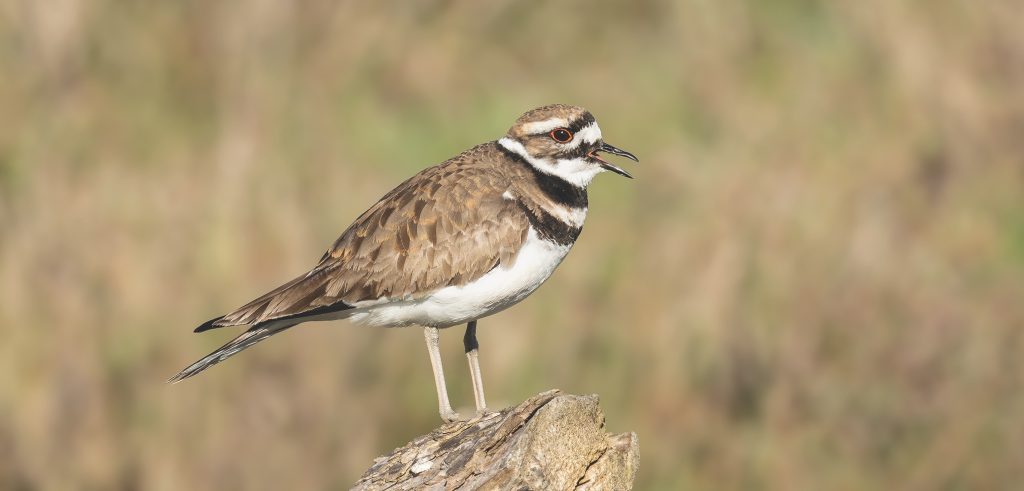
The killdeer is a small, brown-and-white shorebird that breeds in the Sandhills and Piedmont of North Carolina. The species can be found here year-round in the right habitat — and it need not be all that wet. Widespread in North America, most of the killdeer population lives away from the water’s edge. In fact, for egg laying, the drier the spot, the better. In truth, our sandy soil is not unlike the beaches where one would expect to find a shorebird.
This robin-sized bird gets its name from its call: a loud “kill-deer, kill-deer,” which can be heard day or night. During migration, individuals frequently vocalize on the wing, high in the air. In early spring adults will circle above their territory calling incessantly.
On the ground, killdeer are a challenge to spot. They blend in well with the dark ground, hidden against the mottled surface of a tilled field or a gravel covering. Killdeer employ a “run-and-stop” foraging strategy searching for insect prey on the ground. As they run, they may stir up insects, which will be gobbled up as the birds come to a quick halt. Although they live in close proximity to humans, killdeer are quite shy and more likely to run than fly if approached. When alarmed, they frequently use a quick head bob or two, likely a strategy to make the birds appear larger than they are.
During the winter months, flocks of killdeer concentrate in open, insect-rich habitat such as ball fields, golf courses or harvested croplands. Come spring, pairs will search out drier substrates, preferring sandy or rocky areas for nesting. They may even use flat, gravel rooftops. The female merely scrapes a slight depression where she lays four to six speckled eggs that blend in with the surroundings. She will sit perfectly still on her nest and incubate the eggs for three to four weeks. If disturbed by a potential predator, the female killdeer will employ distraction displays to draw the intruder away from the eggs, going so far as to feign a broken wing. The mother bird will call loudly and with her tail spread — to be as noticeable as possible — limp along dragging a wing on the ground. This “broken wing act” can be very convincing, giving the predator the idea that following the female will result in an easy meal. Once away from the nest, the killdeer will fly off, not returning to the eggs until she is convinced the coast is clear. Should distractions by the adults not be effective, the pair will find a new nesting location and begin again. A very determined nester, killdeer are capable of producing up to three broods in a summer.
When the eggs hatch, it will be a synchronous affair. As soon as they have dried off, the downy, long-legged young will immediately follow their mother away from the nest to a safer, more protected area nearby. They will follow her, being fed and brooded along the way, for several weeks. Once they are fully feathered, the young will have learned not only how to escape danger but how and where to find food.
So, if you hear a “kill-deer” over the next couple of months, stop and look closely. You may be rewarded with a peek into the summer life of this fascinating little bird.