Botanicus

Pick a Peck of
Peppers

From heat to sweet, there’s something for every palate

By Ross Howell Jr.

Now that the azaleas are blooming, what better way for gardeners to dream of summer’s bounty than by thumbing through seed catalogs or browsing the internet?

I was searching for hot peppers. A friend told me she loved eating ghost pepper jam — though it made her sweat.

I hadn’t thought about eating one. I just liked the name.

You know the internet. Soon, I was reading how the ghost pepper was supplanted as the world’s hottest chili pepper by the Trinidad Scorpion Butch T, which was supplanted by the Carolina Reaper, a pepper grown next door in the Palmetto State.
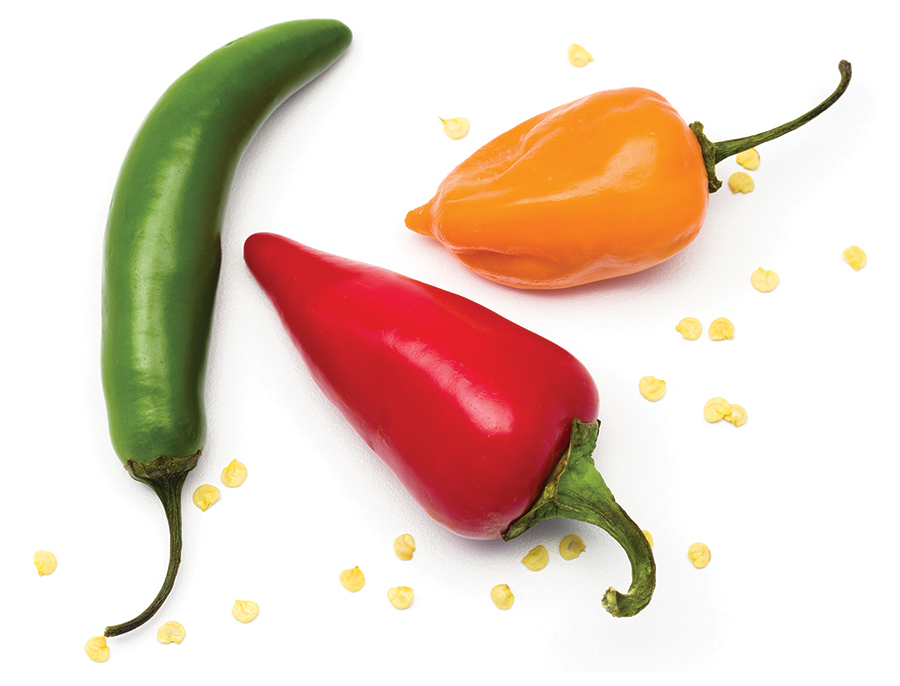
I can’t eat hot peppers. But I like growing them. However, I grew up eating peppers my mother harvested from her garden. Sweet, elegantly green bell peppers.

Turns out I found a kindred spirit.

Julie Hale is the community garden coordinator for Greensboro Parks and Recreation.

“I can’t eat the hot ones, either,” Hale says. “But I like growing them because they’re so beautiful.”

Last summer in Keeley Park Community Garden, she ran a program called One Hot Summer.

“The idea was that we’d teach hot pepper growing and eating,” Hale says. She spent weeks researching the 13 varieties she’d try in the garden demonstration bed. She also developed a field guide for the plants.

The guide includes color pictures, growing times to maturity, what to expect in terms of size and shape, and how hot peppers can be used in food.

“It was important to select varieties that weren’t too hot,” Hale says. “Some people just don’t like much heat or can have a bad reaction.”

In addition to seeing the demonstration bed, participants also could take free plants home to try in their gardens.

“The Jaloro Jalapeño is a variety we shared with folks who signed up for our program,” Hale says. She chose the Jaloro — developed at Texas A&M University — because of its mild flavor. Its yellow color is also unusual.

“Most people think jalapeños are only green in color,” she adds. Since the Jaloro is small, it could be grown in a container if people didn’t have garden space.

Best of all?

“It’s very productive,” Hale says. “We had lots of extra peppers we donated to the food bank.”

Another big producer is the Aji Dulce Spice Pepper, an heirloom originating in Venezuela.

“One of my favorites,” Hale adds. “The plants were covered with peppers all season.” She also recommends the Dulce’s small, thin-walled fruit that offers just a hint of heat. “Great to dry and grind for spice,” she concludes.

Another standout was the Czechoslovakian Black Hot Pepper, which is highly ornamental, with white-streaked, lavender flowers and purple-green leaves.

“With beautiful purple-black fruits, ripening to red,” Hale says, “it was the most commented-on variety in our demonstration.”

Another star pepper was the Mad Hatter, developed from a variety called Bishop’s Crown.

“Featuring spaceship-shaped fruit and minimal heat, this pepper also got a lot of comments,” Hale says. It was voted “very delicious” by official taste-testers at the garden.

Other hot peppers Hale grew were Sally’s Hot, Xochiteco Hot Pepper, Grenada Seasoning Spice Pepper, Carolina Cayenne, Aji Chinchi Amarillo, Baron Poblano, Jasmine Rissie, Hungarian Paprika Spice Pepper and Biquinho Yellow.

And for folks like me, who can’t abide spicy heat, Hale had the Ashe County Pimento. Cultivated in the Appalachian Mountains near Boone, it’s an heirloom sweet pepper with a flattened bell shape.

“Delicious when fully ripe,” she adds.

Hale grew most of the pepper varieties from seed. She recommends Southern Exposure Seed Exchange (SouthernExposure.com) in Virginia and Johnny’s Selected Seeds (JohnnySeeds.com) in Maine.

Summer is a day nearer.  OH

Freelance writer Ross Howell Jr. asks that you put this Parks and Recreation program on your garden calendar: “Intro to Backyard Composting,” Thursday, May 12, 6–8 p.m., Keeley Park Community Garden. Call Julie Hale, 336.373.4549.

Life’s Funny

Hanging in the Balance

Notes from land, sea and air

By Maria Johnson

It was one of the all-time best Christmas presents ever: a red plastic folder from my engineer husband, Jeff.

Ah, but this wasn’t just any festive red folder lying under the tree.

The title page said: “Trip to Florida: Swimming with Manatees.”

The following pages, printed from a PowerPoint presentation he’d made (not kidding) explained how we’d get there; where we’d stay; what we’d do.

The main attraction, hanging out with manatees, was something I’d wanted to do ever since two newspaper colleagues gushed about snorkeling with sea cows 30 years ago.

But I had no clue until I started brushing up on manatees — 1,000-pound mammals that resemble a cross between a big seal and a small whale — that they’ve been very much in the news lately.

That’s because there’s a state-backed program in Florida to feed them romaine lettuce. That’s because a record number of manatees died last year. That’s because the sea grasses they eat have been choked out by algae blooms. That’s because of fertilizer runoff, sewage discharges and the like. And that’s because . . . ta-da, humans.

Merry Christmas.

Still, I was in a cheery mood as we boarded our nonstop flight to St. Petersburg. The sun was shining, the plane was on time and no one at the gate had stopped me because my suitcase was possibly — i.e. definitely — over the weight limit.

I smiled the smile of a scofflaw.

We buckled up as one of the attendants pantomimed what to do in case of an emergency. The engines revved. A couple of seats over, a white-knuckled woman squeezed her eyes shut and started her mantra: “Please Jesus, please Jesus, please Jesus.”

I decided it might be a good time to study the survival cartoons tucked into the seat-back pouch in front of me. I’d never done that. And don’t necessarily recommend it.

But just in case you’re interested, here’s the gist:

If an oxygen mask drops down in front of you, yank on it, put it on, then help the expressionless child who, according to the card, will be sitting right next to you.

If you look out the window and see you’re about to crash on land or water, put your head between your legs so the child will not be able to read your lips.

If you happen to land in one piece and leaving the plane on an inflatable slide is an option, do not jump onto the slide as if you’re having a big time inside a bouncy house. Sit down and slide gently. You won’t have to explain this to Zen-child because they’re way calmer than you are. (Who is this kid, anyway?)

And finally, don’t wear high heels as you leave the plane because if you puncture that freakin’ slide, and the people behind you can’t get off, your fashionable ass will be the last one on the life raft.

I’m just reading between the cartoon lines here.

Conclusion #1: Flying in an airplane is like riding in a bubble. A thin film of safety surrounds you.

Conclusion #2: Don’t wear heels. Ever.

I needed to get my mind on something else. I leafed through a magazine I’d brought and landed, naturally, on a story about a filmmaker and entrepreneur who has been experimenting in Arizona with an enclosed Earth-like environment — imagine a big terrarium, with people — because he’s convinced the actual Earth is going to break up with humans by saying something like:

“Listen, it’s not you; it’s me. Nah, I’m lying. It’s you.”

You might remember that someone else tried to create a sort of miniature Earth — with the idea of eventually hurling it into space — in Arizona in the late 1980s. The experiment was called Biosphere 2, and it failed, basically because the oxygen ran out and the knockoff environment was not complex enough to replace it.

The story pointed out that oxygen accounts for about one-fifth of the air we breathe, and once atmospheric oxygen drops below 19.5 percent, human cells start showing signs of distress.

Guess what the oxygen level was in the latest Arizona bubble after four hours?

Seventeen percent.

I closed the magazine. It seemed like the universe was trying to tell me something. Other than don’t wear heels.

I got the message again a couple of days later, as we wriggled into wetsuits and snorkels and slipped into the 72-degree water of Kings Bay near Crystal River, Florida, a favorite manatee wintering spot because of the warm springs that feed the river.

Our guide, Rob, a former Marine who’d gotten sick of working under fluorescent lights in a warehouse, swam to a spot and pointed down.

We dipped our masks under the water just in time to see a gentle giant glide by.

Rob waved us to another spot, closer to the edge of the cove, where a manatee and her calf noshed on sea grass. The grass grew only in a narrow band, where the sunlight could reach it.

The manatees slipped away faster than we could follow. Rob had told us not to chase them. We were to disturb them as little as possible. We were in their home, he said.

The wind whipped the palm trees on shore. Our captain, Glenn, who described manatees as “the ultimate hippies,” waved us aboard. We’d try another spot. We might get lucky, he said, because a cool front was moving in, and the manatees, ever sensitive to the Earth’s whispers, would respond by eating more.

He piloted the boat to another cove, where we descended again and peered into a world vivid with darting fish and waving crabs and swaying grasses that gave off tiny bubbles.

Several yards below, on the sandy bottom, a mama manatee and her nursing calf hovered.

We hung there in a loose circle on the surface, rocked by the waves and the rhythmic rasps of our breaths moving through the snorkel tubes. With ears submerged, we could hear the squeaky patter of mom and baby.

The torpedo-shaped calf, all 7 feet of it, detached and rose to the surface, its curvy face passing a few feet in front of mine. Smoky spirals of milk streamed from its thick hound-dog upper lips.

Its eyes were round, calm, trusting.

Its blunt snout breached the surface and took in air.

I floated there, enchanted. We were to touch the manatees only with one hand — and only if they touched us first.

Mom and calf drifted away.

A few minutes later, as we paddled toward Rob, who’d made another sighting, Jeff tapped my shoulder with urgency.

I looked over. A huge manatee was moving right beside us.

Its sandpapery skin brushed Jeff’s hand as it slipped by peacefully.

We smiled around our mouthpieces.

It was their home.

And our honor.  OH

Maria Johnson is a contributing editor of O.Henry magazine. You can reach her at ohenrymaria@gmail.com.

Art of the State

Wild & Whimsical

Anne Lemanski’s fanciful patterned creatures

By Liza Roberts

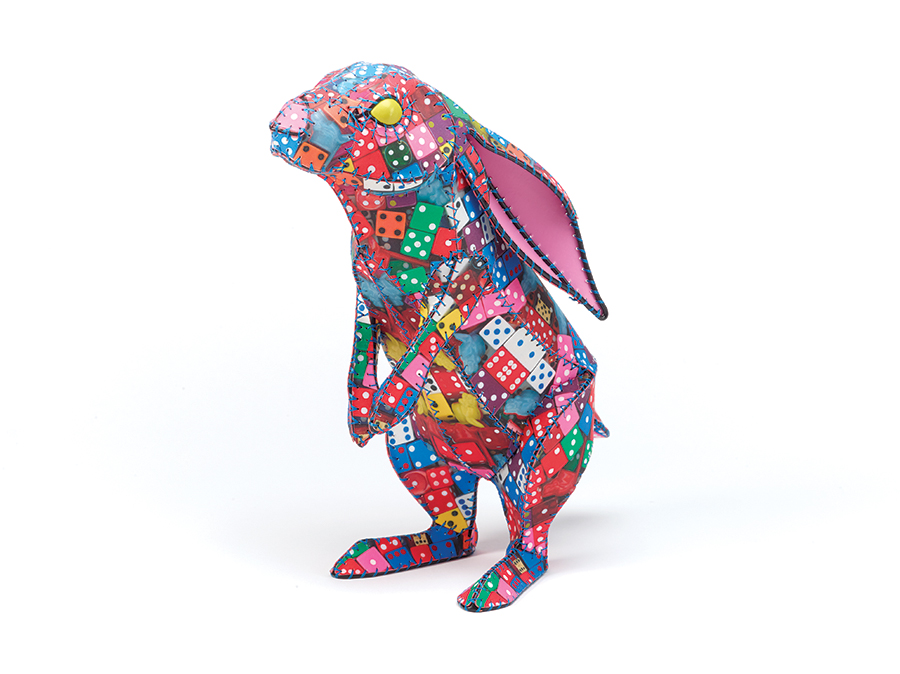
If you’ve seen any of Anne Lemanski’s cosmic, colorful animal sculptures in person, you know they look as if they might twitch, or pounce, or slink on by. The skins that cover them — psychedelic prints and unexpected patterns — somehow add to this unlikely effect. Perhaps her multicolored tiger, or her ocelot, or her amazing rabbit, has emerged through a looking-glass portal from some magical realm and wound up in our own?

You’re not far off.

Lemanski’s Spruce Pine studio is, in fact, an otherworldly laboratory of creation where she doesn’t just make an animal, she learns it inside out. She studies its physicality and psychology, figures out how its haunches tense when it sits back, how they loosen in a run, how its brow might scowl at distant prey. Then she replicates all of that with copper rods she bends, cuts and welds into a three-dimensional sculpture, an armature. In an upstairs made of shipping containers, another act of creation happens, guided not by realism but by intuition. Here, she will create a skin for that armature, make it out of digital photographs or prints or collage or all three, and print it on paper. She will draw and cut a pattern as if she were making a dress or a suit and sew it all on, piece by piece, with artificial sinew. Her tools — wire cutters and an X-Acto knife — are the same, simple ones she has used for 30 years. She has no assistants.

On a warm and wet spring weekend, Lemanski is learning mink. Her giant mastiff, Dill, sits nearby. Photographs of minks in every position and resolution surround her, filling a wall and every tab on her computer. She’s learning about what minks eat, how they’re bred for coats, about the recent killing of 17 million COVID-infected mink in Denmark. “Millions! I’m not exaggerating. I was horrified,” she says, shivering. The armatures for a few minks in different positions are underway; one is complete. She holds it in her hands. “Once the armature is done, that’s the most important part of capturing the animal,” she says. “I ripped this one apart like three times. And finally, one day, it just clicked.”

With the armature complete, Lemanski moves on to the mink’s skin, leaning into the collages that form a significant counterpart to her sculpture. Comprised of illustrated images from the pages of pre-1970s textbooks, comic books, picture books and children’s encyclopedias, Lemanski uses her X-Acto knife to combine, say, giant squid with convertible cars, pigeons with mermaids, skeletons with alphabet blocks, chewing gum with polar bears. There are butcher’s maps for cuts of meat and colored-dot tests for colorblindness, and constellations and cockatoos — a century’s worth of illustrations shaken and stirred into a cocktail of nature and man, science and myth, technology, geometry, and things that are cool. A series made during COVID, Metaphysical Mineral, explores the properties of a series of eight different minerals. Quartz includes a high diver in a ’50s-era swimsuit, a white stallion and a swarm of bees. Sulphur gets a winding snake, a stick of dynamite and a cigarette.

These individual component images are one of a kind and cannot be replicated; to do so would be to lose the unmistakable texture and character of the Ben-Day dots used in printing from the 1950s to the 1970s (made particularly recognizable by the pop artist Roy Lichtenstein). “I’ve tried [copying them], and it just doesn’t work,” she says. So when she uses these images in a collage, Lemanski tacks them down lightly with a little loop of tape so she can take them off and use them again. This technique also adds to the three-dimensional look of the collages once they’re printed.

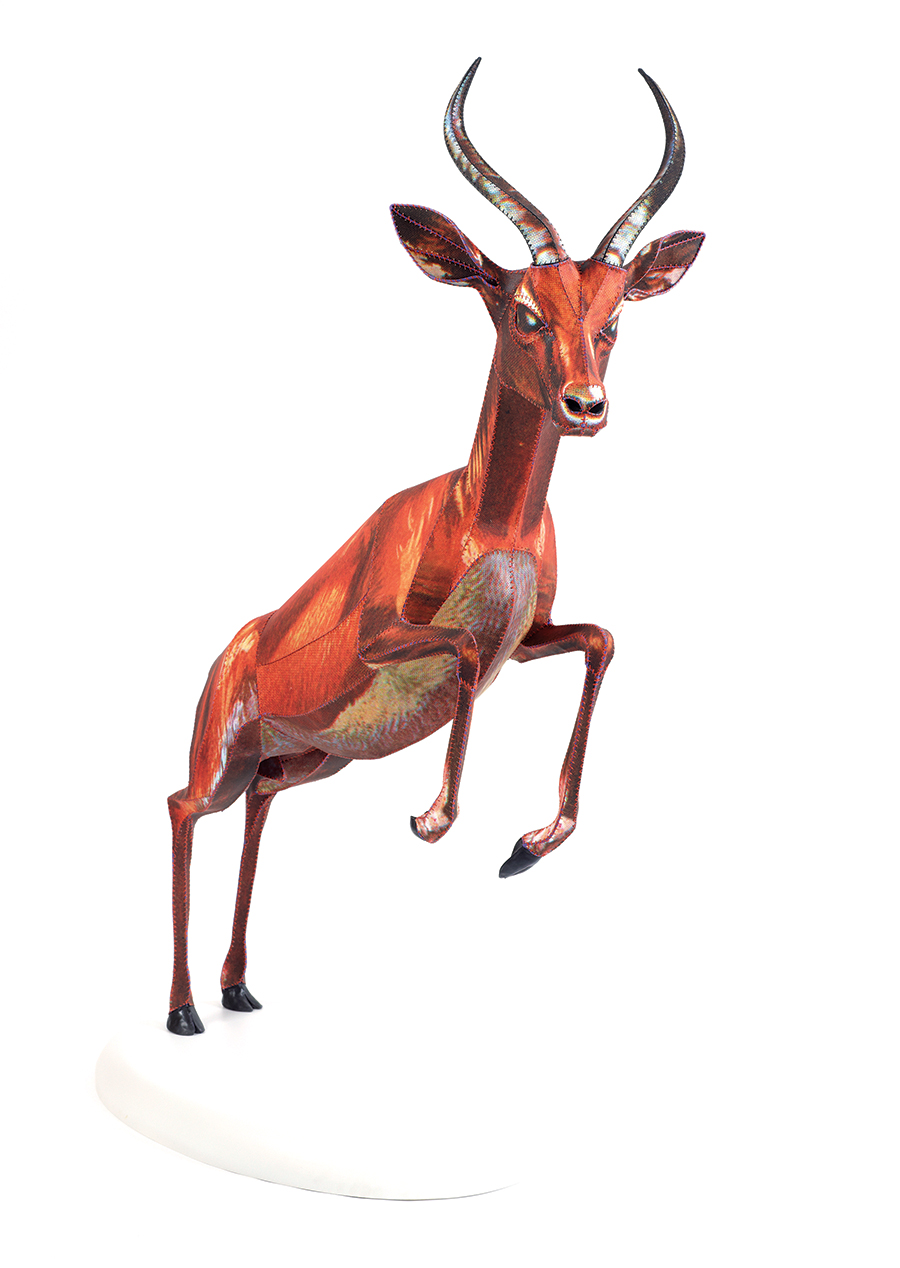
She credits a residency at Charlotte’s McColl Center with launching this kind of work. Inspired by the possibilities of the center’s large-format digital printer, she made 12 small collages and printed them in huge dimensions. These prints ended up forming the basis of a solo exhibition at the center that also included sculpture, in this instance a “three-dimensional collage” that incorporated some of the printed collage animals themselves. A 4-inch image of an impala in one print, for instance, became a life-sized impala sculpture in the center of the room that she “skinned,” in a meta twist, in digital prints of the tiny image’s own fur. “That was a challenging piece to make,” she says.

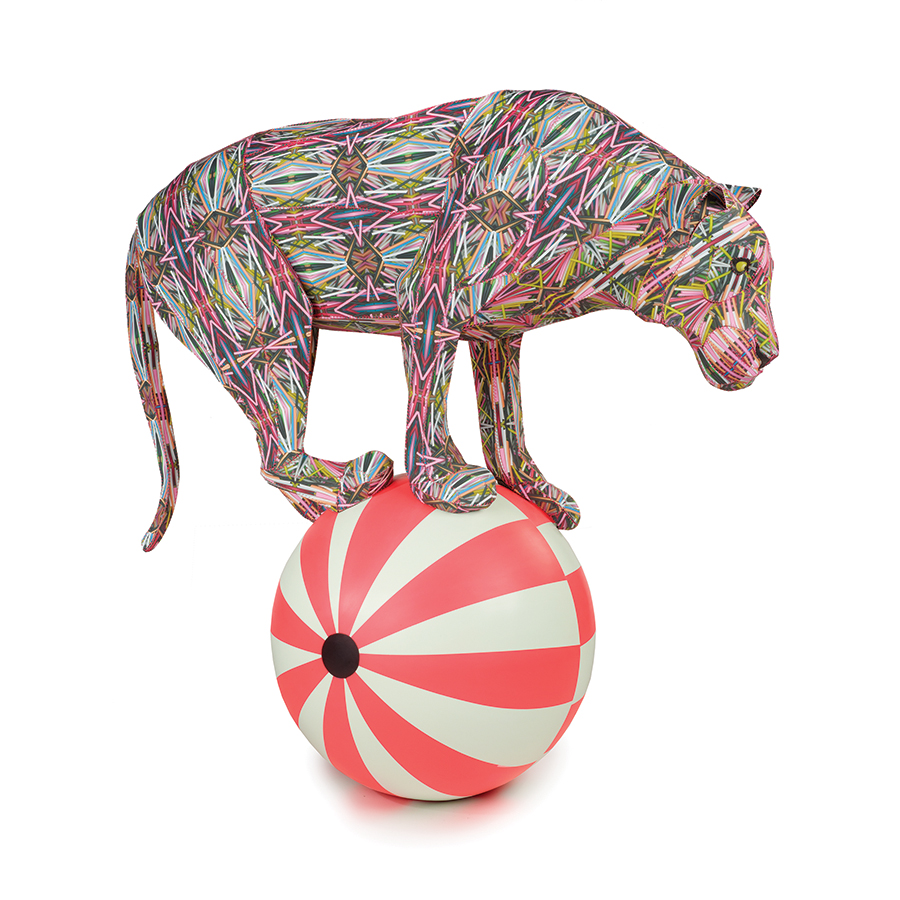
So was the Tigris T-1, a freestanding, life-size sculpture of a tiger balancing on a ball, that was acquired by noted collector Fleur Bresler for donation to Crystal Bridges Museum of American Art in Bentonville, Ark., a career-catapulting moment Lemanski is still pinching herself about. Her work is also in the permanent collections of the Mint Museum, the North Carolina Museum of Art, the Asheville Art Museum and in many private collections. It’s even found its way into wallpaper as part of a fanciful line of sly, butterfly-and-bird-bedecked prints made in Schumacher’s Peg Norris collection, a collaboration between Charlotte gallerist Chandra Johnson and interior designer Barrie Benson.

What’s next is what excites Lemanski most. Lately, she’s been working on an animal that’s captured her imagination for a while: a horse — a life-sized Appaloosa. “Who doesn’t love a horse?” she asks, as she works out the intricacies. “The hooves and ankles of a horse are extremely complex; they’re bulbous, they’re angular, and that’s where all the business happens.” Also in the hopper: her first piece of public, outdoor art — another large animal — to be cast in aluminum. It could mark the beginning of a whole new oeuvre.

“I really am looking forward to the work I’m going to make in the future,” Lemanski says. “I think it’s going to be on a large scale, and I just want to keep pushing the work forward… It’s the unknown of the future that keeps me going.”  OH

This is an excerpt from Liza Roberts’ forthcoming book Art of the State: Celebrating the Art of North Carolina, to be published by UNC Press this fall.

Wandering Billy

The Prez of Jazz Night

Getting into the groove
on Sunday evenings

By Billy Eye

It’s too exciting for words … so they had to set it to music!
movie trailer for Blues in the Night (1941)

I’ve been carping for a decade that this town needs a groovy, early-evening Sunday hangout. Jazz Night at Cafe Europa fits the bill perfectly, especially now that the weather is turning milder and the patio is open. (Let’s hope. I’m writing this in February.) This swinging soiree from 6–9 p.m. is presided over by Prez, spinmeister supreme who also hosts a Wednesday night jam at Flat Iron, broadcast live over WUAG.

As someone who frequented the 1980s and early ’90s Los Angeles underground dance clubs, mid-’90s’ Club Babylon raves here, and, in the early 2000s, footloosing in massive discotheques across London’s underbelly, I’ve had the privilege of grinding behind grooves laid down by the top DJs in the world. <name drop> Keoki, Paul van Dyk, Sasha & John Digweed, plus PeteTong, Fatboy Slim and Paul Oakenfold.

Having been present for a number of Prez’s performances in a dimly lit Greensboro nightclub over the last year or so, I’d rank him with the best on that list, possessing a prodigious talent for transforming the most quotidian room into bouncy blissfulness, drawing on an all-too-rare musical intelligence unleashing a barrage of mind-blowing beats veering wildly but seamlessly from one genre to the next.

“I could be at a bar, for example, and everybody’s got their back to me,” Prez tells me. “But something they hear they register with, either their head nods, their foot taps, fingers clicking, and you know that, ‘Oh, wow. They recognize what they’re listening to.’”

For Sunday Jazz at Cafe Europa, Prez spins a mellower tone, with a softer but no less sharpened edge. It is anchored in part by modern jazz-inspired pioneers like DJ Can and Amerigo Gazaway, echoing with the vocals of Aretha Franklin, The Chi-lites, Nina Simone and other seminal 20th-century soul sensations. Who is this guy?

“My parents were into music and they’re from the South,” Prez says. “So, there were cross-cultural dynamics for me, like them growing up in a Southern culture, then my father joining the military, traveling around the world while raising kids along the way. Then I came to UNCG as a freshman, where I honed my skills.”

Residing in various countries, like Germany and Thailand, as a child before settling in Massachusetts had to have influenced his musical preferences. “I think it gave me a taste of what the culture of a certain environment sounded like,” Prez says. “Finding different dynamics in soul music but with kind of an African flavor or a Polynesian flavor or Latin rhythms.”

This DJ paints with a broader brush than one would expect, which makes sense because jazz underpins so many contrasting styles. “You get a different flavor that’s not just classical jazz,” Prez says about his style. “It’s not just big band; you get a little hip-hop flavor, some soul, house, electronic and funk music that stems from jazz.”

Cafe Europa attracts an eclectic clientele on a regular basis, that’s part of the appeal of the place. “We started Jazz Night back in May 2021,” Prez says. Just took a chance. My man [bartender] Jonny Alright and [owner] Jacob Pucilowski over at Europa said, ‘Hey, let’s do something kind of cool, something different.’” When Jazz Night first got underway it was just the lone DJ flying solo alongside crates of his albums. “It was not what the crowd expected jazz to be,” Prez recalls. “That’s why we kept doing it and why we’re still doing it now.”

Warding off any remaining chill in the air with more chill on the patio at Europa, surrounded by our downtown parks? For a serene Sunday twilight, nothing could be finer in Carolina when you consider this is a casual bistro offering affordable cocktails and slightly Southern comfort cuisine. Its French dip sandwich, steak & frites, and the cafe burger come highly recommended. I’ve never ordered anything that didn’t satisfy.

“Of course, you go with the classics,” Prez explains about his choice of needle drops. “Coltrane, Miles, Max Roach, Dizzy, then venturing into Roy Hargrove, Robert Glasper, Ali Shaheed Muhammad.” As word spread and the audience expanded, people started bringing their own records. “I was like, ‘Cool.’ Then people started turning up with turntables, keyboards, a guitar now and then, and it became a kind of a jazz jam formulated around the records.”

Kinda reminds me of a smoky little joint (back when smoky was okie) called Sammy’s in the Plaza Shopping Center where, a few decades ago, a combo on Friday nights drew legions of jazz enthusiasts.

Moving a crowd with your rhythmic repertoire begins with an understanding of the basics. “I tell people,” Prez says, “if they want to collect records, if they want to become a successful DJ, you listen first. You don’t go out and buy gear or buy records; it’s about listening and then you can curate. Then you can turn that into a three-hour mix where people are entertained.”

In an atmosphere infused with melodic precision, a totality of tonality presented in a way that Greensboro hasn’t heard or seen before, somehow every week Prez manages to discover another fresh take on what jazz can be, constantly experimenting with syncopated juxtapositions.

Arrive alone or with a coterie, and should winter’s icy fingers linger the proceedings will be relocated indoors.

Wheels of steel are largely digital now, but they still spin. Prez has been honing his craft for two decades. “I don’t really know what keeps me going, to be real. I think it’s the joy that I see on younger people’s faces that are new to this, are fresh into music. Seeing their energy, feeding off of their energy. How do you capture that moment?” Prez asks, knowing full well the answer. “That’s what being a DJ is.”  OH

Next month marks exactly six years since Billy Eye started writing “Wandering Billy,” which is why the schools and liquor stores will be closed during April to honor that landmark occasion.

Tea Leaf Astrologer

Pisces
(February 19 – March 20)

The only difference between a mythical creature and a Pisces is that a mythical creature believes in itself. Pisceans are magical by nature and naturally psychic. That’s because those born under this mutable water sign are masters of subtle emotion. This month, the cosmos is dealing you a planetary royal flush. In other words, you don’t have to keep swimming upstream. But will you?

Tea leaf “fortunes” for the rest of you:

Aries (March 21 – April 19)

Don’t forget to stretch.

Taurus (April 20 – May 20)

There’s a whole world outside of the box. Think about it.

Gemini (May 21 – June 20)

Less talking. More dancing.

Cancer (June 21 – July 22)

Slow down. Proceed with caution. Be prepared to pivot.

Leo (July 23 – August 22)

You’re back in the spotlight. Breathe easy.

Virgo (August 23 – September 22)

A little salt goes a long way.

Libra (September 23 – October 22)

Someone’s got color in their cheeks again.

Scorpio (October 23 – November 21)

Try zooming out.

Sagittarius (November 22 – December 21)

When one door closes, best not to set up camp on the front porch.

Capricorn (December 22 – January 19)

Three words: Don’t look back.

Aquarius (January 20 – February 18)

Timing is everything. Read that again.   OH

Zora Stellanova has been divining with tea leaves since Game of Thrones’ Starbucks cup mishap of 2019. While she’s not exactly a medium, she’s far from average. She lives in the N.C. foothills with her Sphynx cat, Lyla. 

The Creators of N.C.

The Lost Treasure of Home

Jonas Pate and
his runaway hit
Outer Banks

By Wiley Cash 

While there is plenty of mystery in the breakout Netflix smash hit Outer Banks — everything from a father lost at sea to a legendary treasure — the mystery that director and co-creator Jonas Pate seems most intent on exploring is the age-old mystery of what divides people along class lines. It worked for Shakespeare with his Montagues and Capulets, and 370 or so years later it worked again for Bernstein’s and Sondheim’s Jets and Sharks. Pate’s rival groups are similarly aged, sun-kissed teenagers living and partying along North Carolina’s Outer Banks, where a group of working class kids known as the “Pogues” continually find themselves marginalized and dismissed by the “Kooks,” who are the children of wealthy residents and seasonal tourists. Fists and hearts certainly fly, but despite the show’s use of cliffhangers and action-packed sequences, at its core Outer Banks investigates the emotional and experiential threads that pull some of us together across class lines while invisible barriers push others of us apart.

According to Pate, the divide between the haves and the have nots is “the oldest story in the world. It cuts across everything,” which he believes explains the show’s broad appeal.

Broad indeed. In the late spring of 2020, just as the people of the world were settling into the pandemic and the realization that they did not want to see or hear another word about Tiger King and Joe Exotic, Outer Banks debuted in mid-April and quickly became one of Netflix’s most watched shows of the year. The following summer, the show’s second season hit No. 1 on the Nielsen report. The success seemed immediate, and the show’s slick production quality made it all appear as easy and relaxed as a day on the water, but Jonas Pate and his twin brother, Josh, with whom he created Outer Banks along with Shannon Burke, had spent their whole lives preparing for this moment.

The Pate brothers grew up in Raeford, North Carolina, where their father served as a judge and their grandfather owned a local pharmacy. “It was amazing,” Jonas says. “It was like Mayberry. I’d ride my bike to the pharmacy and get a Cherry Coke and a slaw dog, and then I’d visit my dad at the courthouse. My stepmom was head of parks and recreation, so I’d go over there and help ref T-ball games.”

We are sitting on the second-story porch of the home he shares with his wife, Jennifer, and their two teenage children in Wilmington, just across the water from Wrightsville Beach. The January morning is unseasonably warm and sunny, and Jonas is dressed as if he just stepped off the set of Outer Banks, not as its director but as one of its stars. (How handsome is Jonas Pate? A few days later, our 5-year-old daughter will walk past Mallory’s computer while she is editing photos of Jonas. She will stop in her tracks and ask, “Who is that?”)

Jonas’ surfer appeal is not surprising considering that while he primarily grew up in Raeford and attended high school there, he spent his summers with his mother along the barrier islands near Charleston. “Outer Banks is an amalgam of different high school environments and things that we went through,” he says. “It helped create the mythical environment of Outer Banks where we kind of knew what it was like to live feral in a small town with haves and have-nots. Kiawah and James Island were like that. It was poor kids and rich kids, and they would get into fights. And Raeford is still very rural.”

Rural, yes, but Jonas and Josh still found plenty to keep them busy. If they were not exploring the marshes and waterways off the coast of Charleston, then they were shooting homemade movies back in Raeford, where they made films of Robin Hood and Hercules and edited them by using two VHS machines. He laughs at the memory of it. “The cuts were terrible and fuzzy,” he says, “and all the special effects and sound were awful.” But he admits that something felt and still feels magical about it. He had always loved film, especially those by Steven Spielberg and Frank Capra, saying that he has “always been drawn to filmmakers who are a little sweeter and have a little more heart.”

After college, the brothers found that they still had the desire to make films, but they did not know how to break into the industry. “We didn’t know anyone in the film business,” he says. “We didn’t know anything.”

The brothers moved to New York and worked to immerse themselves in the city’s film culture. While interning at the Angelika Film Center, Josh met Peter Glatzer, who was a fundraiser for the Independent Feature Project. They talked about screenwriting, and the Pate brothers soon had a script that Glatzer was interested in producing. Their first film, The Grave, was shot in eastern North Carolina, and while it did not receive a theatrical release and went straight to video after premiering on HBO, the Pate brothers had their collective foot in the door. In 1997, they made another North Carolina-shot film with Glatzer, The Deceiver, that starred Tim Roth and Renée Zellweger, and it found a larger audience after debuting at the Venice Film Festival and being distributed by MGM. The brothers headed for Los Angeles.

Once there, Jonas found himself “taking jobs just to pay the bills” and “getting further and further away from what I actually wanted to do.” One bright spot of his time in LA was meeting his wife, Jennifer, who also worked in the industry as a casting agent. Not long after they met, Jennifer started her own agency, and Jonas went to her for assistance in casting his first television show, Good vs. Evil, in 1999. From there he went on to direct and produce a number of television shows, including the NBC shows Deception and Prime Suspect and ABC’s Blood and Oil. In 2005, the Pate brothers partnered again and returned to North Carolina, where they filmed a single season of the television show Surface, which they co-created. After having kids, Jonas and Jennifer decided to move back to North Carolina in time for their son and daughter to attend high school. Jonas suddenly found himself on the other side of the country from the industry he had devoted his life to for the past 20 years.

But then something magical happened. Jonas understood two things: First, he needed to create something that could be shot on the coast so he could stay close to home. Second, he would draw from his own experiences to make it real. “When I pulled from my own life instead of the movies I’d seen, it all came together,” he says. “You get to the universal by being super specific.”

One big challenge that Jonas and his team encountered was casting the show’s young stars. “We auditioned maybe 500 or 600 kids, and we really had to try to find kids who’d been outside and lived in the outdoors.” Not surprisingly, given the Pate brothers’ personal ties to the show’s geography, nearly every star they cast was from the South, except for one who hailed from Alaska. “Growing up outside, being around boats,” Jonas says, “it’s hard to fake that stuff, and it’s hard to make it look real if it’s not.”

I turn off the recorder and Mallory packs up her photography gear, and we say our goodbyes to Jonas. He is leaving soon for another production set. We share a number of mutual friends in Wilmington with him and Jennifer, and we talk about getting together for dinner once he returns.

Mallory and I are alone in the driveway when I realize that I have locked the keys in our car. To say that I was embarrassed — and, let’s be honest, panicked — would be an understatement. Mallory pulled out her phone and began searching for a locksmith. I have a flip phone, so I just stood there, weighing the two most logical options: breaking the window with one of Jonas’ landscaping rocks or just leaving the car and walking home, denying it was ever ours.

I cannot help thinking that if I were John B., the star of Outer Banks and leader of the Pogues, played by Chase Stokes, I would sneak into a neighbor’s garage and hotwire their car, drive home, procure a backup set of keys, and return for Mallory while passing under the investigating deputy’s nose. Or, if I were Topper, the leader of the Kooks, played by Austin North, I would bang on Jonas’ door and use his phone to call my father’s car service. But I am neither of these characters. I’m just me, so I apologize again to Mallory, and we wait for the locksmith together.  OH

Wiley Cash is the Alumni Author-in-Residence at the University of North Carolina Asheville. His new novel, When Ghosts Come Home, is available wherever books are sold.

From the Editor

From The Editor

It is the first mild day of March:

Each minute sweeter than before …

There is a blessing in the air

— William Wordsworth

March can be a fickle month, but having grown up in the 1960s and 1970s in rural Guilford County, March brought the promise of hope to my family.

While snow and ice still were probabilities, something about my father shifted during the year’s third month. Subtle, nevertheless unmistakable.

He began making lists and outlines of the vegetables he planned to plant in our garden. Even though the temperature often was chilly, he spent time surveying his plot.

It wasn’t a huge spot behind our house, but it was large enough to be bountiful. My four siblings and I spent time tilling, fertilizing, planting, caring for, harvesting and, finally, consuming or canning — and had a grand time. Under my father’s guidance, we shared with our neighbors the vegetables we grew — string beans, crowder peas, cucumbers, peppers, squash, tomatoes and more.

As my father’s garden flourished, so did our understanding of him.

Born in a tiny community along the Pamlico Sound in the 1920s, my dad developed an appreciation for and the importance of satisfying one of the most basic needs of survival — nourishment.

The youngest of nine children, my father spent his early years close to my grandmother while my grandfather and four older uncles fished. In that remote, windswept coastal fishing village — and under my grandmother’s gentle yet watchful eye — he learned to cook, care for relatives and friends, develop a love of poetry, and cultivate a garden. The Great Depression brought hardship, and what once had been the family’s successful, statewide seafood business languished.

And then, in 1943, the U.S. Army “invited” my father to serve. In 1944, he marched from France to Berlin. When he wasn’t in combat, he cooked, preparing meals for hungry, scared and often wounded young soldiers.

My father returned home in 1946, and after a difficult time adjusting to peacetime America, in 1947, he entered college, earned a bachelor’s degree, moved to Stokesdale, met my mother and became a beloved school principal — while raising five children.

Heroes define and shape our lives. He was — and always will be — my mentor, best friend, shelter, protector. And, yes, my hero.  OH   

Mary Best

Editor

mary@ohenrymag.com

Life’s Funny

What a Gas

A lesson on finding what you need

By Maria Johnson

A dark green cylinder.

About the size of a football.

Says “Coleman” on the side.

White label.

Red-and-black print.

I know exactly what I’m looking for — a propane tank for a camp stove — and why.

The ice is coming.

Or so the forecast says.

My memory jumps to a little more than a year ago, when a weekend ice storm left us in the dark and the cold.

We didn’t have it as bad as many others did — our electricity went out Saturday morning and came back on Sunday afternoon. We were pure-T lucky that some parts of the city still had power and that we had enough gas in the cars to go and get McDonald’s coffee and takeout meals.

We brought them home — instead of eating across town — because the pandemic raged on.

Our wings were clipped. Twice. But we had a gas fireplace. And water. And batteries for our flashlights. And quilts and afghans stitched by long-gone grannies who lived when these conditions were closer to the norm — when winter nightfall meant kindling a fire.

We did as they would have done. We turned the sofa to face the fireplace and literally huddled with our hound and our loved ones. Our older son and his girlfriend were still here, stretching their Christmas visit because they were working from home, and they allowed “home” to be with us for a while.

We warmed Thai takeout — not very well — in a Dutch oven over the fire, under an open flue.

We read Sherlock Holmes stories aloud, by flashlight.

We went to bed early and rose with the sun.

In daylight, we drove — carefully, around downed trees and through intersections with stoplights gone dark — to a park. We stayed long enough to be dazzled by the sunlight dancing in the diamond woods — and to be scared into retreat by the gunshot pops and muffled whooshes of trees breaking and falling under the weight of their jewelry.

On the way home, I saw a friend striding, as she usually does, for exercise and joy, down an empty Lawndale Drive in a neon parka, her New England hardiness in full view.

We, however, were reduced to basics.

A walk.

A fire.

Some food.

And water.

Good health.

Good humor.

Each other.

When everything else fell away, it was easy to see what we had.

And be grateful.

It’s hard to talk about this — gratitude in the face of hardship — even with the pandemic waning somewhat. So many people in this country have died of COVID in last two years: 886,000 at this writing.

Eight. Hundred. Eighty-six. Thousand.

So many people have suffered and are still suffering with empty chairs and guilt and long COVID.

But I hear timid thanks leaking out in people’s stories these days.

Timid thanks for the hard stops that enable us to see that simple is OK.

Small is OK.

Dare we say it: better, even.

Maybe giving thanks is where this gets sticky. Thanks implies a giver with an intention. A purpose. A reason for the rattiness. We love a reason, don’t we?

But sometimes, I think, there is no reason. Bad stuff happens because it can. And will, inevitably, in this God-filled universe.

Sometimes we get caught in the jaws of life and don’t survive.

Sometimes, we do survive — for a while longer.

Whether we can scrape up any wisdom afterward is up to us.

Whether we can look around and see the doors that have been, many times, open all along — that’s up to us.

Take, for instance, the opportunity to buy a gas camp stove after last year’s power outage.

I saw it. And took it.

Bought a gas cylinder, too.

And stored it in the garage, separate from the stove.

But where, oh where, I wonder now, a year later.

We comb the shelves and crannies.

Then we look in insane places — as people who have lost things often do.

Could it be in the laundry room?

The pantry?

Your sock drawer?

Jeff searches the attic — the attic! — as I stand before the garage shelves that seem to mock me.

“OK, I know you’re here,” I finally surrender. “Just show me where.”

I take a breath and soften my gaze.

And there it is.

In a cardboard box, on edge, that I had clearly labeled like the spine of a book: “PROPANE GAS FOR CAMP STOVE.”

Ohhh yeahhh.

I had put the tank there, after several months of watching it get knocked over and roll around on the shelf, because it seemed safer that way.

I laugh out loud.

Because what I wanted wasn’t in the form I was looking for — and by my own hand, to boot.

     But it was there all the time.  OH

Maria Johnson is a contributing editor of O.Henry magazine. You can reach her at ohenrymaria@gmail.com.

Birdwatch

Cleanup on Aisle 2

The vulture’s role in the ecosystem

By Susan Campbell

Vultures: All of us have seen them. Maybe it’s been passing a group feasting on a recently killed animal by the side of the road. Or, more likely, you have spotted an individual soaring overhead on long, outstretched wings. These odd looking birds are too often misunderstood and even disliked — for nothing more than their appearance. In actuality, they are fascinating creatures that perform a vital role in the ecosystem: They are Mother Nature’s cleanup crew.

Often referred to generically as “buzzards,” vultures are part of a family of birds found worldwide with dozens of species, including South American condors. Here in North Carolina, we have both turkey and black vultures year-round. Individuals from farther north significantly boost flock numbers in the cooler months. These large black scavengers lack feathers on their heads: likely an adaptation to feeding almost exclusively on carcasses. Turkey vultures are the more common species from the mountains to the coast. Soaring in a dihedral (v-shaped profile) on long wings with silver linings, they have red heads and long tails for steering.

Black vultures, however, have gray heads and white patches on the under-wing as well as somewhat shorter wings and tails. As a result, they soar with a flatter profile and fly with snappier wing beats. This species has really expanded across the Piedmont in recent years, perhaps due to development, increased road building and the inevitable roadkill that results.

The winter brings vultures together in what can be impressive roosting aggregations that are known as “wakes.” These groups can build to 100 or more individuals of both species that will roost close together in a particular spot: night after night during the season. Late in the day, they will gather in mature trees with larger branches capable of holding significant weight. It is easy to spot them on tall snags or sitting side by side on communication towers. Given the human tendency toward neatness, there are fewer and fewer dead trees for the birds to utilize — so they have been forced to use manmade perches. They may choose rooftops and this can, believe it or not, include people’s houses.

It is not obvious as to why they choose the locations that they do each winter. Given the ease at which they roam in search of food, proximity of their next meal seems rarely a concern. They are capable of gliding and soaring many miles each day. No doubt they require a location with a substrate that warms readily in the morning sun to provide the updrafts they require to reach cruising altitude. Vultures do need a perch that is open enough to allow them to spread their wings on takeoff. This is likely why they are found roosting in more open environments.

For those living near a vulture roost site, be aware that the birds seldom use the same location for more than one season. This could be for reasons of cleanliness or to perhaps reduce the chances of predation — but we really do not know. Also, do not expect that the wake will persist beyond early spring. The group will break up and head off to their breeding grounds by late February or early March. Using prevailing southerly breezes, they will be carried back north in short order.

Although we do have small numbers of breeding vultures in the Piedmont and Sandhills of North Carolina, they are widely dispersed and are quite secretive during the nesting season. Unless they are on the wing, sniffing out (yes, they use their noses more than their eyes) their next meal, they may go completely overlooked.  OH

Susan Campbell would love to receive your wildlife sightings and photos. She can be contacted at susan@ncaves.com.

The Pleasures of Life

Ode to a Daffodil

Acres of yellow blooms beckon the splendor of spring

By Lindsay Morris

In the evening Alice sat on her grandfather’s knee and listened to his stories of faraway places. When he had finished, Alice would say, “When I grow up, I, too, will go to faraway places, and when I grow old, I, too, will live beside the sea.”

That is all very well, little Alice,” said her grandfather, “but there is a third thing you must do.”

“What is that?” asked Alice.

“You must do something to make the world more beautiful,” said her grandfather.

“All right,” said Alice. But she did not know what that could be.

Miss Rumphius by Barbara Cooney


I remember the morning as if it were yesterday. It was early, oh so very early. Much too early for my 8-year-old, growing body. With every ounce of my being, I silently commanded my spirit to ignore the telltale signs of the low beams of light seeping through my blinds. I ordered the gentle tugging on my shoulder to relegate its dictates to the deep recesses of my dreams. Within moments, the strong hands that tugged also separated me from the comfy sanctuary of flannel sheets that enveloped me and jarringly forced me to welcome the earliest moments of dawn.

And then the magic words were spoken: “It’s time.” Just as a hypnotist awakens his client from the edge of consciousness, I was completely awake and reminded of our task at hand. In a trance, I methodically enumerated my to-do list, putting on work boots, donning gardening gloves and grabbing whatever was accessible on the kitchen counter to fuel what I knew would be a long day ahead.

Opening the back door of my childhood home has always brought about visions of Wonderland or Terabithia, and that morning was no different, other than the sun shining much lower and more intensely through the dense trees that hedged our little world of Avalon Loop. You see, Avalon was a world my sisters and I firmly believed God created for our imaginations. The animals of the realm, while not visible, could certainly be heard talking among one another. From the swans’ snorts and the ducks’ cackles on the pond to the neighing of our horse, Ike, son of Tina, and the low whimpers and barks of our dogs, all were offering their morning greetings. But time with furry and feather friends would have to wait. It was as if they, too, had heard the summons, “It’s time,” as my father walked by with tools and bags in hand.

I followed his lead with confidence, knowing that he always had a plan prepared with precision and efficiency. I also knew there would be rules that I must follow, but that is how order thrives in the kingdom of Avalon. My father was a Renaissance Man, one who could dream, create and implement with scientific acumen — a rare man of beauty and science. As much as my young mind could conceive, I knew his goal was never to disrupt nature, but instead to curate it and if possible, unveil and highlight its beauty.  

But that warm October morning, I feared our task that day may not reach completion as I observed the mound of bulbs at our feet. My father, a patient and determined man, seemed nonplussed and content to get started. According to my father, we had around one thousand bulbs to plant alongside the driveway and the north end of the pond. Listening closely, I absorbed with great care his meticulous instructions. He demonstrated how to push the spade into the soil just enough so that the bulb was covered but would still have room to adequately grow and absorb the earth’s nutrients. I worked alongside him, mirroring as closely as possible how he broke the earth. With his small spade, he calculated the distance, spaced and designated a home for each bulb. His plan was masterful, and it played out like a lyrical dance as we glided down the hillside.

The minutes quickly turned into hours. Only when the sun began to dim over the pond did it call out to the swans, ducks and geese, who echoed in unison to the fading sunlight. As I surveyed our work, a sense of pride filled my entire being. With a reassuring smile, my father glanced over at me, tired, but expectant. While my arms and limbs were heavy with fatigue, it could not rival the growing anticipation of what I knew the spring would reveal.

And spring could not come soon enough for my impatient spirit. I remember assessing the soil on a daily basis, practically pleading with it to offer any sign of life. 

The winter of 1990 was a particularly cold one, and those first shoots of bright spring green seemed as though they would never appear. I imagined myself to be an evangelist, praying and wooing those tiny bulbs that we had so carefully sown to rise from the earth. I wasn’t even particularly sure what variety of flower they were because I had never asked my father. Instead, I hoped to be surprised by what would spring forth from the work of our hands. I wanted their beauty to be unveiled in their own timing. And it wasn’t long after their green shoots greeted the sun that I noticed a yellow tint to a few of them. However, as quickly as my synapses fired this message to my brain, my heart sank with great dismay. 

Yellow: The color of sickness, the color of school buses and pencils. For me, it was more than just a color that clashed with my golden blond hair, impeding me from wearing anything in its hue, but it also made me anxious and uneasy about everything when it surrounded me. For some reason, yellow fully dilated my senses. You see, colors have always had a way with me. I have synesthesia, in which colors dictate my mood, my taste and my sense of well-being about the world. After all these months of anticipatory excitement, I was now utterly uncertain what this initial indication of yellow would reveal. However, just a few mornings later in February, I was awakened to an unseasonably warm and sunny day. Rushing outside, I expected to be greeted with sickness at the sight of so much yellow. 

However, nothing could have prepared me for what my eyes encountered and the response that followed. If heaven could be so adorned with rays of golden and lemony yellows, and even yellows marked with golden orange halos, I would have thought that I was in the realms of glory. I willingly abdicated my senses and gazed upward to the sun and offered it gratitude for the beauty that it had nurtured and now reflected. Yellow no longer triggered painful anxieties to rush through my veins, but instead lovingly beckoned me to sit among it to just soak in its splendor.

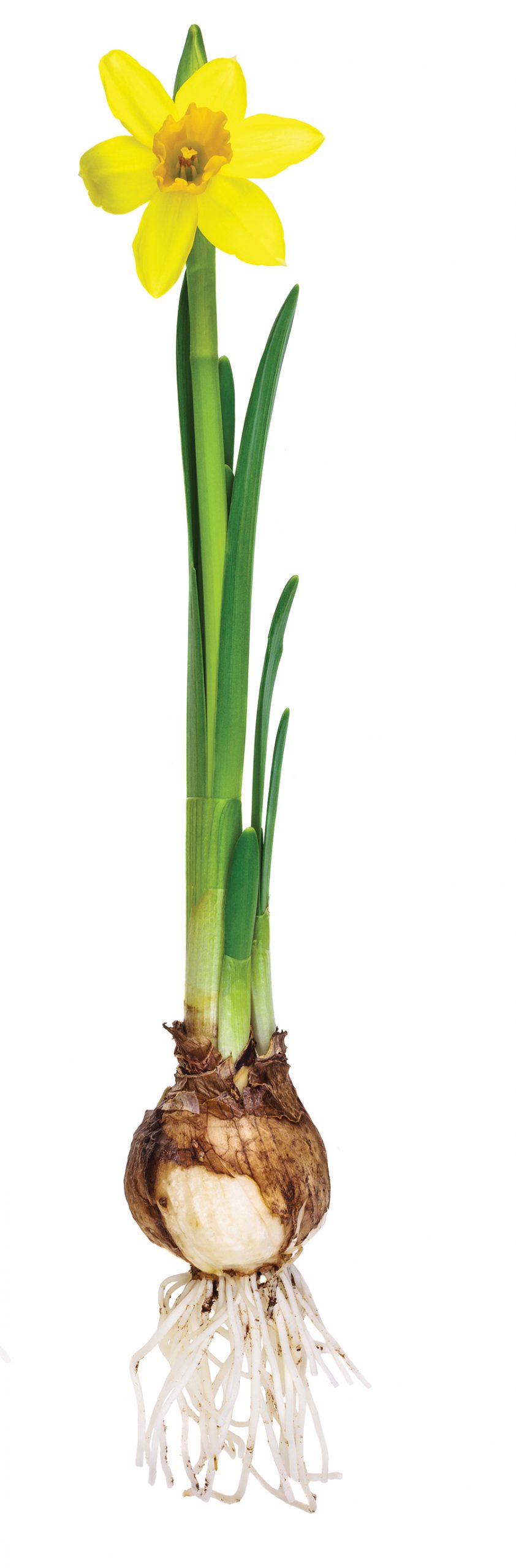
And the splendor of our daffodils has grown exponentially over the years. More than 30 years later, their yellow blooms have become an intrinsic part of our family’s life, just as they have become the centerpiece around many occasions with family and friends. Not only are they the foremost indicator of spring’s arrival, but each year, without fail, they celebrate my March 1st birthday with grandeur. They have marked with great intentionality baptisms and homecomings. 

Now, more than three decades later, not only has my memory of that day remained vividly intact, but with each passing year numerous events and moments with the daffodils have been added to the storehouse of my memories. You see, over the course of three decades, the daffodils have been divided and spread over and under and around our property.  Easily covering five or more acres, adorning both entrances and even abounding in great numbers around the loop road surrounding our pond, their numbers now add up to more than 25,000 flowering blooms. The magic of that day has turned into a proliferation of beauty that not only welcomes but befriends all who enter the realm of Avalon each spring. Their beauty, and the work of our hands, has been a reminder of what planting and nurturing can create. 

This is how Miss Alice Rumphius from Barbara Cooney’s beloved children’s book learned to make the world more beautiful by spreading her lupine seeds across her home and down by the sea. Similarly, my father, on that unseasonably warm October day, showed me with love and patience how beauty can be elicited and magnified in unexpected ways through the vision of a daffodil bloom.  OH

Though living alongside the Mayo River in Rockingham County, Lindsay Morris is connected to Greensboro through the spirit of Howard Coble and her love of the local arts scene.