Bookshelf

March Books

Compiled by Shannon Purdy Jones

After an entire winter spent indoors (and especially this COVID winter) spring feels like I’m shedding a winter cocoon and stepping back out into the world.

It’s no surprise that at Scuppernong one of our favorite ways to connect with our community is over a good book. We have four book clubs that meet on a monthly basis at Scup, including a brand-new Romance Book Club launching this month. If you’re feeling the urge to shake off the winter cobwebs and reconnect, then find below our next few month’s book club picks to see which conversations fit you. Or, head over to our events calendar at scuppernongbooks.com. (Book clubs meet on Zoom, though we hope to move back to in-person this year as COVID precautions allow. Login info for each book club Zoom is available on our events calendar.)

White Shadow by Roy Jacobsen (Biblioasis, $16.95).  March Reading the World Book Club pick

No one can be alone on an island . . . but Ingrid is alone on Barrøy, the island that bears her name. The war of her childhood has been replaced by a new, more terrible present — the Nazi occupation of Norway. When bodies from a bombed vessel carrying Soviet prisoners of war begin to wash up on the shore, Ingrid can’t know that one will not only be alive but could be the answer to a lifetime of loneliness — nor can she imagine what suffering she will endure in hiding her lover from Nazi authorities, or the journey she will face, after being wrenched from her island as a consequence for protecting him, to return home.

This highly anticipated follow-up to Roy Jacobsen’s International Booker and Dublin Impac Award-shortlisted The Unseen, a New York Times New and Noteworthy book, White Shadow is a vividly observed exploration of conflict, love and human endurance.

Velocity Weapon by Megan E. O’Keefe (Orbit, $17.99) 

March Sci-Fi Book Club pick

Nominated for the Philip K. Dick Award for Best Novel

Sanda and Biran Greeve were siblings destined for greatness. A high-flying sergeant, Sanda has the skills to take down any enemy combatant. Biran is a savvy politician who aims to use his new political position to prevent conflict from escalating to total destruction.

However, on a routine maneuver, Sanda loses consciousness when her gunship is blown out of the sky. Instead of finding herself in friendly hands, she awakens 230 years later on a deserted enemy warship controlled by an A-I who calls himself Bero.

The Love Hypothesis by Ali Hazelwood (Berkley, $16.00) March Romance Book Club pick

As a third-year Ph.D. candidate, Olive Smith doesn’t believe in lasting romantic relationships. So, like any self-respecting biologist, Olive kisses the first man she sees.

That man is none other than Adam Carlsen, a young hotshot professor — and well-known ass. Which is why Olive is positively floored when Stanford’s reigning lab tyrant agrees to keep her charade a secret and be her fake boyfriend.

Suddenly their little experiment feels dangerously close to combustion. And Olive discovers that the only thing more complicated than a hypothesis on love is putting her own heart under the microscope.

Dead on Arrival by Jaki Shelton Green (Blair, $10.95)

March Poetry Book Club Pick

This is a welcome reissue of Jaki Shelton Green’s acclaimed premier collection of poetry. Green’s earlier works pulse with the intoxicating rhythms and fierce clarity of image that made her one of North Carolina’s most popular poets. Here is an artist, at turns, angry and wickedly funny, demanding justice yet possessed of a refined grace.  OH

Shannon Purdy Jones is store manager and children’s book buyer for Scuppernong Books.

Short Stories

Lovin’ Some Lyle

Singer-songwriter-actor Lyle Lovett brings his witty lyrics and distinctive spin on country music to the Steven Tanger Center for the Performing Arts on Tuesday, March 8 at 7:30 p.m. Accompanied by an acoustic band, the four-time Grammy-Award winner hit the road at the beginning of March — the first time in two years. The show will feature acoustic arrangements of Lovett standards, as well as a preview of songs from his upcoming album, scheduled for release in May. The smaller ensemble and Lovett’s informal, conversational onstage style will provide the audience with an up-close, “living-room” listening experience. Rumor has it that the Texan lives near Houston in a house built by his grandfather in 1911. Explains a bit about the diversity of his music. Info: TangerCenter.com

Fun and Names

The Greensboro Children’s Museum is upping its game for kids of all ages. In January, it received its largest donation in its 23-year history. The $1.25 million donation from Frank and Nancy Brenner will be used to advance the museum’s mission to inspire hands-on learning through play, as well as fund building repairs and upgrades to more than 20 indoor and outdoor exhibits. The gift officially launched the museum’s capital campaign, “Building for Tomorrow,” to raise $2 million for infrastructure improvements to the facility. In honor of the gift and recognition of the museum’s expanded presence throughout North Carolina and Virginia, in July the museum will be renamed the Miriam P. Brenner Children’s Museum. Miriam Brenner is the late mother of Frank Brenner. Info: GCMuseum.com

As Seen in O.Hey

Don’t throw away your shot to hear a phenomenal entertainer speak and perform as part of UNCG’s Concert & Lecture Series. Daveed Diggs is an actor, rapper, singer-songwriter, screenwriter and producer known for his work in Hamilton, Black-ish, Snowpiercer and Disney’s forthcoming The Little Mermaid — we hear he’s a little crabby about that. Catch Diggs at 8 p.m. on March 5. Info: VPA.UNCG.edu/ucls-2; to subscribe to O.Hey, visit oheygreensboro.com

A Fairy Tale Come True

Cinderella — the time-honored, beloved story of a dreamer — shunned by her step-monsters and saved by a fairy godmother, glass slippers, industrious mice and a charming prince — comes to life at the Carolina Theatre, 5 p.m., Saturday, March 26 and, 3 p.m., Sunday, March 27. The classical ballet version of the Brothers Grimm fairy tale brings drama, romance and humor to the stage — not to mention outstanding performances by the Greensboro Ballet. Set to the music of Sergei Prokofiev, the ballet will remind you that dreams can come true. And sometimes losing a shoe isn’t a bad thing. Young Cinderellas in training can dress in their favorite princess costume and enjoy a tea party with Cinderella and her friends. Included will be a goody bag and a princess craft project. Meet many of the characters from the ballet and, of course, the Cinderella herself will pose for photos and give autographs. Definitely a sugary sweet event for sugary sweet sweeties. Info: CarolinaTheatre.com/Events

Dynamic Duo

While we’re on the subject of 24-carat entertainment, chanteuse extraordinaire Jessica Mashburn, along with world-renowned singer/songwriter /devoted husband (because why wouldn’t you be?!?) Evan Olson, are once again performing as AM rOdeO. They will bring their merry melodies to Grandover Resort’s 1808 Lobby Bar from 7–10 p.m. on Friday, March 11. Two of the most talented performers you’ve ever heard of, AM rOdeO reminds O.Henry’s me of big city lounge entertainment. Practically a lost art, Jessica and Evan bring with them a wide repertoire of tunes from The American Songbook classics to the present. Evan Olson’s musical compositions recently have been featured on network shows such as The Young and the Restless, America’s Funniest Home Videos and Dexter: New Blood on Showtime. This promises to be a sophisticated, enormously entertaining kick-off to your weekend. Info: GrandoverResort.com — Billy Eye

Ogi Sez

by Ogi Overman

Let’s pause for a moment and reflect on the past two years — how we handled the horrors, the isolation, the fear of the unknown, the suffering that began not one but two Marches ago. Many of us were on the brink of losing all hope, and, maybe, some of us did. But then came that sliver of light at the end of the long, dark tunnel, and now we hope that we will find ourselves at the dawn of a new day, a new season, a new and vastly different March.

Let the music play.

• March 19, Greensboro Coliseum: Women’s basketball takes center stage at the Coliseum this month, but nestled between the ACC tourney and the Regionals, the Avett Brothers managed to sneak in their rescheduled New Year’s Eve show. They promised they’d be back and they didn’t disappoint. But then, they never do.

• March 25, High Point Theatre: The mid-’90s were marked by a resurgence of swing music, led on the East Coast by the Squirrel Nut Zippers and the West Coast by Big Voodoo Daddy. But the phenomenon also was going on in Great Britain, with the Jive Aces leading the charge. They’re bringing their “Jump, Jive & Wail” tour stateside this spring, and I think I’ll Zoot up and flip, flop & fly over to High Point.

• March 26, Ramkat: It seems almost cliché to call Donna the Buffalo a cult band. Granted, a quarter century ago they amassed an immediate cult following that has only multiplied today. But by taking a leap of faith and forming the Shakori Hills GrassRoots Festival down the road in Pittsboro, they took on an aura all their own. So, if you can’t wait until May to see them, head over to Winston.

• April 1, Ziggy’s: I know, I know, I’m breaking the rules by hyping a date in April, but, as Barney said when the gold truck came through Mayberry, “Ange, this is big. This is big — big!” Indeed it is. When a legendary music venue reopens in a new town and is again run by a venerated impresario, Jay Stephens, it deserves a month’s notice. Ever-popular newgrass act Acoustic Syndicate hosts the grand opening. And it promises to be grand.

O.Henry Ending

André Leon Talley

A sense of self at the rainbow’s end

By Cynthia Adams

A gangly Black kid, left in infancy to be raised by his grandmother, a domestic in Durham, became the “last great fashion editor,” declared The New York Times.

André Leon Talley, who died January 18, wrote: “To my 12-year-old self, raised in the segregated South, the idea of a Black man playing any kind of role in this world seemed an impossibility.”

His eyes “were starving for beauty.” Talley found it in high fashion.

His death at 73 was first announced on Instagram to his 403,000 followers.

Talley, 6′ 6″ in his stocking feet, became a towering figure in Vogue, Harper’s Bazaar, W, Interview, Ebony, HG, Women’s Wear Daily, Vanity Fair and Numéro Russia.

Yet, he remained gracious. My friend, Irene Moore, who worked for W, said, “In spite of his forbidding look, he was a really nice guy.” Maureen Dowd remembers how “He told me about his late grandmother in Durham,” after she wrote about how her mother descended from a line of Irish maids.

Bennie Frances Davis was a stylish and proud grandmother, a lodestar.

Dowd intimated Talley was a hoarder, stuffing his home with crystal, linens, even Truman Capote’s sofa. Like Capote, the legend was “prowling the world in search of glamour and beauty, disdaining ‘dreckitude.’” Dreckitude, Talley explained, “is the lowest point in the lowest ebb.”

Talley’s touchstones remained his Southernness and beloved grandmother. These, Southern writer Julia Reed said, secured their friendship until her death.

In his memoir A.L.T., André Leon Talley wrote: “At the end of the rainbow that has led me to a successful career in the world of fashion . . . I find that the things that are most important to me are not the gossamer and gilt of the world I live in now.” His deep Southern roots furnished “a sense of place, a sense of self.”

Born in 1948, Talley’s sense of self came early. He recalled walking across Duke’s campus, where Davis worked in housekeeping, and being peppered with rocks by students. (He was on his way to read Vogue.)

Talley studied French and literature at N.C. Central University, with graduate studies at Brown University.

He interned in New York for his idol, Diana Vreeland, at the Metropolitan Museum Costume Institute. She connected Talley with Andy Warhol, founder of Interview.

Designer Tom Ford kept notes, faxes and emails from Talley, describing them as “works of art.”

Post Vogue, Talley experienced the chilling effect of “Nuclear Wintour,” the staff’s nickname for the brusque and demanding Dame Anna Wintour, the editor of Vogue portrayed in The Devil Wears Prada.

Despite all, Talley remained the toast of New York and France, where he had lived and was awarded the Chevalier de l’Ordre des Arts et des Lettres.

Yet he was tugged southward to the Carolinas for frequent honors. Last November, N.C. Gov. Roy Cooper awarded Talley the state’s highest civilian honor, the North Carolina Award (for Literature).

Since 2000, Talley was a trustee at SCAD, The Savannah College of Art and Design. He also was a headliner at Charlotte’s Mint Museum, curating an Oscar de la Renta exhibition in 2018 and chairing the 2019 Coveted Couture Gala. In addition, he was a television personality on America’s Next Top Model and artistic director for Zappos.

He wistfully hoped Wintour would reconcile with him at his deathbed.

On April 19, Louis B. Gates Jr.’s popular ancestry-tracing program, Finding Your Roots, will feature André Leon Talley.

Yet, Talley already knew who he was — a caped crusader, fighting the good fight against dreckitude.  OH

Cynthia Adams is a contributing editor for O.Henry. She can be reached at inklyadams@aol.com.

Simple Life

The Baker’s Assistant

How sweet it is

By Jim Dodson

Not long ago, my wife, Wendy, joined 47 million foot soldiers of the Great Resignation by retiring early from her job as the longtime director of human resources for one of the state’s leading community colleges.

She loved her job at the college. It was fun and fulfilling in almost every way.

But something more was missing — and revealed — when COVID invaded all our lives.

Simply put, it was time to follow her heart and do something she’d envisioned doing even before I met her 25 years ago: to start her own gourmet, custom-baking company called Dessert du Jour.

News late last year that an innovative shared community kitchen for food entrepreneurs (called The City Kitch, based in Charlotte) was opening branches in Greensboro and Raleigh propelled her into action. She signed up for the first private kitchen studio and got to work preparing for her debut at a popular outdoor weekend market just before Christmas, selling out everything she baked in a couple hours. It was a promising start.

I should pause here and explain that Wendy is no novice or newcomer to the luxury baking world. Even while masterfully holding down a demanding career over the past two decades, she made stunning custom wedding cakes, luscious pies, artistic cookies and other baked delicacies for friends and neighbors.

As I say, she was already wowing customers in Syracuse, New York, when we met during one of my book tours in 1998, and she agreed to go on a formal first date that turned out to be, as I fondly think of it, baptism by baby wedding cakes.

To briefly review, on a brisk autumn evening after a seven-hour drive between my house in Maine and her home in Syracuse, I arrived just in time to find Wendy cheerfully boxing up 75 miniature, exquisitely decorated wedding cakes for some demented daughter of a Syracuse corporate raider.

“Oh, good,” she beamed, flushing adorably with a dollop of icing on her button nose, as I appeared. “Want to help me box these up and take them around the neighborhood for me?”

How could I refuse? Her neighbors, it seemed, had offered space in their refrigerators and freezers until the cakes could be delivered to the wedding hall in the morning.

Truthfully, I don’t recall much about being pressed into service as an impromptu delivery man. I just have this vague memory of carefully boxing up dozens of the beautiful little cakes and bearing them all gussied up with elegant ribbons and bows to her lady pals around the cul-du-sac. “Oh,” one actually cooed as she looked me over. “You must be the new boyfriend from Maine. Careful you don’t put on 50 pounds. Wendy’s cakes are awesome.”

I gave her my best Joe Friday impersonation. “Never tasted ’em, ma’am. Just here to help out the baker lady.”

Happy to report, the baby wedding cakes made it safely to the wedding hall the next day without incident. The grateful baker lady even thoughtfully saved one of the gorgeous little cakes for the trip home to Maine.

I’m embarrassed to say I never sampled it. Cake wasn’t my thing, probably because I grew up with a mama who annually made me a birthday cake from a Betty Crocker box mix and store-bought frosting that tasted like chocolate-flavored sawdust with icing. I gave Wendy’s baby wedding cake to my children, who absolutely loved it.

Another issue emerged on my next visit to Syracuse, our critical second date. When I breezed into her kitchen with a bottle of her favorite wine before we went out to dinner, I found her putting the finishing touches on another masterpiece of the baker’s art.

Sitting nearby on her kitchen counter, however, was a beautiful wicker basket full of popcorn, my all-time favorite snack food. As she opened the wine, I grabbed a big handful of what I thought was popcorn.

Her lovely face fell. It turned out to be a groom’s cake that only looked like a wicker basket full of popcorn.

Profusely apologizing, as I licked the evidence of the crime off my greedy fingers, figuring this might be our last date, I had something of a dessert awakening.

“Hey, this is really good. I don’t even like cake. What’s in this?”

To my relief, she laughed. “Only the finest Swiss white-chocolate, sour-cream cake with salted buttercream. But no worries. I can make another one pretty quickly. Let’s just get Chinese takeout for dinner while I work.”

I’d never seen such composure under fire. Right then and there I decided to propose to this remarkable woman and even confessed my sad history with Betty Crocker, wondering if she would do the honor of becoming my wife and someday making me a birthday cake.

“Sure,” she said. “I’ll even make you a Betty Crocker box cake if you want it.”

Talk about a selfless act of love! This was like inviting a Wine Spectator judge to enjoy a lovely bottle of Boone’s Farm’s Strawberry Hill or LeRoy Neiman to do a doodle of a racehorse! She actually made me a box-mix cake, which I took one taste of and dumped in the garbage.

Fortunately, by the time our wedding rolled around two years later, Dame Wendy had schooled me up like a pastry chef’s apprentice, a culinary awakening sealed by my first taste of her incredible old-fashioned caramel cake — which she now makes me every year for my birthday (along with a sour cherry pie). 

Not surprisingly, the spectacular cake she made for our outdoor wedding beneath a gilded September moon disappeared without a trace before I could even get a taste. Our greedy guests left nary a morsel and even took home extra pieces stuffed in their pockets. 

Since that time, a long and steady stream of fabulous specialty cakes, cookies, pies, scones, muffins and the best cinnamon rolls ever made have flowed from her ovens to the tables of friends, family and customers from Maine to Carolina.

Which is why the creation of Dessert du Jour is such a milestone for the love of my life. She’s never been happier, launching her little dream company at a time we’d all like to see in the rearview mirror as soon as possible. In the meantime, she shares her happiness with others, one gorgeous theme cookie or slice of roasted pecan-studded carrot cake at a time.

And for the moment at least, I have the honor and pleasure of still being her sole employee, the one who puts up the tent and tables at the street market and delivers the goods wherever I’m sent around town, a baker’s assistant happily paid in cake tops and leftover cinnamon rolls.

I ask you, does life get any sweeter than that?  OH

For more information, visit thecitykitch.com and dessertdujour.net. 

Jim Dodson is O.Henry’s founding editor and ambassador at large.

Omnivorous Reader

Balancing the Scales

Justice among disparate
peoples in Colonial America

By Stephen E. Smith

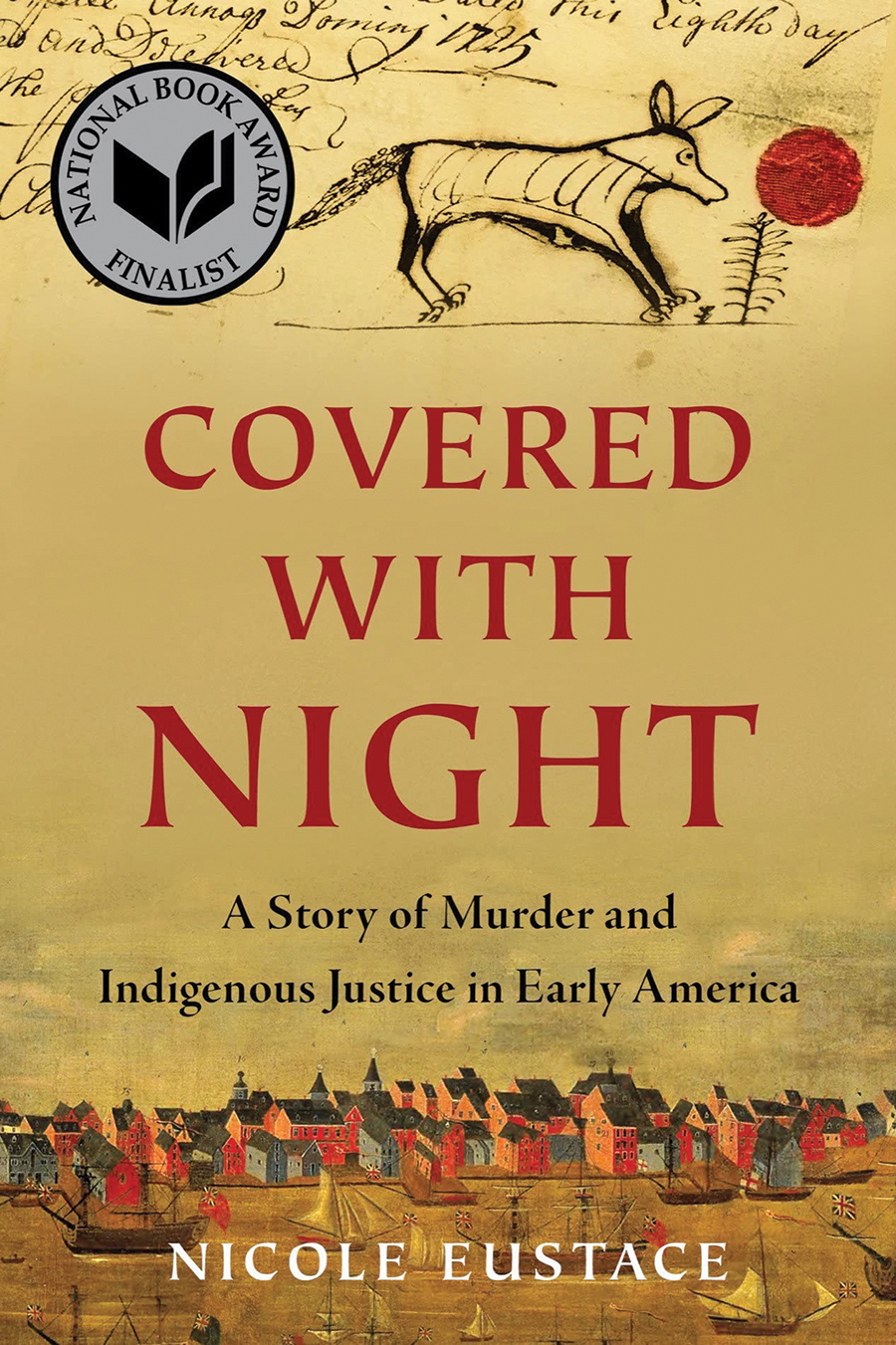
Humorist Edgar Wilson “Bill” Nye is credited with saying: “Wagner’s music is better than it sounds.” Readers of popular history who tough their way through 464 pages of Nicole Eustace’s Covered with Night: A Story of Murder and Indigenous Justice in Early America will likely be left with the notion that what they’ve read is more profound than entertaining.

“Covered with Night” is an Iroquois expression describing the state of grief or mourning inspired, in this instance, by the 1722 murder of a Native American man who lived near Conestoga, Pennsylvania, a small community north of the Maryland-Pennsylvania border. Details of the fatal encounter are straightforward and commonplace: English merchants John and Edmund Cartlidge were bargaining with Sawantaeny, a Seneca hunter and fur trader, when an overindulgence in alcohol, probably by all parties concerned, led to a disagreement. Sawantaeny went for his rifle, but John Cartlidge disarmed him and bashed in the Seneca’s skull.

“My friends have killed me,” were Sawantaeny’s last words.

Such incidents, terrible though they may be, are not an uncommon aspect of human interaction, but in the early 1700s, a period in America’s past that is strangely deficient from the history we’ve been taught (we learn about the Lost Colony, Jamestown, Plymouth and mysteriously we jump to the Boston Harbor Tea Party), such a death had far-reaching ramifications for the Native American and Colonial communities. Covered with Night explores the causes and consequences of the Cartlidges’ ill-advised assault on Sawantaeny, while illuminating the fundamental flaws in the relationships that existed between the Native American and Colonial cultures.

Eustace’s complex treatise was made possible by the meticulously documented speeches of a Native man called “Captain Civility,” who reacted to the death of Sawantaeny by attempting to strengthen the tenuous bonds that existed between the competing cultures, and Eustace was able to draw on earlier studies by 20th century ethnographers and on postmodern analyses on social and criminal justice. If all of this sounds complicated, it is.

Investigations of Sawantaeny’s murder by Native American leaders and Colonial officials initiated a debate about the very nature of justice and its cultural context. Colonial authorities were fearful that the murder might bring on a full-scale war, endangering the white population and disrupting trade. The crisis was serious enough that news of it reached the British Board of Trade in England, resulting in a region-wide treaty conference that produced an obscure document signed at Albany in 1722 between members of the Five Nations of the Haudenosaunee and representatives from the colonies of New York, Pennsylvania, and Virginia. It remains the oldest recognized treaty in the history of the United States. Much more than a simple diplomatic instrument, the treaty records a foundational American debate over the nature of justice.

Avoiding conflict with their Indigenous neighbors was the foremost concern of the Colonial authorities, and they held the Cartlidge brothers in irons pending their execution — which is exactly what the Native Americans hoped to avoid. Pennsylvania Gov. William Keith was dismayed to learn that sending the Cartlidges to the gallows was counter to the Native American notion of justice. Native diplomats Satcheechoe and Taquatarensaly asked that the Cartlidges be released from prison and from the threat of execution. They preferred that Keith journey to meet with the leaders of the Five Nations to “cover the dead” by offering reparations and performing mourning rituals that addressed their grief — all of which ran counter to Colonial assumptions about what constitutes civilized retribution.

The Iroquois weren’t “savages,” as characterized by the Colonial authorities. They were possessed of a humanity that tied them to the land and their communities, and they saw the murder as an opportunity to establish stronger and more lasting bonds with their Colonial neighbors. They wanted their collective grief assuaged emotionally and accounted for economically.

“Colonists were so unprepared for Native offers of clemency, a total inversion of their expectations, that they made little deliberate note of the philosophy that informed Native policy,” Eustace writes. “Indigenous ideals entered the record made at Albany almost inadvertently, the by-product of colonial desires to document the land and trade agreements that would further Pennsylvania’s prosperity and security. Still, colonists dutifully wrote down the speeches that Captain Civility and other Native speakers made to them. And in the process, they preserved Indigenous ideas on crime and punishment, violation and reconciliation.” Negotiations were complicated by barriers of language and dialect. Various Native American tongues had to be translated from one Indigenous speaker to another until the words evolved into a concept that could be realized in standard English.

If Eustace’s explication of events is occasionally academic, it’s also thought-provoking, requiring patience and commitment on the part of the reader. Attempts to energize the narrative by using present tense, and a somewhat awkward fictional attribution of motivations to characters whose true emotions are unknowable, only serve to lengthen and diminish the story: “Seated at his table, William Keith warms the bottom of a stick of vermilion sealing wax,” she writes. “He feels the heat but will take care not to burn his fingers. In a quiet room, a dollop of wax makes a soft splotch as it hits paper, round and red as a drop of blood. Keith lets the wax cool a moment from liquid to paste, then presses smartly with his seal to emboss the wax with an intricate pattern of scrolls.”

Eustace also includes detailed descriptions — furniture, dwellings, the travails of daily living, concepts surrounding indentured servitude and slavery — that enhance the reader’s knowledge of an otherwise obscure period in our history. But her primary contribution is the reclamation of alternative concepts of crime, punishment and the mitigation of grief that are no longer components of contemporary life. OH

Stephen E. Smith is a retired professor and the author of seven books of poetry and prose. He’s the recipient of the Poetry Northwest Young Poet’s Prize, the Zoe Kincaid Brockman Prize for poetry and four North Carolina Press Awards.

Home by Design

Travels With Mom

Art — like beauty and stars — is in the eye of the beholder

By Cynthia Adams

Nobody in our town, nicknamed Hell’s Half Acre, talked or thought about it. They talked about the price of soybeans. We didn’t need to think about art.

Art was unambiguous; what an artist friend calls “accessible.” Artwork matched the sofa and rugs, usually purchased in the same place.

Only Ruth, my mother’s friend, owned actual art. Hell’s Half Acre’s sole sophisticate chose abstracts, not the matadors and tearful clowns that dominated other homes.

For this, Ruth aroused quiet suspicion.

With flair matching her Julie Christie looks, she knitted plum and pink throws when everyone else chose ugly avocado greens, browns and harvest golds that matched their kitchen appliances.

During European summer study with a group of teens and art teachers, I discovered that art actually provoked something. Seeing. Thinking.

Soon after Ruth lost a battle with cancer, my mother struggled with the same. Post-surgery, she chose a trip to a place where she hoped to see stars lolling around crap tables. Mom didn’t dream of seeing great art or cities. She wanted to “do Vegas.”

Steve Tesich quipped in a review of Larry McMurtry’s Desert Rose he hoped the desert would take Las Vegas back. Me, too! Let the sand swallow it — the gaudy flash, splash and obsession with cash.

In Vegas, Mom showed remarkable stamina for a cancer survivor. The first evening, we sat at a one-armed bandit while downing Bloody Marys. Light headed with booze, I jumped as the machine erupted in explosive honks.

“You won! How much?” Mom trilled as it spat quarters into a plastic cup.

“I don’t know,” I shrieked. “Too much to count!”

Black streaked my cheeks from touching the filthy lucre and clapping my hands to my face. It was 40 quarters.

Mom played all night; certain she would spot celebrities. Alas, no.

I did encounter art in Vegas when fate returned me to the wasteland the desert would not take back. Mogul Steve Wynn had opened a museum in the Bellagio Hotel.

The (since closed) Guggenheim Hermitage Museum in the Venetian Resort Hotel was mostly void of tourists, however.

And Mom’s health battles continued. Post heart surgery, Mom was deeply depressed. A geographic cure was needed once more.

When an old debt was suddenly repaid, I offered to go wherever the windfall would afford us. She chose Los Angeles.

Great, I thought gloomily. Mom might glimpse a star.

And there was a splendid new Getty.

Day one in Los Angeles was consumed by Mom’s request for a hairdo and my dread of freeway driving.

Day two, a freshly coiffed Mom could not comprehend my desire to see the Getty. I tried to sell her on its cinematic views of Tinseltown. Soon after arriving, Mom shrugged off the museum. I found her on an outdoor bench staring into space. She waved me off, claiming tiredness.

Yet she magically rebounded when we decamped to Nate ’n Al’s, a Beverly Hills deli once frequented by stars: Doris Day! Tony Curtis! Larry King!

Day three, we refocused on Mom’s idea of a well-spent day. We booked a Gray Line tour, trolling the homes of stars from yesteryear. She loved the guide’s spiel: Hitchcock’s mansion, Lucille Ball’s ranch, Aaron Spelling’s compound.

Steve Martin’s modern home stood apart. Filled with L.A.’s most important private collection, its windows were oriented to protect the art from damaging light. (An embarrassing encounter with Martin years later is a subject for another day.)

We continued star stalking — which had not produced a living celebrity — booking the Dearly Departed tour. Tooling around L.A. in an old hearse, visiting infamous crime scenes, star-soaked stories of overdoses and untimely deaths, we eventually entered the Hollywood Forever cemetery. Within its mausoleum lay Rudolph Valentino and Marilyn Monroe.

Proximity to dead stars was nearly as soul-satisfying for Mom as a brush with a living one. We paid quiet tribute at celebrity gravesites.

A television and film museum had opened near our boutique Beverly Hills hotel, but at the word museum, Mom shuddered.

Instead, we visited Rodeo Drive, where certain retailers employed the Vegas trick of free drinks as a means to lower inhibitions. Giorgio’s on Rodeo, where Mom’s favorite (Elizabeth Taylor!) once shopped, sprinkled fairy dust over us. We sipped champagne and spent money we didn’t have.

Window shopping on Rodeo Drive, Mom exclaimed, was much more thrilling than any museum, her yellow-and-white-striped Giorgio’s bag swinging in time with her excited step.

Weren’t displays of inaccessible, beautiful things also visual art?

Aware at last, I smiled. OH

Cynthia Adams is a contributing editor
to
O.Henry.

Love During Lockdown

How my parents maintained a steady diet of simple pleasures during COVID

By Georgianna Penn

“It’s the little things that mean a lot, just like the song,” says my mom, who, as a teenager in Gretna, Va., sang that song a dozen times on her radio show in the mid-1950s. For my parents, who have been married for more than 63 years, it has been the little things that have kept their love alive.

During COVID lockdown, I got a brief glimpse through that lens of love my parents so cherish.

My mom remembers the Alta Vista Rotary Club recommending her as a singer for the Russ Carlton Orchestra. Sax player met young jazz singer, and the rest is history.

Remember the saying, “Those who play together stay together”? Dad courted Mom by writing arrangements for her. “In My Solitude” was the first tune. And when they did not have a gig, they danced in the living room on Saturday night. “You Send Me” by Sam Cook was their favorite for non-gig date nights. “We never went to prom because we always played proms,” Mom says. Performing at places like Virginia’s Hotel Roanoke and riding home in the back of the band’s station wagon holding hands was date night for them.

On their first Valentine’s together, George gave Dixie a huge heart-shaped box of chocolates. Because of a massive snowstorm, Dad was unable to drive from Danville to Gretna in his 1941 turtle-back Mercury Coupe for weeks, so Dixie made that box of chocolates last an entire month by eating one piece a day. Fast forward 60 years, George and Dixie, who live in Madison, still eat one piece of chocolate a day — after dinner but before the TV show Suits.

Dad’s biggest accomplishment during COVID has been having his 1935 Conn Naked Lady baritone sax worked on by Greensboro’s saxophone whisperer, Evan Raines, at Moore Music. He also patched the toe hole in his New Balance sneakers during COVID. That’s a trick he learned from his dad, who patched the innertube tires on his 1936 Ford sedan during World War II when rubber was rationed.

If the sweater fits, buy eight of them. With a December birthday, four daughters and Christmas, Mom racked up turtlenecks from Chico’s. One for each day of the week and an extra one for non-gig date nights in the basement.

Watching daily rituals of meal planning or choosing what to wear for Rotary Zoom meetings have been special.

I often catch them holding hands in their matching recliners with their matching Maine Coon cats and matching Timex watches. Each year for New Year’s, they somehow manage to give each other the same gift, a Timex Indiglo watch. Mom has so many, she keeps extras as backup. During lockdown, gig night has turned into basement jazz. Mom and Dad’s most treasured gigs, however, are playing with their four daughters for the O. Henry Hotel’s Jazz Series before COVID.

Their biggest little thing, however, during this time of less-is-more, is their 3 p.m. Bake Me Happy parking lot cupcake dates in Madison, which has taken their romance full circle for sure — while, yes, holding hands. But this time, in the front seat, not the back.  OH

Madison native and Greensboro College graduate, Georgianna Penn loves sharing stories of hope and finding the extraordinary in the ordinary. Performing the music of the Great American Songbook with her family at O. Henry Hotel’s Jazz Series is what she has missed most during the pandemic.

Illustration by Harry Blair

Life’s Funny

Streaming Consciousness

When a little TV wisdom comes in handy 

By Maria Johnson


Like many people coping with COVID restrictions, I’ve been watching more TV — especially series with episodes that you can stream back-to-back-to-oh-look-it’s-next-month-already — on platforms such as Netflix, Prime Video and HBO.

My husband and I have snickered our way through The Marvelous Mrs. Maisel; been thoroughly freaked out by the all-too-timely The Plot Against America; cast a suspicious eye on just about every character in the detective show Endeavour (“Did you see the way that passerby pedaled his bicycle? Wasn’t it just a little too quickly?”); and been mesmerized by The Queen’s Gambit, in which the hauntingly beautiful actress Anya Taylor-Joy plays an addicted genius. The show has sparked renewed interest in the game of chess (see last month’s O.Henry magazine). It also has prompted armies of tippling women to look deep into their souls and ask themselves the hardest question: “Should I be wearing my hair in bangs like she does?”

I was so enchanted by the show that when my younger son offered to teach me to play chess during a recent visit, I agreed. He explained the rules. I knew that I needed to make a clever opening move. So I did.

I put my hand on a piece, stared at my son, and said with all the gravity I could muster, “Is this the piece that can hop like a bunny?”

He gave a barely perceptible nod.

I moved my piece to a square, held it there, looked at him intensely, and lifted one eyebrow.

“Are you sure you want to do that?” he asked.

In this fashion, I touched all of the pieces and moved them to every conceivable spot — not unlike a primitive computer pondering all the possibilities — until he finally said, “OK, whatever, that’s a good move.”

I’m happy to report that this worked great. The game was close — long, but close — and he won only by moving a pawn to my back row, at which point the pawn became a queen who could do whatever the hell she wanted.

Which brings me to another show we’ve been watching, The Crown, which is about Britain’s royal family and the issues they confront — or, more accurately, don’t confront — in their personal and political lives.

Before I watched this show, I never knew much about the royals other than what I read in an occasional email digest from Quora, a question-and-answer website that deals in a fair amount of palace intrigue.

For example, a reader will ask a question like “What’s Prince Harry really like?” and a plumber from Gloucester will answer with great authority because a union buddy of his once fixed a loo in Kensington Palace, two floors away from Harry’s apartment.

That was good enough for me — until I started watching The Crown. Since then, I’ve been diving into royal history, customs and etiquette, just in case the queen and I ever meet up.

It could happen. Let’s say I’m in London, and I’m walking around Hyde Park, which is right next to Buckingham Palace and is slap full of dogs running loose. Maybe I notice a corgi that looks lost and more than a little irritated with other dogs sniffing its butt. I check its collar, hoping to see the owner’s contact information, and — whaddya know — there’s a tag that says “QE II, B. Palace.” So I call the number, and this little voice says, “Yesss?”

And I’m like, “Um, yeah, I found your dog, and I’m pretty sure I saved its life, so . . . ”

She tells me to come right over. When I hand over the dog, the queen is overcome with emotion. “Thankew,” she says. You know how she runs those words together.

And I’m like, “No problemo, Your Majesty.”

I know from watching the show that I’m supposed to call her “Your Majesty” on first reference and “ma’am” from then on.

Also, I curtsy to her, which goes against my grain, but in my head I think of it as a tiny reverse lunge.

So I do a quick set of tiny reverse lunges, just to prove my good intentions and general fitness, and I wait. Unless the queen makes the first move, you never touch her. This won’t be easy. I’m a toucher. If she doesn’t offer me her hand to shake or fist bump, I’ll probably just give her a thumbs up, and say something like, “Cool purse. Ma’am.” If it’s the middle of the afternoon, she’ll probably invite me in for tea to show her gratitude.

Again, from studying up, I know that no one eats until the queen eats, and if the queen stops eating, you stop eating. I know I can handle the first part, waiting for her to start, but if they’re serving something delicious, like macarons — which are basically MoonPies — or little pimiento cheese sandwiches with the crusts cut off . . . I can’t make any promises.

But I’ll definitely let her lead the conversation. When she makes a point, I’ll agree by saying, “One would think so.” This is a very royal way of talking — saying “one” instead of “I.”

Given a chance to speak, I would try to find common ground, probably by talking about dogs because dog people love to talk about their pups. I might say something like, “One is curious, ma’am: Has Her Majesty’s dogs ever pulled her underwear out of the royal laundry basket?”

She could find this kind of familiarity refreshing.

Or she could use the royal accessory that I envy the most, the bye-bye button, a buzzer that summons her assistants to whisk away visitors when she’s heard enough.

Either way, I would be instantly qualified to answer a question on Quora.  OH

Maria Johnson is a contributing editor of O.Henry. She can be reached at
ohenrymaria@gmail.com.