
For the Love of Lindley Park
On his nursery acreage, J. Van Lindley planted the seeds of a beloved neighborhood that continues to blossom
By Jim Dodson
Photographs by Bert VanderVeen
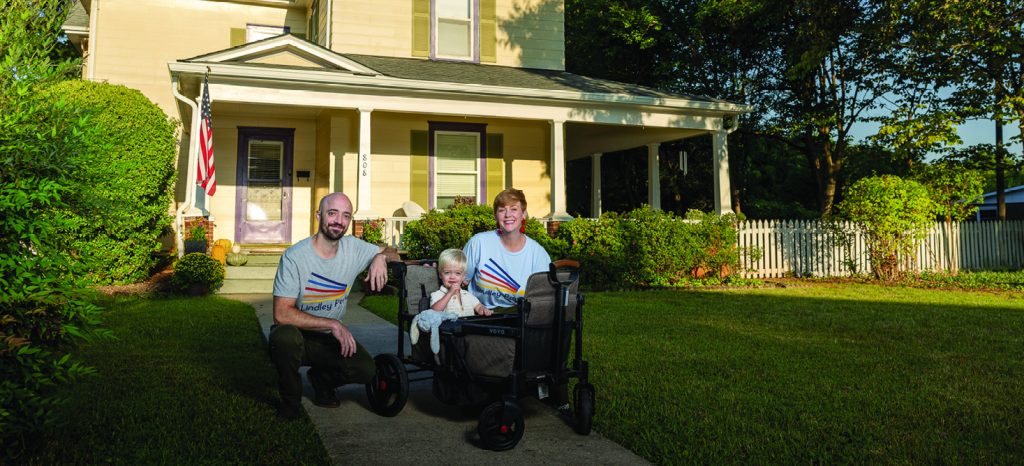
On a warmly flaring afternoon in late August, Smith High School AP History teacher Nick Jordan, wife Macy and their young son, Rowan, are settling into their spacious new house on Northridge Street in the Lindley Park neighborhood. This is their second home in the neighborhood, having moved just two weeks ago from a much smaller two-bedroom bungalow just down the block. Renovation of their handsome Dutch Colonial with its sweeping front porch is well underway, but neighborhood history is on Jordan’s inquiring mind this day.
“Our house was known as the Dailey Retreat,” he explains during a break from clearing his overgrown yard for new shrubs and native plants. “Its previous owner operated it as a traditional bed and breakfast and cooking school for more than two decades. As we all know, houses don’t stay on the market for very long in Lindley Park. “That’s why we grabbed it. We wanted more room for my work and maybe a second child down the road.”
Two years ago, Jordan became the neighborhood’s official historian, researching and writing colorful vignettes about Lindley Park’s storied past for the seasonal newsletter. Though the historic neighborhood is relatively compact in size (it occupies roughly a mile between West Market Street and Spring Garden Street one way and Elam Avenue and Holden Road the other), its 1,200 homes present a remarkable array of 20th-century housing styles that range from quaint bungalows to Colonial revivals, stone mansions to mid-century ranches, charming cottages to Craftsman classics.
Jordan’s own house was built in 1914 by a shoe salesman named A.E. Fordham, who reportedly had a shop on a corner near the site where the future 18-story Jefferson Standard Building (today Lincoln Financial Group) would rise in 1923. His brother, C.C. Fordham, was a prominent pharmacist on South Eugene whose son later became the dean of UNC-Chapel Hill’s School of Medicine. Fordham died after three years in the house but passed its ownership on to his wife, an unusual circumstance for that era of home ownership, Jordan notes.
The Jordans’ next-door neighbor’s house holds even greater interest to the historian. The Boren House was built by a man who worked as vice president of Pomona Terra Cotta Company, which was owned by John Van Lindley, a visionary Quaker who left the area to fight for the Union Army during the Civil War and returned to dramatically expand his father’s commercial nursery and florist business. By the late 19th century, J. Van Lindley Nurseries reportedly occupied 900 acres between Oakland Avenue and West Market Street. As biographer Joseph C. Carlin notes in J. Van Lindley: His Ancestors, Life, and Legacy, the Lindley operation was at one point, on its 1,130 acres in nearby Pomona, “likely the largest nursery operation in the then-known world with 1.5 million plants under cultivation.” In addition to founding Pomona Terra Cotta Company, Lindley also helped start Jefferson Pilot Insurance Company and built peach orchards in Southern Pines.
A young girl named Mary K. who grew up in the Boren house during the late 1920s, Jordan learned, was part of something called the “Northridge Gang,” a troupe of neighborhood kids that attended the new Lindley Elementary School. “These kids wrote and performed plays around the Lindley Park neighborhood to raise money for helping to feed the city’s hungry children,” he explains. “I also found a remarkable wedding notice from 18 years later that this same young woman grew up to become a Guilford County social worker working with the poor in the city.”
He sees a timeless message in her story. “I think this is why Lindley Park folks today are so keen to preserve the spirit of a neighborhood that echoes J. Van Lindley’s own love of nature, love of a community and our fellow human beings. We treat our neighbors accordingly. I believe almost everyone here carries that legacy with them.”
•
First, a brief history lesson. At the turn of the century, with an eye to Greensboro’s future, Lindley donated 60 acres of land along Spring Garden Street for the establishment of an amusement park with a manmade lake designed to showcase the beautiful forest and landscape of the city’s western boundary.
The park’s grand opening in June 1902 coincided with the inauguration of the Greensboro Electric Company’s new streetcar service from downtown to the park entrance and serves as the birthdate of the neighborhood that would carry its benefactor’s name.
The amusement park featured a Vaudeville show, dining casino, bowling alley, dancing pavilion, miniature railroad, movie theater and recreational lake for boating. Lindley’s gift also included 17 undisturbed acres for an arboretum. As Greensboro writer Tim Cole notes in a 2015 remembrance of the park, “The Greensboro Patriot recorded that the new park was visited by thousands on a single Sunday in June 1902.”
When the amusement park closed in 1917, a year before Lindley’s passing, the lake was filled in and the city hired a Charlotte city planner and landscaper named Earle Sumner Draper to design a planned neighborhood development that would be named in Lindley’s honor. In time, Draper’s name would become associated with some of the finest subdivisions in the South including Charlotte’s Myers Park, High Point’s Emerywood and Druid Hills Historic District in Hendersonville.
Distinctive stone entrances were created to establish Lindley Park’s neighborhood presence on an expanding Spring Garden Street in hopes of attracting the growing city’s middleclass families. It was also Draper who reportedly coined the term “urban sprawl” to describe how the quality of otherwise attractive neighborhoods could be threatened by encroaching commercial development — a cause still close to the hearts of many Lindley Park residents today.
Following Lindley’s death, son Paul C. Lindley, also a prominent nurseryman, was elected to the city council and became a passionate advocate for an expanding Greensboro’s parks system. His vision included a large meandering public park that would link Lindley and Lake Daniel parks via North Buffalo Creek. But the plan never became a reality. Upon becoming Greensboro’s mayor in 1931, however, Paul was instrumental in the creation of Country Park during the early days of the Great Depression, probably using Federal WPA money to hire unemployed workers to do the job. Sadly, Lindley drowned in a tragic boat accident on the property in 1933.
It wasn’t until the city adopted a formal Master Plan for Recreation by Charles M. Graves in 1951 that playgrounds, ball fields and a recreation center with an Olympic-sized swimming pool were created for the Lindley Park neighborhood. In 1957, about the same time legal efforts by six African American golfers to desegregate Gillespie Golf Course were working their way to the U.S. Supreme Court, Lindley Park’s swimming pool became the focus of a historic effort to desegregate the all-whites facility by a pair of African American women. To avoid opening to all races, the city chose to sell the pool to a private operator but repurchased the facility in 1967, opening it to everyone. Both events have been cited as moments that jump-started America’s Civil Rights movement, prelude to the historic sit-in protest at Greensboro’s Woolworth’s Department Store in February 1960. The popular pool is scheduled to open in 2027 after much needed repairs are completed.
•
The year 1968 was one that Lindley Park residents would never forget, especially Marygrace Llewellyn.
She and her parents, Don and Rose, had just moved from suburban Boston to Greensboro and purchased a pretty, yellow bungalow with green shutters on Masonic Drive, overlooking Lindley Park. They moved in on a Saturday morning in May.
“My father thought he’d moved to Paradise,” Marygrace remembers with a laugh. “And I did, too. When you stood in our yard and look out at the park all you saw were the beautiful trees and meadows of Lindley Park.”
She woke the next morning to start school, however, to the sound of heavy machinery.
“I looked out my bedroom window and saw bulldozers knocking down the park’s trees. My mother was horrified. Our beautiful park was being destroyed to build a road through the middle of the park!”
That road was Wendover Avenue, bisecting the heart of the Gate City from east to west, isolating Lindley Park’s playgrounds and ballfields in the process. That same year, however, Greensboro Beautiful was created as a partnership between the City of Greensboro, civic organizations, local gardeners, private citizens and businesses to develop and fund beautification projects throughout the city.
It wasn’t until the mid-1980s, however, that Greensboro Beautiful broke ground on a 17-acre tract of land off Ashland Street then called the Anniversary Garden. The Greensboro Arboretum — long a vision of one J. Van Lindley — was finally completed and dedicated to the city in 1991.
•
Ron and Theresa Miller moved into a small house on Sherwood Avenue in 1987. Ron worked for the editorial board of the News & Record and Theresa taught composition at UNCG. Five years later, with three small children and a house that no longer fit their needs, they purchased a larger Dutch Colonial on Willowbrook Drive, which sits where the amusement park’s lake was drained to become a park with attractive stone bridges. “The house was kind of a disaster because it hadn’t been fixed up in years,” Ron remembers. “There was plaster falling off the walls, ugly, blue shag carpeting on the floor and only one bathroom upstairs with no shower and only a toilet and small bathtub.”
“I cried when we moved there,” Theresa chips in with a laugh. “There was no air conditioning and the kitchen was tiny and dated.” Moreover, they add, the neighborhood around them had visibly declined, due in part to a 1971 redistricting plan that bussed children from their part of Lindley Park to other schools in the county, fueling an exodus of young families from the neighborhood. In 1993, however, a retired officer named Jack Almon and his wife, Nita, started the Lindley Park Association to lobby for change and improvement. Within a decade, thanks to the association’s persistent work, a revised and more sensible redistricting plan sent all of Lindley Park’s school kids to nearby Lindley Elementary, Kiser Middle and Grimsley High School. “That had a positive impact on the neighborhood,” says Ron. “Young families began to moving back to the neighborhood, sending it in a very good direction.”

As News & Record staffer (and former O.Henry contributor) Jim Schlosser reported during the park’s 2002 centennial anniversary year, the civic mindedness of Lindley residents prompted the “city to spend $216,000 for repairing bridges and gates, planting shrubs and making improvements” that set Lindley Park on an upward trajectory.
“One of the many good results of that time is that our children learned the valuable lesson of civic engagement,” Ron adds. Today, the Millers’ Dutch Colonial is a fully restored showplace overlooking the park where numerous annual events like Spring Fling and the popular fall chili cook-off competition take place.
•
“We were part of a wave of those young couples who moved here and started families about then,” says Joyce Eury, finishing her third term as chair of a Lindley Park Neighborhood Association that’s more active than ever. Eury and husband Steve reside on Howard Street in a charmingly expanded cottage-style house built in 1927. They purchased it two decades ago, having first owned a smaller house on Scott Avenue before moving to the western suburbs followed by a stint abroad due to Steve’s work.
“Like many others, we eventually came back to Lindley Park because this is such a special neighborhood. We missed its friendly sidewalks and not having to drive everywhere for a grocery store or a good restaurant.” She points to popular restaurants only a block away on Spring Garden Street and singles out the revitalization of the “four corners” at Elam and Walker with its eclectic restaurants and hip Bestway Market that “are all within walking distance of anywhere in the neighborhood.” The cultural diversity of the neighborhood also appeals to the Eurys, a cosmopolitan mix that includes faculty and students from nearby UNCG, multiple artists, neighborhood entrepreneurs, cottage industry designers and what demographers call urban homesteaders.
“This gives our neighborhood a cross section of life that is both genuine and important,” Steve adds. “We’re like a small town where everyone knows their neighbor and cares about them. Lindley Park has undergone a renaissance for years and I believe we are starting a new one.”
•
Not far away (for nowhere is far away in Lindley Park), Michelle and Bill Schneider couldn’t agree more. They own a handsome 1927 bungalow on Longview. “Joyce is right. The latest renaissance is well underway,” agrees Michelle, chief philanthropy officer for Cone Health. She points out that, thanks to strong input from residents, local businesses and key support from former council member Nancy Hoffman, a new Spring Garden Corridor plan is scheduled to be unveiled this autumn by the city, addressing neighborhood concerns about the traffic and congestion on Spring Garden Street from Holden Road to Josephine Boyd.
“We started to informally organize several years ago to protect the future of Lindley Park,” she explains. “It began with a concerned group of us just walking around the neighborhood looking at our unique houses and talking about the city’s growth and what could be coming our way. One Sunday afternoon, we gathered to have clam chowder and asked ourselves, ‘What do we want from the change that’s coming?’ My argument was that change happens. You can either fight it or define it.”
Ninety residents, she reports, showed up last October for the city’s first open house on the Spring Garden corridor project, eager to share their thoughts.
She notes husband Bill’s former co-ownership of the popular Spring Garden Bakery as an example of how neighborhood residents are invested in its well-being and points to the community’s enthusiastic support of the Corner Farmers Market that began in the parking lot of Sticks and Stones restaurant before outgrowing its spot and moving to a much larger space beside St. Andrews Episcopal Church on Market Street. “It’s technically in Sunset Hills,” she adds with a laugh. “But its story belongs to Lindley Park.”
A recent sign of the neighborhood’s continued vitality was the groundbreaking this past August for the new Lindley Elementary School, scheduled to open on 17 acres between Camden Street and West Market in early 2028 — exactly 100 years after its original. Sons Wil and Dennis both attended the old Lindley Elementary and are excited about the new school. Dennis still lives in the neighborhood and runs a custom fence and construction company with brother Wil. “And to think it started with them shoveling snow in the neighborhood,” Michelle quips.
Like others in Lindley Park whose children have flown the nest, the Schneiders concede that someday they may consider downsizing to a smaller house in the neighborhood. “We love Lindley Park way too much to think of ever leaving it,” she adds with a laugh. “But I like the idea of giving our house another life after us.”
•
The Littles, Carrie and Randy, are on their third house in Lindley Park, a stately 1915 manor house at the corner of Scott and Sherwood built of locally quarried stone. Likewise, their daughters, Ellie and Georgia, have grown up and moved on, but the Littles’ love affair with Lindley Park goes on. They, too, are investing in the neighborhood’s future with plans to open Smallscapes in early 2027, a specialty plant store on Spring Garden between Scott and Elam Avenue.
Carrie is a former science teacher, veteran gardener and floral designer, who made a name for herself by growing dahlias and other exotic flowers for Abba Design. Smallscapes will specialize in unique flowers and native plants, small landscaping projects, gardening-related goods and maybe even teas and specialty foods from the Corner Farmers Market.
As a former secretary of the Neighborhood Association, she thinks Lindley Park’s best days are still ahead. “There’s a new energy here from young people who are discovering the neighborhood. They’re restoring houses, planting gardens, bringing new life to this wonderful old neighborhood. You see it happening on every block.”
•
Just down the block on Scott, Charlie and Debra Hertlein are celebrating their 44th wedding anniversary. They’ve lived in their handsome Sears-style house for 42 years and have no intention of going anywhere else. “When we got married,” Charlie remembers, “Debra saw this house and we both fell in love with it. It’s been a great place to raise our two sons and five grandchildren. They love it as much as we do. This is home.”
Charlie is a highly respected collector of American political memorabilia and armchair historian of Lindley Park. Patriotic artifacts and presidential campaign posters fill almost every room. Even family pets have patriotic names including Abby, the dog — “short for Abigail Adams” — and cats Harry Truman, Teddy Roosevelt and Betsy Ross.
But it’s Lindley Park memories that matter most to Charlie. He grew up attending Lindley Elementary and Lindley Junior High roaming the neighborhood on his bicycle. Neighborhood stories pour out of him. Best to just sit back and listen.
“It was totally safe. You knew everyone and they knew you. My mother and another lady owned a beauty shop called the Modernistic between Sno-White Cleaners and what today is Wahoo’s Tavern. That was Bocher’s Grocery store in those days. Next to that was the famous Pickwick, a bar that was popular with newspaper reporters. I knew Marvin the bartender. He’d let me come in and eat hot dogs and listen to the reporters talk about whatever was going on in town. I was just a kid. Next door, where Suds & Duds is today, was a drugstore that held yo-yo competitions for kids in the neighborhood. Across the street was the A&P, but it didn’t stay long. Now we have the Bestway. There were two full-service gas stations on Walker back then, both of which became great places to eat, The Lindley Park Filling Station and Sticks and Stones, which first was called The Wild Magnolia and had live Mardi Gras music. The Tic Toc Clock shop on the corner became Fishbones, my friend Neil Reitzel’s place. It’s crowded every weekend . . .”
He interrupts his own narrative flow and smiles. “I could go on and on. Point is, Lindley Park has had its ups and downs but is better than ever. Everyone sits on their porch and waves when you pass. That’s why we all love this neighborhood. It’s been home for more than a hundred years.” OH