
GLORY DAYS
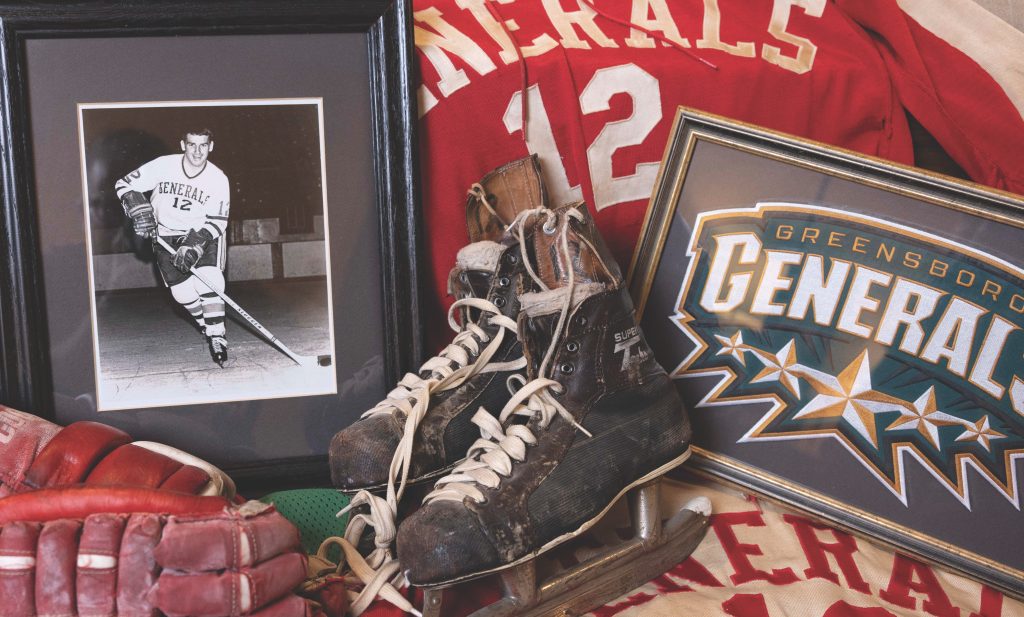
Glory Days
These men aren’t kids anymore, but when they were, they forged a legacy
By Ross Howell Jr.
Photographs by Tibor Nemeth
Former Greensboro Generals ice hockey players Ron Muir, Harvard Turnbull and Stu Roberts have a pretty good idea of what our new professional team, the Greensboro Gargoyles of the East Coast Hockey League, have on their minds.
A league championship.
That’s something the Generals, the city’s first professional hockey team, achieved in the 1962–1963 season of the old Eastern Hockey League. (A later franchise, the Greensboro Monarchs, won the ECHL championship title in the 1989–1990 season.)
After I schedule an interview with Ron Muir, I find it to be wonderfully apt that he lives just across the road from the Guilford Courthouse National Military Park and its monument to General Nathanael Greene.
One old general near another.
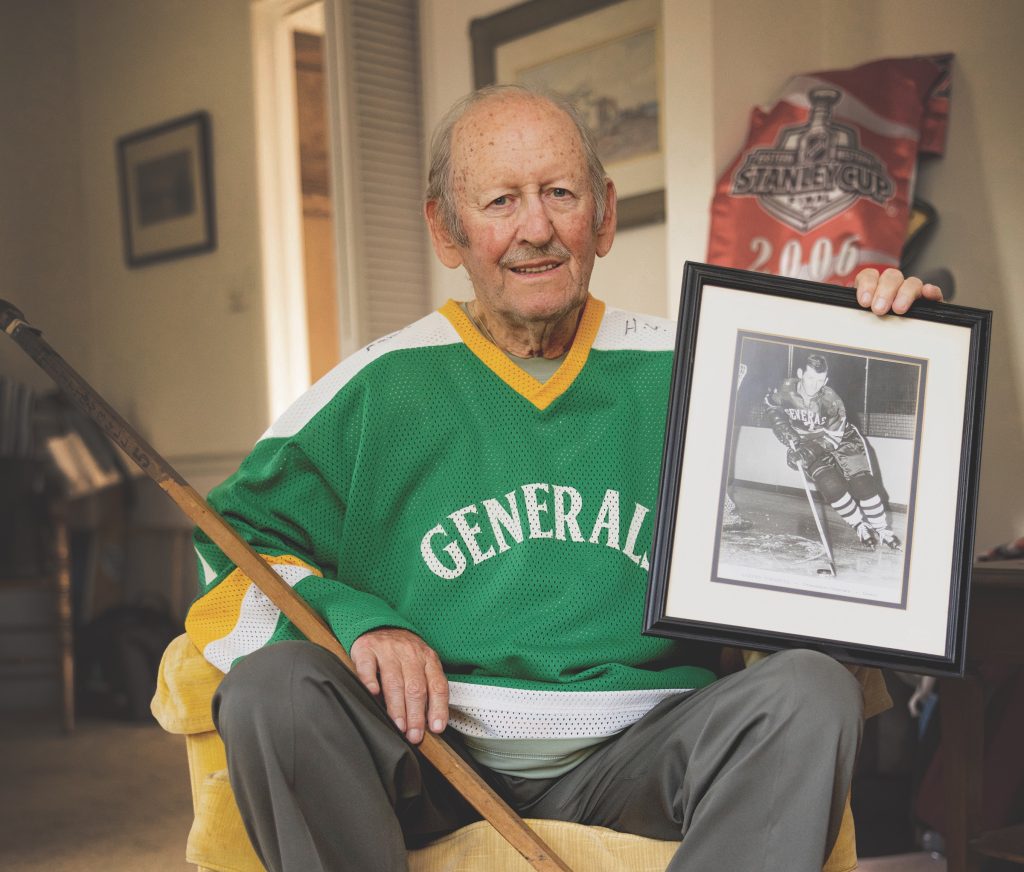
Muir’s 89 years old now, and I’m greeted at his door by two of his daughters, Elaine Miller and Susie Barham. Elaine teaches elementary school in Blowing Rock and Susie lives in Myrtle Beach.
Muir is sitting in a big recliner and is wearing a Wayne Gretzky jersey — for those of you who don’t follow the sport, Gretzky is a legendary National Hockey League player from Canada who was nicknamed “the Great One.” A hockey game set on mute slashes across the flat-screen TV facing Muir’s chair.
Hailing from small-town Seaforth, Ontario, between Lake Huron and Lake Erie, Muir was an athlete’s athlete — playing soccer, lacrosse, football, baseball and, of course, hockey.
“I decided I wanted to play professional hockey when I was about 10 years old,” Muir says.

“He’s always had his goals,” Elaine laughs.
And play professional hockey he did. Before moving his young family to Greensboro for the 1960–1961 EHL season at age 25, he’d already played professionally in Canada for three years. Standing 5 feet 11 inches tall and weighing a bruising 190 pounds, Muir played left wing.
Because of his experience and age, many of his teammates looked at him as a father figure.
“Many of them were these 18-, 19-year-old boys, and their families were all back in Canada,” Elaine says.
“At Christmas, Mom and Dad would have a huge party, and the whole team would show up in our little house,” she adds.
Muir remembers that the person who convinced him to join the Generals was the late Don Carter, who was from Toronto. The two men were the same age and had first met at a Chicago Blackhawks tryout in St. Catharines, Ontario.
When they saw each other again at a training camp, Muir had been scouted by an EHL team in Johnstown, Penn., and was ready to sign with them.
Carter was already a star with the Generals. Playing defenseman, he stood 5 feet 11 inches tall, and weighed 185 pounds.
“So Carter says to me, ‘Ron, you don’t have to go to Johnstown. Come on, we’ll go to Greensboro. I played there last year and it’s a good town,’” Muir recalls.
“I thought, hell, I haven’t signed a contract,” Muir continues. “So, I signed up with the Generals’ manager, who was also at the camp, and loaded up for Greensboro.”
“My father drove us down,” Elaine says. “It was a two-day trip back then, and Susie and I were toddlers.”
“And we just ended up staying,” Muir says.
Two more daughters came along, Sandy and Cindy, and both still live in Greensboro. After Muir’s first wife passed away, he remarried, and a stepson, Jason, became family, too. Now Muir has nine grandchildren and four great grandchildren.
The first season Muir and Carter skated together as Generals, the team made the finals. The second season, they won the EHL championship.
In those days, there was no Plexiglas around the rink, just boards and wire. The girls would sit close to the ice, and, when Muir skated by them, they’d shout, “Hey, Dad!”
“The kids from the other hockey families would be all around us in the crowd,” Elaine says. “It was great.”
Greensboro was a hockey town — and “the Generals were superstars,” Elaine says.
“My husband, Eric, played little league hockey,” she adds. “So he knew about Dad long before he met me.”
Susie laughs.
“Oh, yeah, my husband knew Dad before he ever asked me out,” she chimes in.
Elaine smiles.
“We’d date these guys, and they’d say, ‘You’re Ron Muir’s daughters?’ That was a bonus.”
Harvard Turnbull suggests we meet for a drink at Fleming’s Prime Steakhouse & Wine Bar. Turnbull is 84 years old. Originally from Toronto, he skated at the center position for the Generals, standing 5 feet 9 inches tall and weighing 160 pounds.
Though he was an experienced and skilled hockey player, Turnbull was still a teenager with a dream of making the National Hockey League (NHL) when he arrived in Greensboro. Signing with the Generals represented a big step toward achieving that dream.
Turnbull met with members of the Generals’ staff at the Sedgefield home of businessman Stanley Frank, one of the founding owners of the team, to finalize his contract.
“So, they said, ‘What do you want?’” Turnbull recalls.
“I said, ‘You fill it out and I’ll sign it.’ That’s how green I was. I was going to turn pro. It was like I was going to walk on water.”
Fortunately for Turnbull, coach Ron Spong made sure the contract included generous bonuses each time the team advanced in the playoffs.
And that was the Generals’ championship season.
“I went out and bought a new convertible,” Turnbull laughs.
“It was amazing,” he says. “We were treated like kings.”
Turnbull tells me as many as 5,000 fans would show up to watch the team play in a charity softball game. He and his teammates could play the Sedgefield golf course anytime they wanted. They were often invited into the homes of civic leaders and successful entrepreneurs.
The late Anne Cone was one of the owners of the Generals team in its glory days. A benefactor of UNCG’s Weatherspoon Art Museum, she was the wife of Cone Mills heir Benjamin Cone, mayor of Greensboro, 1949–1951, who passed away in 1982. The couple lived in a graceful Greensboro Country Club mansion.
“Anne Cone was absolutely wonderful,” Turnbull says. “She would invite us single guys to her house for dinner about once a month.”
Among the bachelor invitees was Bob Boucher from Ottawa.
As the story is told, when Cone was in Chamonix, France, on a ski trip, she learned that Boucher, who was playing European hockey, had been arrested in Italy for fighting and couldn’t make bail. Cone managed to have him released and flown to Greensboro, where he skated for the championship team at right wing, standing 5 feet 9 inches and weighing 170 pounds.
“Bobby was a character,” Turnbull says. “So, we’d be at one of Anne’s dinner parties, and Bobby’s sitting at the head of the table where she had all these buttons, and he’d push a button and a servant would come in. Then he’d push another and a wine steward would come in.”
“He was just pushing buttons to see what would happen,” Turnbull laughs. “But Anne was cool — she didn’t have a problem with it.”
Yes, the high life was “plush,” as Turnbull likes to say, but the sport of ice hockey could be punishing, especially in those days.
He shows me a photo.
“That’s Ron Muir in front of the net and I’m taking a shot on goal,” Turnbull says. “Listen, I could really shoot the puck back then, probably get it close to 100 mph.”
He places a fingertip on the goalie’s head in the photo. The goalie’s not wearing a face mask, let alone a helmet.
“If the puck had hit him in the head,” Turnbull muses, “it probably would’ve killed him.”
He shows me another action photo, snapped right at the moment an opposing player knocked Turnbull completely over the boards and into the stands.
“That was very painful,” he says. “But I came right back out on the ice.”
Turnbull tells me that his nose was cut so badly once when he was playing in Canada that it had to be sewn back on. He’s had teeth knocked out, fingers broken and suffered numerous concussions.
“You know what they called the EHL back in my day?” Turnbull asks.
“They called it ‘the meatgrinder league,’” he says, nodding slowly. “That’s how crazy it was.”
Turnbull believes if his teams had “proper helmets, proper rules,” maybe he wouldn’t have suffered so many injuries, which continue to plague him in his golden years.
“Still,” he concludes, “I’d do it all over again.”
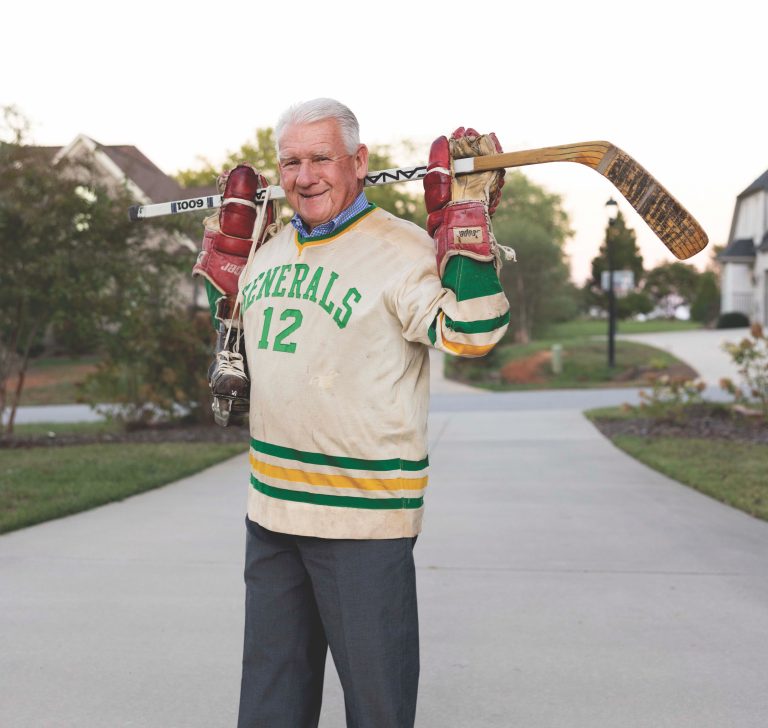
I meet up with Stu Roberts at the Chick-fil-A just off Battleground Avenue.
Roberts is a native of St. Catharines, Ontario, and arrived in Greensboro in 1966. Although he was just 19 years old, he had already been playing for the St. Catharines Black Hawks, a Canadian junior ice hockey team, for four seasons. He stood 5 feet 7 inches tall and weighed 175 pounds, and didn’t waste any time making an impression in the EHL.
Roberts won the rookie of the year award in 1966–1967.
“I was fast, and that was my game,” he says. “And I could score goals. One year, I scored 62 goals in 72 games. Wonderful year.”
Roberts tells me that he wasn’t a bruiser like Muir and Carter — he used his speed to avoid the hits.
And he knew how to please the crowd.
“I’m not bragging, but I’m proud of the fact that I won most popular player three years in a row,” Roberts says. “I used to tell Coach Spong I’d rather keep the people happy than win any other award.”
As long as the fans were behind him, he adds, “I knew I could keep my job.”
One of Roberts’ daughters, Ashley Barker, drops by the Chick-fil-A to show me some of her Dad’s memorabilia.
Among the items is a newspaper article written by a St. Catharines reporter the summer after Roberts’ second season as a General.
The writer called Roberts “Mr. Excitement.”
“He’s a gambler, often diving, literally, across the ice to get the puck,” the reporter wrote.
The crux of the article?
That Roberts was a huge fan of another speedster — No. 43, stock car driver Richard Petty. So much so that he visited Petty in Randleman, who obliged Roberts by letting him try out the driver’s seat in No. 43. Not on the track, of course.
I ask Roberts about the teams the Generals faced in his eight-year career here.
“I’m telling you, we had some great teams,” Roberts says.
“Our nemesis was the Charlotte Checkers,” he continues. “We used to go to Charlotte on a Friday night and fill the place, and come back to Greensboro on Saturday night and fill the place. It was really good rivalry.”
And there were the Roanoke Valley Rebels, originally the Salem Rebels, in Virginia.
“We used to skate in the old Salem Civic Center, but then they built the Roanoke Civic Center, which was a beautiful rink,” Roberts says.
There were the Nashville Dixie Flyers and the Knoxville Knights in Tennessee.
And, yes, even back then, two teams from the Sunshine state — the Jacksonville Rockets and St. Petersburg Suncoast Suns.
“We carried 18 players on the team and did most of our travel by bus,” Roberts says. The bus had about 20 seats and the remaining space was set up with double-deck bunks.
“We had some good times,” he continues. “I remember a lot of bus rides in a lot of snow, getting from Greensboro to Nashville, or Nashville to Knoxville, or Knoxville to back home.”
Roberts pauses for a moment.
“I think maybe people have forgotten about the Greensboro Generals,” he muses.
I tell him about how many fans I’ve seen — some even high school age — who’ve been wearing old Generals jerseys at the Gargoyles media events I’ve attended. His face brightens.
“You know, I want to thank Greensboro,” Roberts says. “I skated on some great teams. I met my wife, Amanda, here. We raised our kids here. It’s been a wonderful ride.”
And who knows? Maybe our Greensboro Gargoyles in their inaugural season will create some glory days of their own.