
I'LL SHOW YOU

I'll Show You
The magical aspect — and real-life pressures — of live entertainment
By Cynthia Adams • Portraits by Liz Nemeth
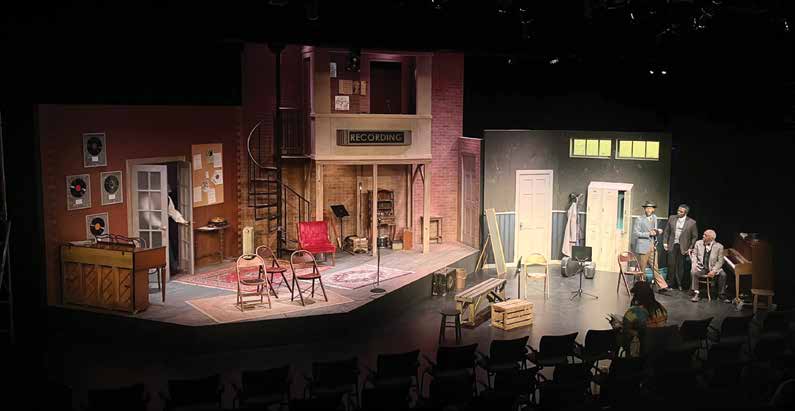
Ma Rainey’s Black Bottom, which opened at the Little Theatre of Winston-Salem February of last year, is where set designer Fatima Njie discovered how much fun it was to be involved in a process she calls “world building.” She made a checklist and pinned it to a vision board, filling in the details to complete Ma Rainey’s world.
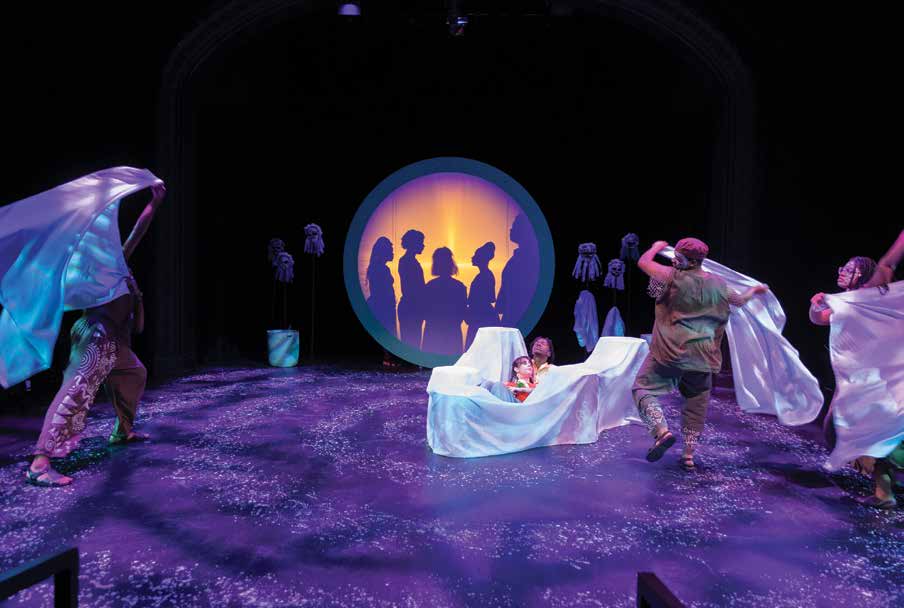
Sometimes Njie’s best ideas come at 2 a.m. — which is exactly what happened when, as an undergrad at UNCG, she worked on Dontrell, Who Kissed the Sea. “At 1:46 a.m., while at the computer,” she says. “Suddenly, I thought, ah, this.”
And sometimes inspiration finds her while she settles in with a coffee, observing, “being around people going about their day.” Often, that’s at Camino Bakery in Winston-Salem, “where I can people-watch in peace.”
Odd moments inspire her, so Njie (pronounced “Jie” with a silent “N”) keeps a notepad handy.
In fact, such random moments influenced her work last spring on a bare-bones-budget, teen production of Twelfth Night for Creative Greensboro and Shared Radiance.
Under creative director Chappell Upper, she had creative carte blanche, which thrilled her.
The vision for her set designs occurred last spring during a fly-on-the-wall moment.
Sitting beside two women lost in conversation, “I was eavesdropping,” she admits. “One of them had just gotten engaged. I got to hear all her wedding plans. She was really happy. How she met him — it was all so great.” Njie, meantime, flashed to Twelfth Night, naturally, a play “in which everyone gets married.”
Inspired, she set to work designing heart-shaped walls (staged at the Hyers Theater). “A house over here, and a house over there,” Njie describes. “One of the houses looked like a broken heart. Another house was a full heart.”
Taking artistic license, she reimagined Shakespeare’s play through the pop-art lens of modern romantic comedy.
“Especially with Olivia, who has lost her brother and her heart is broken,” Njie explains. “I depicted her home/set as incomplete.” All of which, she confesses, grew from eavesdropping on strangers.
If you’re young, ambitious and making theater your life’s work, which Njie is, you must rise to the moment, no matter what — and quickly — using every single resource to create a convincing world.
Sometimes, armed with little more than fabric, a glue gun, some paint, wood, nails and her imagination, Njie needed to manifest the best possible set. Regardless of the budget or project, her vision had to support the plot and the characters. To Njie, it was just another challenge posed by working offstage instead of onstage. Having consciously chosen behind-the-scenes work over acting and modeling, Njie realized that working in tech and design was just as creatively appealing as acting but also practical. “It not only paid more, but it was in more demand.”
No auditions and less uncertainty, too.
Today, Njie is a working designer for sets and lighting at Creative Greensboro (which calls itself Greensboro’s “office for arts and culture”) and assistant technical director for lighting and sound at Temple Theatre in Sanford. She is a calm, collected and resourceful 20-something who dresses like the model she once was.
Wearing her hair down in loose curls with a black ensemble, including a long duster/coat and high-heeled boots, she easily looks the part of a posh character herself, ready to walk onstage.
In fact, she is a sometimes actor, but she is an aesthete who has proven her skills wielding an array of creative tools. While her work won’t be celebrated at curtain call, Njie invests weeks before opening night working with props and the various tools of stagecraft and artifice that conspire to make a production believable.
For Twelfth Night, she transformed a sad-looking chaise. “I made a chair to go with it . . . it wasn’t that good,” she insists. But it worked and was used in later productions.
These are early days for her budding career, but Njie is one to watch, according to Sherri Raeford, head of performing arts company Shared Radiance, who has worked with Njie on at least five productions.
“She’s one of the most versatile theater artists you could meet,” praises Raeford. “I’ve worked with her as an actor, a hair designer, a stylist — in so many capacities — and she always does quality work.”
While a teen in Durham, Njie first tried on the nickname “Jewels,” a name she ditched by the time she entered college, adopting Fatima, a version of her given name Fatou (a popular West African name derived from Fatimah).

For good measure, Njie exchanged her middle name, “Secka,” for “Venus.”
Njie is unashamedly ambitious for her future, having earned a degree in media studies and theater from UNCG in 2022.
Raeford mentions Njie’s 2024 nomination for a Broadway-World Charlotte Award for set design. As for which production, Njie had to think, given she easily creates six or seven in a single year.
“It was for Then There Were None, the Agatha Christie work.”
But now, Njie still thinks her best work so far was seen in Ma Rainey’s Black Bottom, a 2025 production of the Little Theatre of Winston-Salem directed by Tomeka Allen.
“I think that was my best work since Dontrell, Who Kissed the Sea.”
Each set differs vastly. Her work on Romeo and Juliet at the Stephen D. Hyers Theatre in the Greensboro Cultural Center required sets to be minimal, heavily relying upon Njie’s lighting skills.
“With Ma Rainey, there was a much bigger space.” Her designs reflected that.
A fondness for painting and skills in photography and video editing add to her versatility. After all, she’d always possessed the creativity required for that work. “I liked painting, and had been painting since I was 2 years old.”
Before she was born, Njie’s family immigrated from The Gambia, a place where her mother’s own ambitions were tamped down and she became a stay-at-home mom. Born near Atlanta in Fulton County, Ga., her family moved to North Carolina, living first in Farmville and then Wilson. By sixth grade, Njie was completely taken with the world of drama.
Her mother wanted her “to be successful, because . . . she did have dreams and goals, but never went after them.” But Njie had defined goals which her mother nurtured, moving so that her daughter could attend better schools, ultimately to Durham. “Durham has a big theater, an arts community. A lot bigger than Wilson would have had.”
“Man, I really liked being on stage and making people laugh and smile — and, you know, making an impact. Live entertainment has some sort of magical aspect to me.”
By high school she began modeling, already imagining an acting career.
She found work at the Durham Performance Arts Center and a second job at a diner nearby but was laid off from both during the pandemic. “I loved that job [at the diner], too,” she recalls wistfully.
“I didn’t love modeling,” she says flatly. She was appalled by the “ridiculous standards to keep up with and how dangerous it can be.”
Nowadays she might miss a meal or two during a theatrical deadline — but not to meet an agent’s demands to be skinnier, Njie stresses.
Njie moved from the Triangle to study theater at UNCG.
“Nobody knew what was going to happen to live entertainment,” she says. She chose to concentrate her energies upon the technical aspects of drama and media studies.
It was a practical decision that allowed her to use her various talents.
At UNCG, freelance designer Tab May became Njie’s mentor after seeing her work in September 2022 for Dontrell, Who Kissed the Sea. “He saw the set and said, ‘Wow, this is gorgeous!’” Njie beams. She felt pride in what she had done, posting on Facebook, “The curtain closes on Dontrell, Who Kissed the Sea. I can say with confidence this was the best set design I’ve ever done, because it’s the first.”
“I didn’t eat for 26 hours trying to finish everything on time. I worked hard,” she says, putting every skill she had into bringing the story to life.
Later, May supported Njie’s interest in filling his old job at Creative Greensboro when he left to work in technical design in Winston-Salem, introducing her to Todd Fisher, performing arts coordinator at Creative Greensboro.
“I never had an interview,” recalls Njie. “I sent Tab my cover letter. A week later, I learned I was welcomed to the team.” May’s endorsement, it turns out, was enough.

The role at Creative Greensboro became Njie’s first “official” job in set designing.
Young enough to understand the difficulty in getting a professional footing, Njie keeps close to other young theater hopefuls. She volunteers as a lead practitioner on workshops for teens interested in the arts, a joint project of Shared Radiance, which adapts and stages Shakespearian dramas for youth productions, and Creative Greensboro
“Pop art is fun,” Njie says.
For many theater goers, the set itself becomes a leading character. She lights up at the idea. “That is a compliment!”
At Temple, where she enjoys working with technical director Austin Hendrick, she’s gearing up for a spring show. “My next design will be Bright Star . . . kind of close to my heart. It made me cry and I’m not a crier,” she says.
As always, Njie “will live and breathe that show until it is over. Theater is just like that.”
Each show teaches her something new, a trick, hack, or something they don’t tell you in school. Valuable information from “being in the real world, as they say.”
As for her dreams, funnily, “they change a lot.” When “young-young,” Njie wanted to join a touring company. Or Saturday Night Live, but she decided she wasn’t funny enough.
“But now, I think I’m in the place where I have my support system. There’s something for me here,” she says happily. “Companies and people I like working with.”
And she has added a new dream, “a grand dream of restoring Creative Greensboro to its former glory . . . pre-COVID.” Not single-handedly, she adds, but she wants to play a supportive part in a huge comeback.
Meanwhile, Bright Star, written by Steve Martin and Edie Brickell, will open at the Temple in April.
“The story is about family — and that is a subject that is close to my heart — set in two time periods. A woman having a child out of wedlock is looked down upon,” Njie continues. As with her other productions, Njie’s honing her craft. Her goal with this one — and with every subsequent show? “I want to not just be good, but be the best.”
“I’ll show you, which is kind of how I approach it,” Njie says, rising up from her chair with a former model’s poise.
Who would doubt her?