
O.Henry Ending
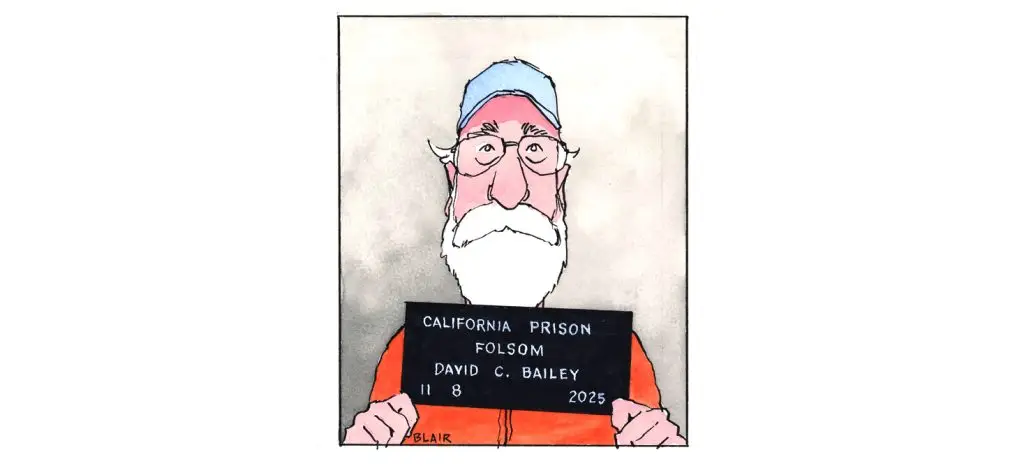
Faux Money, Mo’ Problems
A case of innocent mistakes
By David Bailey
Illustration by Harry Blair
“Don’t get arrested,” I would teasingly tell my daughters as I handed them the keys to the family car. And now here I was, 25 years later, imagining whether I might use my only call to my wife, Anne, or to my lawyer.
It was in the sixth grade that I began worrying about one day being thrown in jail. That’s when our class was taken to Central Prison in Raleigh, where the the tattooed arms of inmates extended from behind bars like tentacles as catcalls echoed down the bleak and narrow corridor. I almost peed my pants when I realized we were actually being taken on a tour of the gas chamber. These memories were among the thoughts of this law-abiding citizen after I heard these words over the phone: “Mr. Bailey, we need you to come by our office right now.”
There was no doubt in my or Anne’s mind that I had broken the law and might hear the click of handcuffs within the hour. “Go ahead, face the music,” Anne told me.
I never meant to pay for the four tires with “funny money.” Now, the clerk, who wouldn’t take my credit card number over the phone, was saying, “We need to take care of this right now — here.”
It all began as a simple prank. My hiking buddy, Randall, gave me a stack of crisp faux $100 bills his wife bought from Amazon. They looked like the genuine article, real enough that I fooled several friends with them, handing over 10 and saying, “Here’s the thousand dollars I owe you for that bet we made.” Bets are often something we make on the trail when we have a strong difference of opinion and a weak internet signal. For instance, after one hike, I sang Johnny Nash’s famous line, “I can see clearly now the rain is gone” instead of “I can see clearly now Lorraine is gone,” which is what Randall thought it was. “I bet you a bottle of bourbon” indicates that it’s a real challenge, payable without fail on the next hike. “I bet you $1,000” or $500 is a sure sign that the bettor is a bit unsure of his memory, but is relatively certain the other person is dead wrong. All of this to explain how an envelope of five $100 bills, admittedly marked in small letters “For Stage Use Only,” ended up buried under the piles of paper that wind up on our kitchen counter.
Anne had unearthed the funny money and unwittingly put it in the same drawer where we keep spare cash. The next day when I went to buy four new tires, I took the five bills with me since the tire shop charged a premium for using credit cards.
I paid with what I honestly-to-goodness thought was cash, rolling away on brand-new rubber. But now, as I pulled back into the lot on as-good-as-stolen tires, my clammy palms turning the wheel into a space, I scanned the parking lot for a police cruiser. Or worse, a Secret Service agent.
The clerk from yesterday had the phone cradled between his shoulder and ear as he was typing something into his computer, but gave me a knowing nod. Sweat rolled down my back as he finished the call and turned to me with a big smile. I began my long explanation of why I had given him “counterfeit” money but he waved my explanation off as as I peeled off four real bills.
“Look, I’m really sorry. I bet the mechanics really gave you a hard time.” Again, he brushed off what had been my third apology.
“Look, it’s no big deal,” he said.
Easy for him to say. OH
Obviously Scots Irish with a name like Bailey, David does, in fact, buy tires costing less than one hundred dollars each.