Wandering Billy

Wandering Billy
Rising from the Ashes
Forty years after devastation, Davie Street sweeps away the dust
By Billy Ingram
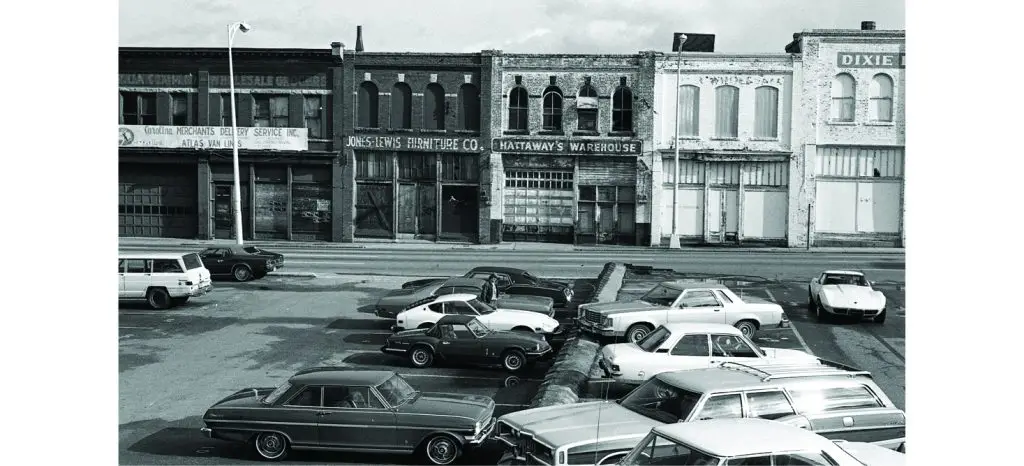
Feature photograph: Photo of buildings destroyed in the Davie Street fire captured by Keith Kolischack in 1976
“Anything you lose comes round in another form.” — Rumi
April 13, 1985. The call came into the Greensboro Fire Department around 10:53 p.m., reporting white smoke wisping from Dixie Belle Textile’s storage facility at 321 S. Davie St. Two minutes later, Engine 4’s crew, led by Captain Bob Bost, roared up on a scene where bellowing, black plumes were now pouring out of two adjacent 85-year-old wooden behemoths. Less than half an hour later, fueled by the mother of all backdrafts, overwhelmed firefighters were driven into defensive positions against a blaze so overwhelming orders were given that, should any storefront on South Elm catch fire, battalions were to fall back to the Carolina Theatre. There, they should hold the line, allowing everything to the east to burn unabated.
When morning broke, ashes still smoldering, Gate City residents peeled away rubber bands encircling the Sunday edition of the newspaper and were confronted with horrific headlines about a catastrophic event downtown. Excepting four storefronts and significant portions of Greensborough Court apartments, then under construction, Davie Street’s business district was obliterated. Two blocks of two- and three-story warehouses and commercial establishments dating back to 1900 on both sides of the boulevard — the primary focus of our city’s multimillion dollar urban renewal effort that was nearing completion — all went up in smoke due to a besotted squatter’s neglected cigarette.
Four decades after disaster, Davie Street is lit up again, ignited with entrepreneurial energy no less incandescent. A creative contagion is coalescing around literature, fine art, sassy stitch-ups, speeding steel balls and four-color fun.
Situated in the building next door to where that 1985 blaze broke out, our journey begins at Strange Ways Comics & More. Proprietor Ben (Never Grimm) Roberts’ pop-culture space-time continuum orbits outside the established parameters most associated with typical comic book shops. For one thing, he says, “We have a video store with VHS tapes and VCRs for sale. We can’t keep them in stock, but people are nostalgic for it.” For youngsters coming of age in the 2000s, he notes, “Everything was digital, so the new thing for them is physical media. They have a lot of respect for it.” The latest fad is owning books, CDs and DVDs? Ahead of the curve, we was!
College students, in particular these days, are gravitating toward graphic novels, which Roberts stocks a-plenty, but his racks are stacked with traditional comic books, natch. “Right now Absolute Batman is the highest selling. That’s brought in so many people who have never read comics before, so it’s been fun to show them other things.” Anything other than Marvel or DC is categorized by genre rather than by publisher. “So if you’re looking at Ed Brubaker, it’s next to other [indie] crime books.” Those irrational intersecting indecencies compounding the comical conundrums that comprise Brubaker’s twisted storylines serve as a mystifying deep dive into the world of adult graphic novels. Great stuff!
A gallery wall showcases local illustrators, while one entire room is ringed in retro pinball machines — “Labyrinth,” “Jurassic Park,” “Teenage Mutant Ninja Turtles,” “Metallica,” “High-Speed,” “Cactus Jack’s,” “Friday the 13th.” No admission to play, just quarters for the slots. Pinball tournaments flip out here on Fridays.
Bathed in Old World decor next door is Unfettered Books, newest edition — er, addition — on the block, launched last June by GTCC English professor Brian Barbour and wife Lisa Yeager, both reminiscent of those indie booksellers in Greensboro whose discernment nourished my insatiable need to read growing up. There’s a resolute lean here into sci-fi, horror, fantasy and the sexy romantasy sub-genre, where forbidden love (fiction’s favored flavor) flourishes amongst fornicating maidens, gregarious gods and discontented dragons.
Tucked into Unfettered’s cozy coffee lounge, where, apparently, “everyone loves the honey whip latte,” a fanciful selection of kiddie lit awaits little readers. Plus, Yeager points out, “an indigenous children’s section and indigenous nonfiction literature, poetry, new fiction and indigenous horror as well.” Various book clubs, including Unfettered’s own, commune over caffeinated beverages and conduct meetings here.
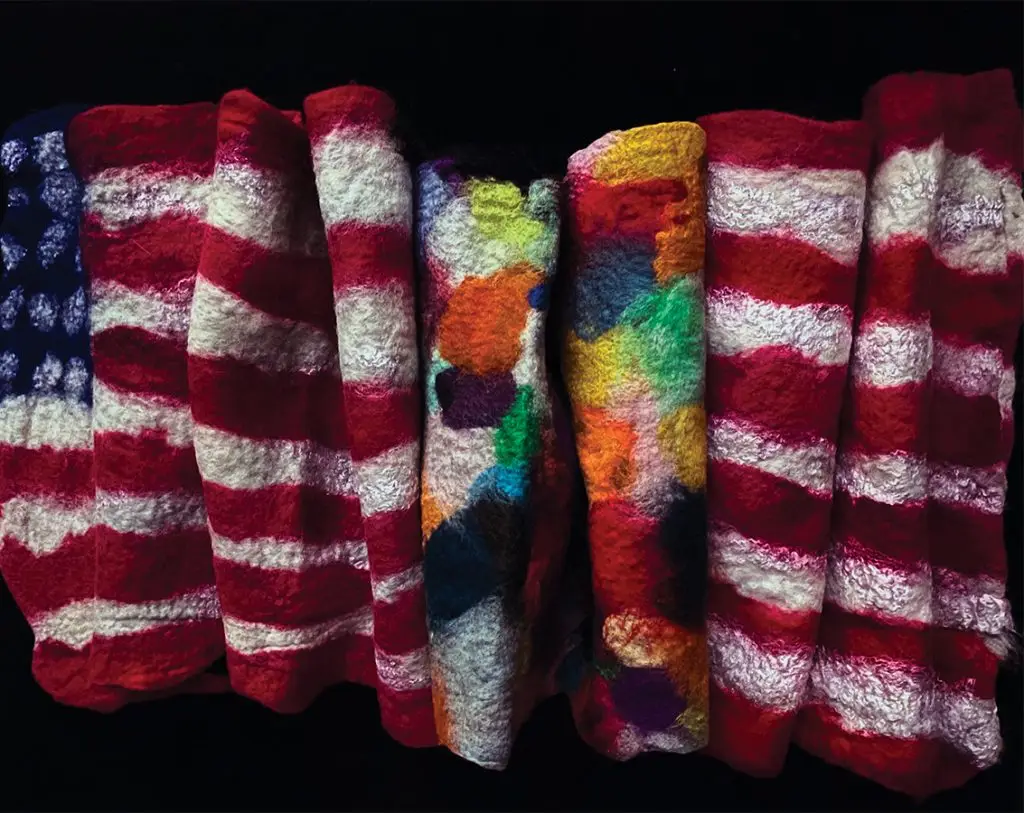
Kaleidoscopic hanks of handwoven yarn strung across one wall weave people together during Friday evening St*tch and B*tch sessions, an unravelling lasting well after the shop closes. “We usually keep chatting until 9 or 10,” says Yeager, “we have a good time.” Internationally acclaimed singer-songwriter Colin Cutler performed a Folk Fest pre-party in the cafe as did children’s entertainer Sam Hensley. Additional bookings forthcoming, I’m told.
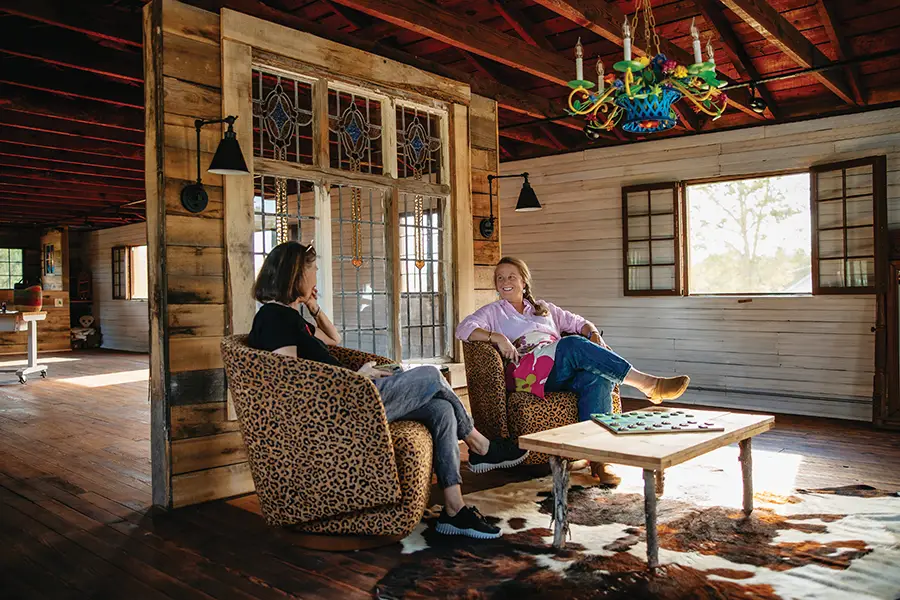
Meticulously reimagined and refashioned in The Farmer’s Wife Antiques’ former longtime hearth emerges PROXY. The avant-art gallery, interspersed with curated collections of unconventional lifestyle accoutrement, is orchestrated by Michael Clapp, locally established architectural romanticist profiled in the March 2019 issue of O.Henry.
Clapp walked me through the concept. “PROXY sort of evolved into this space for housing creation of all types. We do a lot of programming, smaller gatherings. We’ve done film screenings, hosted music artists for First Fridays and have a salon discussion series,” he says. “It’s been really amazing to see the reception that we’ve had.” His wife, Méric Ozgen, is also an architect and artist. “She leads the curatorial aspect of the exhibitions.” Together, they’ve been imprinting their singular architectural style for clients through Schemata Studio, a design practice specializing in adaptive reuse that reflects a harmonious, almost futuristic rusticity.
Clapp’s striking monochromatic, metropolitan deconstructions are on display at PROXY’s current instillation entitled Burn, running through mid-November. Its amorphous motif is that electric esprit one experiences when fully enmeshed in the creative process. He’s inexorably drawn to Matthew Steele’s kinetic wooden compositions that “utilize micropins to construct these very geologic sculptural pieces.” Plus, Clapp is fascinated by the juxtaposition of realism and abstract in Ivan Toth Depeña’s paintings, “the main artist that we were familiar with and wanted to have in this show. You’ll see in a lot of his pieces, he actually includes these little artifacts from the places that he’s depicting.”
Punctuating the surroundings are islands Clapp refers to as “exhibition retail, a way to share some of these little-known companies and products.” Warmly austere B+P lighting fixtures, Danish hardware accents for furniture, eye-catching art books and sleek Swiss mechanical pencils caught my eye.
Circumscribing the block is Davie’s Goliath, largest of the properties, with no imminent expectation of renovation although possibilities abound. Something cinematic perhaps? Clapp, who serves on the board of the Arts Council of Greater Greensboro, envisions this scrappy, compact chorus coursing with creativity as “an extension of the creative corridor that we feel runs all the way up to the Cultural Arts Center.”
One upside of sacrificing those scorched storefronts on Davie back in 1985? A preponderance of parking spaces occupy the empty lots left in their wake. OH
Billy Ingram has a YouTube channel with loads of local history & mysteries at: YouTube.com/billyingram.