Scuppernong Bookshelf

World Enough and Time

August’s releases span the globe

Compiled by Brian Lampkin

Travel guru Rick Steves wrote an interesting book this year: Travel as a Political Act. Reading about the world might also constitute a kind of political act. In an era when simple curiosity about other cultures passes as a suspicious act, understanding and engaging in the culture and ideas of other places becomes downright radical. Here are some of August’s new releases from around the globe. Read them in public places.

August 7: Babylon, by Yasmina Reza (Seven Stories Press, $23.95). Winner of the Prix Renaudot and shortlisted for the Prix Goncourt, playwright and novelist Yasmina Reza’s books have been translated into more than 35 languages. Her play “Art” was the first translated play to win a Tony Award. This book is a truly original and masterful novel from one of the world’s most inventive and daring artists.

August 7: This Mournable Body, by Tsitsi Dangarembga (Graywolf, $16). Tsitsi Dangarembga is the author of two previous novels, including Nervous Conditions, winner of the Commonwealth Writers’ Prize. She is also the director of the Institute of Creative Arts for Progress in Africa Trust. She lives in Harare, Zimbabwe. Dangarembga’s tense and psychologically charged novel culminates in an act of betrayal — revealing just how toxic the combination of colonialism and capitalism can be.

August 7: Maeve in America: Essays by a Girl from Somewhere Else, by Maeve Higgins (Penguin, $16). Maeve Higgins is a contributing writer for The New York Times and the host of the hit podcast Maeve in America: Immigration IRL. She is a comedian who has performed all over the world, including in her native Ireland, Edinburgh, Melbourne and Erbil, Kurdistan. Now based in New York, she cohosts Neil deGrasse Tyson’s StarTalk, both the podcast and the TV show, on National Geographic Channel. Comedian John Hodgman says: “Maeve Higgins is brilliant; but her brilliance isn’t the braggy, headlight kind that tries to trap her subjects deer-like in a cold, dead glare. Instead, she lights every room she enters with warmth, welcome, and generous rays of sheer funny. And in this book, she illuminates the world.”

August 14: Ball Lightning, by Cixin Liu (Tor Books, $28.99). Cixin Liu is the most prolific and popular science fiction writer in the People’s Republic of China. Liu is an eight-time winner of the Galaxy Award (the Chinese Hugo) and a winner of the Chinese Nebula Award. Prior to becoming a writer, he worked as an engineer in a power plant. His novels include The Three-Body Problem, The Dark Forest, and Death’s End. This novel explores what happens when the beauty of scientific inquiry runs up against the drive to harness new discoveries with no consideration of their possible consequences.

August 21: Brazil: A Biography, Lilia M. Schwarcz and Heloisa M. Starling (FSG, $40)For many Americans, Brazil is a land of contradictions: vast natural resources and entrenched corruption; extraordinary wealth and grinding poverty; beautiful beaches and violence-torn favelas. Brazil occupies a vivid place in the American imagination, and yet it remains largely unknown. In an extraordinary journey that spans 500 years, from European colonization to the 2016 Summer Olympic Games, Lilia M. Schwarcz and Heloisa M. Starling’s Brazil offers a dramatic history of this complex country.

August 21: God of Shadows, by Lorna Crozier (McClelland & Stewart, $25) The celebrated poet hailed by Ursula K. Le Guin as a “storyteller, truth-teller, and visionary” gives us a mesmerizing new collection of poems. Crozier is the author of 16 previous books of poetry and lives in British Columbia. Even Canada has become worthy of suspicion in the new paradigm. Let’s cross the border together into the sanity of poetry.

August 28: We That Are Young, by Preti Taneja (Knopf, $27.95). Preti Taneja was born in England to Indian parents and spent most of her childhood holidays in New Delhi. She has worked as a human rights reporter and filmmaker in Iraq, Jordan, Rwanda, and Kosovo. A stunning debut novel, a modern-day King Lear set in contemporary India: the tale of a battle for power within a turbulent family, for status within a nation in a constant state of transformation, and for the love and respect of a father disappearing into dementia. OH

Brian Lampkin is one of the proprietors of Scuppernong Books.

A Passion for Palindromes

A Passion for Palindromes 

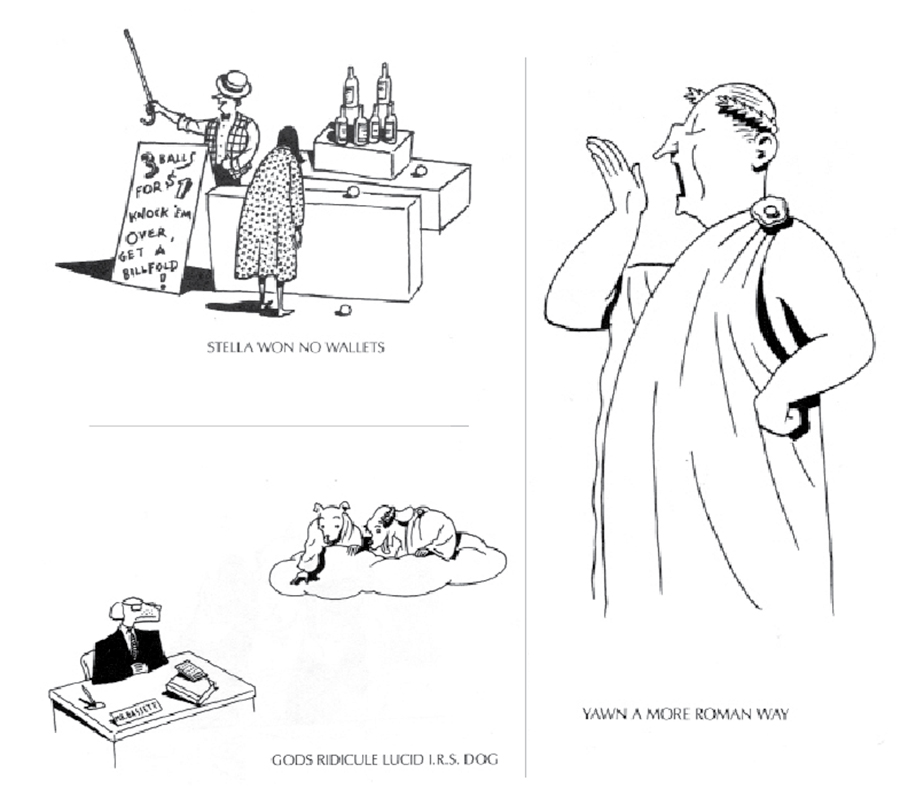
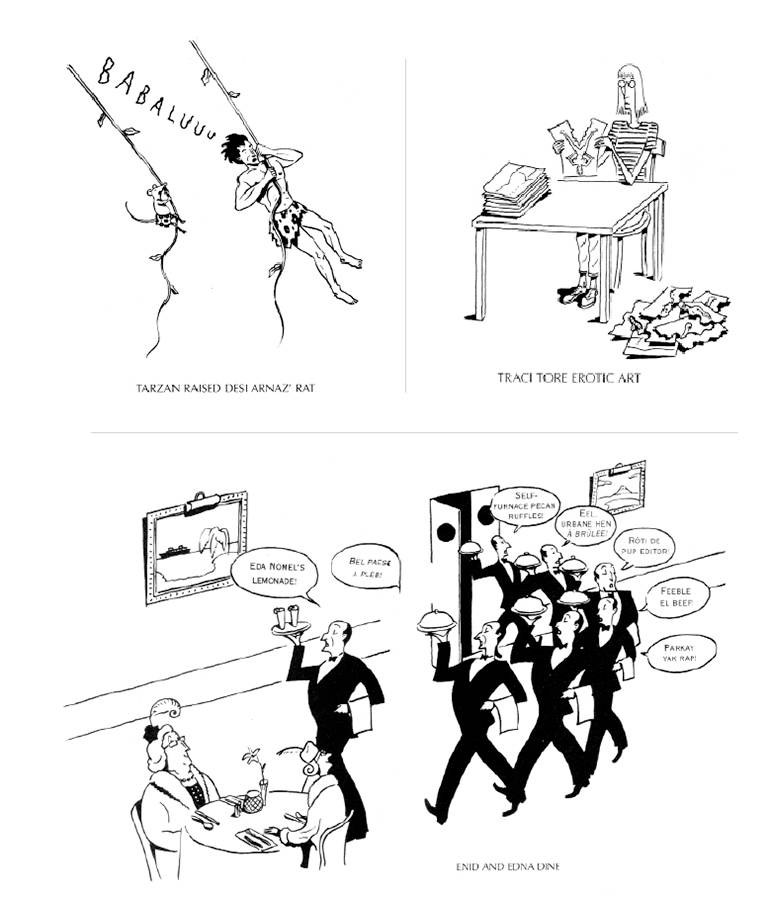
By William Irvine     Illustrations by Steven Guarnaccia

It all started when I discovered the mysterious connection between TUMS and SMUT. This childhood revelation (and the fact that I can read backward, a talent which I inherited from my mother) has led to a lifelong interest in collecting and inventing palindromes, words and phrases that read the same way forward and backward.

The cult of the palindromes owes its existence to Sotades of Maroneia, a Greek poet and satirist of the third century B.C., who invented palindromic verse and coined the term. The last century has produced J.A. Lindon and Leigh Mercer, British palindromists of rare accomplishment, as well as part-time palindromist and full-time humorist James Thurber. (One of his best: HE GODDAM MAD DOG, EH?)

The secret to constructing a fine palindrome is to start with a promising middle word with well-spaced vowels and consonants (FALAFEL or ASPARAGUS or ARUGULA spring to mind) and build outward, rather than starting with an end word (a mistake common to beginners). Punctuation is suspended; the only poetic license. Only a small number of palindromes make any sense without a frame of reference. So, unless you know you are reading a note from a New Guinean decorator, R.E. PAPUA ETAGERE GATEAU PAPER doesn’t mean much. Or AMARYLLIS SILLYRAMA (a comedy club for flowers?) Or how about SATAN, OSCILLATE MY METALLIC SONATAS?

For some reason, there are many good palindromes that incorporate the names of Republicans and dictators: DRAT SADAM, A MAD DASTARD; WONDER IF SUNUNU’S FIRED NOW; NORIEGA CAN IDLE, HELD IN A CAGE IRON. And consider this fine Sarah Palin-drome: WASILLA’S ALL I SAW.

Some of the best palindromes are remarkable in their brevity and simplicity: EVIL OLIVE, for example. Or the exquisite GOLDENROD-ADORNED LOG. But these pale in sophistication when compared with one of my all-time favorites, composed by the British author Alastair Reid:

T. ELIOT, TOP BARD, NOTES PUTRID TANG EMANATING, IS SAD. “I’D ASSIGN IT A NAME: GNAT-DIRT UPSET ON DRAB POT TOILET.”

The artist Steven Guarnaccia and I have been palindrome pals for a very long time. (In fact, so far back that when we began collaborating, the internet was something in a galaxy far, far away.) So in response to those youngsters who say, “Can’t you just look all these up on the Internet?” I gently reply that many of my earliest efforts were actually the result of countless hours with pad and paper, thumbing through dictionaries and collecting word lists of likely candidates. It sounds quaint, now, doesn’t it?

The following drawings are from our latest collaboration, DO GEESE SEE GOD: A Palindrome Anthology (available on Amazon). I hope you enjoy these plums of our palindromic plundering!  OH   

When he is not indulging in logology, William Irvine is the senior editor of Salt.

The Real Song of the South

The Real Song of the South

How an eccentric Alabama spinster collected folktales and living voices — human and animal alike — from an age that is gone with the wind

By Nan Graham

We scrambled flat on our stomachs, wrestling the bulky cardboard box from under the looming four-poster bed. My cousin Anne and I are not teenagers . . . we’re not even middle-aged . . . so it was a grim spectacle of struggling grayheads, who risked never getting vertical again, to do this.

The musty papers and letters of one of the most colorful of our relatives, our great-aunt, Martha Strudwick Young, a diminutive professional writer, born the year after the War Between the States began, contained some surprising new information. Cousin Anne had never looked in the boxes since her mother’s death in 1970, some 40-plus years ago. We were only a few miles from Martha Young’s birthplace in Hale County, Alabama, at a place called The Pillbox a few miles out from Greensboro, Alabama, and my visit had prompted questions about the writer’s childhood. We were well into the second round of iced tea when Anne remembered the flat coat box stored beneath the bed.
We knew from family stories that Martha’s early years were spent riding in the carriage with her father, Dr. Elisha Young, through the Hale County countryside as he made his rounds and tended to his patients. A surgeon in the Confederate Army stationed at Fort Morgan in Mobile — and imprisoned in New Orleans after the fall of Mobile — Dr. Young returned to his little family after the war to practice medicine in Greensboro, Alabama. A born storyteller, the doctor entertained the little girl with stories of making quilts with his black nurse as a young boy, eyewitness accounts of battles on Mobile Bay, and starving troops in the Alabama countryside as the father and daughter roamed the county in his buggy on house calls. He told of performing the first ever successful cutting and suturing of a carotid artery on a man stabbed and brought to his kitchen table in the middle of the night. The patient survived the procedure in the makeshift operating room. Dr. Young said that early quilt-making, common among young Southern boys in the 1860s in the county, gave him his surgical skills.

Martha had a quick ear for the rich dialect of the black folks at home and in the rural countryside. She was spellbound with their musical language and loved their tales of witches, wicked spells and ha’nts, and stories of talking birds. She absorbed the speech, its cadence and energy, of the black storytellers. Martha took mental notes on the actual calls and songs of birds of her native Hale County along the wooded roads. She was a good listener and had an excellent ear for mimicry.

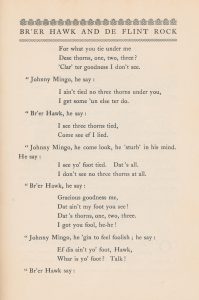
She began to write and craft the oral tales told to her by blacks in her household and those she knew in the small community of Greensboro. She listened to the musical calls from the men and women who peddled fresh butterbeans and field peas ( “Fe-ull Peeas. Yas. Freee-sh Pleeeez . . .”) from carts on the dusty streets of her neighborhood. She listened to the ghost stories of the cook Chloe in the family kitchen house and to the animal stories of Isham, who helped with the horses and cows. She wove the tales into lyrical and haunting stories about sparrows’ chatty conversations with crows and baby robins squabbling among themselves. And useful warnings that picking peaches from the tree after sundown would kill the tree. Martha added her own keen observations of nature in Greensboro and the countryside around it, and incorporated the sounds of the birds and creatures as an integral part of her stories.
Being the oldest child of the eight siblings (of whom only five survived), Martha as a young adult in her 20s inherited the role of caretaker of the family at her mother’s early death in 1887. Her physician father could never have managed without his eldest daughter’s capable and no-nonsense discipline of her younger, motherless brothers and sisters. Martha practiced her bird calls and storytelling skills on the younger children, who were enthralled at their big sister’s tales of the talking buzzards, singing bats and swamp witches. Amazingly, she continued her writing despite being mistress of a large household and surrogate mother to a brood of children ages 7 into pre-teen.

And after raising her younger brothers and sisters, Martha, or Tut (rhymes with foot), as the family called her, decided that the single life was the life for her. As she always replied to inquiries about her marital state: “No, I am not married. I shall stay . . . forever Young!” (Her early sibling-rearing may explain the decision of the many spinsters out there, especially around the turn of the century.) Granddaughter of an Alabama anti-Secessionist, she had a college degree and was encouraged in her writing by her family. She started her career under the pseudonym Eli Shepperd, since young women from the South were not usually accepted in the male-dominated literary scene.

She began submitting her dialect bird stories to the New Orleans Times-Democrat, which first published her work in 1884, a Christmas story titled “A Nurse’s Tale.” Other Southern newspapers published the prolific writer’s stories.
The creator of Brer Rabbit and the Tar Baby, Joel Chandler Harris, gave high praise to the dialect writer, according to one newspaper account and even collaborated with Martha on one of his Uncle Remus collections. Joel Chandler Harris himself wrote: “Her dialect verse . . . is the best written since Irwin Russell died. Some of it is incomparably the best ever written.”

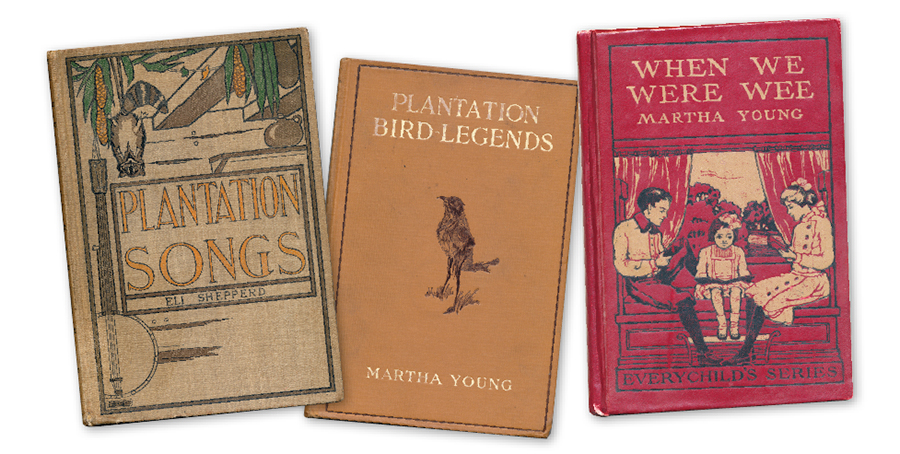
Her first book, with the catchy title Plantation Songs for My Lady’s Banjo and Other Negro Lyrics and Monologues, was published in 1901, still under the pseudonym Eli Shepperd. The originator of Brer Rabbit contacted the writer under that name. Joel Chandler Harris invited “Mr. Shepperd” to join him at a small hunting lodge at his Georgia home, Eagle’s Nest, to work on a collection of folk stories. It was a secluded spot and Harris felt it would be a productive collaboration. Naturally, Martha revealed her identity as a lady and responded that she hardly thought that Mrs. Harris would approve the plan. The two writers did eventually collaborate, but not in the secluded setting first suggested to Eli Shepperd!

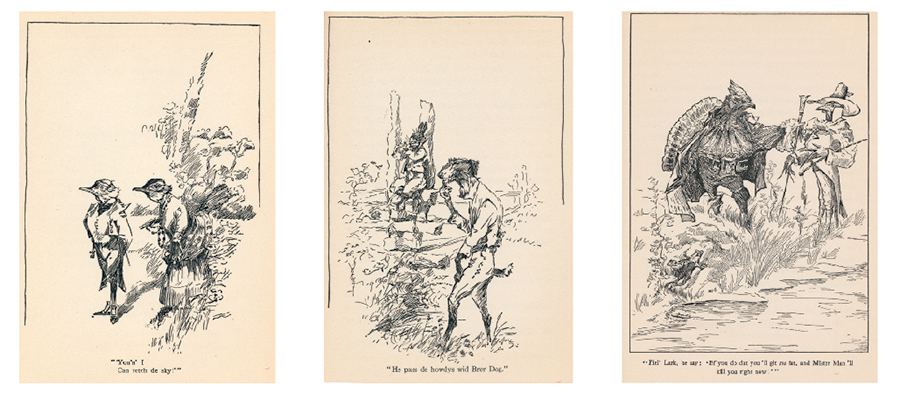
More books followed Plantation Songs: Plantation Bird Legends (1902), Bessie Bell (1903) (later re-released as Somebody’s Little Girl in 1910), When We Were Wee (1912), Behind the Dark Pines (1912), Two Little Southern Sisters (1919), and Minute Dramas: Kodak in the Quarters (1921). Another Martha Young book, Fifty Folklore Fables, was reviewed and mentioned in publicity releases but is unable to be located. Plantation Bird Legends and Behind the Dark Pines are both illustrated with pen-and-ink drawings by J.M. Conde, the artist used by Joel Chandler Harris. Besides her eight published books, numerous articles and stories by Martha appeared in such magazines as Woman’s Home Companion, Cosmopolitan and Christian Advocate. Cosmopolitan, begun in 1886, was a family magazine at the time (a far cry — not even in shouting distance — from the modern Cosmopolitan) and featured such established writers as Jack London, Edith Wharton, Willa Cather, Theodore Dreiser and later H.G. Wells and George Bernard Shaw. (In 1965, Helen Gurley Brown, author of Sex and the Single Girl, revamped the family magazine of Martha’s day, zeroing in on women’s issues, becoming the familiar magazine we know today as the sexy Cosmopolitan.)
Martha Young reached her literary peak in the first decade of the 20th century. Her whimsical bird stories in African-American dialect were a runaway hit. Her books were a smash across the country, North and South. The Pittsburgh Gazette was among those who raved about her Plantation Bird Legends: “What the Grimm Brothers did, taking from the lips of unlettered peasants the folktales of the foretimes and setting them down for the delight of the after age, has now been done by Miss Young.” Martha’s other animal tales included such titles as “Why Brer Possum’s Tail Is Bare,” “Mr. Bluebird’s Debt,” and “Why Mr. Frog Is Still a Batchelor.”

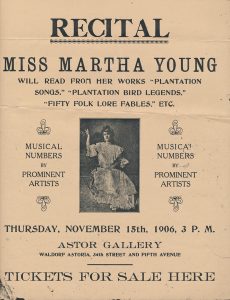
Martha even performed live at the Waldorf-Astoria Hotel in 1906, reading stories and poetry in dialect from her published books and actually performing bird calls and trills to the audience’s amazement and delight. Other “musical numbers by prominent artists,” not mentioned by name, were also to appear on the evening program. She became a popular speaker in the East and almost all reviews of her events laud her delivery and lively presentations with comments about her distinctive voice.

OK. It WAS a different era, but I like to think Martha was an early Susan Boyle — without the bad hair — an unlikely candidate for public success having been raised in the tiny town of Greensboro, Alabama. Tickets for the performance were $1, the equivalent of about $27 in today’s currency, when the 1906 worker’s wage was about $300 per year and the average hourly wage 22 cents an hour.

Her Waldorf-Astoria poster shows the studio photograph of the petite 28-year-old Martha in an elegant pose. Reality was that in 1906, Miss Young was well into her 42nd year and a bit more stout (as they say in the South) than the slender young woman pictured.

Tut even had an offer to perform in vaudeville in New York, but politely demurred. (I am certain her lips were pursed when she did.)

She was quite prolific: plays, novels, stories for education journals and poetry, some even feminist. The poem “Uncle Isham” written under her pen name is narrated by an African-American to suffragettes who laughingly says ladies, don’t bother. He complains that he got the vote, but it didn’t change a thing . . . so never mind!

Hollywood called early on. One of her books, Somebody’s Little Girl, caught a Hollywood mogul’s eye. His office called the author Martha Young. As it turned out, it was not her story they were interested in, it was the title. Could they purchase the title alone, they asked. Martha was mortified at the idea. “Of course not,” she replied. “I would just as well sever my child’s head from its body as sell my title from its story. (It does make you think of Gloria Swanson’s has-been character in Sunset Boulevard when she thinks Cecil B. DeMille wants her for a movie comeback, when he actually only wants to borrow her vintage 1929 Isotta-Fraschini touring car.) Hollywood went elsewhere for a title, and unfortunately, we do not know which movie resulted after these failed negotiations with Martha.

One family story centered around Martha’s ferocious love of coffee and her prodigious consumption of the drink. She downed a dozen or more cups a day, but one Lent she decided to deny herself her most precious beverage. She announced what she was giving up for Lent with an unseemly pride to family, friends and neighbors: No coffee for 40 days and 40 nights.

About a week into her extreme Lenten abstinence, her brother came to see her. The door was open; he called . . . no answer. He wandered through the empty house until he heard a tiny voice from the closet. “In here, Elisha.”

He opened the door and saw his sister sitting on a straight chair in the darkened closet, drinking a cup of coffee.

“Tut,” he chastised, “Don’t you know the Lord can see you, even in this closet?”

“Of course I do,” she said, taking another sip. “But the neighbors can’t.”

Her Presbyterian brother closed the closet door and left her to her secret sin.

Tut became the family eccentric, a standout in a host of relatives competing for the title. Martha Young never voted in any election, even after women won the right to vote. She had been born the year Alabama seceded from the Union. Alabama came back after Appomattox . . . Martha never did. She was of the notion that she was not a citizen of the United States and accordingly, was not an eligible voter.

Her tiny feet were a particular source of pride. And with reason. In Martha’s day, Birmingham was where you shopped when you wanted something grand. It was Alabama’s answer to Paris. Passing the city’s finest shoe store, Tut stopped to read the display sign:

TRY ON CINDERELLA’S SLIPPER

You Might Be the Lucky Winner of a Pair of Shoes of Your Choice!

Tut strolled into the shop and sat while the salesman slipped the crystal slipper on her foot with ease. A perfect fit! She selecting the most cunning — and expensive — shoes on display. With shopping bag in hand, she waltzed out to meet her family for the triumphal return to Greensboro. Needless to say, she and her feet were the envy of every female in town. In all her photographs from that day forward, she managed to display her Cinderella foot peeking out from her floor-length dress.

Also vain about her small hands, she always posed them prominently in every picture. At one dinner party, she took a stroll in the garden at her host’s home at dusk. When she reached to touch a flower, she was bitten by a small garden snake. She rushed to the house, where she dropped to the sofa, crying, “My hand! My beautiful little hand. Ohhhh!” She held her hand aloft for inspection. As the guests gathered round, Martha put on a performance her fellow guests never forgot. Sarah Bernhardt would have been proud. Talk about how to sabotage a party. Tut’s uber-vanity quickly became part of the family history.

Local lore in Greensboro claims that Margaret Mitchell came calling on Tut in the 1930s. She was looking for advice on African-American speech patterns and dialect on a certain book she was writing. There is no evidence of this research visit by the author of Gone with the Wind except three local Greensboro sources who have heard the story handed down.

In 2006, a call came from Hollywood asking if I had or knew of any recordings of Martha Young’s voice. Production was beginning on a new film about Zelda Fitzgerald. They had heard of Martha Young’s work and were anxious to hear her Deep South accent for resource material for the film. Alas, although there is mention of her recordings in several writings about her, none could be tracked down.

The aging author did not mellow with age. One of my favorite stories about Tut was about her later years, when she developed diabetes in her old age and would not go to the doctor for follow-up visits.

“But Martha,” her friends insisted, “You need to get your blood checked.”

“I certainly do not,” she replied, drawing herself up imperiously. “I can assure you, I have the very best blood in Alabama.”

As the century rolled on and literary styles changed, Martha turned from writing lively animal stories to religious poetry and full-length plays as her next endeavors. It was an unfortunate career move. Martha’s religious poems are excruciatingly bad, but despite that fact, they continued to appear in magazines and newspapers. A few of these poetic gems’ titles: “Buddha’s Lilies” (Tut was an avid Episcopalian) and “Sermon on the Mule,” “Blessings of the Magnolia,” and “Sermon Against Bad Language.” The tedious plays (my personal favorite was Dice of Death) and her novels were never published, thank God, and now languish in a library’s special collection archives.

In the late 1930s, Walt Disney contacted Martha’s agent, according to correspondence found under that bed. The Disney studio was interested in animating her bird characters and stories. The elderly author had almost stopped all writing by now, but her agent’s letters were wildly optimistic. Disney, flush with the huge success of the 1937 release of Snow White, was working with Martha’s bird stories and had come up with some ideas on using them in a Disney full-length animated feature film.

“Oh no,” wrote Martha after reading one Disney adaptation, “Sis Sparrow would never say such a thing! No, no, Brer Crow could not possible perform such a dance . . . it’s all wrong. Wrong!” The imperious author was unyielding to the siren song of Hollywood.

Negotiations broke down after several years, the letters reveal. The headstrong Miss Martha Young proved a tough cookie. Five years later, Disney came out with Song of the South, the mix of animation and real film characters. Aunt Tut died in 1941 and the correspondence recording the futile negotiation with Walt Disney was stashed under that poster bed in Hale County, where it remained until a few summers ago.

Sis Sparrow could have been singing “Zip-a-Dee-Doo-Dah” while Bruh Crow and Martha Young’s other bird characters danced, if only Proud Martha had not been so mule-headed. She coulda been a contenda . . . maybe!

Acknowledgment for the culture and dialect of the black stories is a growing movement in the literary world. Zora Neale Hurston’s Barracoon, the true story of a survivor of the trans-Atlantic slave trade, was refused by editors in 1927 because of its dialect narrative and is now published with a scholarly introduction.

Aunt Tut is not completely forgotten. Almost all her early works have been republished by academics and folklore enthusiasts with original titles and author Martha Young’s name. And so the original stories remain in print.

Virginia Hamilton, a noted African-American author, read some of Martha Young’s folktales, rewrote them (it is almost a translation from the dialect) and had famed Barry Moser illustrate the stories. When Birds Could Talk and Bats Could Sing, published in 1996, is a beautifully illustrated book of Martha Young’s stories that are a joy to read today. ( My only complaint: The book is titled by Virginia Hamilton. As an academician, Hamilton surely knew that the correct way to title the book would be: By Martha Young as retold by Virginia Hamilton.) There is a brief explanation of Martha Young on the last page of Hamilton’s book. The beautiful new version of Martha Strudwick Young’s fanciful tales of talking sparrows and dancing crows is thankfully preserved.  OH

Nan Graham is a regular Salt contributor and has been a local NPR commentator since 1995.

Poem

Summer Boy

The summer we were seventeen

I watched you in the sun.

Blond and blue

Beside the pool

Teasing girls you hardly knew.

Jackknife off the high dive —

Daring other golden guys.

I watched. You didn’t see.

Dark and dusky me.

— Phillis Thompson

Life’s Funny

It’s a Dog Meet Dog World

By Maria Johnson

There are times, when you’re tromping around with Don Brown at his Siendo Farmstead in McLeansville, that you know he is talking about dogs, but he could be talking about other creatures, too.

“A dog carries with him a social experience wherever he goes,” Don says. “If that social experience is torn or marred, then you’re going to have problems.”

For the record, we don’t consider Rio, our 8-year-old foxhound, a problem dog. From the time we found him, bony, beaten up and beaten down by whatever had passed in the two years before my younger son heaved him from roadside to backseat, our family has considered this gentle and skittish hound a blessing and an enigma, which is a blessing in its own way.

We pay more attention to a mystery, don’t we?

By “we,” I mean humans. And maybe dogs, too. That’s why I’m here, to learn more about dogs in general and about my dog in particular. The instrument: a WalkAbout with Don, who started his canine jaunts about 10 years ago, after a long hitch in dog training and doggie daycare left him with more questions than answers.

Sure, if people taught their dogs to sit on command, they would feel better about themselves, Don observed. But what were their dogs thinking? How did they see the people? And other dogs? What was going on between them?

Even if obedience was the only thing that mattered to you, the social part was relevant.

“A socially healthy dog will tend to be easier to train,” says Don.

That’s when Don and his wife Hutsie, opened their 16-acre property to friends and others who heard about their LifeStyle Dog Training business by word of mouth. For a small fee, folks and their dogs could roam the fenced farm with Don and his dogs, and sometimes with other owners and their dogs. Don called the events WalkAbouts after the Aboriginal practice of booting young men into the wild where, in the company of other young men, they learn who they are and how they fit into society.

Don did the same with dogs: He turned them loose in nature and watched them become themselves, which they can only do, he says, with other dogs.

“It’s a dose of dogs that dogs need to orient how they think and perform socially,” he says. “A dog needs to be with other dogs at times.”

Don’t mistake Don for an advocate of dog parks. He’s not a fan. Too many owners misread their pooches and other dogs, some of which should not be unleashed in a public spaces. That’s why Don screens visitors — both human and canine — with an application and in-person evaluation.

Having cleared the application hurdle, Rio and I rumble into Don’s driveway shortly before noon. I pop the hatch. Rio jumps out, sniffs a fence with Don’s dogs on the other side, pees on the fence (nice to meet you), sniffs, pees again and trots off to trace every boundary on the farm — fence lines, tree lines, shore lines — with his keen snout.

“His world is full of scent, not so much pictures,” Don says, drawing a contrast between scent hounds and sight hounds such as his own dogs, silken wind hounds, which like greyhounds, employ their eyes more than their noses.

Don characterizes scent hounds as “ignorantly bold.” He heeds the power of breed and age — and temperament, which is inborn and expressed in behavior, which in turn is molded by experience, but only to a point.

In other words, dogs are who they are.

Don releases one of his laid-back dogs, 9-year-old Logan. He and Rio barely nod to each other. Rio skips into the woods. Don shakes the cocktail by adding 3-year-old Cora, 9-year-old Cimarron and 12-year-old Belita. We travel as a crew in search of Rio.

We spot him on the far side of the pond. I call. He gallops toward us then halts. He is wary of the pack, even with me standing in their midst.

I call again. He barrels toward us. He draws closer and . . . whoosh, buzzes by us at full speed.

Don’s dogs stand still. You can almost hear them saying, “What the . . . ?”

They’re stumped. And so is Rio. Dogs, like people, search for familiar ground, a sameness that comforts them, Don says. Rio is reaching out in a way that usually works for him, provoking a playful chase.

He tries one more fly-by with no luck. He disappears into the woods, re-emerging only after I separate from Don and his dogs. He sticks close as we walk back to the house, where Don puts the dogs into a smaller yard. Rio noses around the edges, but he and other dogs don’t engage.

Don’s diagnosis: Rio’s sensitive and stoic with a hefty helping of stage fright.

Sometimes, he distances himself from group experiences that could help him. Like some male dogs, he has a narrow vision of social life. He could benefit from more mixers with dogs and from more “check-ins” that reward eye contact with humans.

“You’re in a position of opening his mind,” Don says.

All of which rings true. And would be fair because Rio has opened my mind, this once- indifferent dog that now “talks” to me when he wants something; who finds me sitting on the patio steps and rests his head on my shoulder; who literally jumps for joy whenever he sees his houndy friends Henry, Annabelle, Archie, Pumpkin and Sally.

He is wonderfully complex, never wholly predictable, ever evolving, full of quirks and love, abilities and fears, a unique bundle of past and present.

He is, after all, who he is.

We’re talking about dogs, right?   OH

Maria Johnson is a contributing editor of O.Henry. Contact her at ohenrymaria@gmail.com. Reach Don Brown at LifeStyleDog@aol.com.

Wandering Billy

Goodbye to a Grand Dame

Martial arts, musical memories, and a shout out to a local birthday girl

By Billy Eye

“If a man dwells on the past, then he robs the present. But if a man ignores the past, he may rob the future. The seeds of our destiny are nurtured by the roots of our past.”
—Master Po, Kung Fu

I spent a lazy hour or so wandering around the nearly empty Elm Street Center one Saturday, where everything was up for sale, including the fixtures, in anticipation of its impending demolition to make way for another new hotel downtown. I dimly recall my mom dragging me along when this was Ellis-Stone department store.

Designed in 1949 by the fabled New York architectural firm Voorhees, Walker, Foley & Smith, this was a more modern structure than was typical on South Elm, with glass balconies, crystal chandeliers, ornate floor-to-ceiling mirrors and a grand marble staircase, a true Grand Dame of southern architecture. At some point, this Ellis-Stone store became Thalhimers before closing in 1975; in the 1990s an antiques mall took over the spacious interior. For the last decade or so, the Empire and Regency Rooms have hosted an untold number of lavish wedding receptions and corporate events while one of the city’s nicer bars, Churchill’s, was neatly tucked away in a ground floor corner until they too were forced to vacate. I hate to see this remarkable landmark swept aside.

***

Watching the TV series Kung Fu (1972–1975) the other night reminded me of a tiny sliver of my well-spent youth hanging out with Radames Pera in downtown L.A.[as per L.A. Times]’s underground music scene circa 1981. The night we met he talked about returning to L.A. after a few years studying acting under Stella Adler in New York. I was fascinated by that, even more so when he told me about how he’d portrayed Young Caine on Kung Fu, the “Snatch the pebble from my hand” kid with the shaved head. I don’t remember him having much more hair than that when we’d run into each other at the notorious punk club Brave Dog and numerous Sunday afternoon The.o.ret.i.cal parties. He was around 21-years-old then, smart guy, still is I imagine, seemingly as centered as his “Grasshopper” role but with an amazing backstory. After Kung Fu ended, he was cast as Mary Ingalls’s beau, John Jr., on Little House on the Prairie and would later play a key role in one of my fave action pics, Red Dawn in 1984. Radames left the business shortly after that, and I understand he lives comfortably with his wife and baby daughter in France now.

***

To celebrate the 40th anniversary this month of Peaches Records & Tapes opening on High Point Road, I interviewed a number of former employees for another venue. There was one person who kept coming up in conversations. Universally loved at Peaches was Raymond Tucker, nephew to Jim Tucker who played Pecos Pete on The Old Rebel Show in the 1950s and ’60s. Jim informed me: “Bill Trotter — he passed away recently — was the classical buyer. One of the things he really prided himself on was that he had every single classical album from all of the major labels in stock,” Tucker recalls. “People would come from all up and down the East Coast just to shop there because they knew they could find what they were looking for.”

Tucker remembers one eccentric customer in particular. “Every time he came in the store he always asked for one thing, if we had any albums by Gogi Grant. We’d go through the same routine.” Tucker recalls how he’d come in every three months and ask if they’d gotten anything by Gogi Grant. “And we had to take him to the Vocal section, to the Gs, show him there’s nothing there,” Tucker continues. “Then he’d ask if he could special order anything and we’d have to take him to this vast directory of everything in print and show him that, under Gogi Grant, the only thing still in print was one oldies 45 of ‘The Wayward Wind’.”

Peaches’ Atlanta megastore was renowned for its Grauman’s Chinese Theatre–style entryway where Emerson Lake & Palmer, J. Geils Band, King Crimson, Gregg Allman, The Kinks, ZZ Top, KISS, and Paul McCartney scribbled their names with a stick before mashing hands into wet cement for posterity. Like the Atlanta branch, Greensboro had its own star-studded entryway where celebrities like Hank Williams Jr., L.T.D., Barbara Mandrell and The Brothers Johnson cemented their relationship with our local Peaches.

Forced into bankruptcy in 1981, investors swooped in to purchase only the most profitable outlets scattered around the South and Southeast. An unfortunate result of that divestiture — the sidewalk of fame in front of the Atlanta franchise was “smashed to bits in a single afternoon” following a dispute over who owned it. The same likely happened to our own concrete autograph garden. Greensboro’s Peaches closed in early 2001.

***

Sending warm wishes and sweet sugar kisses to my new bestest friend, urban explorer, and most enchanting lunch companion Emery Isabella, celebrating her first birthday in July. ¿No es ella la más linda?.   OH

Billy Eye recently uncovered definitive proof that the Earth is indeed flat but, after accidentally catapulting over the edge, he hasn’t been heard from since and is presumed lost in space. 

In The Spirit

The Perfect Martini

How to create — or botch — a great one

By Tony Cross

After closing, I rent out the kitchen at Nature’s Own to work on prepping and batching kegged cocktails. I get ideas just walking around the store grabbing ingredients. One night as I passed the shelf of vermouths, I thought to myself, “Self, I probably need to re-up on some Dolin. Why have people been telling me about their terrible martinis lately?” Let’s talk about what you (or your bartender) are doing wrong.

The martini is the international symbol for cocktails. I just made that up. Or maybe not. What other shape — whether it’s a neon sign, printed on oven towels, or painted on a canvas at Bed, Bath & Beyond — represents an alcoholic drink that’s recognized everywhere? Everyone over 21 knows about the martini. This doesn’t mean that everyone has tried one, much less enjoyed this quintessential classic. I can certainly tell you that I did not fall in love my first go-round. Quite the opposite, actually. If memory serves, I believe all I was drinking was cold, lousy gin, in a martini glass. What a moment.

From talking to my bar guests in the past, to chatting with friends and clients, here are some tips:

Just because it’s in a martini glass doesn’t make it a martini.

I’m getting this one out of the way, because you’d think it should be self-explanatory, but . . .

What recipe?

OK, this one should be pretty obvious, but just like with other cocktails out there, a lot of bartenders (home or away) just throw it all in there and don’t look back. Unless you’re quite skilled, stick to measuring. You might think you look cool behind the bar free-pouring that loooonnnngg stream of gin (probably vodka), but you don’t. If it doesn’t taste good, your guests are ordering something else. Plus, you just poured 4 ounces of gin in an oversized martini glass, and made your server spill it all over his/her hand. Good job. Do this instead: Order some jiggers from a reputable online store (I love the Japanese style) and measure. Consistency is key, and you want your guests coming back every evening because they know that your martini is the best every single time.

What vermouth?

A majority of bars across this county (and country) have rancid vermouth on the shelf. I was recently at a local spot that I wouldn’t have guessed would do such a thing. I didn’t have the heart to say anything, but luckily my buddy did. Vermouth is fortified wine, so you have to treat it like a wine, and refrigerate it. It’ll last for months (if you’re doing it right, you’ll be running out before that’s even an issue). You can also opt for smaller bottles if you’re not making many on average. When it comes to which kind, Dolin Dry has my heart. This French vermouth has been in production since 1821 and been in my belly since I was 21. Just kidding, I was drinking Jägerbombs at 21.

Gin.

To the gin martini drinkers: Just any old gin won’t do. It’s true that we have lots of local distilleries popping up, and they’re making some fantastic stuff, but for a martini, for me, it’s got to be Plymouth Gin. It’s so soft, with slight earthy-like undertones. I’ve never been great at describing spirits on my own, so there you go. Soft and earthy. But really, some other gins have a ton of different botanicals going on, and it’s just too much for me. Plymouth really mingles well with the vermouth. It allows both products to let each other shine. If Plymouth is not available, a London Dry will do. May I suggest Tanqueray 10?

Execution.

In the 1971 copy of Playboy’s Host & Bar Book (I am a loud and proud owner — Mom, I only read the recipes) it says, “A martini must be piercingly cold; at its best, both gin and vermouth are pre-chilled in the refrigerator, well stirred with ice and poured into a pre-chilled glass. Energetic stirring with the ice is all-important; the dilution makes the drink both smooth and palatable.” (Mario, 1971) Yes! Especially that “energetic stirring” part. I’m stealing that. The martini needs to be silky smooth and ice-freaking-cold! Just cold is not going to cut it. If you are (as the same book calls its reader) a martini man, you should always keep your gin in the fridge. Having both your gin and vermouth cold from the start is going to help propel your martini to the next level.

We already know not to use bad ice, but let’s refresh our memory really quick. Rubbish in, rubbish out. If your house water is great on its own, you shouldn’t really worry. Chances are, that’s not the case. So, get your own molds, and fill them with distilled water. Make sure that all of your ingredients go into an ice-cold mixing vessel. I prefer a mixing glass. If you’ve never used one, give it a shot. You can also try (after adding your gin and vermouth; see proportions in “Recipe”, below) to completely fill up the vessel with crushed ice. You can’t get much colder than that. You will be stirring, not shaking. If you’re having a hard time stirring correctly, there are a couple of great videos on YouTube that can guide you. I’m not ashamed to tell you that’s how I taught myself.

Recipe.

These vary slightly, but this is what I make for myself:

2 1/2 ounces Plymouth Gin

3/4 ounce Dolin Dry Vermouth

Strain into a chilled martini or coupe glass. Garnish with olive(s) or lemon peel.

Scroll up and repeat. I should note that some folks like to use a dash of orange bitters. If I do, it’s with a blend that I’ve mixed from a few different companies. Not really a game changer.  OH

Tony Cross is a bartender who runs cocktail catering company Reverie Cocktails in Southern Pines.

Doodad

Strings of Desire

EMF’s fifth annual Guitar Summit

Young classical guitarists often discover their chosen profession comes with one major drawback. Because becoming proficient on your instrument requires a lot of time alone, you’re practically sentenced to a life of solitary confinement. Woodshedding with fellow musicians hasn’t been an option — till now. EMF has come up with a solution, redemption for those formerly incarcerated in lonely rooms.

Now in its fifth year, the Guitar Summit allows EMF attendees the chance to work with their peers as well as to strengthen their skills with one-on-one, master class tutelage from a trio of faculty guitar instructors. The program was developed under the guidance of Kami Rowan, PhD, and currently department chair for Guilford College’s music department where she has helped to build up a robust classical guitar program. She was also involved in putting together the Weaver Academy for the Performing Arts. A classical guitarist, she has long wished for a guitar summit for students, but until recently nothing like it, save the odd weekend-long festival, existed.

When given the go-ahead, there was only one caveat. Music director and conductor, Gerard Schwarz, insisted that Jason Vieaux be on the program. “That was my only thing. ‘You can plan this any way you want, but I want Jason to be one of the teachers,’” Schwarz told Rowan. Vieaux’s 2015 solo album, Play, won the 2015 Grammy for Best Classical Instrumental Solo and he was the first classical musician to be featured on NPR’s Tiny Desk series.

She also recruited Julian Gray, professor of music and director of the Guitar Studies for Shenandoah Conservatory of the Shenandoah University, known for his innovative and progressive arrangements. “I felt like the three of us really complemented each other; we brought very different skills to the table.” Rowan says of the immersive two-week program that will host 18 students (up from 12 the first year), ranging in ages 14 to 28. “They must really want to come,” Rowan allows, emphasizing a rigorous audition process that requires performance videos, a repertoire and instructor list.

“By immersive, I mean they wake up in the morning and they’re on it. We have class first thing and they don’t stop until they go to bed.”

The Summit is also groundbreaking in that the students get to collaborate, first working on-on-one with her, then a large guitar ensemble with all 18 guitarists. This year’s piece, “We’re All In This Together,” was written by local composer and Guilford alum Mark Charles Smith. As a bonus, students are chosen to work with other instrumentalists. “That’s really different, and definitely a plus for their résumés to have that type of chamber music experience,” Rowan says.

EMF Executive Director Chris Williams concurs, citing the solitary life of a guitarist. “It’s a real challenge for some of these people to work in small ensembles,” he observes. “Maybe it’s the first time they’ve done something like that.”  Grant Brittt

Simple Life

Lulu and The Mull

By Jim Dodson

This is a story about two beautiful dogs, one that I’ve known for a decade, the other for less than an hour.

One is my canine soul mate — my God Dog, as I think of her.

The other briefly touched my soul.

So here’s the tale: It was rush hour and I was running late for an afternoon speaking event. On the horizon, the sky was black,  the first fierce thunderstorm of the season was breaking.

The traffic was heavy. Everyone was hurrying home before the tumult broke.

That’s when I saw the dog.

Approaching one of the busiest intersections in the city, traffic zooming in all four directions, a dog bolted across the road two cars ahead of me. Both cars swerved and the driver directly in front slammed on brakes, allowing the dog to barely make the landscaped traffic island.  As I watched, the animal started to cross the oncoming lane, causing a blast of horns and automotive mayhem. One car just missed her, another swerved. The dog jumped back onto the island.

Some things are pretty simple. I stopped my car in traffic and got out, opening a back door, hoping the terrified dog would jump in. She didn’t. She merely stared at me, frightened, panting and exhausted.

Over the decades, traveling hundreds of roads large and small, including in at least two foreign countries, I’ve pulled off busy highways to try and help dogs in distress, not to mention at least one chicken and probably half a dozen snapping turtles.

In almost every case, a good outcome resulted. 

That was certainly the case 10 years ago when I pulled into a park to give a talk at a festival  and saw a skinny black dog  bolt across busy US Highway 1 in Aberdeen, narrowly avoiding the wheels of a FedEx truck. 

Moments later,  as I parked the car, the same skinny dog — a black pup with a white star on her chest — streaked past me, headed for some kids playing near the woods. An hour later, as I was leaving the park, the same black streak passed again, heading straight back to the busy highway.

I squatted and called out, “Hey, black dog! Stop! Come here.”

To this day, I don’t know why the dog stopped. But she did, whipped around and looked directly at me. We were maybe half a football field apart. 

Then she did something amazing. It may have even changed my life. It certainly improved it.

The dog ran straight to me and jumped into my arms, like she’d known me forever. She was filthy, a wiggly pup with liquid brown eyes, a runaway or a stray, the happiest dog I’d ever seen.

I asked some park maintenance men if they knew where she came from or who she might belong to. There was no collar.   

“That dog don’t belong to nobody. She’s been around here a week or more,” one of the workmen said. “I think she lives in the woods and eats from the garbage cans. We can’t catch her. How did you?”

“She just came to me when I called.”

He laughed. “Guess that means she’s your dog now.”

I asked the kids by the woods, too. “She lives in the woods,” one told me. “You should see her run. She catches squirrels and birds and stuff. Fast as lightning.”

So I took her to three different shelters in the county. Two were full occupancy. By the time we reached the no-kill shelter in a neighboring county, the dusty pup was sitting on the center console between the front leather seats of my new car, making herself at home. She was actually leaning against me.

The women who ran the shelter gave her a shot of worming medication, a small biscuit and said to me with a smile,  “That dog really seems to like you.”

So I took her home to my cottage and phoned my wife in Maine to let her know I’d found a pup running wild and might need to keep her until I could find her owner.

My wife laughed.  We already had two dogs, a pair of aging golden retrievers.

“Of course you will.”

“Just until I find her owner.”

“Sure. If you say so.”

I bathed the pup.  She hated it but came out shiny as a baby sea lion.

Next I fed her a can of Alpo. She ate the food in three gulps and threw it up with several small animal bones. The girl was obviously a hunter.  I thought of calling her Diana, Greek goddess of the hunt.

That night I heard snoring and rolled over to find the pup lying on her back next to me in bed, head on the pillow, snoring to beat the band. When I spoke to her, she looked at me with the most soulful brown eyes I’d ever seen and thumped her tail.

I ran an ad in the newspaper but never found an owner.

Looking back, I’m certain the universe never intended me to find an owner. The pup had found me.

I named her Mulligan, a second chance dog, or “The Mull” or “Mully” for short. Some people have a God Parent or God Child. I have a God Dog, an animal divinely sent to keep an eye on me.  Dog, after all, is simply God spelled backwards.

She and I have been together over a decade now, traveling pals through life, best friends who have gone down many roads in each other’s company. Wherever I go, she goes – to the garden, to the store, ever watchful, always waiting, ready to ride. The Mull sleeps beside my side of the bed. And when I leave bed well before dawn, my God Dog follows me and my cup of coffee outside to sit beneath the morning stars and reconnect with the universe.

When Ajax, our big retriever that I call “Junior,” finally lumbers out for our morning walk around the neighborhood, The Mull is ready to lead the pack.  Junior is young, spoiled, far too good looking for his own good. He knows four or five good words like “walk” and “Cookie.” But the The Mull hasn’t given up on him, thinks there’s hope for him yet. Mully has the vocabulary of a gifted middle-schooler – or at least telepathic powers. 

In any case, she roams ahead off the lead, scouting the world where she once ran wild, seeing everything that moves around us, smiling the entire time. Junior lumbers behind, basically oblivious save for the grazing rabbits in yards, carrying his own lead, impressed with himself, following the family alpha dog.

Ironically, I didn’t have the God Dog with me the afternoon I stopped rush-hour traffic in two directions for half a dozen blocks while trying to coax the terrified dog on the island into my car. Fortunately a woman driving the other way stopped traffic on her side of the island and got out to lend a hand. And a second driver appeared with a cup of water, hoping the dog would pause to drink so we could grab her.

For several minutes — a small eternity it seemed rather hopeless. She ran circles around my car, was visibly tempted to jump in, but eluded our efforts. Finally,  as she rounded the corner for the umpteenth time, I dove and grabbed her by the back leg.

People applauded and tooted their horns supportively.

I thanked the two guardian angels who stopped to help but only caught their first names – Laura and Sean

I took the dog straight home.  Mulligan and Ajax warmly welcomed her. But the newcomer was so skittish, she raced behind my den chair and refused to move until The Mull, my wise old foundling, went and sat with her for a spell. It was like watching a family counselor at work, the God Dog doing her thing.

The dog eventually calmed down enough to come out from behind the chair to drink some water and take a biscuit from my hand. I saw a faded tag with a phone number on her narrow collar. Her name was Lulu. The phone number was a Los Angeles number. I called it anyway.

After several rings a woman answered. “Do you have a dog named Lulu?” I asked.

“I sure do,” she said. “You found her? I’ve been so worried. She ran away a when the thunderstorm broke. Lightning struck and she was gone.”

Lulu lived more than 4 miles away. She’d had never stopped running until she’d reached the traffic island.

“Well, she’s safe now at our house.” I gave her our address.

She pulled up 20 minutes later, expressed deep gratitude and informed me that she and Lulu were about to relocate to France.

“I can’t believe she let you get near her. She’s terrified of lightning and people. It’s a miracle you could catch her.”

“I had some help.” I mentioned the two angels on the road and the help of Junior and The Mull.

She scratched Mulligan’s head.  The God Dog smiled, As always, her brown eyes shined, her tail wagged.

“What a sweet dog. How long have you had her?” she asked.

“Not long enough. Just 10 years.” I told her about saving Mully from a busy highway, joking how it was she who really saved me.  OH

Contact Editor Jim Dodson at jim@thepilot.com.

Food for Thought

Pamlico Perfection

There is no need for fancy cooking at the beach, especially when local shrimp are running

By Jane Lear

There is something freewheeling about beach house cookery. All the familiar props, from tools to staple foods, are gone, and most folks happily make do with whatever they can find in a stranger’s kitchen cabinets and at the grocery store, seafood market and farm stand. Everything will taste delicious, after all, because most people who love the beach spend the entire day outdoors. Even if you do nothing more strenuous than laze under an umbrella with the latest page-turner, you somehow manage to work up an appetite.

That’s why I am only fussy about a couple of things. The first is tomatoes. More often than not, I’ve been disappointed by the selection at coastal Carolina farm stands; typically, the tomatoes are commercial hybrids and not very interesting or flavorful. I always hedge my bets, then, by bringing plenty of good ’uns with me — both backyard beefsteaks and heirlooms in varying shapes, sizes and degrees of ripeness. I bring lots of them, enough for a week’s worth of salads and the best sandwiches in the world. I pack them in low cardboard boxes and nestled in beach towels, stem-side up so their rounded shoulders won’t get bruised.

I’m also uncompromising about finding local wild-caught shrimp, one of my favorite beach eats. The brown shrimp (Farfantepenaeus aztecus) that are running now are sweet and fat. And whether you buy them from a seafood purveyor or roadside cooler, don’t be afraid to ask questions about their source. “Anyone selling shrimp should know who they purchased it from (if they didn’t catch it themselves) and should be able to provide some details (e.g., the name of the boat, the fish house, area of the coast, etc.) if it’s from North Carolina,” writes Scott Baker, fisheries specialist for the NC Sea Grant Extension Program. “The NC Catch organization has a directory for seafood retailers that provide local products.” NC Catch can be found online at nccatch.org.

The last North Carolina shrimp I had were real beauts — just hours out of the hold of a boat working Pamlico Sound. This shallow lagoon separating much of the Outer Banks from the mainland is a remarkable body of water; it’s so broad and long that when explorer Giovanni da Verrazzano reached the coast in 1523, he thought he had reached the Pacific Ocean.

My extended family that gathers at the beach expands or contracts depending on circumstances. What never changes, though, is a love of the surf and a great reluctance to leave the beach in order to go make dinner. That means we all share kitchen duty — and no one ever complains about the fact that peel-your-own boiled shrimp is the default meal. Add corn on the cob and a platter of those tomatoes, and you have easily attainable perfection in no time flat.

When it comes to cooking shrimp, I’m a big believer in protecting the physical integrity — thus the flavor and tender texture — of seafood. Unless I’m stuck with very large shrimp, I never fool with deveining. Why open up that thin, resilient armor and risk coarsening such delicate meat? To my mind, there’s no beating the succulence of heads-on shrimp, but lots of people prefer the convenience that comes with buying them heads-off.

I also cook shrimp in the smallest amount of water I can get away with, covering them by just 2 inches or so. As far as the seasoning is concerned, I add a quartered lemon and enough sea salt to make cold tap water taste like the ocean. If you are a fan of a seafood boil blend such as Old Bay or Zatarain’s, toss some in as well, but use a light hand — you don’t want to overwhelm the clean, briny-sweet flavor of the shellfish.

James Beard famously declared that “the unpardonable fault in preparing shrimp is overcooking,” therefore attention must be paid. After bringing the seasoned water to a boil, add the unpeeled shrimp and start timing from that moment. Depending on the size of the shrimp and how many pounds of them are in the pot, begin checking for doneness at about two minutes. Once the shrimp are a beautiful rosy-pink on the outside, opaque inside, and firm yet tender in texture (cut one open to check), immediately drain them in a colander.

Spread newspapers over the table and eat the shrimp hot out of the shell, with melted butter (add garlic or a spritz of lemon if the spirit moves), or cooled, with a horseradishy cocktail sauce. A New Orleans-style rémoulade would be wonderful too, but I don’t know — all that mincing and measuring sounds like too much work at the beach.

The adults in my crowd can easily put away at least three-quarters of a pound of shrimp per person. Any leftovers are tucked into the fridge for lunchtime shrimp rolls the next day. Peel the shrimp and cut them into chunks. Add some Duke’s mayo, a little Dijon mustard, shredded carrot, chopped scallion, and perhaps some chopped red bell pepper or celery for crunch. Serve in lightly toasted hot dog buns. Then slather on more sunscreen and go outside. The surf is waiting.  OH

Jane Lear was the senior articles editor at Gourmet and features director at Martha Stewart Living.