Buffalo Presbyterian Church

BUFFALO PRESBYTERIAN CHURCH
Buffalo Presbyterian Church
From generation to generation, Greensboro's pioneer church lives on
By Jim Dodson • Photographs by John Gessner
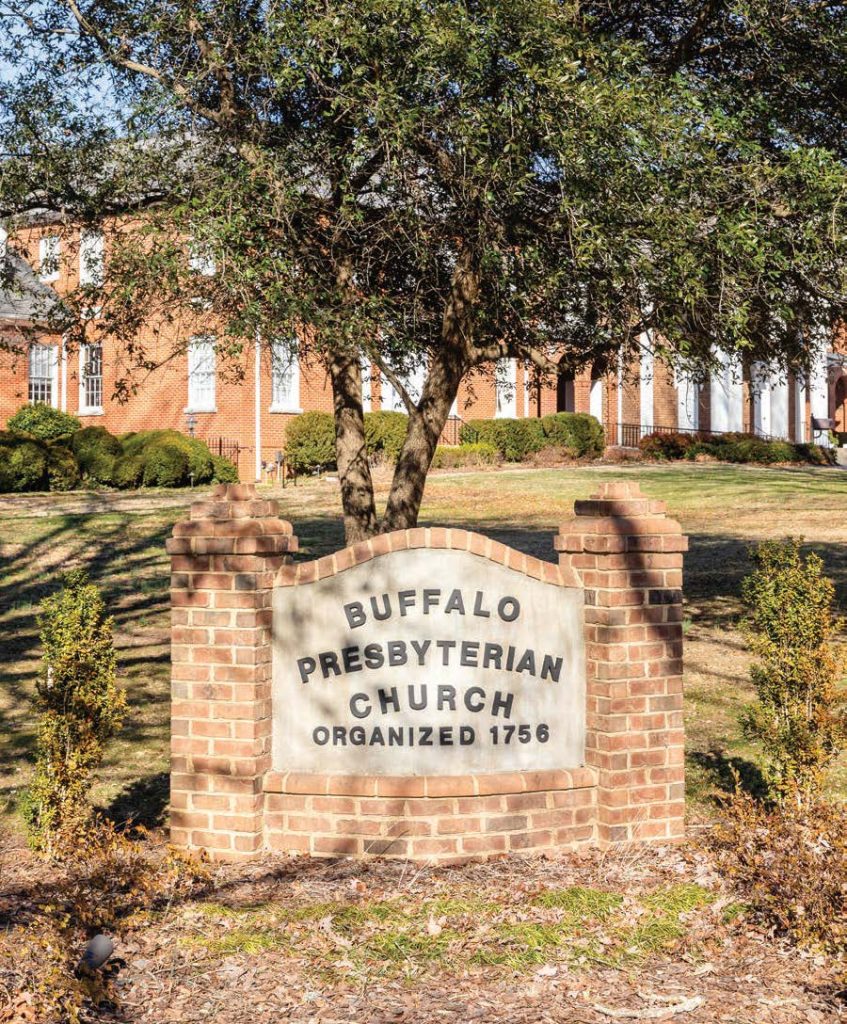
On a mild winter morning, welcome hints of spring in the air, the pews at historic Buffalo Presbyterian Church are nearly full for a Sunday service celebrating Rev. Brian Marsh’s second anniversary. Remarkably, Marsh is only the 17th minister in 269 years to occupy Buffalo’s pulpit since the church was organized by a band of Scots-Irish settlers in 1756. Such longevity speaks volumes about the faith and continuity of a church that predates the establishment of Guilford County by 15 years, the United States of America by 20 years, and Greensboro itself by 52 years.
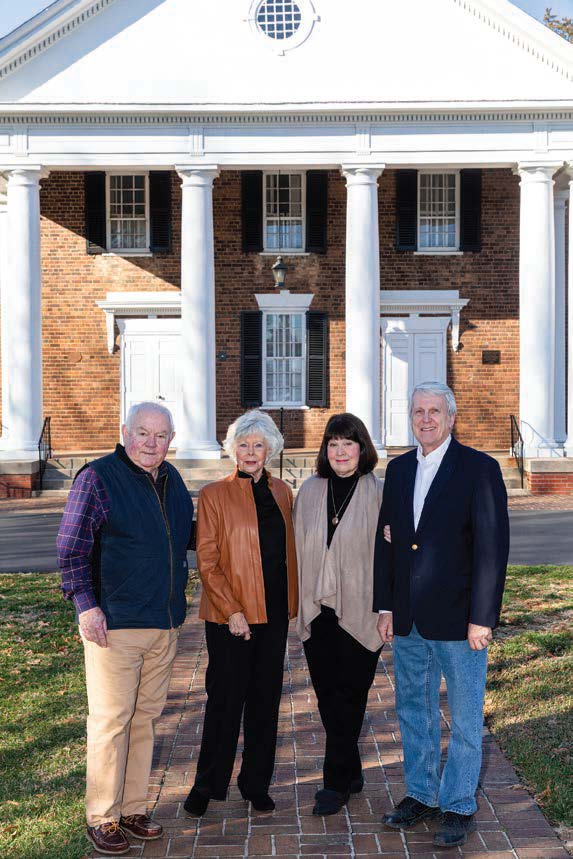
“I sometimes have to fight my emotions when I think about Buffalo’s historical importance to this community, a place where so many families of Greensboro have worshipped for centuries,” says Thomas McKnight, an eighth-generation member whose ancestor wrote the deed for the land on which the church sits. “Through the ups and downs of its history, good times and bad, literally war and peace, Buffalo Church has been a spiritual home where God’s word is preached and all are welcome.”
“I think that’s been the comforting message of Buffalo Church since its earliest days,” agrees Vinnie Gordy, another eighth-generation member who was baptized, grew up and was married in the church. “The settlers who created this church came out of a dangerous wilderness to make this their spiritual home. And that’s exactly what Buffalo Church is to many of us today — a home where we belong, sharing the love of Christ and the word of the Bible.”
Buffalo’s founders were liberty-loving, Scots-Irish immigrants who followed the Great Wagon Road from southern Pennsylvania to new lives in a wilderness area then known as the Nottingham Settlement, formed in 1750. It originally consisted of 33 plots of land purchased from Lord John Carteret, the second Earl of Granville, the last of North Carolina’s Lord Proprietors. The church today sits at the heart of the original settlement, which was framed by Horsepen Creek to the west, South Buffalo Creek to the east, Reedy Fork to the north and Muddy Creek to the south. Lore holds that the church, upon its establishment, took its name from the creek that bisects the modern city of Greensboro.
As I learned while researching my forthcoming book on the Great Wagon Road, America’s Scots-Irish Presbyterians were arguably the most determined travelers of the Wagon Road and the backbone of the country’s westward expansion, hardy souls who built more churches and log cabin schools than any other religious group in the Southern backcountry. They also brought with them a fierce sense of independence and a God-given talent for spreading the Gospels, making music, and educating their young. As Jim Webb writes in his 2004 bestseller Born Fighting: How the Scots-Irish Shaped America, they were also in the vanguard of fighting for liberty from the American Revolution onward.
If you want to know how old a church is, the saying goes, visit its graveyard.
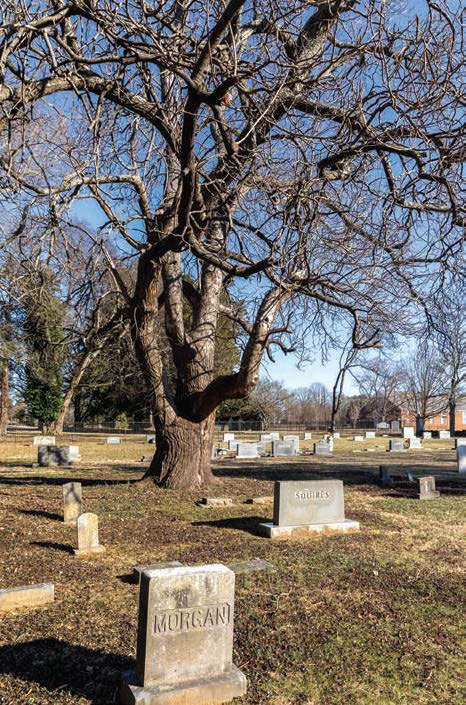
Testament to Buffalo Church’s powerful influence on the history of this region is a peaceful 6-acre cemetery that’s home to one of the largest catalpa trees in North Carolina and an estimated 1,200 graves, including the remains of at least 145 soldiers, many of whom fought in both the Battle of Alamance and the Revolutionary War. Men from the church, in fact, have fought and died in all American wars with exception of one — the Spanish-American War. Many of their gravestones have simply vanished over time.
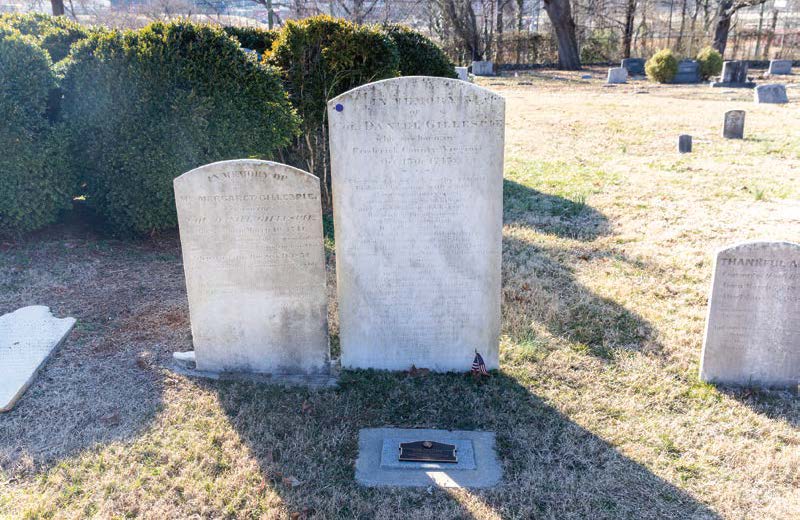
“As a result, there are many more graves out there than we’ve identified,” says Pam Brady, a seventh-generation member who has researched the cemetery for many years. “That’s because many of the original graves were marked with wooden crosses or stones that simply disappeared over the years.” The cemetery’s earliest headstone identifies the grave of Mary Starrett, who was the wife of Benjamin Starrett and was buried in 1775.
Still, a stroll among the hundreds of gravestones that remain intact, however, reads like an honor roll of Greensboro’s pioneer names — Gillespie, Forbes, Donnell, McKnight, Forbis, Dick, Lindsay, McNary, Albright, Mebane and Rankin.
Brady once set out to find the grave of her ancestor, William Rankin, but was only able to locate a faded stone belonging to his wife, Jean. “By the time I did my research on where he might have been buried — presumably near his wife — and got back to the cemetery, even her stone had disappeared,” she says with a laugh, adding that at least 20 current church members have ancestors from the 1700s — not all soldiers — buried in Buffalo’s historic cemetery. “We feel blessed to worship where our ancestors worshiped,” she adds, “because it connects us to the rich history of Guilford County and the creation of Greensboro in a very personal way. I like to think that Buffalo Church is to Guilford County what Bruton Parish Church is to Colonial Williamsburg and the North Church to the city of Boston.”
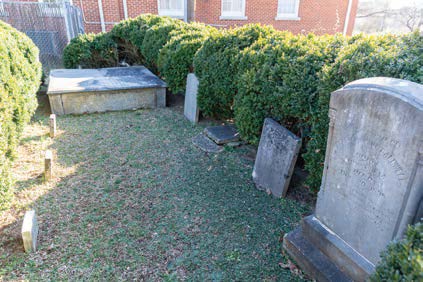
The most celebrated grave site exists directly behind the sanctuary, a family plot framed by century-old boxwoods. It belongs to Rachel and David Caldwell, a Princeton theological graduate who was called to serve as Buffalo’s first pastor in 1765, sharing pulpit duties with Buffalo’s sister congregation just east of what is now Greensboro at Alamance Presbyterian Church for the next 55 years.
Two years after Caldwell arrived, he established what became known as Dr. Caldwell’s Log College, a theological and classical academy for young men. His students included future N.C. governors, members of Congress and at least 50 ministers. He later became a trustee of Liberty Hall, the precursor of the University of North Carolina.
Today, Caldwell’s Log College Site — home to his farm, well-preserved Federal-style house (dating from 1781) and influential school — are part of David Caldwell Historic Park, a National Historic Site that shares space with the Tanger Family Bicentennial Gardens. Come spring, there is probably no more visited public grounds in Greensboro.
In addition to Caldwell’s reputation as a spellbinding pastor, due to a shortage of physicians in the region, he acquired medical books from Philadelphia and became a self-taught doctor, which came in handy during his years as a key patriot leader in the Revolutionary War. According to records, he was present at the Battle of Alamance during the Regulator insurrection of May 16, 1771, and urged his flocks to volunteer during the American Revolution and the War of 1812. His farm also became a prime staging ground for American troops prior to the Battle of Guilford Courthouse, the major turning point of the war.
Rev. Caldwell died in August 1824. His wife, Rachel Craighead Caldwell, daughter of a Presbyterian firebrand patriot leader named Alexander Craighead, followed him to the grave one year later.
Just three years later, in 1827, Buffalo’s congregation replaced a previous pair of wooden sanctuaries — one of which was said to hold as many as 1,000 worshippers — with a striking brick sanctuary that is believed to be the first brick church in this part of North Carolina.
Seventh-generation member Clyde Albright’s great-great grandfather, Jacob Albright, built the sanctuary from bricks made on the property.
Just under a century later, a classical portico was added to the entrance of the sanctuary and a choir loft was constructed. Not long afterwards, an education building named for David Caldwell was built on the west side of the church. A similar structure dedicated to Rachel Caldwell was eventually added to the east side of the sanctuary, completing the evolution of the church campus.
To celebrate Buffalo Church’s bicentennial in 1956, the church underwent a major renovation and sanctuary expansion. Clyde Albright’s grandfather, Lonnie Albright Sr., showed Boren Brick where to dig the clay from the original site (reportedly near Friendly Center) used for the bricks of the expanded sanctuary.
The highlight of the celebration was a dramatic two-night outdoor pageant called Let Freedom Ring, featuring a cast and staging crew of more than 75 members of the church, several professional actors and the choirs of Buffalo and Alamance churches. The play, presented over a trio of outdoor stages, told the story of Buffalo’s extraordinary history, from early days before the church’s founding to the achievement of America’s independence. “It was quite an exciting production,” remembers Vinnie Gordy. “There was great music, and cannons firing and lots of fireworks. I was age 12 and sang in the children’s choir. My older sister, Magie Fishburne, however, had a major role as Hannah Meeks, and my aunt, Helen Andrew, played Rachel Caldwell. There was a large turnout both nights from the community. I don’t believe anyone had ever seen anything quite like it.”
Longtime members also point out that, like many older churches, Buffalo Church has seen its ups and downs over the decades. “By 2015,” says McKnight, “we were a church with a lot of older members, many who were dying out. Before COVID hit, in fact, we were down to about 68 regularly worshipping members — probably the lowest point in the church’s history.”
Ironically, he adds, COVID proved to be the unexpected salvation. When churches everywhere were asked to shut down for the duration, Buffalo’s leadership opted to remain open, employing extreme spacing throughout its handsome sanctuary. “When the word got out that we were holding services as usual, our membership returned, along with a lot of newcomers from other churches. It may be proof that God works in mysterious ways,” McKnight adds with a smile. “But the growth has continued regularly since that time.”
Today, the congregation numbers over 200 and continues to slowly grow, a timely revival for a congregation some affectionately call the “Pioneer Church of Greensboro.”
At a recent Saturday morning men’s prayer breakfast, a record turnout of more than 45 included nine newcomers who’ve recently come Buffalo’s way from other churches.
“I think they are drawn to a church where the fellowship is genuine and the preaching is firmly Bible-focused,” reflects Albright. “When I sit in the choir loft and remember where my parents and grandparents once sat, looking out over a sanctuary that is now almost full every Sunday, I think about the generations of people who were born, got married and passed their lives through this wonderful old church. I think our ancestors would be very pleased to see new faces and a church family that is growing again.”
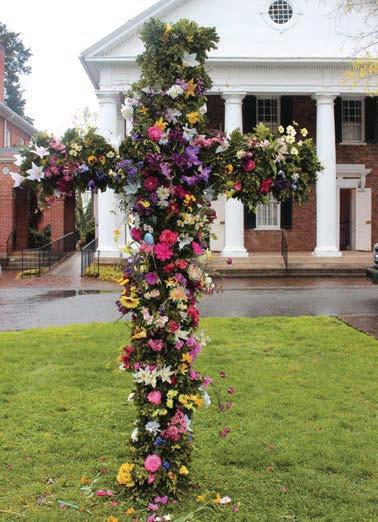
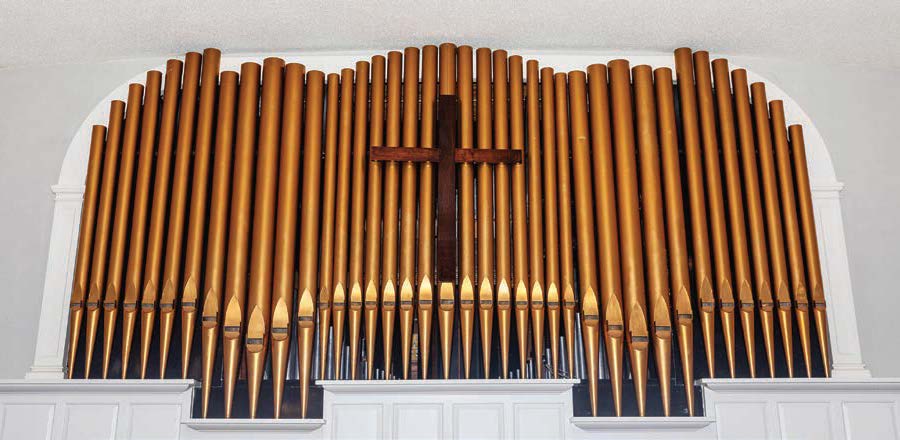
Three decades ago, Albright — a lawyer with a gift for woodworking — took the remains of an 80-year-old white oak that met its demise through a lightning strike during a storm and made a rugged wooden cross. He wrapped it in chicken wire and planted in front of the church portico during Easter week. Last November, the same salvaged wood was used to build a larger cross, which hangs from the organ pipes in the sanctuary.
On Easter Sunday, members adorn the original cross he built with flowers before a sunrise service and congregation breakfast.
“It’s become a very popular tradition at Buffalo Church,” confirms Albright. “As the sun comes up, I think that old cross covered with spring flowers expresses our gratitude for the return of spring and the glory of Jesus Christ’s resurrection.”