Life of Jane

Just Desserts

It takes one to know one

By Jane Borden

In my parents’ home, desserts are both rewards and consolations, applied as prescription and preventative medicine alike. As such, the procurement of them is as important as the distribution. My mother likes to be prepared.

Shortly after Nathan and I were married, we made an impromptu visit to Greensboro from Chapel Hill. Mom not only welcomed us generously but also threw together an elaborate dinner for four in the dining room. Afterward, she announced, “I’m sorry, but I didn’t know you were coming, so we have nothing for dessert.” Naturally, we insisted: Dessert was unnecessary, and we were thankful for the delicious dinner, not to mention full. This was a response to the gesture behind the statement. And once it was made, I considered the statement itself. Suspiciously, I asked, “Wait, you have nothing for dessert?”

When my sisters and I were children, our kitchen pantry was legend. Across different grades and schools, word spread of the snack-food riches therein, making our house the first choice for any playdate location. I’m still not sure who were real friends, and who were mercenaries out for a payday in Little Debbie snack cakes.

They weren’t shy. They knew Mom’s organizational system and poked around freely. It was a bit like looking for coins in a video game. One employs a combination of tactics, returning to previously discovered gold mines while also seeking new sources. That was part of the fun. Our friends knew they could open the freezer door and score a few chocolate M&Ms, but also what’s behind that cereal box in the pantry? Is it one of a dozen cans of chicken consommé (a collection always stocked in case, I presume, the municipal water source became tainted and we had to drink it)? No. Is it a jar of relish that expired five years ago (that’s my dad’s organizational system)? No. Is it . . . yes, Girl Scout cookies! Wait, how old are they? Just kidding, I don’t care.

The shelves were deep. There was a lot to explore. And it required agility, considering the floor was littered with bottles of Diet Rite. I understand this culture of plenty. I inherited the trait. I go overboard, whether in my shopping cart or on my plate. “That looks good. Do I need it? Probably not. But you never know? Anyway, it might taste good. I like things that taste good. OK I’ll take it.”

For example, having a great plenty is what allows one to throw together a dinner for four in a formal dining room on short notice. Appreciation aside, however, I am biologically incapable of missing an opportunity to joke. That is how I came to do the unthinkable: endeavoring to entertain our group by making fun of Mom.

“You have nothing for dessert?” I asked, inviting her into the trap.

“Nothing!” Mom said innocently. “I feel terrible!”

“You’re sure there’s nothing?” I pressed.

“Yes!” she said.

“OK, I’ll just confirm,” I announced, rising from the table and heading first to the second refrigerator in the laundry room. “Bag of M&Ms in the drawer!” I shouted and, moving a bottle of chardonnay, added, “also a bag of jellybeans. And a box of Godivas.”

“Those don’t count,” Mom yelled back. “That’s candy!”

I next turned to the freezer: “Fudge popsicles!”

“They’re Weight Watchers,” she protested, “fake dessert.”

“And what about this homemade chocolate-covered toffee the Hassenfelts gave us for Christmas?”

“Jane,” she said, her voice now grave: “You better be careful.”

Making fun of mother is a risky venture. The situation must be perfect, or plans require, as revenge does, the digging of two graves. But any great endeavor is susceptible to circumstance, and if, when conditions do allow, our heroes fail to act, we’d never have harnessed electricity, or captured a giant squid on film. I realize I’ve just compared my mother to a giant squid, but the sound I sought — of her laughing at me laughing at her — is as rare.

I don’t mean to suggest her hard or stoic. Mom laughs constantly, and labors to elicit the same from others. She’s an entertainer. She says I get my sense of humor from my dad. Maybe. I hope so. He’s one of the funniest people I know. (Last year, when my parents visited Los Angeles, we took an Uber to Hollywood. After embarking, Dad had trouble with his seat belt, so the driver pulled over to wait. When the lock finally clicked, Dad leaned forward to the driver and cheerily announced, “OK, you can get in a wreck now!”) Regardless, I inherited my desire to entertain from her.

She’s a pro. Whether hosting a party in your honor or running into you at the Harris Teeter, Mom makes you feel special. And you can relax meanwhile, because she does all of the work, including the emotional labor. I’m not at her level. But I hope to be eventually. I’m still practicing. Anyway, it’s not my job to entertain when I’m with her. It’s hers. That duty is part of her general position as matriarch. Mom controls everything — including the comedy. If children are serfs, then my aim in mocking her was nothing short of an uprising.

But I had her cornered. I knew I was right and, more important, I knew this was funny. I pressed on to the kitchen pantry, where I found candied pecans, chocolate-covered almonds, gummy bears, and four kinds of Weight Watchers treats (caramels, minifudge bars, shortbread cookies, yogurt pretzels). I shouted out each as I found them.

“Jaaaane. . . .” she replied, threatening the outcome of my continued pursuit. This was getting worse before it got better. But if I stopped now, I’d have already lost. I had to double down.

“OK, I’m opening the kitchen freezer,” I yelled. And then she sighed loudly: resignation, a positive sign.

“Jackpot! Two kinds of ice cream, a frozen loaf of banana bread, a Skor bar, and more popsicles — not Weight Watchers.” I returned to the dining room: “17, Mom. That’s a total of 17 desserts in the house.”

She stared at me for two or three very long seconds, and then raised her eyebrows, shrugged and chuckled. It was a little thing, and also the best thing.

“OK,” she said, somewhat sarcastically. “Very funny.”  OH

Jane Borden grew up in Greensboro and now lives in Los Angeles, where she currently has nine desserts in the house and gets paid to be funny.

Life’s Funny

Ankle-High

Weeding out a CBD treatment

By Maria Johnson

I was at wit’s end.

To shush my mewling left ankle, which I’d aggravated while playing tennis, I’d tried all sorts of remedies: anti-inflammatory pills, gels, and a cortisone injection, which worked — until it didn’t.

A doctor sent me to a physical therapist, who showed me how to build up my foot and ankle muscles. My peroneus brevis never looked so good. She ended our sessions by dressing my ankle with a battery-powered patch that pushed some anti-ouchy medicine into the gristle end of my boney-ass-chicken-drumstick leg — my words, not hers.

The relief lasted for a couple of hours at a time, probably because I was so caught up in the cool factor of wearing a battery-powered bandage. It reminded me of the light-up tennis shoes that both of my sons wanted so much, at age 3, that they endured the rigors of giving mom and dad what they wanted — potty-trained sons — in exchange for the fly kicks.

Who knows? Maybe if the patch had packed a stronger battery and a flashing dump truck, I’d have been cured. Alas, the wee batteries died, and I went back to being my gimpy, unelectrified self.

I tried simpler fixes, too, soaking up enough fragrant Epsom salt to pass as a lavender-scented country ham. And, of course, I’d worn out the RICE regimen, which orthopedic folks use as shorthand for Rest, Ice, Compression and Elevation, but which the rest of us know as Relax In a Chair and Eat the ice cream you got out of the freezer when you fetched the gel pack.

I was desperate for relief. So when post-yoga chitchat turned to a new hemp store nearby, and someone volunteered that she’d rubbed hemp oil into her hip to soothe an aching flexor, I was on it.

Skeptical, but on it.

I hobbled on over to the ol’ hempatorium. Graphics on the windows suggested that CBD — or cannabidiol, a non-la-la-inducing compound in hemp — could be used to treat a wide array of health problems:

Anxiety, chronic pain, insomnia, autism, scurvy, rickets, dropsy, hysteria, ringworm, imbalance of the humours. I exaggerate, but not much.

The kid who was minding the store was extremely friendly, in a floaty, underwater sort of way.

“How . . . can . . . I . . . help  . . . you?” he asked languidly.

“I was wondering if you have any kind of ointment that might help a strained tendon in my ankle,” I replied.

“Everyone  . . . your  . . . age . . . wants . . . topicals . . . instead . . . of . . . smokables  . . . and  . . . chewables,” he observed in approximately the time it would take me to watch a whole season of The Marvelous Mrs. Maisel.

I was tempted to say, “Been there, done that. Why, I recollect a concert by them Who fellers back in nineteen and eighty-two,” but I preferred to focus on my ankle while I was still ambulatory.

He led me over to a wall of shelves and picked up a small white jar with a smudged label that looked to have come from a home printer. “Full Spectrum Hemp Oil Pain Salve, 500mg/1oz,” it read. Everything was spelled correctly, which I took as a positive sign, medically speaking.

“My . . . aunt . . . has . . . bad . . . arthritis . . . in . . . her . . . back . . . and…”

“Good for her,” I said. “I’ll take it.”

I panned the rest of the seascape: tinctures of oil; packs of multicolored gummies; bottles of lotions; tubes of salve promising to relieve, relax or restore one thing or another; a few textile products woven from hemp fiber; and some prerolled joints.

A tray of loose-leaf hemp lay next to the register.

“Is it, uh, legal to sell it that way?” I asked.

“Yeah . . . as  . . . long . . . as . . . it . . . contains . . . less . . . than . . . point . . . three . . . percent . . .THC,” he said, using the initials of Tetrahydrocannabinol, the chemical in weed that makes you high.

I looked it up later. Hemp, a low-grade strain of marijuana, contains less than 0.3 percent THC, which is currently the legal limit in North Carolina. In states that allow the sale of recreational or medicinal pot, the THC content can be more than 20 percent.

Back in the day of  “them Who fellers,” it was 3 to 4 percent.

I’ll leave it to politicians, pundits and public health folks to hash out whether society’s widespread embrace of cannabis makes sense.

But I can tell you that after a few days of rubbing the hemp oil balm on my ankle, the pain faded away.

In fairness to cause-and-effect, maybe it was because I’d laid off the high-impact exercise. Or because I’d flexed my foot and ankle muscles into a state of Marvel Comics buffness. Maybe in the year since the original injury, the frazzled tendon had finally mended on its own.

Or maybe it was because of the healing properties of CBD.

There’s a seed of truth in there somewhere.  OH

Maria Johnson is a contributing editor of O.Henry magazine. She can he reached at ohenrymaria@gmail.com.

Doodad

From Custom to Consignment

Tailor’s Rack is a perfect fit

Armed with a degree in computer science and music technology from Elizabeth City State University, Dana Williams, 28, was on the fast track with a job at Procter & Gamble. Ascending into management, he was overseeing the production of three brands of deodorant. The money was good but the stress was unbearable, and one day he had a potentially fatal seizure.

“I woke up in Moses Cone Hospital,” he recalls, “and the doctor said if I had gotten there two minutes later I wouldn’t have made it.” Stress, the doctor told him, would kill him.

So, Williams went to work for Goodwill Industries and then off-price retailer Ross Dress for Less, rising into management at both stores. “At Goodwill I learned the thrift-store process,” he says. “Ross was buying closeout items, and that taught me about buying and pricing in retail. That gave me my foundation.”

All this time, Williams was developing a passion for sewing he’d had since childhood, engendered by watching his grandmother make and mend clothes on her pedal-powered Singer. By college he was designing and altering clothes for classmates.

“I had my sewing machine right there beside my desk in my dorm room,” he says, adding, “Before long, people were asking me to customize clothes for them and dress them up.”

After renting booths at flea markets, and selling his wares both there and online through Etsy, he was ready to take the entrepreneurial plunge and opened a consignment shop in Rockingham, N.C., near his wife, Felicia’s hometown of Hamlet, expanding into a successful consignment-thrift-vintage outlet.

Moving to the corner of Davie and Friendly, Williams opened Tailor’s Rack on September 28, 2018 (Felicia’s birthday).

With the Tanger Center and the new hotel opening, Williams feels confident about his location and his blend of men’s, women’s clothing and household goods, all very reasonably priced.

Still, the 48-year-old father of two boys (Landon, 10 in March, and Laydon, 8) foresees his own clothing line in his future. He already has a label, Danaanad, has flown to China to develop relationships with manufacturers, and has the hands-on experience to make it work.

“I really want to get back to custom designing,” he mused. “That’s where my heart is.”

Plus, one would imagine, it’s a lot less stress on the heart.  OH

— Ogi Overman

Scuppernong Bookshelf

Let’s Do It!

If birds, bees and educated fleas do it, you can, too — with a little help from book releases in time for Valentine’s Day

Compiled by Brian Lampkin

Yes, love and romance.
Of course, chocolates and flowers. But what is it we really want from Valentine’s Day? January and February bring us a proverbial backroom full of new books on sex and sexuality that will help you separate the players from the performers. With these guides and how-tos, you’ll soon sort out what you actually desire from what you’re supposed to desire. What is it we really want from Valentine’s Day? Books on sex!

January 7: Topics of Conversation, by Miranda Popkey (Knopf, $24). Miranda Popkey’s first novel is about desire, disgust, motherhood, loneliness, art, pain, feminism, anger, envy, guilt — written in language that sizzles with intelligence and eroticism. The novel is composed almost exclusively of conversations between women — the stories they tell each other, and the stories they tell themselves, about shame and love, infidelity and self-sabotage.

February 4: The Queen V: Everything You Need to Know about Sex, Intimacy, and Down There Health Care, by Dr. Jackie Walters (Andy Cohen Books, $27). After twenty years of private obstetrics and gynecological practice, there’s nothing Dr. Jackie Walters hasn’t encountered. And now, in her new book, the widely adored OBGYN invites you to put your feet in the stirrups and investigate. Whether she’s covering libido, contraceptives, labiaplastyor fertility, Dr. Jackie educates readers with her characteristic grace and pragmatism. Both funny and informative, she brings you on a quest through the female reproductive system — answering all the burning (and itching and odiferous . . .) questions you’ve always been afraid to ask.

February 4: Seduction: A History from the Enlightenment to the Present, by Clement Knox (Pegasus, $28.95). Moving from the Garden of Eden to the carnivals of 18th-century Venice, and from the bawdy world of Georgian London to the saloons and speakeasies of the Jazz Age, this is an exploration of timeless themes of power, desire, and free will. Along the way we meet Mary Wollstonecraft, her daughter Mary Shelley, and her friend Caroline Norton, and reckon with their fight for women’s rights and freedoms. We encounter Jack Johnson, the first black heavyweight champion of the world, who became entangled in America’s labyrinthine and racialized seduction laws. We consider how after seduction seemingly vanished from view during the Sexual Revolution, it has exploded back into our lives.

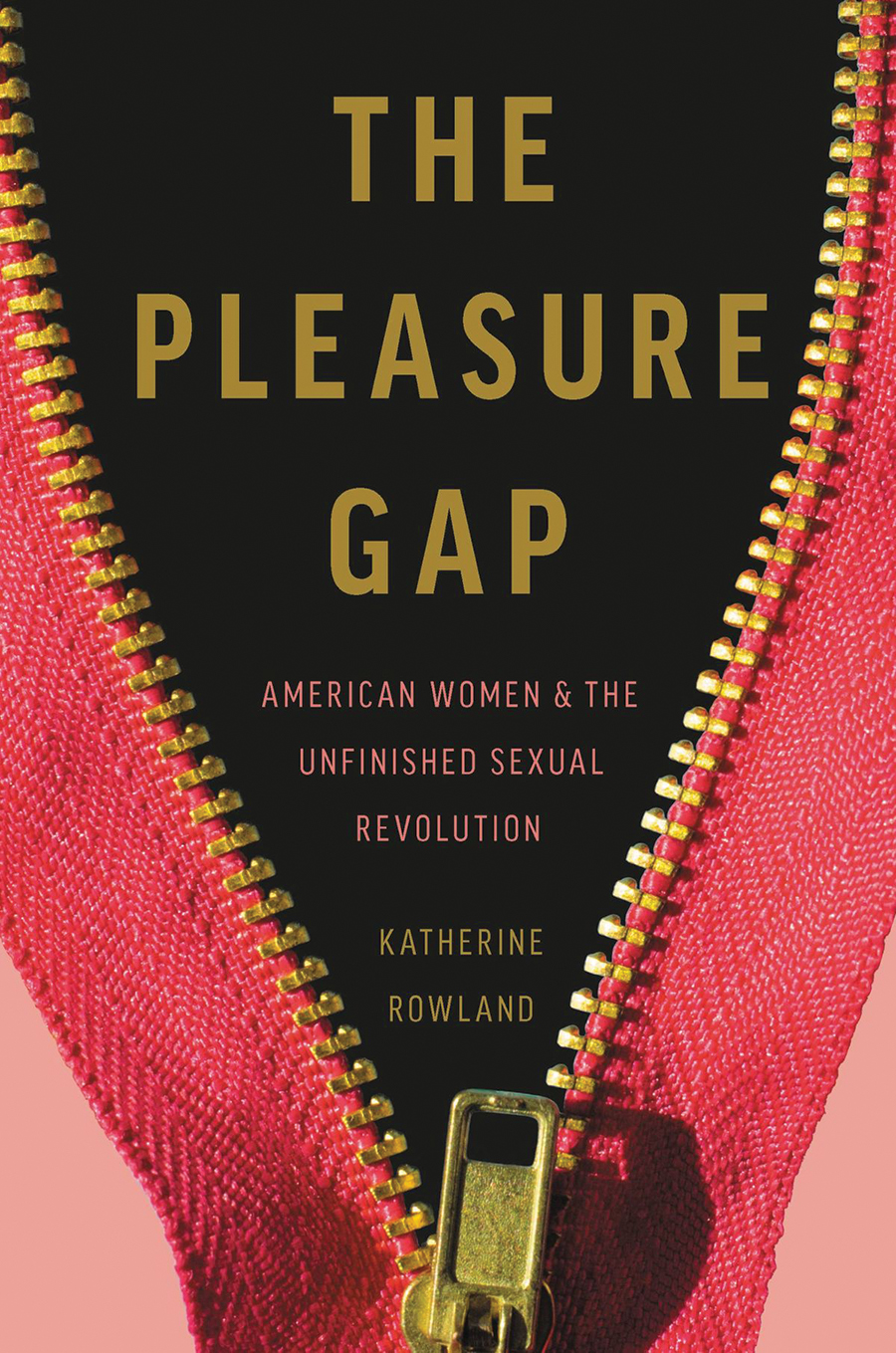
February 4: The Pleasure Gap: American Women and the Unfinished Sexual Revolution, by Katherine Rowland (Seal Press, $28). American culture is more sexually liberal than ever. But compared to men, women’s sexual pleasure has not grown: Millions of American women experience the sexual malaise clinically known as low sexual desire. Between this low desire, muted pleasure and experiencing sex in terms of labor rather than of lust, women by the millions are dissatisfied with their erotic lives. For too long, this deficit has been explained in terms of women’s biology, stress and age, but in The Pleasure Gap, Katherine Rowland rejects the idea that women should settle for diminished pleasure. Instead, she argues women should take inequality in the bedroom as seriously as we take it in the workplace and understand its causes and effects.

February 11: Sex Positive: Redefining Our Attitudes to Love & Sex, by Kelly Neff (Watkins Publishing, $18.95). In this ground-breaking study of modern sexuality, Dr. Kelly Neff explores this new cultural movement and examines LGBTQI issues, #MeToo, female orgasm, the rise of nonmonogamous relationships and robotic sex partners, among many other contentious topics emerging as part of the ongoing social and political shifts surrounding sex, love and identity.

February 11: Summer of ’69, by Elin Hilderbrand (Back Bay, $16.99). Sorry. Apparently this book isn’t about what I first thought. But that does remind me that Scuppernong Books will host its 2nd Annual Non-Erotic Reading on February 13 at 7p.m. We’re guided by The Guardian’s annual Bad Sex Awards in Fiction. Here’s a sample from a “winner,” Elizabeth Gilbert’s City of Girls:

“Then I screamed as though I were being run over by a train, and that long arm of his was reaching up again to palm my mouth, and I bit into his hand the way a wounded soldier bites on a bullet.
And then it was the most, and I more or less died.”

Please join us to celebrate the bad so we can recognize the good!  OH

Brian Lampkin is one of the proprietors of Scuppernong Books.

Drinking with Writers

Songs of Home

The Steep Canyon Rangers celebrate the music of the Old North State


By Wiley Cash     Photographs by Mallory Cash

What do you do after spending several weeks playing sold-out shows across Australia, some of them with Steve Martin and Martin Short? If you are the Steep Canyon Rangers, you come back to North Carolina and play a lunchtime show inside a strip-mall record store in Raleigh. If you are the Steep Canyon Rangers you even carry your own equipment through the front door and snake your way through the crowd on the way to the stage.

There were no crowds when I arrived nearly an hour or so before the noon show on a chilly Wednesday in early December. The Steep Canyon Rangers had just released their latest album, North Carolina Songbook, which they had recorded live at MerleFest in April. The album is a celebration of North Carolina music, featuring the band’s renditions of the work of some of North Carolina’s most foundational voices, including Thelonious Monk, Doc Watson, Elizabeth Cotton and James Taylor. The album was released on the Friday after Thanksgiving, a day that many music lovers have come to revere as National Record Store Day Black Friday. In support of the album, the Rangers had decided to play record stores, starting with School Kids Records in Raleigh.

If you want to feel uncool, I invite you to visit an independent record store that sits a stone’s throw from a university campus.

“VIPs only down front,” says the record store manager from behind the bar. I call it a bar because while it is a counter where you can pay for records and merchandise, it is also a bar in that beer is served from behind it.

“I’m friends with the band,” I say. He knits his brows as if he has heard this hundreds of times over the years from lame dads like me. But it is the truth. I went to college with mandolin player Mike Guggino, and I have written about the band and gotten to know them over the years.

I decide to try another tack. “I’m with the media,” I say, which is also true. After all, you are right now reading the media story I wrote, but this was not enough for the manager.

“You have to purchase an album to be a VIP,” he says.

“That’s it?” I ask. “I was going to do that anyway.”

“Great,” he says, not smiling. “You can be a VIP.”

As the clock crawls closer to noon, the store begins to fill to capacity with a mixed crowd that ranges from college students to retirees. Someone has ordered pizza. Beers are being passed from the bar back through the crowd.

“Do a lot of bands play here?” a middle-aged woman asks the manager.

“A couple times a month,” he says. He looks around. “But nothing like this.”

I hear someone say my name, and I turn to find Graham Sharp, one of the band’s vocalists, carrying his guitar case and pushing through the crowd. I say hello to him and pray that the record store manager has seen us greet one another by name.

The rest of the band streams in behind Sharp, each of them carrying an assortment of instruments. The band takes the small stage, nearly filling it. The room is warm and pleasant; everyone clearly happy to be out of the office or skipping class in favor of live music from one of North Carolina’s most famous bands.

“Hey, y’all,” Sharp says to the audience. “These are songs we recorded at MerleFest.” The crowd cheers at the mention of the iconic festival. “But we haven’t played them since April.”

“We relearned them on the way here,” says lead vocalist Woody Platt to the audience’s laughter. And then the band is off into a rollicking version of Charlie Poole’s “Don’t Let Your Deal Go Down,” Platt’s rich baritone playing a wonderful historical opposite to Poole’s higher pitch.

The event soon takes on the feel of a college keg party, a feel that is intimately familiar to the Steep Canyon Rangers. The band was co-founded by Sharp and Platt at UNC-Chapel Hill in the late ’90s, when both were undergraduates. They released their first album in 2001, and they have released 13 albums since then, a few in collaboration with Steve Martin.

“This new album is a homecoming for us,” Platt later tells the audience. “We released our first record with Yep Roc Records, and that’s who’s just released North Carolina Songbook.”

And what a homecoming. The album is not only a celebration of famous North Carolina musicians and their music; it is also a testament to the Steep Canyon Rangers’ ability to blend and bend genres and styles while making a cover song seem like their own.

The band moves through gorgeous covers of Thelonious Monk’s “Blue Monk,” Tommy Jerrell’s “Drunkard’s Hiccups,” Ola Belle Reed’s “I’ve Endured,” Elizabeth Cotton’s “Shake Sugaree,” closing out the set with the state’s beloved James Taylor’s “Sweet Baby James,” sung by bassist Barrett Smith, a longtime friend of the band who is the newest addition.

At the close of the show, Platt sets down his guitar and tells the audience that the band will hang around for a little “shake and howdy,” but they have to get over to Chapel Hill for a mic check. They are singing the national anthem at the Dean Dome before tonight’s Tar Heels game against Ohio State. A homecoming indeed, but while so much has changed for the Steep Canyon Rangers, shows like the one at the record store prove that so little about them has.  OH

Wiley Cash lives in Wilmington with his wife and their two daughters. His latest novel, The Last Ballad, is available wherever books are sold.

The Accidental Astrologer

Feeling Your Goats

Everyone will experience the Capricorn Effect in 2020


By Astrid Stellanova

Eat your peas and collards, Star Children. Tradition will matter.

Soften your hearts and strengthen your minds.

On January 3, Mercury joins the Sun, Jupiter, Saturn and Pluto in Capricorn, meaning none of the signs can escape the Capricorn Effect in 2020.

Here’s what the sky says: The new year brings a new vision, and, er, caps off the past two years of tumult, transition, mergers and misfires, with calculation and transformations that will change our realities. As any astrologer will tell you: The Goat always triumphs.


Capricorn (December 22–January 19)

You have to think about your professional image, Sugar, or feel like you do. You’ve worried yourself half sick over how you stack up, because you pit yourself against an old nemesis with big juju. Basically everyone from Here Comes Honey Boo Boo could outclass this old blow-hard rival. Stop worrying.

Aquarius (January 20–February 18)

Confidential matters and family secrets have kept you knotted up. Listen, if karma won’t slap you, ole Astrid has to, because it’s time you noticed you don’t have to be the standard-bearer for integrity and discretion.

Pisces (February 19–March 20)

There are changes to your inner circle, and close networks that have been shifting. The old dynamic is completely changed, in case you didn’t notice. Want to be the ringmaster of the s*@t show? Don’t think so, Honey Bun.

Aries (March 21-April 19)

I’m thinking you seized the wrong freakin’ day, Ram. As your mission and position have changed, did you notice exactly what condition your condition was in? Right — you were too busy seizing. Let it go. Not yours to wrestle with.

Taurus (April 20–May 20)

You, Brothers and Sistahs, are sweet but twisted. Some of that blunt force you used will get you over the fence to new places this year, but also forces you to take a kinder view of the differences. That makes the new places mean something.

Gemini (May 21–June 20)

One side of you strongly wants to do the right thing. The other side of you wrestles with giving others their fair share, due credit and fair play. You insist it ain’t your pasture, not your bull crap, but, sometimes, Sugar, it is.

Cancer (June 21–July 22)

Focus on close relationships, Sweet Pea, like your partners at work and at home. It is worth remembering that they are the ham in your ham sandwich. The jam in your PB&J. The clapper in your Liberty Bell.

Leo (July 23-August 22)

You aren’t a fan of fitness or workouts, but your life and lifestyle demand a reboot. It will also need to be interior — think volunteering or offering your services. Don’t rush when you’re waiting for the last dang minute.

Virgo (August 23-September 22)

The next generation, Sugar, is writ large in your sign. Think babies, teens, pregnancies and young adults populating your life. Things are coming full circle. What does this signify? Why don’t you overthink it?

Libra (September 23–October 22)

Home, family and land are all at the center of your world. Given how outdone you feel by those near and dear, realize everybody knows your give-a-damn is busted all to pieces. But giving again, and communicating will be your redemption.

Scorpio (October 23–November 21)

You’re thinking, excuse me, Dante, but what circle of hell is this? Yet the things you excel at (even if you wish they would go away) include publishing, communicating and educating, and they keep offering opportunity. Take the stage, Sugar, and ascend.

Sagittarius (November 22–December 21)

Just show you the money. Everything you do concerning property, charity, and finance will work for you and benefit others. Keep your head up, Darlin’, or that crown will slide right off.  OH

For years, Astrid Stellanova owned and operated Curl Up and Dye Beauty Salon in the boondocks of North Carolina until arthritic fingers and her popular astrological readings provoked a new career path.

Scuppernong Bookshelf

A Backward Glance

A look back at 2019’s favorite books from our favorite bookseller


Compiled by Brian Lampkin

Let’s take a column and look back at 2019 before we return to our regularly scheduled 2020. Here at Scuppernong Books we reject the idea of “Best Of” lists because we don’t believe that our authority extends to such absolute determination of quality. Instead we prefer the inarguable conviction that accompanies a list of our “Favorite Books of 2019.” Each staff member at Scuppernong has offered the two books they most loved — with a few reasons why — without any concern for hierarchy of quality. It’s a good way to go through life: Love more; judge less. Here’s a sampling of our choices:


The Furious Hours, by Casey Cep (Knopf, $26.95). A fascinating investigation of a corrupt, murderous, small-town Alabama pastor who terrorizes an entire county. Eventually, this nonfiction account connects to the unwritten last book of Harper Lee, whose own fascination with small-town murderous Alabama is well understood. It’s a remarkable piece of literary journalism, and Cep will be featured at the May 2020 Greensboro Bound Literary Festival. (Brian)

The Unlikely Adventures of the Shergill Sisters
, by Balli Kaur Jaswal (William Morrow, $26.99). Once again, Balli Kaur Jaswal proves herself to be a captivating and extraordinary writer. Full of authentic characters with rich histories, individual voices, relatable struggles and controversial dilemmas, this book manages to be a family portrait, a mystery, a drama, a cultural exploration and a comedy all at once. With the passing of pages, I alternately shed tears and laughed aloud, which, let me tell you, is no small thing. (Chella)

The Source of Self-Regard
, by Toni Morrison (Knopf, $28.95). Morrison’s death in 2019 left a crater in the literary world that is unlikely to be filled any time soon.  This collection of essays, speeches and meditations is her final published book. The Source of Self-Regard is brimming with all the elegance of mind and style, the literary prowess and moral compass that are Toni Morrison’s unique purview. (Ashley) 

Who Killed My Father, by Edouard Louis (New Directions, $15.95). “That’s the trouble with stolen things, like you with your youth: We can never quite believe they are really ours, so we have to keep stealing them forever. The theft never ends. You wanted to recapture your youth, to reclaim it, to re-steal it.” Skillfully and incisively balancing love, terror, and rage, this taut memoir examines Louis’ own relationship with his father, and the social and cultural conditions in France that formed his father and laid the groundwork for his death. A rare memoir of righteous anger laced with inexplicable affection. (Steve)

The Ash Family, by Molly Dektar (Simon & Schuster, $26). “You can stay for three days, or the rest of your life.” Thus is the ominous timeline given to Berie — renamed Harmony — when she runs away to live off the grid in the North Carolina mountains. At first, life with the Ash Family seems idyllic, but soon Harmony finds that the disturbing feelings she’s tried to ignore were rooted in sinister happenings on the farm. A literary thriller, this novel also has gorgeous nature writing that casts an eerie melancholy throughout. (Shannon)

Maybe You Should Talk to Someone, by Lori Gottlieb (Houghton Mifflin Harcourt, $28). This is an honest look at the practice of psychotherapy as told by a therapist and the therapist’s therapist. “Therapy elicits odd reactions because, in a way, it’s like pornography. Both involve a kind of nudity. Both have the potential to thrill. And both have millions of users, most of whom keep their use private.” A must-read for anyone interested in psychology. (Timmy)

Normal People, by Sally Rooney (Crown, $29.95). This is worth all the hype! Rooney distills what it feels like on that curious edge of teenage/adult life while stumbling through a first love headfirst. Honestly, she may be a mind reader. She is that good at capturing the lives of two friends (and lovers) from very different backgrounds at Trinity College in Dublin. Sally Rooney, I love you. (Mackenzie).

Other choices: Dreyer’s English, by Benjamin Dreyer (Chella); Red at the Bone, by Jacqueline Woodson (Brian), Women Talking, by Miriam Toews (Steve); The Dutch House, by Ann Patchett (Shannon); A Devil Comes to Town, by Paolo Maurensig (Ashley); Monster, She Wrote, by Lisa Kröger and Melanie Anderson (Jenny); Trick Mirror, by Jia Tolentino (Mackenzie); Machines Like Me, by Ian McEwan (Timmy).  OH

Brian Lampkin is one of the proprietors of Scuppernong Books.

Come Join the Dance

Celebrating 36 years of life, the Greensboro Scottish Dance Society keeps ancient traditions alive — while flying into the future

By Jim Dodson     Photographs by Bert VanderVeen

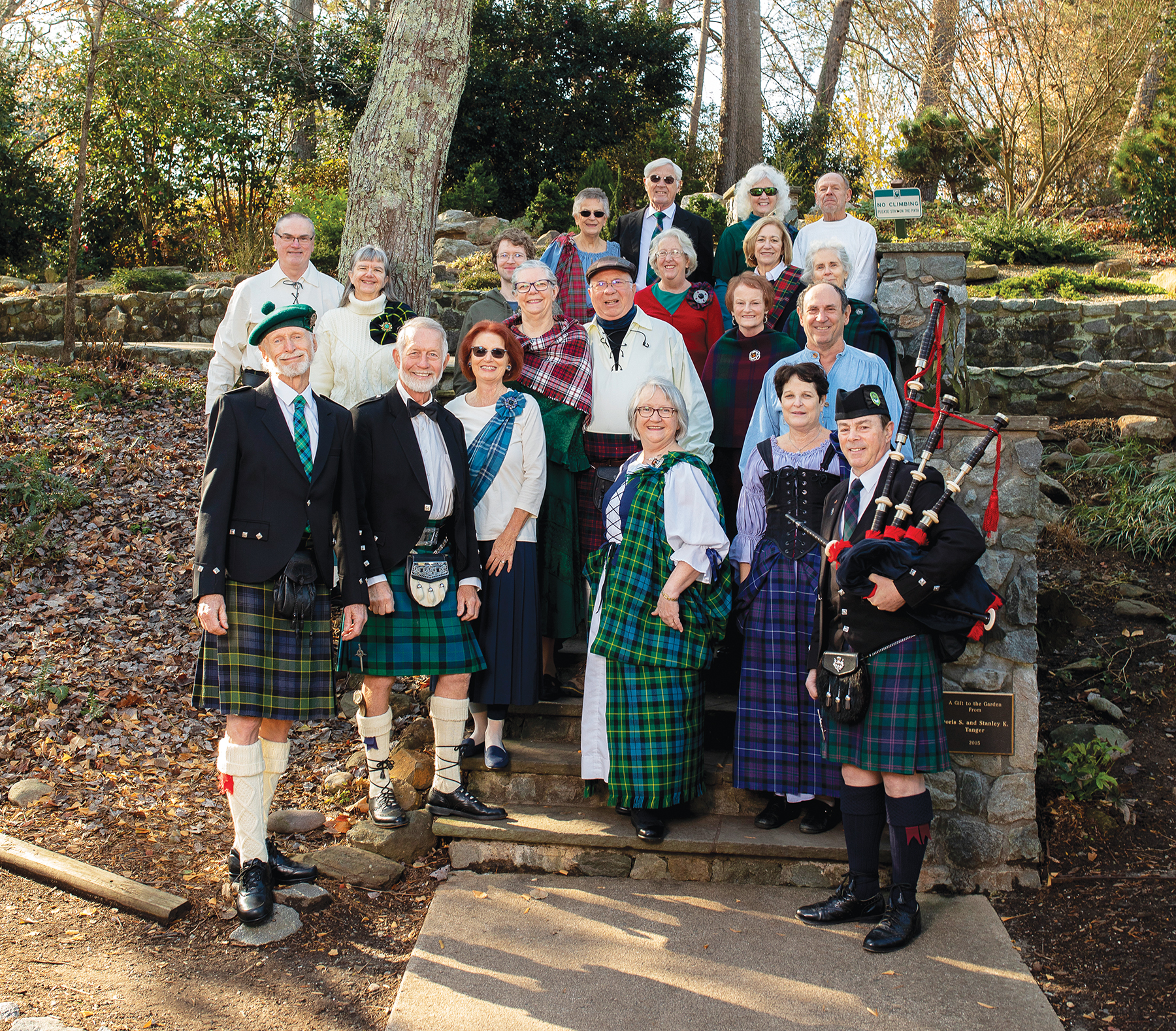
First row: Pete Campbell, Jerry Cecil, Andrea Lee, Mary McConnell, Melody Glick, David Thomas Second row: Craig Davis, Sherri Davis, Kate Seel, Roger Seel, Patty Lindsay Kinkade, David Glick Third row: Sam Dawson, Catherine Holt, Judy Roy, Sarah Vincent Fourth row: Margaret Young, Fran Young, Esther Leise, Merritt Wayt

Fittingly, (as if from the very pages of Robert Louis Stevenson) it was a dark and stormy night.

As wind shrieked and rain swirled outside the warm confines of First Presbyterian’s cozy fellowship hall, the 50 or so members and guests of the Greensboro Scottish Country Dance Society, replete in their finest tweeds and proud clan tartans, performed a country a dance called “The Last of the Lairds” to a lively jig titled “The Stool of Repentance,” the fourth set on the program of their annual Emerald City Ball St Andrews Day Dance.

“It’s a fine night for a Scottish dance,” said Jerry Cecil, coming off the floor with his wife Andrea, a bit winded from a turn that requires both physical and mental fitness. “Then again, any night is perfect for Scottish dancing. Even a cold, rainy night like this won’t stop this crowd.”

Cecil, a retired IRS worker and avid golfer from Forest Oaks, knows what he’s talking about — having been a member of the Greensboro chapter of the Royal Scottish Country Dance Society since 1987, a handful of years after the group was formed by Mary McConnell and later joined by her Renaissance husband, Pete Campbell.

This year’s Ball in late November celebrated the organization’s 36th anniversary. The large turnout in the midst of a November Nor’easter spoke volumes about the passion of these hardy Caledonian dancers.

As Campbell’s nimble piano and Mara Shea’s infectious fiddle filled the room for the next dance set  — a “Reel for Cosmo John” —  Cecil paused to explain that Scottish country dancing — a communal form of folk dancing from the 18th century, when it was done in the barn as well as the ballroom  — that got into his bloodstream near the end of his college days in California. But here in the Gate City, his passion found its truest expression among others who share his reverence for the past and a love of country dancing.

“Because each dance is different, with specific steps and patterns of its own, the switching of partners and such, Scottish dancing can seem a bit intimidating. I know I felt that way at first,” Cecil acknowledges, explaining that’s why most folks who do it attend classes to learn the steps and figures to the many different dances. The good news, he goes on to say, is, once you get a few basics down and practice a bit, everything tends to flow. “Scottish dancers aren’t at all judgmental. Everyone is welcome, especially beginners. You’ll never see Scottish dancers looking at their feet, he reflects. “What you’ll see instead is people smiling and laughing as they twirl around the hall. At heart, it’s really about music, fun and friendship.”

His wife of four years, Andrea, nods in agreement. “I’m afraid that I’m still getting the hang of it,” she allows with just such a grin. “But it really is fun.”

Cecil’s description pretty well describes any of the four dozen or so dancers on the fellowship hall floor at any moment, a diverse gathering of local members and visitors from similar clubs, some of whom traveled from as distant as Atlanta and Staunton, Virginia, simply to be on hand. Even the evening’s gifted fiddle-player, Mara Shea, was herself just off a flight from Aberdeen, Scotland, where she made a quick flight to attend her college graduation from Elphistone Institute at the University.

For her part, Mary McConnell got interested in this form of community dance after she learned about it during a Thanksgiving dinner at her sister’s house in Richmond, Virginia, in 1979. Back home in Carrboro, she spotted  a notice that a Scottish Dance class had just started in town and went to investigate.

“I was coming down a hallway and heard this magical Scottish music coming from the dance,” she recalls. “I knew this music from my childhood. I knew I’d found home.”

A short time later, Mary attended the first Thistle School in Banner Elk the week before the annual Grandfather Mountain Highland Games. It was there, in 1982, that she met Pete Campbell, a researcher in environmental sciences at UNC- Chapel Hill who’d been a country dancing aficionado since his days at Swarthmore College, in Pennsylvania.

“Because I used to stay up half the night in the labs, you see, when everyone else was gone, I always listened to Scottish dance music to keep me awake. I was destined to get hooked!” he allows from his piano bench during a break between dance sets. A musical polymath who founded and played in numerous folks bands, Pete helped found  the international folk dance group at UNC, now celebrating its 55th anniversary,  and did a bit of everything from English contra dance to old-fashioned American square dances until he activated his ancestral genes and gave his heart to Scottish country dance.

At the Thistle School’s Teacher’s candidate class in 1982, Mary met Greensboro resident Karen Becker, who convinced her to start a similar class in the Gate City. The class began at Lewis Recreation Center in September of that year. Mary later went to St Andrews, Scotland, for her Teacher’s Certificate, relocating to Greensboro in 1983 to build the echocardiography laboratory at Moses Cone Hospital. Becker was a weaver at Old Salem with a strong background in early American domestic skills and international folk dancing.

“We started with a small group of about eight or nine dancers,” Becker remembers. “In Scottish dancing,  we dance with a  partner but it is the whole group, or set, that dances as a team.” Adds Mary: “Everyone dances with everyone else and has their part in the dance. There is no need to come with a partner. It’s a very egalitarian dance form.”  Scottish dance steps, she explains, are somewhat challenging and energetic. The figures are complex, and unlike contra or traditional American square dancing, there is no one calling out the moves. The steps, holds and patterns must be learned, something that requires both physical exertion and mental focus. “These factors set Scottish dance apart, and those of us who love it are forever young,” she adds with a laugh.

“It’s really not as hard as it seems to someone watching it for the first time,” echoes Becker, today a semiretired costume and living history coordinator at the Frontier Culture Museum in Staunton, Virginia. “When it’s done well, with the springs and setting steps done in quick time, Scottish country dancing is like watching people take flight, barely tethered to the floor. The energy is quite striking and irresistible.”

Another misconception, says member Patty Lindsay Kinkade, a former American history teacher at Southeast Guilford High School who joined the dance group in 1985, is that participants are obliged to have Scottish heritage and a family tartan. “I happen to wear a Lindsay tartan but other members wear whatever tartan appeals to them,” she says. “Some have Scottish heritage. But many others don’t. “It’s the enjoyment of sharing the dance tradition and dressing up to celebrate this tradition that appeals to everyone.”

For her part, longtime member and textile designer Sarah Vincent points out that a Scottish dancer could go anywhere in the world and feel “right at home joining a dance that goes back hundreds of years.” She got hooked on bagpipe music in college in Michigan and soon found her way to the Greensboro group in 1985, a year after the local club became an official sponsored club of Greensboro Parks and Recreation.

Early on, the Greensboro Society became affioliated with the Royal Scottish Dance Society (RSCDS), based in Edinburgh, which promotes and develops Scottish country dance and music worldwide for the benefit of future generationa. They are now members of the Carolina Branch.

The local chapter found a new home and a boost in membership at The Guilford Grange Hall, which is also the home to the robust Fiddle & Bow Country Dancers. “The wooden floor there is perfect for country dancing — and much kinder to aging bodies,” notes Pete Campbell, inspiringly spry at 79 years and counting. “A good number of our regulars are older folks who find dancing like this a great way to stay in shape — and mentally sharp. It’s also the warm social aspect that appeals to everyone.”

No small amount of socializing goes on between dance sets, when some dancers inevitably “pause to take a rest and catch up on news and gossip,” quips Karen Becker.

“It’s really like a great big family,” agrees Sarah Vincent. “A social dance in which you change partners often and make friends easily doing it. Nobody really cares if you screw up. The fun and friendships are the important parts. Would you believe, weddings have come out of these dances?! We also attend each other’s anniversaries, births and even funerals.”

Over the years, the Greensboro group has performed at Celtic festivals around the state, including the annual one at Bethabara. Last autumn, the Greensboro dancers were featured performers at Hillsborough’s inaugural Outlandish Scottish Festival, with Pete Campbell introducing scores of festivalgoers to  traditional Cèilidh dancing that had whole families and young couples enthusiastically joining the dance. 

“Scottish country dance is really for everyone, young and old, from any walk of life,” says Mary McConnell. “For many of us, it is a joyful thing to dress up and dance the way others have done for centuries.” She adds that her hope is to  attract younger dancers from around the Gate City. In the meantime, the society’s regular dance class series, which began in September, is on Tuesday nights Tuesday night at The Grange. The first class is free of charge and open to all.

A highlight of the Scottish year comes this month with the annual Burns Night supper — a worldwide observance that typically celebrates the life and poetry of Ayrshire bard Robert Burns with music, poetry, dance and a famous “Address to the Haggis” on or about his birthday January 25.

This year, as in years past, Karen Becker will make the traditional haggis — best not to ask for the ingredient list — to be served with “neeps and tatties” along with traditional cock-a-leekie soup.

Piper David Thomas will lead the procession for the meal, followed by an evening of toasts, poetry and song, with Pete Campbell reciting the poet’s famous address from memory.

“It should be a wee fine time for all,” Campbell allows with his usual spry twinkle. OH

When Jimmy McDodson is toasting Rabbie Burns wi’ a wee dram, don’t inquire too closely what he’s wearing ’neath his kilt.

Simple Life

For the Time Being

To count the hours . . . or make them count


By Jim Dodson

My office over the garage, which I fondly call the “Tree House,” is a place where time stands still, in a manner of speaking, something of a museum for dusty artifacts and funky souvenirs that followed me home from six decades of traveling journalism. Among them is a collection of wristwatches that accompanied me most of the way.  They’re part of what I call Uncle Jimmy Bob’s Museum of Genuine & Truly Unremarkable Stuff.

Most unremarkably (if you know me), many of the watches are broken or simply worn out from the misfortune of being attached to my person. Suffice it to say, I have a history of being tough on timepieces, having cracked more watch crystals than I can count, and either lost or damaged half a dozen of these loyal beauties by various means.

I suspect that a good shrink could have a field day with the fact that all these defunct watches are the same model and brand — the famous Timex Expedition models, an outdoors icon known for its durability and rustic beauty.

You can blame black-and-white television for this unholy devotion.

See, when I was a little kid and the TV world was not yet in living color — I was a highly impressionable son of a successful advertising executive, it should be noted — my favorite commercial was a spot for Timex watches in which suave company pitchman John Cameron Swayze subjected Timex watches to a series of live  “torture tests” in order to prove that the durable timepiece could “take a licking and keep on ticking.”

To this day I remember watching slugger Mickey Mantle wearing his Timex during batting practice. Other favorites included watches freed from solid blocks of ice by a wielded hammer, also dropped to the bottom of fish tanks for hours or put through the washing machine cycle, even attached to the bow of a roaring speedboat!

In fifth grade, I actually wrote a research paper on Timex watches, learning that the company started in 1854 in Waterbury, Connecticut, producing an affordable six-dollar clock using an assembly line process that may have inspired Henry Ford to do the same with cars half a century later. The company made its name by selling durable pocket watches for one dollar. Even Mark Twain carried one. During the Great Depression, they also introduced the first Mickey Mouse watch.

I received my first Timex watch for Christmas in 1966 and wore it faithfully everywhere — to bed, to baseball practice, even to Scout Camp where I took it off to do the mile swim and never saw it again, the start of a tradition. 

The next one I owned was an Expedition model purchased for about 25 bucks with lawn-mowing money. I wore that sucker all the way through high school, occasionally losing and finding it in unexpected places while putting it through the kind of personal abuse that would have made me a natural for Timex TV spots.

For high school graduation, my folks gave me an elegant Seiko watch, a sleek Japanese quartz model that never needed winding and kept perfect time but never felt right on my wrist. 

I have no idea what happened to that lovely timepiece. Or at least I ain’t telling.

By the end of college, I was safely back to Timex Expeditions, the cheap and durable watch that would accompany me  — one lost or broken model at a time — across the next four decades.

I mention this because a month or so ago, during a particularly busy stretch, I misplaced my longest-running Expedition and, feeling it might be the end of time or at least civilization as we know it, impetuously ordered a replacement model from the internet with guaranteed 24-hour delivery  . . . only to discover, the very day the new watch arrived, that the missing watch was under my car seat all along, keeping perfect time.

God only knows how it got there.

But the message wasn’t lost on me.

Why do I need anything delivered within 24 hours?  Instead, perhaps it’s time to slow down and pay attention to what is already happening here and now, to pause and take notice of the simple things that give my life its greatest purpose and meaning. 

The start of a new year is a time when many of us pause to take stock of how far we’ve come this year and may be headed in the year to come.  After a certain age, the question of how to make use of whatever time we have left to do the things we still hope — or need — to do is also on our minds.

Yet in modern America, “where time is money,” most of us live by the silent tyranny of the ticking clock, obsessed with achieving deadlines and keeping schedules. With no time to waste, we put everything on the clock or at least mark it down in the Day-Timer, making helpful “To-Do” lists and dinner reservations, planning holidays a year in advance, booking flights to warmer seas, appointments with the decorator or therapist, paying the mortgage on time, picking up the kids at 3 —all of it shaped by, and subject to, the hopeless idea of saving time.

Someone, my late Grandmother Taylor liked to say, is always waiting beneath the clock for a child to be born, a life to pass on, a decision to be made or a verdict to be rendered. A proper Southern Baptist lady who knew the Scriptures cold but enjoyed her evening toddy, she often told me, “Child, for the time being, you’re on God’s time. This is heaven.”

A nice thought, but just to complicate matters on the planetary scale, there’s the shadow of the infamous Doomsday Clock to contend with, the symbolic timepiece created by the world’s concerned scientists that chillingly charts the steady devolvement of the planet’s environmental and nuclear climates. In 2019, the minute hand was moved forward to two minutes to midnight.

So what happens next?

Presumably, God only knows that, too.

When it comes to contemplating the passing of time, I often think about the month “out of time” my wife and young son and I spent following our noses through rural Italy and the Greek Islands with no firm travel agenda or even hotel reservations. We met an extraordinary range of unforgettable characters and ate like gypsy kings. We swam in ancient seas, probed temple ruins and disappeared into another time, discovering a race of people who happily ignore the clock if it involves the chance for an interesting conversation about life, food or family. For the time being, it really was heaven. Somewhere along the way, I managed to lose yet another Expedition watch — but failed to notice for several days.

To us, a siesta between noon and 3 p.m. would be unthinkable in the heart of an ordinary work day, generally viewed as either a costly indulgence or colossal waste of time. Yet in Italy, Spain and many Arab cultures, the idea of pausing to take rest and recharge batteries in the midst of a busy day is viewed as a sensible restorative act, a way to slow down and keep perspective in a world forever speeding up.   

From the mystical East, my Buddhist friends perceive time as an endless cycle of beginning and ending, life and death and rebirth, time that is fluid and forever moving toward some greater articulation of what it means to be human. Native American spirituality embraces a similar idea of the sacred hoop of life, a cycle of rebirth that prompted Chief Seattle to remark that we humans struggle with life not because we’re human beings trying to be spiritual, but the other way around. A version of this quote is also attributed to French Jesuit priest and philosopher Pierre Teilhard de Chardin, proving great souls think alike, even in different languages.

How ironic, in any case, that a booming West Coast city that is home to time-saving megaliths of commerce like Amazon, Starbucks, Costco and Microsoft is named for a man who lovingly presaged, decades ahead of his time, that we humans essentially belong to the Earth and not the other way around, and that, in time, when the last tree falls and final river is poisoned, we will finally learn that we cannot eat money or replace whatever is forever lost in time.

Fearing his own time brief on this planet, Transcendentalist Henry Thoreau went to live by Walden Pond “because I wished to live deliberately, to front only the essential facts of life, and see if I could not learn what it had to teach, and not, when I came to die, discover that I had not lived.”

I hold a similar desire close to my own aging heart, though in the short-term I sure would like to finish a trio of half-written novels I’ve been cobbling on for years, write a few more books about subjects that greatly interest me, and maybe — if there’s any time leftover — build a cabin in the Blue Ridge like the one my late papa and I always talked about “someday” building together.

For the record, just for fun, I’d also like to learn to speak Italian, play the piano and spend a full summer exploring the fjords and forests of Scandinavia with my wife. 

So much to do. So little time to do it.

That seems to be our fate. At least mine.

On golden autumn afternoons and quiet winter days, however, I swear I can almost hear Chief Seattle, Father De Chardin and Grandma Taylor whispering to me that we are all living on God’s Time, wise to wake up and slow down and live fully in the now as we journey into a brave new decade, hopefully appreciating the many gifts of time and its precious brevity. 

For the time being, I now have two fine Expedition watches that can take a licking and keep on ticking.

Though how long I can do the same, goodness me, only time will tell.  OH

Contact Editor Jim Dodson at jim@thepilot.com.