
Farm Small Think Big

FARM SMALL THINK BIG
Farm Small, Think Big
Innovative niche farmers are making our lives better every day
By Ross Howell Jr.
Hard to think of a better time to talk to farmers than spring, so that’s just what I did. What follows is a small sampling of the many creative and determined small farmers in our area who are growing beautiful, fresh and healthy products for our kitchens and homes, season after season.
Bugle Boy Farm, Summerfield

Named to honor James Gillies, a 14-year-old “bugle boy” killed in a skirmish with British troops in the American Revolution, Bugle Boy Farm is emblematic of a major trend in modern farming.
“Our goal is organic,” says owner Elizabeth McClellan, who purchased the farm with her husband, Gero, in 2012.
Elizabeth is a big fan of Joel Salatin, an internationally known pioneer in “regenerative farming” — using modern agricultural methods to grow organic produce and meats while improving and sustaining the land on which they’re grown.
For years, Bugle Boy Farm has produced organic blueberries, pasture-fed beef and chickens, plus eggs.
But it was Elizabeth’s nephew, Christian Hankins, who suggested a unique niche.
Garlic.
Christian, a veteran who grew up in Rochester, Minn., and played minor league hockey, retired from military service during the pandemic. He had fond memories of his grandparents’ family farm and began to research garlic as a crop. For a couple of years, he grew garlic as a hobby, studying the process of growing and curing.
After becoming a member of the Bugle Boy Farm team, Christian purchased 22 acres of open land, expanding operations.
“The clay soil here tends to hold water,” he says. So he developed a special blend to amend the soil, including cow manure, gypsum, bone meal and lime.
“Curing the garlic is a big issue because of the humidity in our region,” says Christian. Recently the farm added a modern drying facility, with humidity and temperature control, where the bulbs are cured and stored until ready for market.
Bugle Boy Farms grows several varieties, each with distinctive flavors. The farmers also test cooking recipes, pairing specific garlic varieties with particular styles of cooking — Italian, Mexican, Asian and so forth.
Garlic is also available in old-fashioned, handmade braids.
“They’re edible craft,” Christian smiles. “People like to hang them up in their kitchens.”
“Customers really enjoy buying them as gifts,” Elizabeth adds.
Another specialty is scapes.
These are the long, slender flower stems that grow from garlic bulbs in the early spring. Growers remove the scapes to concentrate plant growth in the bulbs, which are harvested in early summer.
“Scapes have a scallion taste,” Elizabeth says. Some local restaurants buy them, and, she tells me, she has a special recipe for making scape butter. “It’s very tasty,” she adds.
A big advantage to buying Bugle Boy Farm garlic is its freshness. Plus, Christian says, “You can use less garlic because the quality is better.”
(For more information, visit bugleboygarlic.com)
Sprinkles Gourmet Mushrooms, High Point

If I ask you to envision an urban farm, I’m pretty sure what comes to mind is not a photographer’s studio.
But that’s what ingenuity and fungi can do for you.
Mushroom farmer Troy Sprinkles lived in Greensboro for decades before moving his professional photography studio to High Point eight years ago — continuing to work with a range of furniture industry clients.
But, during the COVID pandemic four years ago, Troy experienced an epiphany. He picked up a copy of a book about mycelium (the root-like structure of fungus) written by Paul Stamets, best known for the documentary film, Fantastic Fungi.
“It was a life-changing experience,” Troy says. He read all of Stamets’ books and every other reference he could find about fungi and began growing mushrooms in the basement of his house.
One day he thought, “Why not convert my studio into a fungi farm?”
Section-by-section, Troy expanded his “farm” in the 7,000-square-foot building that still also houses his studio.
He concentrates his fungi culture on nine varieties.
“We only grow species that are wood lovers and tree dwellers,” Troy says.
Among those are shiitake, blue oyster and lion’s mane.
“Lion’s mane is a native and is the most prolific,” he says. “In the wild, it usually grows on oak trees. It’s excellent for its medicinal value and for its gourmet flavor.”
Troy purchases his substrate materials from reputable producers in Tennessee and North Carolina.
Everything that goes into his growing rooms must be completely sterilized before being inoculated with mycelium spawn.
“What you’re creating is a perfect environment for mold to grow,” says Troy. And stray mold is a real no-no because it overwhelms the spawn.
His farm is a family operation.
Troy’s wife, Beverly Clary — whom he met when she was an art director at Pace Communications — helped him develop the business. These days, she only works with him in the summer months.
“She’s a full-time elementary school art teacher now, teaching seven classes a day,” Troy smiles.
His 34-year-old son, Zachary, who held different jobs before joining his father, works full-time in the business.
“I say growing things is good for your soul,” Troy says.
(For more information, visit sprinklesshrooms.com)
Rocky Forge Farm, Linwood

When I first heard about this niche farm’s specialty, I headed straight to my dictionary. I’ll save you a trip.
“Wagyu” (wah-gyoo) means “Japanese cow.” More broadly, the term applies to cattle bred in Japan that are noted for the rich marbling of their meat, which makes it more flavorful, tender and moist.
A few years back, when Rocky Forge Farm’s owners, Michael and Jodi Jones, were mostly raising horses and other animals, they were celebrating a special occasion with a dinner of Wagyu ribeye steak.
“That experience ignited a passion,” Michael says. Little by little, they decided to go all in on raising American Wagyu beef cattle.
They purchased a purebred Wagyu bull and purebred black Angus heifers. They cleared additional land and built a 30-by-50-foot shelter.
“The first years were hard,” Michael says. “We had no income.”
That’s because raising Wagyu cattle takes patience and time.
“Our cattle are best when they’re 3 years old,” Michael says. “One we took to the processor recently was nearly 4 years old.” Compare that to the industry standard of 18 months for feedlot cattle raised commercially.
The Joneses are careful practitioners of sustainable agriculture. They grow alfalfa and timothy grass, reseeding pastures in the spring for summer grazing.
“We move our temporary fences every other day, so the fields won’t be overgrazed,” Michael says.
The farm also produces more than 100 round bales of hay that’s stored for winter forage.
Remember, these are all natural methods for raising cattle.
Rocky Forge Farm Wagyu cattle follow the quiet rhythms of herding animals — grazing, going to water and resting.
After years of crossbreeding, Michael and Jodi’s herd is more than 87% pure American Wagyu stock now. And demand for Rocky Forge Farm’s beef continues to grow.
The Joneses are the fifth generation of his family to live in the old Rocky Forge farmhouse. They’re proud of the cattle business they’ve built. They’re proud of the picturesque corner of the Piedmont where they live. And thankful.
“We’re all stewards of the Earth,” says Michael. “None of it goes with us when we go. It has to be passed on to others.”
(For more information, visit rockyforgefarm.com)
PTB Farm, Reidsville

PTB is an acronym for “Pine Trough Branch,” a small stream that shapes the western boundary of Hillary and Worth Kimmel’s farm, purchased by Worth’s grandparents in 1953.
The couple were just acquaintances when they both studied ecological agriculture at Warren Wilson College, where students grow and harvest the food they eat using sustainable agricultural practices. They got to know each other when Hillary was growing vegetables on her family’s farm in Boone and Worth was raising livestock on PTB Farm.
Since the Piedmont offers a good environment for both vegetables and livestock, they joined forces.
“In 2014, we got married and started coming to the Greensboro Farmers Curb Market,” Hilary says. “It’s been really key for us, because it’s a year-round market.”
Now the Kimmels have a 3-year-old daughter, Juniper.
The family grows vegetables, herbs and cut flowers, along with grass-fed beef and pastured pork.
For Worth and Hillary, “soil is the heart of what we do.”
“We learned about that at Warren Wilson,” Worth says. Farming, they were taught, is an element of a sustainable ecosystem creating healthy food.
Since agriculture is such a seasonal business, the Kimmels set up a PTB Farm co-op.
“A CSA (community-supported agriculture) co-op really helps us with cash flow,” Worth explains.
“Ours is a market-style cooperative,” Hillary says. Members pay an annual membership for the farm’s products and receive a 10% discount when they purchase against the balance of their fee.
“Members choose the produce and meats they want, rather than receiving a regular allotment,” Hilary adds. “We have some members who’ve been with us since we started. They feel like family.”
Worth tells me that in their first decade, the farm had big expenses just for infrastructure — wells, water tanks and irrigation for their cattle and plants, portable fencing so the animals could be moved about.
“Now, finally, we have a walk-in cooler,” Worth says, smiling. Very handy when you’re packing up meat and flowers for farmers markets.
To market their products, the Kimmels divide and conquer.
During peak growing season on a Thursday, they pick flowers in the morning and put them in the cooler. On Friday morning, they harvest vegetables and lettuce and arugula. By lunchtime, all the vegetables are washed and their special “PTB salad mix” is finished. Friday afternoon, Hillary makes up her bouquets and Worth packs up the meat in coolers.
Then, on Saturday mornings, Hillary works the Greensboro market and Worth sets up at the Winston-Salem market.
Do they ever alternate?
“For some reason, no,” Worth grins.
“And that’s when Juniper spends time with grandmother!” Hilary laughs.
(For more information, visit ptbfarm.com)
Waseda Farm Flowers, McLeansville
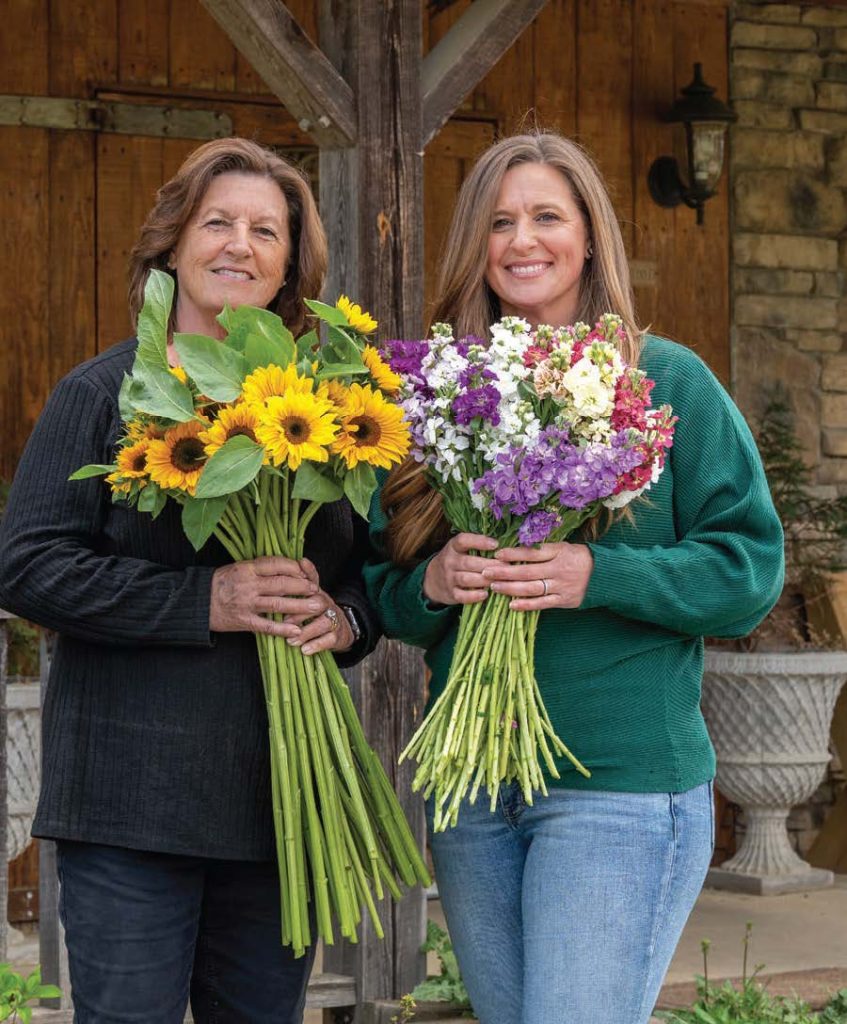
In 2020, Elaine Fryar and her daughter, Crystal Osborne, started growing cut flowers on a half-acre plot located on a 200-acre farm that’s been in the family of Elaine’s husband, Gerald, for more than a century.
Already, the two women have expanded their growing area to three-quarters of an acre, with plans to cultivate a full acre soon.
And, man, they have been keeping Gerald busy.
“We have a cooler now for the flowers,” Crystal says. “We were able to repurpose an old milking parlor from when the farm was a dairy.”
“Yes, Gerald made a nice walk-in cooler for us,” Elaine adds.
Two years ago, her husband completed an even bigger project.
“Gerald repurposed an old tobacco greenhouse for us,” Elaine says. “It measures 30 by 40 feet and has six beds. It was a lot of work for him.”
“There’s still a lot of glass left from the tobacco greenhouse,” Elaine continues. “But Gerald says if I want another flower greenhouse built, I’ll have to get a new husband.” She grins.
The women sell their flowers to other farmers who have their own market sites, to local florists and to a subscribers’ list online.
“And the Greensboro Farmers Curb Market has been fantastic for us,” says Crystal.
Crystal puts together all the bouquets.
She and her mother give a lot of thought to price points. They offer arrangements with names such as “Tiny Tots,” “Mason Minis” and “Nosegays” that come in BBQ sauce jars. They also sell more expensive arrangements in elegant vases or long-stemmed bouquets wrapped in plastic.
At the farm they also offer classes. In December, customers can take a wreath-making class.
“We use our own eucalyptus and purchase Doulas fir, cypress and cedar from local growers,” Crystal says.
In the summer they offer a class called “Petals and Prosecco.” Nothing like a nice bubbly to improve your blossom arranging skills, right?
“Our goal is to have one class each quarter,” Crystal says, noting that they announce advance ticket sales on social media.
There are more activities on the drawing board. This summer, Waseda Farm Flowers will offer its first pick-your-own sunflowers program.
“One day, we hope to have pick-your-own blueberries,” Elaine says. “Eventually, we’ll start keeping bees, to help with the pollination, and the honey, of course.”
“And we’ll be doing special, luxury, pop-up picnics,” Crystal smiles.
Sounds like whatever the future holds for Waseda Farm Flowers, it’ll be a bloomin’ good time.
(For more information, visit waseda-farm-flowers.square.site)