Bloom of the Day

Bill Hurt and Marshall Morrow’s homegrown passion for daylilies

By Ross Howell Jr.

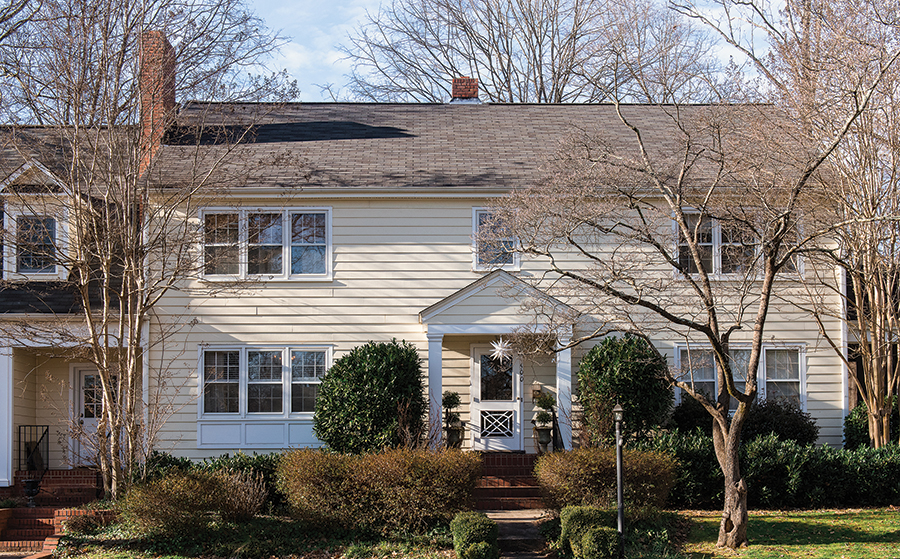
Retired school administrator Bill Hurt of Browns Summit has a Tennessee lilt in his voice and a bright, wide smile. If you want to see that smile really light up, just ask him a question about daylilies.

“Oh, I love them,” Hurt says. He explains his attitude about the flower is anything but rational, and he’s been growing them seriously since 2006.

“The moment you see a favorite plant bloom,” he continues, “it’s a feeling of overwhelming joy, seeing something so beautiful.”

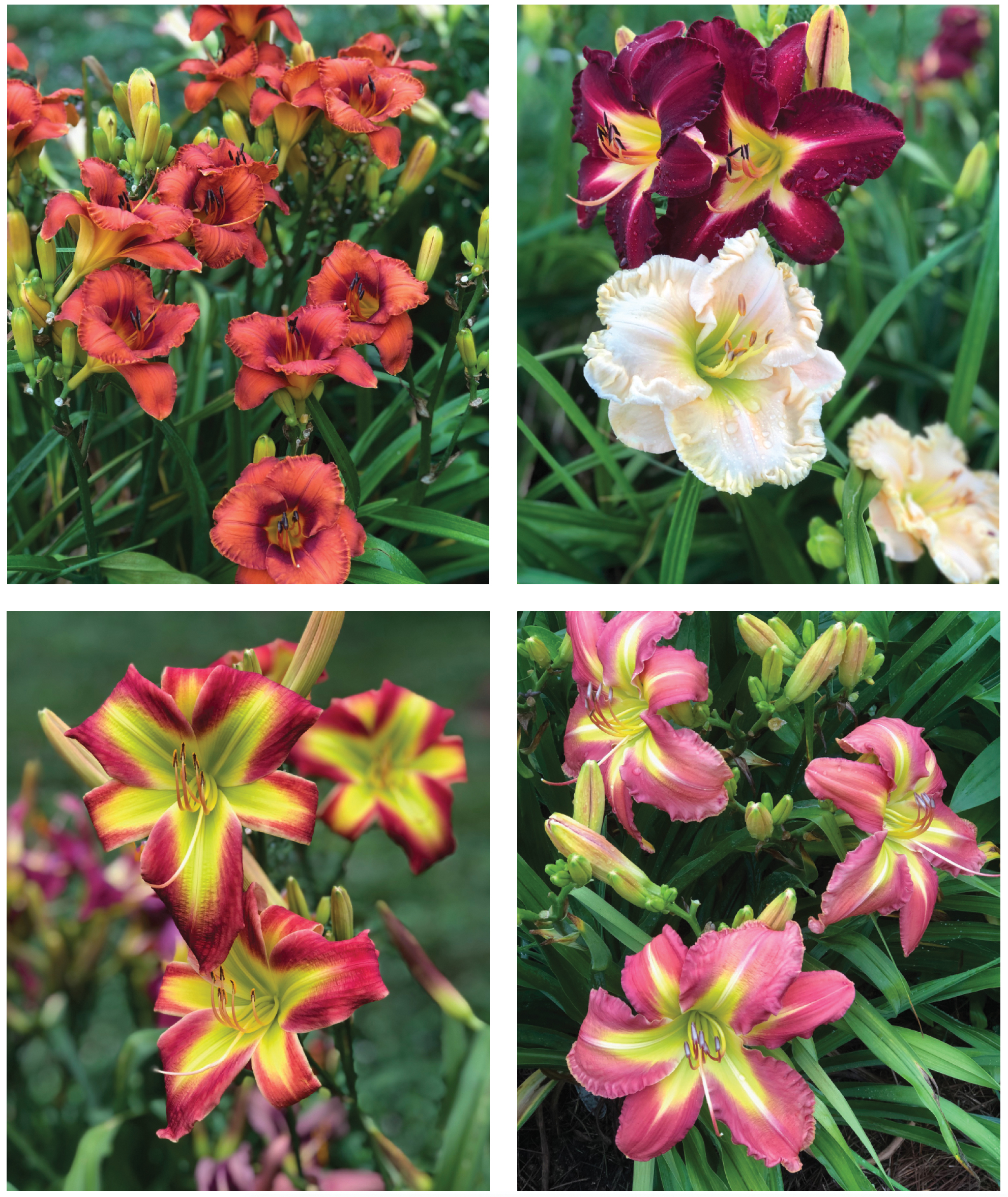
These days there’s plenty of joy in Hurt’s home and garden, which he owns with his husband, Marshall Morrow. Their garden is a National Display Garden, authorized by the American Daylily Society (also known as the American Hemerocallis Society), and features more than 300 hybrid varieties. It is one of only 250 or so authorized display gardens in all of the United States, Canada and Europe.

How about another number?

The humble Hemerocallis, wearing hues of orange and yellow, made its way from Asia to the New World by way of Europe and the British Isles. In colonial North Carolina, there were two types: Hemerocallis fulva and Hemerocallis kwanso, a double-blossom variety. Often called “road lily,” or worse, “ditch lily,” over the last century the daylily has been developed by “hybridizers” into more than 90,000 registered varieties!

Hurt nods at me. “Old as I am, I may run out of time,” he says. “I may run out of money, I may run out of land, but I’ll never run out of daylilies.”

And these many varieties are cloaked in the colors of the rainbow. Well, except for true blue and true white, though the hybridizers are far from giving up on breeding those colors, along with other characteristics, too.

“You know, I was talking with a hybridizer up in Kentucky who’s a friend of mine,” Hurt says, “because deer really like to eat daylilies.” Such damage can be a big problem. While Hurt and Morrow are careful to keep their plants treated with repellant, deer sometimes destroy so many plants set out by neophyte growers that they get discouraged and give up the endeavor altogether.
According to the American Daylily Society, a new grower can spend from as little as $3 to as much as $500 for a small hybrid starter plant. Since Hurt and Morrow like to add a new variety or two each garden year, he figures they’ve spent an average of $175 for each hybrid in their collection.

That’s expensive, especially to a newcomer who sees his garden wiped out in a night.   

“Anyway, I said to the hybridizer,” Hurt says, “‘you want to get really creative You ought to figure out a way to make your hybrids deer-repellent.’

My friend doesn’t miss a beat,” Hurt smiles. “‘It’s not impossible!’ he says. ‘Right now it’s just not feasible economically.’”

Hurt explains that the hybridizer has been experimenting with injecting the tastes of garlic, rosemary and thyme — flavors abhorrent to the deer palate — into his varieties.

Hurt grew up in Tennessee in a family of flower-growers. His grandfather, grandmother and mother all grew flowers.

“I still grow feather hyacinths and peonies my grandmother gave me that date back to the ’50s,” he says. “They’re in a bed at the front of the house,” he continues. “Every spring when they bloom, I think of Momma Hurt.”

After his education, Hurt taught school for many years and served as a school administrator in Franklin, Tennessee. Later he moved to Greensboro, where he served Guilford County Schools for seven years.

In Franklin he left behind a substantial garden.

“Back then I was really interested in Japanese iris,” Hurt says. “I had quite a few varieties. And I’d gotten interested in daylilies, too, which are a great companion flower to the iris.”

When he sold his home in Franklin, the new owners assured him they would take good care of the flowers in his garden. So he left them.

“You know how that goes,” Hurt says. “Their intentions were good, but they really let the plants go.”

Hurt’s first home in Greensboro was at Lake Jeanette. The lot was small, and in no time Hurt and Morrow had it filled with daylily varieties.

“We just ran out of space,” Hurt says. “But during the winter two years ago we found this house with this big lot in Summit Lakes and bought it, so here we are.”

Hurt and Morrow moved the entire Lake Jeanette garden inventory in February. “Fortunately that year we had a dry January,” Hurt says. “So it wasn’t too muddy and we were able to till new beds. We dug the plants, loaded them in garbage bags and drove them out here to get them in the ground.”

Morrow came up with the design of the garden. It’s laid out in curved beds, with ample grassy lanes between, so the gardeners can tend to their daylilies easily, and visitors can roam the beds, savoring the beauty close at hand, without trampling any plants.

“Marshall’s idea was to create something like an orchestra pit,” Hurt says. The effect is both attractive and functional.

Hurt and Morrow have a special method for preparing their plants for spring.

“We’re older now, so we’ll just do a row at a time,” Hurt says. “We don’t want to wear out our knees, you know.”

First, Hurt and Morrow carefully pull back the pine straw mulch from the crowns of the plants.

“See?” Hurt asks. “Some daylilies are evergreen through the winter. Others are dormant. Those stand a better chance in colder winters.”

Then Hurt and Morrow groom each plant, pruning out dead leaves and other organic matter. Some plants are large enough to divide, others will need another growing season. Excess plant matter and mulch are saved for composting. Once plant grooming is complete, they prepare a special spring fertilizer cocktail for the daylilies.

It consists of blood meal, cottonseed meal, alfalfa pellets, powdered molasses, Milorganite and 3 inches composted cow manure.

I ask Hurt if he minds me giving away the secret ingredients of his fertilizer mix.

“Oh, no,” he replies. “It’s all about spreading the love. We want to get as many people growing daylilies successfully as we can.”

After fertilizing, the plants are mulched with new pine straw, and are ready for spring.

“You know, there’s something people forget,” Hurt says. “A daylily bloom is just that. It lasts for a day.” In fact, the word Hemerocallis derives from the Greek words for “beauty” and “day.” The flowering period for an established plant is usually weeks long, however, because of the many buds developed on the “scape,” the leafless stem of a daylily.

During summer, Hurt and Morrow deadhead the spent blooms every evening, so the beds present a pure display the next morning.

“When the plants are really going,” Hurt says, “especially when we have the garden open for viewing, it might take us as much as three hours each night to groom them all.”

Hurt tells me when he was growing Japanese iris, he learned about a Zen practice of meditating on the unfolding of an individual flower.

“That would be a good thing to do with daylilies,” he says. “But you better have some time on your hands.” He reckons the opening of a daylily blossom takes a good hour or so.

Neat, legible labels are set by each hybrid. As required by the American Daylily Society for a display garden, the labels include the registered name of the hybrid, the year the hybrid was introduced and the name of the hybridizer.

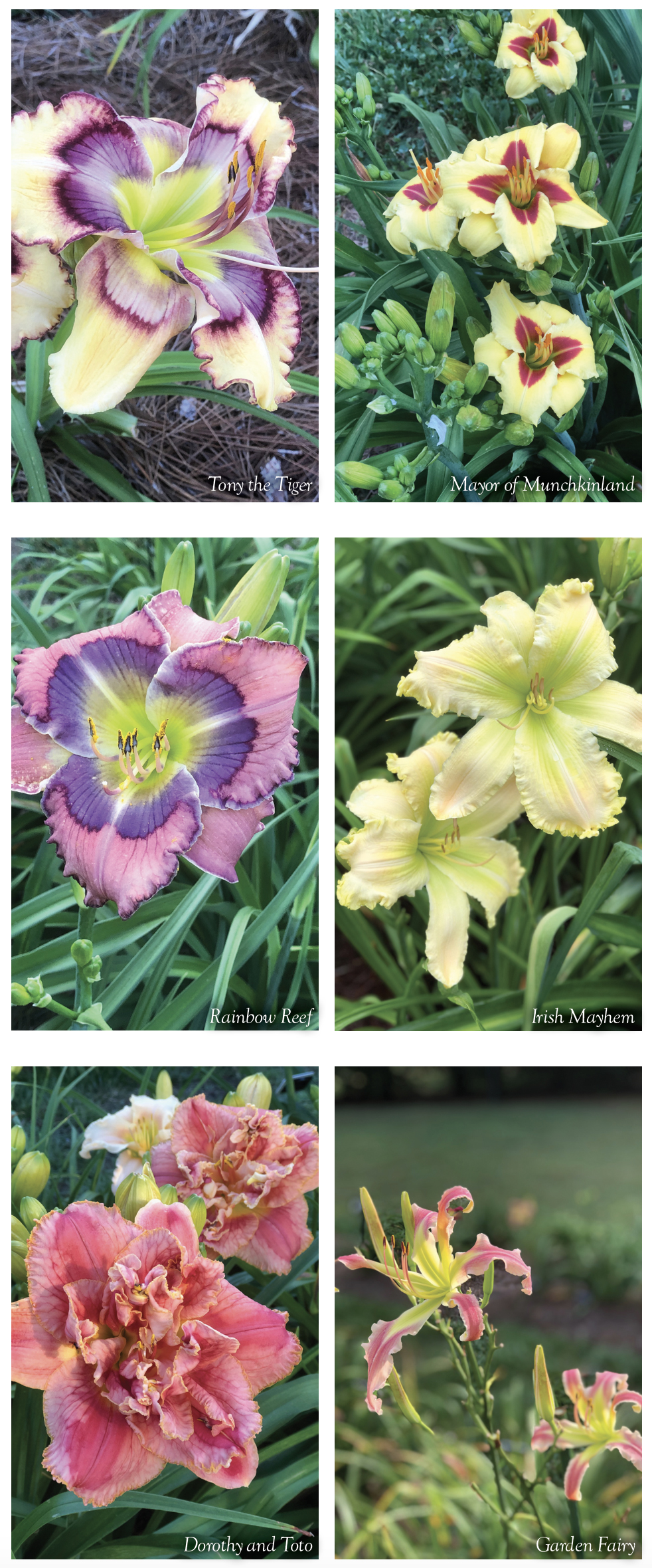
Some of Hurt’s favorites include Tony the Tiger, “an exquisite pattern introduced in 2019, with that elusive blue color and blue/yellow contrast in blooms 7 to 8 inches across,” he says.

There’s Mayor of Munchkinland, “a miniature,” Hurt explains, “meaning the bloom measures under 3 inches across, and it always, always has multiples.”

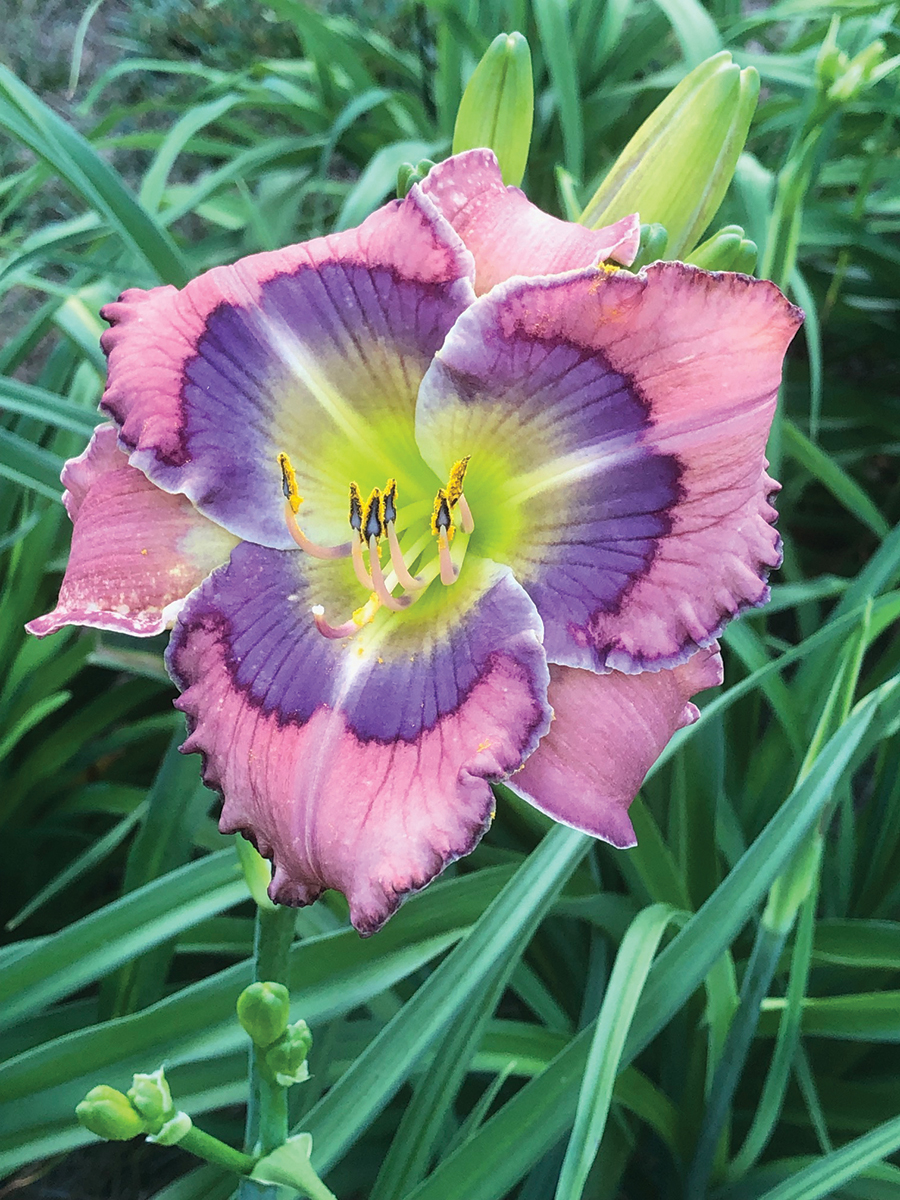
Another is Rainbow Reef, a pattern designated “small,” meaning its blossoms are 3 to 4 inches across, “and the blue is there, contrasting with pink,” Hurt adds.

Irish Mayhem is a variety with remarkable green colors and big blossoms 9 inches across. “The texture of the blooms is amazing,” Hurt says. “They feel just like porcelain.”

Then there’s Dorothy and Toto. “This variety features beautiful double blooms,” Hurt says. “When it was introduced in 2003, it won the Stout Silver Medal, the highest award the American Daylily Society gives to a hybridizer.”

And last, categorized as an “unusual form daylily,” there’s Garden Fairy. “It has this wonderful, open form, ruffles, and grows to be 46 inches tall,” Hurt says.

Clever marketers, those hybridizers. They’re constantly coming up with tantalizing names for their creations. We didn’t mention Heavenly United We Stand, Fluttering Beauty, Boss Hogg, Bloody Marys at Windy Hill, Sips of Sin or Ice Cream Sundae.

And the hybridizers are located all over the country. Hurt likes to support regional hybridizers in North and South Carolina, Tennessee, Kentucky, Florida and Georgia. But he also has purchased cultivars from Minnesota and Kansas.

Want to learn more about daylilies?

There’s a fount of knowledge at the American Daylily Society website, daylilies.org. The society also publishes the Daylily Journal, along with books and other resources and sponsors a national convention, which in 2020 will be held in Savannah, Georgia.

In addition to regular monthly meetings, a local peak season opportunity will be presented by Triad Daylily Fans on June 27, 1 p.m. to 4:45 p.m., at Fellowship Presbyterian Church, 2005 New Garden Road, Greensboro.

And whatever you do, don’t miss Bill Hurt and Marshall Morrow’s Open Garden at 3631 Summit Lakes Road, Browns Summit, on June 13, 9 a.m. to noon. The garden should be at its blooming peak then, and you’ll probably bump into a number of our area’s master gardeners.

“It’s all about spreading the love of daylilies,” Hurt concludes.  OH

Working on this article prompted farm boy Ross Howell Jr. to recall one of his mother’s favorite passages of scripture: “Consider the lilies of the field, how they grow; they toil not, neither do they spin: And yet I say unto you, That even Solomon in all his glory was not arrayed like one of these.” Matthew 6:28-29 (KJV)

March Almanac

Spring makes its own statement, so loud and clear that the gardener seems to be only one of the instruments, not the composer.

— Geoffrey B. Charlesworth


March is the blushing maiden, bright-eyed and smiling, her wild locks softly brushing your skin as she frolics past.

You knew she was coming. The birds have been singing her name for weeks. And yet her arrival has taken you by surprise. You, too, are blushing.

March is the blossoming redbud, soft light, a tapestry of pine needles, bark and grasses.

The nuthatch has crafted her nest, and like the pregnant doe, belly swollen with late winter pansies, a new energy is alive inside of you — a new innocence.

Pale pink blossoms adorn the saucer magnolia, but a tiny yellow flower has caught your eye.

Dandelion.

Simple, immaculate, glorious dandelion.

You see it as if through the eyes of a child, pluck it from the tender earth, tuck it snug behind your ear.

The birds are singing louder now. Ballads of clover, crocus, daffodil. And in the garden, each tiny blossom smiles back.

March has arrived and, with it, spring — as much in your heart as the outside world.


Dandelions don’t tell no lies. — Mick Jagger

Destination Dandelion

Sometimes, especially on dreamy March mornings, the gentle pull of adventure arrives.

On such mornings, you will wander for the sake of wandering, nectar-drunk as a hummingbird as the fragrance of spring blossoms swirls around you.

You might follow the warmth of the sun, or a sweet aroma, or the distant rapping of a woodpecker, any of which will guide you someplace new.

Then maybe, on some quiet woodland trail, you will discover a fluffy young dog.

He won’t look hungry. Or lost. And from the way he is looking at you, he seems to be inviting you farther down the path.

You’ll walk together, for a mile or so, before the path reveals a rolling field. This is when you’ll realize that, across the field, inside the cottage with the smoking chimney, someone might be wondering where their dog went.

And so you’ll walk him home.

Inside the cottage, which smells of rich and exotic spices, an elderly woman is cooking dal on the stovetop. Her husband thanks you for returning Houdini (he slipped the gate again), and invites you to stay for lunch.

“I’ve just gathered greens for the dandelion salad,” he tells you.

You can’t say no to that.


Dandelion Salad

All you need: dandelion greens, wild and tender. Wash thoroughly, then toss with whatever you’d like. Lemon juice, fresh dill, olive oil and pepper.

Glory of Spring

Goddess of Fertility Day is observed on Wednesday, March 18 — the day before official spring. Among the goddesses celebrated on this day, Aphrodite is by far the most widely known.

Born from the foam of the sea, it’s fitting that this goddess of love and blinding beauty be remembered at a time when tender green shoots and brilliant flowers seemingly appear out of nowhere. 

Historically, those seeking to conceive would make offerings to Aphrodite on this day — flowers, greenery, dessert wine, and triangle-shaped honey cakes.

Or, grow a garden in her honor.

Laugh in Flowers

The earth has softened. In the garden, sow seeds for spinach, radish, turnip and kale. Plant a Flower Day is celebrated on Thursday, March 12 — but why stop at just one? March is a good month for planting lilies, tulips and roses. And don’t forget landscaping beauties, like rock cress, sweet pea or — in celebration of Saint Patrick’s Day on March 17 — clover.

First Class

How the Page Pirates got their swagger

By Billy Ingram

In 1958, three seemingly unrelated events would lead to unforeseen inevitabilities, all but assuring that life in America would never again be the same — the nation’s first satellite was blasted into orbit, credit cards were test marketed in one small city and an obscure Texas Instruments’ engineer developed the first microchip. But, as far as teenagers around here went, they were under the thrall of Kookie’s comb and Wham-O Hula Hoops.

An assembly was held at Aycock Junior High in the spring of 1958 during which ninth graders were asked to come up with a mascot for Greensboro’s brand-new Walter Hines Page High, the school where most of those students would be attending in the fall.

Ironically to this day, it remains something of a mystery why the school was named for Walter Hines Page. The student body came up with “Page Pirates.” Perhaps apropos when one considers that, in addition to that enormous lake to the north of the property, just beyond the trees in front of campus sat another large body of water where Sherwood Country Club and Fountain Manor are today. Surrounded on all sides by lagoons and tall pines, Page High School was essentially an island unto itself.

On Thursday, September 4, 1958, around 500 students along with 30 teachers and administrators began a scholastic journey that continues to this day. A ready-to-go opening with varsity football, junior and varsity basketball, wrestling, cheerleaders, majorettes, band, along with girls speedball and basketball teams. Extracurricular activities included Junior Engineers, Hi-Y, Civitans, and Junior Optimists. Page was the first school in North Carolina history to earn accreditation in its first academic year.

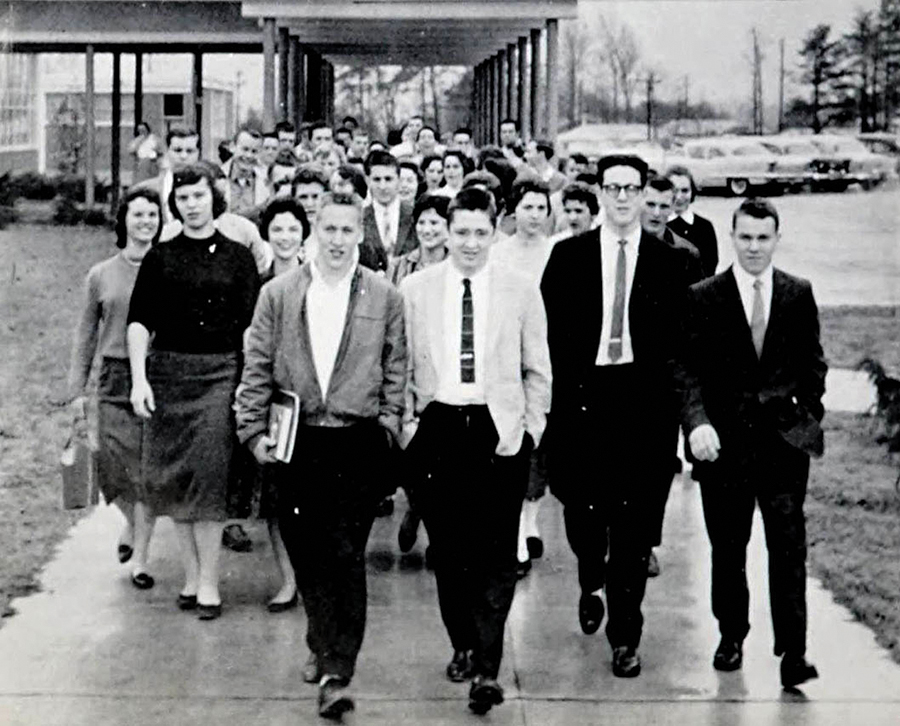
Casual school day attire for men consisted of Madder-Tone shirts, polished cotton slacks and penny loafers. Male students were no longer required to wear coats and ties on a daily basis but it was still de rigueur for picture days. In a photo of the first senior class walking toward the camera, some subversive beatnik in the front row has no tie on, clad in a windbreaker instead of a sport coat. That guy’s cruisin’ for a bruisin’!

Co-eds strolled the halls in Kerrybrooke car coats, pullover sweaters, sensible blouses with Peter Pan collars, pleated calf-length dresses, with nylon stockings tucked into E-Jays saddle shoes or black ballerina flats. Single strand of petite pearls optional. Slacks? You’d be sent home to change into something more ladylike.

In Mrs. Luther’s Family Life class, students were subjected to educational films instructing kids on how to navigate the boundaries of a polite society, with titles like How to Say No: Moral Maturity, The Bottle and the Throttle and Duck and Cover (“when an atomic bomb explodes”).

Page’s Cafeteria was up and running on day one but students with wheels peeled out at lunchtime for Alpat or the snack shop inside the GI 1200 store, both on Bessemer. State Street Grill was closest to campus. No fast food chains, the city’s first McDonald’s on Summit was a year away from opening.

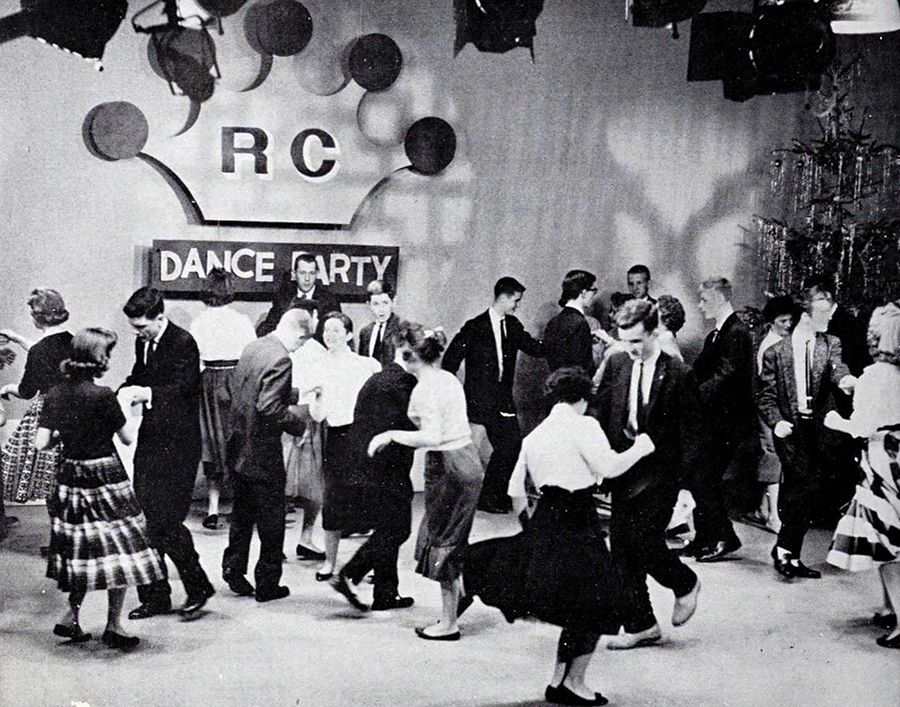
On Thursdays after school, cool cats and kittens pointed their jalopies toward WFMY’s studios to make the scene on the RC Dance Party, airing live at 5:30 p.m. Sponsored by Royal Crown Cola, Twisting teens gyrated to the sounds of The Big Bopper, Teresa Brewer, Ricky Nelson, and The Purple People Eater by Sheb Wooley. Like endsville, man!

Changing out of school clothes, that’s when girls slipped into their pedal pushers, Blue Bell Jeanie capri pants and tight, pink cashmere sweaters (“Daaaad . . . all the kids dress like this!”). Date nights began with a fellow in his Sunday best appearing at the door, gotta chat up the old man before escorting his dish for a night on the town in his ’55 T-bird meatgrinder.

Daddy-os and dolls burned rubber to the edge of town at night for curb service at the Boar and Castle, a ‘Flake Shake’ with two straws at Monroe’s, making goo-goo eyes over a “Bucket Full” of spaghetti for only a buck at McClure’s Sky Castle, or catching — not necessarily watching — a double feature at the South Drive-In Theatre where guys hoped to engage in some Back Seat Bingo (“Hey baby, I’m layin’ it down but you’re not pickin’ it up!”).

With no athletic field to speak of, Pirate home games were played on the football field at Greensboro High School, soon to be renamed Grimsley. Taking to the gridiron on the Friday night after school started, it was a blowout, Fair Grove whipping Page 14-0. Next week was even worse, 21-0 in favor of Mebane. Finishing the 1958 season 2-8, it wasn’t until 1960 that Pirates and Whirlies squared off against each other, sparking a never-ending rivalry.

Yes, 1958 may have been an inauspicious beginning to the proud Page Pirates dynasty but at least a dozen athletic stars went on to impressive professional careers including Michael Brooks (Chargers, Cowboys), Lamont Burns (Jets, Eagles, Redskins), Lee Rouson (Giants, Browns), and Mo Spencer (Cardinals, Saints) who all played for the NFL. Former professional basketball player Danny Manning is currently head coach of the Wake Forest Demon Deacons.

The most famous Page alumnus would have to be pro tennis great John Isner, who twice reached the quarterfinals at the US Open, and physician turned actor Ken Jeong (Knocked Up, The Hangover).

Never underestimate the underdog, our landlocked Pirates continue to thrive on their veritable island of imagination, opportunity and individual visions for the future. Isn’t that the ginchiest?  OH

Billy Ingram attended Page High from 1971–74. He went on to a career in Hollywood as a movie poster artist and is the author of five books including Hamburger², a book (mostly) about Greensboro.

March 2020

Awoken

The moon awoke me

howling for attention

the stars were distant, aloof

a few gregarious, Gregorian twinkles

made celesta accompaniment

lunar fugue

a chorus of seas

echo of my cathedrals

trumpets and choirs

the organist’s foot pedals

faster than tap

Did the moon not wake you?

No tom toms, no Tchaikovsky cannons?

Oh your serene dreams of a

more melodious siren

That is why I love you

listening to the moon in your eyes

Ry Southard

A Page Out of History

The greatness of Walter Hines Page


By Bill Case

Woodrow Wilson spent the bulk of his first term steering America clear of World War I, which had raged over Europe for 2 1/2 years when he made his bid for reelection. He used the slogans “America First” and “He Kept Us Out of War” during his 1916 campaign, which led to his narrow electoral victory. However, a growing number of Americans felt that Wilson’s neutrality policy was wrongheaded following his response to a German U-boat’s May 1915 sinking of the unarmed British ocean liner Lusitania with 128 American passengers aboard. Few in his administration spoke in opposition.

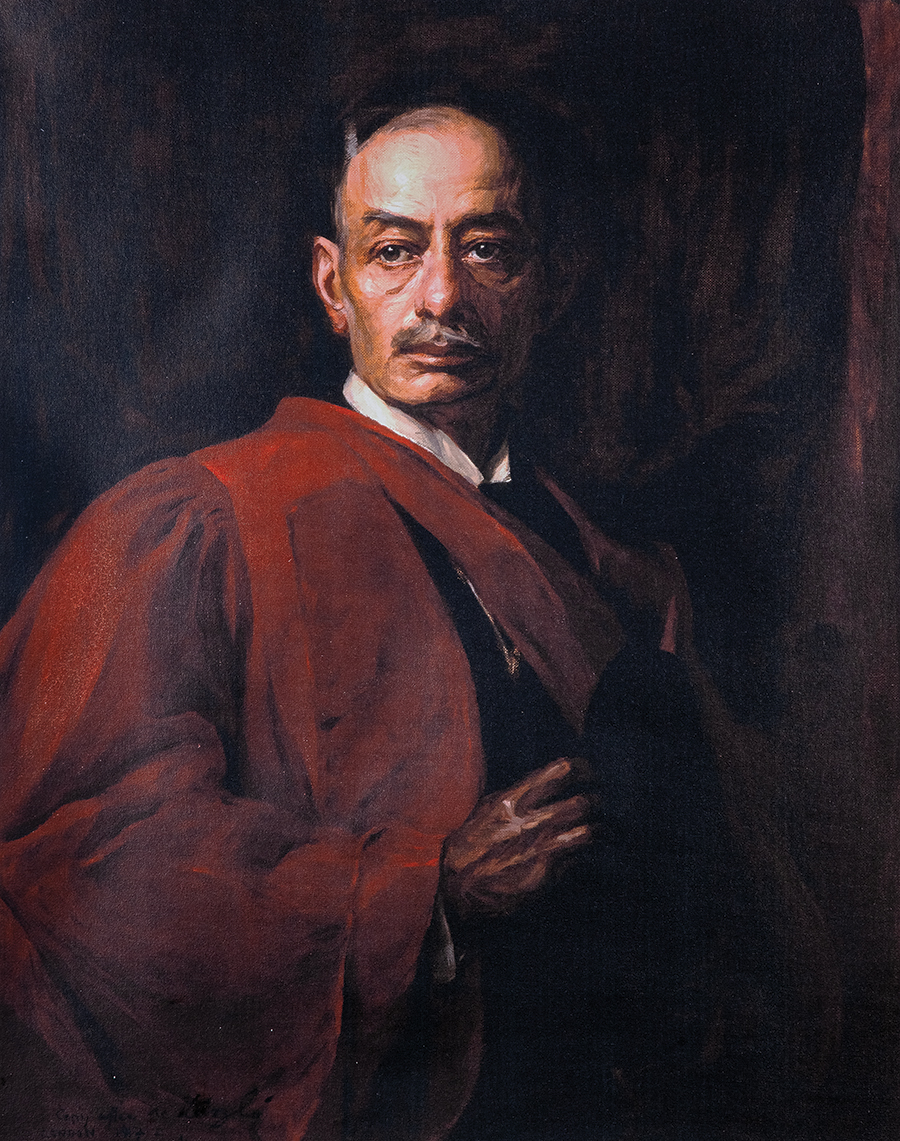
One member of the inner circle who dared to question the president’s approach was Walter Hines Page, America’s ambassador to Great Britain. Wilson had appointed his longtime confidant to the prestigious post in 1913. Page’s selection was not based on his diplomacy experience, since he had none. It had more to do with rewarding the native North Carolinian for his role in aiding Wilson’s political advancement over a 30-year period.

It was presumed the ambassadorship would provide the 57-year-old Page a mostly trouble-free conclusion to a remarkably eclectic career that had included successful turns in academia, journalism, publishing, social reform, public policy advocacy and farming. But the ambassador considered it his duty to inform the president of British (and his own) disapproval with the administration’s failure to act more decisively toward Germany. His fault-finding missives from London irritated Wilson, who complained that Page “seemed more British than the British.” A degree of frost formed over their relationship.

Page was born in 1855 in a small settlement in Wake County, North Carolina, that eventually became the city of Cary. His father, Allison Francis (Frank) Page, founded the town. A rugged, God-fearing Methodist, Frank Page made a small fortune extracting turpentine from pine trees and sawmilling them into lumber. Standing an impressive 6 feet 5 inches, he commanded respect bordering on awe. Walter’s mother, Catherine, was of a more intellectual bent, usually observed with a book in her hands.

The tall, gangling, curly-headed boy’s parents steered their scholarly son in the direction of the ministry, sending the 16-year-old to Methodist-run Trinity College, located in the backwoods of Randolph County (later the school moved to Durham and was renamed Duke University).

Wat, as he was called, was miserable at Trinity, and after an unhappy year transferred in 1872 to another Methodist school, Randolph-Macon College, in Ashland, Virginia.

“It was at Ashland that I first began to unfold,” Page would later remark. “Dear old Ashland!” Though he loved school he resisted his father’s wishes that he become a minister. “I’m damned if I’ll become a Methodist preacher,” he told his father. After a disappointed Frank refused to pay for further tuition, Walter self-financed the remainder of his education.

In 1876, Page was one of 21 students gaining admittance to America’s first graduate school at Johns Hopkins University. Initially, he flourished in the intense regimen, but by the midterm of his second year, he had become bored with the nuances of Greek and Latin, disparagingly calling himself a “Greek drudge,” and left without completing his course of study.

Visualizing a career in journalism and harboring “dreams and aspirations” of owning and editing a magazine, he invested $1,000 and became half-owner and the editorial writer of a fledgling Louisville weekly called The Age after teaching there.

Unfortunately, it folded in June 1879, barely three months after his investment.

Undaunted, Page combed his native North Carolina looking for “any sort” of journalistic position, but, as he ruefully put it, “journalism didn’t seem in any hurry to make up its mind to admit me.”

During a summer stay in Cary, Page fell in love with Alice Wilson, whom he’d first met as a teenager. The smitten couple became engaged during the 1879 Christmas holidays, postponing marriage until Page could obtain gainful employment.

Unable to find his footing as 1880 loomed, a breakthrough occurred in January when Walter Page landed a job as a reporter at a St. Joseph, Missouri, newspaper, The Gazette, contributing all kinds of articles “from stockyard reports to political editorials and heavy literary articles.” After five months, the publisher promoted young Page to editor-in-chief and raised his salary, giving

Walter and Alice the wherewithal to tie the knot in November 1880. Page wrote to several Northern newspapers, advising them of his intention to travel, observe and write about the post-Civil War South.

His letter-writing gambit succeeded. The big-city papers printed his submissions and paid for the privilege. “I had money in my pocket for the first time in my life,” he recalled. Moreover, the essays impressed the editor of the New York World, who offered Page a correspondent’s job with the paper. He accepted and headed north. His beat included congressional hearings regarding tariff measures as well as the tariff commission itself.

Page’s coverage of the commission brought him to Atlanta in 1882, where he met 26-year-old Woodrow Wilson. The two men engaged in a discussion regarding the merits of protectionism versus free trade. Believing he had discovered a budding political star, Page would gush to a colleague that Wilson “has one of the finest minds in America. Keep your eye on him!”

When the World changed ownership in May 1883, Page resigned and returned to North Carolina hoping to personally own and edit a publication in his home state. With financial help from his father, he launched a weekly newspaper in Raleigh, The State Chronicle. Page’s editorials lauded Democratic presidential candidate Grover Cleveland and derided local politicians as “small men” holding obsolete and parochial views.

The paper proved unprofitable, however, and in February 1885, Page ceded its control to Josephus Daniels (who would later buy Raleigh’s principal newspaper, the News and Observer), and retreated to New York. Though still revering North Carolina, the frustrated Page abandoned thoughts of making a living there. He told his father, “there is no (use) in my trying to do anything down south anymore. I have proved disastrous every time.”

Comfortably ensconced in Manhattan with Alice and two toddlers, Ralph

and Arthur (who would later be joined by two more children, Frank and

Katharine), Page penned freelance articles for magazines like The Atlantic and Harper’s Magazine mostly pertaining to the South and national politics. He was becoming, as one biographer put it, “a self-appointed but recognized ambassador from the South to the North.”

Page rose to prominence in New York’s magazine scene — unusual for a Southerner at the time — ultimately landing in Boston as the editor of The Atlantic — the magazine industry’s gold standard — and its book-publishing parent, Houghton, Mifflin & Company.

As editor, Page cultivated the era’s top fiction writers, and expanded Atlantic’s treatment of political topics such as American imperialism and the perils of unregulated monopolies. At Page’s behest, his friend Woodrow Wilson contributed three public policy articles.

Page’s gravitation toward national politics did not deter him from expounding on a pet concern: Southern educational reform. He spoke on the subject in Greensboro at the Normal School’s 1897 commencement exercises. In his eloquent “Forgotten Man” speech, which served as an important catalyst for educational reform in North Carolina, Page maintained that the state had

failed to develop its most valuable resource, “the people themselves . . . forgotten and neglected.” He decried North Carolina’s long history of providing scant resources to educate the less fortunate. These were the people whom “both the politician and the preacher have failed to lift.”

Though sitting in one of publishing’s most prestigious editorial chairs, Page still longed to be his own boss. He resigned from The Atlantic in 1899 and, after a brief misbegotten adventure with McClure’s Magazine, ventured into the book publishing business with Frank   in New York. Doubleday, Page & Company started small, but grew quickly. Page enticed prominent men of letters like Theodore Dreiser, Booker T. Washington, Rudyard Kipling and Upton Sinclair to join the publisher’s list. Woodrow Wilson’s book The New Freedom was sold under the Doubleday, Page umbrella. The company published a magazine, The World’sWork, which became Page’s primary focus.

Sons Ralph and Frank would follow their father into journalism. Ralph wrote a successful book as well as articles for The World’s Work. Frank became an editor.

Meanwhile, Page continued to assist Woodrow Wilson’s political advancement.

He came to his fellow Southerner’s aid in 1910 when Wilson, then the president of Princeton University, successfully ran for governor of New Jersey.

Wilson’s meteoric political rise was capped by his election to the presidency two years later. Page played a significant role in Wilson’s presidential campaign, raising money and providing reams of favorable publicity in The World’s Work. Following the election, Wilson met with Page to obtain the latter’s advice regarding prospective administration appointments. The Washington rumor mill speculated that The World’s Work editor would soon be appointed either secretary of Agriculture or secretary of the Interior.

On March 26, 1913, now-President Wilson threw Page a curveball. Instead of the anticipated Washington Cabinet post, Wilson offered Page the position of ambassador to Great Britain. The surprised Page harbored misgivings over the prospect of leaving America for an extended period but understood the ambassadorship was a glamorous assignment. He agreed to serve, and boarded the ocean liner Baltic sailing for England on May 15, 1913. “Here I am going to London to talk international affairs with the men who rule the British Empire,” wrote Page while aboard ship.

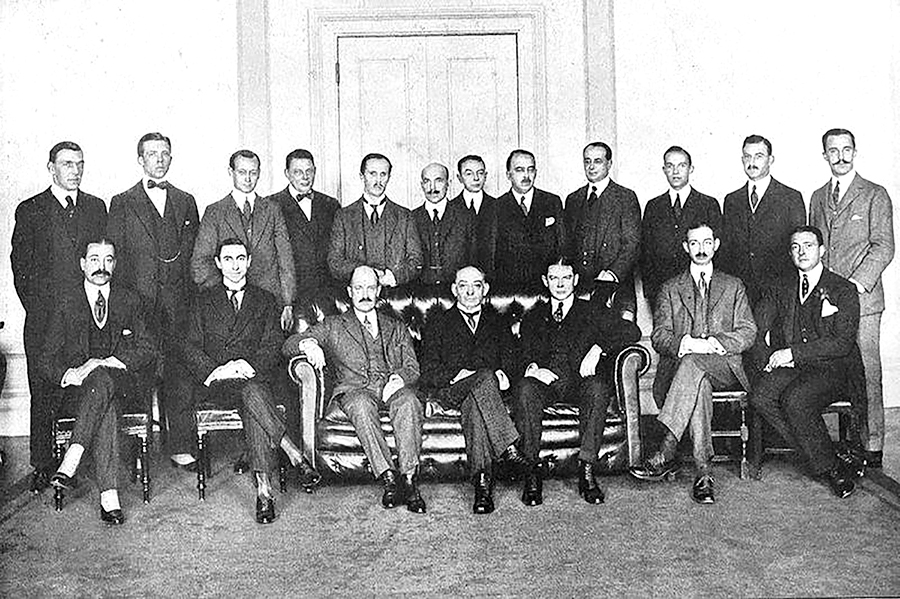
Indeed, he got along famously with the bluebloods in London’s highest places: royalty, members of Parliament, and most especially Sir Edward Grey, the foreign minister, who would become a close personal friend.

Page regarded it his responsibility to provide the president unvarnished

British reaction to U.S. policies. One such example occurred when Congress enacted legislation in 1912 exempting American ships from the payment of tolls when passing through the Panama Canal. An outraged British government claimed this measure breached a treaty providing that ships of all nations would be treated equally in their use of the canal. Page’s September 13, 1913 letter to Wilson cited “the dishonorable attitude of our Government about the Panama Canal tolls . . . We made a bargain — a solemn compact — and we have broken it.”

Wilson agreed with Page’s view and appreciated the ambassador’s hard-hitting assessment. “Your letters are like a lamp to my feet,” responded the president. Wilson persuaded Congress to repeal the exemption.

Throughout the first year-and-a-half of Page’s ambassadorship, Wilson expressed delight with his friend’s erudite correspondence. “I hope that Walter Page’s letters will be published. They are the best letters I have ever read!” exclaimed the president.

The outbreak of World War I in July 1914 aggravated the manifold burdens of Ambassador Page’s office. London-based Americans, fearful of being caught in the middle of the war, were leaving England in droves, requiring the ambassador’s assistance. But the ambassador’s hardest task was to avoid doing anything that would contravene American neutrality toward the belligerents while at the same time conveying his personal sympathy and friendship to Great Britain. The exhausting duties caused his health to deteriorate as an ulcer flared up, made worse by Page’s incessant smoking.

During the first years of the war, Wilson sought to be an impartial mediator, hoping to obtain peace by seeking common ground between the warring countries. Page considered the president’s impulses noble but naïve. According to Page, the German leaders, were “another case of Napoleon— even more brutal; a dream of universal conquest . . . Prussian militarism (must) be utterly cut out, as surgeons cut out a cancer. And the Allies will do it — must do it — to live.”

Wilson’s reading pleasure dissipated as Page’s increasingly unwelcome correspondence advanced positions out of synch with those of the administration.

With his re-election campaign looming, Wilson was determined to do nothing that could draw America into the war or undermine his role as a mediator of peace. The antagonized president ignored his ambassador’s entreaties, other than to warn him through staff “to please be more careful not to express any unneutral feeling either by word of mouth or by letter.”

Page was stunned by Wilson’s failure to comprehend the threat to democracy caused by autocratic Germany. His exasperation grew when the president issued a “we are too proud to fight” statement in response to the sinking of the Lusitania. After the Germans torpedoed another ship with Americans aboard,

Page wrote the president in January 1916 that officials in the prime minister’s cabinet had confided their impression “that the United States will submit to any indignity.”

American state department diplomats began meeting regularly with their British counterparts without bothering to notify the out-of-step ambassador.

Page visited America during August and September 1916, ultimately gaining an audience with the president on September 23. Although cordial enough, the president stiff-armed Page’s assertion that Germany was the world’s scourge. The ambassador was profoundly discouraged with Wilson’sassessment that the war was “essentially a quarrel to settle economic rivalries between Germany & England.”

Wilson assumed his bargaining hand as peacemaker would be strengthened by his re-election, but he was wrong. Two events in early 1917 would end his mediation efforts and draw America into the conflict.

In an attempt to starve out its enemy, Germany announced that it would henceforward commit unrestricted submarine warfare against any neutral countries’ ships transporting goods to England, including the U.S. This was followed by British intelligence’s discovery of the “Zimmerman telegram” cabled by the German Foreign Office to the Mexican government. It proposed a military alliance between those two countries in which Mexico would ultimately recover the states of Texas, Arizona and New Mexico in the event America entered the war. Americans were outraged at Germany’s treachery, and public opinion suddenly turned in favor of entering the war.

It took another month for Wilson to abandon hopes for peace and ask Congress to declare war, but he finally did so on April 2. Page was elated. “I cannot conceal nor can I repress my gratification we are in the war at last,” he wrote. He felt vindicated that his “letters & telegrams . . . for nearly two years” had proved clairvoyant and helped alter Wilson’s pacifistic stance. “I have accomplished something . . . I swear I have.”

The war dragged into 1918, and American casualties mounted, including

Page’s nephew, Allison Page, a U.S. Marine, killed in battle at Belleau Wood.

Page’s health, never robust, got progressively worse. He suffered from hardening of the arteries, high blood pressure and early-stage emphysema. Told he would require six months’ rest, Page wrote Wilson on August 1 and submitted his resignation. When he left London on October 2, he required support on each arm to make it to his private railroad car. Upon reaching New York, further examination added diagnoses of retinal hemorrhages, heart congestion and kidney failure to Page’s mounting woes.

On December 11, Page boarded a private railroad car and came home to North Carolina. Literally carried off the train by his son at the Aberdeen station, he remarked, “Well, Frank, I did get here after all, didn’t I?”

Walter and Alice Page rented a cottage in Pinehurst.

Page was reunited with several of his siblings, but his condition declined a week later. He died on December 21. Following its practice of not printing a word about deaths in Pinehurst, the Pinehurst Outlook, coincidentally edited by Ralph, made no announcement of his father’s demise.

But Page’s Christmas Eve funeral at Page Memorial Church and burial at the Page family plot at Old Bethesda Cemetery in Aberdeen did receive international attention. Given his role in ending the “War to End All Wars,” virtually giving his life to the cause, Walter Page was hailed as an American hero. His grave became a mecca, visited by grateful Americans paying him honor. The state built a road to the cemetery to absorb the traffic.

Johns Hopkins would honor Page by founding the Walter Page School of International Relations.

While Wilson and his administration did not always appreciate Walter Hines Page, England still does. In a vestibule of Westminster Abbey is a sculpture of Page with a testament that reads, “The friend of Britain in her sorest need.”  OH

Pinehurst resident Bill Case is PineStraw’s history man. He can be reached at
Bill.Case@thompsonhine.com.

Renaissance Man

Jan Lukens’ passion to paint

By Nancy Oakley


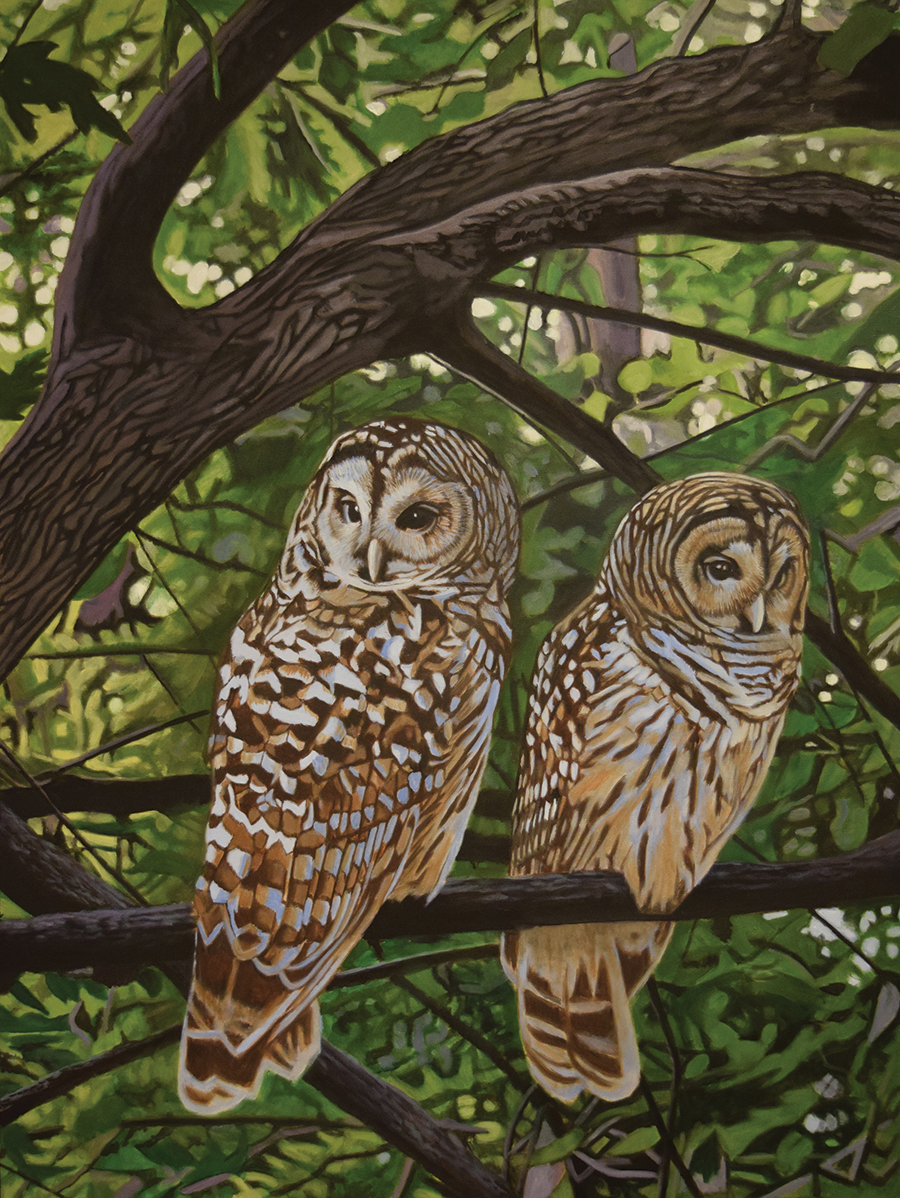
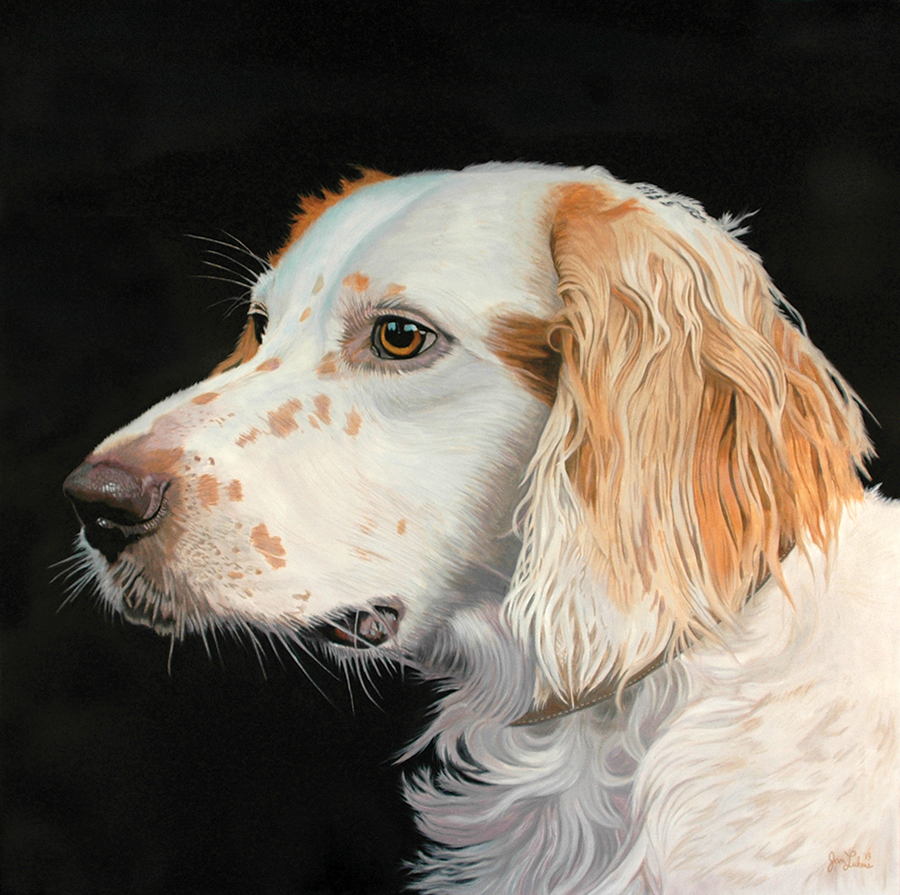
The shortest distance between two points may be a straight line — unless you’re pursuing a career as a professional artist, as Jan Lukens has discovered over a lifetime. His large, vivid, hyper-realistic canvases of horses, wildlife and cityscapes that fill his studio in Revolution Mill, all precisely wrought in the finest detail, are the culmination of a childhood dream. One that began with, yes, the straight lines of a child’s stick figures but took a turn in the Prehistoric Age.

“There was nothing remarkable about what I was doing,” he says of the rudimentary cowboys and Indians or soldiers engaged in battle that he and his first-grade classmates liked to draw in crayon during art class at Irving Park Elementary School. But at home, the seeds of his artistic ability were taking root. “I had a set of dinosaurs and printed on the belly of each one was the name.” So he could name and identify them: “the stegosaurus and the T-Rex and the triceratops, and all these weird amazing-looking creatures,” Lukens recalls. “I was always fascinated with animals anyway. These were crazy, wonderful.” He had also taken to copying photographs in Newsweek and National Geographic on sample pads of printing paper his father would bring home from his job at Pilot Life Insurance. Perched at a coffee table at his parents’ feet as the family watched TV, “I would do that two or three hours a night, just because that’s what I liked to do,” Lukens remembers.

A year later, those hours of practice would come to the fore when, one day, a second-grade class assignment was to draw a Tyrannosaurus Rex. Lukens’ advanced rendering of the dinosaur was well beyond those of his classmates, who, along with the teacher gathered round his desk expressing admiration and awe. “That’s when I realized, ‘Wow! I’m pretty good at this, and nobody else in the class can do it; this is pretty cool.” In the ensuing years, he would capitalize on Beatlemania, parlaying his skills into a lunchroom trade by copying images of the Fab Four from trading cards and other memorabilia for appetizing contents of his classmates’ lunchboxes. “I saw my market and I went after it,” he jokes. A foreshadowing of things to come.

By the time he was coming of age in the early to mid-1970s, Lukens had spent about a year at East Carolina before withdrawing to work for a couple of years. He also faced another hurdle: His preference for representational art, exemplified by Renaissance masters Titian, Caravaggio, Rubens and Velázquez and later artists such as Corot, Degas, John Singer Sargent, George Bellows and Edward Hopper, was unfashionable at the time. “It was all about Modern art,” Lukens remembers. With Abstract Expressionism ruling the day, art instruction emphasized “an idea,” he observes, while basic skills — drawing, composition, color — “got swept under the rug.”

Nonetheless, his dream of becoming a professional artist burned bright. To fulfill it, he enrolled in a nascent but rigorous commercial art program at GTI (now GTCC). He was one of only eight out of 120 students to graduate and embarked on a career as an advertising illustrator. “When I was in advertising, I would make ads and then do the illustration for it, because that’s what I really wanted to be doing. Not making ads. But I also needed to make a living as an artist. And this was the best way I could figure out,” he concedes. He talks of the layers of agency bureaucracy — art directors, creative directors, committees of clients — affecting the final outcome of his work. “You learn to put your ego in a box,” he notes.

After 15 years in the business and earning a good living, Lukens was approaching a turning point. He was also keenly aware of changes in the business that the digital age had ushered in. “All the art directors and illustrators were sitting in front of a computer all day long doing their work. And I thought, ‘There’s no way I’m going to do that.’”

He wanted to paint full time and knew he had to find a market — just as he had with his lucrative Beatlemania enterprise all those years ago — and considered wildlife paintings, which were popular. The only problem? “You do three paintings a year, you pay for a thousand prints of each and you’d spend the rest of the time selling those prints,” Lukens says. “That just didn’t appeal to me. I just wanted to paint all the time.”

In the early ’90s, a visit to the Sedgefield Horse Show with a colleague provided him with a solution. “I got the picture pretty quick that this is an expensive sport and all the people who participate in it are wealthy.” In other words, he’d found a market. It would take some trial and error, and making the rounds of the horse-show circuit with a vendor’s tent and forging connections that led to clients by word-of-mouth, but again, Lukens succeeded.

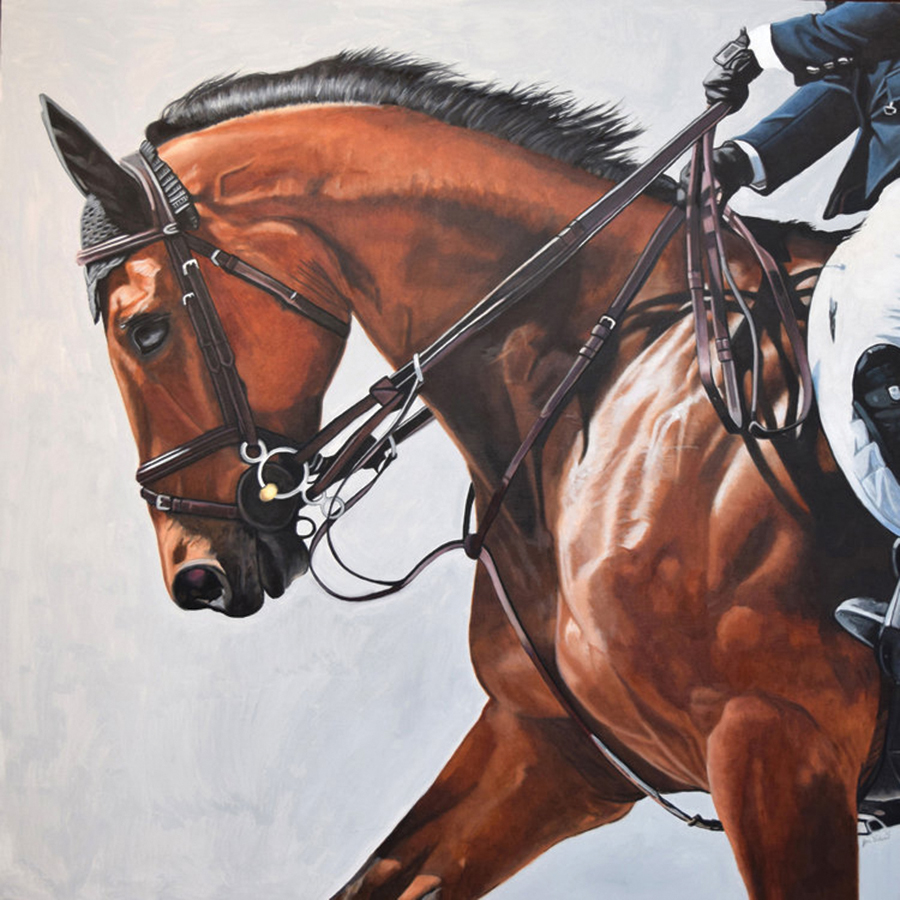
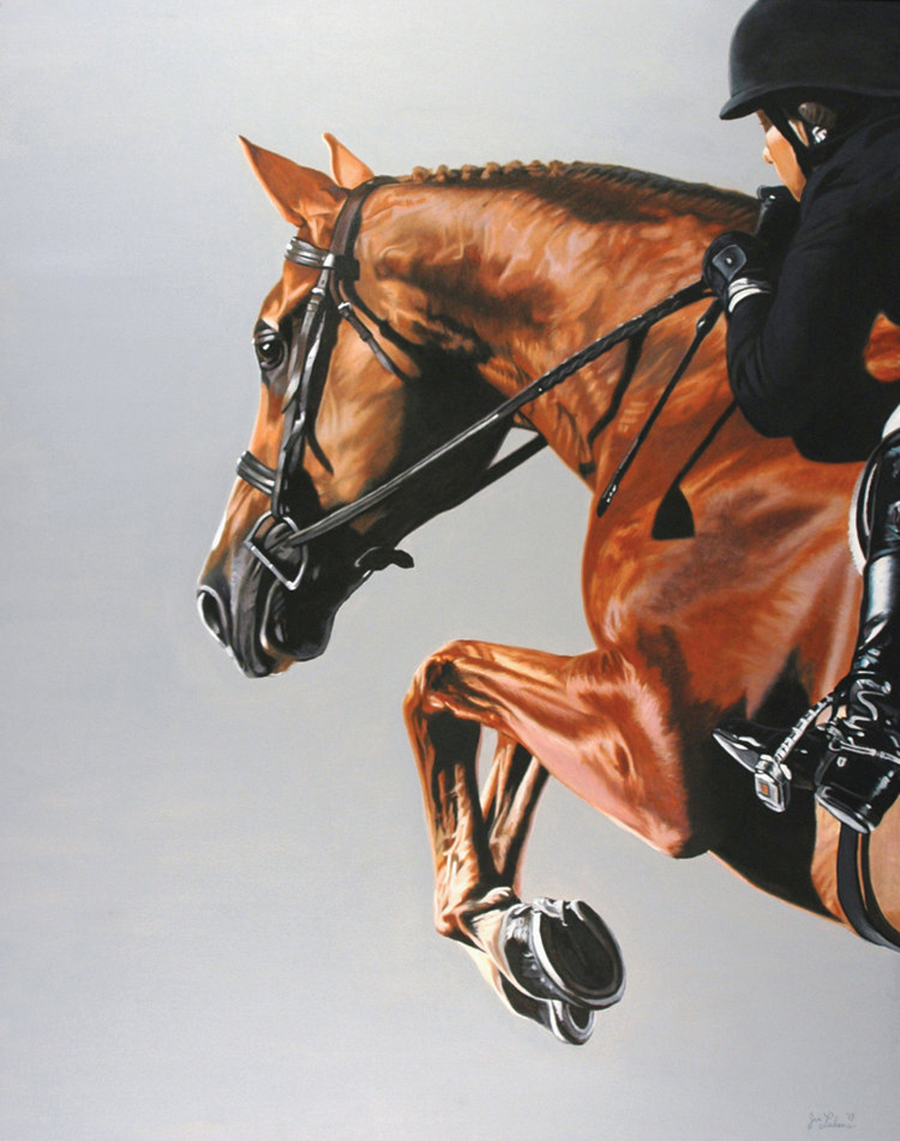
His approach to equestrian portraiture was unusual. Working in acrylics, Prismacolor pencil and watercolor from photographs taken at his clients’ stables (“you can’t get a 1,200-pound horse to stand still”), he applied his uncompromising representational style in depicting equine anatomy, highlighting every sinew beneath the sheen of his subjects’ glossy coats. But he brought to his compositions a contemporary feel, perhaps owing to his advertising background. In one painting, the graceful curve of a horse’s neck dominates the foreground, as its head is turned in profile. In another, the muscles of a foreleg are set in high relief, framed by the rider’s boot in the stirrup at the painting’s edge. Sure, Lukens’ artistic eye didn’t always jibe with clients’ wishes and he’d have to make concessions, as he did in the advertising business, but he was living out his dream.

Or partially.

Lukens’ desire to work in oil on canvas, like his Renaissance idols, tugged at him. “I started thinking: ‘How can I improve?’” the artist remembers. “I literally thought, ‘these old masters that painted oil on canvas .  . . I’m just not worthy.’” He tried the medium on his own, took workshops here and there “but just couldn’t get it.” And that’s why, at age 47, Lukens went back to art school.

At the time, in 1998, there were no institutions in the Southeast offering the classic academic curriculum the artist sought. His choices were by and large limited to the Northeast. Having lived for seven years alone on a 600-acre farm in Lewisville, he packed up his belongings and moved to a bungalow in the tiny coastal town of Old Lyme Connecticut, home of Lyme Academy of Fine Arts. “It was fantastic,” Lukens enthuses. “The second year I had over 1,000 hours of drawing and painting from a live model, which was the training that all my heroes from the Renaissance had.” With classmates ranging from recent high school graduates to 65-plus retirees, he was the only middle-aged student, but he says, “Everybody was in it together, there to learn.” He relished the moments, when live models would take breaks, affording the students opportunities to assess each other’s works. “I learned as much from the other artists during the model breaks as from the instructors,” Lukens says. One of them, Sam Adoquei, had made a profound influence in a life-drawing class. “He taught me how to construct the figure and the composition in a third the amount of time that I’d been spending,” the artist remembers. “That gave me two-thirds my time to develop my drawing. So all of a sudden, my work just looks phenomenally improved.”

He decided to study further under Adoquei’s tutelage at the National Academy in New York, conquering one hurdle of finding affordable housing through an equestrian connection, only to face another: The course of study began in early September of 2001. Lukens’ stay in New York started with the attacks on the World Trade Center, which the artist would witness from atop a 41-story building at 90th Street and Broadway. After a semester at the National Academy, he applied for the Copyist Program at no less than the Metropolitan Museum of Art, replicating the works of Velázquez. “It was as good as any class I took,” he allows. Sure, you can read about the artist or observe it. “Or you could attempt to copy what the artist has done, which forces you to observe all the nuances.” He likens the process to playing tennis against a stronger opponent, who ups your game. He was even filmed on PBS program, EGG the Arts Show, expressing a similar sentiment. Following his brief appearance on camera, the Met saw a spike in copyist applicants.

While living in New York, Lukens also took to painting streetscapes, but big city representational galleries were interested only in artists with Ivy League training. So in 2008, with his aging parents in need of help, Lukens headed home.

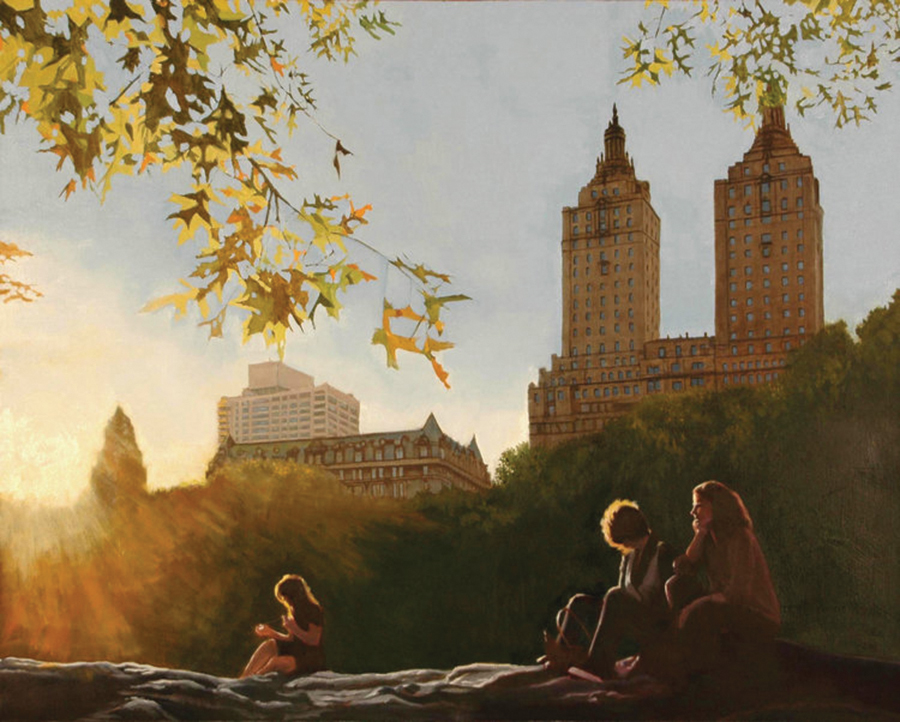
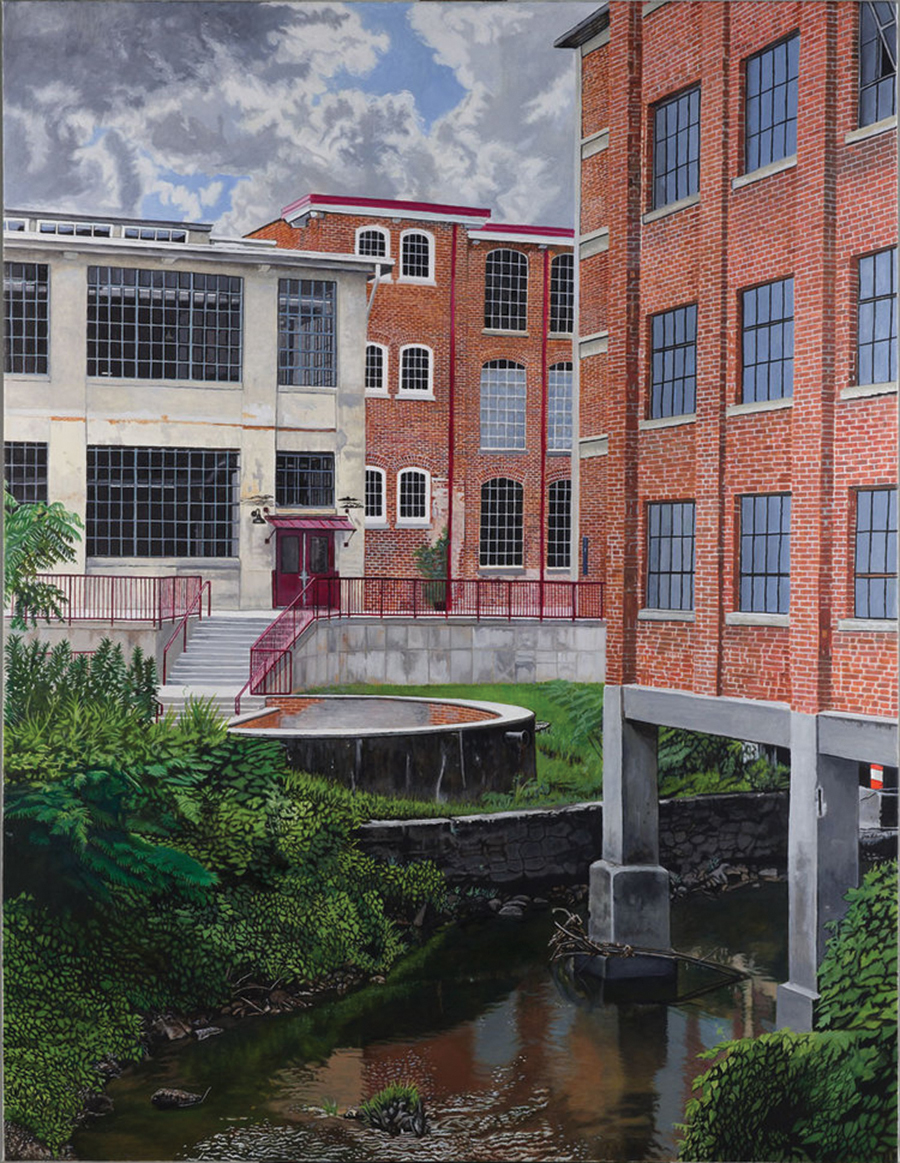
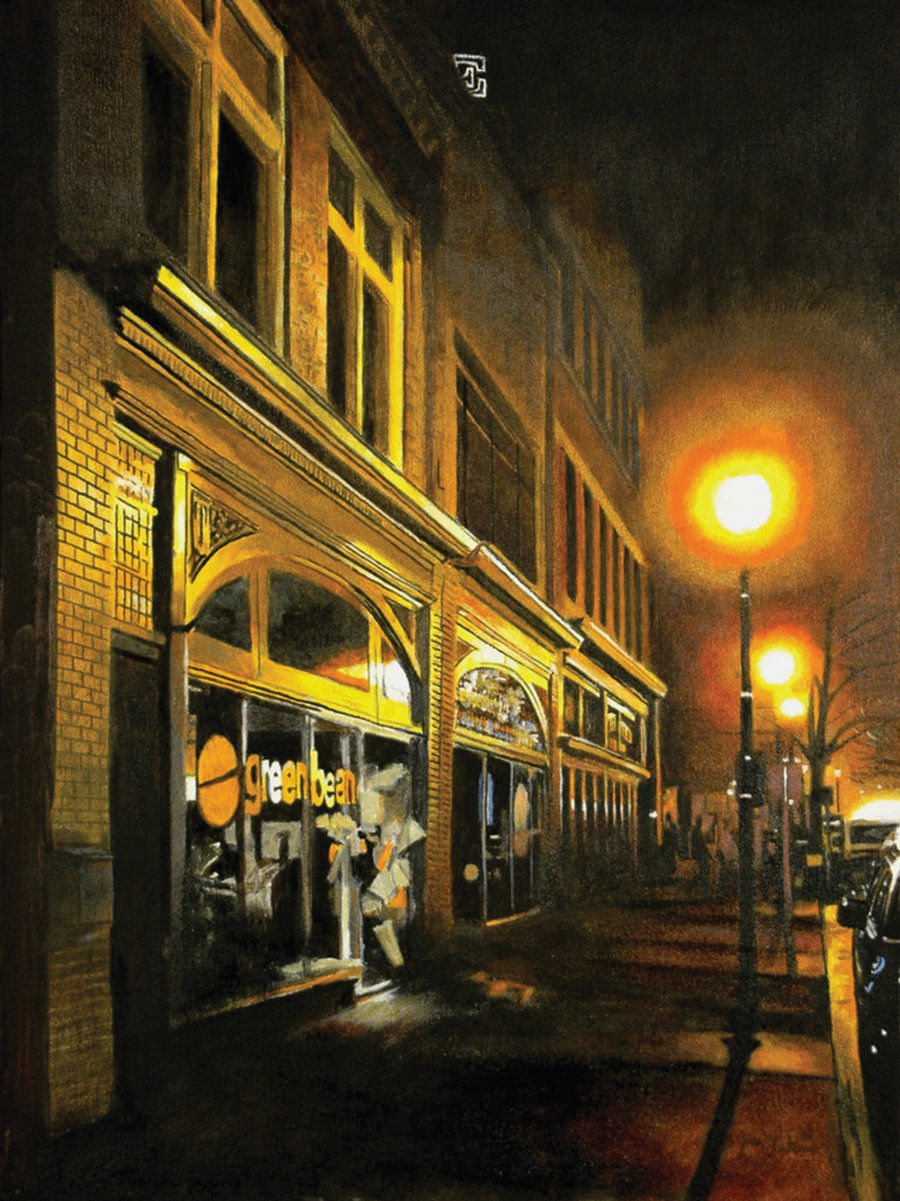
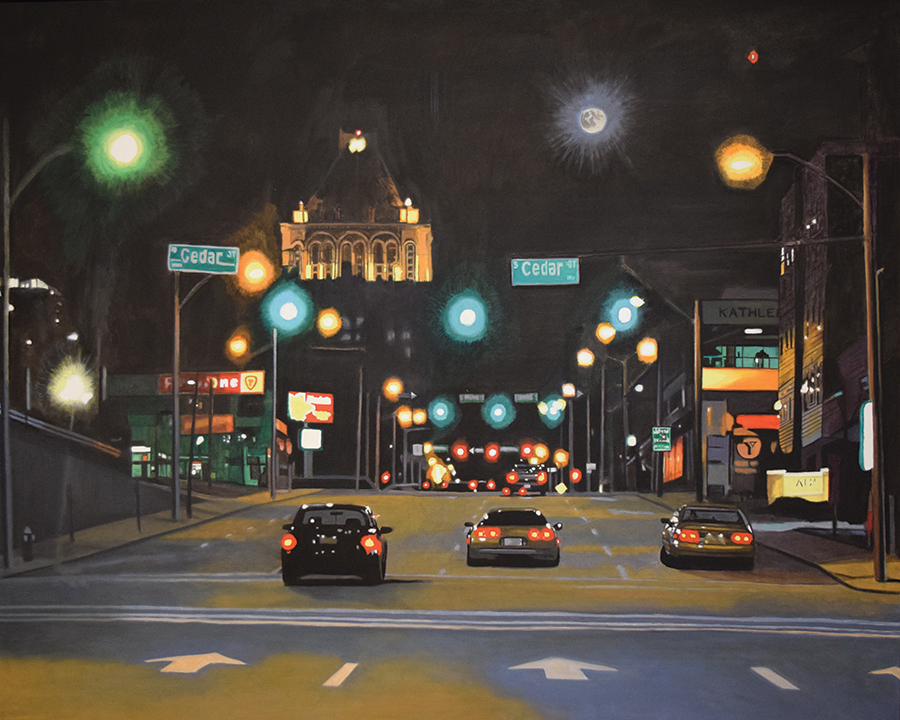
Greensboro, like so many places at the time, was falling into the slumber of the Great Recession, but Lukens still had his equestrian portraiture to keep him going. He was reconnecting with family and friends, ensconcing himself in the local arts scene. With a studio downtown, he took a notion to start painting streetscapes of the Gate City. In one, a ghostly Jefferson Building looms on the horizon. Another depicts the former location of the Green Bean, one of Lukens’ favorite haunts, glowing against a night sky. After his move to Revolution Mill, he would paint its courtyard, painstakingly recreating the individual bricks of the old factory. “I’ve always worked very tightly,” Lukens says. “I guess that’s my Dutch-German roots,” he adds

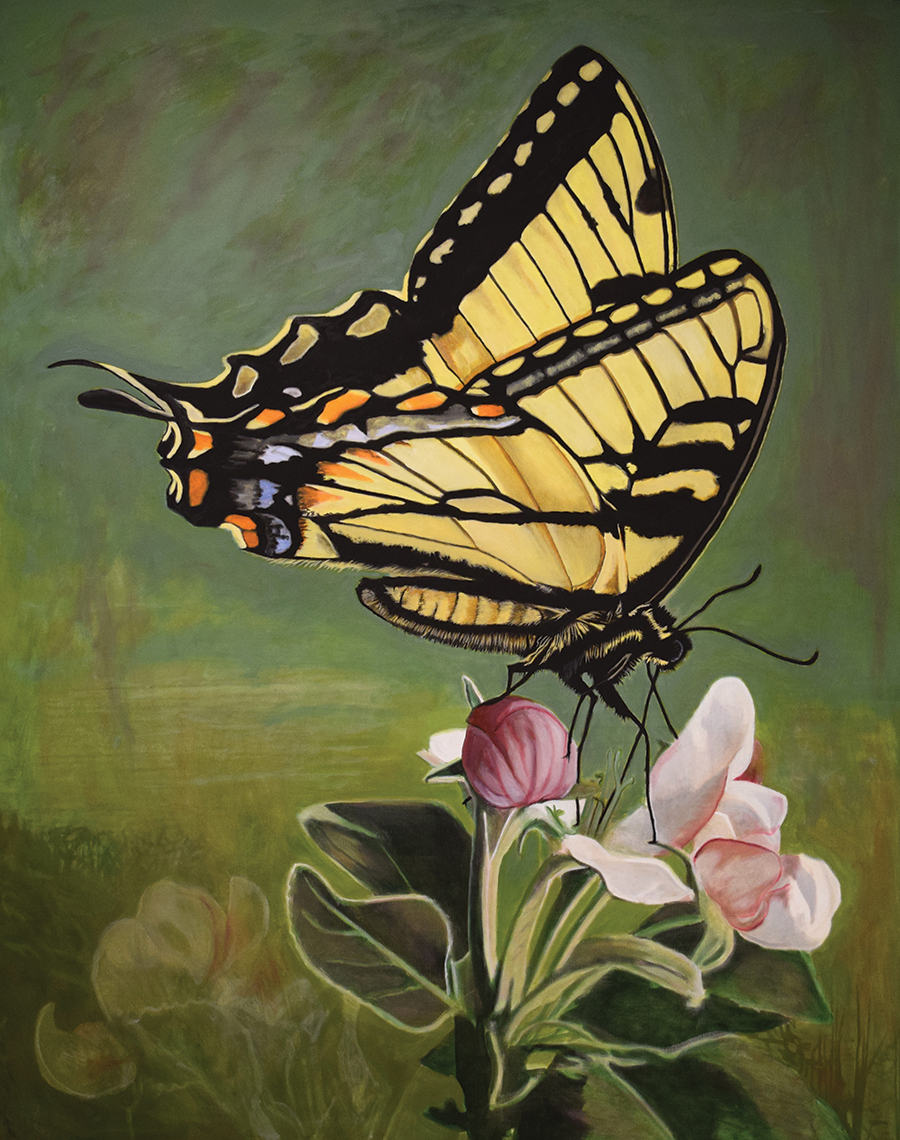
This tendency stands out in a close-up of a butterfly alighting on a flower. The brilliance of the wings, with every marking visible and every vein of a plant framing the foreground, stands in stark contrast to a plain background of dark green. Lukens explains how he had painted out a busier background consisting of hills and woods and a pond that competed with the butterfly. The plainer background makes the image pop. It’s also bears out the artist’s love of oils. Not only is the medium more forgiving, allowing him to paint over something if he chooses to change, it also “creates an aura” or added layer of energy to the painting.

Greensboro, it turns out, is more receptive to these true-to-life works. In fact, the world at large is waking up to the value of representational painting. “It’s huge!” Lukens says, citing a movement called Disrupted Realism, combining representational art with abstract, the vindication in his voice palpable. A major catalyst for the change in attitude? Social media. “I’m there for inspiration,” he explains. “When I have time to work on my own paintings, it’s the imagery that I’m finding on Instagram that inspires me that motivates me to tackle my next painting and how I’m going to tackle it.”

It’s also led him to other artists, such as the five he’s highlighting in a new show, Interiors, which opened last month at Gallery 1250, across from his studio at Revolution Mill. As chronicled in this magazine last fall, Lukens proposed a use for the space originally intended as an extension of Weatherspoon. “One of the things that motivated me to start this gallery: I want to show the best professional painters in the area and showcase them. I want to expose them to people who might not be familiar with their work,” he says. The role of gallery director is uncharted territory for the artist, who estimates it’s taking up about 70 percent of his time. Even so, Lukens carves out enough to sustain the dream that he’s pursued so relentlessly, for, as he says, “It’s the only thing I’ve ever wanted to do.”  OH

Info: janlukens.com; revolutionmillgreensboro.com/gallery-1250

Nancy Oakley is the senior editor of O.Henry.

Model Citizens

For Fred and Kay Ayers, collections are the comforts of home

By Cynthia Adams     Photographs by John Koob Gessner

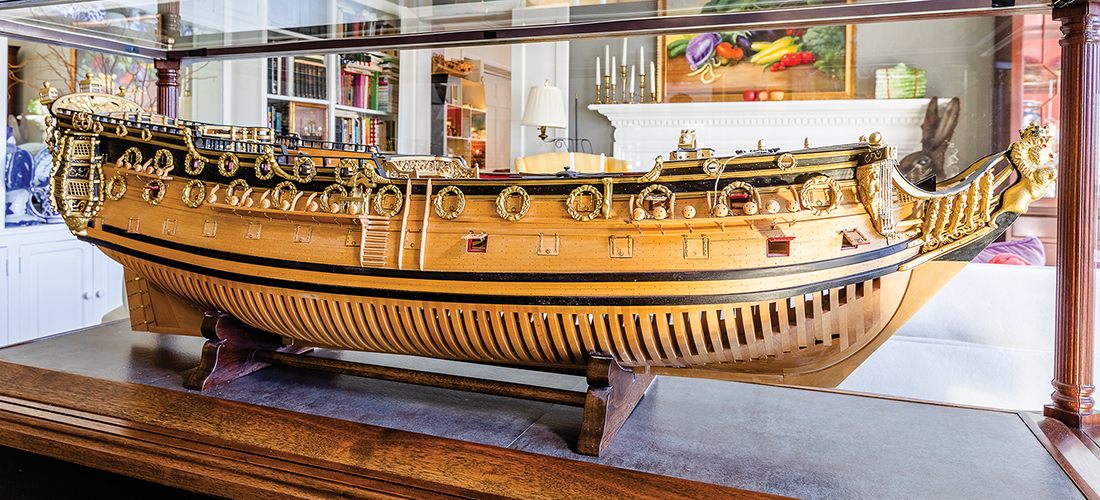
Passion is at the forefront of Fred and Kay Ayers’ Hamilton Lakes home — and at the very center of their lives. Over the past 40 years, the residence evolved to serve the things that matter to its owners— highly crafted scale models of historic planes and iconic ships, plus tiny but incredibly accurate reproductions of rooms.

The two are remarkably involved with their interests.

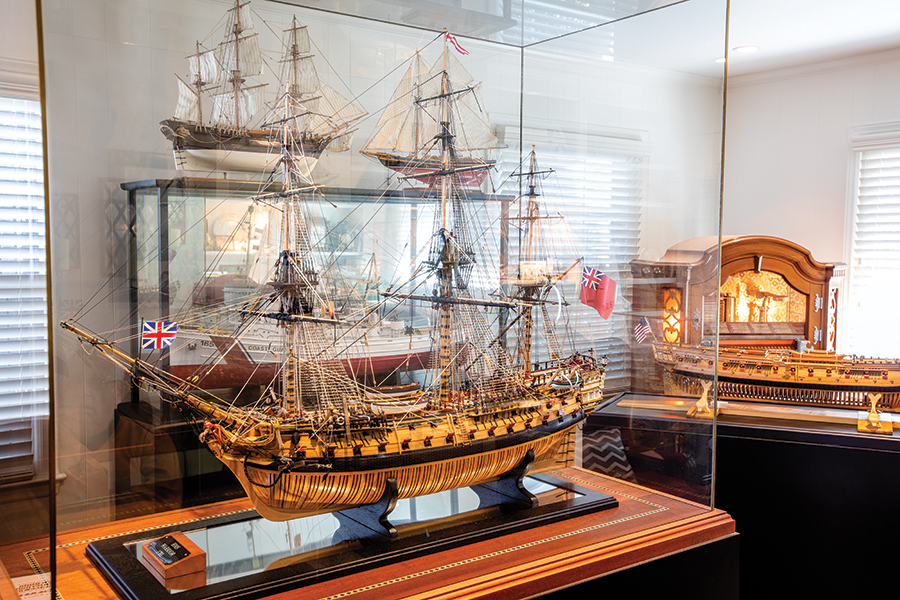
One step inside the door and their passions are unmistakable. Two steps farther inside, where an enormous cabinet contains the HMS Sussex, an English warship lost in 1694, and both Ayers begin to smile. They already know what you are thinking — and don’t care. And, unlike the Victorians’ amazing cabinets of curiosity, this is a home. (Though it should be noted, the term “cabinet” originally meant “room.” 

And the good ship Sussex?  That took years to complete.)

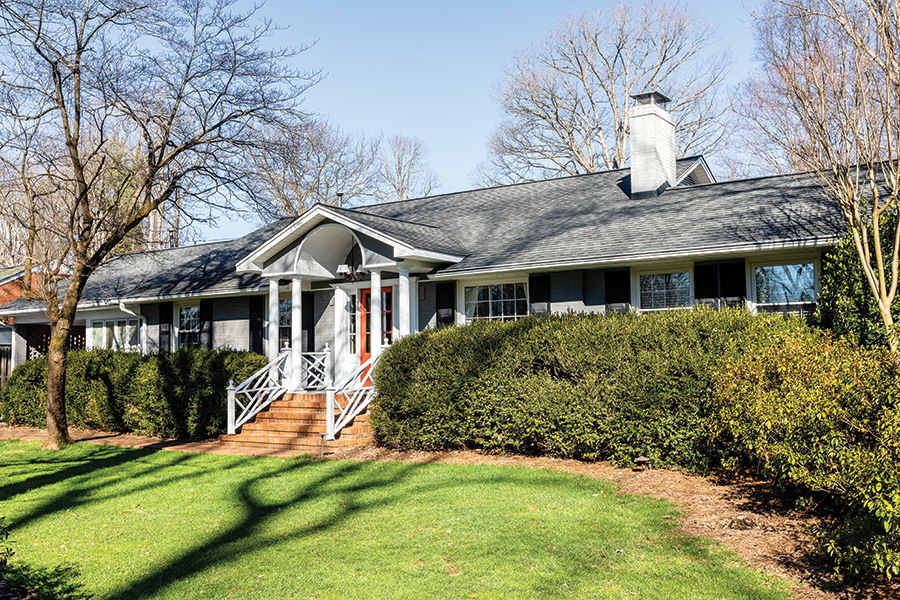
The Ayers’ 3,500-square-foot ranch was already spacious when they first moved there in 1981 as newlyweds, but it has been added onto seemingly to accommodate the owners’ hobbies and collections. Giving new meaning to the term “project creep.”

Today, the Ayers’ house and property are almost as much a museum as a home that represents a capacity to create and live with their hobbies and collections in an exuberant way. Like the Isabella Stewart Gardner Museum in Boston, or the Frida Kahlo home in Mexico City, the house exists not only as a residence, but to house what the resident collectors valued most. The Ayers give new definition to collector; they are also makers who have given themselves over to their interests.

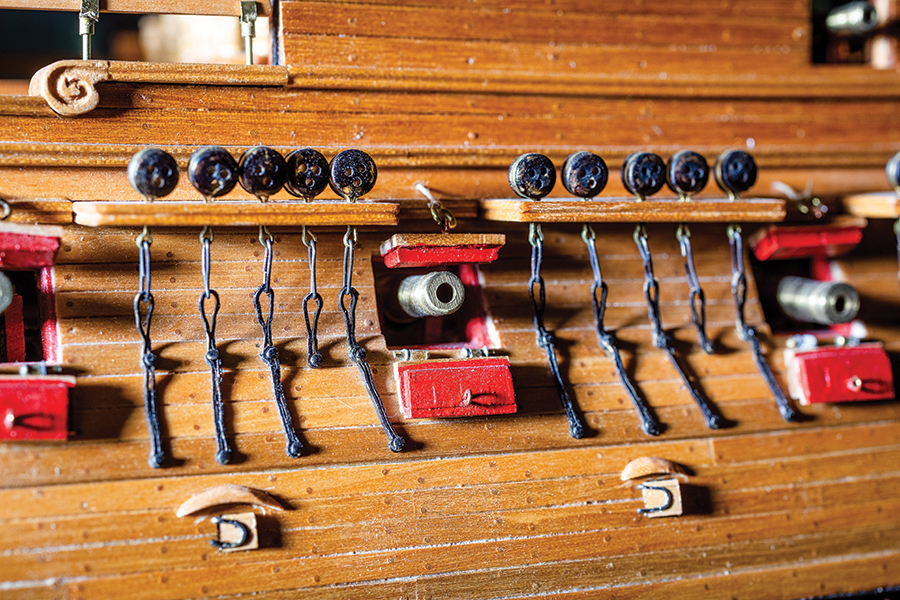
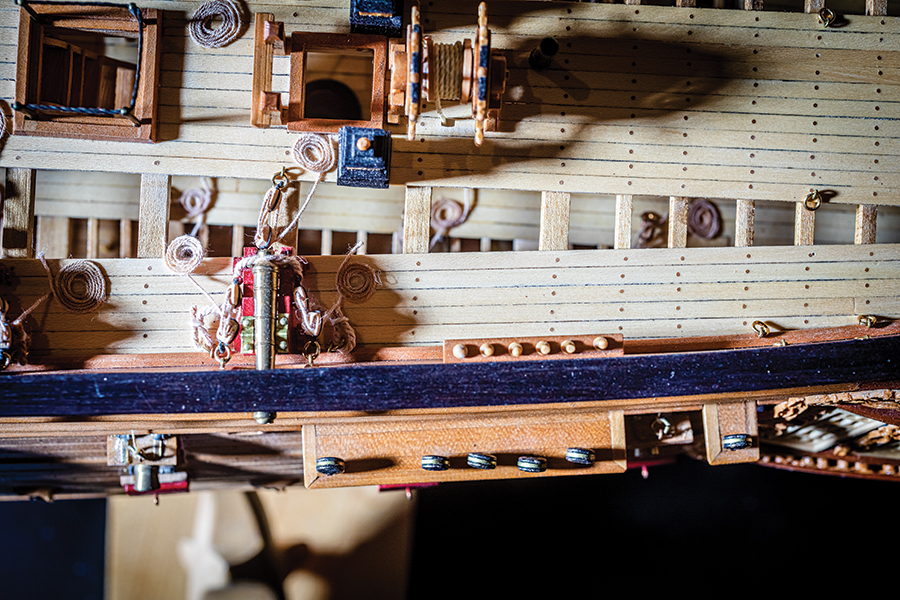
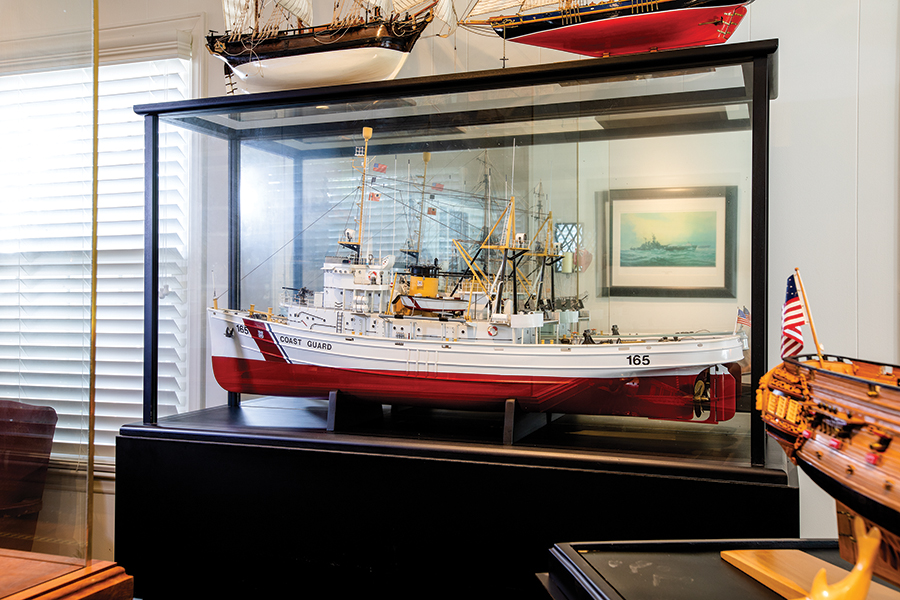
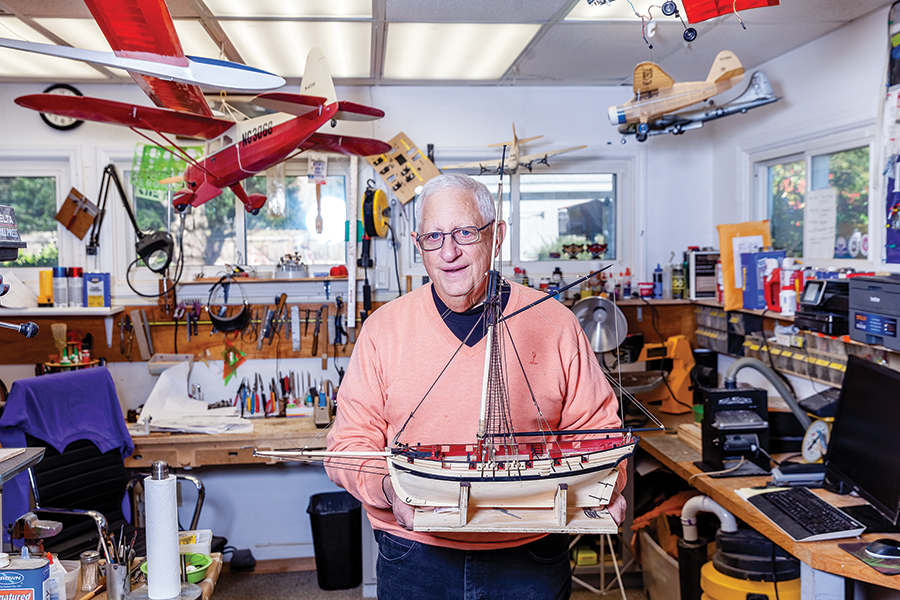
Models, created by Fred through countless hours of painstaking precision, are jaw-droppingly detailed, scale replicas of ships of various types and vintages. They bristle from wooden and glass cases. Handcrafted models of planes hang from the ceiling. These creations are museum-worthy. In fact, two of Fred’s models are in museum collections in the Wilmington area.

“On a normal day, he goes to his (work) room and works on something, and I do the same,” says Kay. But the boat models, she says with evident pride, “are what people need to know about. They’re museum-quality. He’s an artist.”

“Aw, shoot,” Fred scoffs. “There’s always somebody better than you.”

Each room of the Ayers’ home, from the entry to the gardens beyond bears the indelible stamp of the Ayers’ obsessions. Over time, the house had to change to accommodate their collections, not the reverse. Rather than moving on, they called the contractor.

“We kept adding on,” says Fred. “But the first thing we did was to put in the swimming pool.” 

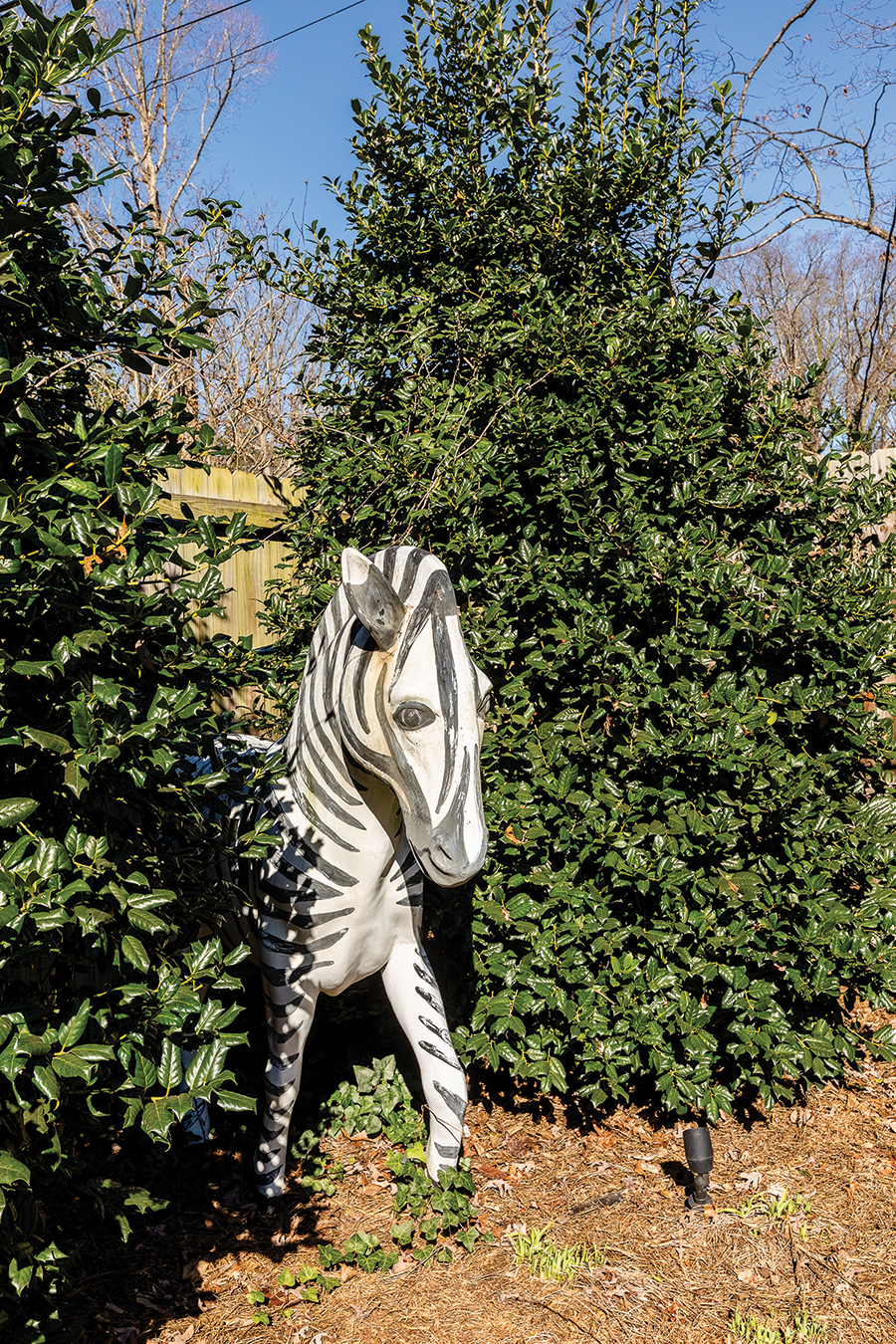
The swimming pool is just off the den at the rear of the house. It, by the way, is surrounded by four oversized fiberglass animals from a former miniature golf course on Battleground Avenue that the couple had invested in. 

“We bought the franchise for the golf course,” says Fred. “We brought four of the animals here and three are in the country,” he says. (They’re installed where they can enjoy the great outdoors at the Ayers’ getaway near Siler City). 

He jokes wryly, “that’s about all we got out of it.”

Kay says the elephant was sitting right outside for several years. 

“Our neighbor, David Kriegsman, said he missed the elephant when we moved it with the giraffes to the country.” The couple add the details, shaking their heads, both chuckling.

But room after room showcases hand-built collections that span their lifetimes.

Kay calls one room the “JV — junior varsity — room” as it contains the boat models that are kit-built. “The other is the Varsity room — for scratch-built models.”

Much like cameo carvers who sacrifice precious vision to their art, it’s impossible not to wonder how Fred Ayers has any vision remaining at all. 

The simpatico collecting couple came from different backgrounds — hers is finance, his is the family business, Colonial Vending Company. (More about that later.)  He’s a Carolina fan. She pulls for Duke. 

Yet they bonded like, well, glue, over their shared passion for creation.

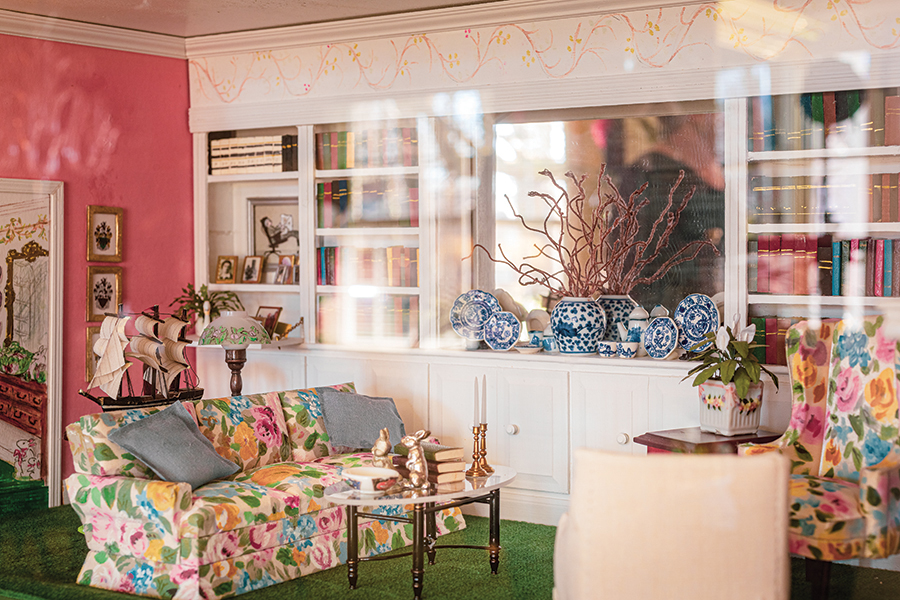
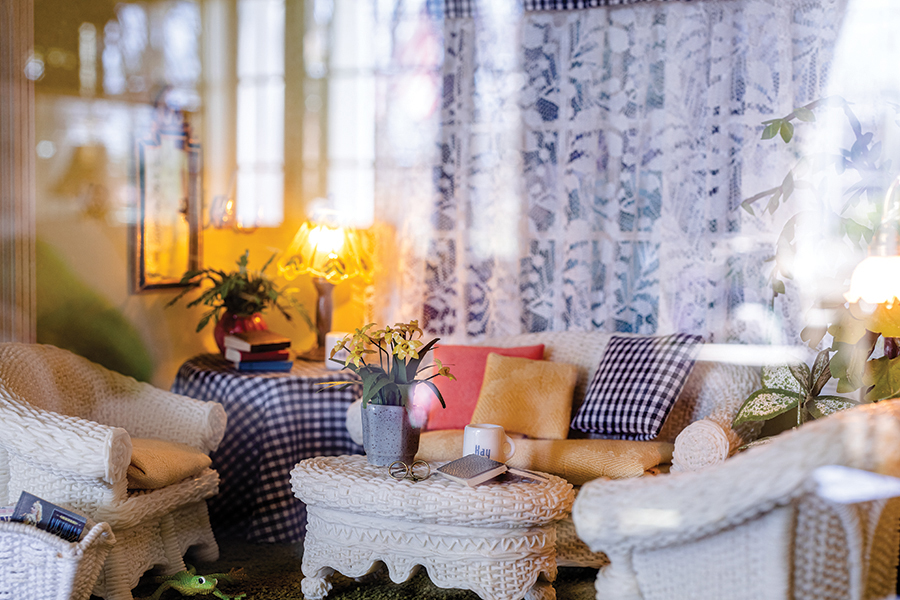
“Kay’s an artist. Has a lot of good ideas,” says Fred Ayers. And by George, she can execute those ideas. Proof of this — seven glass-encased miniature rooms she created in intricate detail — much like the ones Otto Zenke designed still exhibited at the Greensboro History Museum.

She half-heartedly explains that she stopped producing them due to lack of display space as Fred’s prolific model-making expanded.

The rooms are proof of a latent artistry Kay developed after retiring from the State Employees Credit Union, which she managed. Her mother, Ella Lewis Cobb, was an artist, who sold depictions of family coats of arms, and commissioned pastel portraits. Her works are scattered throughout the house, as well.

Cobb also painted several faux details in the Ayers’ home, including a bathroom that Kay jokes “I can never change.”

Ayers’ father, Fred Sr., developed the family business, which included amusements and music (including video games, juke boxes, you name it.)  His father was originally a bank teller. When he left banking at age 45, he bought a jukebox route. Fred Jr. was only 5 at the time, so he grew up with vinyl records and developed a full initiation into amusements. He joined the family business part time at age 16 in 1963 before attending college, as the business morphed into the Fred Ayers Music Company. 

“The shop was on Greene Street, next to a Scott Seed,” says Fred. “It later moved to Chapman.”

Today, the 76-year-old business is known as the Colonial Vending Company.  It remains under the auspices of Fred Jr.

He points to a 1949 Wurlitzer. “We saved it off the route; we used to drive them [jukeboxes] to the dump.”

It is a symbolic collectible, a still-working reminder of the jukebox origins of a business created by his father.

Yet since childhood, Fred immersed himself in creating scale models. He found helping hands in the neighborhood and also downtown. 

In the 1950s, the Ayers’ family lived on Wright Avenue in Sunset Hills. “We moved to Audubon Drive in 1954, after Hurricane Hazel,” he says, not due to storm damage, although he remembers downed power lines around the former Ham’s restaurant on Friendly.

He most fondly recalls mentors in the neighborhood and downtown near his father’s business. One, named Bob Foster, lived on Wright. He was a librarian by vocation, but “messed with model airplanes.” 

“We’re still friends,” Fred says.

Then another key influence was Harold Bunting, who owned a hobby shop.  “He was upstairs over the Coble Sporting Goods store downtown.”

Bunting would help kids learn, Fred says. “He helped a lot of kids with models, helping them build. He dedicated himself to helping kids.” Now, Fred “loves to see kids get into working with their hands.” 

Young Fred spent hours helping neighborhood fathers building pinewood derby cars, while assembling his own plastic model airplanes in his attic. He spent much of his spare time scavenging for supplies to repurpose. 

“I went to construction sites and asked for scrap.”

Come Christmas, young Fred would ask for tools. “A hammer and saw.”

Now his workshop contains every tool, gadget, and necessity a kid could dream of owning.

On a winter’s afternoon early in January, an oversized truck in the couple’s driveway was backed up to the street with a handwritten sign indicating that UPS should leave packages there. The Ayers were about to go check out a collectible in Florida that interested them.

Meanwhile, a Ferrari sat nearby under cover, quietly minding its own business and managing to keep a low profile, hemmed in behind the no-nonsense truck. A chainsaw whined farther down the street, a pleasant, albeit ordinary, tree-lined thoroughfare.

Except, the sign on the truck is a mystery that deepens later, as most of the deliveries to Fred Ayers are wee supplies extremely small in scale — the odd bits and bobs he needs to complete replicas. Hardly large enough to need a truck bed.

Of course, Fred sources many things online, even the rare cars he admires around the globe, locating one in South Africa. So, it’s not necessarily the case that all packages are small.

As an adult, the maturing Fred moved onto the real thing — enjoying big boy’s toys.

Fred Sr. liked statement cars, which must have been an influence. 

“He owned a pink T-bird with a black interior,” Fred remembers. “My first car was a [Datsun] 240 Z, white, acquired in the 1970s when they first came out.” He wishes he still had it.

(“His tastes are more expensive than mine,” inserts Kay. “He would keep everything he ever had if he could,” she adds.) 

And Fred has a need for speed. “My nerves are very good,” he grins. 

Good enough to corner the red 1990 Ferrari in the carport. “It has 16,000 miles on the odometer,” he offers. 

And certainly, good enough to drive a Ford G 240 replica, the same as the one depicted in the recent Oscar-winning flick, Ford v Ferrari. He has owned or still owns two MGs, BMWs, Porsches, a Lotus, a 1967 Mini Cooper S and a Daytona Cobra, also a kit car. 

“I got the GT40 from South Africa,” Fred says. “Built as a 1966 replica. Shipped in on a container.”  There have been other exotic cars in his past.  “I had a Lotus Super 7, and traded it for a 2005 Mercedes.”  He calls the Mercedes “Kay’s car,” yet he drives it to the office, she points out.  Meanwhile, Fred wishes he had the Lotus back. 

The couple also acquired more mainstream cars, like Navigators, Tahoes, a Lexus, and even Ford trucks.

But the GT40 Ford, the replica, is Fred’s current favorite. 

“I want to find a Morgan,” says the tireless collector of rare cars. He keeps several cars in the country where the couple often spend weekends. Here, a garage and other buildings have slowly evolved into a country place with a water view. 

Over the past 40 years, Fred Jr. has built more than 50 plane and boat models. One, a one-eighth scale replica of North Carolina’s most famous battleship is now owned by the N.C. Port Authority and on display in the Roll of Honor room inside the ship at the USS North Carolina Battleship Memorial.

That replica was nearly three years in the making.

Fred began working on the battleship model in the kitchen in 1991, taking multiple trips to Wilmington to study the actual ship while the work progressed. He photographed and noted, even memorized, details of the ship on repeat trips to the USS North Carolina, now permanently docked. 

A catalog photo first caught his eye. Then the real thing proved it would be a worthy challenge.

Eventually, the sheer size of the battleship model overtook the kitchen. This prompted the couple to add on the workroom at the rear of the house because, Kay smiles, “He needed a place to work and we needed a place to eat.” 

It was challenging, even though Fred used a pre-made fiberglass hull and superstructure. He assembled all else, which included decks, towers, even guns. The Ayers rented a van and drove it to the Port Authority in Wilmington in 1993 on New Year’s Eve. 

The van was of necessity; the cargo was too large for their car — the finished model was 91 inches long, 13 inches wide, and 24 inches high.

News accounts reported on a gift that both Fred and Kay downplay.  The News and Record wrote about the replica:

“The detail is astounding. Tiny life preservers, fire extinguishers, fire hoses and nautical flags dot the gray exterior of the ship. At the stern, two OS2U Vought Kingfisher seaplanes stand ready to zoom into the wild blue yonder. Nearby are two cranes which were used to pluck the planes from the sea and return them to the ship.”

That was nearly 30 years ago, Fred protests, batting away praise. Many, many projects ago.

He built a Liberty ship and donated it initially to the Bellamy Mansion, also in the Port City.  “I think it is at the Port Authority. I loaned it to them, then later just left it with them.” Frankly,” Kay adds, “We’ve got nowhere to put it.”

Fred also built troop transport ships, a submarine and other historically precise ships of many types and eras. 

A loosely organized group of model builders, including retired doctors and artists, meet for what Fred calls “show and tell.” The craftsmen live in Southern Pines, Raleigh, Beaufort and Matthews.

“We try and get together every couple or three months. Last month we met at I-Hop in Clemmons. We talk shop.”

That prompts him to mention, “Everybody wants to see each other’s shop, and sometimes that’s where we meet.” He adds that there are a lot of doctors who create models.

“They’re good with their hands.” Also, exacting. 

Although he was never a sailor, the Chapel Hill graduate served in the National Guard in 1970.

All the while, Fred explores full-size cars, planes and now even full-size ships. He recently built a boat — “a big one” Fred clarifies. It is a “Chris-Craft type mahogany one.” He points out the name painted on boat’s stern: Miss Kay.

As for collecting, it isn’t sated.  Fred has his eye on a 2002 Morgan, a rare car built with a partly wooden frame. He pulls up an image of the roadster online; it is now in Savannah, Georgia. It’s probably the same one he nearly bought years ago, and he is itching to call the owner.

Meanwhile, their Amazon blue-front parrot, 19-year-old ironically named Byrd, calls to him reproachfully, as if chiding: “Fred. Fred. Fred.”

Fred looks away from the coveted Morgan on the computer screen to answer. “What Byrd?”

It was a rhetorical question; Byrd doesn’t respond.

And Kay shakes her head, grinning.  OH

Cynthia Adams is a contributing editor to O.Henry. Her first car was a rusty powder blue Corvair, bought from Preacher Lanier — the same car made infamous by Ralph Nader’s Unsafe at Any Speed. Meanwhile, her Dad drove a Chevy pickup and her mother’s sled was an Elvis Presley pink Cadillac.

February Poem

The Arrow

I tried to explain Cupid to a 4-year-old today. 

He was making a Valentine for his grandmother, 

festooning a pink paper heart with stamps and stickers, 

writing ‘I love you’ across it in big, shaky letters. 

Then he asked about one of the stickers: 

Why does that heart have an arrow through it? How sad.

Even after I told him that it was more like being ‘struck by love,’ 

he held his hand over his chest. 

I don’t want Cupid to shoot me, he said. 

That would hurt.

I couldn’t disagree.

— Ashley Wahl

Creative Crossroads

For artist Kelly Rightsell, home is an ever-changing canvas

By Nancy Oakley     Photographs by Amy Freeman

I always have this feeling: It would be great to have this blank place to work where there are no distractions,” Kelly Rightsell admits as she starts a tour of her house near Latham Park, her boisterous yellow Lab, Mary following close on her heels. “I do go through and try to get rid of stuff.” But with her youngest son, Ben at home and a full plate teaching art part time at Canterbury School, the artist admits it’s hard to find the time to “scale back” and start purging. “I probably need to but haven’t,” she adds with a self-deprecating chuckle.

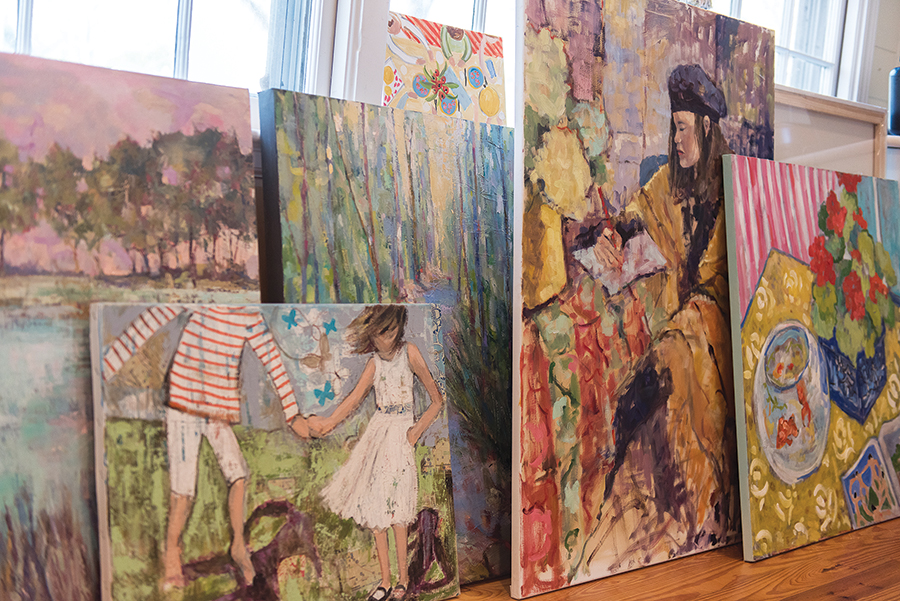
But where Rightsell sees a “mess” in her light-filled studio, converted from a screened porch on the second floor of her home of 20-plus years, a casual observer immediately sees a colorful explosion of the artist’s restless muse within. On a compact work counter, jars of paints and paintbrushes flank a small landscape in greens, pinks and grays; more canvases reminiscent of Matisse or Cézanne are propped up on easels or a counter on the wall opposite — a colorful interior scene here, a seascape here, an abstract or figure painting there. Tubs of paints and other tools from the artist’s toolbox and stacks of vintage children’s books, such as a dog-eared copy of Uncle Wiggily, (named for the floppy-eared rabbit and main character of popular kids’ books at the turn of the 20th century) fill a couple of bookcases.

The art supplies and books are a telltale indication of the long days Rightsell and her husband, Brian, put in for nearly 15 years: creating and selling a line of wallpapers, trim, rugs, ceramic sets, among other items, for children’s bedrooms under the handle Kelly Rightsell Designs. “This is my wallpaper book from years ago,” she says, flipping through a tome of pages with patterns featuring fanciful animals rendered in a light hand — rabbits, bears, lions, frogs — in various settings. “This was one of my favorite ones,” Rightsell says, pausing at a page depicting a cheerful menagerie in an entirely blue palette reminiscent of Delft china. “Then we did catalogs,” she continues, picking up a publication from the late 1990s that includes one of her earliest designs: an elegantly rabbit clad in a Harlequin suit, replete with ruffled collar, and a companion print of an elephant.

Rightsell designed the prints about 25 years ago, shortly after her first son, Owen, was born, when the family was living in Kirkwood. “I couldn’t find anything I liked for his nursery,” she recalls. She remembered that her high school art teacher in South Carolina had created prints, so Rightsell reached out to her former instructor and figured out how to mass-produce her own paintings. She and Brian then took them to the gift show in Atlanta. “And we sold $10,000 worth of art,” she remembers. Tapping into an unfilled niche, they expanded the line to include rugs and other home accents sold through children’s specialty stores. The business thrived, with Kelly on the creative side of it and Brian tending to daily operations and marketing. “It was really a neat thing. We could do it together,” the artist reminisces. “We had so many stores all over the country . . . and they just all went out of business.” The Great Recession would require the Rightsells to create a new life.

But recreating and revising is part and parcel of any artist’s journey. The family had by then moved to their forever home near the park. Early on, Kelly used its standalone garage as her studio, but relinquished it to accommodate an addition to the side of the house where a spacious den is now situated off an equally spacious kitchen. “Now I kind of miss my studio,” she says, her easygoing laugh returning. “I mean, I love this room, it’s nice. But you know how it is, the grass is always greener.”

And who wouldn’t love the airy space, thanks to a series of long windows that let in the afternoon light? Or the comfy sectional and oversized ottoman, animal print cushions, which, along with more of Ritsell’s paintings, many of them abstracts, lend a collective vibe to the classic room with its handsome built-in bookcases? On these are several volumes, family photographs and a series of charming painted, wooden figures. “An uncle carved these people,” Rightsell says, pointing to yet more figures occupying a shelf in a nearby hutch. “We have a whole lot of artists in the family,” she adds, reeling off a South Carolina cousin who makes jewelry, another who paints portraits, and her own daughter, Kathleen, who’s eyeing a career in art therapy. And then there’s Rightsell’s mother-in-law, Helen Farson, who lives in Greensboro, who is also a working artist. The two have taken painting workshops together and often joke that “Our children aren’t going to get anything but art when we die!” Kelly says, laughing yet again. “But that’s fine with me; I love art.”

So it will come as no surprise that there are D.I.Y. projects waiting in the wings all around the comfortable house: maybe reverting the dining room just off the front hallway back into a den, as it was when the Rightsells first moved in. “It is so cool to have that fireplace,” Rightsell says of the wood-burning feature. She would have to find another place for her grandmother’s furniture — a long dining table and chairs, and a stately china cabinet atop of which sits a smirking Staffordshire dog, both traditional counterpoints to the more casual straw rug, a chandelier from the Red Collection, yet more of the artist’s paintings and what’s this? An old-timey brass cash register perched on a sideboard? “My grandfather was a barber and had this in his barbershop. I couldn’t get rid of it,” Rightsell says, mentioning her fondness for estate sales, dating back to visits to flea markets with her grandparents and cousins. “I’m sure nobody has one in their dining room,” she adds wryly. “But I can’t get rid of this stuff.”

Of course not. It’s fodder for that restless muse, who deems the house as much a canvas as those used for Rightsell’s paintings, including the latest inspiration that has taken hold of the artist’s imagination: one day painting a mural in the front hall with motifs of trees and birds similar to those on a chinoiserie vase or screen.

But that will have to wait, like a lot of other things, although she loves teaching art to the kindergartners, first-, second- and third-graders at Canterbury. The part-time position is the perfect solution for now to the demise of her design business post-recession (Brian has since gone on to work full-time in sales at Browns Summit’s paper-and-packaging giant Morrisette). “It’s nice to have that rejuvenation being around kids,” she says of her charges’ unbridled creativity. She nourishes their budding talents by submitting their works for publication in the newspaper from time to time, recalling the thrill of her own work published when she was a girl. And her efforts are bearing fruit: Their works caught the eye of Downtown Greensboro, which will reproduce them on electrical boxes downtown as a part of a student art project. “They’re so excited!,” Rightsell says, channeling their enthusiasm.

She has worked with her students on other community projects, such as soon-to-be-unveiled mural in the women’s wing at Cone Health and a painting auctioned off at the annual JDRF gala a few years ago. Rightsell describes it as an “Impressionistic background” consisting of thumbprints of children with Type 1 diabetes that set into relief figures drawn in her own hand. “I was really nervous,” she says of the gala, “because it was a live auction.” She needn’t have been: The painting sold for the tidy sum of $7,000. “I’ve always wanted to do stuff that helps or affects children,” Rightsell adds. “It’s a great thing to be able to use your talents.” She’s also lent her artist’s brush to United Way of Greater Greensboro’s Handbags for Hope, along with Hands for Hearts, a nonprofit founded by her good friend Kathleen Little, that supports research into congenital heart defects.

Even so, her muse keeps calling. “Our business was great when it was going,” Rightsell reflects. “But I’m trying to figure out the next big thing,” she says. “It’s such a big range, the things that I do,” she says, nodding at a figure painting of four young girls standing against an open sky, their backs to the viewer. And there may be yet another turn in the artist’s path owing to the one vestige of her children’s line: needlepoint kits for Christmas stockings. Holding up a pattern adorned with a congenial, smiling bear, Rightsell explains that she’s had several inquiries about the festive items.

Like any artist, Rightsell expresses what’s in her heart, but having run the design business for so long, suppressing her entrepreneurial instinct is challenging. “What do I want to paint without thinking: ‘What does somebody want? What’s cool?’” Rightsell posits. “It’s hard for me to shut that off, because for so long that’s what I did: What do I have to have new for the next season?”

Whatever it is — a rabbit, a frog, a smiling bear — she’ll surely pull it out of her hat to the enchantment of all . . . including her mutable but never muted muse.  OH

Info: kellyrightsell.com

Nancy Oakley is the senior editor of O.Henry.

The Love Connection

Avid Aggies and organic farmers. Foodies and Philanthropists. High school sweethearts and high-stepping seniors. Meet five couples who share a common passion — and the joy of being together.
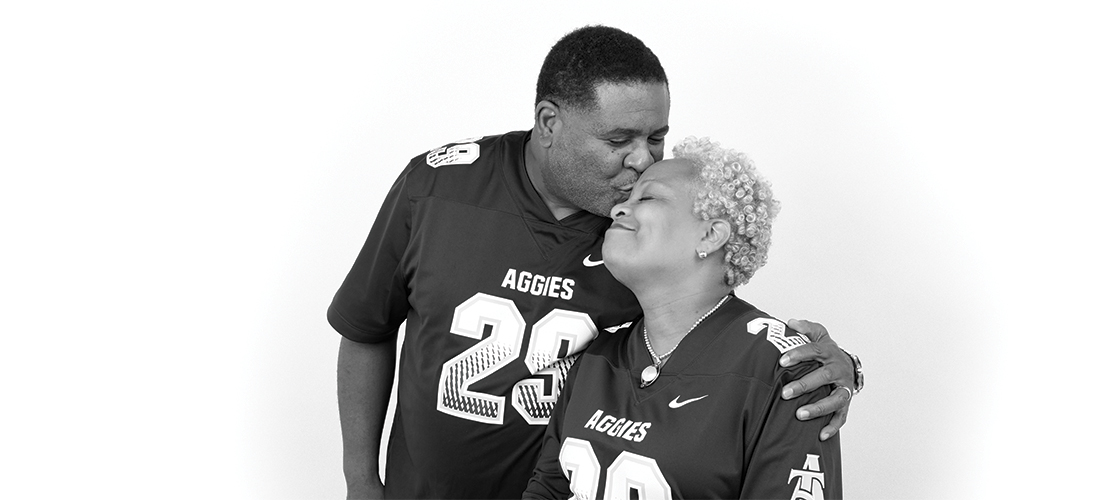
True Blue & Gold Aggie Love

Frank & Vicki McCain

By Jim Dodson     Photographs by Mark Wagoner

Frank and Vicki McCain are living proof that timing is everything in the mysterious ways of love.

They met 38 years ago when both were high school students attending a gathering of North Carolina student councils in Raleigh. Frank was president of the statewide organization and president of his senior class in Charlotte. Vicki Hinton was senior class president at Rocky Mount Senior High School Down East.

“He was wearing a Kelly green sports coat and looked so confident and handsome,” she recalls with a laugh.

“Oh, you better believe I noticed her too,” says Frank with a chuckle.

One year later, they were both freshmen at North Carolina A&T State University. Vicki was rooming with a girl from Charlotte, planning to major in accounting. Frank was studying marketing and management.

“One evening there was a knock at our dorm door and there was Frank McCain,” she remembers.

“You’re that girl from Rocky Mount,” Frank said with a smile.

Their love affair began — as many enduring ones do — with a strong friendship, time spent in classes together and conversations around campus.

Two years later, Vicki was attending the Aggies’ away football game against N.C. Central with friends from back home, when Frank happened to be there. He offered to drop off her friends at their campus in Durham after the game and give Vicki a ride back to Greensboro. 

Dropping her off at her dorm, he boldly asked to kiss her goodnight.

“Naturally,” she says, “I said no.”

Frank McCain is living proof that faint heart never won a fair maid. He kept asking Vicki out, and she finally consented to a first date to Chi-Chi’s Mexican Restaurant in the spring of 1986.

On the drive back to A&T, Frank calmly spoke from the heart. “I want you to be my wife,” he told Vicki. “And I want you to have my children.”

She was sure her was joking. “I laughed till I cried,” Vicki remembers. “We were just great friends at that point.  I couldn’t believe he was serious. But when I looked at him, he wasn’t laughing.”

“We’ll see who gets the laugh,” Frank said with a stoic shrug.

Upon graduation in ’87, she took an accounting position with Cargill Corp. in Memphis, Tennessee. Frank went to work for First Union Bank in Greensboro.

During one of his visits, Vicki informed him that when he left, she was going with him. A more promising job awaited her in Richmond, Virginia. They loaded up her Chevette with her belongings and headed home to Rocky Mount. Vicki soon moved on to Richmond.

From December of 1987 to late summer of ’89, the couple managed to see each other every weekend. During a weekend visit to Georgetown, Frank proposed marriage. Vicki told him she needed to speak with her mother, Lucinda “Miss Tab” Hinton, who affectionately called Frank “Hotdog” because of his name. Vicki also said she needed to pray on the proposal.

They got married August 12, 1989, at Vicki’s childhood church in Rocky Mount. It was really the first time Vicki had a chance to get to know Frank’s extended family.

Something lovely happened before the service. Vicki was all alone in a room, dressed in her wedding gown and watching guests arrive, when there was a knock at the door and Frank’s father, Franklin McCain Sr., stepped in to have a quiet word with the bride.

Franklin McCain was an American icon, one of the four brave A&T State freshman who staged a peaceful sit-in at the Greensboro Woolworth on February 1, 1960 — a moment broadly regarded by historians as a key moment in the birth of the nonviolent American Civil Rights Movement.

“He knew I was nervous and calmly told me ‘You look mighty pretty, Sugar.’” McCain then asked her if she was absolutely sure she wanted to marry his son, she recalls. “He explained that marriage is a serious commitment and that if I had any doubts I was free to change my mind.”

She didn’t. This pleased him. “Big Daddy was such a wise and reassuring man. That meant so much to me. We became such close friends.” 

After the couple exchanged vows, the groom couldn’t resist a gentle dig. “I guess I got the last laugh after all,” he told Vicki with a chortle. 

Today, Frank McCain carries on the family tradition of public service as vice president of United Way of Greater Greensboro, and Vicki serves as pastor of the Presbyterian Church of the Cross on Phillips Avenue and works as a royalty auditor for Centric Brands. Both are deeply involved in A&T alumni affairs and athletics.

In fact, three generations strong, they may be the poster family for Aggie Blue and Gold.

After graduating from Ragsdale High with high honors (serving as homecoming queen, varsity head cheerleader and student government president as well) daughter Taylor, 25, attended UNC-Chapel Hill and today works as operations manager for a major snack company in Miami.

Son Frank III — whom everyone calls “Mac” — a graduate of Dudley High Academy, is a star footballer whose key interception in the closing moments of the 2017 Celebration Bowl led to MVP honors in a win over rival Grambling State and a perfect 12–0 season for the Aggies. The redshirted McCain picked up two All-America honors and snagged eight interceptions during his first two years, running two of them back for touchdowns, including a 100-yarder against East Carolina for the victory.

Last December, Mac McCain helped guide the Aggies to their third straight HBCU national title with a third consecutive win over Alcorn State at the Celebration Bowl in Atlanta. After battling food allergies and injuries, he is now in graduate school at his alma mater studying agricultural business and preparing for a fourth season in Aggie Blue and Gold.

“We are blessed to have children who are such good people,” says Pastor Vicki. “We’re also proud to be part of the A&T community, which is really our extended family.”

“A&T allowed us all to grow,” agrees Frank. “It’s who we are — and who we will always be. Aggie pride is nationwide!”  OH


Providential Pairing

Katie Clark & Branyon Spigner

By Maria Johnson     Photographs by Bert VanderVeen

If they get married as planned, Katie Clark and Branyon Spigner won’t have to worry about becoming one of those couples who start to look like each other.

They already do.

With their broad, easy smiles, their clear blue-green eyes and their rosy 19-year-old faces, they could be mistaken for sister and brother.

“I’ve had people say to me, ‘You’re like the same person,’ “ he says.

Their differences stood out the first time they met — or became aware of each other.  They were in seventh grade, doing a walkathon on the grounds of Mendenhall Middle School in Greensboro. Katie was strolling with friends behind Branyon, who, having already experienced a growth spurt, was 5-feet-9-inches tall, by far the biggest kid around.

“I was like, ‘Why is there a 16-year-old at our walkathon? And what’s his name again?’ I couldn’t say his name,” Katie recalls.

It’s Branyon, rhymes with canyon.

They had English class together the following year.

“I remember, I heard her talking about a Christian football movie, When the Game Stands Tall. I was like, ‘Hey, I love that movie,’” he says.

They were too shy for conversation in person — she hid behind a locker door to avoid making eye contact with him in the hall — but they struck up a friendship by texting, mostly about their faith in God.

When Katie’s friends threw a surprise party for her December birthday, they invited Branyon.

“Most people gave me gift cards,” Katie remembers. “He gave me a plaque with Proverbs 3:5.”
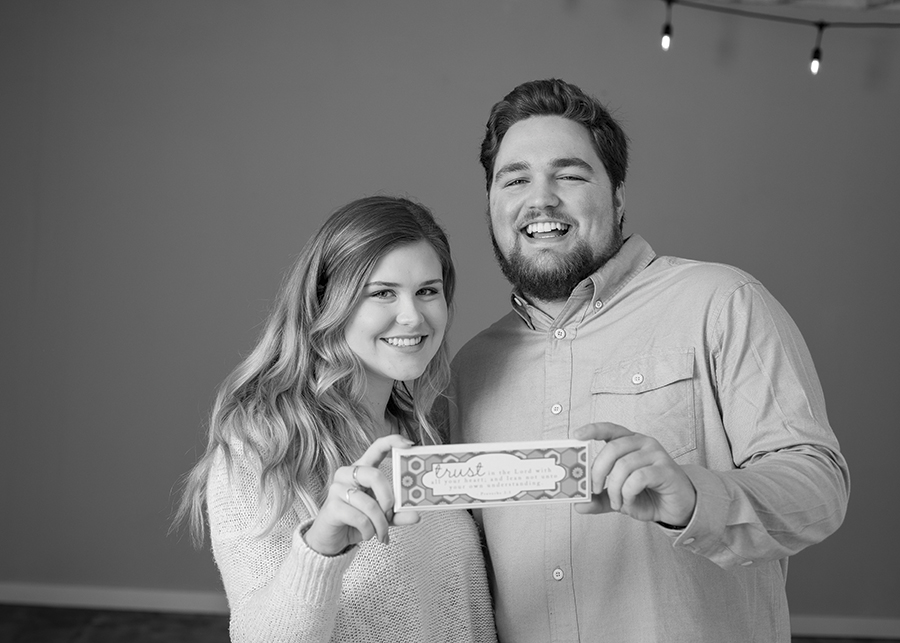
Trust in the Lord with all your heart and lean not unto your own understanding.

“I thought that was charming,” she says.

They talked face-to-face. It was a good sign.

“It was like, ‘OK, we can talk without a phone.’” says Branyon.

They held hands at a New Year’s Eve party.

She invited him to a community theater production of Sleeping Beauty, in which she played the lead role.

“It was funny,” Branyon remembers. “The first girl I fall for, I have to watch her kiss a 17-year-old.”

Their own first kiss came a few weeks later, on a snow day when school was canceled. They went sledding then walking in the woods with friends. Suddenly, the friends vanished.

“I think they all planned it,” Katie says of the couple’s instant privacy. “We talked for a while and then he kissed me. It was cute.”

They went to a Christian music festival on Valentine’s Day.

They became each other’s best friends in high school. Their friends called them Mom and Dad. Or KatieBranyon. Neither drank. Both were on student council and participated in the Fellowship of Christian Athletes and in the faith-based organization Young Life.

He joined her youth group at Lawndale Baptist Church.

“It was so natural,” she says. “It felt like we’d always been together.”

He played varsity football for three years at Page High School, and she stayed until the end of every game, partly because she was in charge of the pep club and partly to get post-game pictures of her and Branyon.

“It was nice to have that support,” he says.

They planned to go to different colleges, she to Carolina to study psychology, he to N.C. State to study civil engineering.

She was accepted by both schools, but State offered her a scholarship, and a campus Christian group reached out to her. She changed her mind about going to Chapel Hill.

“It was a God thing,” she says. “It was a bonus that Branyon was at State.”

Now, they live in the same dormitory, in suites one floor apart. When he’s done studying, he’ll text her to see if she has time for a visit. Sometimes, they meet in the dining hall.

Like any couple, Katie and Branyon quarrel at times.

“At first, we didn’t really understand our differences,” he says.

“We tried to look past them,” she says.

“We needed to understand where the other person was coming from,” he says.

“Now it’s more like, “What do you need from me?’” she says.

For a while, they thought they would get married in college, but now they think they’ll get engaged while in college and get married right after graduation in 2023, after he starts a full-time job, possibly with the construction company he will intern with this summer.

Katie has changed her major to communication, with a minor in Spanish, to prepare for a more flexible career should Branyon’s future employer send him to another city.

“All of our ducks are almost in a row,” he says.

They look at each other with the same eyes. 

They smile the same smile.  OH
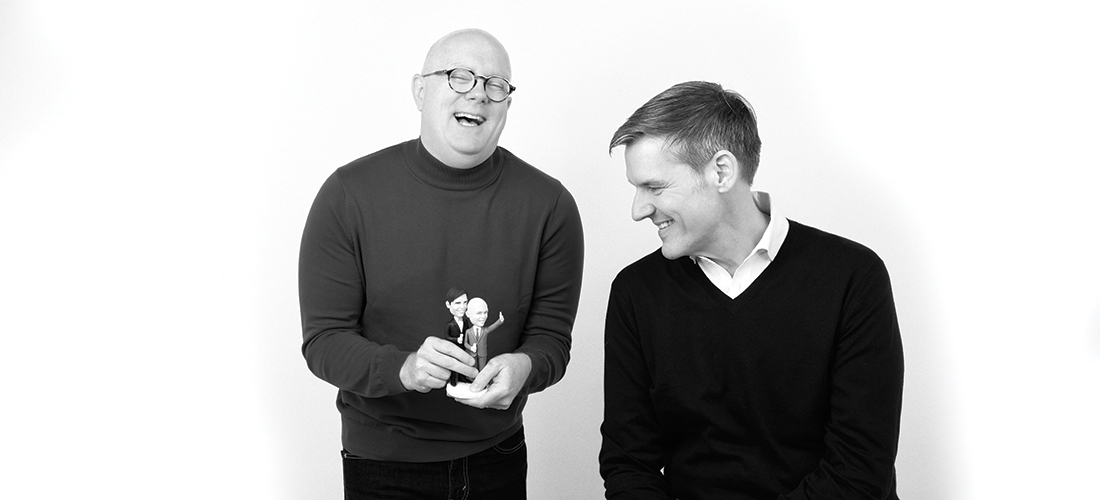

Planned Spontaneity

Paul Russ & Lynn Wooten

By Cynthia Adams     Photographs by Mark Wagoner

Cooking, art and philanthropy cinch the relationship for high-profile Triad couple Paul Russ and Lynn Wooten.   

Food is the extra ingredient: It was in a Triad restaurant that they met and they were married in another, with a celebratory party thrown on a later date at an art gallery.  

In 2006, Russ and Wooten had a blind date for brunch at Greensboro’s Green Valley Grill. Then they took the blinders off. “It’s unusual, because less than a month before we had seen each other across a room,” says Wooten, with Russ completing the thought “ . . . at a Durham film festival.”  

With a shock of recognition, the pair discovered they lived parallel lives.  

They were the same age. 

The Russ-Wootens simultaneously attended UNC-Chapel Hill with studies overlapping three out of four years.  

They earned the same degree (Journalism).   

Russ’ good friend lived next door to Wooten. “And we’d never met!” Wooten exclaims.  

“We had to have met, at some frat party, or walking across the quad,” muses Russ.

“Or on an elevator,” offers Wooten. 

“Or basketball games at Carmichael,” adds Russ. A bit like the romantic comedy, Sliding Doors, he says. 

“We were not meant to meet before we did,” agrees Wooten, who invited Russ to a Durham party. “We were inseparable from then.” Synchronicities abounded.  

Each transitioned from journalism to public relations. When they met, Wooten worked at UNC-Hospital; Russ worked at Hospice and Palliative Care of Greater Greensboro.     

“We both were involved in nonprofits, volunteering and helping out,” Wooten says. “As corny as it sounds, we both liked giving back,” he adds. 

Then there was a shared joy of cooking — and eating well.

“We love food,” he confesses. “There are very few ways we differ.  He won’t eat goat cheese and I won’t eat raw tomato,” sighs Wooten.

“I can watch cooking competitions ad nauseum,” confesses Russ.  

Both laugh.  

The foodies married in 2015 at 1618 West — the restaurant’s first wedding. 

For the celebration held at GreenHill, Ibby Wooten supplied a Japanese-made cake topper featuring Lynn snapping a selfie — a signature move. Her brother paused for a selfie during the ceremony.  “I did it at the end!  I pulled out a selfie stick, popped the camera up, and got the photo with everybody behind us.  It turned out great.”

Russ is now vice president of marketing and development for the newly merged AuthoraCare Collective, formerly hospices in Greensboro and Alamance/Caswell.  Three years ago, Wooten became vice president of marketing and public relations for the Well-Spring Group.)  

In those roles, they meet people who are farther along life’s pathway. 

“At Hospice I’ve learned more about living than dying,” says Russ. “We’ve met people with the capacity to do great things.”

Working with seniors and those with fewer days apportioned to them, they also have learned something valuable.  

So the couple, who have both done a lot of public service work as volunteers and on various boards — e.g., Triad Stage, Weatherspoon, the Public Art Endowment — discovered the need for “me time.” 

“Paul rules the finances,” says Wooten. “I do the calendar.” In which he occasionally writes, “Do Nothing.” 

On those special weekends, they may not leave the house, one filled with antiques, books, and an art collection amassed together. Russ is in the kitchen cooking. Wooten reads or naps.

They reserve uncommitted weekends for forays or outings to restaurants they haven’t yet experienced. (A recent such trek was to Acropolis, the downtown Greek restaurant.) “It was great,” enthuses Wooten.

They call this, “planned spontaneity.”  

“We love fun, good experiences. It’s a simple life,” says Wooten.  OH

Happy Trails

Sue Beck & Bill Haney

By Nancy Oakley     Photographs by Bert VanderVeen

“You really gotta like someone a whole bunch to sleep in a tent and walk every day with a pack on your back,” says Bill Haney with a broad grin. But Haney has done just that for most of the 44 years he’s been married to Sylvia “Sue” Beck.

“I had always wanted to do hiking,” says Sue, now 83, while Bill, whom she affectionately describes as “just a kid,” at 80, “was interested in wherever we both went.”

“Actually, I was interested in her,” he chimes in, his Cheshire Cat grin reappearing.

The two met in the mid-1970s when Sue was completing her master’s in music at UNCG and needing some education courses to fulfill teacher certification requirements. She landed in two of Bill’s classes one summer. An avid athlete, Bill’s interests included cycling and rock climbing, and, as Sue would later discover, swimming and diving. “That’s what really got me interested in him. I saw him diving and wow! He was amazing!” she says with a soft, low chuckle.

They took their courtship slowly, having both been married before, “and not anxious to get into that mess again,” Sue says with her ready laugh. But they tied the knot in 1975, blending families, and working — Sue with the Guilford County Schools, Bill with the Employment Security Commission.

As they approached their late 50s, the couple had heard about classes offered at Guilford College’s Wilderness Center. “Canoeing, backpacking, climbing,” Bill recalls.

“So we took the backpacking thing, and I loved it,” Sue waxes, explaining her deep appreciation of the outdoors and the natural world. “I’m an explorer at heart,” she adds, “but I could never have done it without Bill.”

While she carried “around 35 pounds,” he would shoulder a heavier 45- to 50-pound pack as the two began to hit various hiking trails in the Southeast. “He just sort of put up with it,” Sue laughs.
“There were times when either one of us would have enough for that day and throw a fit,” Bill concedes. Like the time they had run out of food a day before reaching Nantahala Gorge. “I get very grouchy when I’m hungry,” Bill admits. Or the times they’ve been injured, or when their camp stove once blew up. But taking the mishaps — how else? — in stride, Sue remarks, “We’ve had some fascinating experiences and we’ve met some amazing people.” Particularly groups of other hiking enthusiasts they’ve encountered on the Appalachian Trail.

In 1988 the two hiked a southern portion of the famed 2,200 route stretching from Springer Mountain, Georgia to Mt. Katahdin in Maine and would periodically hike various sections of it. “We just jumped around. We’d hike for a weekend. Or maybe during a vacation period for 10 days or something like that,” Sue recalls. “And all of a sudden I said to Bill: ‘You know what? We’ve hiked a lot of this trail, why don’t we just do the whole thing?’”

Under the trail moniker, “NC Pole Cats,” a nod to their use of ski poles for balance and safety well before it became accepted hiking practice, the two completed their goal, encountering a cast of characters along the way: the Four J’s, three guys and their unseen fourth, Jesus; or The Three Little Pigs, three gals who described themselves as “looking like pigs and smelling like pigs,” says Sue. And the ultimate payoff: Mt. Katahdin. “The end of the trail at Katahdin is spectacular,” Sue enthuses. “There’s a beautiful campground at the bottom. Then you have to hike up, up, up.” She recalls going by a beautiful waterfall. And as they got higher and higher, it turned out to be not so much a trail as a jumble of rocks. “Huge rocks. Car-sized rocks” she says. “And they’re all piled up on the top of this mountain. And just before you get to the very end, it becomes a trail again. It’s very challenging.” Here, Bill’s rock climbing expertise was crucial. “I don’t think I could have done it if he hadn’t been there to explain to me where to put my foot next and my arm next,” Sue observes.

By 2001, Bill and Sue earned their AT patches that they proudly wear on the sleeves of their camp shirts, along with their perennially young hearts. They’ve become an example, if not an inspiration to their peers, sharing their experiences with local groups such as the Shepherd’s Center, or Abbotswood, where they live. Its nearby 3-mile loop and regular yoga sessions keep them in shape for excursions to favorite hiking destinations such as Hanging Rock and Grayson Highlands State Park in Virginia, with its “beautiful rock formations and wild ponies,” says Sue. They’ve trekked through Canada, New Zealand and Switzerland, and imparted a love of hiking and the outdoors to their grandkids. And though age has necessitated some modifications — no more 50-pound packs for Bill — the two have “a long life to live,” Sue says, laughing, and as long as they’re able, they’ll continue speaking their love language — step by step.  OH

For Love of Family & Good Food

David & Nneka Williams

By Jim Dodson     Photographs by Mark Wagoner

A dozen years ago, David and Nneka Williams made an important decision about their quality of life and young family.

“We decided it was time for a healthy change in the food we ate — realizing that what we were eating was simply not making us healthier,” explains David.

“It was an epiphany for us.”

The roots of this awakening lay in his evolution as a landscaper who, in the early 1990s after graduating from Northwest Guilford High School, started out with New Garden Landscaping & Nursery. Williams eventually opened his own business, having morphed into a specialized personal landscaping designer with a dozen private clients he works with to this day.

Out for an evening in 1998, he happened to bump into pretty Nneka Little — pronounced “Nay-Kay” — a UNCG dance major and ballet dancer who grew up in New York City. David was shy. Nneka wasn’t. They swapped phone numbers but she had to call him first.

Your classic case of country mouse meets city mouse.

“I’m a city girl. If you’ve ever seen the movie Big,” Nneka says with a laugh, “that was supposed to be my life.”

Because David grew up on a family farm in Stokesdale, he had no interest “whatsoever” in returning to the farming life — or so he thought.

Lightning struck fast. The next year the pair were married at a quiet family ceremony in Stokesdale.

When their sons Logan and Gavin were 5 and 3 respectively, it bothered them that both children suffered from allergies and asthma, requiring daily breathing treatments. Nneka also required her own medication for allergies, and everyone in the family was putting on weight.

Fearing years of medical issues, the Williamses boldly switched to a vegan diet and experienced a quick and remarkable turnaround. “Healthy organic food was the answer,” says David. “It healed our bodies and resulted in making all of us dramatically healthier. Within a few years, everyone in the household was off meds and had lost weight.”

Moreover, their shared passion for healthful food led to an exciting new chapter of life. A backyard, raised-bed organic garden fueled their growing knowledge of organic gardening and in 2011 led to visits to a pair of sustainable farms in Saxapahaw.

“That was all I needed to see,” says David, who began meeting with a farm consultant to plan and gather ideas for their future organic farm.

For the next two and a half years the couple searched for the right piece of property, eventually settling on a rolling 13-acre parcel off Church Street extension, in the rural community of Midway, just into Rockingham County.

A week before Christmas in 2015, the Williamses moved into a handsome energy-efficient 3,200-square-foot house they designed and built themselves. Soon thereafter, they completed work on their first high tunnel–heated greenhouse and started building their washing and packing facility, just in time for their first harvest.
Sunset Market Gardens was born.

Today, its fourth year, the farm boasts three state-of-the-art large greenhouses (plus two smaller ones) filled with a bounty of USDA-certified organic produce that looks almost too good to eat — spectacular Asian greens and several varieties of gourmet lettuce, bok choy, baby kale, radishes, beets, carrots, spinach, scallions, plus turnips and collards. Ditto various herbs, ginger and turmeric, and pasture-raised eggs. As February dawns, new potatoes, summer squash, cucumbers and heirloom tomatoes are already planted in immaculate rows, working their way to market. The Williamses even sell organic bread and have an online store. No surprise that their customer base is growing robustly.

The farm’s prime sales venue is the historic Greensboro Farmers Curb Market on Yanceyville Street along with their own ever-expanding farm store, open Wednesday afternoons and Saturday mornings. Sons Logan and Gavin, at 15 and 13 respectively, have grown into impressively polite young men, homeschooled by their mother. They run the farm store and ultraclean packaging operation. Two other mouths to feed and two more pairs of potential helping hands have expanded the Williams family.

“It’s not been a easy life but it’s such a rewarding life,” says Nneka, as she spoon feeds organic veggies to 5-month-old Kieran while keeping an eye on Falynne, age 2, playing in the gated living room. “David is a perfectionist about the farm — his passion — and the boys are learning valuable lessons about work and life and sustainability.

“My mother’s dream was to live in the country and have a farm like this,” she adds with another laugh. “Whenever my parents come to visit, they’re so excited they hardly come in the house because there’s so much to do and see.”

“For us, this is really is a dream come true,” adds David, who continues to beautify the property’s landscape with plans to eventually offer farm suppers and special events on the grounds.

“To think how far we’ve come in such a short period of time makes me humble and very grateful. That’s something we love to share with people who buy our produce and come out to the farm to see how we grow our food — a love of family and good healthy eating.”  OH

For more info: Sunset Market Gardens, 346 Woolen Store Road, Reidsville  Open: Wednesdays 4 to 6 p.m. and Saturdays, 9 a.m. to 12 p.m.
Phone: (336) 362-1344   |   Sunsetmarketgardens.com