February Almanac

February blossoms make the cold hard to shake.

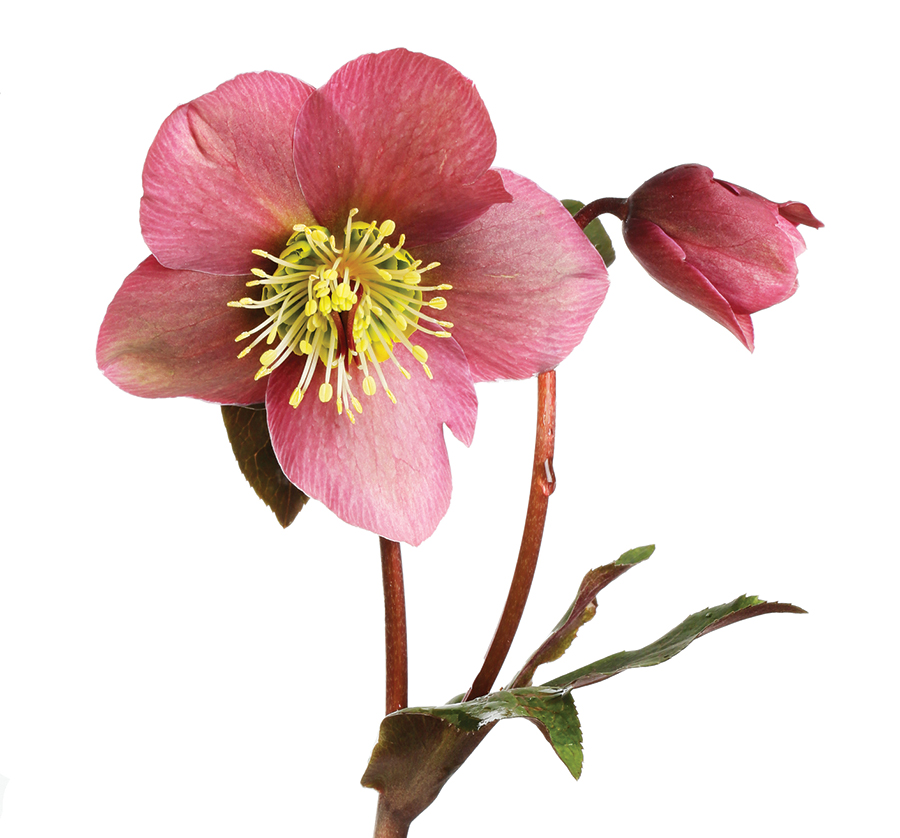
Crocus burst open like paper fortune tellers, hellebores whisper prophesies of spring, and in the backyard, where a speckled bird is kicking up fresh mulch, winter Daphne blushes like bright-eyed maidens in faded terra-cotta planters.

All of this, yet winter feels deep-rooted, endless. As if her flowers were cruel illusion. As if your bones could be forever yoked to this chill. 

Then one day, out of nowhere, a new warmth arrives with the daffodils, a new softness beckoning you outdoors.

Beneath the bare-branched sycamore, where the picnic table has all but forgotten its name, February sunshine feels like a warm bath. You’ve brought lunch — a thermos of soup — and as the sunbeams dance across your face and skin, you feel, for the first time in months, as open as the crocus. As if winter might release you. As if hellebores were true harbingers of spring. 

Beside your thermos, a feathery caterpillar edges toward you. Did it fall from the sky? You look up toward bare branches, wonder where he came from, where he’s going, whether he’ll be the speckled bird’s lunch. He’s closer now, gliding across your idle spoon, and as you observe his wispy yellow coat, you see yourself in this tiny being and in what he might become:

Enamored by each fragrant blossom; wide open; ever-seeking the simple grace of light.

February sunshine has transformed us, encoding within us the promise of spring. We can feel it now.

The Lenten Rose

When a plant blooms in the dead of winter, it is neither ordinary nor meek. That plant is a pioneer.

Also called the “Lenten rose”, the hellebore is a beloved and shade-tolerant herbaceous or evergreen perennial — not a rose — that so happens to thrive here. Some species more than others.

Take, for example, the bear claw hellebore, which is named for its deeply cut “weeping” leaves. February through April, this herbaceous perennial displays chartreuse green flowers that the deer won’t touch, and you shouldn’t either (read: toxic when ingested). As the flowers mature, the petal edges blush a soft, pale ruby. Talk about subtle beauty, but more for the eyes than for the nose (its crushed leaves are what give it the nickname “stinking hellebore”).

On behalf of every flower-loving soul aching in their bones for the coming spring, thank you, hellebore. You’re a true queen.

Full Snow Moon

The Full Snow Moon will rise at night on Feb. 8, peaking in the earliest hour of the morning on Feb. 9. Also called the Bone Moon, this supermoon (the closest the moon can come to Earth in its orbit) marks a time of heavy snowfall and, in earlier times, little food. If you’re warm and full-bellied, this moon is a good one to share the wealth.

I know him, February’s thrush,

And loud at eve he valentines

On sprays that paw the naked bush

Where soon will sprout the thorns and bines.

— George Meredith, “The Thrush in February,” 1885

Warm Your Bones

This month in the garden, sow beet, mustard and turnip seeds. Plant your spring salad (loose leaf lettuce, arugula, spinach, carrots, radish, cilantro). But while it’s cold out, soup!

The following recipe from DamnDelicious.net is a quickie — all the better for soaking up more February sunshine while the spring garden grows.

Spinach and White Bean Soup

Ingredients:

1 tablespoon olive oil

3 cloves garlic, minced

1 onion, diced

1/2 teaspoon dried thyme

1/2 teaspoon dried basil

4 cups vegetable stock

2 bay leaves

1 cup uncooked orzo pasta

2 cups baby spinach

1 (15-ounce) can cannellini beans, drained and rinsed

Juice of 1 lemon

2 tablespoons chopped fresh parsley leaves

Kosher salt and freshly ground black pepper, to taste

Directions:

Heat olive oil in a large stockpot or Dutch oven over medium heat. Add garlic and onion, and cook, stirring frequently, until onion is translucent, about 2-3 minutes. Stir in thyme and basil until fragrant, about 1 minute.

Stir in vegetable stock, bay leaves and 1 cup water; bring to a boil. Stir in orzo; reduce heat and simmer until orzo is tender, about 10–12 minutes.

Stir in spinach and cannellini beans until the spinach has wilted, about 2 minutes. Stir in lemon juice and parsley; season with salt and pepper, to taste.

Serve immediately.  OH

Every gardener knows that under the cloak of winter lies a miracle . . . a seed waiting to sprout, a bulb opening to the light, a bud straining to unfurl. And the anticipation nurtures our dream. — Barbara Winkler

Greensboring No More

For the Gate City, the ’20s are set to roar

By Margaret Moffett

Midsummer, like clockwork, it begins — the rat-a-tat-tats and oompahs and wah-wha-whas  floating across east Greensboro, teasing autumn’s arrival.  

“It,” of course, is the N.C. A&T State University Blue and Gold Marching Machine, a drum-banging, horn-tooting, whistle-blowing wall of sound that high-steps through half-times of Aggie home games several Saturdays each fall.

Year after year, the band starts preparing for football season around July, when air conditioners run without ceasing and even the evenings leave you hollow-eyed and sweat-soaked. 

Ask anyone who lives within a mile or two of campus — from Dunleath to downtown, East Bessemer to East Market. Ask them about the time they sat on breezeless breezeways, or opened their windows in the middle of a heat wave, just to hear The Machine practice. Not perform, mind you. Practice. 

They’ll tell you it was worth it. So worth it.

This is a small thing. Impactful, yes, and also delightful. But small.

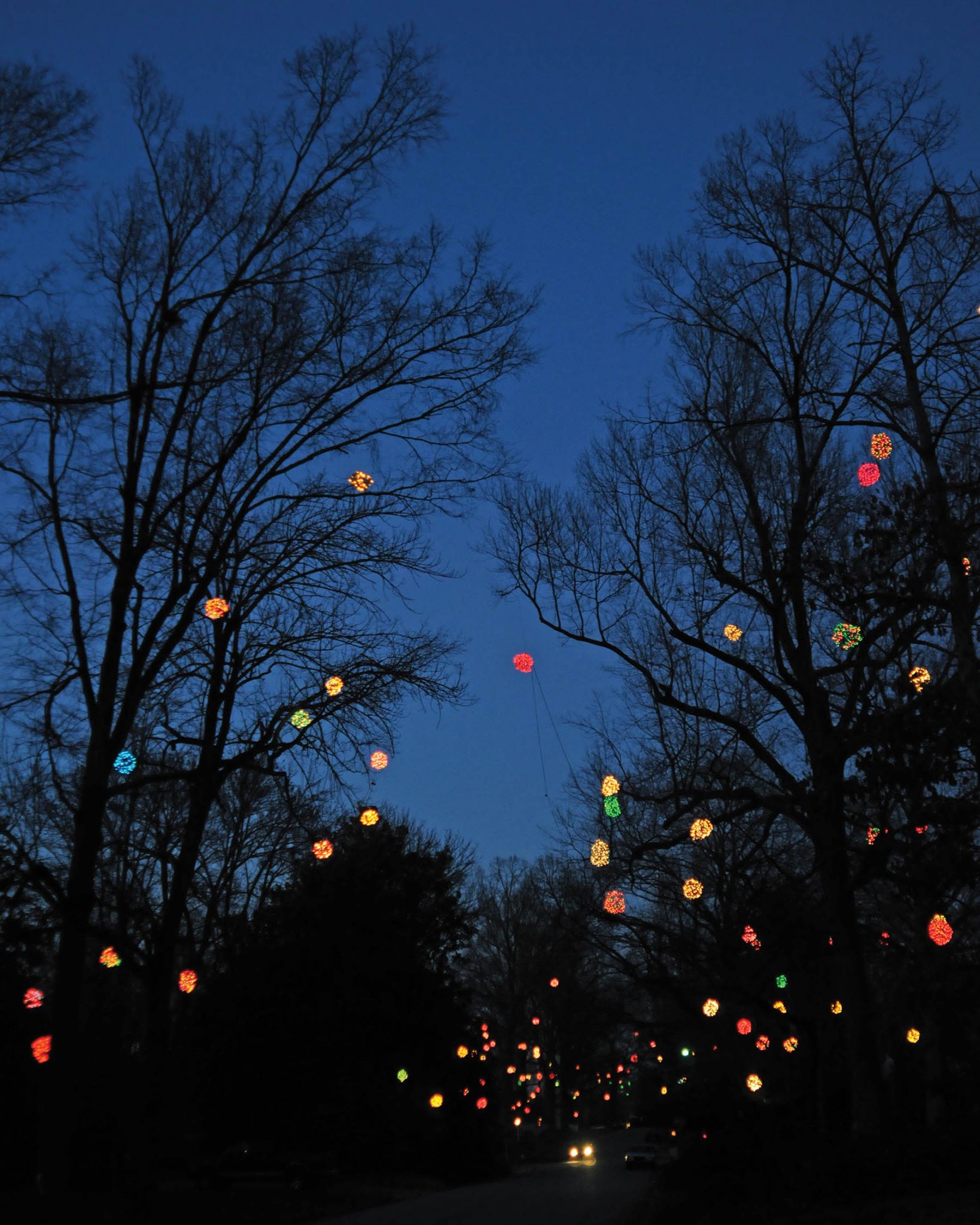
Greensboro is home to a thousand small things. The lighted Christmas balls in Sunset Hills. The hippie scene on Tate Street, unchanged since 1969. The dogs that chase fly balls at Greensboro Grasshoppers games. The Eastern freaking Music Festival.   

Combined, they constitute the je ne sais quoi that is Greensboro. Woe betide any newcomer or visitor who scoffs at our je ne sais quoi:

“OK, maybe we don’t have a Trader Joe’s or a world-class auditorium,” we would snarl — obviously in the pre-Trader Joe’s/Tanger Center for the Performing Arts era. “But we re-enact the Battle of Guilford Courthouse here all the dang time. Plus our community swim meets are fierce. Oh, and Safety Town. Bet your kids didn’t go to Safety Town (clearing our throats for compulsory recitation of Greensboro’s unofficial motto). “This is a great! Place! To live!”

For years now, we have clung to small things as proof of this city’s worth. But they don’t fit neatly on marketing materials or land us on lists of Best Cities in America. The ice skating rink at LeBauer Park is all well and good to a Fortune 500 company looking for a new headquarters. Its leaders, however, would much prefer a robust economy and low unemployment; an entrepreneurial spirit and an energetic workforce; a youthful culture and a vibrant downtown. 

They’re looking for big things. And big things have been missing from Greensboro’s narrative for far too long.

But the times they are a’changing. Over the course of 2020, the city is set to blossom like a Greensboro red camellia (It’s our official flower. Look it up.) 

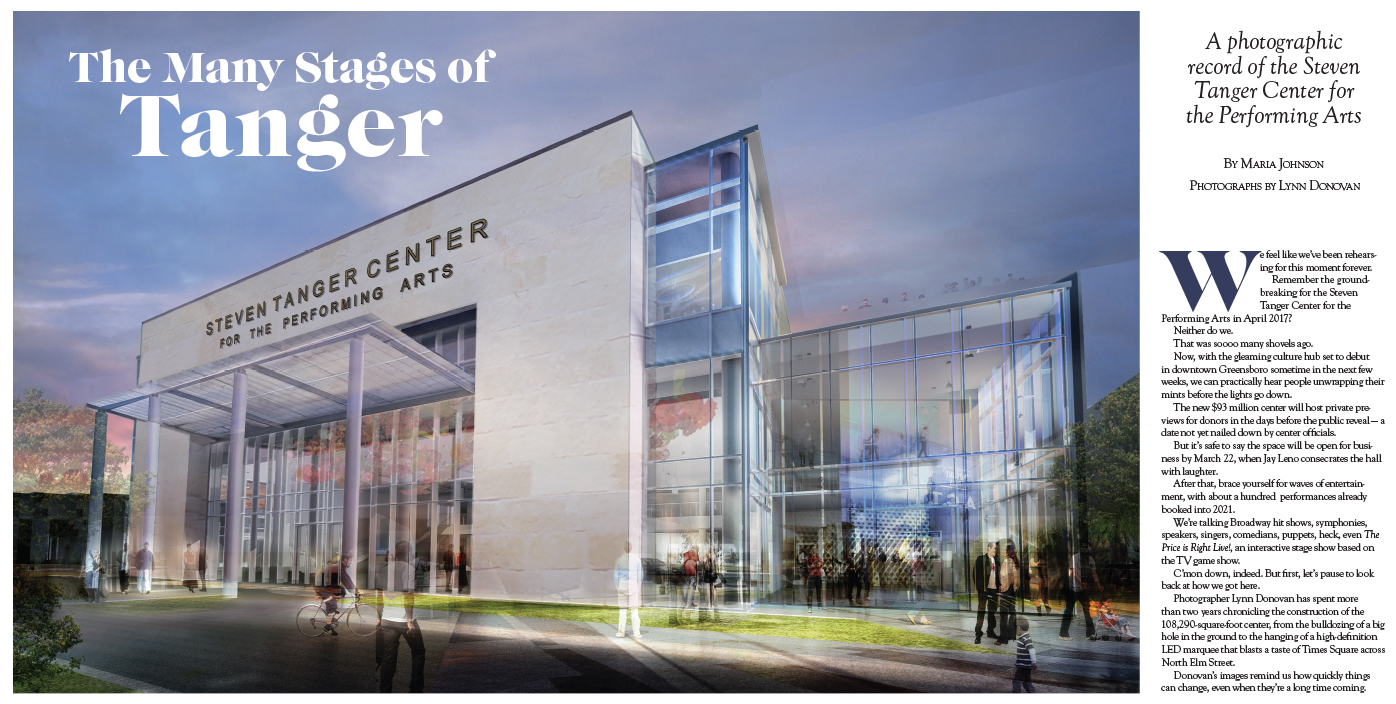
In the first quarter alone, the Greensboro Coliseum will host the U.S. Figure Skating Championships, the women’s and men’s ACC basketball tournaments and first-and second-round games in the NCAA basketball tournament. The $90 million Tanger Center on the eastern tip of downtown will open sometime amid March Madness.

As the year unfolds, we’ll be treated to one of the busiest periods of construction and revitalization in the city’s history. That means more luxury apartments and boutique hotels. More office towers and mill renovation projects. More cool entertainment districts and cultural pop-up events.

You know, you almost could make the argument that this city is poised for a rebirth.

Aw, heck, let’s just go ahead and call it: 

Greensboro is back.

***

Shall we take a moment to recount the Dark Days?

Quickly summarized: Textiles and tobacco began their slow marches to death in the mid- to late-1990s. Then came 9/11, followed by a brief economic resurgence, followed by the Great Recession. 

Greensboro lost more and struggled longer than other progressive Southern cities, which seemed to more easily be replacing the high-paying manufacturing jobs lost to overseas competition and recovering from the disintegration of entire industries.

In North Carolina’s third-largest city, however, tobacco farmers and textile workers found themselves at the mercy of a service economy that offered lower wages and reduced benefits. Unemployment rose and median income fell. Corporate headquarters moved and longtime businesses folded. Developers delayed projects, or axed them altogether.

Greensboro was depressed. And depressing. 

Robbie Perkins had a front-row seat for the downturn — as a nine-term member of Greensboro City Council, including a turn as mayor from 2011 to 2013; as a commercial real estate developer who struggled to close eight-figure deals at the height of the crisis; and as a resident of four decades who was emotionally and financially invested in the community when it was at its most robust. 

“This city got hit really hard,” he says. “People who lived here and slogged their way through it don’t realize it as much as people from the outside.” 

One thing he knows for sure: “We’re better now than we were. A lot better.”

And then some. Median household income is on the rise — finally — as is the promise of better-paying jobs. Young people are sticking around a little longer. Exciting projects are beginning to gel. New industries have emerged. Vitality has returned.

For proof, look no farther than our burgeoning aerotropolis. About 5,800 people work in and around Piedmont Triad International Airport — roughly 1,500 of them at the world headquarters of HondaJet. Perkins notes the aviation economy is prompting an unprecedented surge in nearby development. Even as we speak, workers are grading 700 acres here and there around the airport, perhaps for future distribution and logistics operations, or maybe retail and office construction.

He’s expecting the N.C. 68 corridor to  pop sometime this year.

Then there’s the Publix distribution center, which Perkins promises will have “a substantial benefit to Greensboro.” Around springtime, the Florida-based grocer will start building a $400 million warehouse for 1,000 workers, whose $44,000 annual salaries will surpass the city’s median earnings.

Perkins goes on to praise Greensboro’s emerging downtown and incredible infrastructure. Plus, our universities will collaborate on projects like the Joint School of Nanoscience and Nanoengineering — and even relocate some functions to the Center City, as they did with the Union Square Campus. 

So sayeth Robbie Perkins: “It’s all going in the right direction.”

***

If Perkins is correct that people outside Greensboro best recognized our economic malaise, then perhaps the reverse is true:

It takes someone with perspective to recognize our renaissance.

Enter Denise Turner Roth, a former city manager who left town in 2014 to work for the Obama administration. As the General Services Administration’s No. 1, she managed 12,000 federal employees, oversaw a $20 billion budget and travelled to just about every major metro in these United States. 

Upon moving back to Greensboro with her family in 2018, Roth immediately spotted the most noticeable — and to hear her tell it, the most significant — upgrade made in her absence.

There’s street art everywhere. On buildings and parking lots, storefronts and retaining walls.

“I thought it was an explosion of energy,” she recalls. “The colors jumped off and caught my eye. They made me want to stop and investigate.”

Most of the murals come courtesy of developer Marty Kotis, who has commissioned more than 100 pieces on buildings he owns across the city. City leaders followed Kotis’s lead, cataloging all of the city’s public art on a webpage — even relinquishing an old water tank at the Mitchell Water Plant to become an artist’s canvas.

Roth found it added an edgy, exciting, unexpected je ne sai quoi to the Gate City — the sort of quirky edge she noticed among other hip cool cities she visited as GSA administrator. 

“This is it,” she remembers thinking. “This is what Greensboro needs to be.”

Here’s why: If the city is to maintain its forward momentum, we must — What’s the right word? — mesmerize? captivate? beguile? Millennials and Gen Z’ers. Period. End of argument. They’re every successful urban area’s economic engine, not only as innovators and entrepreneurs, but also as homebuyers and consumers.

On that front, too, Greensboro has gained ground. You can see it in the way downtown comes to life after midnight on Friday and Saturday nights. 

And in the sudden explosion of breweries and distilleries near Center City. 

And in the popularity of Boxcar, a combination bar and arcade on Lewis Street that’s packed with college students craving dollar mimosas and Dance Dance Revolution SuperNOVA (yes, it’s a thing) on Sunday evenings. 

Since Roth’s exit and return, the city has opened two skate parks, a long sought-after amenity in street-punk chic. And UNCG basketball, now experiencing its own renaissance, has become a popular, inexpensive hang for students and alums.

But Greensboro’s menu now offers something Millennials and GenZ’ers need more than microbrews and games: opportunity. Take LaunchLab, a business accelerator program provided by the Greensboro Chamber of Commerce. The program pairs its startups with college interns from the city’s seven colleges and universities, doing both parties a solid. Another small business incubator, the Nussbaum Center for Entrepreneurship, offers budding business owners everything from coaching and office space to financial assistance.

And 2020 promises more of the Wow Factor 20-somethings demand.

Sometime this year, a new six-story Hampton Inn & Suites will open downtown, joining a Hyatt Place that welcomed its first guests in 2019 — and Westin and Aloft hotels are in various stages of development.

Also opening soon: a 188-unit upscale apartment complex — Hawthorne at Friendly — that’s so close to Friendly Center that residents will be able to smell the salmon patties cooking at K&W Cafeteria.

And later this year, redevelopers will finish a $54 million project bringing 200-plus apartments to the old Proximity Printworks Mill — just a hop across Yanceyville Street from the previously rehabbed Revolution Mill. That’s in addition to the nine-story, 111,000-square-foot office building set to open at the Greensboro Grasshoppers’ baseball stadium.

What was that we said about a deficit of “big things” filling Greensboro’s narrative? About fixating on “small things” to distract us from our economic unpleasantness? Meh, that’s so 2008. No, this is a city reborn, a city on the . . . Wait. Is that “Smells Like Teen Spirit” we hear coming from the general vicinity of N.C. A&T State University? Is the Blue and Gold Marching Machine actually playing Nirvana?

Cool.  OH

A graduate of UNCG, Margaret Moffett has called the Greensboro area home since 1985. After 27 years career as a newspaper journalist, she embarked on a career as a freelance writer and adjunct instructor of journalism at UNC-Chapel Hill. She resides in Dunleath in a 100-year-old house with her two cats.

To Hair Is Human; To Give, Divine

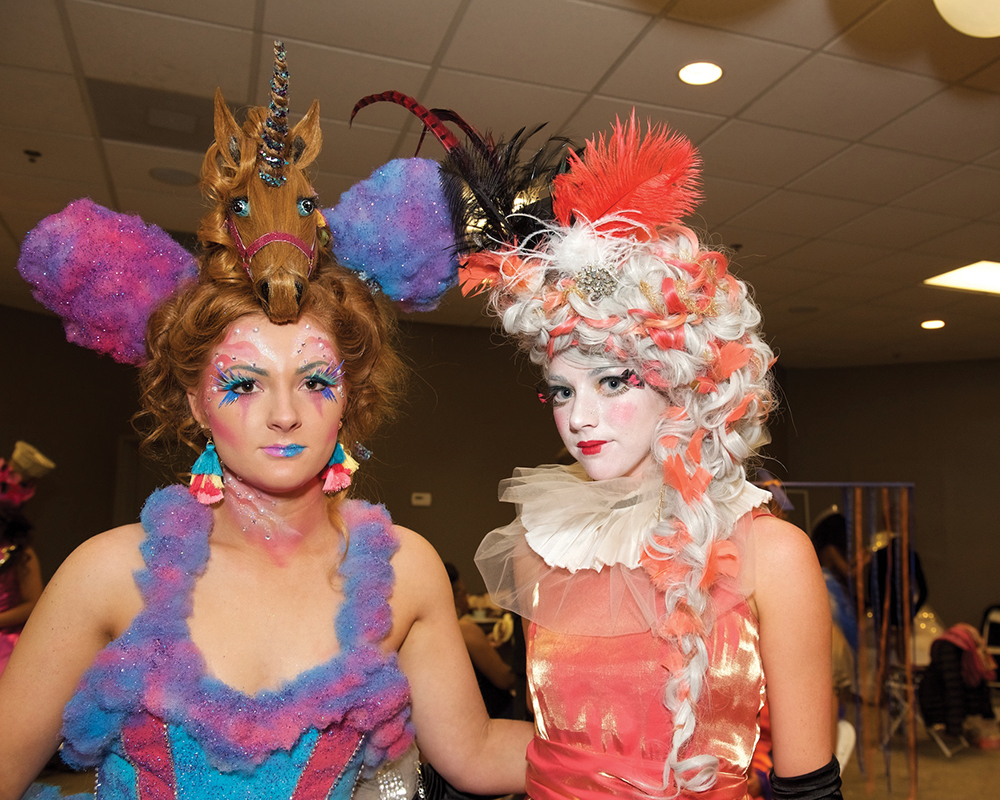
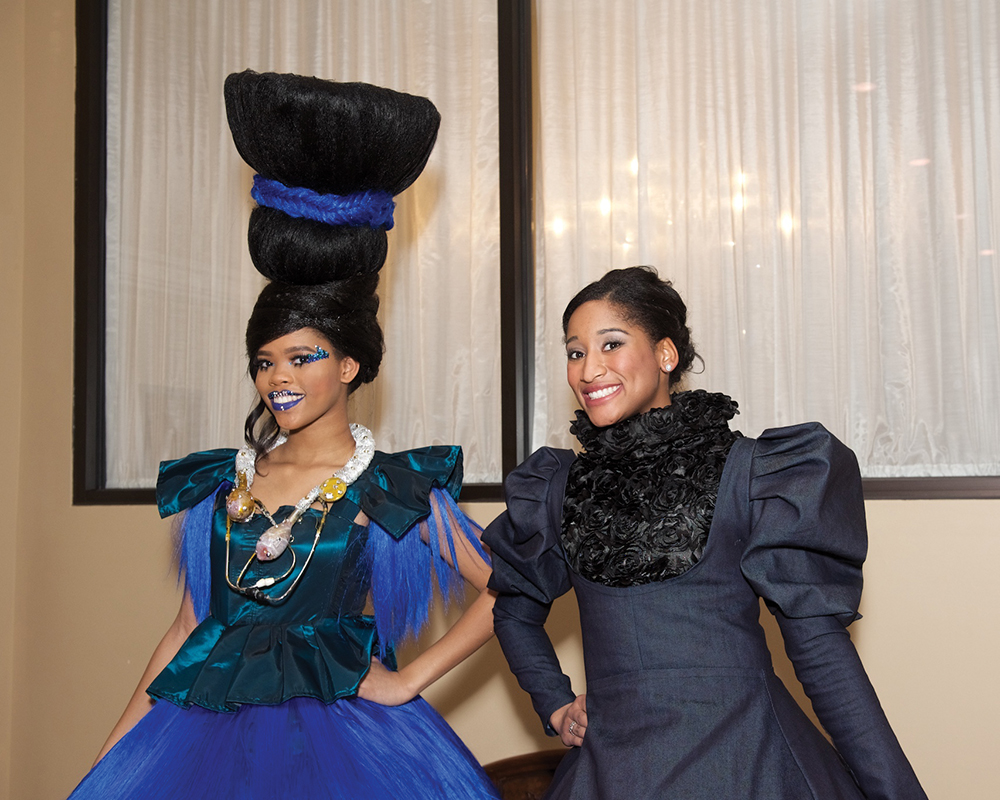
The Big Hair Ball is January’s mane event


By Waynette Goodson    Photographs by Lynn Donovan

“Higher the hair,
closer to heaven.”
— Parlor Salon


It was 2002, and my country needed me. I got the call from the World Championships of Hairdressing, known as the “Hair Olympics,” to join the U.S. team to model for their stylists competing for the gold. (Yes, this is a true story. Think of the Indie hit movie Blow Dry.)

Before I could say “shampoo,” I was on the floor of the Las Vegas Convention Center, positioned amid rows upon rows of salon chairs and numbered mirrors, with 10,000 spectators looking on in anticipation. Three-hundred stylists from more than 40 countries had gathered here to hair off in events like “Classic Cut & Style” or “Hair by Night.”

When the judges announce “Start!”, my stylist, Stephanie Loy, begins furiously pinning layers of my hair to the top of my head. As if we were performing surgery, she barks at me “Water!”, “Wax!” or “Freeze!” and I pass her the right products (this is a timed event, of course).

“Stop! Step away from the models! Do not touch the hair!” The battle of the bouffant is over. The result? It looks as if I’m wearing a sleek, futuristic orange helmet — neon orange. One alfalfa sprout springs from the top of my head. And the shape in the back looks like a “V” at my neckline, which is dyed a plum purple color.

Out of the 100 competitors, we would place ninth in the world. Not bad for my then 23-year-old junior stylist who also took home the highest honor: the Grand Prix Master Alexander de Paris Trophy.

True, the World Championships of Hairdressing can’t be compared to the physical contests of the Olympic games. Still, these brave stylists’ javelins and shot puts are their blow dryers and curling irons, which they use to create modern interpretations of hair designs that epitomize the art of hairdressing.

Yes, hair is art.

And there’s no better place to enjoy the craft of coiffure locally than the annual “Big Hair Ball.” The eighth annual event will take place January 25 at Grandover Resort. The theme: 20/20: A Landmark Vision.

Be forewarned: This affair is no pixie cut. The 2019 Big Hair Ball attracted more than 1,000 revelers and helped raise more than $315,000 to help fund the Greensboro programs of Family Service.

Proof positive that hair is power.  OH

For more information, go to www.fspcares.org/bighairball/.

Waynette Goodson enjoys “Club Level” membership at Blasted Blow Dry Bar where she gets her long locks washed and styled twice a month.

Almanac January 2020

January is fresh linens, heightened awareness, infinite possibility.

Like a dream within a dream.

Last night, I dreamed I was flying through a thick forest of pine, a holy swirl of stars like pinholes to the heavens in the winter sky above me. Cassiopeia the Queen was dancing west of Polaris, and my breath became a living veil, the Big Dipper disappearing and reappearing with every exhale. Suddenly, in the midst of all this magic — flight, the crisp night sky, the dance of breath and starlight — I realized that I could plummet to Earth at any moment. And yet the thrill of the alternative ignited me. This is my dream, I thought. And to claim a dream requires faith.


As the Big Dipper rose above the North Star, I began pumping my legs, swimming through the air at what felt like the speed of light, weaving between trees, between realms, between worlds.

January is here, and with it, a world of infinite possibility.

A seed of hope.

A bulb, cracking open beneath the soil.

A field of daffodils in the making.

New beginnings, new rituals, new dreams.

All that is required is faith.

Rabbit, Rabbit

Every New Year’s morning in the first blush of light, I bundle up, go outside, and listen to the deep quiet. As Earth begins stirring with unseen critters, silhouettes dance in the periphery. Often, one of a rabbit.

On such occasions, I’ve wondered if there was some correlation between rabbits and New Year’s, but settled with my own belief that it was some sort of good omen. Only recently did I discover the quirky superstition of saying “Rabbit, rabbit” on the first day of the month for good luck. Have you heard about this?

According to the Farmers’ Almanac, the first written record of this strange rabbit habit traces back to a 1909 British periodical called Notes and Queries

I think I prefer my New Year’s tradition, and how the language of nature seems to transcend words. But, for what it’s worth: Rabbit, rabbit.

Rabbit, rabbit, and happy New Year!


In the Garden

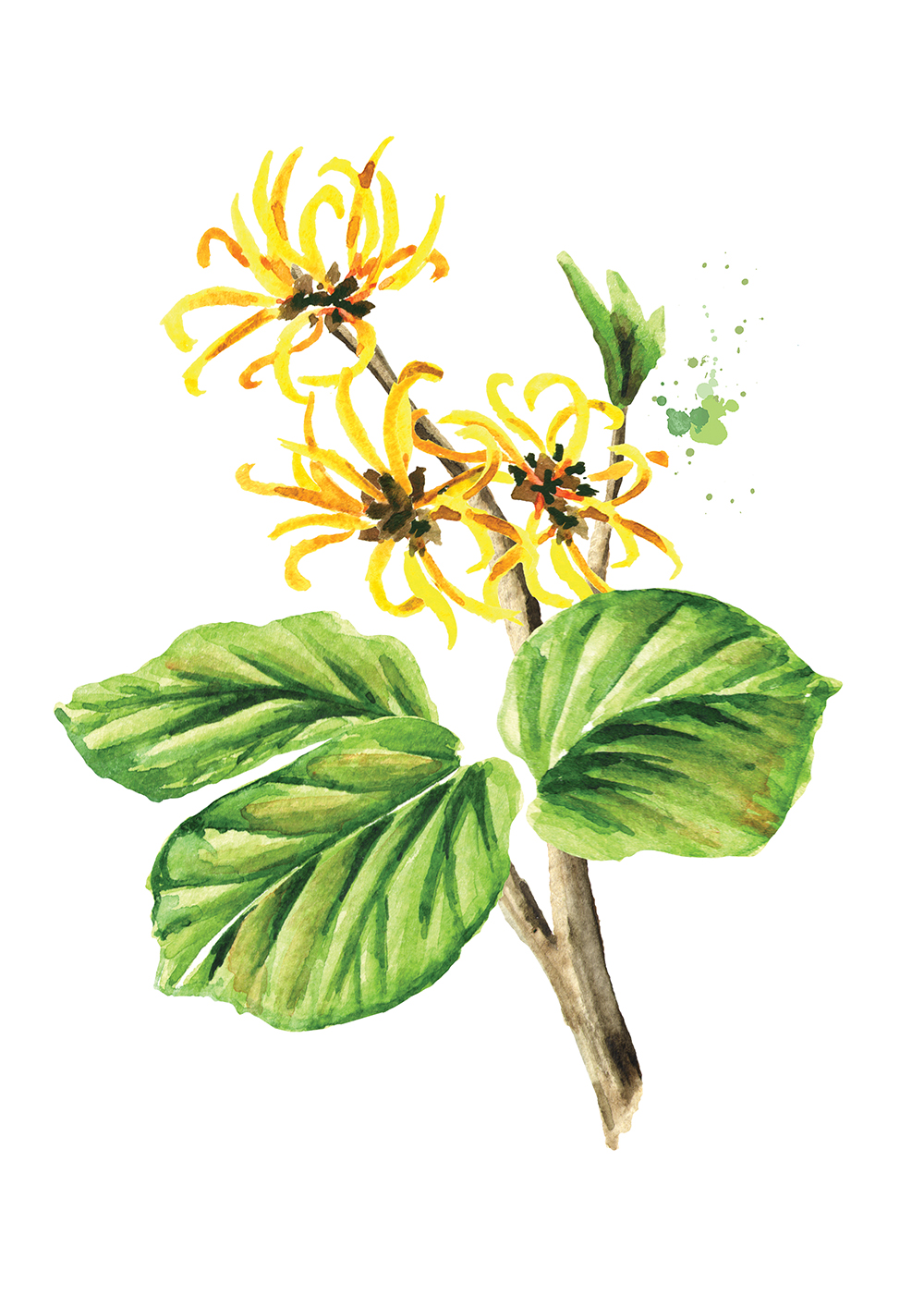
Bare branches against bright sky in every direction, and yet a closer look reveals flowering witch hazel, camellia and daphne, hellebores, apricot and winter jasmine.

In the garden, now’s the time for preparation. Prune what’s asking to go. Fertilize beds with wood ash. And when the soil is dry enough, plant asparagus crowns for early spring harvest.

Soon, a sea of spring vegetables will grace the garden. English peas, cabbage, carrots, radish, turnip, rutabaga. But now, patience.

Patience and faith.


Nature has undoubtedly mastered the art of winter gardening and even the most experienced gardener can learn from the unrestrained beauty around them. — Vincent A. Simeone

Top Notch

Johnny and Karen Tart’s downtown penthouse perch

By Maria Johnson     Photographs by Nancy Herring

How do you know when a downtown has arrived?

Maybe when people who live on the outskirts of town also keep “a place in the city,” an apartment with easy access to the thrum of center-city life.

If that’s so, then downtown Greensboro is headed for success because at least one local couple maintains a leafy suburban residence, as well as an urban getaway.

Johnny and Karen Tart’s permanent address is a modern stucco-and-glass home on the golf course at Sedgefield Country Club.

Their citified roost is a penthouse atop a newly constructed building that hugs the Eugene Street overpass on the southern skirt of downtown.

“It’s our home away from home,” says Karen Tart. “It’s mainly a weekend place.”

The Tarts own the three-story brick building, which also houses the headquarters of their business. Johnny is president of J.T. Enterprises, which holds the franchises for 16 McDonalds restaurants sprinkled across Greensboro,  Reidsville and southern Virginia.

Fittingly, the Tart’s new building is a stone’s throw from Hamburger Square, the downtown intersection that was once home to steamy diners and grills.

The new building’s proximity to Hamburger Square is coincidental, but Johnny, who’s nearing 70, has fond memories of the district from the 1950s.

Every other weekend, he and his dad would grab lunch at the California Sandwich Shop while his mom shopped at the A&P grocery store across the railroad tracks.

“I’ve seen downtown in its heyday, and I’ve seen it in its worst days,” Johnny says. “It’s come a long way.”

The idea to live downtown was born several years ago, after the Tarts moved back East from California. They lived on a pastoral spread in Johnny’s hometown of Pleasant Garden, about 10 miles south of Greensboro.

The couple often came to town on weekend nights to wine and dine at their favorite downtown restaurants, then drive or Uber home. They started mulling the idea of a downtown crash pad.

“We thought, ‘Maybe we’ll get a little condo or something,” says Johnny.

At the time, they owned an office building on Oakcrest Avenue, off Battleground Avenue, in an area known as “drill hill” because of numerous dentist and doctor offices.

“I was the only guy who had a car in the parking lot on Friday afternoon,” Johnny says. “All the doctors were gone.”

One day, Tart was approached by the wife of a doctor who practiced in a nearby office. She said they were interested in buying Tart’s building.

“I said, ‘Well, it’s not really for sale,’ and she said, ‘Here’s how much we’ll give you,’ and I said, ‘When do you want us to move out?’” Tart recalls, laughing.

The Tarts leased office space. They also downsized from their Pleasant Garden homestead to slightly smaller digs in Grandover. But the siren call of downtown, still 9 miles away, remained strong on the weekends.

Johnny had an idea. Why not combine business and pleasure in one building?


He sussed out a parcel on a triangle of land bound by the Eugene Street overpass, Eugene Court and Spring Garden Street. The wedge, home to a bail bond business, a vape stop and a billboard advertising lawyers, would allow for a new building with wide balconies facing the crane-studded vista of downtown.

Architect Grant Fox, of Elon, drew a 6,000 square foot building flecked with enough classical elements — see pilasters and pediment — to harmonize with the neighborhood. The first two floors would be dedicated to business. The top floor, a two-bedroom penthouse crowned by a deep cornice with down-lighting between brackets, would be devoted to leisure.

Fox introduced the Tarts to several builders, and they picked Jason DeBoer of Burlington.

All that remained was the interior.

The Tarts’ homes had always leaned toward traditional/transitional styles, but they knew they wanted a sleeker vibe for their new living space.

“We wanted an urban feel, but not industrial,” says Karen, a native of Thomasville.

“We were a little outside  our comfort zone,” says Johnny.

For the first time, they sought help with the decor.

Johnny Googled designers in Greensboro. He liked what he saw on Marta Mitchell’s website. He called the number.

“Her husband Peter picked up,” Tart remembers. “He had a nice voice and was very helpful. I thought, ‘Well, maybe we just found a designer.’”

Their hunch was confirmed when they met with Marta.

“I knew it was going to work instantly,” says Karen. “The ideas she was throwing out — I was like ‘Yes, yes, yes.’”

Mitchell helped them to create a refuge anchored by blacks and grays, glass and iron. For warmth and verve, ambers and ochres play with blues and greens. Conversation pieces wink at visitors.

Take the Elton–John–worthy eyeglass frames, purely decorative, on an end table in the living room. Or the two metal hands that protrude from the wall near the elevator.

They hold keys, dog leashes and cell phones.

Nearby, a skinny hall table, sold by Phillips Collection in High Point, is fronted by a slab of polished wood from a decayed fallen tree. Knotted by swirls and pits, the plank is boxed by a black metal frame. No doors or drawers in this piece; it’s chiefly a tone note.

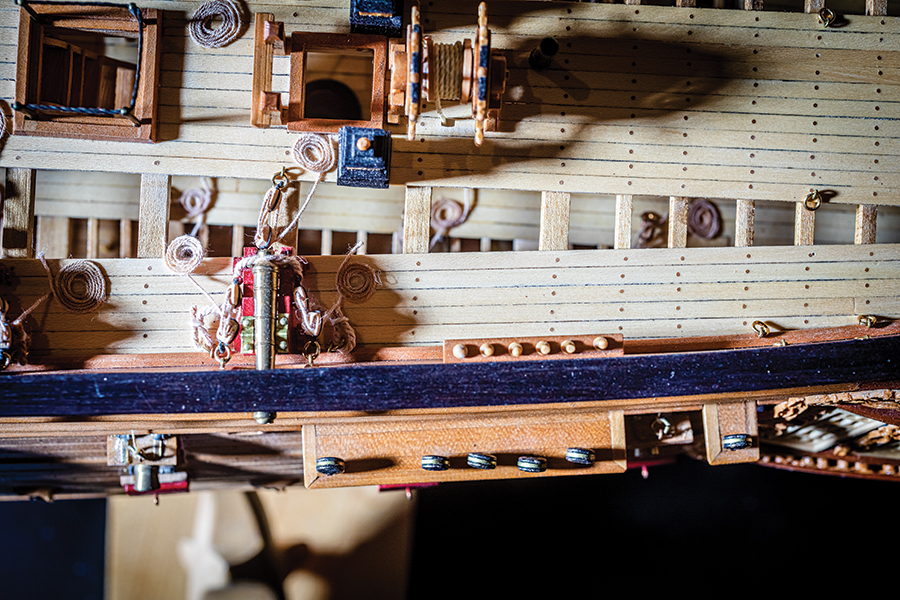
The central kitchen/living/dining area features more flavors of axe and anvil: a live-edge stump as coffee table; walnut shelves propped on black iron pipes that jut from walls; and a black rolled-steel wall with a recessed fireplace and a motion-sensitive TV screen that displays a photo when it detects movement.

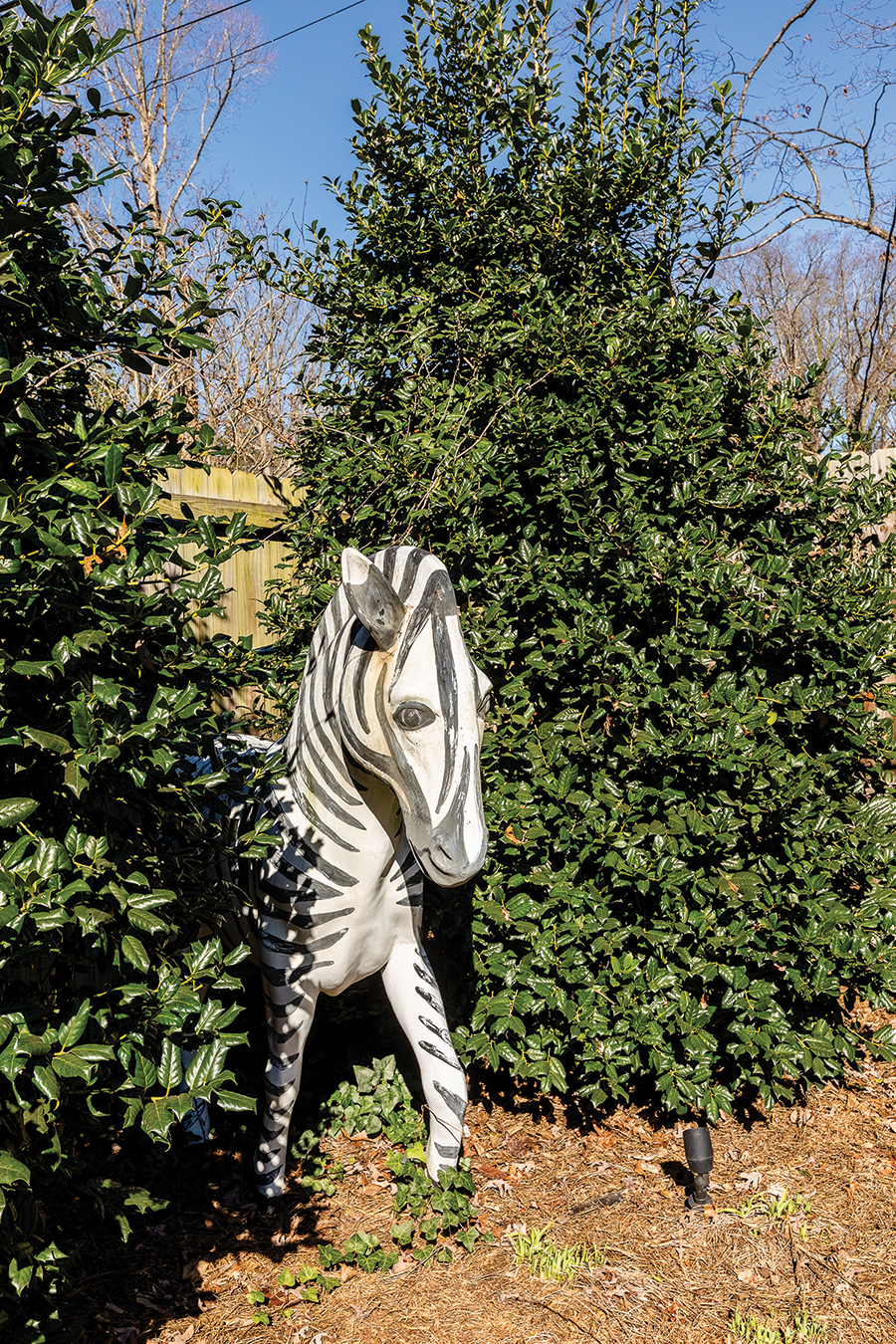
On a recent afternoon, the screen showed a black-and-white photo of a zebra, which fit nicely with the decor and with the Tarts’ love of all things equine; both of them used to ride, and they also raise Quarter Horses on a farm in Climax.

The neighs have it, judging from a crystal horse head that rears atop a sideboard bar.

Reidsville cabinetmaker Richie Alcorn built the kitchen and bathroom storage, as well as floating nightstands for the master bedroom, and a custom dresser with a motorized lift for a TV screen that vanishes into a pocket at the back of the dresser.

He also added geometric fretwork to the rolling barn doors that separate  master bedroom and bathroom. The deluxe bath includes a glassed-in shower stall that measures about 6 feet by 8 feet.

“I told Johnny that was about the size of the nursery in our first apartment,” Karen says, referring to a unit in the former Colonial Apartments on West Market Street.

The couple has moved 27 times in 47 years of marriage, including pre-McDonalds stints in Phoenix and Los Angeles, when Johnny was working for Golden State Foods.

They are happy to be back home. Whenever possible, they pick furniture and accessories made by North Carolina artists and craftspeople.

The black rolled-steel wall around the fireplace was built by Brian Wilkinson of Winston-Salem. He also welded the base of the dining room table, which resembles an X-shaped truss under a nearby railroad bridge.

Charleston Forge, of Boone, made the weighty dining room chairs, framed in wood and iron and padded with rust-colored leather cushions.

The rippled glass tabletop — from Andrew Pearson Glass in Mount Airy — looks like ice cut from a frozen creek.

Side-by-side abstract panels, painted by Charlotte artist Jenny Fuller, finish the space.

A few steps away, the kitchen, which is equipped with Wolf appliances, harbors what amounts to a midair sculpture — a cluster of pendant globes suspended inside geometric frames.

Below sits an island topped with leathered grayish granite; glossy black granite countertops line the walls. One plane spans a tall picture window, creating a bridge and knee-hole for two stools.

“It’s a good place to have a cup of coffee, and read the paper, and watch students going to UNCG,” Johnny says.

“Lots of scooters go by,” says Karen.

Being within the city’s Downtown Design Overlay, which requires new buildings to amass points tied to aesthetic features, the Tarts notched a point for including a “wayfinder,” or landmark, on their property.

Johnny hired local sculptor Jeffrey Barbour to make a sculpture to stand outside the building, at the corner of Eugene Court and Spring Garden Street.

“Whaddya want?” said Barbour.

“Be creative,” said Tart.

Barbour thought about the project for a couple of days and called Tart.

“I got it,” he said.

Barbour had been raking leaves in his yard when — as artists who are engaged in yard work are wont to do — his attention wandered to an interesting form in nature. He noticed a carpet of spiny brown balls dropped by a sweet gum tree. But instead of cursing the underfoot wobble-makers, he wondered what was inside them.

He cut one open and found out: lots of seeds.

That was it.

He would make for the Tarts a brown metallic sculpture bursting open to reveal seeds, a symbol of downtown Greensboro’s rebirth. In this case, the seeds would serve double duty: the turquoise orbs also would reflect Karen Tart’s love of the western gemstone and her affection for Santa Fe, New Mexico, a favorite destination.

The sculpture’s metallic shell would signify the neighborhood’s industrial history, visible from the back of the Tart’s building, which overlooks active railroad tracks and affords glimpses of a former lumber yard and the street art commissioned by developer Marty Kotis.

That side of the Tart’s building, parallel to the sidewalk along Spring Garden, actually looks like the front — until you climb steps to what appears to be a double-doored entrance and notice there are no handles on the doors.

The real entrance is tucked into a courtyard on the city-side of the building.

From their broad balcony facing the same direction, the Tarts can see most of the city skyline, including a new Hampton Inn rising a block away. Were it not for the faces of the personal injury lawyers on the billboard, they would have an unobstructed view of more hotel and office space under construction near the downtown ballpark.

“Maybe someday, if we hit the lottery . . . ” Karen muses.

Still, the Tarts treasure the covered space, which Johnny also refers to as the “smoking room.” Amply furnished as an outdoor living room, complete with gas-fed fire table, the space is a good location to sip morning coffee or after-brunch bubbly while soaking up the swish of traffic on the bridge below.

“It’s like Karen says: ‘If we were in Pleasant Garden or Sedgefield, we’d be complaining about the noise,’” Johnny says.

Instead, Karen, tests herself by trying to identify, according to the diesel roar, how many engines are pulling a train passing on the other side of the building.

“I call it the sounds of the city,” she says.

The downtown loft was finished in March of last year. The couple lived there full-time while they moved their main residence again, this time from Grandover to nearby Sedgefield, within walking distance of grandchildren.

“We have a habit of moving, but I think we’ve stopped,” says Karen.

“The next house,” joshes Johnny, “will be the poor house.”  OH

Maria Johnson is a contributing editor of O.Henry. She can be reached at ohenrymaria@gmail.com.

Fungus Among Us

Haw River Mushrooms literally strike paydirt with organic farming techniques

By Ross Howell Jr.    Photographs by Sam Froelich


For many, mushrooms are the Rodney Dangerfield of the plant world. They get no respect. Heck, they aren’t even called plants anymore.

Up to the mid-19th century, scientists categorized fungus as nonchlorophyll-producing plants. But German botanist Heinrich Anton de Bary (1831–1888), who spent much of his career studying plant blights, slime mold, wheat rust, and the like, realized that what he was observing wasn’t plant material at all, but something different.

In the process, de Bary was able to show that potato blight was spread by fungus. This was a big deal, since hundreds of thousands of Irish a few years earlier had perished in the Great Famine. For his discovery, de Bary would be recognized as the father of mycology, a branch of biology devoted to the study of fungi.

Mushrooms differ from plants in that they secrete digestive enzymes to process food, which makes them more closely related to animals than to the vegetables we buy at farmers’ markets. To me, that’s a little creepy.

So you have to respect any farmers’ market grower who opens an online presentation with the words, “I’m Laura Stewart, and I grow fungus for a living.”

And Laura Stewart — along with her husband Ches — is the reason I’m turning into the gravel drive of Haw River Mushrooms, an organic farm outside Saxapahaw, a town on the banks of the Haw River. The town’s name was influenced by a Native American tribe first chronicled as the “Sauxpa” by Spanish explorers in the 16th century.

Along the driveway some pickups are parked. To the right I can see a couple semitrailers. Next to them stands a low cinder-block skirt and a metal superstructure for what looks like a soon-to-be-completed growing house.

I park by a big oak tree and step out of the car. Two men are working in front of a big shed at a substantial piece of equipment I don’t recognize.

A woman drives up in a dark minivan. She pulls a lock of auburn hair behind an ear as she gets out, gathering items from the front seat. She closes the driver’s door with a hip. Her hands are full of keys, mail, a cup of coffee and a half-eaten muffin. She smiles, looking at me quizzically.

“You must be Laura Stewart,” I say.

“Oh, my goodness,” she says. “We’ve been so busy I forgot! I just did a mushroom growing program at my daughters’ day care. Have you been waiting long?”

“Just got here,” I answer.

We walk toward a pretty farmhouse with a vegetable garden by the porch. Inside, I’m greeted by a big, friendly shepherd dog named Isaac.

Laura introduces me to her husband Ches, a compact, powerfully built man who’s just about to head out the door with an interviewee for a full-time job at the farm. Ches and I shake hands.

He tells me he’s from South Carolina and was interested in horses when he was younger.

“My background’s agricultural,” Ches says. He attended Middle Tennessee State University Auburn University, and received a master’s degree at Clemson University. “All I ever wanted to do was farm,” he adds.

Ches and the interviewee head out the door, Isaac trotting along behind them.

Laura and I sit down at a thick-legged dining table. She tells me she and Ches founded Haw River Mushrooms in 2012, when each of them still had full-time jobs. Ches was working for a company as a crop adjuster and she was education director at the Carolina Farm Stewardship Association, a nonprofit organization in Pittsboro that encourages people in the Carolinas to grow and eat local, organic food.

Like Ches, Laura has seen a good bit of the country, too. She studied at Knox College in Galesburg, Illinois, and received a master’s degree in management at Antioch University in Seattle, Washington. The couple met in Columbus, Ohio.

“Our first date we went to Polyface Farm,” Laura says. My initial thought is, well, maybe that’s the name of a fancy restaurant in Columbus.

Was I ever wrong.

Polyface Farm — the “Farm of Many Faces — is located in the Shenandoah Valley near Swoope, Virginia. For anyone deeply interested in sustainable, organic agriculture, the farm is a place of pilgrimage, offering a variety of educational tours, programs and seminars.

Back in 1961 William and Lucille Salatin purchased a worn-out, eroded property and settled there with their young family. Rather than follow the conventional principles of farming at the time, they used nature as a pattern and began the long process of organically restoring the land.

The Salatins planted trees, built compost piles, dug ponds and moved grazing livestock daily using electric fencing. They were pioneers in grass-fed beef production. Along the way they invented portable sheltering systems for cattle, chickens and rabbits, and introduced sustainable methods for raising pigs in woodland areas.

One of the Salatins’ sons, Joel, is the spokesman for Polyface Farm. Considered by his fans to be “the most eclectic thinker from Virginia since Thomas Jefferson,” he is sometimes labeled a “charlatan” by his detractors.

Whatever Joel Salatin is, he’s inspirational. He’s written 12 books and delivers inspiring educational presentations around the country.

“Ches and I read Joel’s book, You Can Farm,” Laura says. “And it had a big impact on us. We started thinking even more seriously about how farming could earn us the living we wanted for ourselves and our children.”

So the couple moved to our part of North Carolina — for the climate and the close access to local urban markets.

“This is a great area to locate a small, sustainable family farm,” Laura says. In addition to climate and markets, there are excellent resources, like Laura’s former employer, the Carolina Farm Stewardship Association, and the Rural Advancement Foundation International-USA(RAFI), also headquartered in Pittsboro. RAFI’s mission is to cultivate markets, policies and communities that support thriving, socially just and environmentally sound family farms.

In the end, though, it all comes down to hard work and good dirt. And mushrooms are about as efficient at making good dirt as any living thing you can think of.

The vegetative part of a fungus is called the mycelium, a system of fine, branching filaments. Think of the mycelium as the “roots” of a mushroom, and the edible part as its “fruit.” Mycelium may form a colony too small to see with the naked eye, or one that can spread for thousands of acres.

Secreting enzymes that are remarkably effective at breaking down plant material, these colonies add essential organic material to the soil. They also enhance nutrient and water absorption by the roots of plants, increasing their resistance to disease. And the mycelium colonies release carbon dioxide into the environment.

And carbon dioxide is just what green plants need. By photosynthesis, they use carbon dioxide and water to produce sugar and oxygen, vital to sustaining their life and growth. Of course, the oxygen green plants manufacture is fairly important to us human beings, too.

“We’re surrounded by an amazing system of abundance,” as Laura likes to put it. She suggests we head outside so I can see how they grow fungus at Haw River Mushrooms.

As we walk toward the machine where the two men are working, Laura points out a raised bed in the garden by the house. She explains that it’s an example of what the Germans call Hugelkultur, a technique using compost materials to build beds where plants can be grown. Here the bed is underlaid with mushroom-inoculated logs covered with straw. Atop the bed grows a squash vine.

“We harvested more than 40 yellow squash,” Laura says. “And there are healthy mycelium developing on the logs under the straw.”

She stops by an enormous oak tree near the garden. There’s a mulched bed surrounding the tree. Laura reaches into the mulch, carefully exposing the white tendrils of mushroom mycelium with her fingers.

“In the wild, mushrooms often grow at wood’s edge, so we thought we’d give this a try,” Laura says. She tells me she and Ches have farmer friends who are trying to grow mushrooms between rows of sweet corn. She calls all these growing experiments — the squash bed, the mulched bed around the oak, the corn row mushrooms — “citizen science.”

Now we’ve reached the machine in front of the shed. It’s used to inject substrate — the material in which the mushrooms will grow — into clear bags. After the substrate, a splash of water is injected. The tops of the bags are folded over. Then they’re placed into a galvanized livestock watering trough that has been outfitted with propane burners on the bottom.

“The substrate is a mix of mulch, soybean hulls, straw and oak sawdust,” Laura says. “There’s a sawmill in Liberty where we especially like to get our sawdust,” she adds.

Once the trough is filled with bags, a lid is put over the top and the burners ignited. Since they are so rich in organic materials, the bags have to be sterilized.

“Otherwise, any sort of bacteria or fungus could start growing inside,” Laura says. Once they’re sterilized, the bags are transferred to racks in the cooled shed behind us. There they’ll be inoculated with the spores of the various types of mushrooms that are the farm’s specialties.

We walk across the drive to one of the semitrailers, or “grow houses.” Laura closes the door behind us. Inside the space is dimly lit.

Laura explains the growing houses could be lit with blue light only, since that’s the range of the spectrum the mushrooms respond to.

“We thought one Halloween we might hang blue lights when we do tours, just for effect,” she says.

It’s cool and damp. The only sound is the whirring of air-moving equipment. Clear bags now removed, blocks of substrate with mushrooms emerging at various states of development rest on racks running the length of the trailer.

As I’m making notes, I look up, befuddled to see I’m suddenly shrouded in fog. Laura smiles.

“The misters come on every six minutes,” she says.

Outside I blink in the sunlight. Laura points out the new growing house with the metal superstructure.

“We’re going to plant blackberries,” she says. “The native soil is poor, so we’ll compost. When the blackberries are growing, we’ll pipe in carbon dioxide from the mushroom growing houses.”

An amazing system of abundance, indeed.

Haw River Mushrooms now has six full-time employees, counting the Stewarts, and several part-timers. They organically grow lions mane, oyster mushrooms, shiitake, cinnamon caps and reishi, supplying mushrooms to several restaurants in the Triangle and Triad.

Haw River also sells mushrooms at the Eno River Farmers Market in Hillsborough, the Chapel Hill Farmers’ Market, the Durham Farmers’ Market, and the Greensboro Farmers Curb Market. They ship mushroom vegan jerky to customers throughout the country.

The farm offers classes on mushroom cultivation and tincture-making.

“Mushrooms have amazing medicinal powers we are just beginning to understand,” Laura says. While they’ve long been studied for their curative and culinary value, there’s a great deal that remains unknown. With more than 600,000 known varieties on Earth, only about 44,000 have actually been studied.

“The lions mane we grow here at the farm is a North Carolina native,” Laura says. “It’s recently been studied to see if it might have value in treating dementia.”

Or consider the cordyceps mushroom, a species native to the North Carolina mountains. Like its nearly 400 cousin species around the world, our native cordyceps is an endoparasitoid, meaning that it’s parasitic, feeding primarily on insects.

But it gets way weirder. Once cordyceps invades the body of a host insect, its mycelium begins to grow, replacing the bug’s innards. In the process, the cordyceps somehow gains control of its host’s brain, so that the insect climbs to the highest point of whatever bush or tree it might be inhabiting. There, it dies.

Since Laura has told me about maybe using the blue lights in the growing houses for Halloween, I ask her if she’s pulling my leg.

“Oh, no,” Laura assures me, “You can Google it.”

In fact, cordyceps reproductive strategy is very effective. There are a plenty of insects on which it can hitch a ride, and when its fruit appears, it’s perfectly perched for its spores to achieve their widest geographical distribution.

Maybe this one can be researched for its psychedelic powers?

A perennially popular class at Haw River Mushrooms is “log inoculation,” offered in fall, winter and spring. Hardwood logs three to six inches in diameter that have been harvested by local farmers — typically in annual field brush-clearing, since sustainability is so important to the Stewarts — are cut into roughly four-foot lengths.

“After leaf fall, the logs have a high concentration of sugar,” Laura says. The concentration of sugar lengthens the amount of time that the logs will sustain mushroom growth.

Students then drill holes in individual logs, inoculate them with mushroom spawn, then take their logs home to enjoy the fruits of their labor. Actually, it’s a bit more complicated than that, which is why you’ll enjoy taking one of the classes.

For those of you who’d like to forage for wild mushrooms and avoid poisoning yourself in the process, the farm also offers field trips. Laura is a certified mushroom forager for North Carolina, South Carolina and Georgia.

There are also programs on mushroom growing for kids, using mushrooms in raising other crops and soil building in the garden. Laura, Ches and staff regularly welcome groups to the farm for tours.

With all the interest, the Stewarts are looking for a larger farm nearby.

“Long-term, we’d love to be able to convert everything to solar power,” Laura says.

I’d say mushrooms are finally getting the respect they deserve. Cue Aretha Franklin..  OH

If you have a garden or landscape topic you’d like Ross Howell Jr. to write about, email ross.howell1@gmail.com (don’t miss the number 1 in the address).
For more information on Haw River Mushrooms programs or products, visit its website, hawrivermushrooms.com, or follow on Facebook and Instagram at the handle @hawrivermushrooms, or check out the farm’s Pinterest page.

November Almanac 

By Ash Alder

Two sounds of autumn are unmistakable, the hurrying rustle of crisp leaves blown along the street or road by a gusty wind, and the gabble of a flock of migrating geese. Both are warnings of chill days ahead, fireside and topcoat weather.Hal Borland


November is cold mornings and cashmere.

Before the earliest skein of geese break the silence of the day, you unearth your winter wardrobe, rediscovering the ageless sweater that, despite its annual reappearance, always feels brand-new.

When the geese trumpet across the sky, you are cradling your coffee by the kitchen window, watching the backyard squirrels zigzag like pinballs as they unearth their own buried treasures.

November is time to take stock.

On the back porch, there is kindling to split. And back in the kitchen, one dozen Bartlett pears resemble a Claude Monet still-life.

What will you bring to the table this month?

One dozen Bartlett pears now peeled, cored, and chopped, simmer on the stovetop with three pounds of cranberries, two cups of dried cherries, one cup of sugar.

November is equal parts sweet and bitter.

Your bones seem to know that winter is near, yet your skin sings in cashmere.

Even as the autumn leaves descend, the Earth continues to give, give, give.

Pastel sunrises.

Winter squash and rainbow chard.

Murmurations of starlings.

And camellia blossoms which, despite their annual reappearance, always feel like tiny miracles.


What Will You Create?

Thanksgiving is celebrated on Thursday, Nov. 28. As you craft your Thanksgiving plate with the zest of a landscape architect, consider what you are creating on a larger scale. Are you building a life that is savory? Bitter? Sweet? Or does it offer a little bit of everything — bursting at the seams with color and flavor, yet with enough space for gratitude and magic?


Looking Up

According to National Geographic, three of the top sky-watching events of 2019 happen this month, beginning with the Transit of Mercury on Nov. 11. Of course, you won’t be able to witness what will look like a tiny pinhole traveling across the sun with the naked eye, nor should you attempt this without safety precautions (eclipse glasses, solar binoculars, solar filters, etc.). According to the article, “This will be the last transit of Mercury available to North Americans until May 7, 2049.”

On Sunday, Nov. 24, don’t miss brilliant luminaries Venus and Jupiter close as ever in the southwest horizon — just 1.4 degrees apart. And on Thanksgiving Day, 45 minutes after sundown, take another look low in the southwestern sky and see what National Geographic calls the “celestial summit meeting” of Venus, Jupiter, Saturn, and a hairline crescent moon.


The Power of Gratitude

The correlation between gratitude and happiness was common sense long before it was research material. And yet, time and again, psychologists’ findings support what poets and sages of the ages have long been conveying: Gratitude is good for you.

Moreover, it can radically change your life.

A recent article by Harvard Medical School’s Harvard Health Publishing offers six simple practices for cultivating gratitude:

1. Write a thank-you note.

2. Thank someone mentally.

3. Keep a gratitude journal.

4. Count your blessings.

5. Pray.

6. Meditate.

And while we’re on the subject, here are three powerful quotes on gratitude that suggest its utter potency:

“Acknowledging the good that you already have in your life is the foundation for all abundance.” — Eckhart Tolle

“We need to learn to want what we have, not to have what we want, in order to get stable and steady happiness.” — Dalai Lama

“Be thankful for what you have; you’ll end up having more. If you concentrate on what you don’t have, you will never, ever have enough.” — Oprah Winfrey

Happy Thanksgiving!  OH

Follow the Yellow Brick Road

To the 25th anniversary production of CTG’s The Wizard Of Oz

By Quinn Dalton


Justice Reeves-Burke, a sophomore at Weaver Academy and one of two Dorothys cast in Community Theatre of Greensboro’s production of The Wizard of Oz, knows what it’s like to grow up in the theater. At 15, and now in her seventh year in the production, she’s been acting for literally half a lifetime.

She credits her mother, Adriane Reeves-Burke, for her start. “My mom had been the stage manager in Oz the year before,” Reeves says. Her first role? A munchkin. “I was in the Lullaby League, and I was also a crow,” Reeves recalls. That was the first three years. The second three she spent in the Women’s Chorus — they are on stage when Dorothy makes her first entrance running down the aisle. She auditioned for the Dorothy role at age 12, 13 and 14 before being offered the role this year. “I finally got it,” she says. The excitement is clear in her voice. So is the confidence. She has followed her passion and she’s kept coming back year after year — for the joy of it, mainly — and she’s ready to make her own run down that aisle.
Reeves-Burke’s story echoes the story of so many actors, stage crew members, volunteers and family members who, over 70 seasons, have formed the family that is the Community Theatre of Greensboro.

CTG executive director Roz Fulton came to Greensboro as a student at N.C. A&T, graduating in 2000 with a B.S. in family and consumer science education. CTG was the only place she applied to, hired as an administrative assistant. When she joined, the annual Wizard of Oz production was only in its fourth year, and it was also the only CTG production that provided an abundance of roles for children.

Over the next few years, she saw so many talented young people play their hearts out as a munchkin, poppy or crow. But there weren’t many opportunities for kids in other CTG productions. “I wanted to see all the kids shine.”

In 2005 the education director role came available and she asked the CTG board to consider her. “I always had a creative side to me,” she says. “They gave me the chance.”

Their first youth production kicked off in 2008 with High School Musical. Many other famous musical productions adapted for younger audiences have found their way onto the stage through Music Theatre International’s Broadway Junior series.

With all of this developing talent, Fulton launched CTG’s Centerstage Youth Performing Group and began adapting those performances to compete in the Junior Theater Festival, a national competition held in Atlanta in which youth theater programs perform 15-minute versions of full-length performances. To be clear, these short versions are not simply a selection of scenes. They are in fact a 15-minute version of a full-length production. The youth actors help with selection, and Fulton scripts each one. The actors practice under a tight schedule to prepare. In 2020, Fulton and her talented troupe will also attend Junior Theater Festival West in Sacramento for the first time. “It’s the most exciting thing we do,” she says.

Passing the Wand

This year, 19 years after newly graduated Fulton decided CTG was the only place she wanted to apply, she became CTG’s executive director, stepping smoothly into the role formerly held by Mitchel Sommers, who still directs Oz as he has every year since the first production in 1995. Which means Fulton and Sommers have been taking us down the yellow brick road for longer than many of the cast members have been alive. And this is a big year — it’s CTG’s 70th season and the 25th production of The Wizard of Oz.

“It’s the longest continuously running Wizard of Oz production in the world,” Sommers says, and he’s put in the time to know. He is always looking for other longer-running productions as he’s worked year after year to keep this classic production fresh.

This involves frequent changes to sets, choreography, costumes and even adding to the cast. Last year for example, the newly minted Emerald City Ensemble added dance and comic sparkle, and this year some major set design updates will wow audiences.

The scale of CTG’s Oz is in and of itself dazzling. Because of its popularity, it’s the one show staged at the historic Carolina Theatre. The roughly 100-
person cast is only a sliver of the picture. Backstage, two sets of 25 volunteers work in different teams, one on each production weekend, assisting with props, set and costume changes, with lighting and sound crews hired in.

Then there are the parents, bless them, who get their munchkin or flying monkey to practice every afternoon and on weekends as the show dates near, and may volunteer as well. Often, it’s truly a family effort. In Roz Fulton’s case, daughter Morgan did a munchkin/poppy turn while husband Jevon was one of the Fly Guys — the volunteers who run the rigging that puts the air under the Wicked Witch’s broom.

All told, between cast, crew, professional technicians, volunteers and of course CTG staff, each production directly involves around 220 people. That’s, of course, not including the thousands of audience members — multiplied by 25 years. That’s a lot of people coming together to share the wonder of one of the most famous stories in the world, one that happens to be not just about going home, but knowing where your home really is.

There’s no Place like Home

Mitchel Sommers has seen first-hand how thousands of young and adult actors have found their home in theater. “Many people who perform with CTG, and not just with The Wizard of Oz, their lives may not be ideal,” Sommers says. “This lifts them up to a better place. Sometimes it’s just a matter of learning basic life skills — how to dress themselves or how to read or how to just have a conversation.” Often, he says, it’s as simple as walking into a world they wouldn’t know otherwise. “Some of our actors come to practice from a shelter and they live for being part of this production. When they come here they’re on the same stage and singing the same songs as people who have grown up in a mansion and had every advantage.”

And the stories. Too many to count. Too many to mention. The grandmother who’s brought her granddaughter to every production for 20 years. The mother who, as a little girl, was in the cast of Annie, the first production Mitchel directed, and years later performed in Oz with her daughters. The friendships and even families that found their start on that stage. The people he runs into everywhere he goes, locally and in far-flung places, who tell him about their own experience in the show, or about their child’s, or how it was the first play they ever saw, made possible by CTG’s free school performance during the week before opening night.

Mitchel found his home too — in CTG, in Oz, and the theater, always the theater. Every story is another reason he stays with it. “This is how we share what it’s like to be human,” he says. “We are all transformed on the stage.”

Justice Reeves-Burke, who shares the role of Dorothy this year with High Point’s Penn-Griffin School for the Arts’ junior Mackenzie Mullins, agrees. The two Dorothys split their performances over the two weekends — partly so there is an understudy in case of sickness, and partly to allow more opportunity for actors to shine. She says she might never have found her passion if both of her moms hadn’t suggested she try it. So she wants to pay that favor forward to anyone wondering if there might be a place on stage for them. “Try it,” she says. “It’s taught me so much. And when it comes together it’s the best feeling in the world.”  OH

Quinn Dalton is the author of two story collections and two novels, most recently Midnight Bowling. She also co-authored The Infinity Of You & Me under the pen name JQ Coyle with fellow UNCG M.F.A. grad Julianna Baggott.

 For information on showdates: November 16 – 24. https://www.facebook.com/pg/communitytheatreofgreensboro/events/?ref=page_internal

Singing Tables

A poetic meditation

By Jaki Shelton Green

I’m never cooking alone, even at my most solitary moments. I am surrounded by generations of cooks, their wisdom, laughter, and their flawed and perfect recipes lifting my hands and heart savoring each ingredient as I realize that each ingredient represents all the joys, sorrows, healing and restoration of my life’s journey. These unseen hands hold me in passionate surrender to generosity as family and friends gather at my table reminding me that food creates community, holds my sense of identity, and conjures sensory surprises over and over again. The ghosts of other tables, other kitchens remind me that we are all just ingredients, and what matters is the grace with which I cook the meal.

My food odyssey is a soundtrack re-mix like the texture of an autobiography offering a throw-back to prayer-song, dance, birth, death, sex and rock and roll. The backyard chicken coops, vegetable gardens and mini orchards are long gone like my elders and the neighborhood of my childhood. What remains is me . . . the brown woman-child writing down the sizzle of cast iron skillets, the bold of the beet, the hot of the pepper pot, the earthiness of walnuts, the bitter of arugula.

Food helps me to express my past and present. Food helps me to create communal ties and honor my ancestral roots.

“Blessed assurance, Jesus is mine!

Oh, what a foretaste of glory divine!

Heir of salvation, purchase of God,

Born of his Spirit, washed in his blood” — Frances Crosby

My grandmother, Eva White Tate, hosted the Ora Shanklin African Methodist Episcopal Missionary meetings, which gathered monthly on first Monday evenings during the springs and summers of my youth. An agenda of devotions, song, prayer and Scripture segued into Old and New Business, projects to raise money for their many charitable activities, missionary dues, and a “love offering” for the sick. My grandmother, mother and aunts raced around all day preparing food and setting an elegant table for the elaborately coiffed church ladies in their flawless pristine summer linen, pastels, crepe de chine, patent leather and sexy slingbacks that made ticky-tacky squeals across the glistening, freshly waxed wood floor.

This monthly soiree featured milk glass vases holding peony globes and arrangements of snapdragons, Queen Anne’s lace and foxgloves strategically placed on the crisp white linen tablecloth adorning the antique oak dining table, monogrammed linen napkins, and the heirloom silverware that was left to my tiny hands to polish on a monthly basis. I was impressed that the deviled eggs required their own unique platter, designed especially for — deviled eggs. Mounds of homemade chicken salad garnished with apples, pecans and grapes, potato salad, pear walnut salad, canapés of cucumber-dill cream cheese, pimento cheese, stuffed olives, and perfectly browned chicken legs were presented on sparkling crystal and carnival glass serving platters.

The inlaid glass sideboard was majestic with a centerpiece of magnolia, camellia and gardenia blossoms fresh cut from my grandmother’s flower garden and hosting cut glass pedestals of scrumptious coconut cake, petit fours, homemade (pink, green, yellow) mints, fresh strawberries, chocolate-covered peanuts, and my grandmother’s famous secret recipe egg custard. Pitchers of brewed mint tea and punch bowls bearing icy rainbow sherbet flanked both sides of the dessert display waiting to be admired and devoured by the white-gloved missionaries.

This pageantry of memory continues to feed my upper-crust soul. This pageantry was the backdrop for all the whispered gossips and secrets of uppity church women in between “a piece of this and a little dab of that.”

“Summertime, and the livin’ is easy

Fish are jumpin’ and the cotton is high

Oh, your daddy’s rich and your ma is good looking

So hush little baby, don’t you cry.” — Dubose Heyward

The smell of coffee brewing, bacon frying and hot biscuits browning were the only summer alarm clocks in our house. The first few weeks following school vacation, my brother and I spent lazy days playing between our house and Aunt Alice’s house or hanging out at Uncle Ervin’s Service Station pretending to be proprietors behind the counter taking money for gas, candy, milk, bread, but never the cigarettes. That fun would be interrupted when “the garden came in” with lima beans, snap beans, wax beans, okra, peas, squash, cucumbers, tomatoes, cantaloupe, cabbage, lettuce, watermelon and corn. The litany from porch to porch throughout the neighborhood addressed to our bored little brown bodies was, “Shut up whining, your little bellies will be glad to get this food come wintertime. Don’t put those hulls in that bowl.” So we pouted in-between snapping, shucking, peeling and rinsing so the grown folks could can, freeze, stew and preserve.

These were the summers when our “Up South” Northern kin folks took a notion to jump in a car or hop a bus or train and show up unannounced, usually with five or six children in tow. Our family had abundant land and food, so this uncouth behavior never daunted my mom, grandmother and aunts. They knew how to “hold their mouths right” and bring forth their best masks of civility so refined that no one ever read their furious annoyance hidden beneath the labor of love they laid out for two or three weeks presenting daily breakfast, lunch and supper smorgasbords of cured smoked ham and red-eye gravy, scrambled cheese eggs, grits, salmon croquettes, biscuits, bacon, sausage, homemade peach, strawberry, blackberry, pear jelly and preserves, stewed apples, potato cakes, cinnamon rolls and toast. The “guests” would feast and then retreat to the front porch, into the yard, watch television, or return to bed to sleep away their city blues.

With the guests “out of the way,” the women folks washed dishes, swept crumbs, cleared the table and talked in hushed ridicule and dismay about their hungry citified relatives. After they caught their breaths and a few of the leftover table scraps, they started the operation for lunch or “just a little something to tide them over,” which was usually homemade egg, tuna or chicken salad, the optional ham and cheese sandwich, tossed salad, chilled watermelon and cantaloupe, iced tea and fresh lemonade served outside on the porch.

Fried chicken, fried fish, turnip salad, chicken and dumplings, stewed tomatoes, potato salad, rice pudding, fried okra and squash, pound cake, apple pie and yeast rolls made the “Up South” folks remember where home really was. They never suspected by our good manners how their unannounced visits interrupted our summer explorations, building camps and forts in the woods, fishing, skinny-dipping, catching tadpoles, making June bug whistles, chasing lightning bugs and baking mud-pies all day in the sun.

“If you want to know

Where I’m going

Where I’m going, soon

If anybody ask you

Where I’m going

Where I’m going soon

I’m going up yonder

I’m going up yonder

To be with my Lord” — Tremaine Hawkins

Death often disrupts my family and community. We gather with food because food is the ultimate and final expression of how we love and the culture of our community. Feasting with the dead even now and in my past continues to provide me a way to reconnect and maintain connections with my ancestors and my daughter. My family and extended tribes have never needed a copy of “Being Dead is No Excuse: The Official Southern Ladies Guide to Hosting the Perfect Funeral.” It’s in our blood . . . we know what we know about the power of fried gizzards, leftover meat loaf, turkey necks, fried croakers, okra gumbo and moonshine.

The laying out of the dead and the laying out of the food pulls me closer and closer to that vortex of all things familiar and comfortable. These are forever images imbedded in my mind’s rolling video screen of the deaths of my father, grandmother, aunts, uncles, cousins and my daughter.

When my precious daughter Imani died, people came with their stories of her life neatly folded in the corners of picnic baskets. They delivered their stories of her whimsy, her sass and her bravado rolled inside a fresh loaf of sourdough bread, slithering across roasted vegetables laced with slow-drizzling balsamic, baked inside a piping hot strawberry rhubarb pie. The stories were alive inside the food. Imani loved food. Imani loved to feed people, so her stories became the food itself … roasted with superfluous green garlic, cilantro, cumin, basil, a rack of lamb Imani threatened to throw at her brother one Easter, the duck medallions I cooked for the last Christmas meal of her life with us, or the wild salmon steaks she’d hide in the freezer.

What I know that I know is food heals. Food covers the wounded heart. Food holds the raging storm and invites Spirit to the table.

“I will love you anyway

Even if you cannot stay

I think you are the one for me

Here is where you ought to be

I just want to satisfy you

Though you’re not mine

I can’t deny you

Don’t you hear me talking baby?

Love me now or I’ll go crazy” — Chaka Khan

Appearance. Taste. Texture. Symbolism. Succulence. The Interaction of Colors. The Dance Behind Oven Doors. Edible Metaphors. Velvety. Heavy Cream. Spice Jars. Simmer. Pan Fry. Cold Wash. Knead. Roll. Curl. Caramelize. Braise. Soak. Stir. Roast. Open Fire. Hot Oil. Blend. Fold. Mortar and Pestle. Pine Nuts. Raspberries. Almonds. Champagne Grapes. Mango Preserves. Muscadines. Tomatoes. Expresso. Le coq au vin. Charred Romaine. Mousse. Rose Water. Artichokes. Truffles. Butter. Candied Ginger. Chocolate. Dirty Rice. Brie. Cherries. Figs. Saffron Threads. Cinnamon. Nutmeg. Chutney. Parfait. Hazelnuts. Orange Peel. Lime Zest. Gar-licky Collards, Ambrosia, Chow Chow. Red Rice. Rosemary Sea Salt.

I love the way these words, sounds and ancient cooking rhythms sing inside my mouth . . . and honey chile’ don’t forget the Honey.

“If you really want to make a friend, go to someone’s house and eat with him. The people who give you their food give you their heart.” — Cesar Chavez

I remember the first meal I ever prepared for my husband. Lots of talking and long glances over a table full of lush sensuality. Mango gazpacho. Grilled salmon with a black bean-ginger-garlic glaze. Roasted asparagus. Brussels sprouts, beets, feta and walnuts drizzled with fig balsamic vinaigrette. Basmati rice. Yeast rolls. Arugula salad. Sparkling pear cider. Mixed berries dusted with coriander.

Once upon a time, I prepared a “last supper” for a lover I was kicking to the curb. It seemed best to leave a taste of me on his lips. Filet of beef in puff pastry and Madeira cream sauce. Caramelized shallots, carrots and mushrooms. Roasted lemon-garlic artichokes. Grand Marnier cheesecake.

My first memory of a romantic meal was sharing a tomato sandwich made with tomatoes I’d grown in a small bucket as a child with a little boy visiting my grandmother with his grandparents. I was mesmerized by his seersucker plaid shorts and matching bowtie. Crisp white shirt. White crew socks. White bucks. Magic happened between us when the juicy tomato dripped down his long elegant hands and he slowly licked the essence of my first harvest.

My husband and I love to cook. Our food landscape is forever changing, moving, reinventing itself, but what remains always is “sauce” so rich and soulful that it requires the licking of fingers, eyelids, noses, jelly-roll laughs, and oceans of soft fluttery kisses. Our food adventures continue to awaken our passion . . .

“Your stature is like that of the palm, and your breasts like clusters of fruit. ‘I said, ‘I will climb the palm tree; I will take hold of its fruit.’ May your breasts be like the clusters of the vine, the fragrances of your breath like apples, and your mouth like the best wine. May the wine go straight to my lover, flowing gently over lips and teeth. I belong to my lover, and his desire is for me.” — Song of Songs 7:7-10

We stroll into each other’s perfumed gardens gathering wild honeycomb. Whether dining by candlelight in our intimate dining room or sitting at a makeshift table in the woods with dandelions my love has picked on the way, we savor the bread between us. The anticipation of a romantic meal is oftentimes aphrodisiac enough. We can’t stop smiling and casting knowing glances at each other the whole time we are preparing the meal. Late at night I flow through celestial whipped dreamy clouds trailing the scents of rose and lavender as I fold gently into the crevices of pillows stuffed with crushed rosemary*.

*According to ancient scribes, rosemary was a love potion for engaged or married couples, symbolizing remembrance and fidelity.  OH

Poet and teacher Jaki Shelton Green is North Carolina’s ninth poet laureate and is the recipient of a Poets Laureate Fellowship from the Academy of American Poets.

This piece was previously published in The Carolina Table: North Carolina Writers on Food (2016); Eno Publishers.