Almanac

By Ash Alder


I perhaps owe having become a painter to flowers.

–Claude Monet

May is a month of magic. A single flower is proof. But the Earth spills fragrant blossoms with the fervor of a child in a spring wedding, hands dipping into that shaky wicker basket until the aisle resembles a sea of brush strokes — a Monet painting come to life.

May is a month of abundance. Plump strawberries. Rhubarb pie. Tomato vines winding up rustic garden trellises.

On May 1, an ancient fire festival called Beltane celebrates this fertile season with feasts and rituals. Midway between the spring equinox and summer solstice, Beltane was traditionally a celebration of light that marked the beginning of summer, a Gaelic May Day festival during which cattle were led between two sacred fires, the smoke from which was said to purify and shield the herd from disease before they were driven into open pasture. Villagers and couples danced round and leapt over the flames to cleanse their souls and invoke fertility and good fortune.

May is a month of flowers. In her book of essays and meditations inspired by a retreat to Florida’s Captiva Island in the early 1950s, Anne Morrow Lindbergh mused that “arranging a bowl of flowers in the morning can give a sense of quiet in a crowded day — like writing a poem or saying a prayer.”

Mother’s Day falls on Sunday, May 14, two days after the full Flower Moon. Gift her wildflowers. A sprig of dogwood. Irises from the garden. Gather them in the early light and feel the magic of May pulsing within them.

  The May Bush

The first maypoles were made of hawthorn, a mystical tree whose pale blossoms represent hope and supreme happiness. Also called thornapple, hawberry and May bush, the ancient Celts believed this magical tree could heal a broken heart. If you stumble upon a wild hawthorn, especially one growing among ash and oak, legend has it you have found a portal to the faerie realm.

The Celts sure love their nature spirits. According to Celtic tree astrology, those born from May 13 – June 9 draw wisdom from the sacred hawthorn. Creative and charismatic, hawthorn types are often found performing for a crowd. They’re most compatible with ash (Feb. 18 – March 17) and rowan signs (January 21 – Feb. 17).

And wouldn’t you know it? The hawthorn is one of two birth flowers of May, the other being lily of the valley — less fabled but far more fragrant.

Spring in a Bottle

Remember picking your first dandelion? How it yellowed your clothes and fingers? How its tiny florets rendered it the most perfect specimen you’d ever seen? Before you knew it as weed or edible, dandelion was faithful companion. You wove it into wildflower crowns, you gathered them for Mother, and gasped when you found one gone to seed. Even as a child, you somehow knew that dandies spread like laughter. For that, you were grateful.

In the spirit of that playful inner child, harvest a basketful of dandelions on a warm May evening. Make wine. Pop off the blossoms. Soak them in citrus juices. Boil with ginger and clove. Bottle the sweetness of spring to enjoy all year.

Dandelion wine recipes are nearly as easy to find as the star ingredient. Just be sure to harvest from someplace free of pesticides. And when the blossoms stain your fingers, don’t be surprised by a sudden impulse to turn a cartwheel or somersault across the lawn. 

Weeds are flowers too, once you get to know them.

— A. A. Milne

dandelions on wooden white background flat lay

— Botanicus —

Joy Mongers

The peony is sure to bring a smile to anyone’s face

By Ross Howell Jr.

Marco Polo described peonies as “roses the size of cabbages” when he returned to Italy from his sojourn in China in the 13th century. Before Polo’s visit, the flower had been cultivated for centuries by the Chinese for its beauty and for its taste.

“I eat nothing without its sauce,” philosopher Confucius (551 B.C.–479 B.C.) is said to have commented about the peony. “I enjoy it very much, because of its flavor.”

Despite the fact that a quick Internet search yielded a surprisingly tasty-sounding recipe for peony jelly from a Benton Harbor, Michigan, newspaper, the only way peonies make their way to the dining room in my household is in a flower arrangement.

But what arrangements they are!

After frail, wine-colored shoots in spring, peonies give way to clenched balls of blossom amid a profusion of green leaves, the nectar of those balls sweet bliss to the ant world. Heavier, they nod and tenuously open, the most voluptuous of all flowers — pink, red, white, whites limned with pink or red — petal after ruffled petal offering beauty to the light.

When I cut these flowers for my wife, and see the smile on her face as she arranges them in a vase or bowl, I find myself experiencing for a moment what anyone who grows flowers longs for, maybe what anyone at all longs for — pure joy.

In the end, after their beauty has passed and they disintegrate, leaving a clutter of petals on the dining room table after a party, as if someone had tried to bring a touch of elegance to a scene in one of the Hangover movies, I carry them unceremoniously to the trash or compost.

Since I’m a young man no longer, I feel a bit more wistful each time I enact this ritual.

But I grow maudlin.

How about taking part in a celebration of peonies?

Founded in 1903, the American Peony Society notes that the flower first enjoyed public interest primarily as a cut flower in the first half of the 20th century. Since peonies could be harvested in bud and refrigerated without damage for several weeks, they could be shipped by train from cultivating areas to urban markets.

Early APS exhibitions, therefore, were primarily cut flower affairs, and extremely competitive. “In 1936, Harry F. Little brought over three thousand blooms to the show, held in Toronto that year,” the APS writes. “The most coveted award in those days was that for Class No. 1: A collection of 100 blooms made up of not less than 80 different varieties. . . . Modern shows are more relaxed affairs with highest honors going to the one best peony in the show.”

So for a virtual day trip (Marco Polo’s China journey lasted 26 years!), you might want to take in the American Peony Society’s Annual Convention. This year it’s online only on June 20. While most APS events — such as the guided tours of the Sarah P. Duke Gardens in Durham, N.C. State’s JC Raulston Arboretum, and plant hunter Tony Avent’s Plant Delights Nursery and Juniper Level Botanic Garden in Raleigh — are for members only, this virtual presentation provides options for public as well as member participation. Be sure to check the line-up here.

And don’t forget your peonies for Mother’s Day!  OH

Ross Howell Jr.’s novel Forsaken has been named a finalist for the 2016 “Foreword” INDIE Book of the Year in the Historical Adult Fiction category.

Story of a House

The Art of Imperfection

The intentional and unintentional meet in Leslie and David Moore’s High Point home

By Maria Johnson     Photographs by Amy Freeman


Her blousy white shirt — worn simply and smartly over black leggings and accented with white stone beads — isn’t exactly a lab coat, but you could think of interior designer Leslie Moore as a domestic scientist.

And you could think of her home, a nearly 100-year-old English-style cottage in High Point’s Old Emerywood neighborhood, as the place she conducts her residential experiments.

“This is my laboratory,” she says. “I try things out here.”

She points to the hardwood ceiling, starry with can lights, in her vast kitchen.

“I wanted to try that. None of my clients would do it,” she says. “I love it. It makes the ceiling disappear. If this room had a white-painted ceiling, it would look like a runway.”

Strolling through the home, where Leslie and husband David have raised two children, is the best way to get a feel for Leslie’s taste.

“It’s very eclectic,” she says. “That’s an overused word, but that’s what it is.”

Her outlook was informed by her art history education at Vanderbilt University and a short stint in Jackson, Mississippi, where David, an ear-nose-and-throat specialist, was a resident.

While in Jackson, Leslie took interior design classes at Mississippi College and worked for a residential designer who imported European antiques. When David had time off, the couple drove to New Orleans and haunted the shops along Magazine Street.

“We’d go to all of these antique stores, and then we’d go eat,” Leslie says. “It was awesome.”

From that experience, Leslie gained an appreciation of French-flavored furniture and accessories. The woman knows her way around Empire, Louis XV, Napoleon III, and Directoire styles. She relishes weaving together old and new pieces of different genres.

“When you do things like that, it gives the room an evolved look, like it wasn’t all done at one time,” she says. “I like things to look lived-in, even if you haven’t lived there very long. You don’t want it to look like the designer just walked out the back door.”

When David joined a practice in High Point in the early ’90s, he and Leslie bought a house that was the perfect proving ground for her ideas. The house, built in the 1920s, was originally a two-bedroom cottage on a sloping corner lot in a sparsely populated section of the then-new development.

An early black-and-white photo, given to the Moores by the daughter of the developer, shows a modest gabled brick house, painted white, with thick timber window frames and a copper overhang at the front door.

The setting is downright pastoral; no other structures are visible. The front yard is striped with tall pines and trimmed by a split-rail fence. The driveway is dirt.

“We have at least half a dozen magnolias, and they’re enormous. They’re not even in the picture,” says Leslie.

Early on, physician Stanley “Brick” Saunders owned the house. He and his family lived there for several decades.

“When we moved here, a lot of older people referred to it as the Saunders House,” Leslie says. “You know how it is: It’s never called your house until you move.”

After the Saunders clan left, the home changed hands several times, sprouting additions and modifications along the way.

The house encompassed nearly 3,000 square feet in 1994, when the Moores moved in with their daughter, Braeden, now 25, and the first in a long series of Golden Retrievers. The following year, son Will arrived.

Leslie dipped her toe into a career a few years later. She imported antiques and sold them in Charlotte for a while. In the late ’90s, she launched a solo design business.

“I’ve always been a freelancer,” she says. “All of my work has come from referrals and word of mouth.”

Her clients include some of High Point’s well-known furniture families.

“I feel very humbled by that,” she says.

The families pay Moore to do what she has done in her own home: sweat the details until the space sings.

“My husband says I’m picky,” she says. “I say I’m discerning.”

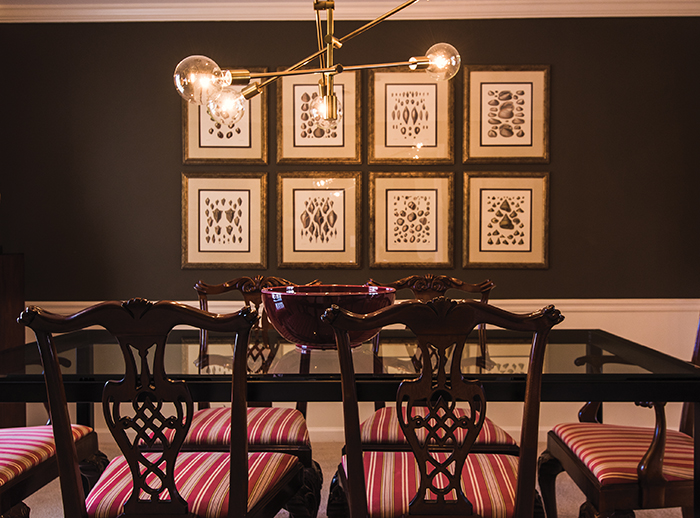
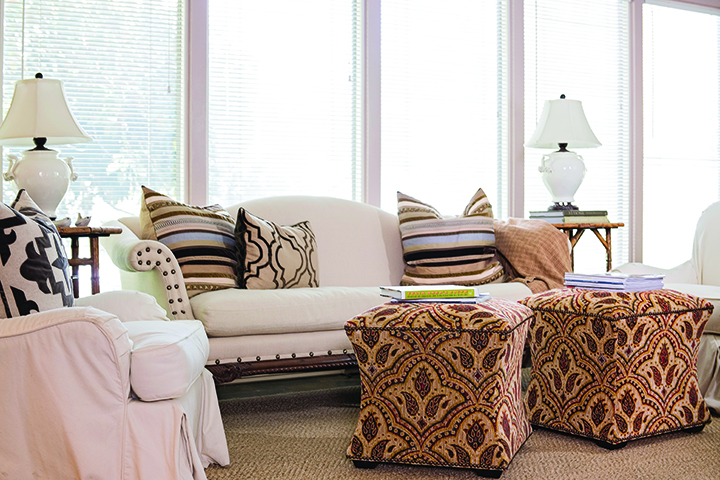
Her front room, which is layered with warm colors and textures, is a microcosm of her exacting approach.

Take, for example, the high-armed Knoll-style sofa. It’s a custom piece — “My middle name is ‘custom,’ ” Leslie says — covered with a milk-chocolate brown cotton velvet in a basket weave. The sofa is dabbed with cotton-print pillows in rose, gray and bone.

The gold metallic coffee table, stamped with a linen-pattern top, hovers over a toasty Aubusson rug.

The yawning fireplace is flanked by two chairs: a smoking chair covered in ostrich-embossed brown leather and a slipper chair cloaked with a rosy pink-and-taupe toile slip cover. A creamy cashmere throw lolls over the back. “I’m all about throws,” Leslie says.

The other end of the room is anchored by a meaty chest of drawers that was painted with a tortoise shell pattern at The Wind Rose in Greensboro. Until it closed a few years ago, the store was a designers’ mecca of custom-made furniture and finishes.

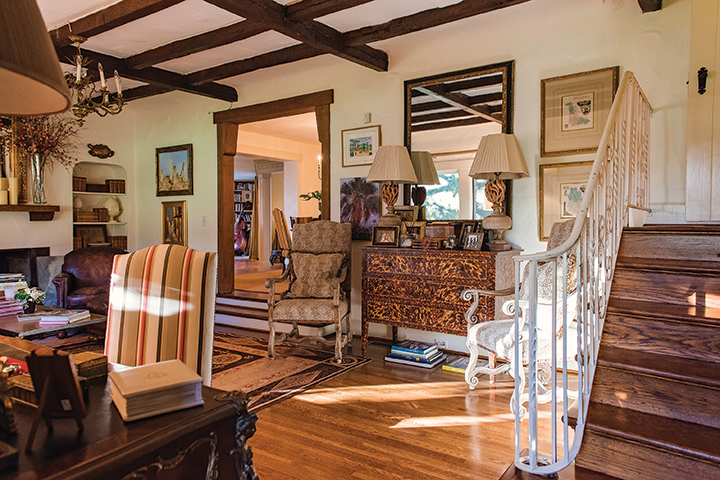
Leslie balanced the chest with an antique French writing desk on the opposite wall. With its leather inset top and molded gold ormolu accents, the desk is more ornate than Moore’s overall style, and certainly fancier than the room itself, which is rustic with wavy hand-troweled plaster walls and a beam-embedded ceiling.

But the desk works, and it’s evidence of how Moore stamps a room with curveballs —unexpected splashes of colors, textures and styles. Uniformity is not her way.

Often, her off-speed pitches show up on the walls. She’s not much on contemporary furniture, but she laps up contemporary art, as long as it’s original.

For a client in Pinehurst, she’s assembling the works of emerging Southern female artists. She’s adamant that art does not have to match the sofa.

“Buy what you are drawn to,” she advises.

All of the Moores’ art is original, and some of it originated with them.

Leslie points to a piece that she did, an impressionistic acrylic painting of a European alley. Another wall holds a precise watercolor that David painted, guided by a photograph of the garden at Villa Borghese, which they visited in Italy. The columnar cypresses and umbrella-shaped pines captivated him. More of his paintings — abstract color blocks — are grouped in the butler’s pantry and walk-through bar.

David confines his artistic bursts to music these days. He plays upright bass in a new-grass band called Blue Ridge James. The group was known as Blue Ridge Jams, with no “e”, until a venue wrongly advertised them as Blue Ridge James, and the bandmates decided they liked that name better.

Leslie says that David doesn’t have, or want, much say in how she decorates. All he asks is that no one disturb his encampment, a planet with just enough gravity to suck in musical instrument cases, papers, files, packs and the like, on one end of the family room.

“This I’d like to blow up,” Leslie says, waving her hands at the loose ends. “Just like he’d like to blow up what we call Mommy World in the kitchen.”

Mommy World is a catchall counter full of Target bags, reading glasses and recently opened mail. Life in progress.

Leslie made sure there was plenty of room for that when they doubled the size of house with a massive addition 10 years ago.

Away went the old breakfast room, deck and carport. In came a two-car garage with upstairs playroom and office. The satellite is docked to the house with a screened breezeway, a favorite place for the family to catch a breeze and a bite to eat. 

A colonnade of chunky posts and curved brackets bolster the breezeway.

The thick beams and beefy wooden door and window frames — distinctive with their overhanging lintels — echo the original house. So does
the unusual brickwork.

Under Leslie’s watchful eye, masons replicated the squash mortar, which spills from between the bricks like an overloaded tuna sandwich, and the occasional clutch of bricks that jut from the otherwise plumb walls.

“Some of the masons were like, “I don’t know about this,” she says. “But once they did it, they got into it. They were feeling very artisan-like.”

The main house grew, too. The huge new kitchen revolves around an island that seats six; no breakfast table need apply.

An enclosed loggia punched with skylights overlooks a terrace.

An airy new master bedroom provides a refuge. The master is as cool and restful as the sitting room (at the front of the house) is warm and spicy.

“If I had a refrigerator and a Keurig up here, I could stay here 90 percent of the time,” says Leslie.

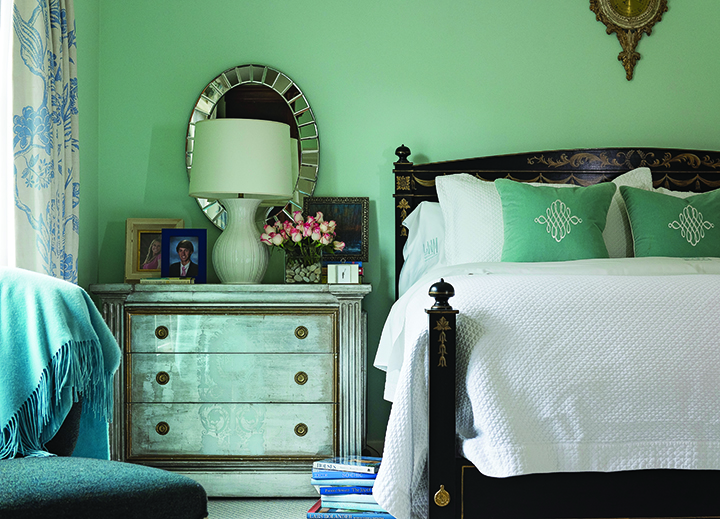
The bedroom is a study in the unexpected. For bedside tables, Leslie uses chests of drawers, each of a different style and color. Her fondness for chests is well-established throughout the house. In Leslie’s mind, drawers beat shelves for storage every time. She and David use the bedside chests for clothes. A towering armoire holds linens.

A television floats above a raised gas fireplace that’s built into a wall across from the king-size bed.

“I wanted to see it,” Leslie says, explaining the elevated firebox.

More surprises converge where pale aqua walls meet cotton print drapery panels with periwinkle blue, a hue that’s repeated in the delicate trellis pattern of the wool carpet.

“It doesn’t need to match; I don’t want it to match,” she says. “I tell my clients, if the colors don’t match, it’s easier on your eye. In nature, nothing is the same color.”

She credits her art-history training for this understanding.

“Sometimes,” Leslie says, “it’s the color that you think shouldn’t go that makes the piece and gives it fluidity.”

As with most old houses that have been appended, the Moores’ place is full of quirks and whispers of lives past: half-steps and slightly ramped changes in floor elevations; scrolled iron stair railings; white-painted plank doors leading to the original bedrooms.

It’s all fine with Leslie.

“I like things perfectly imperfect,” she says.  OH

Maria Johnson is a contributing editor of O.Henry magazine. Email her at ohenrymaria@gmail.com.

Revolutionary Design

An industrial icon from Greensboro’s past time tunnels to the present with a brilliantly scaled human campus

By Billy Ingram     Photographs by John Gessner

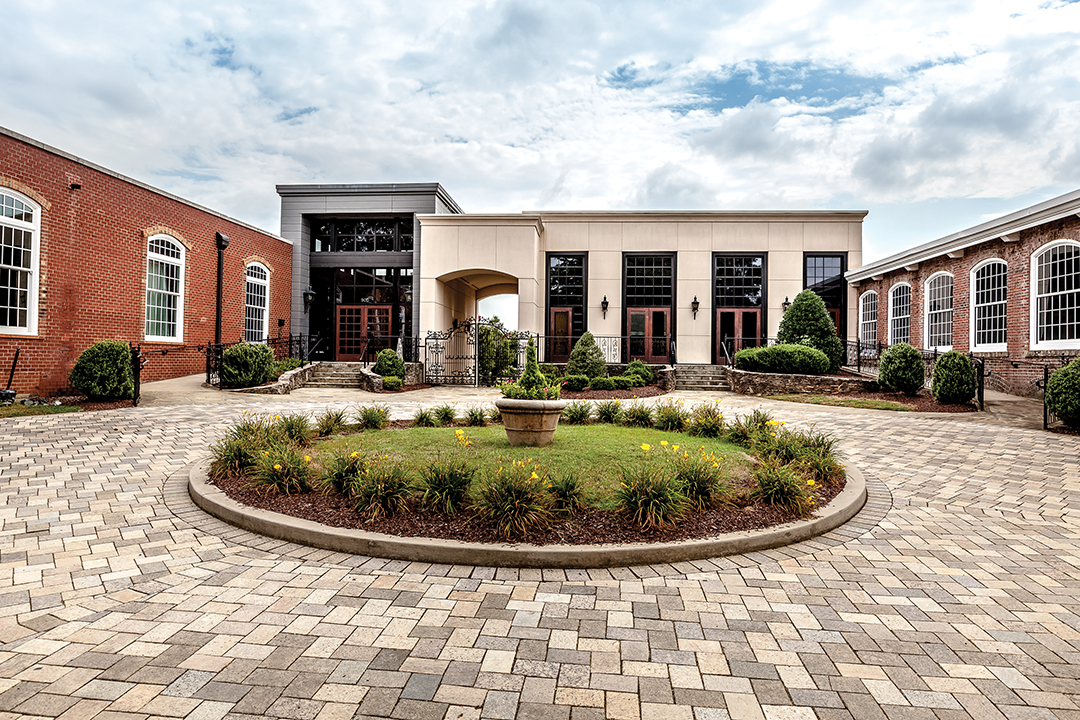
Repurposing derelict tombstones of the Industrial Age — Brightleaf Square and American Tobacco Campus in Durham, High Point’s Market Square and multiple factory buildings in Winston-Salem’s Wake Forest Innovation Quarter — have resuscitated entire communities, infusing a permanent sense of vibrancy and viability into what were forlorn economic and cultural dead zones. With the aggressively forward-thinking adaptive reuse of Cone’s former Revolution Mill, Greensboro can finally lay claim to our own cutting-edge venue sculpted from a historic property, a multi-modal monument as impressive as the metropolitan jewels other Carolinians have been bragging about for years.

Abandoned manufacturing hubs have been reacclimated here before. Cotton Mill Square was a magnificently funky shopping mall carved out of an 1895 textile works that also served as Western Electric’s top-secret electronics headquarters. It was regrettably demolished in 2008 but Wafco’s one-time flour mill (condominiums since the 1980s) is a lynchpin of the College Hill neighborhood. The urban reinvigoration underway now is on a scale we’ve not witnessed, and it’s as essential to the future of this city as the industries they supplanted were to our past.

No question, the Cone family put Greensboro on the map beginning in 1895. Recognizing an emerging market for durable work clothes, they ramped up quickly with four enormous manufacturing plants: Proximity, Revolution, White Oak and Proximity Print Works. Built in 1898, Revolution Mill became the largest producer of flannel in the world. By the 1920s, one in seven Gate City residents worked for Cone, with more than 200,000 yards of denim leaving the weave sheds every day.

That was when working for Cone was a way of life, literally. Fifteen hundred employees lived with their families in houses provided by the mill, shopped
at several company-owned grocers, sent their kids to Cone schools and to Camp Herman in the summer and gathered at annual picnics. Teams from each plant competed against each other on four adjacent baseball diamonds. There was a hotel, coffee shop, fine dining restaurant and two YMCAs with bowling alleys and fully equipped gymnasiums with year-round swimming. A worker could easily spend weeks without leaving the Cone confines where every aspect of life was represented, or replicated you might say, right down to the mill barbershop, drugstore and doctor’s office with nurses who looked in on expectant mothers. A single sheriff’s deputy kept the peace in this city within a city. Not that it was an idyllic utopia. It wasn’t, but that’s another story.

Cone continued to manufacture denim in Greensboro until it was blended into Internation Textile Group (ITG) in 2004. ITG still produces denim at its White Oak plant. In the 1960s, however, Revolution Mill occasioned one of the biggest fashion fads ever in jean manufacturing — but not by design. Old-timers still gab about that Sunday afternoon flood in June of ’68. Although a tremendous amount of rainwater fell in a short period that day, the mill’s runoff system was able to handle the capacity. That is until an empty 500-gallon tank came unmoored from its scaffolding, slid into the rushing creek, then jammed like a cork into the outflow under Summit Avenue, sending chemical wastewater surging into nearby homes and overwhelming a storage facility at Revolution. The aftermath left thousands of yards of denim hopelessly mottled and bleach-stained. Someone had the bright idea to stitch them up anyway and the acid washed jean was born.

Cone unloaded Revolution Mill in the early 1980s after the bottom fell out of the textile business, locally anyway. Two decades later, developers Frank Auman and Jim Peeples converted a large swath of the mill into an office and event space, the most visible occupant being The Nussbaum Center for Entrepreneurship. Forced into foreclosure in 2012, Revolution Mill found a savior in Self-Help Ventures Fund of Durham, which develops and invests in commercial real estate projects like this one and paid $8 million to rescue the 45-acre property. “CEO Martin Eakes is from Greensboro so it was a pretty easy decision for him that we would complete this development rather than try to develop it with somebody else,” says Self-Help’s Development Manager Micah Kordsmeier. The organization then proceeded to plow an additional $100 million to forge a campus where creativity, commerce, art and contemporary living converge.

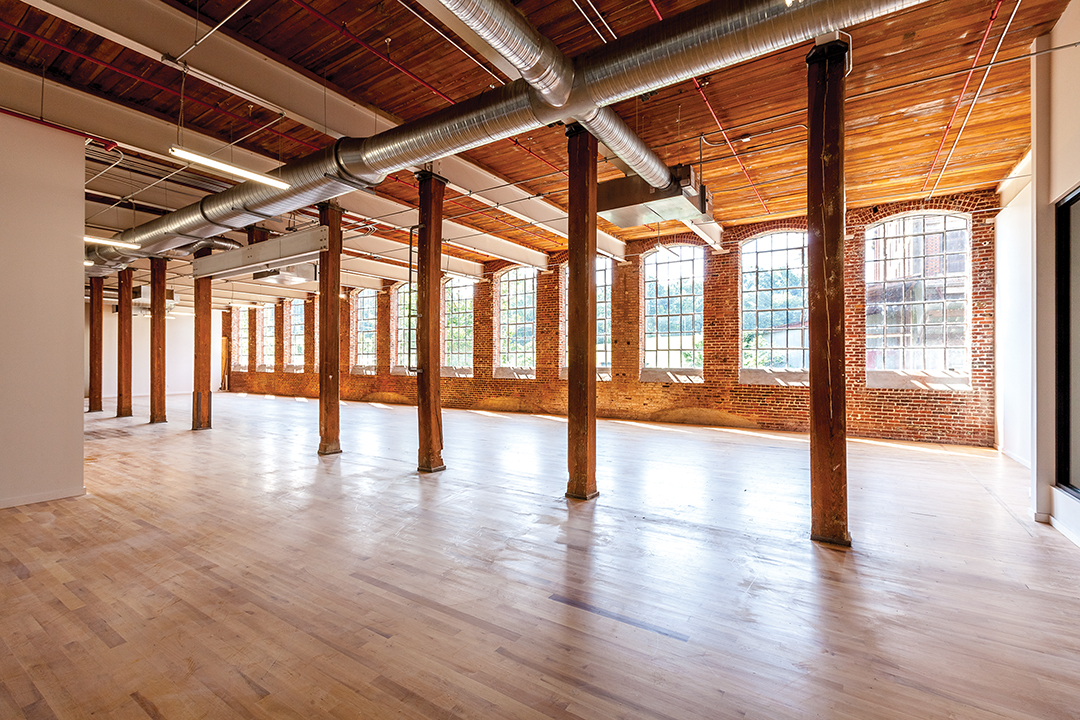
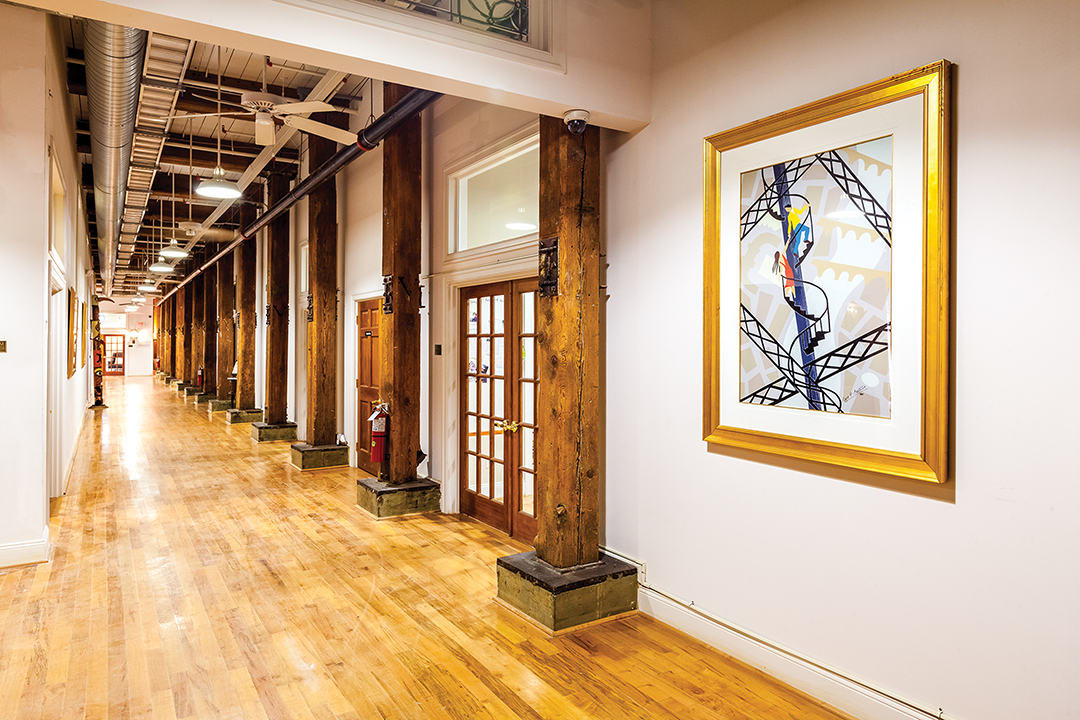
It’s a miraculous makeover of colossal proportions, this Gate City phoenix. Listed on the National Register of Historic Places, Revolution Mill had to be gutted and reimagined from the ground up. The original maple flooring, sturdy brickwork, oak support beams and frames were all preserved and enhanced with the latest technological advances, then made to look sleek and ultramodern with interior glass walls. The result is a hive of activity with 250,000 square feet of office and studio space where the entrepreneurial spirit thrives. The variety of enterprises afoot runs the gamut — optometry, portraiture, finance, retail, advertising, dining, digital illustration, furniture design, 3D rendering, you name it.

Architectural artifacts of an earlier age abound. A heavy metal fire door in one office, barn-like gates in another, not to mention the numerous weather-beaten, concrete bunker like flying buttresses that at one time secured outside walls since the vibration from the looms would have quaked the bricks from the framework without them. Attention to detail? Even sewer covers with the Cone logo were restored. Hundreds upon hundreds of energy efficient, 8-foot tall windows needed to be manufactured, almost every one requiring slightly different specs because of the age of the building. Large segments were cut out of the upper level flooring to give the interior a feeling of grandiose openness throughout.

Kordsmeier explains their approach: “We wanted you to be able to see the full expanse. That’s what these old mills offer really, the rhythm of the columns and wide open spaces.” To give you some idea of the enormity of the task, most of the doors and windows had been securely bricked in decades ago to “permanently” seal off the site. Every one of those archways and frames needed to be meticulously reconstructed. “Masons don’t just come knowing how to do that,” Kordsmeier notes, “they had to be shown by our architect [Eddie Belk] very specifically how he wanted these bricks to be laid out.”

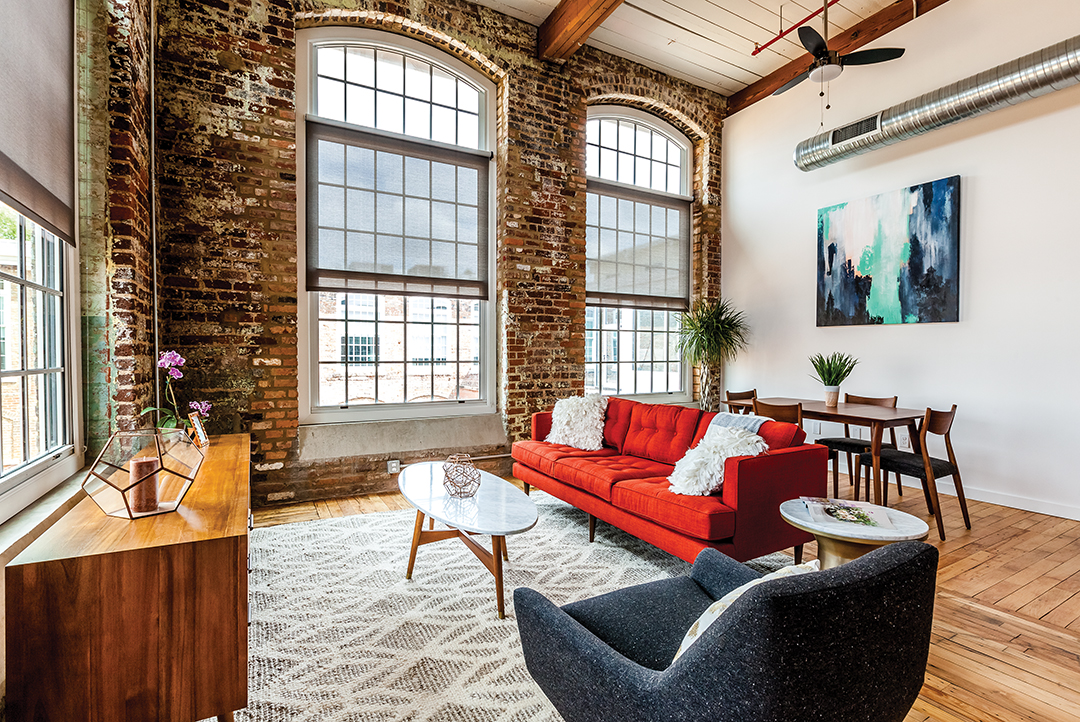
Revolution Mill is a way of life once again. Located in the oldest portion of the building are 142 one- and two-bedroom loft apartments with rustic touches throughout. Original artifacts are incorporated everywhere, 26 separate floor plans all reflect an unmistakable solidity. Look for the dull, comforting thud of hardwood floors, hallways of polished concrete with exposed wooden structural beams, Manhattan-sized windows tucked into 100-year-old, thickly mortared brick walls stretching 20 feet upward. The building’s solidity makes for a spectacular setting, whatever one’s taste in home furnishings or entertainment style. Perfect for hobnobby cocktail parties or literary receptions, but equally well-suited as a crash pad for your old college buddy’s punk band.

In another wing, an artist colony with a dozen studios for working painters, designers and sculptors is flourishing alongside UNCG’s Weatherspoon’s spacious outlier gallery hosting bimonthly installations. The Artist In Residency Revolution (AirRev) program offers politically and socially conscious artists the opportunity to do their thing in a 1,774-square foot shared studio space at greatly reduced rates.

How fitting that textiles are making a comeback at Revolution. One of the larger spaces is taken up by LT Apparel, a New York–based designer and manufacturer of children’s clothing for labels like Healthtex, Adidas and Carhartt. Fashion designer Rosalyn Womack is known for her elegant, custom-made Bob Mackie-esque dresses for women of all sizes. Kordsmeier tells me Self-Help made accommodations so that established businesses already on site could transition into new digs as seamlessly as possible. “Some people like to be pioneering. And that’s part of the story, but they had a pretty big tenant base here for a long time,” he says. “Over 50 businesses have been here for years; it’s just that we have more space available.”

The inner core of the works features a large but surprisingly intimate open-air courtyard with a built-in stage and terrace seating for concerts, a wall for projecting movies, a dance shell, and a modular food truck docking station with a side kitchen to service outdoor events. There’s also an adjoining conference center. Kordsmeier believes this and other nearby gathering spots are key to the identity they’re striving for. “Ninety percent of Greensboro may never have a reason to come to the offices here or the apartments, but we want to give them all a reason to come here on a nice summer afternoon,” he explains, adding that the city expressed some concern that the project would siphon away downtown denizens. “We’re conscious of that because we’re big downtown boosters,” Kordsmeier says. “It’s actually unusual for us to do a project outside of a downtown. Anything exciting that happens downtown we want to have a connection to it.”

There’s plenty of opportunity for cross-pollination between the two districts. An indispensable catalyst in the downtown music and art scene, Urban Grinders, is extending it’s robust blend of caffeine culture into what owner Jeff Beck is calling a more “refined coffee shop experience.” Fronted by an inviting courtyard and topped with a hardwood slanted ceiling and exposed steel supports, the satellite cafe is situated inside a cozy corner of Revolution Mill. Located in the former machine shop, Cugino Forno’s Italian wood-fired pizzas are flash-baked in a 900-degree oven that boasts “volcanic rock bottoms from Mount Vesuvius.” Their savory Neapolitan pies are sourced strictly from Old World ingredients, right down to the imported flour. The handmade Mozzarella is flown in weekly from a small town in Campania. An expansive dining area is kept impressively sunny thanks to two facing walls with rows of towering cathedral-like windows.

Opening later this month, Natty Greene’s Kitchen + Market will specialize in locally sourced foods with meats cut to order, fresh baked goods and, of course, beer. This emporium can be found in the one-time carpentry shop where a striking boathouse-style canopy of shellacked maple planks, embedded with glass panes encircling its center, bathes the room in natural light. This standalone building has been augmented with a mezzanine and a super-sized party deck over the reservoir next to a rivulet where the water runs so clear you can watch tadpoles and sunfish fantailing their way east. Once considered the rear of the property, an entranceway is being fashioned off Yanceyville Street to make the brawny eastern facing buildings the first thing visitors will see. Other than the three mammoth smokestacks that is, remarkable when you consider they’ve held their ground for well over a century.

That Greensboro could support such a cosmopolitan concept is an amazing leap of faith. With construction on the $100 million campus nearing completion, Micah Kordsmeier recognizes, “These industrial reuse projects have been going on for 30 years at this point.” In that time, trial and error — how to adapt the spaces for commercial use as opposed to living spaces, for example — bore out. “There’s been a lot of proving of concepts over that time so they were started in stronger markets because there was the ability to take more risk. It took a long time for investors and lenders to develop a comfort and understanding of it,” Kordsmeier says. Thanks to the previous owners, the property was in much better shape than would normally have been the case with these types of reconstructions. The surrounding landscape came adorned with lush greenery and mature trees where slate steps and stacked stone garden walls neatly frame some 1,200 parking spaces. Warehouses with no historical value have been removed, and gently sloping green hills with new shrubs and saplings have replaced the muddy rivulets and thickets that once populated this panorama. It’s here that the Greenway will one day connect Revolution to downtown 2 miles away, a 15-minute bike ride.

Vestiges of a long-gone way of life can be faintly detected in the patches of woods still remaining in the neighborhood. I’ve uncovered steps to homes that no longer exist and almost-buried rail spurs. Legend has it the remains are out there somewhere of an outdoor pool that was destroyed in the 1940s, when the old patriarchal system began to slowly unravel. By the 1960s, the company houses had been sold off to the employees that lived in them at bargain prices, greatly enhancing our city’s middle class. Proximity Mill was lost to the bulldozer in 1979. White Oak is still producing denim, albeit on a smaller scale, while the greatly deteriorated Proximity Print Works was recently purchased, slated to be renovated into affordable housing that will anchor a mill village of sorts for future generations.

My grandfather, Judge E. Earl Rives, had the city motto from the 1940s embossed across his business card. It reads: “Greensboro is a good town.” Not exactly a ringing endorsement. Indeed, for far too long Greensboro seemed oddly preoccupied with constructing avenues out of the city, expanding highways and skyways for hastening people away from here. Perhaps at last we’re at a crossroads between what was, for most folks anyway, a good town and what may one day be a great city. As youthful innovation merges harmoniously with the prodigious labors of our rarely romanticized past, perhaps now we rise.  OH

Billy Ingram was born and raised in Greensboro but hightailed it out of here as soon as he could, only to return 15 years later so he could torture you with his indigestible word salads. He is the producer of a local music TV series, The Nathan Stringer Summer Music Show, available this month on DVD at Amazon and streaming on YouTube.

Designing Woman

Carolyn Shaw’s furniture magic

By Cynthia Adams

“My dad designed a collection called Great Hill Road for Riverside Furniture, which they sold for over 20 years,” Carolyn Shaw recalls proudly. That was back when the furniture industry was going great guns, before profit margins got trimmed. “Our Dad bought two new Mercedes in the same day,” Shaw grins.

But today the family business, Otto & Moore, would be unrecognizable to its founders, Shaw’s grandfather, William Dudley Moore Sr., and his partners, who established the company in High Point in 1960.

The family, though, is no newcomer to the furniture industry. William Sr. had trained with the famed furniture designer Gordon Perlmutter in New Jersey before striking out on his own. His father, James D. Moore, had founded Home Chair Company in North Wilkesboro.  Moore Sr. possessed a talent for passing on his design skills to others, including his granddaughter, Carolyn, and her father, William Dudley Moore Jr., who took over the company last year when Moore Sr. died.

The company remains a close-knit family affair. Grandchildren Liz Moore, and William (Will) Dudley Moore III, are also furniture designers working in cubicles within a spit-ball throw of one another. But it’s a completely different animal from William Sr.’s and William Jr.’s heyday.

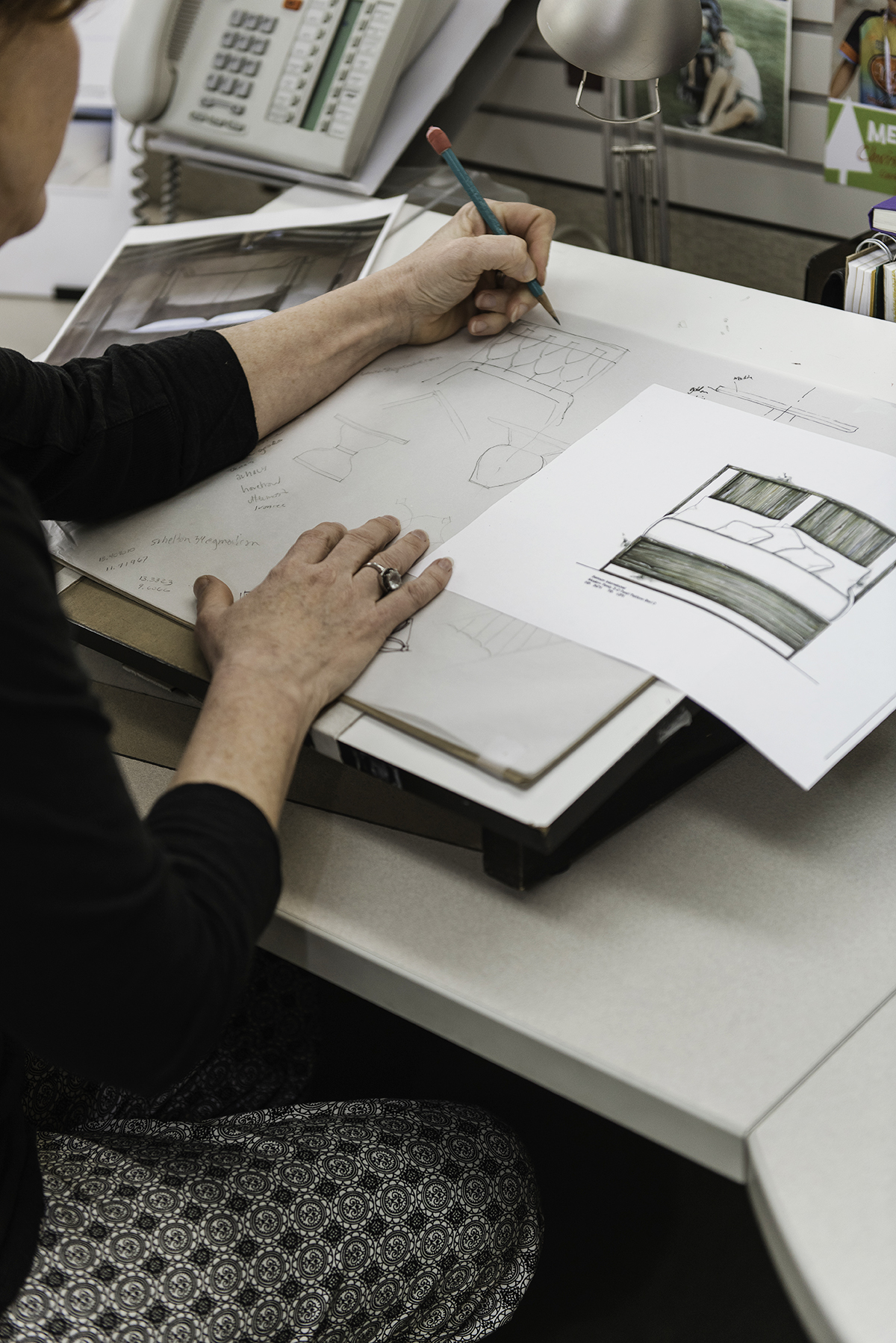
“I think people are surprised by how technical my work is — staring at a computer 80 percent of the day,” Shaw says. She stresses that, in addition to needing a design eye, the work today requires spot-on engineering and high-tech skills, because the new manufacturing processes are so computer-integrated.

Furniture manufacturing has also shifted overseas, erasing wiggle room for design flaws that could be fixed with a quick trip to the factory. (Client Vaughan-Bassett is still manufactured in Galax, Virginia. This means design changes for them can be tiger-fast, as there is no time delay as with offshore manufacturing.)

Design today is engineered to precise standards. The proof of a workable (and profitable) design concept is exactitude as well as commercial appeal. A centimeter of error can be a multimillion dollar error.

Shaw likes the synergy of collaboration and seems to thrive in the high-octane world of pressing market deadlines and has little time for office tomfoolery. She is a fine artist (and a 1984 Chapel Hill graduate) who decided to become a furniture designer at the urging of her father.   

“In our firm, four designers are women, and three are males.” Shaw isn’t an engineer. The company has four on staff who handle the heavy lifting of turning what is, after all, an artistic vision into something that can be mass produced.

Still, Shaw emphasized, “It’s technical.” She did take some engineering classes in order to better master the job skills. “I learned to paint at Carolina,” she says, but had to go back to school to understand the manufacturing side of things. After graduation, she landed a job in architectural illustration in Dallas, which was her initial ambition. Her grandfather constantly wheedled to get her to return to Otto & Moore.

Shaw finally relented after several years. “I moved back here,” she laughs, “because I was tired of being poor.” She also missed her family.

The bulk of Shaw’s hours are spent using AutoCAD (computer-aided design) software. In May, she is creating designs that will manifest in furniture shown months later in the fall market. The spring market is deeply affected by the fact that their manufacturers close down for Chinese New Year in February. Spring furniture designs must be completed by January. Manufacturers must have final details months in advance. The time between pre-market and market “tends to be a difficult time.” 

Perhaps the client loves a bedroom group design as a whole but hates the bed; this means, Shaw explains, they have a month to get designs, specifications, samples, etc. turned around.

Container ships are not fast.

The turnaround happens because Otto & Moore is “a collaborative firm,” Shaw says, pointing to the congenial mix of family closeness and intense work deadlines.

Despite being family-intensive, there is no fudging on the workload. After sending designs to the client, once approved, a sample can be produced in Asia within a week.

The downside? The furniture sample may be at sea for a month in transit. Changes are extremely expensive. If the product has to arrive sooner, it means costly air freight. 

Don’t, however, picture Shaw designing only living room and bedroom suites. At the moment, she is working on color renderings — believe it or not — for Brunswick Billiards of pool hall fame. Brunswick is an old Otto & Moore customer. In their case, Shaw creates color renderings which they approve before she and the engineers develop the final plans. Not all clients request color renderings. “We just do the casing. It’s complex to design a pool table. You have to have multiple internal floor levelers, just to get them flat.” 

Shaw brings a pool table she designed up on her computer screen: “This is one more contemporary design that I did.”  It is a surprise: streamlined, Art Deco in its sleekness. 

Having worked with Brunswick for years, Shaw anticipates their tastes, but also dedicates time during the furniture market to do a walk through with officials, sharing influences and trends to better understand the company’s target customer.  She did so again during the April market. “There are only so many who can afford pool tables. They tend to be older people who have more traditional leanings.”

And yet, she describes how vital it is that she can communicate with a great product developer, her liaison to clients. Product developers give Shaw assignments. An example is “to build a short bedroom” by which Shaw means, a small line that can expand if it does well. She discusses cost containment, proportions, finishes, hardware, and all the things that can affect a designer’s work.

If they are compatible, if they allow creative license, Shaw is jubilant. “A day like that can end in a celebration at Blue Zucchini,” which is among her favorite restaurants in High Point.

That’s about the only time for fun in games, in this intensive day and age. With buying being more segmented, the majority of Otto & Moore’s income is royalty-based, and Shaw says, “We work a lot harder now.  They used to take a break and go outside and pitch pennies at lunch.”

No more. Shaw’s brother is in China six to eight times a year with accounts. 

The majority of Otto & Moore’s company accounts are middle to high end names:  Century, Riverside Furniture, Barnhardt, Universal, FFDM, Vaughan-Bassett, Lexington, Lane, Hooker, Brunswick Billiards and others. For two weeks each year, during spring and fall, the High Point Market is a daze of client activity and interaction, and “throwing sketches down for the next market,” says Shaw. 

The intensity is such that Shaw describes the “post market assignments” — juggling the next generation of new designs immediately after market.

“I like to go to market one day, and let the creativity wash over me.” If Shaw can go alone, just to experience the sheer creative force of the event, “that’s a great day.”

Shaw, who is surrounded by furniture, insists, “I’m still not indifferent to furniture!” In an interview with Furniture Today, she once described how she uses the “mood board.” The mood board tells the story of a design. By pulling tear sheets from magazines and going online to sites such as 1stdibs, an online antique marketplace, Tumblr or Pinterest, Shaw finds inspiration and direction. The global reach of the internet and the personal perspective gained from social media helps her better understand where things are trending but also helps her with “clues and ideas.”

That said, though, Shaw gets a faraway look in her eyes and grins, tucking away a stray hair, and sighs, “I would love to go back to a drawing board!”  OH

Cynthia Adams is a contributing editor to O.Henry.

Bicycles Spoke-n Here

The two-wheeled designs of David Johnson

By Maria Johnson     Photographs by Bert VanderVeen

If you go to David Johnson for a custom bicycle, you might feel as if you’re getting a tailor-made suit.

He’ll stretch a tape measure down your arms, your torso, and your legs, noting your inseam and the length of your thighs.

Then he’ll get more cycle-centric. He’ll test your flexibility — that is, your ability to reach the handlebars — and pepper you with questions.

How are you going to use the bike? For racing? Weekend road riding? Touring with packs? Trail busting? Commuting?

How often?

How many speeds do you need?

What kind of brakes?

What about aesthetics?

Johnson’s signatures are curvy lines and one-of-a-kind paint jobs. Unlike Henry Ford’s early cars — which came in any color his customers wanted, as long as it was black — Johnson’s bikes come in any color his customers want, except black. That’s too stock.

“I have a soft spot for the 1950s colors — creamy whites, pastels like sea foam green, soft pinks and, in the same breath, bright intense reds, 1957 Buick Roadmaster red,” says Johnson, a welder who trained his torch on a different mode of transportation five years ago when a local airplane maintenance company began shedding jobs, including his.

Johnson, now 51, had been looking for a way to combine his artistic eye, his mechanical skills and his boyhood love of bikes: “I said, ‘Screw it. I’ve been putting this off for years.’”

He raked up his savings and started a Greensboro-based business called Serif, which he changed to Dogwood Cycleworx two years ago.

To date, Johnson has designed and built about 25 bicycles. Some clients have hard-to-fit bodies. Some want hard-to-find features. And some just crave the cachet of a custom bike.

Brian Bilich, formerly of Greensboro, owns two Johnson-built machines: one for roads, one for trails. The average-size Bilich can, and does, ride off-the-rack bikes. But he also wanted to support a local craftsman who happens to be a friend, and he wanted a bike that was unique.

“Riding a custom-made bike is more of an emotionally satisfying experience, having something that no one else has,” says the 38-year-old Bilich, a special education teacher who lives in Asheville now.

His mountain bike is painted pink and covered with silhouettes of black luna moths. His road bike is white, decorated with images of honeycomb and bees. The designs mimic the tattoo sleeves that cover both of his arms.

“I have an appreciation for the creepy crawlers,” Bilich says. “It’s about expressing yourself.”

Johnson makes all of his creations from steel alloy tubes and other parts that he orders from the United States, Germany, England and Italy. Against a background of country music, he spends about 80 hours building each machine in his garage workshop and paint booth. He incorporates flourishes as his customers’ tastes and budgets allow. Most of his finished bikes cost $4,000 to $6,000, less for frames only. If that sounds like a wad, consider that high-end, factory-built bikes can range from $3,000 to $9,000.

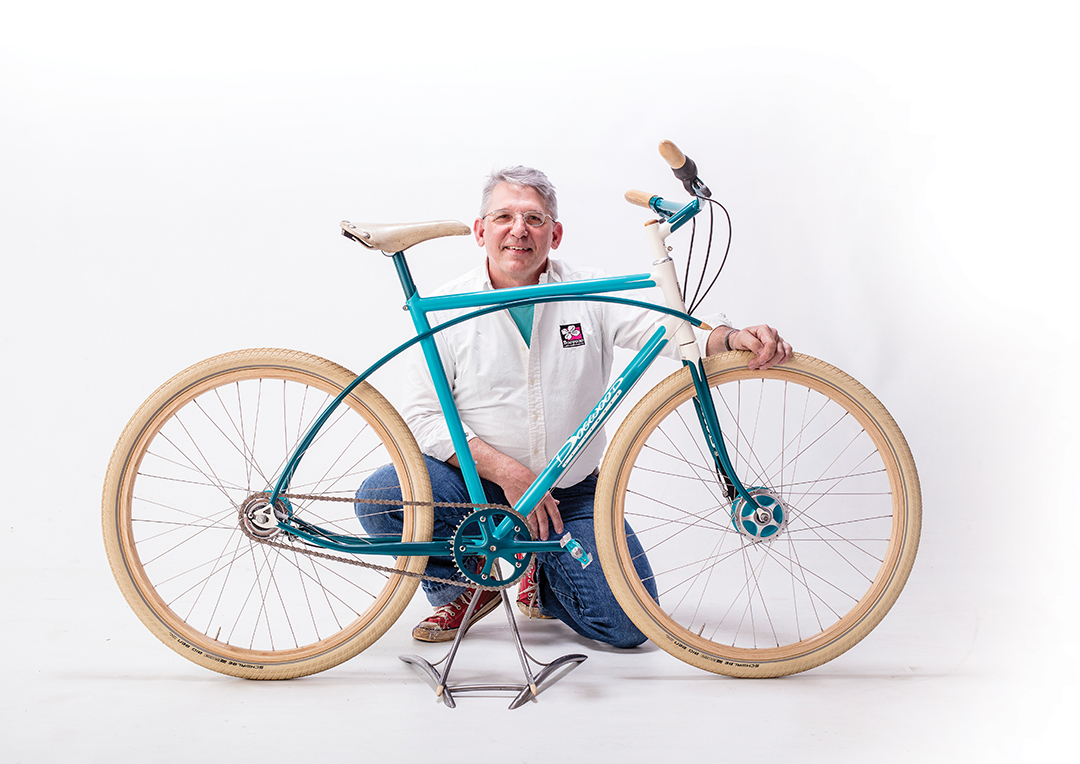
One of Johnson’s prototypes, which he calls Marilyn in memory of curvaceous Marilyn Monroe, shows what he can do differently.

Marilyn is a sexy blue retro cruiser. She sports a three-tone paint job and cantilevered seat stays that arch upward from the rear hub, peak under the top tube (the ouch-y tube to quick-stopping laymen), and come to rest at the head tube, just beneath the handlebars. The dual curves end in pointed tips made from an old ash baseball bat.

Marilyn’s wheel rims and bullet-shaped handlebar grips are made
of ash, too.

Her cream leather saddle is trimmed in conchos, coin-like ornaments that are more common to motorcycle seats.

With rat-trap pedals, white tires, front and rear drum brakes and an eight-speed internal rear hub, Marilyn is ready to roar.

Will Johnson take her for a spin? Alas, no. She’s only for show.

“I don’t have a bike of my own,” Johnson says. “ The cobbler’s children have no shoes.”  OH

Maria Johnson, no kin to David Johnson, is a contributing editor of O.Henry. She can be reached at ohenrymaria@gmail.com. See more images of David Johnson’s work at dogwoodcycleworx.com

The Color Purple

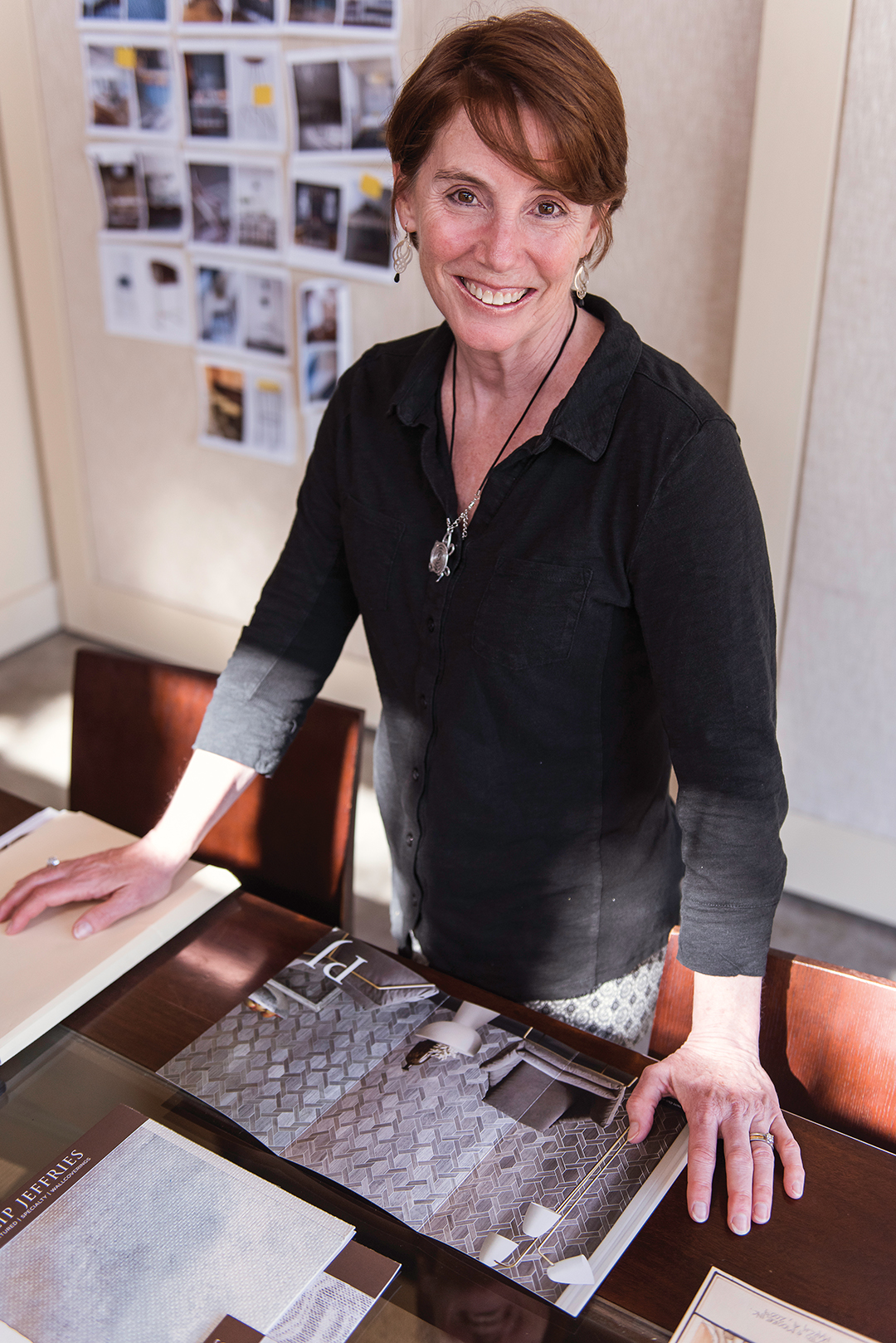
How Linda Lane finesses fabric

By Cynthia Adams     Photographs by Amy Freeman

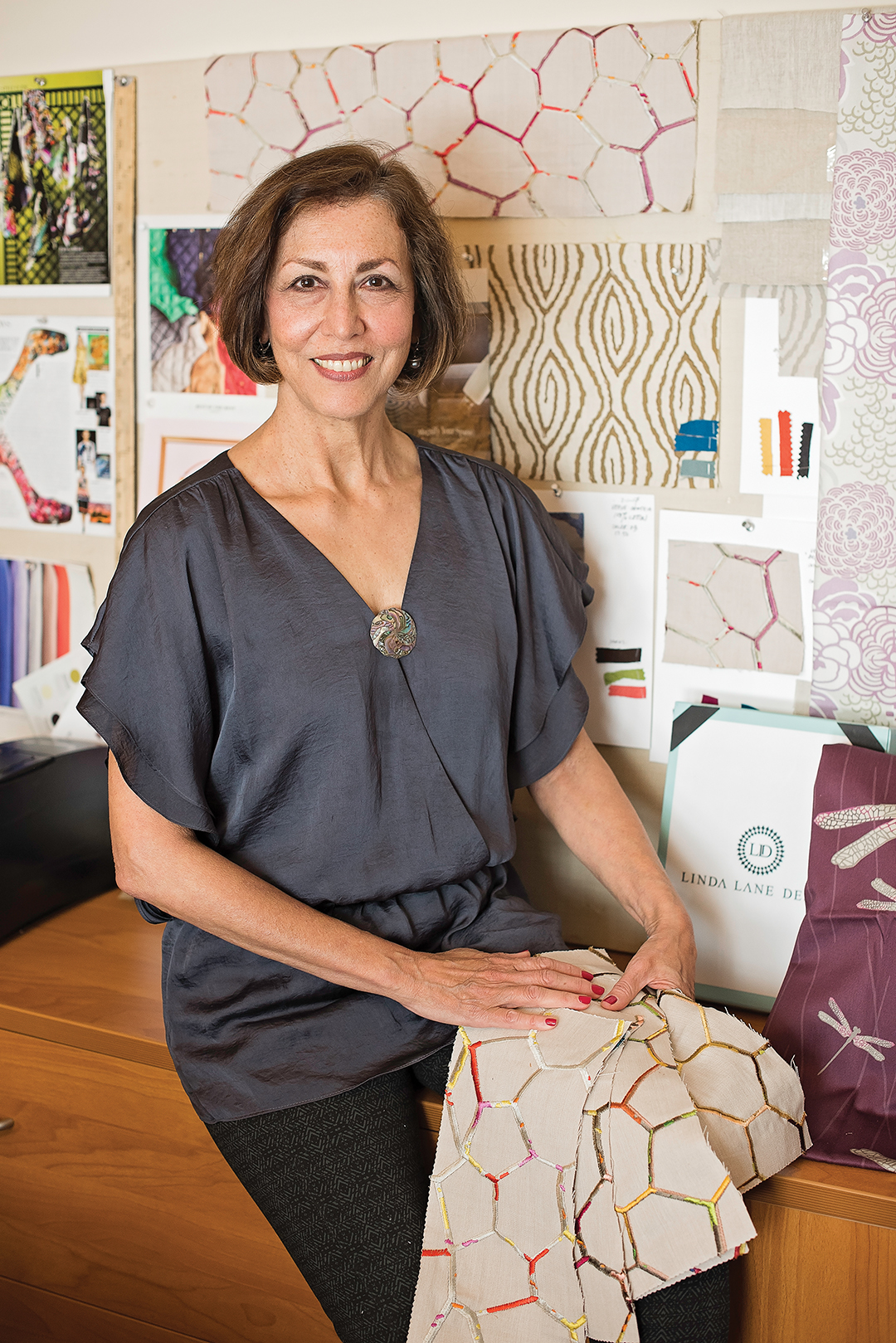
Textiles designer Linda Lane, deeply absorbed as Puccini plays softly in her Fisher Park home studio and workspace, is thinking about purple. It is, far and away, her favorite color. Lane’s eyes widen as she says this, lest she be misunderstood. Purple has been trending for years, she says.

Purple is intense. Lane is intense. She laughs to indicate she knows this, but make no mistake:  Color is the main stock in trade for Linda Lane Design. “I think I’m good at color,” she says.  “I dream in color.  Just last night I had a dream about my old periwinkle Volvo from 1980!”  Although her studio is a creative place for imagining and creation, this is Lane’s work: manipulating color in infinite design variations and patterns for her own and others’ textile designs.

But back to purple. If Lane could speak in color, why, she might be speaking in Purpleese. 

Purpleese would be a magnificent sound.

Color is all, she explains. Colors come. Colors go. Gray has stayed, displacing beige for some years as the neutral favorite of designers. These are trends, Lane says, with a wry smile. Trends change. Lavender, a cool gray-lavender, “not mauve — nobody says mauve anymore,” is still a huge hit. Shades of pink (Lane produces swatches) and mercurial shades of gray play well together.   

“So you will see a sofa that’s gray with a violet tinge,” she says. “Gray is still taking a stronghold over beige,” she adds.

Lavender-not mauve plays into many of the swatches Lane has “edited” and curated for a client.   Whenever she isn’t noodling and doodling to create her own fabric designs, she is rethinking and refreshing the popular classic fabric designs her client already owns. Lane sends the redesigns in new colors to her client, who approves and forwards them to India for execution. 

Lane also creates an array of paisleys, chrysanthemum, crane and tree-of-life–inspired patterns.  Many become new classics that will be reiterated and reimagined in new colors but they originated right here, in Lane’s studio. “Every house of fabric has in-house or outside designers,” she explains. “And there are hundreds of companies who make fabrics. I’m in the background.” In M.B.A parlance, she’s B2B, business-to-business.

The fabrics chosen will be produced then shown at the semiannual fabric market in High Point, Showtime, the only one of its kind, which takes place June 4–7 and December 3–6.


Some of the fabrics will be chosen by the flood of buyers (more than 800) who represent the biggest names in furnishings: Ralph Lauren, Pottery Barn, West Elm, Crate & Barrel, Restoration Hardware, to name a few. Their buyers will go through hundreds of fabrics, anoint the winners, and those (and only those) will be issued and used as upholstery fabrics for the following High Point Market. There, she will see the fabric as imagined: gracing sofas, armchairs, ottomans, curtains, bedding or tabletops.

Many of Lane’s favorites never enter production. But happily, many do. It is a gamble, a toss-up, a complete unknown. 

And Lane loves doing it, in the same way she loves going alone to museums. “I want to spend my days just losing myself in it.”

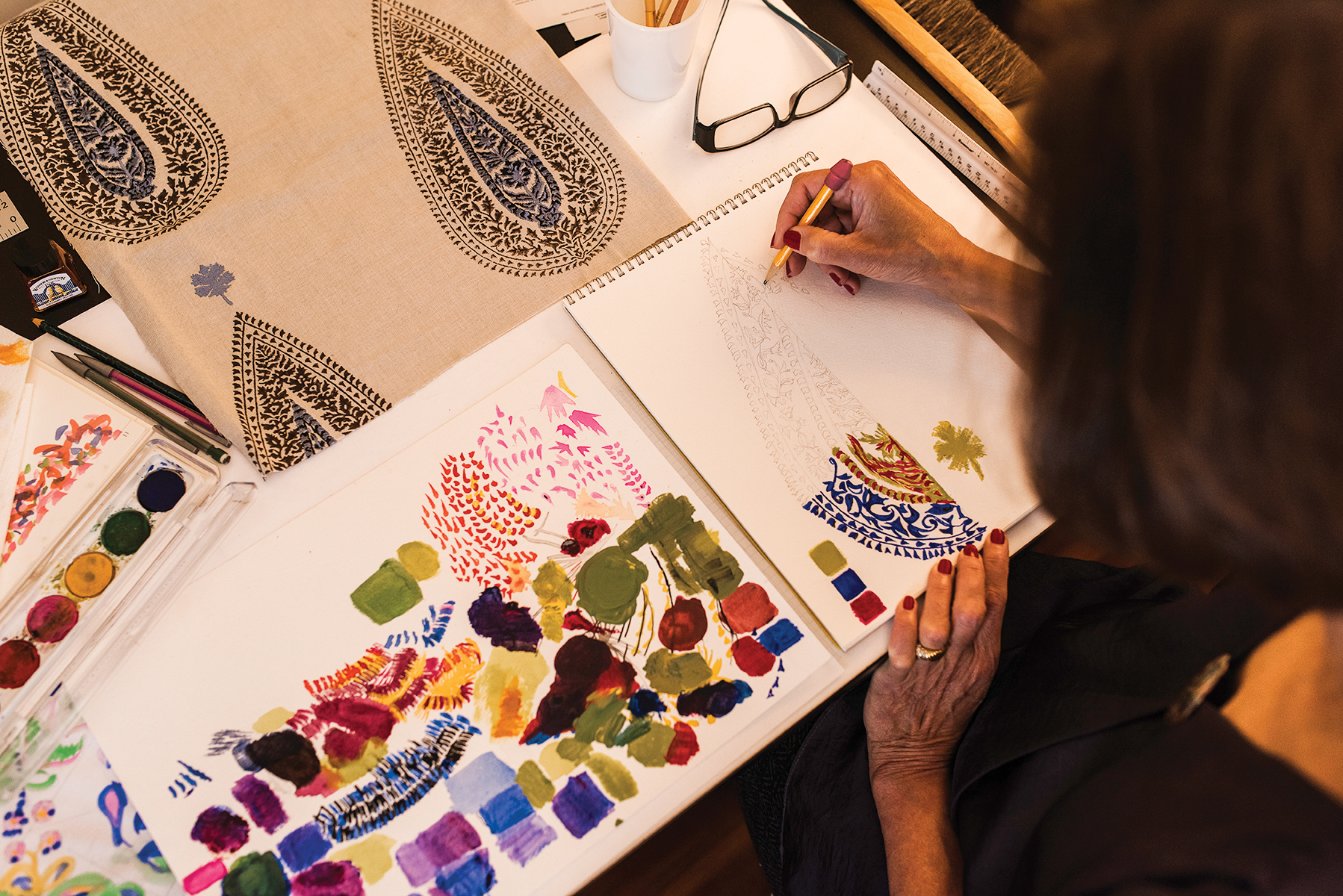
However, deadlines are waiting, and there is work to be done. Lane is in her work uniform, dressed, head-to-toe in varying intensities of gunmetal gray. She swivels in an office chair and glances outside the window. Because she does not render her fabric designs via computer but by hand, Lane’s computer is more a tool for communication than design. “I’m old school,” she says.  “I hand draw and paint everything.”

There are watercolors on Lane’s drafting table where a bohemian paisley fabric sketch is in process. 

Everywhere the eye lands there are fabrics of Lane’s own design, sketches, inspiration books, and Lane’s paintings and paints.  And color! Color everywhere. The home office, which is more studio than office, is temporary. Lane is gearing up for a home redo at the house she and her husband acquired nearby in the Fisher Park historic district, and they’re living in the rental for the short-term. 

A love of exuberantly colorful and tactile fabrics is generational for Lane. This passion, she explains, reaches back to her mother and grandmother. A fondness for a riot of color in designs also speaks to her exposure to different cultures.

Born in Beirut, Lane grew up in New London, Connecticut. Lane says she was inspired early on by the French influences in postwar Beirut (following World War II).  Also, the women in her family moved her. She reaches into a box and produces intricate pieces featuring her mother’s painstaking French knots, cutwork, needlework, even twee children’s clothing that she sewed, or knitted, many fully lined.

“What do I do with these?” she asks softly. “They’re so wonderful.  I couldn’t get rid of them.”  She still keeps her mother’s sewing machine. Growing up, Lane accompanied her mother to the fabric store where she chose her own fabrics and notions. Her mother would create any outfit Lane wanted. 

While in her 80s, her mother took up painting.   

The room is a light-shot one with a drafting table and inspiration boards and fabrics everywhere, draped, pinned to boards, or folded on shelves. There is a spotlight that Lane can direct onto a sketch or painting of a new fabric under development in order to dissect how the color changes. She must, Lane explains, have good light in order to properly work with color.   Lane worked for Baker Furniture after attending art school where she majored in interior design at the Paier College of Art. Her mentor there was married to painter Henry Gorsky. “It was sort of Bauhaus school,” Lane says.  Fashion was her first wish. “That was my heart,” she says. Her parents moved to D.C., and Lane eventually moved there, too. In retirement, she will return to the home the couple keep there and become a “museum rat.” 

“That is where I get inspiration,” Lane says. And a good place to be lost, in a rapture of color.  OH

Cynthia Adams is a contributing editor for O. Henry and a contributing writer for Seasons. Linda Lane serves with her on the Greensboro Historic Preservation Commission. Lane is also chair of Preservation Greensboro’s Hillside Designer Showhouse May 20–21.

May Poem

Cave Men

A full wine rack is

Saturday mornings,

The first day of vacation,

A just-waxed car.

It is a promise of future good dinners,

of future celebrations,

of a future.

A full wine rack murmurs:

Don’t worry.

There’s plenty.

You’re safe.

— Joseph Mills

from Angels, Thieves, and Winemakers

Story of a House

Redo, Redux & Release

Thomas Buckley on artful designing — and turning — on a dime

By Cynthia Adams
Photographs by Amy Freeman
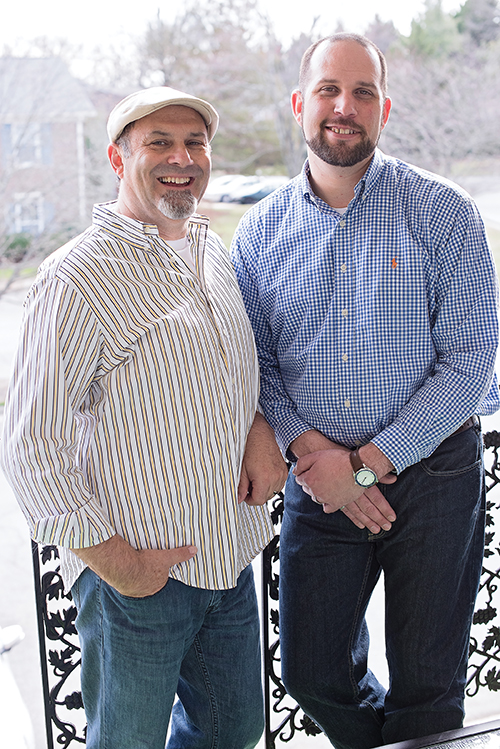
Last May, Thomas Buckley and his partner, Cecil Lockhart, left an 800-square-foot, renovated home on Roseland Street for a move of less than one mile. They had bought a Fountain Manor condo in the neighborhood and did what they enjoy most: They started all over with a clean slate. 

There was little to pack. The couple’s modus operandi is to take their artwork and a few personal effects with them, and dispense with the rest.

By September, their fifth and latest renovation was completed in just four months, with a few tweaks left in the kitchen. But by the time their newly befriended neighbors blink, the home makeover addicts will be gone again to embark on their sixth redo. (They already have an eye on a new fixer-upper.) Between them, they have lived in California, Connecticut, Colorado, South Carolina and now North Carolina.

A fresh design canvas is just the ticket for the designing duo. 

But back to last spring, and the previously sight-unseen condo they now call home. Before the partners bought the Fountain Manor condo, they already knew it was the right price and the right location. “We like a bargain,” Buckley confesses, which is putting it mildly.

But — once seen, the 1,700-square foot Fountain Manor abode (double the size of their former home!) featured dated wallpaper and flooring, and a blasé look. It was stuck in a 1980s time warp. The condo was, by any measure, clean and livable but read much too traditional for their tastes and eclectic artwork.

Buckley set out to do what he relishes, designing on a dime. He established an exceedingly small budget to make their new home hum. The couple’s renovation budget? They look at each other and smile. “$10,000, all in all, including new kitchen appliances.” 

Paint — the cheapest of tools in a designer’s arsenal — is also the most powerful. 
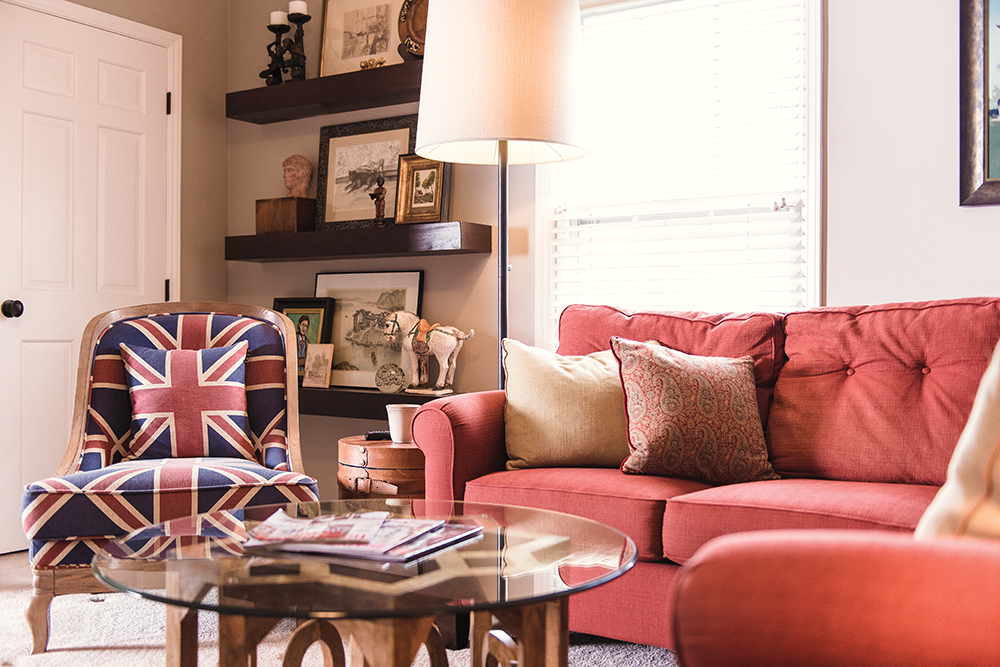
Buckley enthuses, too, at the Triad’s trove of riches when it comes to furniture and home furnishings! Greensboro offered unparalleled consignment choices, thanks to the area’s being at the epicenter of the furniture industry. Buckley says he can scarcely believe his good luck.

“The thrill of the hunt,” Buckley smiles, to furnish a new space, is his second greatest kick once he has plotted how to make a design fresh and refreshing. For this purpose, he goes right to the “incredible array” of consignment shops that populate the Triad. He points to a coffee table — like all the other furnishings, it appears to be brand-new. (Nothing in the condo appears remotely shabby, but polished and chic.)

“This coffee table is a $2,200 Baker table, and I paid $240,” the designer says with no small amount of pride. “I know high-end furnishings, and I love consignment. I’m totally into repurposing.” 

He is quite possibly as addicted to the next new thing, as some are addicted to collecting.   

As he explains it, Buckley truly likes cha-cha-changes.   

“I’m ready to do it again,” he grins. When working for a client, he occasionally sells something straight out of his home. “I’m very into creating good energies in a space,” he explains.  “But I’m not into the pressure to keep up with the Joneses.”

Buckley qualifies this. He likes small change with maximum effect. Meaning, when this designer takes on a new home interior, he enjoys the challenge of a very slim budget.    
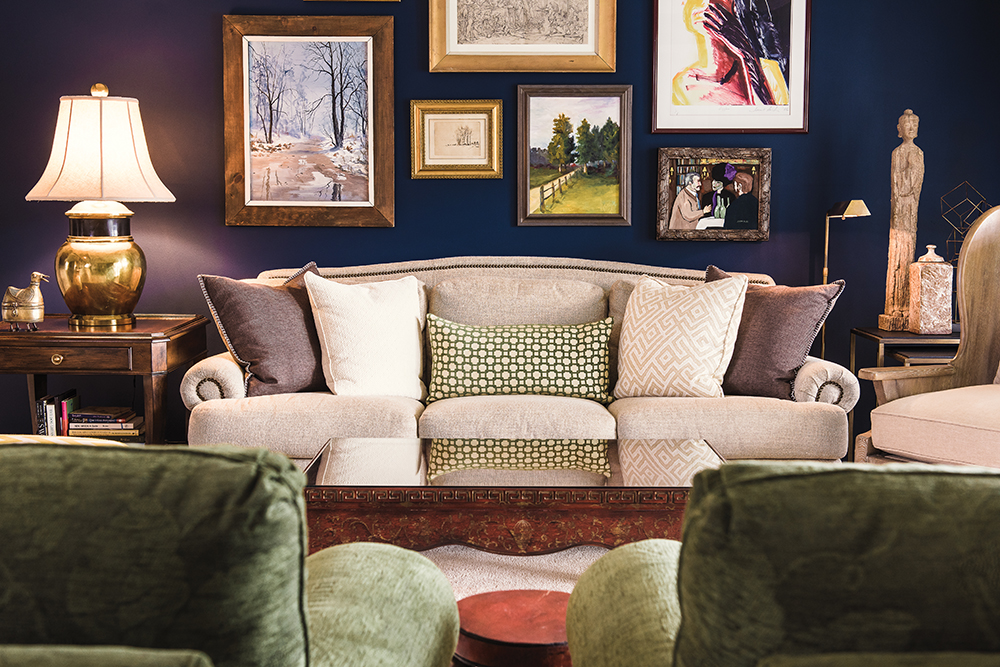
 

“Anyone can design with a huge one,” he frowns. But not everyone can reuse, repurpose, reinvent and rejuvenate, all the while honoring the discipline of keeping things to, as he adds, “a very reasonable cost.”

The availability of beautiful things at a bargain still stuns Buckley. Taking advantage of that bounty is simply what Buckley loves, and he is slowly bringing Lockhart around to his point of view. Together, the couple moved from “a big house in Denver, Colorado, to Florida, then to a (N.C.) house, then a townhouse, then to the house on Roseland, and now here.”   

Buckley says he’s been designing since he was 10 years old. “After the first design job, I got the Carly Simon album, You’re So Vain,” he chuckles. It was thrilling, to source collectibles, especially art and high-end furnishings, and reinvent a space. And to make money doing it, he says.

Buckley still owns a painting he chose for his uncle when he was only 15 and later inherited. He keeps deeply sentimental things, especially the art that he loves, but all else is up for sale. Or else, he says, it is up for donation.   

“You shouldn’t get attached to anything,” Buckley says. Then, Lockhart quietly confesses, “But I do get attached to things.”

Buckley amends, “I did get attached to a Drexel Heritage sofa I once had.” He says this apologetically, as if he needs to explain.

How did this gypsy-spirited design philosophy develop? A growing awareness of mortality made Buckley realize how fleeting life and possessions are.

“I have had health issues. My former partner, Dan, had leukemia, and I took care of him.”  The entire experience was deeply affecting for Buckley.  It caused him to also redesign his own life, creating one that would not place possessions over meaning. He did not wish to be owned by his possessions.   

Furniture, furnishings and other material objects were no longer imbued with the meaning they once had. They simply could serve as a substitute for what he had lost. Buckley landed on the idea that he could approach each home like a Zen garden — one designed without attachment. Lovely and temporary. He could indulge a passion for designing new spaces and the all-thrilling hunt for treasures, without accumulating material objects that tied him down more.    

The answer was to design, decorate, and then polish a rough stone until it shone like a diamond, and move on.

“Who needs so much stuff?” he asks plaintively. As his parents aged and their health declined, Buckley frequently returned to their Connecticut home — large and stocked with treasures. He preferred to live simply, with far fewer things.

So, the couple has begun refining the art of moving in only a day when the whim hits them. 

Lockhart had to be converted to learn to redo a place, furnish it, then leave it and start afresh. “It became liberating. I resisted it at first, though. But I see the beauty of it now,” he admits.

He still works at various jobs through the week, which include real estate, retail and one day weekly as a hairdresser, his former profession. He likes the variety and freedom.

“When I lived in Greenville, S.C., people bought my house fully furnished,” Buckley says. “I sold it all, because I felt it wasn’t fair to Cecil not to start afresh in our new relationship.”

After the couple bought the Fountain Manor condo, they proceeded to change some of its more dated aspects in record time. They opened up space, removing, for instance, a half wall divider with pickets that impeded the flow of the room. They then claimed a closet, “Which we repurposed into a ‘dry’ wet bar,” Buckley jokes. It immediately upgraded the hipness of the living room. Their next inspiration cost a mere $300 and sweat equity.

“I found a fireplace insert on craigslist,” says Buckley. “I told them I wanted the electric fireplace only.” A new fireplace adds panache and visual interest upon entering the house — where there had previously been none. 

Next they undertook cosmetics, ending with the kitchen. Down came kitchen wallpaper that Buckley instantly recognized as a Waverly favorite he had used years ago on design jobs.
 

Using a color-saturated palette as a better backdrop for their art collection, replacing flooring, and a kitchen upgrade made significant impact for an insignificant investment.

“We had a $10,000 budget and we did it all — kitchen included,” Buckley says with obvious pride. “And that is, the kitchen and all appliances: $4,200 for the appliances. There was an appliance sale and I knew when to buy them.” They kept the cabinets, which were in good condition, except for one section, which was removed to expand the room. The cabinets were painted and given spiffy new hardware. Then, the couple replaced the countertop with a reasonably priced laminate and refinished the floors.

The kitchen is now more open, and a clean, fresh room rather than detraction.

Buckley does have a case of reverse snobbery.

One of the couple’s wing chairs was featured in the February issue of Architectural Digest.  Buckley proudly says it is the very chair he sits upon, a $3,000 chair, one he snagged for $300 on consignment.  (The thrill of such a deal excites him as much as the beauty of the piece. “I love the Red Collection, and also buy things at the Carriage House nearby.”)

But when it comes to bargain-hunting, it’s the art collection that shows their true colors. Buckley says he scored two framed sketches of the RMS Titanic and the Mauretania.

They also own a piece by James Austin, one of many designers to help originate the AIDS Memorial Quilt.  In addition to many others, the couple is proud of two works by Jim Hahn, an artist of note who began painting later in life.

Did Buckley buy these pieces of art retail?  “Oh, no,” he says, taken aback.  That, it happens, is against Thomas Buckley’s religion. Think of him, if you will, as the Warren Buffet of design. In this case, he’s actually the Design Oracle of the wealthy enclave of Greenwich, Connecticut, where most of his family still resides.   

But a true home, as Buckley will point out, is not an address. It is where you find meaning. A friend just called them about a house she hopes they will take on, and they are already twitching to do it. It’s smaller than the condo. Not a problem, says Buckley. 

“We eventually hope to downsize our way to live in a tiny home,” With this, Buckley  shoots a quick glance at Lockhart, who, unfazed, scarcely raises an eyebrow. “Well,” Lockhart points out, “at least this way our closets are always neat and our house is always clean.”  OH

Cynthia Adams is a contributing editor to O.Henry and writes for its sister publication, Seasons.  She is convinced that style has little to do with money, and everything to do with imagination. 

Brother, Can You Spare a Dime?
Thrifty Design Ideas from Thomas Buckley

1. Buckley loves color and advises, “Don’t be afraid of color. Color is one of the cheapest, most dramatic ways to change a space. Also, no color is out of style!  So, choose a color you love, and run with it.”

2. Whatever you do, consider keeping your interior classic. “Timeless design is balanced.  And, it is a comfort to your heart,” Buckley says.

3. Stay well away from trends. Buckley believes trends may quickly date and limit an interior.

4. Making your house a true home “needs you in it,” says Buckley. Express yourself in your home and it will read as cozy and more distinctive.

5. Consider carefully what your interior actually needs versus what you want, making a distinction in order to control clutter.

6. When buying pieces, buy whatever goes best with what you already have. He advises that you know a piece of furniture or decorative object will work before you commit. “Don’t buy an item just because you like it,” he cautions.   

7. Make whatever you have the best you can make it. “I’ve designed a mobile home in Myrtle Beach, and it was great,” says Buckley.

8. Buckley believes that “all art goes together,” saying he doesn’t limit his collection to a single artist or style.  In his view, art has the advantage of having no floor space and yet it is transformative. 

Earth, Wind & Fire

Wild Fired

The animal-inspired pottery of Charlie Tefft

By Maria Johnson

dozen years ago, Greensboro artist Charlie Tefft thought

he knew what being a successful potter meant.

It meant getting your work in big-city galleries.

It meant schlepping your wares to far-flung weekend
pottery shows.

It meant getting written up in pottery publications such as Ceramics Monthly and Clay Times. (Yes, those are actual, credible publications, not fake ceramic news).

Eventually, all of those benchmark things happened to Tefft, and guess what?

He wasn’t that successful. At least not monetarily.

So, spurred in part by the need to support his growing family, he shifted his thinking and his practices.

He simplified.

He cut expenses.

He came home.

He stopped spending so much time and money on the photography, correspondence and shipping required to land a few pieces in galleries that took
50 percent of his sales and, therefore, made him hike the prices of his work.

He sliced his travel bill by focusing on regional and local pottery shows where he sold directly to customers.

He camped out at the Catawba Valley Pottery & Antiques Festival in Hickory,

He became a regular at the spring and fall craft shows at the Greensboro Farmers Curb Market on Yanceyville Street.

He signed up for Keep It Local, the twice-a-year art show hosted by friend and fellow potter Leanne Pizio at her Oak Ridge studio.

Tefft compiled snail-mail and e-mail lists of people who bought his work, and he notified them about upcoming shows.

His repeat sales climbed.

“How many people are in Greensboro?” he says. “Certainly not all of those people are interested in pottery, but even if 1 percent are interested, that’s a lot of people. . . Doing something that’s not prestigious, but local, that’s what built my business. It wasn’t getting in Ceramics Monthly. It was doing the Farmers Market every spring and fall, and building clientele through that.”

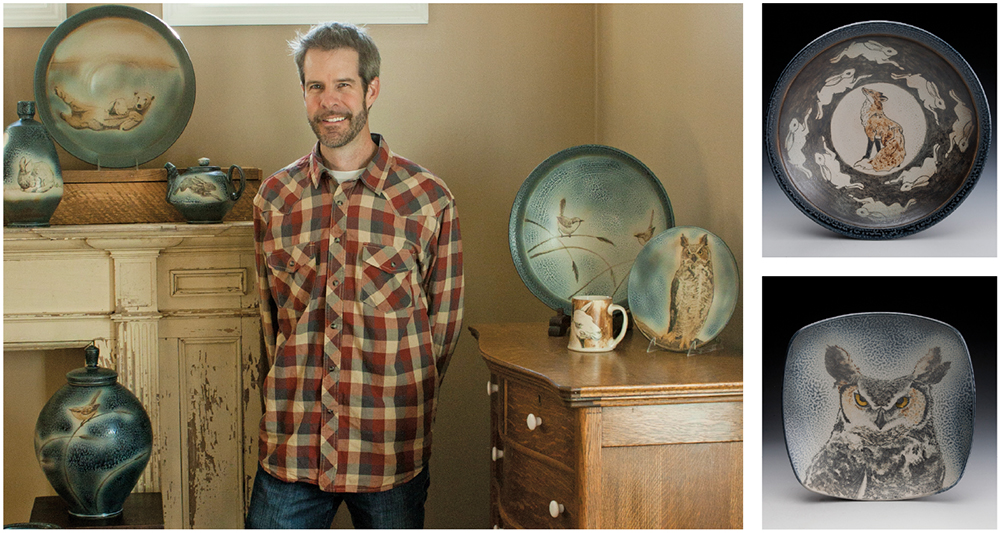
As he waded into a smaller pond, Tefft refined his signature techniques and style, including spray-on glazes, which pool in pockets of deep color. His tones stick close to the earth: tawny browns, creams, blues and grays.

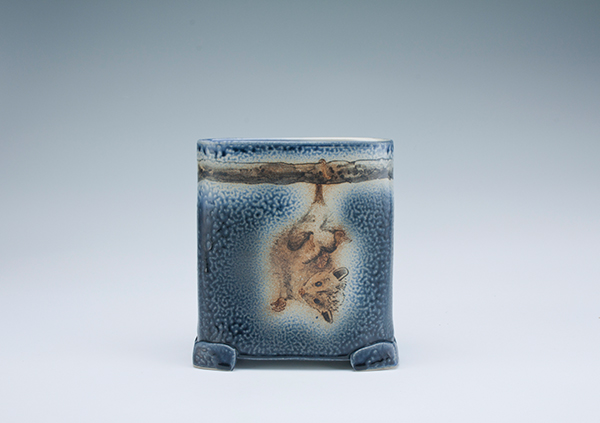
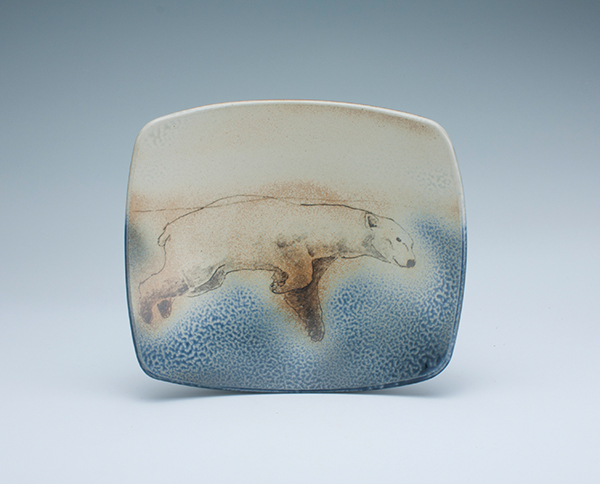
He also perfected the delicate paintings of the wildlife that populate his work. Among his favorite subjects: Carolina wrens, black bears, polar bears, deer, opossums, foxes, owls, rabbits and squirrels.

Tefft — who briefly fancied a career as a veterinarian — paints the critters on his pottery using fine brushes dipped in washes and stains.

“It’s like a watercolor painting,” he says.

There’s a pipeline between what Tefft sees in everyday life and the designs that appear in his work.

The foxes? Inspired by a vulpine neighbor that Tefft unmasked when the animal got its head stuck in a Lay’s potato chip bag.

The black bears? Tefft, his wife and three kids, spotted one on a trip to Skyland Resort in Virginia’s Shenandoah National Park three summers ago.

The squirrels? There are more squirrels than students under the oaks at Guilford College, where Tefft teaches.

The swimming polar bears? Saw them at the North Carolina Zoo
last summer.

The opossums? A friend in wildlife rescue showed Tefft a box of baby opossums at the Farmers Market, and Tefft was so charmed he made her a cup painted with the wee marsupials.

The wrens? They built nests in a shed outside a home where Tefft and his family lived years ago. The pert birds pop up all over his work, not only in image — they often appear perched on grasses and thorny vines — but in form. His wren-shaped pitchers beautifully suggest the birds’ beaks, eyes, breasts, wings and tail.

The pitchers predated the paintings.

“For a long time, I wanted to have animals on the pots, but I couldn’t figure out how to do it,” says Tefft. “That wren pitcher was really satisfying. I felt like I’d tapped into something. It’s just been a long explorations of how to incorporate animals in ceramics.”

His love of ceramics ignited in childhood.

Born in Raleigh, he moved with his family to Columbia, Maryland, outside  Washington, D.C., when he was a year old. His father was an early computer consultant. His mother was a gifted watercolorist. Their boy Charlie was drawn to art, too.

“Being dyslexic, reading was hard for me, so I was an art kid,” he says. “That was the place in school where I excelled the most.”

He discovered pottery in a class at his Episcopal elementary school, which led to a clay-themed summer camp, which led to an infatuation with the pottery studio in his Quaker high school.

“I always liked working with my hands,” he says. “We had this creek near our house, and I remember dragging this bucket of clay across a field with a friend of mine to make stuff.”

His bond with earthenware led him to another Quaker school, Guilford College, the home of a ceramics program that was started and nurtured by Lisa Young.

By his junior year, Tefft was basically living in the studio.

“I became a teaching assistant. We were given the keys. The growth during that time was amazing,” he says. “I’d go into the studio and do things I couldn’t do the week before.”

He moved to Atlanta after graduation in 1997, intending to work a day job and throw pots at night. His parents encouraged him to take a slightly different tack: to throw himself into his pots day and night.  “They said, ‘We really believe in you,’” he says. “That made all the difference in the world.”

He haunted a cooperative studio and lived on a trickle of income that allowed no TV or cell phone.

He banked experience instead, developing his hallmark eye-hand coordination.

Whatever fascinated his eye, his hands translated to clay. When he saw a photograph of a twirling dancer, her skirt an eddy of fabric, he reincarnated the image as a teapot. A picture of Whirling Teapot was published in a 1998 book, Wheel-Thrown Ceramics by Don Davis.

The picture got Tefft noticed.

A friend rang the following year. There was a temporary teaching position at Guilford College. The job was supposed to last one semester, while Tefft’s former teacher, Lisa Young, was on leave.

“A couple of weeks later, she said, ‘What about two semesters?’ Then it was ‘What about years?’” Tefft remembers. “She left the college and passed it to me.”

That was 18 years ago.

As the college’s only pottery teacher, Tefft leads two classes a semester, which leaves him time to work in his studio, a converted outbuilding in his side yard. He shares the space with apprentice Ray Knirs and another colleague: Tefft’s Australian Shepherd-St. Bernard mix, Walt. Accommodations have been made for Walt’s tail.

“You see there’s nothing wet on the lower shelves because of his hair,” says the 44-year-old Tefft, who looks and acts as you might imagine a potter would.

Lanky, bearded and unpretentious in a T-shirt, work pants and spongy black Crocs, he’s animated by a gentle spirit, but his keen eyes record everything.

He works on pottery daily, often at night after the kids are asleep.

He sweats the details, laboring to make the lips of his tumblers dribble-proof, the spouts of his teapots dripless, the handles of his mugs comfortable to adult fingers.

His pieces work, both functionally and aesthetically, a harmony born of long hours.

“I’m not a production machine,” Tefft says. “I do higher quality work. I touch these pieces a lot.”

But all is not drudgery. Tefft injects his work with humor, too. A plate titled Dreaming Fox shows a wily red veteran pondering rabbits that circle him like clouds. A mug shows a wren perched on the back of a snake that resembles a vine. By depicting animals in moments filled with prey-predator tension, Tefft makes them characters, not just decorations, and implies their lives beyond pottery.

“I feel like I’m capturing them in a small part of their world,” he says. “That’s the art side versus the merely craft side.”

Ironically, the big galleries call Tefft more
than ever.

He ships pieces to AKAR Design in Iowa City, Iowa, and to Pewabic Pottery in Detroit. He recently sent about twenty pieces to a three-person show at The Clay Studio in Philadelphia.

“That’s a big deal,” he says. “They’re a major spot for collectors on the East Coast, a clay hub.”

Still, he cleaves to local collectors. Last year, he rented a booth at the National Folk Festival in Greensboro. He plans to do it again this year, the final chapter of the festival’s three-year run here.

He also entertains customers in a showroom that he built next to his studio on Hamburg Mill Road three years ago. He splits the 15-by-30-foot space, which is called Summerfield Gallery, with potter-friend Phil Haralam. They host twice-a-year sales. The next one will be June 16–18.  Shoppers can see the pottery by appointment at other times.

The cost of Tefft’s work ranges from $15 for a small, undecorated vase to $1,200 for a large animal vase. Most items are priced between $40 and  $150.

“I want my neighbors to be able to afford my pottery,” he says. “I want to be the local potter.”  OH

See more of Tefft’s work, as well as a schedule of his upcoming shows, at ctpottery.com. Maria Johnson is a contributing editor of O.Henry. She can be reached at
ohenrymaria@gmail.com.