Earth, Wind & Fire

The Power of Wind

The unseen takes shape in Jim Gallucci’s wind-powered sculptures

By Jim Dodson     Photographs by Sam Froelich

To begin, a breezy pop quiz:

What do politicians and pump organs have in common? Not to mention pop singers and iron sculptors?

The answer, of course, is wind.

When Iron Sculptor Jim Gallucci heard a version of this somewhat lame joke one early spring afternoon while standing in the work yard of at his 7,000-square-foot studio and fabricating shop in South Greensboro, the acclaimed iron sculptor simply smiled and nodded.

“If you think about it,” he mused, “wind is a major force in almost everything around us in life. Wind brings weather, the change of seasons, provides a force for birds and seeds to fly over the Earth, moves everything in the world.  The wind shapes things, sculpts the Earth, propels sailboats over the water, moves people, ideas across the Earth! You name it.” As an example, he mentions a 50-ton airplane. “You think, oh my goodness, how can that thing possibly fly? The answer, of course, is engineers have learned how to use the wind. They can’t quite harness it — wind has a mind of its own — but they can utilize it to serve some amazing purposes.” Gallucci goes on to say that figuring out how to deal with wind is crucial to his job as an artist who creates large sculptures. “It’s called the sail effect,” he explains. “You have to find a way to work with the wind, not against it.”

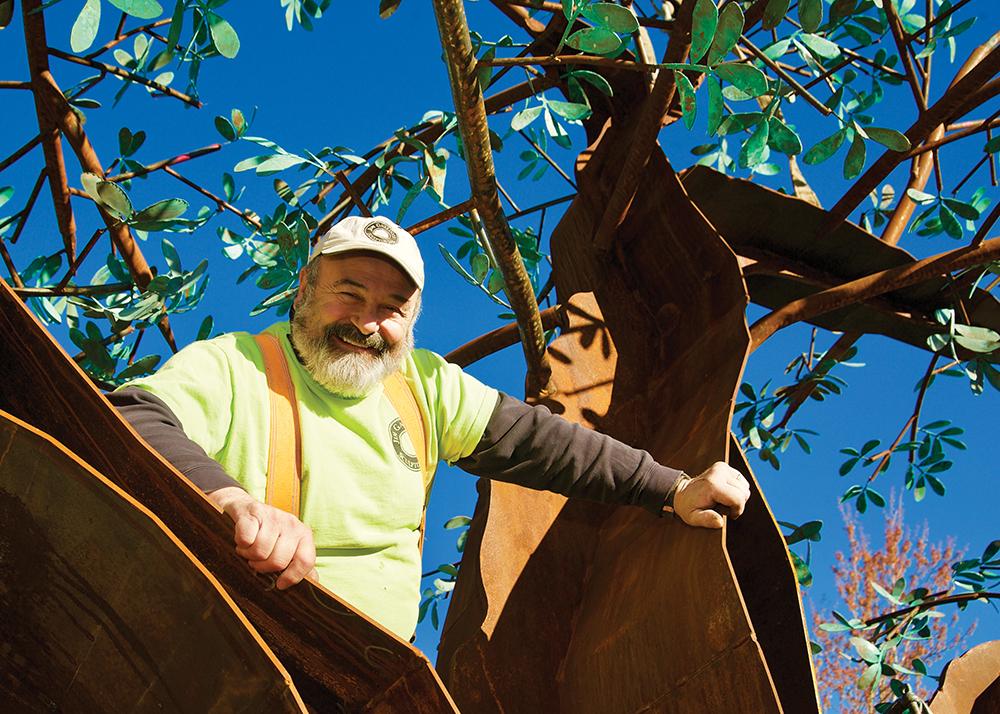
As he says this, Gallucci — a cheerful, stocky, bearded artist  whose spectacular iron sculptures grace significant public spaces and private gardens all over the state and nation, and who looks, moreover, like a fellow who is gifted in the art of shaping steel to his purposes — stands near one of his latest creations, a monumental work called the Tree of Life. It is a spectacular tree made of structural steel with brass leaves of green that rises 40 feet into the air — i.e. wind — and will soon be bound for the Hebrew Cemetery in Charlotte.

Inside his large fabricating shop, a crew of two assistants is busy welding rebar together for the massive concrete footing that will anchor his stunning
Tree of Life. “Thinking about the wind and its effects is something I had to learn early in my career, which is why an understanding of engineering is critical in this kind of work,” Gallucci says. “Thanks to sitting with so many engineers, I’ve become something of an expert on such subjects as wind loads, sail effect and the other impacts of wind on my large-scale projects.”

The artist recalls a dramatic lesson learned of this expertise, remembering a frightening moment he and his assistants were just finishing the installation of two sculptural steel towers at Raleigh’s City Plaza in July of 2009. “We were welding the last pieces in place when suddenly, a large thunderstorm hit, bringing a microburst of wind that was later determined to be hurricane strength,” he remembers. “It flung three-quarter-inch plywood like pieces of paper through the air and actually moved our 38,000-pound boom truck several inches. But the towers didn’t budge. That was a relief — and not a small message about the importance of understanding wind. It comes from all directions, and it’s often unpredictable.”

Over the course of a distinguished 30-year career as an educator and sculptural artist, Jim Gallucci has made his share of chimes that rely upon the wind to produce sound. But he’s perhaps best locally known for his dramatic gates and bridges that evoke a palpable sense of place and offer a sense of earthy welcome, including Greensboro’s iconic Millennium Gate — plus gates at UNCG, O.Henry Hotel and First National Bank Field, where the Grasshoppers play. His extensive opera also includes gorgeously wrought bridges at Durham’s Duke Gardens and the JC Raulston Arboretum in Raleigh. Several of his more dramatic pieces with specific wind themes regularly show up at important civic and art shows around the country.

“Some of them travel, just like the wind itself,” Gallucci quips, leading his visitor over to a magical looking piece called Divine Wind featuring a circular vortex of iron with sculptural squares that resemble pages caught up in the cyclonic whirl of wind. “We’ve taken this piece all over the country,” he explains. “It’s symbolic of how everything in our lives is shaped in one sense or another by wind of some kind or another. I have hopes that this piece may someday wind up out at the airport, where the wind is very much part of life moment to moment.”
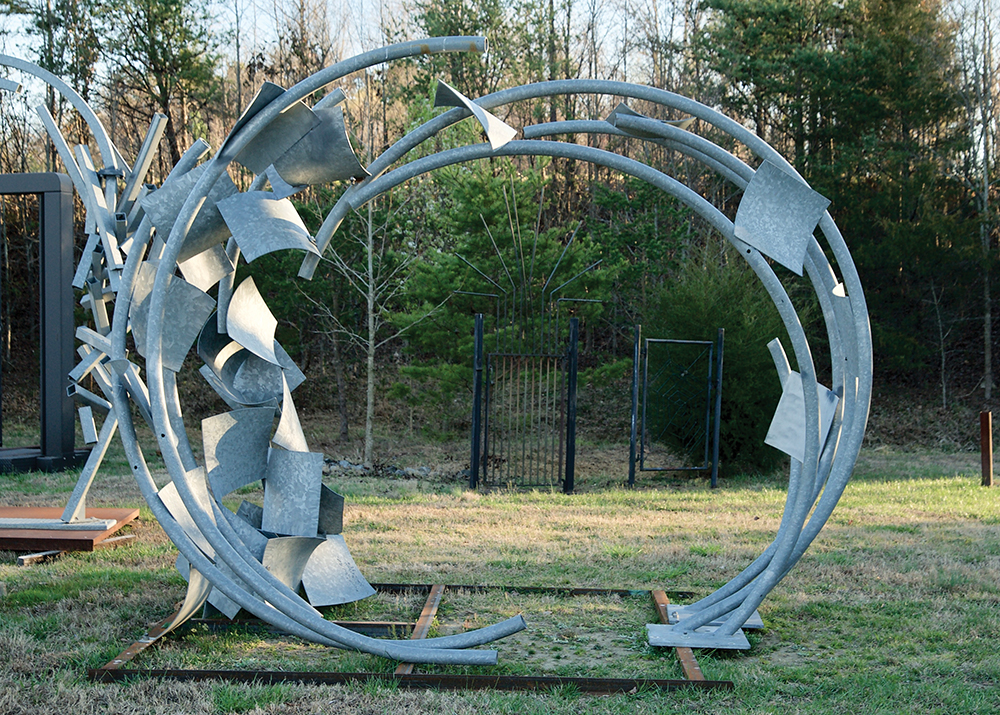
 

A similar piece, he notes, was created for the citizens of Greensburg, Kansas, the famous little town in Southwest Kansas, 95 percent of which was s leveled by an EF5 tornado May 4, 2007. The storm killed 13 and injured 60. Since that time, Greensburg has risen remarkably from the rubble of its devastation, rebuilding a town that is 100 percent Green and now a model of environmental technology that includes one of Gallucci’s rendering of wind’s destructive force called Wind Passage.

“The first thing the community did was rebuild its police station and an art center — realizing that art is something that can hold a community together through the winds of change,” the artist explains. “When the mayor first looked at the piece, he wondered what the little squares in it were supposed to represent. When I explained that those were papers caught up in the vortex, he simply nodded. It was very emotional but quite an inspiration how they’ve come back.”

Here in the Gate City – “a place that — tradition holds — earned it nickname for all the railroads that once passed through this city, though I prefer to think the nickname comes from the fact that we are a city of open gates where all are welcome,” he says — a trio of moving Gallucci wind sculptures connect important spots on the campus of Hospice and Palliative Care of Greensboro. A colorful butterfly sculpture that holds the name of children who were served by the organization’s Kids Path program (but have passed on) graces the entry of the garden adjoining the facility that counsels ill and grieving children. “Every child whose name appears has his or her own color,” notes Paul Russ, HPCG’s vice president of marketing and development. “It’s the first thing you see when you enter the garden — butterflies in flight — a symbol of the young lives we’ve served.”

A few steps into the garden sits Gallucci’s novel pipe organ bench, a multi-colored confection of iron encircled by foot pumps that send air and sound through genuine organ pipes the artist salvaged from a church. The whimsical sound machine was funded in memory of a Hospice patient named Bruce who loved music and sound of any kind.

“It’s playful and irresistible to almost everyone, and that’s the point,” says Russ. “You have to step on the foot pedals to make the sound. Everyone feels a little like a kid around it, if only for a little while. The families and children who use our services come for therapy or help in dealing with a serious medical crisis, something that makes talking difficult for many children and young people and even many adults. Bruce’s organ bench is a wonderful tool for us in our work. It brings people out.”

And so, in a quieter way, does Jim Gallucci’s plum-colored Whisper Bench that reposes in a small cove of trees near the rear of the garden. It’s a tubular contraption where visitors may sit on the bench and whisper into a trumpet-like cone placed at one end of the bench and be heard clear as a voice in your ear at the opposite end.

“Many of the children who come to Kids Path really can’t vocalize their fears or whatever else is on their minds,” Gallucci says. “But what the bench enables them to do is whisper and be heard, to communicate in a private way. The staff says the bench is very popular — a place many children gravitate to. Everyone loves to listen to a whisper.” A similar bench resides at the Greensboro Montessori School.

Whether it comes from a foot pump, the lungs of children, or the divine winds of the Earth, Gallucci says, “wind is simply a magical force in our lives. It really does shape our lives in powerful and unseen ways,” he explains to his visitor before heading back inside to check up on the footings for his Tree of Life and to finish up work on a brass eagle model he was preparing for
High Point University. 

Across the yard stands an equally massive but somber-looking metal sculpture that features cutouts that were clearly silhouettes of human forms standing beneath a structural girder that looks as it had been tossed and mangled by the wind. His visitor suddenly wondered. . .

“Yes, that steel came from the twin towers,” Gallucci explains somberly, “some of the 9/11 steel I was offered some years ago. I hope it may find its way to a proper place someday, a public setting where it memorializes the terrible events of that day. Talk about the winds of change,” he adds with a sigh.

But then, brightening, he adds: “That’s the thing about the wind. Its power is magical, terrifying, unpredictable. It may even be our future — once we learn to harvest and use it for the good of this world.”  OH

With the wind at his back, Jim Dodson manages to edit four magazines, write books and tend his garden.

Earth, Wind & Fire

Iron Man

Mark Green’s calling to ancient arms

By Ross Howell Jr.     Photography by Bert VanderVeen

Ask Mark Green — a landscape professional in Greensboro since 1986 — what he enjoys doing most, and you’ll get an unusual answer.

“I like making swords from dirt,” Green says.

A native of Rockport, Massachusetts, Green first came to North Carolina to train with the U.S. Army 82nd Airborne Division at Fort Bragg. After service in Vietnam, he attended UNCG from 1979 to 1983, studying business and art.

“Unusual fields of study to combine, I guess,” Green says. “But my dad was a builder, and as a kid, it seemed like I was always drawing or painting.”

He continues: “Art is something that stayed with me. Somehow I got interested in Japanese sword-making and started collecting them. Then I got the idea that I wanted to try crafting tsuba, the hand guards for the swords.” Tsuba are traditionally elaborate in decoration, often given generation to generation in Japan as heirlooms.

“So I started working with different materials to make these guards,” Green says. “Copper. Bronze. Iron. And that’s how I met Jesus Hernandez.”

Hernandez crafts exquisite swords and knives near Roanoke, Virginia. Once a physician with a successful practice, he decided to give up medicine and build a house near the Blue Ridge Parkway. Hernandez taught himself how to smelt the iron and steel he often uses for his handmade blades.

Hernandez was Green’s introduction to a community of artisans he alternatively calls “smelt buddies,” “smelt-heads” or “wizards of bloom.” It’s a select community identified by arcane knowledge and arduous labor. Its roots go back at least as early as the philosopher Aristotle, who wrote a treatise on the use of charcoal to increase carbon in the smelting process, thus hardening iron and steel. (Additional carbon is what makes iron steel. The longer the iron is fired with charcoal, the more carbon it absorbs.)

And smelting begins with dirt.

Green will tell you the hills of North Carolina are laced with the kind of dirt you need — iron ore — and he should know. He’s been searching it out for two decades.

“The problem is, the ore is scattered, or it’s in veins,” Green says. “It’s not concentrated, like iron deposits, say, in Minnesota, or other states in the Midwest.”

It helps to know what you’re looking for. The first discovery Green made was at the Guilford/Rockingham County line.

“It was an old trench mine,” he says. “Hand-dug by slaves. The trench is overgrown with trees and brush, but it’s maybe 3 to 4 feet deep and runs for hundreds of feet. It looks like an old World War I trench, as much as anything.”

Here and there are loose rocks in the trench. Green picks one up. It’s brown and otherwise nondescript. Typically these stones are limonite, generally described as a mixture of hydrated iron oxide minerals. Limonite has been mined to produce iron, according to some sources, for more than 4,500 years. Green picks up another rock and points out darker veins. This is magnetite, another iron oxide mineral. It contains iron dense enough to be drawn to a magnet. Farther along the trench, there’s a big hole, maybe 12 feet deep. Around it are mounds of earth, some as high as 8 feet.

“There must’ve been a really big chunk of ore here,” he says. “You’ll find holes like this sometimes.” Slaves excavated the massive stone, breaking it into pieces for transport.

“In time these old mines were abandoned,” Green says. “But during the Civil War, they were reopened, because iron was needed for the war effort. That’s how I’ve found some of my biggest hauls. Slaves would stack dump piles of the ore they found. But when the war ended, they just left them, and walked away.”

“From one dump alone,” he continues, “I’ve taken out 1,600 pounds of ore. It’s a lot of work, I can tell you, but it’s less time-consuming than prospecting along the trenches.”

When Green shows up at landowners’ houses with his empty wheelbarrow, asking to cart away rocks from their property, they’re usually more than happy to accommodate him.

Then comes the next step, and it’s just as laborious, maybe even more so. Smelting.

First the ore must be roasted. Then crushed to bean size. Then a “bloomery” or “stack” is built. Green’s friend Hernandez began his smelting experiments with a relatively simple and small smelter called an Aristotle Furnace. But another friend, Lee Sauter, whom Green calls a “smelting magician,” has spent years researching and experimenting with ancient forging methods.

Sauter, who took up blacksmithing at the age of 12 in 1973, produces iron sculpture, and maintains his forge near Lexington, Virginia. He, like Hernandez and Green, might do as many as twenty smelts a year, traveling to festivals in Maryland, Louisiana, and other locations around the country.

The stacks they build are vertical cylinders made of about 55 pounds of clay. The “dragon” stack Green built at his home recently has an internal diameter of about 8 inches and stands 40 inches tall. Near the base of the cylinder one or more tubes — called tuyères — of metal or clay are introduced. These tubes enable the smelters to increase the air flow into the chamber using a bellows or other means and also to inspect the progress of the smelting. Openings are introduced at the bottom of the stack for the “slag,” or waste iron, to escape, and also for removing the molten “bloom” when it’s ready.

Once the clay cylinder has dried, charcoal is added to the top and fired to preheat the bloomery. Typically the “wizards” will include hot peppers from the garden or other “sacrifices” to the fire gods in the first charge of charcoal. Once heated, ore and more charcoal are added in stages for the smelting process. A typical “burn” might take four hours.

Once the ore melts and the molten slag drains away, a “bloom” is left at the bottom of the stack. The flickering, glowing bloom is removed with tongs and hammered atop a big wood stump to tighten the metal. Then the bloom is split in half using an axe and more hammering. The individual halves are shaped into bars with a cacophony of more hammering, often carefully choreographed, with wizards timing their individual strikes in precise sequence. It’s hot, backbreaking work, and watching, I understand why Green places so much value on the expertise and energy of his smelt buddies.

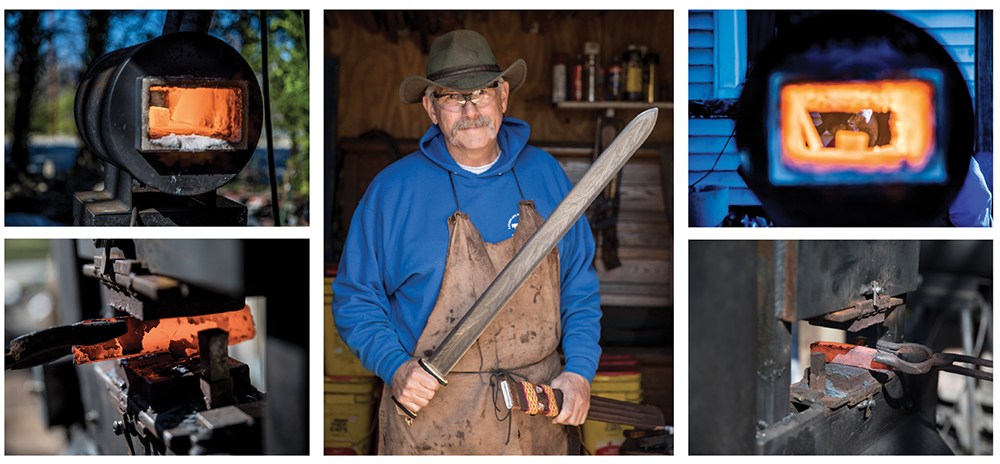
About five years ago Green started making blades for swords and daggers (he calls them seaxes) from the bloom iron and steel he produces. (For blades, the halves must be cut, folded, and hammered many times. But this folding and refolding brings out magnificent colorations and patterns in the iron or steel, and beautiful grain.

Green has studied the examples of Anglo-Saxon weapons found in the Sutton Hoo burial site in England. He has also pored over modern reference books, ancient chronicles, and the collections of various museums and private individuals. Some of the best examples of the designs of Viking and Roman swords, he says, can be seen in old frescoes and paintings.

“The Celts and the Romans understood the carburization process,” Green says. “So they had steel weapons. The Britons and Vikings, not so much. Their weapons were usually iron. And sometimes you’ll find an iron sword with steel edges.” The Franks, however, really understood steel: “In medieval times it was illegal to sell a Frankish sword,” he says. “Their swords were all steel, some of the finest weapons in the world.”

Making the blades is intricate and arduous. Sometimes metal from a meteorite is included in the smelting process for coloration and texture. The bar that will become vthe blade is folded on itself and hammered, folded and hammered again, as many as fifteen times. Watching the process brings a whole new level of respect for the village blacksmith in days of yore.

Interest in these ancient blades isn’t as limited as you might think. For years Green has been a member of the Society for Creative Anachronism. The organization is an eclectic mix of professionals, blue-collar workers, artisans and others, including history geeks, of course. Dressed in full regalia, the group meets regularly for historical recreations and festivals representative of pre-17th-century Europe.

According to the organization’s website, the SCA has more than twenty kingdoms in the “Known World,” with a total of 30,000 members scattered in countries around the globe.

I’m the leader of the Barony of Sacred Stone,” says Green. “Sacred Stone covers western North Carolina, and is one of the larger baronies in the kingdom of Atlantia.” The kingdom of Atlantia includes Maryland, the District of Columbia, the Carolinas, and part of Georgia.

An online check of Atlantia spring events includes this call to arms: “Join your fellow Atlantians at the Barony of Ponte Alto’s Annual St. Paddy’s Day Bloodbath where the fighting is fierce and the lunch is free.”

Green grins and nods.

“Yes, we get together about every other weekend,” he says. “There are archery lessons and competitions. Medieval feasts. And full-contact, hand-to-hand combat competitions with rattan weapons. It’s good cardiovascular exercise! For some events there’ve been as many as 1,500 people reenacting a period battle.”

Green’s handmade swords and seaxes are sometimes part of the costume, pomp and circumstance of coronations or the conferring of a knighthood.

“Yeah,” he reflects. “It’s pretty cool to see a sword I’ve made by hand used in a reenactment ceremony. Especially when you remember it began as a lump of dirt.”  OH

Alliterative flowers, fruits and foliage are about all writer Ross Howell Jr. can produce successfully from dirt. Well, not always successfully.

Rising from the Ashes

Things Old Photo Specialists lost — and found — in the fire

By Billy Ingram     Photographs by John Gessner


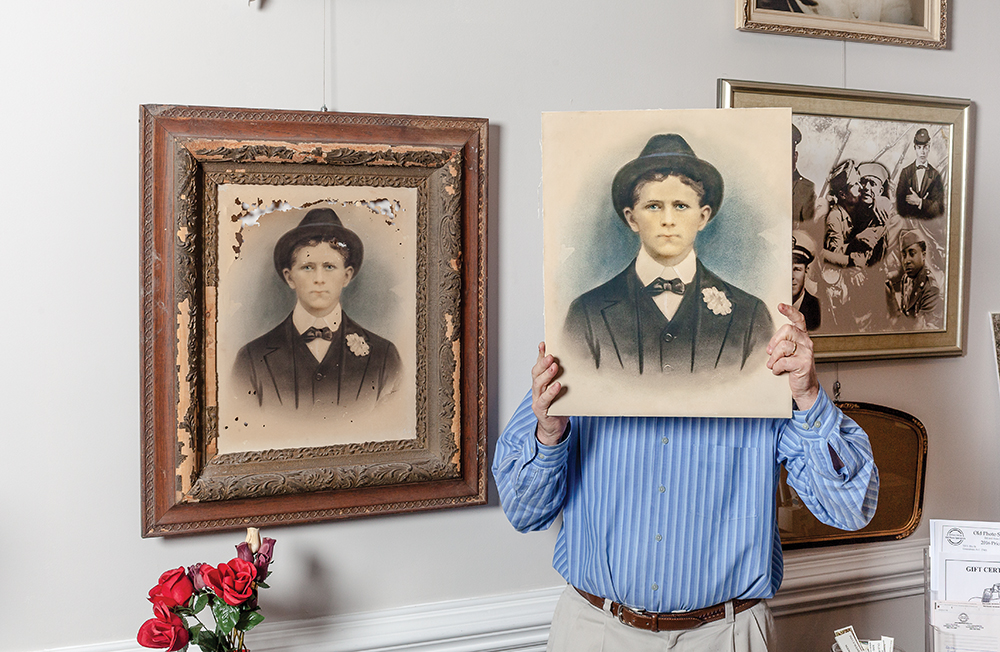
Just as the bottom was falling out of the commercial photography business, Bill Heroy of Old Photo Specialists was surprised to discover that his side business, meticulously producing hand-tinted restorations of antique photographs, had mushroomed into a burgeoning enterprise. Moving seamlessly into the digital age, he is today one of the most sought-after artists in his field, as the images covering the walls of his shop attest. “There’s an interesting story behind every picture,” says Bill’s wife and partner in the business, Anna. Equally remarkable is the Heroys’s own story.

During the 1980s when other businesses and residents had all but abandoned the city center, Bill and Anna raised their family downtown. Setting down roots in a decidedly inhospitable environment, their arduous journey is reminiscent of those pioneers of old, something akin to the trials and tribulations associated with Little House on the Prairie but with more bums and winos.

To hear Bill tell it, he was perfectly happy in 1977 operating a photography studio out of his Victorian home on Spring Garden but, “I wanted to hire an artist,” he says. The city council had other ideas and refused to change his zoning from residential to commercial. “I said, ‘Well, I’ll move then,’” Bill remembers, and he called a Realtor. “Back then everyone was emptying out of downtown,” he recalls. “This building [320 South Elm] was in horrible shape but it was only $30,000, so I said I’d buy it. I had no idea what I was getting into. I made ten grand selling my house, and I’d only had it two years. I lost that ten grand in a week.”

What Heroy bought into was the Fortune Building, constructed for
R.G. Fortune Dry Goods and Notions during the aggressive modernization taking place downtown at the turn of the last century. It’s a study in resolute austerity, bucking South Elm’s architectural trajectory that generally favored European-inspired flourishes accented with marble. No. 320 South Elm was a revolving door of disparate businesses from the very beginning. The Schiffman brothers opened a department store there in 1905. During the 1930s, it was Rustin-Johnson Furniture. Advance Automotive occupied the building in the ’40s, various shoe stores in the ’50s, and after that, it was almost always vacant.

Bill Heroy was faced with the ravages inflicted by decades of neglect. “Back then I put about $80,000 that I borrowed and begged and went through hell and back with the banks.” With his studio in the back, the bachelor photographer devoted the storefront (which has since been split into two units) to a 3,000-square-foot art gallery in 1978 while he crashed in a makeshift man cave on the second floor. “What I found out is — art is one of the most unprofitable businesses you can possibly get into. But when we closed Elm Street Gallery in 1981 we had one of the largest parties they ever had in downtown Greensboro. We had over a thousand people in here.” He managed to keep the photography business afloat for another seven or eight years, but commercial clients were few and far between. “We did some work for companies like Ciba-Geigy and Western Electric,” Bill recalls, explaining that the bulk of his work consisted of portraits, weddings and a lot of Bar Mitzvahs. “That’s what propelled me through the Jimmy Carter [years]. I was working all the time,” he says.

Bill’s wife, Anna, remembers their first night out together, spent right next door: “We had our first date at the Mantelworks when it was a dinner theater. We went to see Inherit the Wind.” The Mantelworks was a cavernous, three-story former factory where lacquered wooden fireplace frames were manufactured in decades past. Beginning in the mid-1970s, a soda shop and artists’ enclave coalesced there in an effort to re-energize downtown, but Anna wasn’t impressed with the place that night, “The play was so boring,” she says with a laugh. “Afterwards, we all went to The Pickwick on Walker and Elam and that was fun so I agreed to go out again. We got married in ’79.”

It was Bill’s dream that the couple leave their Fisher Park neighborhood and reside in the Fortune Building, but Anna remained unconvinced. “Bill kept talking about how great it was downtown,” she says. He chuckles, thinking back on those early days, when Old Photo Specialists was directly across the street from Sam & Mack’s Newsstand, the city’s purveyor of porn mags and peep shows. “We would get up on the roof and watch these people go in. First they would walk past it, they’d look around, they’d walk this way and that way, then they would finally go in the shop and we would yell out, ‘Repent!’ and it would echo up and down the empty streets.”

The first time he brought me down I said, ‘Eeehh, I don’t know about this place,’” Anna says, describing the shop as “old,” its second floor a former warehouse “just one huge space.” Then there was Bill’s “horrible bachelor apartment up there,” she recalls. “He had to take a bath in his darkroom. The first time I came to check it out there was a wharf rat up there; he had promised me there were no animals! Anyway, that was the end of that idea for a while.”

They refurbished the entire second floor before moving in with their young son (with another on the way) in 1982. Anna recalls their Green-Acres-in-reverse lifestyle: “There was nothing going on downtown. It was us and the winos. My parents lived in Fisher Park so I picked the kids up every day and we’d go play at Mother and Daddy’s house and then come back. We did make a yard on the roof, put Astroturf up there and made a wall around it with a picnic table and we had a little swimming pool for them, that was fun.”

The lack of excitement in the Heroys’ environs changed around 11 p.m. on April 13, 1985, when a General Alarm was sounded summoning firefighters from every corner of the city to battle a blaze that would, in a matter of hours, lay waste to a significant portion of downtown Greensboro. Fire Chief Bobby Nugent has four decades’ experience taming flames in our city. A six-year veteran in 1985, he described venturing into a maelstrom that quickly devastated historic Davie Street business district: “We had a backdraft, kind of like a smoke explosion. The truck I was driving, Engine 8 on Chapman Street, we were actually on another fire and cleared that when the backdraft happened. That’s when they called for Second Alarm.” The backdraft, he remembers, was a source of confusion among the crew. “It blew a couple of people across the street, messed up the hose lines so they had to regroup after that and start getting back into firefighting mode.”

In less than an hour, seven multistory buildings were fully engulfed in a towering inferno fueled by century-old hardwood interiors, a battlefield growing more fierce by the minute as fireballs and thousand-pound chunks of brick and mortar rained down around emergency workers. Fire Chief on the scene R. L. Powell sent out word to his shock troops that, if the blaze were to spread into any of the antiquated buildings along the 300 block of South Elm, firefighters would fall back to Greene Street, at the Carolina Theatre, leaving Hamburger Square to burn unabated.

The Heroy family was driving home after an evening out when they encountered their neighborhood exploding in frightening light. “It looked like the whole city was ablaze so we just were freaking out.” Anna still recoils from the horror. “Our babysitter cancelled at the last minute so we had to take our children with us. I’m thinking, ‘My God, what if our kids had been in there?’ We weren’t allowed to go in our building.” Fire Chief Nugent recalled the smoldering wreckage revealed as the first rays of Sunday sunlight filtered through a thick cloud of soot: “It was by the grace of God that it got stopped in the alleyway behind where Greensborough Court backs up to the building that faces South Elm Street,” he says.

That was, unfortunately, a mere harbinger.

The Heroys moved to the country in 1988. By that time they’d constructed five rental units on the upper two floors, enjoying a 100 percent occupancy rate through the 1990s and beyond when adventurous folks started giving downtown another look. Meanwhile, that hulking tinderbox known as The Mantelworks had been left fallow, strung with frayed electrical wiring dating back to before the first radio broadcast. In the early morning hours of October 23, 2003, tenants in the Fortune Building were abruptly roused from their slumber by police officers banging on their doors. They found themselves fleeing into the freezing night air with only the clothes on their backs. It took more than a hundred firefighters to contain that blaze.

It wasn’t just the Mantelworks left in ruins: Bill and Anna Heroy were faced with near total devastation of the Fortune Building, with smoke and water damage from floor to ceiling. Bill still finds it difficult to talk about. “It destroyed our building, it destroyed our business. We were forced out of here.” A two-year court battle ensued before reconstruction could begin in earnest — to the tune of about $1.8 million. At the same time, the rapidly changing landscape of digital technology was resulting in dozens of local photographers being forced out of business. “There was a lot of work for everybody really, and then it just . . . dried up,” Bill says. That was when he noticed a trend. “Some days the orders for old photographs were bigger than the commercial jobs. We had customers keep coming in with old photos and we were able to build up the business.”

Ironically, when it comes to photo restoration, the more ancient the picture is, the more gray tones and contrast are hiding beneath the surface, waiting to burst through with astonishing clarity. That’s where Bill’s degree in chemical engineering at Duke came in handy. “Everything made through World War II had a fairly high concentration of silver,” he says. “And the older they are, the more silver they have. He points to some whitish pictures from World War I and explains how they became so faded. “We didn’t have air conditioning back in the ’30s and ’40s; it got hot in the summer, got humid.” He explains that the chemicals used on the photos got moist and absorbed dirt and water, causing them to look faded and colorless. “When we get them in here we can get the detail back like the day they were shot.” As for those washed-out snapshots from your youth? “Color, once it fades, back in those days it couldn’t be recovered,” Bill says. “Between our scanning system and the computer, we can get it back.”

This painstaking devotion to detail has led to the resurrection of some remarkable moments in time, captured on cameras with extremely long exposure times. Looking at a 1916 panoramic view of a contingent of soldiers positioned where the Carolina Theatre is today, one can’t help but be amazed at an image so crisp, so clear, you can read the lettering on buildings a quarter mile away, even make out the whites of the soldiers’ eyes. Bill retrieves another recovered image with local historical significance. “This is St. James Presbyterian. We didn’t even charge to do this. This original photograph of a groundbreaking for the church goes back to 1880s. It was white, you could hardly detect [any image] but I could see there was silver in it so I knew we were well on our way.” He picks up another image. “We had a guy come in that had an entire collection of pictures from the Holocaust. His father was there, he had pictures from the Battle of the Bulge all the way to Auschwitz,” Bill says. He says his most remote client was from South Africa, likely “a plantation owner with one of the native chiefs in the frame who had on a necklace made of teeth. It was in bad shape.”

At times Bill’s work reunites families with long lost ancestors. One of the more difficult aspects of this artcraft can be reconstructing faces. Bill is especially proud of one job: “This soldier had three children when he went off to Vietnam and was killed. This picture he had made with his wife before he left,” he recalls. When he got killed, the picture ended up out in a barn. “It was warped and nasty looking, [eaten away] with mold and watermarks. The kids were rummaging through the barn one day and they found this picture.” The wife had gotten remarried and then divorced, he says, “but she never forgot about her first husband, so we put this together the best we could. Now she can make copies for all the children.”

Anna leads me to the front of the studio where they have a minigallery, motioning towards a wide-angle 1916 photo of a line of soldiers from Canada’s Fort Gary Horse Regiment. In the background a soldier can be seen entertaining a small black bear, one of three that accompanied regiments from Winnipeg. “This was their mascot,” Anna explains, adding, “They were sent over to England to fight so they took their mascot with them. When they got to England they knew they’re going to get shipped over to France and they didn’t want to take the bear because they might be killed.” One of those three bears was left in the care of the London Zoo where he became their star attraction. That zoo was around the corner from the home of A.A. Milne, whose son, Christopher Robin, named his teddy bear after the furry mascot nicknamed “Winnie” after his port of origin. “This came from a lady from Canada whose great-grandfather is in this picture,” Anna tells me.

“You have to have a love for this kind of stuff, it’s a job that takes time.” Bill Heroy laments the art of rehabilitating ancient photographs is becoming a lost one: “I don’t know why there’s nobody in Charlotte doing it. Why is no one in Raleigh doing it? Or Wilmington?” he wonders but doesn’t complain since he gets work from all three cities.

Bill and Anna Heroy are not just in the business of restoring photos. What they truly enjoy is bringing stories back to life that have been lost to time: ““There’s tons of photos out there that have all kinds of stories to them,” Bill says. Which is why, forty years on, the customers keep coming.  OH

Billy Ingram moved to downtown Greensboro twenty years ago after a career in Los Angeles as one of the team the ad world has dubbed “The New York Yankees of Motion Picture Advertising.”

The Breakfast Club

Every Wednesday morning at Tex & Shirley’s, fellowship and photography are served over easy

By Jim Dodson

On a drizzly late winter morning, a lively buzz of voices flows from the rear dining room of Tex & Shirley’s Friendly Center restaurant where nine members of the Bokeh Photography Club are catching up on each other’s adventures since their last Wednesday morning gathering.

The group, which has met weekly for more than two decades, can range anywhere from five to fifteen “members” on any given Wednesday morning. But as de facto spokesman John Poer quickly notes, “We never quite know who is going to show up. We’re just a bunch of people who share a love of photography and enjoy each other’s company over breakfast.”

“In other words,” says Doug Swanson, a retired CPA who spent several years working as Dale Earnhardt’s chief operating officer, “we have no rules, no dues, no bylaws — just a lot of great conversation and talk about photography.”

“We’re a diverse group who love breakfast and expensive cameras,” puts in Bob Poston, just back from a fishing trip to Costa Rica, where he caught two marlin and fifteen tuna and “took a couple thousand photographs.” Together with wife, Diana, Poston owns Greensboro’s historic Guilford Building. Prior to his retirement twenty years ago, Poston enjoyed a long career as a pioneering computer expert who ran, among other things, NASA’s Western Aeronautical Test Range in the early 1970s. Now his computer expertise serves fellow members of the Breakfast Club who often show up at his downtown office to tweak their digital photography.

Across the table sits Tommie Lauer, 74, a retired psychiatrist and former commercial photographer for Alderman Studios, who learned some of her early craft under Gerhard Bakker, the acclaimed American photographer. “I’m still something of a newbie to the club,” she explains, “only been in for four years. But I love these folks. The gab is fantastic. We all share ideas and learn a great deal from each other.”

Lauer is particularly drawn to photographing street people, iconic buildings and fast cars. “That’s one of mine right there,” she says, pointing to a dramatic portrait of a cowboy that hangs with the work of other Bokeh Club members on the meeting room’s walls and across Tex & Shirley’s entrance lobby. “I just happened to see him sitting at Starbucks at Quaker Village and asked if he would let me take his picture. He did. Splendid, isn’t he?”

Indeed he is, this urban cowboy. But equally arresting are the diverse photos of other club members (including O.Henry’s stalwart, Lynn Donovan; see page 56) who are on hand for pancakes and favorite egg dishes this morning. Their regular waitress, Susan Almazan, quips that she rarely has to write down an order. “Like their photos, every one is different. But I know exactly who wants what.”

To her point, the work of Cheryl Garrity and Doug Swanson’s bird photos are nothing short of breathtaking. Ditto Chicagoan Sandy Groover’s candid people shots, some of which she takes for the Rhino Times newspaper. “I’m just a point-and-shoot photographer,” Sandy modestly insists. “I shoot and hope for the best. The others are so technically savvy, I can’t keep up with them. Also,” she adds wryly, “I’m the only Canon user.”

But one look at her shots of her granddaughter mugging by a blue jean statue downtown or her photos of the Wyndham Championship or a group of costumed mermaids gathered poolside, and you realize what a gifted eye this former secretary for Jefferson Pilot possesses.

Groover’s Cannon quip provokes a good-natured groan from the others around the table — most, if not all, indeed, use sophisticated Nikons, some owning several.

Graphic artist and photographer Stephanie Thomas believes she might be the oldest member of the unofficial club, dating her arrival at the Tex & Shirley’s breakfast table from 2006, when much of her work was shown at several prominent galleries. One day several years ago she took a photo of a homeless teenage girl that changed her life. “I was so moved by her, I started shooting homeless women in Greensboro.” Eventually Thomas’s project developed into a photo documentary book called Pushed to the Corner, which she recently completed and is now in search of a publisher and literary agent. “Working in their world opened my eyes,” she adds thoughtfully. “The material things I used to value so much just fell away.”

Sharon Canter listens, smiling, just back from one of her famous wintertime shooting trips up at Roan Mountain in east Tennessee. “She’s the real star — our award-winner,” says her frequent travel pal, Cheryl Garrity, a retired elementary school guidance counselor and hiking enthusiast. Garrity once led hikes for the Sierra Club but got so frustrated trying to identify wildflowers and native plants that she began taking photos of them — which in turn brought her to a photography class at GTCC hoping to improve her craft. There she met Sharon Canter. For an anniversary present, Cheryl Garrity’s husband, Dale, gave her a very nice Nikon camera and soon she and Sharon were off on photographic expeditions to Roan Mountain, Lake Mattamuskeet and other unspoiled corners of the wild — often braving the most extreme temperatures.

“We’re usually up there well before sunrise and never come back until way after dark,” says Garrity. “Sharon is totally fearless. I can never keep up with her. We’ve spent a lot of nights searching for great photos in the dark.”

After one of their memorable photo jaunts in sub-freezing temperatures, Garrity wound up losing the tip of a finger to frostbite. But her photos of the mountain and night skies — especially the Milky Way — are stunning.

Garrity and Canter joined the photo group about the same time around 2009, making their first trip to the Smokies soon afterwards. “The group was such a pleasure — no competitiveness, just smart photographers happy to share their knowledge,” says Sharon Canter. “We both learned so much about lenses, for instance. We’ve been hooked ever since.” 

Canter grew up in Kernersville hoping to be a veterinarian but switched to conservation studies at N.C. State. Like many of the Bokeh Club members, she picked up photography as a hobby with the arrival of children. “Around the year 2000 my oldest son got married and my husband suggested that I get a really good camera to record the event. One thing just led to another,” she adds, describing how her family photos blossomed quickly into a full-blown passion for landscape photography. She talks of a “Bucket List” trip she still hopes to take to California’s Yosemite National Park.

Canter’s photos of Roan Mountain and other nature shots have found their way to the pages of Wildlife In North Carolina magazine, Backpacker, and collected a Best of Show award at the prestigious Appalachian Mountain Photography Competition in Boone, an annual photo contest that draws more than 900 entries from all over the Southeast.

Regulars Claude “Monet” Hutcheson, 77, and Ron Day sit eating and listening to these reflections, nodding in agreement. “I don’t consider myself a photographer,” says Hutcheson, a retired engineer who earned an M.F.A. degree in industrial design and worked for Xerox for more than two decades. “I’m really more of a painter who has seriously upgraded his photography skills thanks to being associated with these folks.” (Hence the affectionate nickname). His specialty is wildlife.

Ron Day’s photographic love is capturing weddings. An engineer who served as the last superintendent of Cone Mills’ Proximity plant before it shut down in the late 1970s, Day, 73, enjoyed the blossoming of a second career as a wedding photographer who has covered more than a thousand nuptials. “I also do some birds and landscape and always dreamed of being a photographer for National Geographic,” he adds with a wry smile. “Haven’t quite made it that far yet.”

But others associated with the Tex & Shirley club have done so, notably Paul Salazar’s daughter, Gabby, 29, who now shoots regularly for the internationally respected magazine and who got an early start on her career attending the breakfast sessions her dad organized — and named — more than two decades ago. At age 11, Gabby sold one of her photographs to Our State magazine, an image of a butterfly on a flower.

“A few of us used to get together at Tex & Shirley’s for breakfast and then walk over to the camera shop in [Friendly] shopping center to look at equipment. This was back in the dark ages of film,” Paul Salazar remembers. Salazar now resides in Port St. Lucie, Florida, where he teaches photography to various skill levels at the Elliott Museum. The name “Bokeh,” he explains, is a Japanese word that simply means a soft focus of light, often a background. “The group just grew and grew by word of mouth. I’m guessing forty or fifty people have been part of it.” Many of them, he adds, belong to the larger Triad Outdoor Photographers organization that conducts seminars and stages shooting trips. “But the breakfast club was always a more informal affair,” Salazar notes. “It’s really as much a social gathering — but a great deal of sharing without any competitiveness goes on there. That’s something really special, and why the club is still going.”

Salazar passed the mantle of leadership on to the genial, John Poer, a longtime systems analyst for BP whose specialty is outdoor photography. “There’s really no leader in this group,” Poer insists, “or oversized egos. We share a love of shooting beautiful photographs, wherever that experience takes us.”

Poer, who was just back from a 10-day photo shoot to a game preserve near Glacier National Park where he shot snow leopards, tundra wolves and Arctic foxes in their wilderness habitat, notes that rapidly changing technology and constant innovations make sharing knowledge all the more important. Among other things, he’s become something of an expert on an Adobe digital darkroom system called Lightroom and happily shares his knowledge of the system with fellow members.

“Essentially,” Poer says, “photography is about the art of capturing light and the image that Henri Cartier-Bresson called the Decisive Moment when an action takes place, whatever its source. That’s why, no matter how digital and scientific photography becomes, there will always be the vital human element — the mind and eye of the photographer who sees the image even before the picture is taken.”

“And that’s why we come every Wednesday, rain or shine,” chimes in Sandy Groover. “For good friends, a good breakfast and a chance to learn even more how to take the perfect photograph.”  OH

Jim Dodson and his wife, Wendy, regularly have breakfast at Tex & Shirley’s ons Saturday morning before going to the Greensboro Farmers Curb Market.

The Lives of Others

Echoes of the past in a College Hill treasure

By Nancy Oakley     Photographs By Amy Freeman

The past, as William Faulkner once famously wrote, “is never dead. It’s not even past.” And no one grasps this concept better than Bill Moore, who, as former director of the Greensboro Historical Museum (recently renamed the Greensboro History Museum) walked and worked with the past for forty years. For the last twenty-six, he and his wife Jane have lived with the past — a big distinction he’ll tell you, from living in it. The Moores, you see, reside in one of the oldest houses in Greensboro and one of ninety-some properties on the list of officially recognized Guilford County Landmarks. The walls of this stately structure on McGee Street in College Hill echo with the lives of those who came before — amid hustle and bustle of students and downtown denizens and athletic contests on the Greensboro College soccer field lying directly opposite.

On a warm day in early spring, Moore is deciding what to do about a portion of the front porch that has buckled. “Treated wood just does not like paint,” says the soft-spoken 78-year-old. A contractor had suggested using Trex, a wood alternative frequently used on decks and patios that’s impervious to the elements. “But the Historic Commission said, ‘no,’” Moore says. “That was three years ago.”

He doesn’t seem to mind the time it takes to patch and repair, considering the years of “constant maintenance” the frame structure has required, including, on one occasion, burst pipes. “My wife was very brave to accept my challenge to buy this house,” Moore says with a gentle laugh. That was in 1986, when it had deteriorated to the point of being condemned. By then, the city had taken ownership of the property, saving it from being razed so it could be converted into a condominium development. “They turned it over to the College Hill Neighborhood Association and put certain restrictions on the restoration, and encouraged people to bid on it,” Moore recalls. “We were the lucky bidders at that time,” he says, pausing to correct himself: “We were the only bidders, I should say.”

And little wonder. The house, as Moore remembers, “was in pretty rough shape.” The porch, which was added in the 1920s, was in much worse condition than today’s incarnation with its single wrinkle and had completely rotted. The gutters, supported by protruding eaves were rusted and “useless,” Moore says. Its grimy walls, painted white, were framed with dark trim. “Things had been stolen and destroyed,” Moore recalls. The entire back of the house, a later addition, had completely worn away. In sum? “It was a mess,” Moore says. “When my mother saw the house, she cried. She probably thought I’d lost my mind!” he says, with a chuckle.

But the pairing of the house with its new owner was “a perfect match,” says Benjamin Briggs, executive director of Preservation Greensboro, for the house was alive with history. And it ignited Moore’s lifelong passion for earlier times.

As a boy, he remembers collecting Indian artifacts near his home in Asheboro, with his father’s brother, a deaf mute, as his guide. “He may have lost his hearing and his voice, but he had keen eyesight,” Moore remembers. “And he could find arrowheads in the fields that I would have walked right over. So he taught me a lot right there.” His high school history teacher and a Sunday school teacher further fueled young Moore’s interest in history, as did another uncle in Washington, D.C. “My mother’s brother lived up there,” Moore says. “He was very interested in history and he would take me to places.” Ford’s Theatre, with an exhibit on the assassination of Abraham Lincoln, was a favorite, and gave rise to Moore’s fascination with the nineteenth century and the sixteenth U.S. president.

By the time he was in college at High Point University (then High Point College), Moore had discovered Town Creek Indian Mound, whose archeologist told him about a new summer job opening. He applied and got the job. In the mid-1960s, Moore signed on with the Historical Museum. “There were no museum training programs like there are now,” he notes. “I learned on the job.” One of his first responsibilities was to restore the Francis McNairy House. “I had to do a lot of research and just got into it and thought, ‘Wow! This is what belonged here. This is the kind of corner cupboard they would have had — it’s not the greatest in the world, but it’s the kind they would have had,’” Moore says. “So I began, systematically, to put myself in those peoples’ place and say, ‘What would I have done? What kinds of things would I have had?’” His approach led to further restorations, of the Museum’s Christian Isley House, and the Hockett Blacksmith and Woodworking Shops. That experience “fine-tuned” his interest, not only in history, but in decorative arts, as well. It also helped him expand the Museum’s collections. “I probably overdid it sometimes,” Moore now admits, “But I wanted to be sure the Museum had a good quality of collections.” His work experiences prepared him, in the mid-1980s, to bring back to life the frame “mess” on McGee Street. 

“This is what you call an Italianate farmhouse,” Moore explains. “It was outside the city limits until 1911,” he posits. He has identified its origins as dating to somewhere between 1845 and 1855, and in tearing out its damaged walls during the course of the restoration he discovered parts of other houses used in its original construction. “I’m also getting closer to whether Gov. Morehead bought this house for his daughter Letitia,” Moore says, adding that there has long been chatter about the twenty-ninth N.C. governor’s association with the property. “Why would something like that just come out of the wood?” Moore wonders. His take is that Gov. Morehead likely owned the land and when his daughter was married to Mr. William Walker, the newlyweds occupied the house for a time, until Walker’s ferry business on the Yadkin River prompted a move. After his death, Letitia and the children moved back in with her father. “So the focus is on Blandwood,” Moore notes. Preservation Greensboro, where Moore has served as a board member, has been helpful providing clues suggesting Morehead’s ties to the property, but more sleuthing is required to confirm it. “It’s a wonderful, charming problem to have,” observes Briggs, and one particular to old Southern towns with rich oral histories, such as Greensboro. Still, Moore believes uncovering indisputable evidence of the Morehead connection “Is going to be a lucky find.”

A find as lucky as a single diary entry linking the house with another historic figure, Jefferson Davis, for instance. “I’ve never quite proven that,” Moore is quick to say. “That story started at least in the ’20s,” he recalls, a period of romantic revival for the Civil War. Moore does know that at the time of that conflict, the house was owned by Samuel Scarborough, a grocer, who rented the dwelling to a Col. Samuel Potts. Moore has also confirmed that by 1865, Jefferson Davis’s nephew and aide de campe, John Taylor Wood, had come to Greensboro with his wife and children. With the Confederacy disintegrating, it was a period of near chaos in the Gate City. “There were riots and people were stealing things,” Moore says. When a friend discovered a sentence in Wood’s diary, “Went to Potts’ to pick up Lola and the children today,” Moore surmised that the Scarborough house was where John Taylor Wood had installed his family and feared for their safety when violent outbreaks had overtaken the city. “And probably what happened was, when he went to get his family members, Jefferson Davis accompanied him.”

He would put his imagination to similar use in bringing back the residence, now commonly referred to as the Walker-Scarborough house (from which Walker Avenue takes its name, according to Briggs). In addition to tearing out the walls, removing the porch extension and replacing the rusted gutters with French drains, Moore had to replace the dilapidated rear of the house, where he and wife Jane would live for four years, from 1990 to 1994, before restoring the front rooms and upstairs bedrooms. For this back section, he chose an Italianate design, in keeping with the original style of architecture. The area contains a completely modern kitchen, painted slate blue, replete with granite countertops and a sunny sitting area where Moore keeps a number of his beloved books and one of the first antique pieces he acquired — a simple chest from New Hampshire. He stops and opens its lid, attached with original cotter pin hinges, to reveal a brownish stain on the underside. “This is where somebody set a candle down, and they closed the lid and they came back in and scooped it up before it burned,” Moore explains, relishing the human error forever imprinted in the chest fashioned completely by human hands — from a single piece of wood.

Joining the back portion of the house to the front rooms is a butler’s pantry with a “ghost drawer.” Moore playfully closes a recalcitrant drawer that automatically opens again. “For some reason, we have a ghost that likes to have it open all the time,” he says with a mischievious twinkle. But the focal point of the tiny room is not so much the drawer as the stained glass window above it. Bearing a grape motif, it was salvaged from a house that was being torn down across from the Museum. “It’s very comforting,” Moore says, “I knew the people who lived in the house. It was a brother and a sister. They were quite elderly and neither one had married.” He had an electrician configure the wiring so the window can be illuminated from either side — in the butler’s pantry or the adjoining front hallway. And it is here that one begins to see the full scope of Moore’s imagination and love of old things.

Where does the eye alight first? On the checkerboard floor — faux painting that Moore did himself, along with local artisan John Kraus? Or on the card table and chairs in the hallway that Moore bought on antiquing trips to New England (“because I didn’t want to create a conflict as much with the Museum’s collecting,” which he explains was primarily local and from Virginia)? Standing sentry by the door is a grandfather clock; on one of its ledges sits a tiny toy mouse. “Hickory, dickory dock,” Moore jokes.

Flanking the hallway are the two front rooms awash in bright hues, typical of the Federal period, a favorite of Moore’s. “We’ve always liked color, and we decided to do the ceilings white and the walls in different colors,” Moore says, explaining that he’ll experiment with swaths of color on a portion of wall before committing to a more permanent palette. The dining room, scene of frequent family reunions and holiday gatherings, is painted a deep rich purple that carries contrasting gold accents from pieces of pottery, many of them reproductions of Salem and Alamance styles. Golden hues also glint from and gilt picture frames, one of which encompasses a dramatic wilderness landscape reminiscent of the Hudson River School featuring tiny figures of Indians in the foreground. “It’s unsigned and I didn’t pay much for it,” Moore says. “But I like the scenery, and the Indians.” He stops by the sideboard and retrieves a glass dish with an imprint of Little Bo Peep.

It was a gift from his mother. He once suggested to her that it might be of some monetary value. “And she looked at me, and she said, ‘I wouldn’t sell it for anything. That belonged to my father.’” He laughs. “And I realized then what she said: It has no value; it’s priceless.”

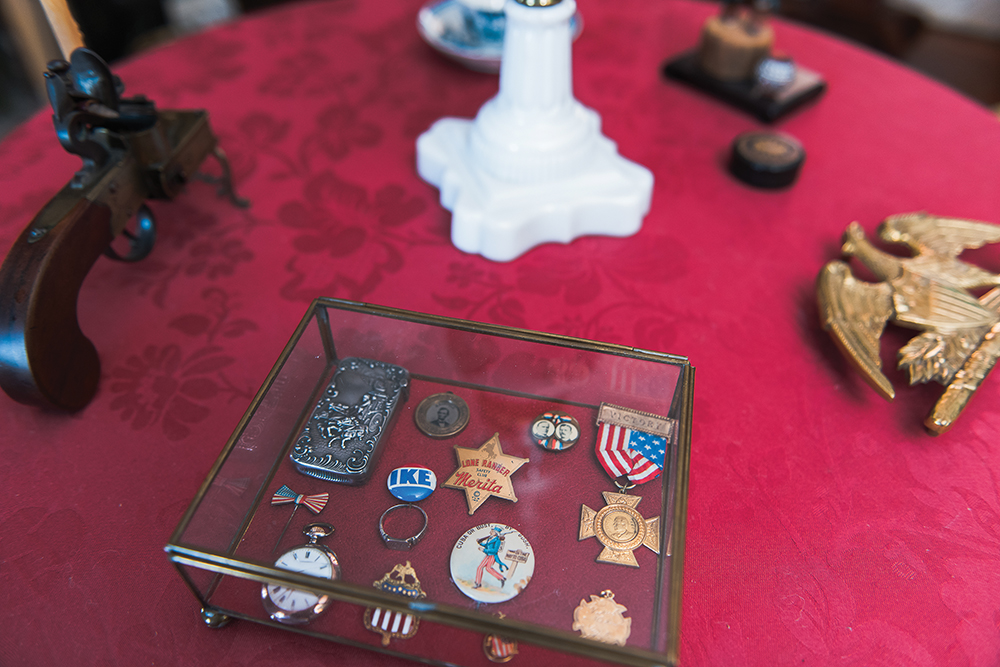
Which is how Moore has come to view the objects scattered throughout and the house itself. “It speaks to me,” he says. “Everything has a story.” Such as the figurine of Gov. Zebulon B. Vance in the teal-colored living room —a plaster replica of the bronze sculpture by Henry Jackson Ellicott that stands in Union Square around the Capitol in Raleigh; Moore picked it up at an estate sale for $5 and had the dismembered arm repaired by a dentist friend. Or the box of tiny curios — a medal that Moore won in high school, his wife’s grandmother’s ring, an “Ike” campaign button and another one from one of Abraham Lincolon’s campaigns. Or the Kachina doll he picked up in Santa Fe, New Mexico. Or the brass bucket by the living room mantel, a wedding gift from his Sunday schoolteacher. Or the model of the ironclad Monitor, from Dr. John Murphy, donor of the Museum’s collection of Confederate firearms. “I can look at something, and I can remember where I was when I got that, or somebody gave it to us for whatever reason,” Moore explains, insisting that his home is not a mausoleum to the past. “We sit in here sometimes and listen to music, and just talk, maybe have a glass of wine or something like that. It just sort of feels good. It’s relaxing,” Moore says. He likes to light candles in the evenings set them before a Moravian cupboard handcrafted in maple, and watch its curly grain fairly dance under the tapers’ flickering glow.

And he feels a connection to house’s previous occupants, appreciating their “hardships and their joys,” whether the 19th-century family of eight, who had no electricity or running water, or actor Donald O’Connor of Singin’ In the Rain fame, who lived upstairs while he was stationed in Greensboro at the Overseas Replacement Depot during World War II. “It’s a very personal thing,” Moore says. “I told my son, ‘When I’m gone, don’t worry about anything. You keep what you want to, that you remember growing up. But you can sell the rest.’” He pauses. “We’re only custodians for a while of everything. We have somewhat of an obligation to look after it and an opportunity to say, ‘Do you feel the same way about this that I do?’ And if they don’t, then so be it.” At this, Moore smiles, perhaps with the knowledge that those things will go on long after we will, absorbing the joys, sorrows, ponderings and imperfections of subsequent generations — the eternal human bonds that keep the past ever present.  OH

Over the years, Nancy Oakley, senior editor of O.Henry, has occupied a series of tiny but historic apartments.

The Glory of Guilford

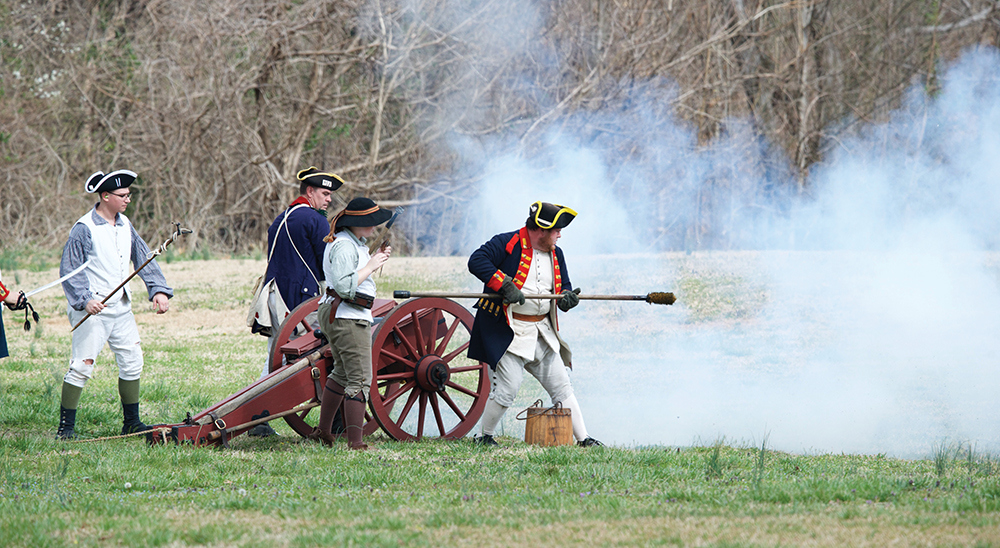
The largest and most fiercely contested battle of the Revolutionary War’s Southern Campaign was fought in the small North Carolina hamlet of Guilford Courthouse. Almost 4,500 American militia and Continentals, commanded by Major General Nathanael Greene, defended the ground against 1,900 British veteran regulars and German allies commanded by Lord Charles Cornwallis.

After two ½ hours of intense fighting, Cornwallis forced Greene to withdraw from the field. By retreating, the strength of Greene’s army was preserved, but Cornwallis’s victory was won at the cost of almost 25% of his army. Weakened, Cornwallis headed to Virginia where seven months later in Yorktown he would surrender to General George Washington.

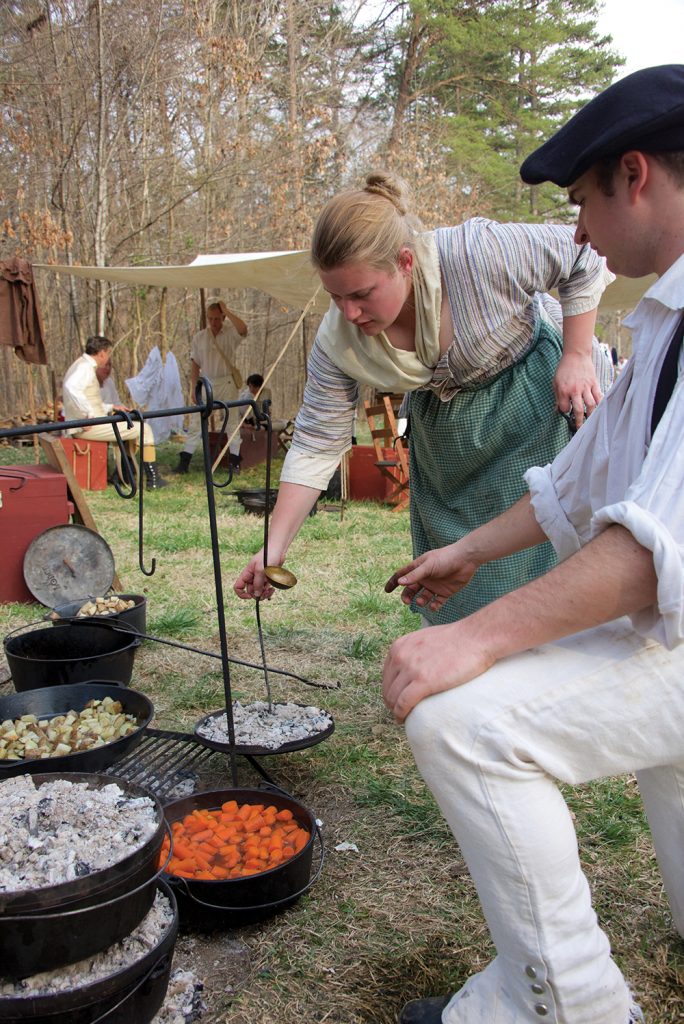
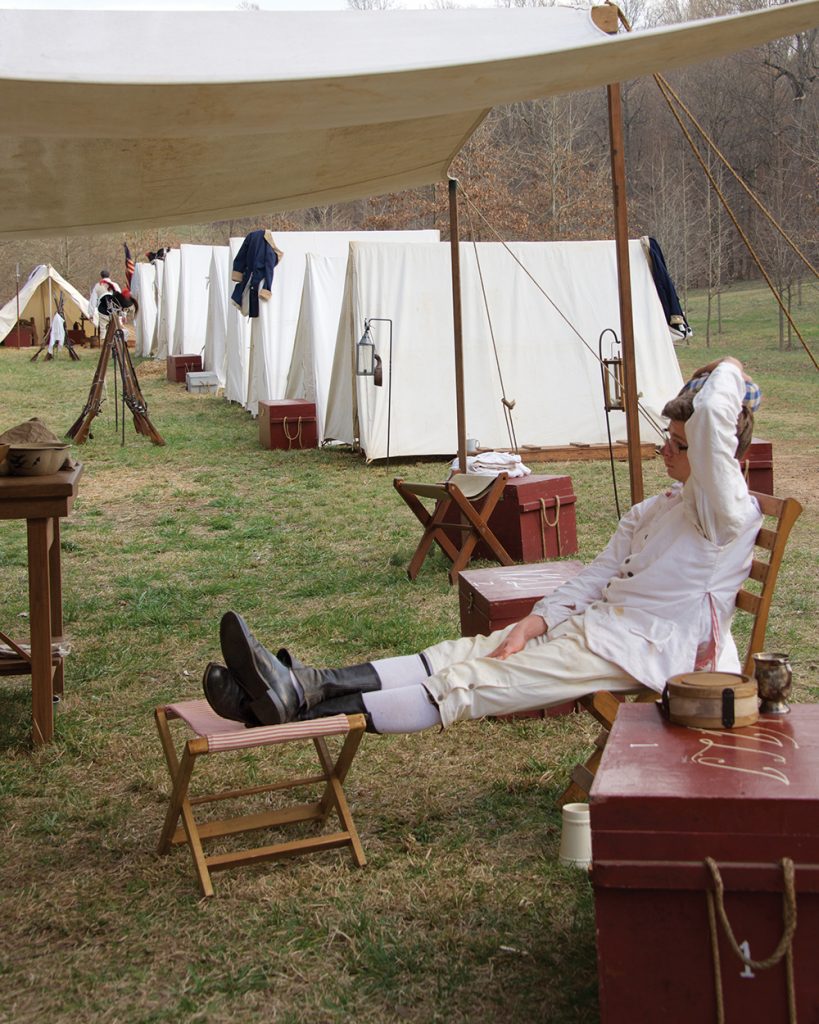
More than 300 Revolutionary War reenactors from across the county muster at Guilford Courthouse Nation Military Park, the Colonial Heritage Center and Greensboro Country Park each March to reenact the battle and to live as the colonials did for the weekend. This year’s event takes place March 18-19.  OH

Lynn Donovan is a contributing photographer to O.Henry magazine.

March 2017 Almanac

By Ash Alder

It was one of those March days when the sun shines hot and the wind blows cold: when it is summer in the light, and winter in the shade.

–Charles Dickens, Great Expectations

Worms on the March

March is here and the world begins to soften. Some six feet underground, the earthworms are thawing, and when their first castings reappear in the dormant garden, so, too, will the robin. You’ll hear his mirthful, rhythmic song on an otherwise ordinary morning, pastel light filtering through the kitchen window where the sleeping cat stretches out his toes and, slowly, unfurls.

Cheerily, cheer-up, cheer-up, cheerily, cheer-up.

In other words: Spring has arrived.

All at once you notice flowering crocus, catkins dangling from delicate branches, colorful weeds dotting sepia toned landscapes. You watch the robin trot across the lawn, chest puffed like a popinjay as he pinballs from worm to fat, delicious worm. Soon he will gather twigs, feathers and grasses to build his nest.

Cheerily, cheer-up, cheer-up, cheerily, cheer-up.

As the kettle whistles from the stovetop, the aroma of freshly ground coffee warming the sunny room, a smile animates your face with soft lines.

Spring has arrived, you think.

And the world stirs back to life.

The Goddess Returns

The Full Worm Moon and Daylight Saving Time both happen on Sunday, March 12.  Because maple sap begins to flow in March, Native Americans deemed this month’s full moon the Sap Moon. You won’t want to miss it. And while you may miss that hour of sleep after turning the clocks forward, the longer days will make up for it in no time — especially when the field crickets start sweet-talking you into porch-sitting past supper.

Although the lusty robin may have announced the arrival of spring weeks ago, Monday, March 20, officially marks the vernal equinox. Greek myth tells that Demeter, goddess of harvest and fertility, celebrates the six-month return of her beautiful daughter, Persephone (goddess of the Underworld), by making the earth lush and fruitful once again. 

International Day of Forests and World Poetry Day fall on Tuesday, March 21 — a day after the start of spring. Celebrate with a poem by your favorite naturalist, and if you’re feeling inspired, try reading a few lines to a favorite stand of oak, maple or pine. 

In the spirit of Saint Patrick’s Day (Friday, March 17), why not spread white or red clover seed across bare patches of the lawn? One benefit of this flowering, drought-resistant legume is that it attracts pollinators and other insects that prey on garden pests. Plus, if you find a four-leaf clover — supposedly there’s one for every 10 thousand with three leaves — it’s said to bring you good luck. Give the shamrock to a friend and your fortune will double.

According to National Geographic, one of the “Top 7 Must-See Sky Events for 2017” will occur on March 29. On this Wednesday evening, Mercury, Mars, and a thin crescent moon will form a stunning celestial triangle in the western sky, with Mercury shining at its brightest to the right of the moon and Mars glowing above them.

Bald Facts about Daffodils

The daffodil — also known as jonquil, Narcissus and “Lent Lily” — is the birth flower of March. Synonymous with spring, this cheerful yellow flower is a symbol of rebirth and good fortune. And a little-known fact: Medieval Arabs used daffodil juice as a cure for baldness. 

Each leaf,

each blade of grass

vies for attention.

Even weeds

carry tiny blossoms

to astonish us.

–Marianne Poloskey, “Sunday in Spring” OH

Poem

Hawk

Driving to work, I spotted

the red-tailed hawk perched on the stop sign

at the corner of Courtland & Adams.

Surveying the suburban yards

for his next meal, he looked in my direction,

then turned away, disinterested. 

I lowered my eyes to check the time

and when I looked up again he was gone,

leaving me alone in the warm comfort of my car,

delighted by what I’d seen,

desperate for his return.

—Steve Cushman

Botanicus

What’s in a Name?

That which we call a daffodil by any other name still ushers in spring

By Ross Howell Jr.

Despite the cold, when March came to the mountains the boy I once was felt there might again be spring. After a snowy season feeding cattle with their rumps — and mine — bowed against bitter winds, I walked along split-rail fences, melting drifts limning muddy pastures.

The earth was warming with spring, and on sunny afternoons groundhogs nosed from their dens, groggy with winter sleep. I hunted them with my uncle’s pump-action .22.

One afternoon I came upon a sight that filled me with wonder. A neat row of daffodils nodded in the sun at the edge of a wood. Their yellow blossoms were all that remained of what had once been a homestead. I watched them as they danced with the breeze. Their faces were hopeful. I imagined a mother planting them for her family, a thin border next to a log house, long since vanished.

Back then, I didn’t call them “daffodils.” Among my kin, they were known as “jonquils.” In fact, I don’t remember hearing the word daffodil until my senior year of high school, in Mrs. Humphries’s English class, when we read the William Wordsworth poem, “I Wandered Lonely as a Cloud.”

I raised my hand, wanting desperately to impress
Mrs. Humphries. She was a recent Radford College graduate, and quite attractive.

“Yes, Ross?”

“Those flowers sound like jonquils to me,” I said.

“In England, they’re more commonly referred to as daffodils. From the Latin asphodilus, The English ‘daffodil’ is probably adapted from the Dutch, ‘da asphodel,’”
Mrs. Humphries said.

I was crestfallen.

“Why everybody knows that,” my nemesis,
Verna Belcher, hissed from the desk behind me.

A quick poll of my Greensboro neighbors — my “scientific” question was, “When you were growing up, what did you call the yellow flower that bloomed first in spring?”— yielded mostly “jonquil,” though “daffodil” was an occasional response, and even “buttercup.”

It’s complicated.

“In some parts of the country any yellow daffodil is called a jonquil, usually incorrectly,” writes the American Daffodil Society, employing what I expect is their euphemism for the rural South. “As a rule, but not always, jonquil species and hybrids are characterized by several yellow flowers, a strong scent and rounded foliage.”

Now that plant sounds like what I think of as narcissus. So when I say “jonquil,” I should be saying “narcissus”? It’s not that easy.

“The term narcissus (Narcissus sp.) refers to a genus of bulbs that includes hundreds of species and literally tens of thousands of cultivars!” writes gardener Julie Day. “The Narcissus genus includes daffodils, jonquils and paperwhites, among many others, so when in doubt, this is the term to use.”

Just to confuse me further, Day adds this statement: “However, when someone says ‘narcissus,’ they’re usually referring to the miniature white holiday blooms of Narcissus tazetta papyraceous, known as paperwhites.”

Now I have paperwhites in my garden, too. But I call them “paperwhites.” So am I to understand that the flowers I called “jonquils” as a boy I should’ve called “daffodils,” and some of the bloomers I have in my garden now, the ones with the small trumpets, rounded leaves and scent, the ones I’d thought were narcissus, are in fact jonquils?

Not necessarily. Julie Day goes on to say that “daffodil” is “the official common name” for any plant in the genus Narcissus.

“So, if the plant is considered a Narcissus, it is also considered a daffodil,” Day writes. “However, most people use the term ‘daffodil’ when referring to the large, trumpet-shaped flowers of the Narcissus pseudonarcissus. These are those big, showy, familiar bulbs that bloom in spring that we all know and love.”

Got that?

But what about Mrs. Humphries? And the asphodels? Turns out they’re a different genus altogether. But some of their blossoms sure look a lot like jonquils. I mean, narcissus. Oh, you know what I mean.

And what about buttercups?

Things sure were simpler when I was a boy in the mountains hunting groundhogs.  OH

Ross Howell Jr. was rewarded for dividing and replanting bulbs this fall with a display of daffodils that brightened even the most confused and gloomy of March days.

Way to Go

For the ultimate send-off, hire a funeral band

By Grant Britt
Photograph by Sam Froelich

I’m gonna blow you away.

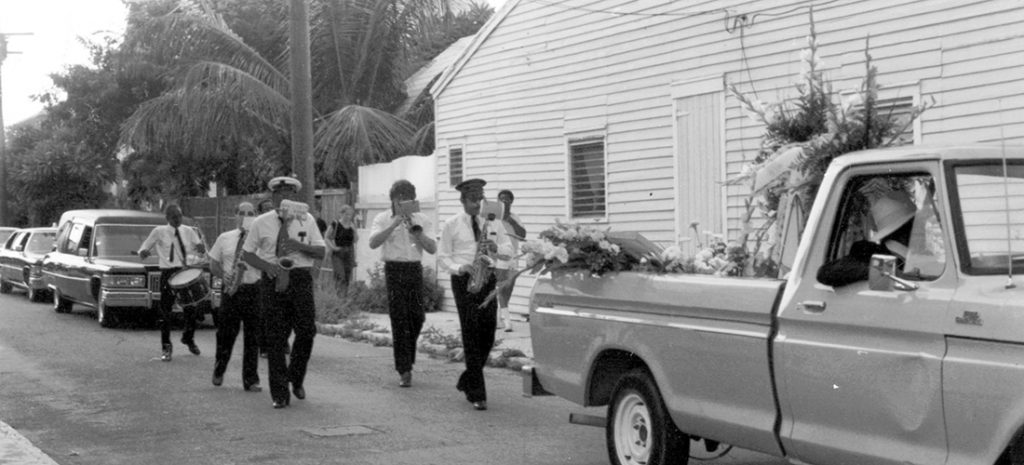
I made good on that promise in Florida many times, playing trumpet in the Key West Funeral Band in the mid-1970s to the early 1980s. That’s not so unusual in itself, but the fact that I’m a white boy born in North Carolina — and was the only band member of that persuasion — gives my accomplishment a little different perspective. The 150-year-old Key West Funeral Band was the only one of its kind outside of New Orleans, and some of the grandsons of the founders are still current band members.

I first found out about the band when they came marching by the house where I was living in The Conch Republic. I came running out and stood gaping as they passed by in all their ragged splendor, then followed them all the way to the graveyard. I finally worked up enough courage to approach the man I assumed to be the bandleader because he was wearing a captain’s hat, and asked him what the joyful noise was about. Thinking I was just another tourist inquiring about the quaint native customs, he gave me the short version. “It’s a funeral, white folks!” he snapped before turning back to the graveside festivities. After the service, however, I convinced him that I wasn’t a tourist and in fact lived right around the corner from him and had a genuine interest in the proceedings. That’s when he relaxed and opened up a bit.

It helped that I was familiar with the music. I am a confirmed backslid Baptist, a condition brought on by my abiding disrespect of authority of any kind, secular and especially ecumenical. I also have a healthy appetite for alcohol. Though estranged from the church, I have retained both a love and admiration for the hymns. The Baptists can’t abide drinking or dancing, but they’ve got some catchy rhythms suitable for either activity, and I recognized a few of them being played that afternoon.

In the course of the conversation, the bandleader mentioned that they were looking for a trumpet player. I was in my late 20s at the time, and although I hadn’t played since the fifth grade, I told him I was the man and he set up an audition for the following week.

I went back to the trailer my wife and were renting in Key West’s Old Town in a neighborhood settled by the island’s black Bahamian residents and dug out the tarnished, battered horn I had ever since I was thrown out of band for smoking cigarettes. I commenced to drive the neighbors, dogs and family to the brink of madness with my horrendous bleating. By the time of the audition, I had re-familiarized myself with The Broadman Hymnal, that great Baptist musical celebration of blood and salvation, and had honed my bleating to a semiprofessional level. I passed the audition and was inducted into the band. This consisted of the consumption of a bellyful of beer, frenzied backslapping and the eliciting of a couple of promises — that I could perform under the influence and could get Sunday afternoons off, as that is the popular planting time in those parts.

There was one other condition. I had to assemble a uniform — white shirt, black pants and black shoes. Simple enough — for most people. But this was the mid-1970s and I was in favor of an alternative lifestyle, and, being of the hippie persuasion, had thrown out all my corporate togs before relocating from Carolina to Key West. I owned nothing that was the least bit respectable, so I’d have to make do.

Let’s see — here’s a pair of blue pants — that’s close to black, and maybe my fellow band members won’t notice the 2-inch-wide red stripe running down the outside of the leg. And as for shoes, these boots ought to work. So what if the sides are green, red and blue tapestry with 4-inch Cuban heels? The pants will cover them — most of the time. And as for a white shirt, why I’ll just pull out the guayabera, the ornate shirt worn by barbers and Cubans that somebody gave me as a joke. I looked like a Cuban executive or an escapee from a Haitian disco, but it’ll work, I thought.

The other band members thought otherwise and rode me for about six months. They finally gave up when I told them it was a marketing technique to add a little color to the band and that it was good PR. They thought I was crazy, but since I could play the horn and showed up on time, I guess they figured that dressing a little funny could be overlooked, and they finally left me alone.

Now it’s time to get down to business. There you are, all laid out in your Sunday best, looking natural, or as natural as a dead person can look. But looks don’t matter when you’re in the situation you’re in. You’d get a pretty good sendoff even if we weren’t there, because in this part of town, people down here turn a funeral into a celebration. But this is your lucky day. Somebody in the family has scraped together a few extra bucks and hired the funeral band to see that you go out in style.

But first we’ve got to loosen up a little. We usually gather in Regular Fellows, a little club with the coldest A.C. and the hottest jukebox this side of Nassau to have a few tall, cool Ballantine Ales. For the uninitiated, Ballantine is a greenish malt beverage with the odor of kerosene and a kick like a booster rocket. About five of these bad boys running around in your system will have you speaking in tongues. In short, it’s a quasi-religious experience, just the thing for a funeral warm-up.

Don’t infer from this that we got blind before a job. We just needed a little lubrication, as this stuff was thirsty work, and it’s warm down there.

We’re ready. We plant ourselves on your front porch if you got one, or in front of your house if you don’t. Here you come out the door feet first, in the hands of six strong men, and we blow at you until they load you in the hearse. It’s a good-sized blow. Depending on the stature of the deceased in the community, which determines how many people will come out and line the streets to see us strut our stuff, there can be as many as ten of us who have rolled out for the occasion. With a bass, drum, a snare, a pair of tenor saxes, a clarinet, a couple of ’bones and as many as three trumpets on a good day (and only me on a bad one), we could stir up quite a breeze.

Now that we’ve got you tucked away for your last limo ride, we line up in front of you and behind the flower car. We used to follow the hearse, but the exhaust fumes nearly laid all of us to rest, so we spoke with the undertaker and he made other arrangements.

We always try to follow Satchel Page’s admonition about never looking back, because something might be gaining on you, and because the last time we did, something was. On that memorable outing, the hearse stalled and couldn’t be restarted. The pallbearers took the coffin out and put it on rollers for the few final yards into the graveyard. Unfortunately, the hearse had stalled at the top of the only hill in Key West, Solares Hill, which is all of 6 feet above sea level. To complicate matters, the deceased was of considerable bulk. What’s more, the rollers in the hearse were well oiled, and before the pallbearers could get a good grip on the casket, it had gotten away and was headed straight for the band. We turned around when we heard the pallbearers shout, then commenced the fastest double-time in band history, still blasting away. When the pallbearers finally caught up with their charge, we were already in the graveyard hiding behind the biggest tombstones we could find. We all stayed put until they lowered that gentleman in the ground, for as somebody in the crowd remarked, he just wasn’t ready to go yet, and we wanted no part of any more escape attempts.

But that was the exception. Most of the jobs were routine, with the only danger being of a dental nature. As any marching band brass section member can tell you, the meeting of enamel and brass when you step in a pothole and your mouthpiece gives you a good rap in the choppers is not a good thing. It hurts like hell, it plays hob with the rhythm and it’s messy — you get blood all over your nice white shirt. But there’s not a whole lot you  can do about it. You just spit out the teeth, wipe your mouth and keep playing, because we’re just getting started.

We’re going to church now, and this is the toughest part of the job. Since we don’t have a lot of material, we compensate by playing each tune five times. That’s not too bad if it’s a small funeral, but you’ve got a whole lot of friends, you rascal you, and so once we’ve marched to the church, we’ve got to stand outside and blow until the whole funeral procession, including all the mourners have gone in. When we’ve blown the chorus of “Nearer My God To Thee” twenty-five times in a row and the people are still lined up on the sidewalk with no end in sight, we start to get a little edgy. All that Ballantine Ale we loaded onboard earlier is starting to back up in our throats, the sweat is pouring into our eyes and our lips are swollen to the size of truck tires. Finally all your friends, lovers, family and insurance agents have straggled in and the wailing begins.

This is where we break off. All of the services down here are of the open casket variety, and I don’t care how natural you look, none of us wants to be looking at your ugly puss for two and a half hours while the preacher whoops and testifies, and the professional mourners your family paid for are screaming and falling out of the pews and rolling in the aisles. It’s not that we’re disrespectful, but doing this two or three times a week, all that concentrated grief can makes us a little crazy. So we take a serious break and go down on the strip to pass the time. We know you ain’t going anywhere.

After a few more tall cool ones or maybe a little man, as a half pint of hooch is known around here — and maybe a game of dominoes in Bop Brown’s Jazzy Spot — we’re rested and ready to roll once again.

This is the best part of the day. All we’ve got left to do is the home stretch, and just like they do in New Orleans, we’re gonna strut. The city in its wisdom had banned us from rocking out on the way back home from the graveyard because it causes too much commotion and ties up traffic, so we’re gonna do our strutting on the way to the bone yard.

We’ll have plenty of company, and they’re in high spirits as well. Most of the congregation has sneaked out of the church at some point during the two hours the service had been going on and has been doing the same thing we have. The Ladies Auxiliary Choir has been warming up in church during the proceedings, and they’re going to be right behind us. The streets are lined with well-lubricated participants, and we trot out our zestiest stuff for this part of the journey.

The ’bones are wailing, their slides hooking unwary onlookers if they lean in too close to the band. My whole body is vibrating from the blowback from my horn and the others around me. The bass drummer is pounding so hard that the beats are coming back off the walls of the buildings we pass and slamming us in the heart. There ain’t nothing finer — it’s like walking with the King. As one blissful mourner once shouted as we passed by, “Man, you guys sound so good I wish I was dead!”

When we hit the graveyard, it gets even better. All that marble acts like an echo chamber and you can hear the notes running around seconds after you’ve played ’em. We march over to the grave and play one more chorus of “Lead Me To Calvary” as the family gathers around us. The sun is setting, the choir is humming softly in the background, and we finish up in a circle, playing softly as the coffin is set down for the last time.

That’s it for us. We don’t stay for the last rites for the same reason we don’t go in the church. It’s just too much. But still, the day is not over for us. All of us have full-time jobs, for the death rate in this little town won’t allow us to make a living as a band. But that’s fine too — we couldn’t take a lot of this, and at the prices we charge, there’d have to be an epidemic for us to make a killing at this.

So that’s it for you. Everybody said they had a good time. Sorry you missed it. Tell all your friends — well, maybe not. But the word’ll get around anyhow. If you want the best, the Key West Funeral Band is the only way to go. After all, it’s your funeral.  OH

 Grant Britt is still blowing O.Henry readers away, but with his keyboard, not a trumpet.