Poem

Wintry Mix

Without warning, you alter my day —

wanting more firewood before

it becomes soggier with morning snow.

I see no reason to disembark the sofa.

Horizontal before the fireplace,

I offer you a quilt that needs no tinder —

but your posture is stern and straight.

Rising, I moan like only I can, still unconvinced.

Children sled outside, asphalt’s black spine

revealed with each pass, down the block where

we sometimes stroll comfortable evenings,

or other everyday occasions when we leave,

yet return. Warm in a wool scarf I gave you,

you emerge smiling, extending leather gloves

to fend off spiders and splinters, and seize

some oak, encouraging me to hurry inside.

— Sam Barbee

from That Rain We Needed

White Christmas, Dry Christmas

How the spirit(s) of the hippest holiday in memory were dampened by a state court system determined to play Ebenezer Scrooge

By Billy Ingram     Illustration by Harry Blair

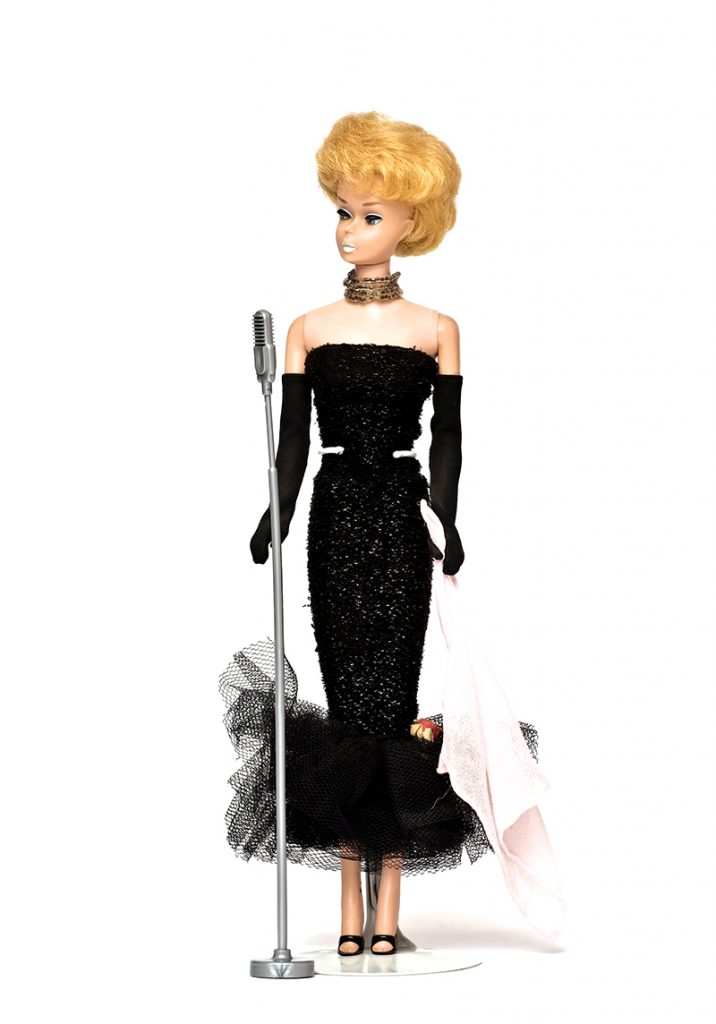
"Sydney Australia - March 3, 2009. A vintage Barbie, one of the first editions of the doll to be created,  isolated on white. 2009 marked Barbie's 50th anniversary."
“Sydney Australia – March 3, 2009. A vintage Barbie, one of the first editions of the doll to be created, isolated on white. 2009 marked Barbie’s 50th anniversary.”

The year 1966 brought the grooviest Christmas season Greensboro will likely ever see, a time of unprecedented prosperity in a nation embracing a Space-Age future, in an era when the provincial collided with the outlandish — at a moment that just might have been the tipping point when Pop became forever enshrined as America’s dominant culture.

The Gate City was basking in the dawn of the Go-Go Years. At a time when you could purchase a Moravian star for $3 at The Corner on Tate Street, Thalhimers Department Store would custom-decorate your Christmas tree . . . if you opted for a natural one. Original model aluminum trees with a rotating lighted color wheel, sought-after collector’s items today, were at the time considered the height of tackiness — or chic, I’m not sure which. To each his own at Christmastime, right? When I was a kid our neighbor Jane King absolutely hated blinking lights on a tree. Naturally dad made sure there was at least one bulb that flashed on and off just to get a reaction from her that was as much a holiday tradition as can-shaped cranberry sauce.

Every evening hundreds motored way out High Point Road to cruise slowly past Pilot Life’s Nativity scene (currently on display at Greensboro College). The first reception at a decrepit Blandwood Mansion kicked off a fundraiser that would eventually save the property, leading to our modern-day Preservation Greensboro. City and county leaders got behind a referendum that would raze the 56-year-old courthouse to erect a new municipal center.

The affairs of the Court — with its back-and-forth rulings on the use of alcohol — would be on everyone’s minds, however as the twelfth month of that pivotal year arrived. Especially on the minds of convivial gals in pillbox hats and little black dresses, or daring new mini-skirts, and guys in Sansabelt pants and velour mock turtlenecks, fashions of the day that would ultimately descend into that hippy-dippy madness we think of as the late ’60s.

But in ’66 mock-Ts and LBD’s were de rigeur for restaurant patrons and tipplers, who’d walk into restaurants with brown bags or knitted cozies containing the hooch of their choice, which a bartender would take and measure into cocktails, then charge for set-ups. Cin Cin! Bottom’s Up! Here’s mud in your eye!

Since 1935, a state-controlled Alcohol Beverage Control distribution and tax system had been in effect for those communities passing referendums allowing liquor sales. That didn’t happen in the Gate City until 1952. Even so, you couldn’t stroll the ABC store aisles to make your selection as you can today; that was done by no-nonsense clerks who kept the merchandise behind a counter. Moreover, bars and taverns couldn’t sell liquor throughout the state, so a wink-wink, nudge-nudge practice known as “brown bagging” was instigated. So called “bottle clubs” like the Sir Loin Room inside McClure’s Restaurant in the Summit Shopping Center allowed repeat diners to store their booze on the premises. Country clubs offered liquor lockers to their members.

While swinging singles were out swilling, kids were left chilling to primetime shows, all broadcast in “living color” for the first time ever, giving many families an excuse to rush out and purchase top of the line Curtis Mathes console television sets retailing for around $700 at Steele & Vaughn (where Pryor Brewery is today). A dented model from the Sears Outlet Store on Lawndale was a money saving option for cheapskates like my dad.

Equally appealing to impressionable young minds as Bewitched and Batman were the commercials. Toymakers opened the spigot to feed the insatiable maw of Baby Boomers coming of age, expanding the fantasy universe of established best-sellers like G.I. Joe, Johnny West and Barbie, while launching new franchises such as the inexplicably popular Suzy Homemaker appliance line that included an oven, washing machine and dishwasher. Seemingly reinforcing the stereotype that a woman’s place was in the home, how could these little girls imagine they’d be working two jobs when they grew up?

What kids hollered most for, introduced in 1966: G.I. Joe Astronaut with floating capsule, Debutante Ball Barbie and her mod cousin Francie, Twister, Batman Utility Belt with Batarang and Bat-Cuffs, 330-piece Fort Apache battle set, Baby Teenie Talk with moving lips, Major Matt Mason and Captain Action action figures, See ’N Say, Lego Car Repair Shop, Spirograph, Operation, Creepy Crawlers Thingmaker, those Show’N Tell ersatz-TV record players synced to a built-in slide projector, the Addams Family Thing Bank with a little green hand that snatches the coin away.

Weaponry and subterfuge were all the rage for kids as a Cold War gripped the nation. The Mattel Zero M was by appearances a transistor radio that, at the touch of a button, expanded into a cap firing assault rifle. Along with a Luger that transforms into a submachine gun, the ISA 07-11 Super Spy Attache Case featured a built in telescope, working hidden camera and walkie-talkies that could transmit a signal up to a 1/4 mile away as long as there were no impediments like walls or buildings, which was kinda the whole point so they were basically worthless. For the purist there was Mattel’s M16 Marauder, just like big brother carried in Vietnam, with realistic Braap-Braaaaaap, Brap Brap sound. Nothing compared to the Johnny Seven O.M.A. (One Man Army) by Topper, the ultimate killing machine with a grenade launcher, anti-tank weapon, antibunker missile, armor-piercing shell and detachable pistol for when the fighting gets close.

For $70 Santa scored a chrome-plated Schwinn Fastback Stingray bike with a 5-speed stick shift and elongated banana seat; the Slik Chik model for girls came with a flowered wicker basket up front. Low-riding youngsters rolled in style in AMF’s Mustang metal pedal car with spinner hubcaps. If Dad wanted his own ’66 Mustang, Friendly Ford was all too happy to hand over the keys for around $2,200.

Ah! Nothing succeeds like excess! (I wish I’d thought of that line first.) Just ask His Royal Greenness. Dr. Seuss’ How the Grinch Stole Christmas! aired on TV for the first time in 1966, and as mean a one as Mr. Grinch was, it was the N.C. Supreme Court, with hearts two sizes too small, that handed down a draconian ruling that threatened to torpedo the holiday season, criminalizing perfectly normal behavior while setting up a situation where anyone could be hauled off by police for re-gifting that fruitcake from Aunt Betty.

Wait, what? Stick with me . . .

North Carolina has always had a tortured history with alcohol. The state enacted Prohibition a full decade before the nation followed suit in 1919. The General Assembly passed the Turlington Act a few years later declaring that the consumption of spirits was allowed only in the privacy of one’s own home (medicinal and religious uses exempted). How it was supposed to get into the home when it was illegal “to manufacture, sell, barter, transport, import, export, deliver, furnish, purchase or possess intoxicating liquor” was anyone’s guess but it led to a labyrinth of shady practices and elaborate delivery schemes, one of which evolved into what we now know as NASCAR. Small wonder, spiriting bathtub gin from one surreptitious rendezvous point to another was as much sport as commerce. For three decades Greensboro residents purchased liquor in dark alleyways, carefully hidden inside a bushel of apples bought on Commerce Street or slipped surreptitiously from under the counter at Fordham’s Drug Store on South Elm, until the aforementioned brown bagging became a common practice in ’52. For almost fifteen years it seemed a reasonable coexistence between wet and dry forces had been reached.

That peace was shattered on December 1, 1966, however, when citizens awoke to the news that the N.C. Supreme Court had unanimously ruled brown bagging unconstitutional, that “the Turlington Act is still the primary law in every area which has not elected to come under the ABC Act.” Once again a person could possess liquor only in their own private dwelling or while traveling to and from the ABC store. No more than a gallon of liquor could be transported across state lines, any more than that in any one place carried with it the presumption of intent to resell.

Potent potables could be served to guests in one’s home but nowhere else, not even a rented hall or private club hosting a wedding reception or holiday party. It was suddenly illegal to bring a $2.79 pint of Old Crow to someone’s house (as it should be), present a giftbox of Chivas Regal to your dinner host or give a bottle of Smirnoff to your uncle. Gifting baked goods containing rum or brandy? They may as well have been pot brownies — you’re going to jail, Grandma!

Mass confusion ensued. Restaurateur J. W. McClure expressed a frustration felt by many, “I don’t know what the laws are and I’m afraid nobody does either,” he declared with exasperation. When a Mecklenburg judge suggested the ruling could be postponed for the season, the State Supreme Court, with “unprecedented swiftness,” dispatched a marshall from Raleigh to Charlotte with a copy of the proclamation to be recorded immediately at the Mecklenburg Superior Court, something no one had ever recalled happening before. Their adjudication was effective immediately and would not be forestalled, not even by the Supreme Court in Washington D.C., which refused to intervene. The state ABC Board announced that no warrant was required for their officers to infiltrate any venue where festivities were underway to enforce compliance and arrest offenders if necessary.

Just so there was no doubt about the seriousness of this decree, the Greensboro and Sedgefield country clubs were formally notified that, from that point forward, beer and wine alone could be served on the premises. The Sand Hills Country Club dismantled their signature bar shelves stocked with members’ bottles. The manager of the Reidsville Elks Lodge declared, “This is going to bring back the hip flask and the lady with the big pocketbook.”

The effect on the hospitality industry was swift and devastating. McClure’s Steak House saw receipts drop 59 percent, forcing the closure of its members-only bottle club. Reservations for New Year’s Eve parties at nightclubs and eateries plummeted by as much as two-thirds. Supper clubs suffered the most. The Tropicana ceased operations entirely while Fred Koury’s Plantation experienced a 70 percent revenue drop. Waitstaff at Cellar Anton’s, McClure’s and The Colony grew used to diners, those they had left, sneaking back to their cars in the middle of a meal for a quick nip.

That December, Harold Driggers and the Six Key Brothers were opening for Jerry Butler at the Plantation when they recorded a regional hit single at Copeland Sound Studio in Greensboro called “Brown Baggin’”, a Paramount Records release riffed on an earlier soul tune, “Barefootin’”. It quickly became the second most requested song on WCOG with scintillating lyrics:

I just heard Mr. Fred say I know what to do.

I’ll brown bag if you brown bag too,

And if the brown baggin’ crowd is big enough,

I don’t think they’ll try to lock us all up.

Of course, to toddlers and teetotalers this was all much ado about nothing, for most folks the holidays soldiered on without a hitch despite a dampening of spirits. Shoppers jockeyed for parking spaces downtown in front of Prago-Guyes and Belk, or a few blocks down South Elm at Tiny Town Toyland. Big Bear at Lawndale Shopping Center prepared family sized Christmas dinners for $8.95. Moon Wyrick brought up the rear as Santa in the Holiday Jubilee parade following WFMY’s Old Rebel and Pecos Pete waving from a Model T Ford, while, just up ahead, Little Miss Sunbeam tossed miniature loaves of bread to an eager crowd from her fanciful float.

As it happened, there were no arrests locally for unlawful partying but the ABC board reported lower sales than the previous December. Within a few months the 1967 legislature bent to the will of the people and reinstated brown bagging. It wasn’t until two decades later that Greensboro residents could walk into a bar or eatery and order a drink without a bottle in hand, a concept known fifty years ago as “whisky by the drink.”

My most cherished memory of Christmas ’66, besides that cool Lost in Space Roto Jet Gun that rained spinning plastic projectiles on my younger siblings for weeks afterward, was the storm Christmas Eve that delivered nearly 3 inches of snow just as St. Nick began making his rounds. It was a White Christmas that found children of all ages hopping onto new Flexible Flyers, carving deep ruts into the Greensboro Country Club golf course while others rocketed down slippery slopes on Northwood in Latham Park or down Fairmont in Lake Daniel.

In a scant few years the Big Wheel rendered pedal cars and tricycles obsolete, and Barbie had long ago stopped hanging out with her hard-partying cousin Francie. Still, an amazing number of 1966 sensations are still with us. Spirograph, Twister, Operation and sophisticated Lego systems haven’t lost their allure. I even saw one of those Addams Family banks not long ago, although I suspect there won’t be many Batarangs with handcuffs under trees this Christmas. And who needs walkie-talkies and hidden cameras? We carry them around everywhere we go.  OH

Billy Ingram was so far into Santa he wrote and starred in five hours of Christmas specials for the Bravo network in 2005—06 and portrayed Father Tobias in A Killer Christmas Carol film. He has an extensive tribute to Christmases of old on TVparty.com.

December Almanac 2016

By Ash Adler

How did it get so late so soon? It’s night before it’s afternoon. December is here before it’s June. My goodness how the time has flewn. How did it get so late so soon?

– Dr. Seuss

Mistletoe bunch hanging from a red ribbon isolated on white XXXL

Nature Whispers

According to Celtic tree astrology, those born between Nov. 25 and Dec. 23 draw wisdom from the sacred elder. Highly intelligent and energetic, elder archetypes are known as the “seekers” of the zodiac. Variety is this sign’s spice of life, but they’re most compatible with alder (March 18 – April 14) and holly types (July 8 – August 4).

Narcissus — aka daffodil — is the birth flower of December. Those familiar with the Greek myth know that Narcissus was a beautiful hunter who fell so deeply in love with his own reflection that it killed him. Speaking of hunters, the sun remains in the astrological sign of Sagittarius (the Archer) until the winter solstice on Wednesday, Dec. 21. Consider gifting your favorite Sagittarian with a potted daffodil, a vibrant spring perennial that carries messages of rebirth, clarity and inner focus.

December birthstones include zircon, turquoise and tanzanite — all blue, the color of communication and truth. In 2001, a 4.4 billion-year-old piece of zircon crystal was found in Jack Hills, an inland range north of Perth, in western Australia. Known as the “stone of virtue,” this ancient stone offers grounding and balancing energies to those who wear or carry it.

Kissing Bough

The ancient Druids believed that the mystical properties of mistletoe could ward off evil spirits, while Norse mythology rendered it as a symbol of love and friendship. ’Tis the season, and nothing spells romance like cutting a sprig of it from the branches of a sacred oak, apple or willow. During the early Middle Ages in England, mistletoe was used to ornament elaborate decorations made of holly, ivy, rosemary, bay, fir or other evergreen plants. Kissing boughs, as they were called, symbolized heavenly blessings toward the household. If you find yourself standing beneath one with someone you adore, consider it a heavenly blessing indeed.

hyacinth and daffodils flower on window sill in early spring

Winter Solstice

As we approach the winter solstice — the longest night of the year — we look up to the planets and the stars to gain insight into the final hours of 2016. The Geminid meteor shower is expected to peak on the night of Tuesday, Dec. 13, until the earliest hours of Wednesday, Dec. 14. Although a full moon will make viewing conditions less than ideal, the possibility of sighting upward of 120 meteors per hour is reason enough to add the Geminid shower to your list of things to do this month. You’ll also want to note that Mercury goes retrograde from Dec.19–31. This will be a good time to review plans and projects. Test your soil. Think about next year’s garden, reflecting on the crops that fared well — or didn’t — in 2016. Consider waiting until Mercury goes direct on Jan. 1 to order seeds.

I Heard a Bird Sing

I heard a bird sing

In the dark of December.

A magical thing

And sweet to remember.

“We are nearer to Spring

Than we were in September,”

I heard a bird sing

In the dark of December.

— Oliver Herford, From Welcome Christmas! A Garland of Poems
(Viking Press, 1955) 
OH

– Botanicus –

Oh, Christmas Tree!

How North Carolina became the fertile crescent of the Fraser fir

By Ross Howell Jr.

Chances are the tree you decorated for your home this holiday season is a descendant of natives in the North Carolina mountains.

The Fraser fir, Abies frasieri, owes its name to an enterprising, “indefatigable” botanist, a Scotsman named John Fraser (1750–1811). Fraser was born in Tomnacross, near Inverness, Scotland, and moved to London in 1770. There he pursued various trades before — through frequent visits to the Chelsea Physic Garden, founded in 1673 as the Apothecaries’ Garden — he hit upon his true interest, horticulture.

Fraser took up a career in botanical exploration and collecting. After returning from his first voyage to Newfoundland in 1780, he founded a commercial nursery in London to sell the plants he brought back. On later expeditions he trekked the Appalachian mountains, following Native American hunting and trading trails, becoming the first European to discover the Rhododendron catawbiense, which he was able to propagate in England, selling the plants for “five guineas each.”

During his career Fraser would travel the world, locating plants for clients as diverse as William Aiton, the director of  The Royal Botanic Gardens at Kew, to Catherine the Great, empress of Russia. Fraser is credited with introducing his eponymous fir, along with about 220 other plant species from the Americas, to Europe. His sons continued in their father’s business, and his grandson John would be elected a member of the Royal Horticultural Society.

The firs John Fraser discovered grow wild only at high elevations — 3,900 feet and higher — in the Appalachian chain from northern Georgia to southwestern Virginia. Mature trees may reach a height of 30 to 40 feet. Their needles are flattened, like the native hemlocks growing at lower altitudes. From September through November, they bear cones upright on their branches, like candles on a nineteenth century Christmas tree.

North Carolina is the center of the Fraser fir’s habitat, and that’s important. According to carolinanature.com, trees can be found wild in nine counties of the Old North State, but in only one county in Georgia, and in only two counties in Virginia and Tennessee. That’s it.

Sadly, like our native hemlocks, Fraser firs are under attack. The number of trees in the wild is being diminished by acid rain, by air pollution, and especially by nasty little creatures called balsam woolly adelgids (whose equally nasty cousins have put native hemlocks at risk). These insects have wiped out whole stands of the Fraser fir, leaving behind only “skeleton forests” on the high slopes of the mountains.

Of course, we don’t clamber over bare rock faces on the steep pinnacles of western North Carolina to harvest Fraser firs today. Remember I said it was likely the tree in your house is a Fraser fir? Just how likely is it?

The North Carolina Christmas Tree Association notes that more than 50 million Fraser firs are grown in our state, and they represent 90 percent of all the trees grown in North Carolina for use as Christmas trees. These commercially grown Fraser firs can get hefty — as tall as 80 feet, with a trunk diameter of a foot and a half.

When you’re relaxing at home this holiday, say, just minutes before Santa’s to arrive, and you’re admiring your Fraser fir’s lights and its sweet balsam fragrance, take a moment to imagine its ancestor, high on a cold North Carolina peak, an upright cone or two pale in the moonlight, reaching toward stars so close they seem to be tangled in its wild boughs.  OH

Ross Howell Jr. grew up in the mountains of Virginia, where his family usually harvested a native white pine Christmas tree from the farm woodlands, along with running cedar and spicewood berries for decoration.

The Eternal Child Within

The ubiquitous, serendipitous life and art of Chip Holton

painting2

By Nancy Oakley

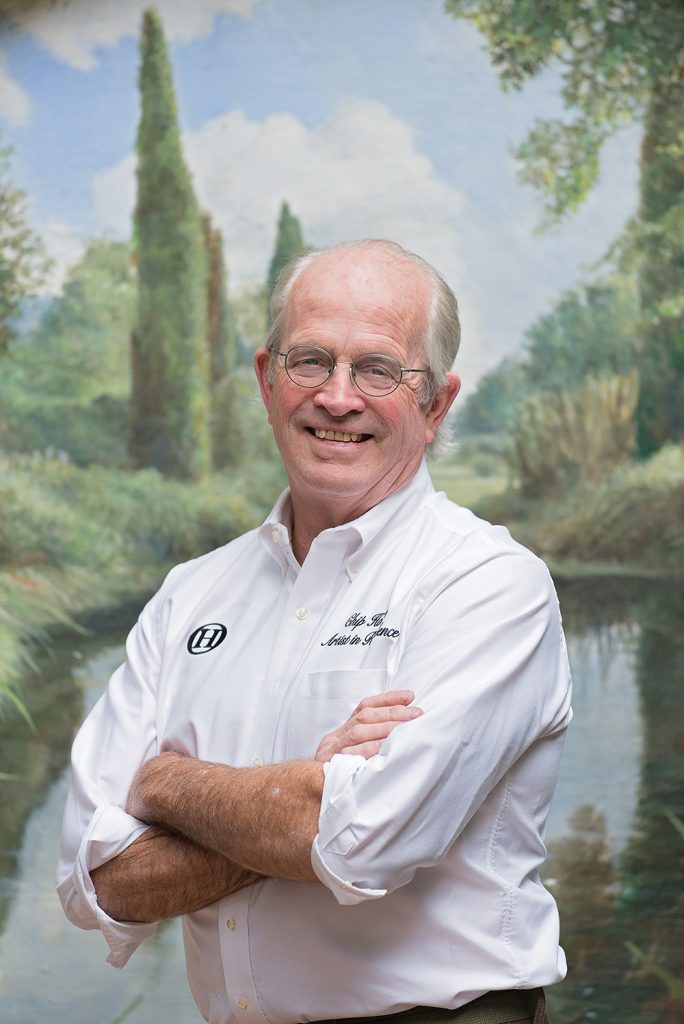
Chip Holton breezes down a central hallway of the O.Henry Hotel, clad in a simple black T-shirt and jeans, greeting the hotel staff with affable “heys” and “hellos” as he makes his way to the Green Valley Grill before it opens for lunch. Pointing to the arched space, or lunette, above the kitchen, the artist explains that the mural occupying it — a massive table laden with a feast of chicken, ham, fish, a loaf of bread, fruits, melon and wine — was meant to effect the Old World ambiance that hotelier Dennis Quaintance hoped for.

“I’ve been working for Dennis for twenty-plus years,” says Chip, who insists that everyone call him by his first name, certainly not “Mr. Holton,” let alone “Frank P. III.” He and Quaintance met when the hotel’s designer, the late
Don Rives, (“one of my best buddies,” Chip describes him . . . as nearly everyone he encounters seems to be) recommended to Quaintance that Chip paint a mural for Lucky 32 Restaurant. “Serendipity is part of what I do,” Chip observes. “A lot of work comes to me that way.” Whether helping out a friend, which landed him a gig as set designer for Twin City Stage in Winston-Salem, or striking up a conversation with Dave Fox at Thursday night Cocktails and Jazz and agreeing to give a visual interpretation to a “musical tapestry” the musician is composing.

painting3

Chip describes his relationship with Quaintance as “brotherly,” unusual for a boss and employee, or patron and artist, if you will. “He’s sort of my Pope Julius,” the artist says of his employer, referring to Julius II, who commissioned Michelangelo’s painting of the Sistine Chapel. “I kid him about it. But he’s a jolly pope. Nobody that would put you in chains in the Vatican if you misbehaved.” In time, with his exceptionally broad range of skills and artistic styles, Chip became vital to the aesthetic of both the O.Henry and Proximity Hotel, where he was given the title, artist-in-residence.

He painted the semirecumbent portrait of William Sydney Porter in the lobby of the O.Henry. Taken from a photograph he and Rives discovered at the Greensboro Historical Museum, “part of the picture didn’t exist,” Chip recalls. “So I had to have somebody pose in a jacket in the chair and invented the environment. The curtain and all that stuff. And I was trying to make it look like the time period, the turn-of-the-century, with the tones and the painting, so it didn’t look modern,” the artist says. It was a challenge, because Chip, who had been working at the McWane Science Center in Birmingham, Alabama, had accidentally dropped a metal exhibition piece on the fingers of his left hand — the one he paints with. He reveals the scar from the injury. “So I had this hand all bandaged up and I started this painting with my right hand,” he continues. Don’t get the idea that he’s bragging, though: “It was something I had to do, but in the process of doing that, I realized I could do either, so I can write with both, write upside down.”

painting4

He can also do faux-finishing on walls, paintings and furniture, repair carpet, and with equal agility paint architectural renderings and English-style watercolors that evoke the Belle Époque of a John Singer Sargent painting. There’s one of these, each different, in every room and in the downstairs of the O.Henry, painted live, on-site. Some depict the pergola outside, some are interiors of, say, a lamp on a table, or of Chip painting himself doing a painting of a sofa. “It can get monotonous doing the same place all the time,” he says. “So I move around a little bit, but it’s still the same subject.”

He flexed different artistic (and physical) muscles working on the interiors at Proximity Hotel, stating in a fleeting moment of solemnity that he feels “honored to visually represent a place in more than one way.” Leaving the Print Works Bistro, where he has just shown how he painted a Matisse-like floral motif on the backs of the restaurant’s chairs, Chip feigns a limp, clowning around, and says, “Walk this way.” It is his salute to the late Gene Wilder who limped the same limp at British comic Marty Feldman’s command in the film Young Frankenstein. “He said it, ‘wyay.’” Chip mimics Feldman’s  English accent with no trace of his Lexington roots. He climbs the stairs from the social lobby to the mezzanine lined with his border bearing a faint pattern of tree branches rendered in metallic paint on wood, and retrieving a couple of room key cards, jokes with the young woman at the check-in desk about burning his paintings and making a bonfire out of them.

Opening an unoccupied room, he reveals yet another style of painting that “vacillates between Cubism and Abstract Expressionism,” to fit the hotel’s Mid-Century Modern vibe. Monocrhomatic black-on-white (Chip is currently adding color accents to all 150-some paintings throughout the lodging), the works are more restrained. “You would think it would be real restrictive, but it hasn’t been, for me. It’s been liberating, in that you have to engage your mind and your brain in a different way that’s really tightly controlled.” He pauses.

“I’m not sure many other folks in my position would be comfortable switching back and forth between modes. But I am. I’m sort of like that, because I do a lot of different things. But my normal style is realism, with a nod to surreal.”

Such as the mural in the Green Valley Grill that Chip considers his best work in the style. It derives from a 17th-century Baroque painting by Dutch master Jan Davidszoon de Heem. “They brought the fish to me from Lucky 32 on a platter. I got a ham from Conrad & Hinkle [Food Market] in Lexington to use as a resource for the color on the ham,” Chip says. Prior to tackling the larger work, he painted six or seven studies of it, one of which hangs in a private meeting room in the O.Henry Hotel’s lower level. When it came time to paint the mural he approached it the way it would have been painted during the Renaissance or in van Heem’s day, starting with an underlayer, or grisaille, in shades brown, before applying the color with oils. All told, the project took him about four months to complete.

One wonders whether restaurant patrons, as they’re diving into a helping of grits, appreciate his skill and labor that went into the piece.
“Probably not,” says Chip, matter-of-factly. “But I’ve run into some people who stare at the painting and figure out how it was put up.” Answer: He painted it on canvas off-site, rolled it up, stretched it, and with the help of some workers stapled it into its arched alcove.

It’s how he configures most of his murals, “an effective use of my time,” Chip says. Additionally, they are more transportable, such as the comical one in the Black Chicken Coffee shop in Lexington that was moved from the establishment’s original location to its current one on West Second Street. Painted in folk art style, it depicts several chickens and roosters reading books — Don Quixote, The Golden Bough, Animal Farm, The Little Prince, Grimm’s Fairy Tales and volumes of poetry by John Keats and W. B. Yeats (“books I like to read,” says Chip); trotting across the bottom of the mural is a Scottish terrier — the original black “chicken.”

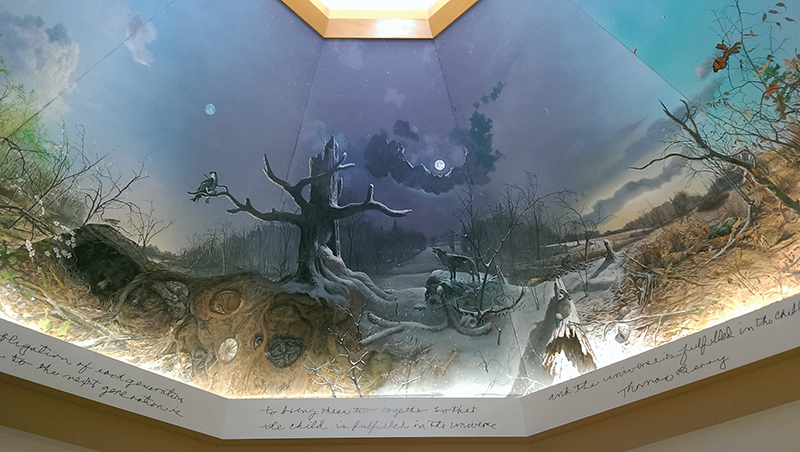
Another mural, based on the writings of Thomas Berry, fills the octagonal rotunda of the Kathleen Clay Edwards Library in Greensboro’s Price Park. The mural is a favorite of Chip’s, he says, because it’s “more intellectualized” than some of his other woks. Yet more adorn walls of several Mexican restaurants in the Triad and beyond. And then there’s the one in the children’s room at the Lexington Public Library that pays homage to the department’s librarian, Valerie Holt Craven, who met an untimely death at the hands of an abusive boyfriend. “I was so distraught, because my kids loved coming up here and talking to Val. She was a fantastic person,” Chip reflects. The mural, spanning two adjacent walls in a corner of the library, is a colorful fantasyland with the Tree of Knowledge as its focal point. Children, engrossed in books, lounge on its branches or in its shade. Oversized mushrooms (“hallucinogenic mushrooms,” Chip clarifies with a sly laugh) punctuate the scene. A dog and cat, and a frog enjoy a Punch and Judy show; a man on stilts throws balloons. Tom Sawyer makes an appearance, as does a windmill (another allusion to Don Quixote); a Chinese laborer unloads a boat “a reference to the furniture industry leaving,” Chip explains. “There’s all kinds of stuff in there.”

He frequently adds symbols and jokes to his works. And his own image.

“That’s me reflected in that green thing,” Chip says, pointing to a shiny object in the upper right-hand portion of the Green Valley Grill mural. “There’s a fly in there, too, somewhere, but I couldn’t tell you where.” In a drawing in his Lexington studio, a finished barn at March Motors, he has depicted himself with a portion of his head as a drip sandcastle (“I used to make ’em all the time at the beach,” he laughs). In another, the artist looks outward — his eyes and forehead painted over with a patch of blue sky and clouds. He’s sculpted himself as a crude clay Cro-Magnon man from a museum exhibit he worked on; and painted a serious self-portrait during his grad student days, his faunlike face framed by beard and long hair. “I had much longer hair than that,” Chip says. But as it began to thin, he decided he looked too much like Ben Franklin and keeps it short most of the time.

The self-portraits are scattered alongside other works in the barn: Fauvist-style paintings of musicians performing live; a backdrop for the set of a play about Siamese twins Chang and Eng for the Andy Griffith Playhouse in Mount Airy copied from a vaudeville poster; commissions from photographs (“so terribly boring”); a portrait of his daughter as a child; a representational sculpture in resin of his son as a boy: a bust of an anguished woman filled and painted with bronze powder; an acrylic painting of his dog; a wooden headboard with an animal motif carved for his children’s crib. These are situated among his brushes and paints, and MGs, Austin Healeys and assorted English racing cars.

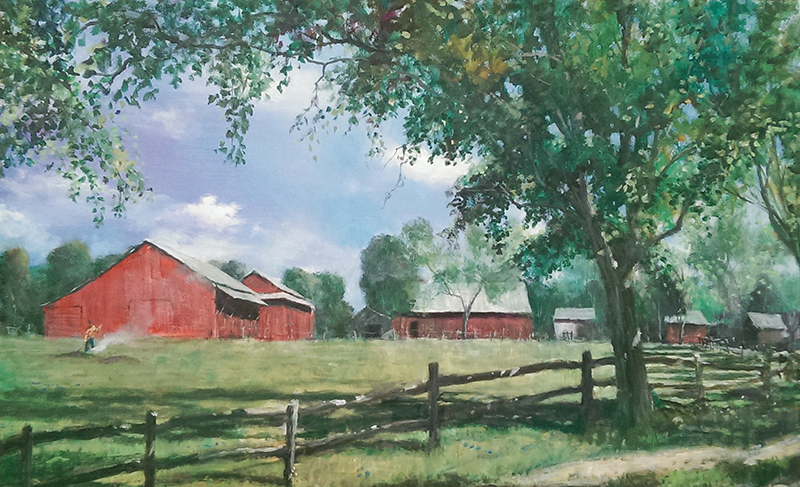
He discovered the barn — how else? — serendipitously when he bought a car (a Ford Taurus not a racecar) from owner Jeff March and wound up doing a painting for a charity auction the car dealer was sponsoring. Several paintings of cars (Chip’s “overhead,” as it were) also hang on the studio’s walls and in an adjacent room. In one, set against the backdrop of an imaginary farm, the artist has playfully added a country bumpkin burning trash. Chip likes the building’s long walls, conducive to working on murals, but it often gets too cold to work with paint. “I guess, in some ways, I’m an itinerant painter, because I don’t have a permanent studio,” he says, having given up the one in his house after his marriage ended. He has an apartment in Greensboro, and the hotels, of course, but has to be careful not to spill paint on carpets and curtains. “You want this little place that’s yours, that you think is yours,” Chip says. “But everything’s temporary. You’re only there long enough to eat a little bit and turn back to dust. But in reality, it’s a comfort to have that place to locate our work in and do it. It’s practical to have a studio.”

On the back wall of the barn behind a worktable is a sentimental favorite, a portrait of Chip’s mother that he painted just before she died. Also a painter, she was the primary artistic influence in his life. “She’d burn toast and fried chicken while I was in the next room coloring,” he remembers, and provided him with “constant exposure to art.” The family home contained volumes of Michelangelo’s paintings alongside copies of The Saturday Evening Post, famous for its covers by Norman Rockwell. “I grew up instinctively drawing things I could see and wanting to draw them like that,” Chip says. They were his early steps in the direction of realism.

He says the painting of her is more than a portrait, but “a statement about change that connects everybody” through various images and symbols. In it, his mother faces the viewer, her back to the ocean while Chip’s nephew makes a drip castle in a tidal pool in the background. “I’m reflected in the fisherman’s buoy,” Chip says, referring to the white sphere his mother is holding in front of her womb. The top right-hand portion of the canvas is damaged from where an air-conditioner leaked water behind it, a haunting reminder to Chip that he “often neglects things” and an ironic one, too: The title of the painting is Mother and the Sea. “You know, “Ave Maria.” Mare [Italian for ‘sea’]”, Chip says, with an Italian accent.

It recalls his stint in the late 1960s when he studied in Asolo, Italy, under Jim Moon. The founder of the Art Department at School of the Arts in Winston-Salem, Moon became a mentor to Chip, one of many artists he supports with collective shows through the Asolare Fine Art Foundation. A simple line drawing of the Northern Italian burg and a painting of the house where Chip stayed while under Moon’s tutelage have prominent places in the racecar barn.

Chip’s formal study of art didn’t begin until graduate school. He had hoped to train as an architect at N.C. State’s School of Design, “but my math allergy set in,” he quips. The barn/studio in Lexington contains a pen-and-ink drawing of figures striking poses similar to Rodin’s The Thinker; they are set in a warped black-and-white checkered background. “It’s based on the work of Jean-Paul Sartre, called Nausea,” Chip says, adding that it was around this time he started studying philosophy. “Learning how to reason was helpful. You start with an idea and must reach a conclusion. It’s helpful in artwork: Start to finish with logic in between.”

He went on to UNCG, where he got his Master’s in Fine Art with a concentration in portrait painting. In the barn/studio, he stops by a portrait of his father, shown in profile sitting in an armchair and wearing a simple undershirt. There is a noticeable resemblance between father and son. “It wasn’t his favorite,” Chip admits. “I said, ‘Dad, I know I’m not going to depict you in a smiley-face kind of way,” he remembers, adding that the point of the painting was to support his Master’s thesis: “studying the structure of the head in a simplistic pattern, in a simplistic way, with a reduced number of colors involved.” He explains that the painting only uses about four or five colors. “And it’s been urinated on by cats,” Chip laughs. “Anyway, I’ve got to clean it.”

Frank P. Holton Jr. was an attorney in Lexington, and Chip remembers, as a child, visiting his dad when he worked at the splendid antebellum courthouse downtown. It is now the home of the Davidson County Historical Museum, and it is here that Chip has contributed some of his more unusual work: twenty life-size cutouts, or dummy boards, of participants of the famous and sensational 1921 trial of Dr. John Peacock, who shot a police officer in cold blood in the light of day — and was acquitted on what was an early use of the temporary insanity defense. Some of the cutouts are so realistic in detail and liveliness, you find yourself turning around to see if one of them might wink at you. “It was a lot of fun,” Chip says, recalling the careful planning and historical research of the cutouts’ details, from the dress and haircuts among the millworkers who comprised most of the jury, to the cigarettes that an attorney is puffing on (horrifying to visiting schoolchildren). The tableau is an extension of Chip’s museum work that he’s done off and on over the years — at the N.C. Zoo in Asheboro, the N.C. Museum of Natural Sciences in Raleigh, the McWane in Birmingham where he crushed the fingers of his painting hand. He’s done a lot of work around his hometown: a bronze sculpture for the police station in Lexington, Italianate murals in the tasting room at Childress Vineyards and numerous paintings that hang in private homes. “It’s all a part of the output of an artist,” he says.

And yet, his restless creativity, “the eternal child thing,” as Chip calls it, longs for expression without a commercial element; expression of his choosing. “I feel like if I don’t do it, I’m going to die . . . unrequited,” he says. “One thing’s certain: I’m gonna die. The other thing that’s uncertain: I might die happy if I do more of my own stuff.” Whatever that might be, it, too, will be as eternal as that eternal child who long ago dreamed of being a modern-day Michelangelo
. . . while he colored to the smell of burnt toast and fried chicken. 
OH

Nancy Oakley is the senior editor of O.Henry

Out of the Shadow of Shadowlawn

For the Culler family, home is truly where the heart is

By Cynthia Adams   •   Photographs by Amy Freeman

house

“The story of our house — destroyed,” is the heading written neatly on a sheet of legal paper. Below the heading are notes, penned by Ashley Culler. She has a Christmas story unlike most, and one she has finally decided to tell.

Hers is the story of what was lost, but more importantly, what was found.

Ashley and her husband Braxton’s current Emerywood house in High Point is a beauty. Although the newer section of their home is only a few decades old, skillful renovations make it appear as if it were much older. The carriage house, however, is a period piece that once belonged to the “lost house” and is now a wing of the Cullers’ new home. Some of the artful trickery employed to give this new home vintage appeal results from craftsmanship better known to another century. Authentic plaster-cast moldings and 1920s era details appear throughout the main rooms and even show up in private areas, such as dressing rooms.

The home features a few relics, lovingly restored, carefully salvaged from the family’s prior house that once stood only a few yards away.

The most obvious artifact of the lost house is what they now call a gazebo. It stands as a proud and touching emblem. It was a covered stone and brick rear entry, formerly attached to their destroyed home but now freestanding.

housefire

There is a chandelier in the elegant red dining room and wall sconces that were sent to New York for restoration. A few leaded glass windows (salvaged, miraculously enough) were installed near the library. A once-charred mantel was plucked from the ashes and placed in the living room — and a single finial in the front stairwell is nearby. A few beams, recovered from the former dwelling, made their way to an outdoors terrace. These emblems are not only architecturally important; they are symbolic of this family’s triumphant rise from a tragic fire during Christmas six years ago.

What the Cullers’ new home doesn’t have are any pieces of furniture, any paintings, any crockery, memorabilia or pictures, not even a single family photo, from their former one.

That is all gone, lost in the fire and belonging to the past. What the Cullers do have are a glorious present and a sense of gratitude.

housetree

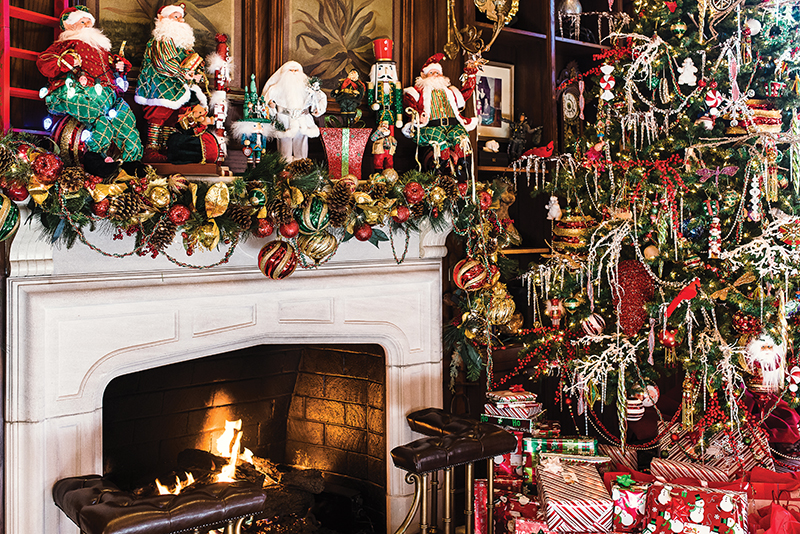
Come Christmas, the “new” Culler house glows within and without, with twinkling beauty. High Point designer John Paulin, of Grassy Knoll, drapes the exterior and the surrounding evergreens on the sizeable property with fairy lights. Iron reindeer that were spared immolation are on display on the lawn. Inside, traditional Christmas colors are employed and a family Nativity scene is on display that once belonged to Ashley Culler’s mother. After her mother’s death, the tableau was carefully restored by artist Dana Holliday. A deft touch can be seen in every room and the largest tree is in the library.

“We decorate after Thanksgiving,” Culler says, “and it is magical.”

The Culler family purchased their original Emerywood home from their much-loved neighbors, Harold and Peg Amos. From the time of the purchase more than thirty years ago, the Amoses were literally in their backyard — domiciled in a beautifully built house facing Country Club Drive whose design incorporated a carriage house original to the property. The Cullers’ house and grounds backed up to the Amos house and faced Emerywood Drive. The Amos house was sympathetic in period and design, built on land carved from the estate circa 1980. In essence, the Amoses had downsized directly behind their sprawling former home, one which echoed some of what made their historic home, Shadowlawn, so splendid.

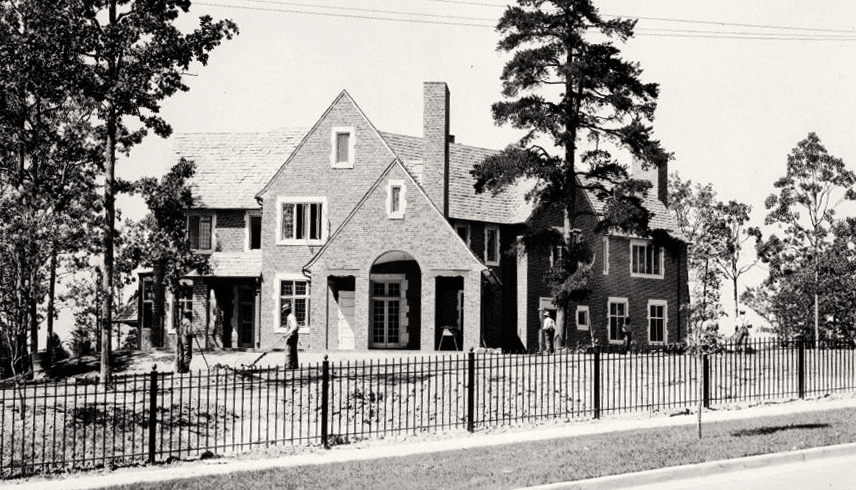
The 1920s era mansion called Shadowlawn was a dream — a brick French Revival Tudor. Shadowlawn, designed by, the architecture firm Northup O’Brien in Winson-Salem, known for designing Graylyn and other distinctive homes, was known as a fine example of his residential work. Built by Quaker businessman J. Elwood Cox in 1926, Shadowlawn’s 10,000 square feet were packed with the lush details: soaring, beamed ceilings; rich wood paneling and carvings; leaded windows, elaborate stairways and exquisite architectural details, making Shadowlawn known to preservationists and architects. But six years ago, the dream was destroyed.

“We turned the Christmas tree on and it exploded into flames,” says Ashley Culler. “I escaped from the house and ran down my driveway with my 3-year-old granddaughter in my arms. I turned around and looked back at my house. Oh, my God!”

On a November day Culler perches on a sofa on the back terrace that faces the grounds where Shadowlawn once stood, soaking up the slanting rays of the afternoon sun. She wears casual clothes, tucks a strand of hair behind her ear and pauses from the yellow notepaper in her hands. “May I read something to you?” she asks politely. It is a first-person account of events of December 26, 2010. There is no trace of the panic she once experienced only yards away from where we sit. She calmly reads from an account she has written by pencil in neat longhand.

“In three minutes our entire house was engulfed in flames. I know this, because my neighbor had recorded it on his video camera — that was time-stamped.” 

It was that point during the holiday when the family had entered the winding-down time, and Ashley Culler was still wearing sweatpants and sneakers. As always, Shadowlawn was a splendid festive setting — with Santas, garlands, flowers and favorite seasonal mementos out on display. The Cullers’ live Christmas tree was illuminated with strands of lights that were controlled by a floor switch, which granddaughter Libby loved to operate. Tiny Libby stepped onto the switch — but this time, the tree ignited in furious flames.

Culler had planned to run upstairs for a quick shower before her son arrived with his family — but they arrived early and so she was still puttering downstairs. “If I had been in the shower, I probably wouldn’t be sitting here,” Culler says. “No one was upstairs.”

The fire was astonishing in its speed. The flames licked through the downstairs and shot up two large stairwells to the second floor. “It burned so ferocious and quickly because there was a 2-foot concrete divide above our 11-foot ceilings, so the fire could not burn upward. Instead, it spread through our two staircases, and through another staircase to the attic.” The attic featured the playroom, created for the Cullers’ five grandchildren. The children loved to play air hockey, foosball, pingpong and other games there.

“Thank the good Lord they were not playing up there that day!” Culler reads on, her voice steady. “No one would have survived.”

What Culler shares next is an account of fighting to remain calm, with toddler Libby in her arms and the stately Shadowlawn engulfed in flames behind her as they fled.

“We ran to my sweet neighbor’s house,” she remembers. “And I just sat with Libby and we looked at Christmas cards.” This tranquil activity, she hoped, would help offset the panic that had overcome the tyke, and everyone around her. “I was determined to stay strong and peaceful for my family’s sake. If I fell apart, so would they, understandably.”

She had bolted from the house without her purse or even a coat. A neighbor brought her a heavy coat and the neighborhood and her family rallied, soothing them as the flames licked higher and leaded glass windows blew out of their beloved home. “I remember my nephew saying, ‘Sassy,’ which is what they call me, ‘don’t worry about the house. Christmas will always be wherever you are.’”

The fire completely savaged the house. The family could save nothing, though Culler’s husband, Braxton, and son, Brack managed to edge back in at the very inception of the fire, clutching one another given the dense smoke, and crawled across the floor to retrieve car keys. Ashley Culler says the men feared their four cars might explode.

Culler remembers, too, how the Red Cross was soon on the scene. “I realized at that moment,” she recounts, “that I was truly blessed. That I did not need one thing! I was surrounded by friends and family who made sure I was taken care of. They say your real friends would give you the shirts off their backs. And many of them did.” She says she could tell hundreds of stories of acts of kindness that ensued. “Life is not about what you have,” Culler says firmly. “It is about who you have. It’s not what’s on your back, but who has your back!”

After the fire, the family became nomadic for the next two years. They lived with family members, at the J. H. Adams Inn, and the Marriott Hotel. The family moved on, examining properties and trying to determine where they might go. Eventually, they purchased a condo nearby so that Braxton could manage his furniture business, as they simultaneously hoped to restore Shadowland. The entire neighborhood grieved the loss of a landmark that was now a fire-blackened ruin.

Braxton had been Ashley Culler’s rock for almost fifty years of marriage. Throughout the ordeal, he proved stronger than ever. “My husband remained the pillar of strength. I realized more than evert why I had married this wonderful man. Not just because he is so handsome, charming and lovable, but because he is reliable, sensible, persevering, hard-working and determined.”

It was a full two years after the fire before the Cullers learned a restoration of Shadowlawn was impossible. The historic house could not be rebuilt. The day they had to watch bulldozers raze the house was the couple’s worst moment, and it devastated them both to see their home of thirty years finally erased. “It was worse than the fire,” she says. “When the bulldozers arrived to take the house down, we dropped to our knees.”

And then, a solution emerged. The Amoses, the Cullers’ long-time, backyard neighbors, were selling their home and moving to Pennybyrn, a retirement facility. Facing the fact that Shadowlawn could not be restored, the Cullers purchased the smaller house built those many years ago — officially now the second residence bought from the Amos family.

There are traces of life at Shadowlawn within a house that literally lay in its shadow. It is beautiful yet small by comparison, although the library most demonstrates the fineness of rooms in the lost house. Ashley Culler points out how the rear terrace’s outdoor fireplace incorporates a stone detail from Shadowlawn. There are stones they lovingly brought over and incorporated as literal touchstones of the past in the terrace; they value what artifacts remain. But what would their home be without all the antiques Ashley Culler once loved that are long gone? Her answer is resolute: “You cannot live in the past.”

“We don’t look back,” she adds. “We are grateful for what we have, not what we used to have.”

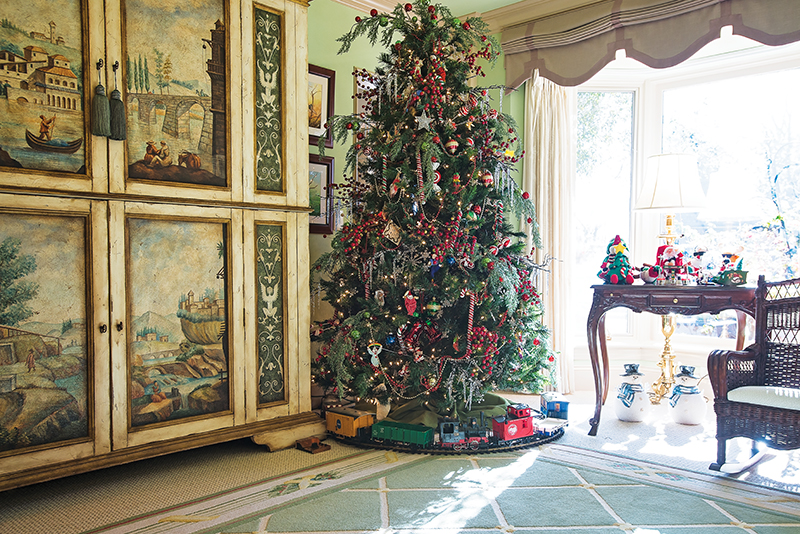
Today, Ashley Culler still loves Christmas and does not dread the day after. She is neither jaded nor fearful, but she does use artificial trees and fireproof decorations only. She works with Paulin, to deck the halls immediately after Thanksgiving. “John Paulin turns it into a winter wonderland!”

Her mother’s Nativity crèche is on display in the hallway, and her mother’s antique train set is beneath the tree in the library. Culler also displays Italian leather reindeer that somehow survived the fire — but there is nothing else. The dining room, a cheery, cheering red, features a table set for a feast — and the Cullers gather here together, just as before, their hearts full. OH

Cynthia Adams is a contributing editor to O. Henry.

Room at the Inn

The spirit of Christmas is alive and well at an aptly named shelter for homeless expectant mothers

By Annie Ferguson     Photographs by Amy Freeman

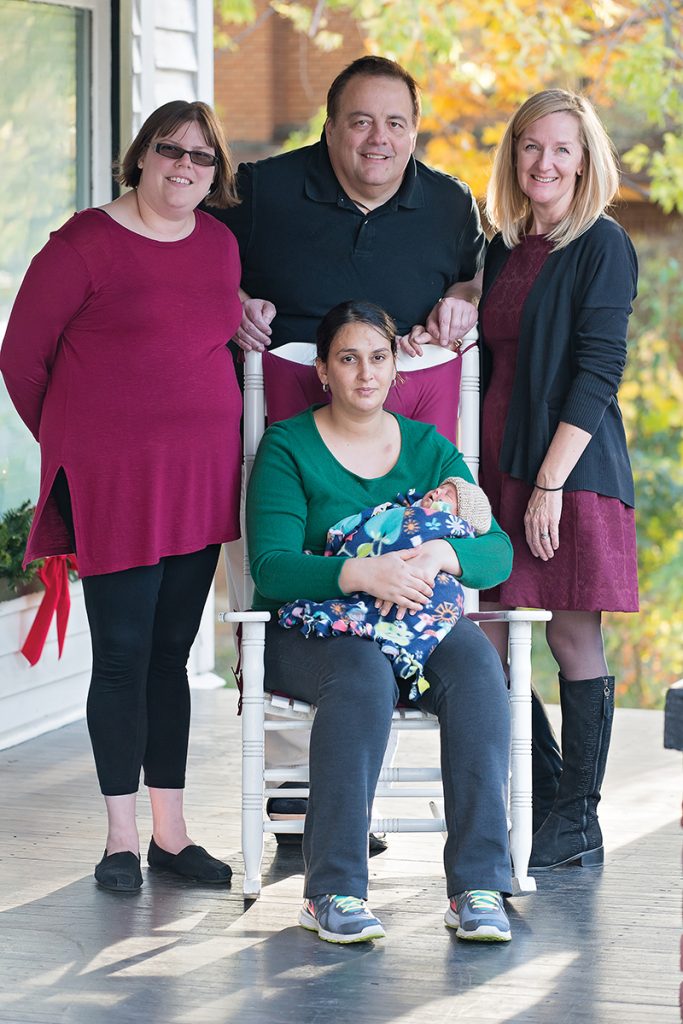
roomattheinnftr2

There’s something extraordinary happening in Greensboro’s Historic Aycock Neighborhood, where Queen Annes, Tudor Revivals, Dutch Colonials, and Arts-and-Crafts–style bungalows stately sit along tree-lined drives. On Park Avenue in particular, you’ll find a lot of activity, both visible and invisible, at the former Sternberger Mansion, a large home inspired by Victorian and American Foursquare architecture that was built in 1898 on Summit Avenue and later moved to its current location.

The building is now the Mary C. Nussbaum Maternity Home, where the lives of pregnant, homeless women are transformed into ones of hope through the support of Room at the Inn, the only licensed maternity home in Guilford County that accepts women of all ages — and one of only eight licensed maternity homes in North Carolina. The nonprofit organization provides shelter, counseling, child care for clients’ older children, transportation and more during the pregnancies of women from across the state — from Murphy to Manteo.

After the babies arrive, women who have graduated from the program can stay at what’s affectionately called Amy’s House next door while attending college. Women waiting for an opening in the maternity home may also stay there. Donations from Francis and Patty Disney of Our Lady of Grace Church, the Greater Greensboro Builders Association and collaboration with local churches have made Amy’s House and the college program possible.

“We began our support of Room at the Inn after losing a child,” says Patty Disney. “My husband and I saw Room at the Inn as a means of strengthening our belief in the gift of life and that God has a plan for each soul.” Disney says her family’s involvement with the organization began with the initial hands-on renovations of the Mary Nussbaum House. Later, they were able to help
Room at the Inn expand with the college program. “God’s providence offered funds to support the establishment of Amy Elizabeth Disney Home. We believe in offering a place for the women and children while they get the support they need to get a step up on providing for their families.”

The Disneys and many others in the community have truly rallied behind the organization with the aim of providing as much room as possible.
Cherry Street United Methodist Church began offering space to Room at the Inn in 2005 through The Back Yard Ministry.

Now let’s take a look back at how all of these developments came to be. Room at the Inn’s genesis was in the early 1990s in the living room of the rectory at St. Benedict Catholic Church on West Smith Street. Gate City native Albert Hodges along with the pastor and several other parishioners were sitting around a table discussing a serious need. “A good number of us were inspired to get involved in efforts to help pregnant women and their unborn children, especially in the Greensboro area,” explains Hodges, whose grandfather moved to the city in 1920 to work at Cone Mills. “We were largely supported in our efforts by the pastor of Saint Benedict at the time, Father Conrad Kimbrough.” (Kimbrough passed away in 2011.) After the decision was made, Hodges, now Room at the Inn’s president and CEO, went to Good Counsel Homes in New York and New Jersey to learn how such ministries operate. Maternity homes opened in Charlotte and Raleigh too, but the three efforts later went their separate ways. In Greensboro, with the help of forty-five church organizations, various community leaders and along with Disney Construction Co., the home was completely renovated from a run-down triplex into a home that can house six women and their children. It opened in 2001.

Since then, the organization, which is affiliated with the Catholic Church, has served more than 400 women of all faiths and became accredited by the Council on Accreditation in 2010. Room at the Inn is the only Catholic maternity home in the Southeast with this national recognition. Although clients are invited to attend a place of worship of their choice, they are not required to. Hodges is proud of the accreditation since most charities that earn this recognition have millions of dollars, and Room at the Inn operates on a “shoestring budget.” But what speaks to Hodges’ heart of hearts, more than any outcome, statistic or official recognition, are the life-altering changes he and his staff have helped foster over the years.

“The mothers must make the decision on their own to change their lives, and we are here to support them as much as possible,” he says. Nicki, one of the first women to stay at the home, apparently caused some problems when she was living in the house. Hodges decided to have what people like to call a “come-to-Jesus” talk with her. “I said, ‘You know this isn’t a prison; you don’t have to stay here, but we don’t have to keep you either,’” Hodges explains with visible emotions. Afterward, the young woman proceeded to change her attitude and land a job, which led to finding her own home. When it came time for Nicki to leave the maternity home, she pulled Hodges aside and said, “You know, Albie, this place changed my life. I feel wholesome now.”

The organization has enjoyed impressive outcomes and success stories, including moms who have graduated from college with honors and a mom who earned a standing ovation in court for turning her life around. Yet Hodges says he can’t imagine a better outcome than knowing someone who once felt broken now feels complete.

“Albert Hodges’ whole life is this agency and these women,” says Marianne Donadio, who met Hodges at St. Benedict. “He’s a father figure to the women, women who have grown up without that male figure in their life. It’s nice to see that dynamic.”

Donadio volunteered as Room at the Inn was getting its start and for many years later. Five years ago Hodges hired her as the vice president of marketing and development. “Everyone has a story. You see someone on the street, and you just don’t know what they’ve been through, and it’s easy to make rash judgments,” Donadio says. “I enjoy the one-on-ones with the clients that allow me to get to know them and their stories. It’s not just generic information about the program that I share. I talk about our mothers, and the people relate to them. It’s much more convincing when I know closely what’s going on.” One of Donadio’s major responsibilities is planning the annual fundraising banquet in October, an enormous undertaking. This year’s event set a record by raising $150,000. More inspiring was the speaker: Immaculée Ilibagiza, a Rwandan genocide survivor and best-selling author who spoke on mercy and forgiveness.

With all of the activity in the home and of running the organization overall, Hodges shies away from the spotlight. “It’s really about the mothers and the amazing staff,” he says, mentioning Donadio; Jason Melton, support services manager; and Edith Clifford, vice president of administrative operations; and Sally Foroudi, the volunteer coordinator of baby showers and after-care resource center. Then Hodges mentions a more-recent staff addition.

“Danielle Dean is our residential supervisor. I’ve never had a house manager who could enforce the rules the way she does while still being respected and loved by the women who live there,” he says.

After just one year on staff, Dean feels at home, too. “I oversee the mothers, interview them when they come in, and basically provide them with everything they need resource wise: transportation to doctor appointments, attendance with clients at court, help getting them enrolled into child care centers in the area,” says Dean, who has fifteen years of professional child care experience and is studying to earn her bachelor’s degree in Birth through Kindergarten Education at North Carolina Central University. “We do parenting classes here as well. I try to teach them the proper way to raise healthy, thriving children and have a healthy pregnancy. I also do the food program to help ensure they’re getting the proper meals each day, so they’re balanced according to state regulations.” In March, Dean became a certified labor coach so she can be a support system for the moms who don’t have anyone in that role. Dean’s role has a special significance to her. “I felt this was a calling because I was down in the dumps. On November 1, 2015, I applied for what was going to be a part-time job doing childcare and parenting classes. I was full time before the end of the year,” she says. Dean hesitated to go in before her first visit, until Melton came outside to welcome her. “I walked through the doors, and I felt this is where I need to be. Hodges hired Dean the same day.

A year on, Dean says she feels like she’s the house mom. Everyone loves it when she cooks chicken and waffles. “The children don’t even talk during those meals, so it must be good,” she says with a smile.  “You’re not just here for a paycheck,” she reflects. “I’m a missionary right here in our local town of Greensboro.”  OH

Annie Ferguson was fortunate to have Danielle Dean teach both of her children when they were toddlers. To support Room at the Inn, visit roominn.org, like them on Facebook or sign up for the fifteenth Annual Amy Elizabeth Disney Memorial Golf Tournament on May 4.

Poem November 2016

BIRD FEEDER

I never said

we weren’t sunk in glittering nature,

until we are able to become something else.

— Mary Oliver

Perches pique a matter of strategic

challenges, this chess game of

poached positions and rotating

flurries of chromatic energy,

as if the flash and dash of feathers

in flight was more about the dance

and not the flush of necessity’s plight . . .

as if we ourselves were not also

in restless rush, breathing out

the flux and plottings of our small

and uncertain profundities.

— Connie Ralston

November Almanac

Fresh beetroot with leaves isolated on white.

It was Autumn, and incessant

Piped the quails from shocks and sheaves

And, like living coals, the apples

Burned among the withering leaves.

–Henry Wadsworth Longfellow

Sprout Clout

November is crisp air and burn piles, corn crows and starlings, stone soup and Aunt Viola’s pumpkin bars. 

Many consider this eleventh month to be an auspicious time for manifestation. But first we must clear out the old. As we rake the fallen leaves that blanket the lawn, something deep within us stirs, and an ordinary chore becomes a sacred ritual. This is no longer about yard work. We look up from tidy leaf piles to naked branches, a gentle reminder that we, too, must let go. And so we stand in reverent silence, eyes closed as autumn sunlight paints us golden. In this moment, even if we feel sadness or grief, we give thanks for nature’s wisdom and the promise of spring. Wind chimes sing out from a neighbor’s porch, and we exhale a silent prayer. 

This month in the garden, plant cool-weather annuals such as petunias and snapdragons, and color your Thanksgiving feast delicious with cold-weather crops such as beets, carrots and Brussels sprouts. Arguably the country’s most hated vegetable (if overcooked, these edible buds turn pungent), one cup of Brussels sprouts is said to contain four times more vitamin C than an orange. Our friends across the pond sure go bonkers over them. In 2008, Linus Urbanec of Sweden wolfed down a whopping thirty-one in one minute, a Guinness World Record. Not to be outdone, in 2014, 49-year-old Stuart Kettell pushed a Brussels sprout to the top of Mount Snowdon — the highest summit in Wales — using only his nose. Although this peculiar mission was designed to raise funds for Macmillan Cancer Support, it also raises a valid question: What else might this cruciferous veggie inspire? Perhaps a nice cherry or Dijon glaze? Better yet, bust out the panko and try your hand at Buffalo Brussels. Thanksgiving football will never be the same.

To Your Health

white chrysanthemum on pure white. clipping path included.Related images:

Chrysanthemums are the birth flower of November. Sometimes called mums or chrysanths, this perennial grows best in full sunshine and fertile, sandy soil. Because the earliest mums all had golden petals, many view this fall bloomer as a symbol of joy and optimism. First cultivated in China, these daisylike flowers so entranced the Japanese that they adopted one as the crest and seal of the Emperor. In fact, Japan continues to honor the flower each year with the Festival of Happiness. Legend has it that placing a chrysanthemum petal at the bottom of a wine glass promises a long, healthy life. 

Arboreal Wisdom

The ancient Celts looked to the trees for knowledge and wisdom. According to Celtic tree astrology, those born from October 28 – November 24 associate with the reed, a sweet-smelling, canelike grass the ancients used to thatch roofs, press into floors, and craft into arrows, whistles and flutes. Think Pan’s pipe. Reed people are the secret keepers of the zodiac. They can see beyond illusion and have a strong sense of truth and honor.
But anyone can look to this sacred and useful plant for its virtuous qualities.
When the wind blows through a field of them, it is said you can hear their otherworldly song. But you must be willing to receive their message. Reed people are most compatible with other reed, ash (February 19–March 17) or oak (June 10–July 7) signs. In the Ogham, a sacred Druidic alphabet, the symbol of the reed spells upset or surprise. 

No spring nor summer beauty hath such grace

As I have seen in one autumnal face.

—John Donne

Story of a House

Tearing Down Walls

For Kathleen Lucas, remodeling was essential to moving in and moving on

By Maria Johnson     Photographs by John Gessner

hosue3

Anyone who ever carried a feverish child to Dr. Kathleen Lucas’ pediatrics practice — and there are three or four thousand of us — would recognize her new home immediately from the outside.

The purplish colors, clean lines and tropical vibe echo her former office at the corner of Yanceyville and Meadow streets in Greensboro.

Just look at her mailbox post, which is punctuated with purple house numbers and, underneath, a small flag with a smiling frog. “Welcome to My Pad.”

Check out the purple-roofed birdhouse by the street.

See the Zen garden with a sculptural fountain.

Rest your eyes on the angular front porch and a door that blossoms with a stained-glass flower, a bird of paradise, made by her sister, an artist.

Inside, the theme repeats.

Purple. Playful. Peaceful.

What former patients and others might not recognize immediately, though, is the curative power of the house, which Lucas moved into earlier this year following a patch of personal upheaval.

Her husband of twenty-two years left in 2011.

A year later, with divorce on the horizon, Lucas retired earlier than she had planned. Rather than cling to a stable part of her life, her career, she let go.

“Well, I always jump in,” she says with a self-effacing laugh. She sits at a dining room table that’s topped, appropriately enough, with granite. “I never go around the periphery. I walk right through it.”

Her raspy, tell-it-like-it-is voice remains the same as it’s always been. Her naturally gray hair is longer than it was for most of her doctoring years. And she’s thinner, at age 64, than most patients would remember.

For two years, she felt, quite literally, as if there was a hole carved in the center of her. She lost 40 pounds as she shed the symbols of her old life.

She and her ex-husband sold the Prairie-style medical building that they’d designed and built on Yanceyville Street.

Then Lucas sold a home she loved, the one she’d bought after her residency at Moses Cone Hospital, the one she’d added onto, and groomed, and grown  — with her ex’s help — into a haven worthy of a lifestyle piece in the local newspaper.

After the split, she realized the yard was too big for her to tend. Gardening was his thing.

She realized something else, too.

“I felt that I would be better off, after the divorce, getting myself in a new environment,” she says. “Moving to a new place would give me a new vision to move on.”

So the physician set about healing herself.

She moved to an apartment.

She made plans to travel, something she’d always enjoyed.

“I decided that the fact that I was single wasn’t going to keep me from doing what I wanted to do,” she says.

fan of Asian architecture, she yearned to see the East again, having spent six weeks in Nepal during a med-school rotation.

A family, whose children had been patients, invited her to stay with them in Singapore. She took them up on the offer.

From there, she traveled alone to Thailand. She spent a few days in Bangkok, then pressed on to the country town of Chang Mai, where she visited a preserve for elephants that had been abused.

“We got to wash elephants in the river,” she says.

She signed up for a nighttime bicycle tour. No one else did. Not to be foiled by the two-person minimum, she paid double the $20 ticket price. Her young guide led her on a private tour all over town. He stopped at the local market and explained the different kinds of produce. He took her to Buddhist temples, which glimmered with gold at night.

“That felt like Thailand to me,” she says. “I got to see the culture.”

She flew to Krabi, home of towering limestone formations, known as karsts, that jut from the South Andaman Sea. Most people go to Phuket to see the karsts.

“I didn’t go there,” Lucas says. “I don’t go where other people go.”

She rented a longboat with a guide and snorkeled the caves of the karsts.

On the way back home, on a layover in Tokyo, she looked at Zillow, the real estate website, on her phone. She searched for one-story homes in the New Garden area, where she’d lived and wanted to stay.

She got a hit: a 1962 brick ranch with three bedrooms, a full basement and a carport.

She tapped on the pictures. There were only exterior shots — a potential red flag — but she was undeterred. She liked the lines of the house. The brick reminded her of the house she’d just sold. She liked the dogwood tree, which was pictured in bloom, in the backyard. She liked the lake behind the house.

She made an appointment.

She closed on the 2,800-square-foot house a couple of months later and got to work with her old friend and collaborator, architect Carl Myatt, who’d designed Lucas’ medical building on Yanceyville Street.

“I’ve been a lucky guy to get her for two projects,” says Myatt. “The first time, you have to educate the client. The second time, it’s fun.”

Like many homes of the era, Lucas’ ranch was a warren of walls and halls inside. She wanted more openness and light. She wanted to see the lake when she walked in the front door.

“I did what I did with the other house: I took down walls,” she says. “I don’t like things that impede me from going forward.”

By understanding the value of demolition, she cleared one of the biggest hurdles faced by people who love a home’s exterior but shrink at a boxy interior.

“Most people are afraid to open it up,” says Myatt, the architect. “Don’t be afraid.”

In most cases, if the walls are load-bearing, they can be replaced by ceiling beams that are propped up by posts, he says.

An architect and a structural engineer usually can lick the challenge for a few thousand dollars.

“It’s expensive, but not outrageous,” says Myatt.

The walls that Lucas erased — around the foyer, dining room and kitchen — were not loadbearing. She added a beam across the ceiling for visual reasons. Two mahogany posts under the beam are cosmetic, too, like commas separating the entry from the rest of the room.

More walls came down at the end of a central hallway, where Myatt fused the master bedroom with a bedroom across the hall to create a master suite with an enormous dressing room. Japanese-style sliding screens function as doors to the dressing room and bathroom.

Myatt also bumped out the master by 6 feet at back of the house and added a small deck overlooking the lake.

“I like to sit out here and have coffee,” says Lucas.

house4

Myatt enlarged another lakefront room, the den, by 8 feet. He tacked on a larger deck there. Both decks, cedar stained dark red, are hemmed with horizontal cables.

“That’s so you can see the lake,” Myatt says. “We provided pickets you could see through.”

On the front of the house, Myatt drew a gabled overhang that rests on square posts over fieldstone piers.

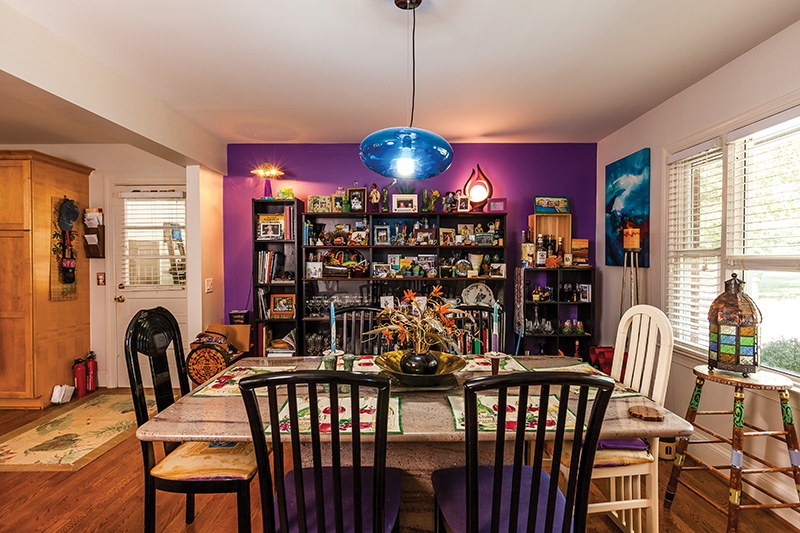
The additions bear Lucas hallmarks: geometric lines, low angles, big windows; and purplish hues that include Sherwin-Williams’ dusty Renwick Heather and the taupe Manor House.

Myatt approved of the palette.

“If clients have an imagination that I can bring out, I do that, and she has an imagination with color,” Myatt says. “She has a good control of color and good feel of what she likes. I would say it’s an upbeat color scheme.”
hosue2

And the style of the home?

It’s not Prairie, says Myatt. Or Asian. Or Craftsman. You might call it post-Modern, but that’s too generic.

“It’s really her. It’s her style,” he says. “I’d say that’s a Kathleen Lucas design. I only interpreted her personality, her desires.”

Lucas traces her architectural taste to a love of Asian design and the work of Frank Lloyd Wright, who was enthralled by Japanese motifs.

In renovating her home, Lucas applied the principles of functional beauty that she admires. The overhaul tapped a reservoir of goodwill. Over the years, Lucas had treated the children of three people who worked on her home.

“You know them, so you trust them,” she says, mirroring the trust she’d won during her 25-year practice.

The tradesmen stripped the carpet and tile out of the home’s main level and laid down white oak floors swabbed with a walnut stain to prevent yellowing.

A floating floor of sturdy bamboo went down in the basement.

“If I have a shag-dance party, this is where it’ll be,” says Lucas, a grandmother of four who has been taking dancing lessons.

She opted for simple lines again with the upstairs fireplace, which was brick, painted white, with a traditional mantel.

She dropped the mantel and hid the brick by sheathing the fireplace with new surfaces. Workers glued drywall to the sides. On the front, they stuck travertine marble — leftover from Lucas’ other house — and tongue-in-groove boards.

A metal tree of life sprouts from the diagonal boards. The result is a sleek focal point for the den.

Lucas also modernized the master bath with a vessel sink, pebbled floors and a walk-in shower that’s walled with granite, interrupted by a vertical stripe of glassy blue tile. The band resembles a waterfall.

house5

With 3-foot-wide doors and smooth thresholds throughout the master, Lucas planned for the long run.

“It’s accessible, if I’m ever in a wheelchair,” she says.

In the half-bath, she chopped down a narrow wall next to the vanity, and painted the walls — what else? — purple. She’s so sensitive to color that she painted the toilet niche a slightly darker shade of purple so that it would appear, when illuminated by a bright light from above, to be the same shade as the rest of the room.

What is it about purple?

“I see the warmth and excitement in purple,” she says. “You know, purple represents power and suffering. In the Catholic Church, they drape the altar with purple during Lent and around Christmas. Aesthetically, I like it, but also what the color represents is important to me.”

house1

She’s had her share of trials, and not just from the recent divorce.

As a kid growing up in Morganton, West Virginia, she suffered from a lazy eye. She wore an eye patch, then glasses from a young age.

A bicycle wreck at age 6 knocked out teeth and required surgery on her face and mouth. She wore braces until she was 15.

Some kids made fun of her lazy eye and bucked teeth.

“I never felt like I was less of a kid, but it made me realize at a young age that if you’re not within the norm of the group, someone is going to pick you out and pick on you,” she recalls. “I had sympathy for kids with disabilities, and things that were different about them. I think that’s why I went into pediatrics.”

But first, she went to Woodstock.

At age 17.

In a VW bus.

With kids from the Catholic parish at West Virginia University.

“I was with a church group, if you want to say that,” she says, laughing.

“I was a hippie.”

Married right after high school, she became a mom at age 19 and again at age 21. She ended the abusive marriage soon after her second son was born.

Subsisting on Aid to Families with Dependent Children, a welfare program, she took student loans to snare a degree in medical technology. She worked in labs for a few years, then, using scholarships and more loans, she went to medical school at Marshall University.

“If I hadn’t been a pediatrician and gone to medical school, I would have been an architect. My second love is architecture,” she says.

A body, a house. They’re not that different, she points out.

Both are physical structures with support systems that change as time passes – developmental phases they’re called in pediatrics.

Lucas’ latest phase has been expensive.

She has spent as much money on renovating her house as she did on buying it. The upside: She has purchased a lifetime of creativity.

Future projects include landscaping the backyard and enclosing the carport. A new electrical-engineer boyfriend — whom she met, fittingly, at a children’s birthday party — helps her with wiring questions.

The work is ongoing.

“It’s actually been emotional,” she says. “Doing this house was part of me moving on. This is my job, and it’s an enjoyable job, during my retirement. This is a new phase of my life.”  OH

Maria Johnson is a contributing editor of O.Henry.