Botanicus

The South’s Favorite Nut

Whether “pee-can” or “puh-con,” it’s actually a fruit — and makes for delicious pies

By Ross Howell Jr.

Squirrels have been foraging in the pecan trees for weeks; come November the crows take a turn. They’ve gathered at dawn in the big trees scattered among neighbors’ yards around the corner from our house. They’re raucous, but they don’t seem especially quarrelsome this morning — though with crows, it’s always hard to tell.

As I turn the corner with my dogs, a sentinel sounds the alarm. None of the other crows seem to pay much mind. Their dark shapes litter the street, sidewalk and tree limbs, as if a UPS truck loaded with black fabric remnants had sped by with its cargo door rolled up.

They squawk and clatter as hulls and shells patter across the asphalt. The dogs lift their ears, curious about the commotion.

A crow picks up a pecan in its beak and flies to the power line over the street. It perches and drops the nut, watching it tumble down, bounce and spin on the pavement. The bird glides down, cocks its head to inspect its work, picks up the pecan and flies back to the line. It drops the nut again. It bounces, not so high this time, and rolls unevenly to a stop. Success. The crow flutters down and pecks at the spoils.

OK, I just called the pecan a “nut,” which it isn’t, really. Technically, it’s a drupe, which is a fruit with a single stone or pit, protected by a husk (sometimes called a “shuck”). The four-sectioned pecan shuck is spongy and green, eventually drying and becoming thinner, turning dark brown, and opening as the drupe matures, exposing a thin shell containing the nut, or more accurately, the seed.

North Carolina’s Piedmont is located on the northernmost and westernmost geographical region where the pecan tree, Carya illinoinensis, thrives. The pecan is a species of hickory native to Mexico and the Southcentral and Southeastern United States. The name “pecan” derives from the Algonquian word describing a nut that requires a stone to crack it.

Native Americans foraged for pecans and traded them between tribes. Spanish explorers in the 16th century were the first Europeans to describe the nut, coming across pecans in what is now Mexico, Texas and Louisiana. Thomas Jefferson grew pecans at his Virginia home, Monticello, and George Washington wrote in his journal that Jefferson had made him a gift of “Illinois nuts,” which he planted at Mount Vernon (Both Jefferson and Washington obviously lacked USDA climactic range maps.)

In the South, the pecan was often planted as a “homestead” tree, its bounty providing a remarkable amount of energy as a food, especially when compared with wild game or other comestibles more arduous to acquire. Deciduous, the pecan can reach the height of 140 feet, with a trunk more than 6 feet in diameter. Trees produce both male flowers (catkins) and female flowers, and have been known to produce edible pecans over a three-century life span. That places the pecan among the longest-lived trees of the Southern forest.

To some it’s the “pee-can” and to others, the “puh-con;” no one in the South seems to agree on the correct pronunciation. What we do agree on is that the tree has given us two of our favorite desserts, pralines and pecan pie.

Uh-oh. Another pronunciation quarrel. “Pray-leens” or “praw-leens”?

On the pronunciation of “pie,” we agree. Although not, of course, with our neighbors to the North.

I’d like a little whipped cream to top mine, please. And if your recipe happens to include chocolate, that’s fine by me.  OH

When Ross Howell Jr. is not thinking about or eating pie, he’s working on a novel, walking his dogs and preparing his garden beds for winter.

The Light Within US

And the ways it spreads

In a city shaped in part by the frontier Quaker families who established New Garden Meeting in the early 1750s, the concept of a sustaining “Inner Light” has long informed the spiritual life of Guilford County.

The idea of an “inward light” or the “light of God found in every human being,” is central to Quaker doctrine, derived from numerous Biblical passages including the Gospel of John (8:12), which quotes Jesus of Nazareth explaining to his followers: “I am the light of the world. Whoever follows me will never walk in darkness, but will have the light of life.”

Poets and sages from every spiritual tradition have articulated some version of a divine inner light that motivates one neighbor to befriend and help another. “Just as a painter needs light in order to put the finishing touches to his picture,” Leo Tolstoy wrote in his memoir of faith, “so I need an inner light, which I feel I never have enough of in the autumn.”

This autumn, as we gather round a table resplendent with the harvest of our labors, we think this to be the perfect moment to “illuminate” eight stories of local people and organizations whose quiet determination to help others in need sustains their lives and serves as a model of true friendship to us all. Most operate well beneath the public radar, grown from the grassroots of someone else’s keen personal need, living proof that there is a light within us all.

And all we need to do is let it shine.— Jim Dodson

Gathering Together

Mary Lacklen’s Community Tables feeds body and soul during the holidays

By Nancy Oakley     photograph by Amy Freeman

light1

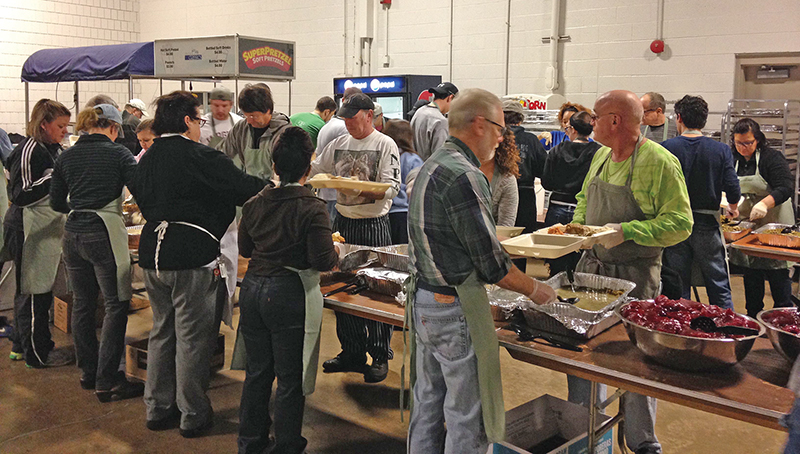
Early on Thanksgiving morning they’ll arrive at the Greensboro Coliseum: The couple who’ve pitched in every year for for twenty-five years. Ted Hoffler, wielding “Excalibur,” his electric carving knife, will lead teams of carvers slicing into 1,500 pounds of boneless turkey breast along with 2,500 pounds of mashed potatoes, both cooked ahead of time at Victory Junction’s kitchens in Randleman. Others will slice 450 pumpkin pies. Legions more working in shifts — giddy high school students, church and civic groups — will fill Styrofoam clamshells with the turkey and mashed potatoes. The containers will be filled with other sides — green beans cooked in ham hocks, gravy, stuffing from the Painted Plate, cranberry sauce, sweet potato casserole and rolls. Counters will apportion the boxes to tables, before they are bagged two at a time with two cartons of milk. Yet more volunteers from Triad Health Project, Senior Services, Delancey Street and local churches will retrieve the meals and deliver them to recipients of the agencies’ services. One year, a ponytailed fellow made deliveries to homeless denizens of the woods and bridges.

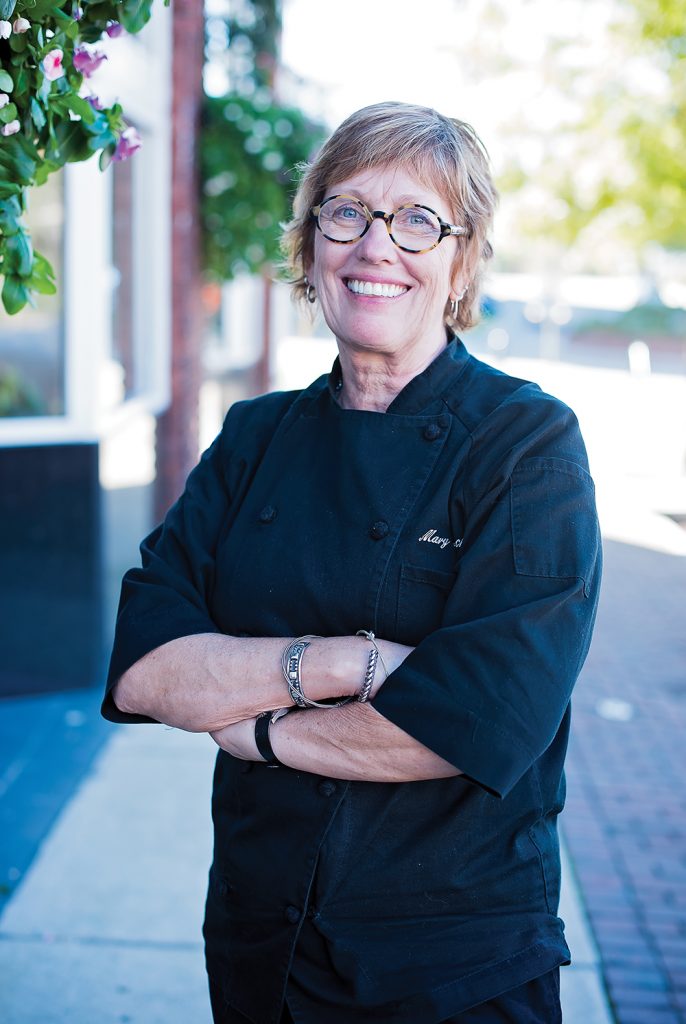
Amid the hustle and bustle will be Mary Lacklen, coordinating this massive effort known as Community Tables’ Thanksgiving Day Feast, which feeds nearly 5,000 people in need.
light2

“I feel like I’m a drill sergeant,” quips the director of operations for Libby Hill and one of the founders of Bert’s Seafood. “But you want people to have fun. You want to engage people, because somebody has to take my place eventually.” Whoever assumes Lacklen’s mantle will have a tough act to follow. A tireless community servant who also devotes time to Triad Local First and Share the Harvest, she has been a driving force behind Community Tables since its inception thirty years ago as an annual project of the now-defunct Guilford County Restaurant Association back when Lacklen served as its president. “We worked with Ham’s the first year,” she says, explaining that the meal was patterned after the annual Christmas dinner for the needy started by Ham’s proprietor Marc Freiburg. (His daughter, Anna, who runs Bender’s Tavern, has continued the tradition; for the last six years she has partnered with Lacklen, sharing funds through Community Foundation of Greater Greensboro and feeding another 5,000 people annually). “We did it outside [at the Salvation Army] on the big pig cookers. Sat up all night long,” Lacklen recalls of the initial endeavor that fed 300 people.

“We” included the other guiding spirit behind Community Tables, the late Ken Conrad, former owner of Libby Hill, and Lacklen’s mentor and friend who died from pancreatic cancer just weeks after last year’s Thanksgiving meal. “I still save all my texts back and forth. I sent him pictures during the course of the day,” Lacklen remembers. She has since established the Conrad Endowment through the Foundation.

The two kept the annual Thanksgiving feast going, moving first to the Greensboro Urban Ministry and then four years ago to the Coliseum. For the last five, churches have come aboard. One of them, United Congregational Church, hosts a buffet-style meal, replete with tablecloths, fresh flowers, live music, and a table of desserts and fruit, courtesy of the Fresh Market. “People come dressed in their Sunday best,” Lacklen says, some homeless, some barely getting by, some elderly and alone, some of them college students with no place to go on the holiday. From 10:30 a.m. to 2 p.m. they’ll arrive at the church on Radiance Drive by bus, thanks to volunteer Matt Logan, and will be greeted with a cup of hot cider in the lobby. “I want people to feel warm and welcome,” Lacklen says. “That was the intent.”

All told, Community Tables has fed about 100,000 people in its thirty years, and each year costs rise, because, as Lacklen observes, “more and more people need food.” (It takes $25,000 and change to fund the operations for the Thanksgiving meal and the Christmas dinner at Bender’s Tavern). Lacklen is quick to point out that support comes from individuals, and all of it goes directly to the meals. “There are no administrative fees. It’s very grassroots-driven,” she says, adding, “I’m proud of Greensboro.”

And at the end of an arduous day, after seeing so many old friends and the faces of people sated from a meal, Lacklen admits she succumbs to the emotion — and exhaustion — of the occasion. “I always cry the whole way home when I’m done,” she says. “I always try not to, but I always seem to.”  OH

To donate to the operations of Community Tables, go to cfgg.org and under the “give” tab, select “contribute online” and choose Thanksgiving/Holiday Fund in the dropdown menu, or mail a check, designated for the Thanksgiving/Holiday Fund to: CFGG, 330 South Greene Street, No. 100, Greensboro, NC 27401. Additionally, donations can be made to the Conrad Endowment, which has its own field in the dropdown menu.

To volunteer: Go to Community Tables’ Facebook Page, www.facebook.com/CommunityTables

Neighbors Helping Neighbors

Barnabas Network refurbishes household goods and lives

By Jim Dodson    photographs by Sam Froelich

light3

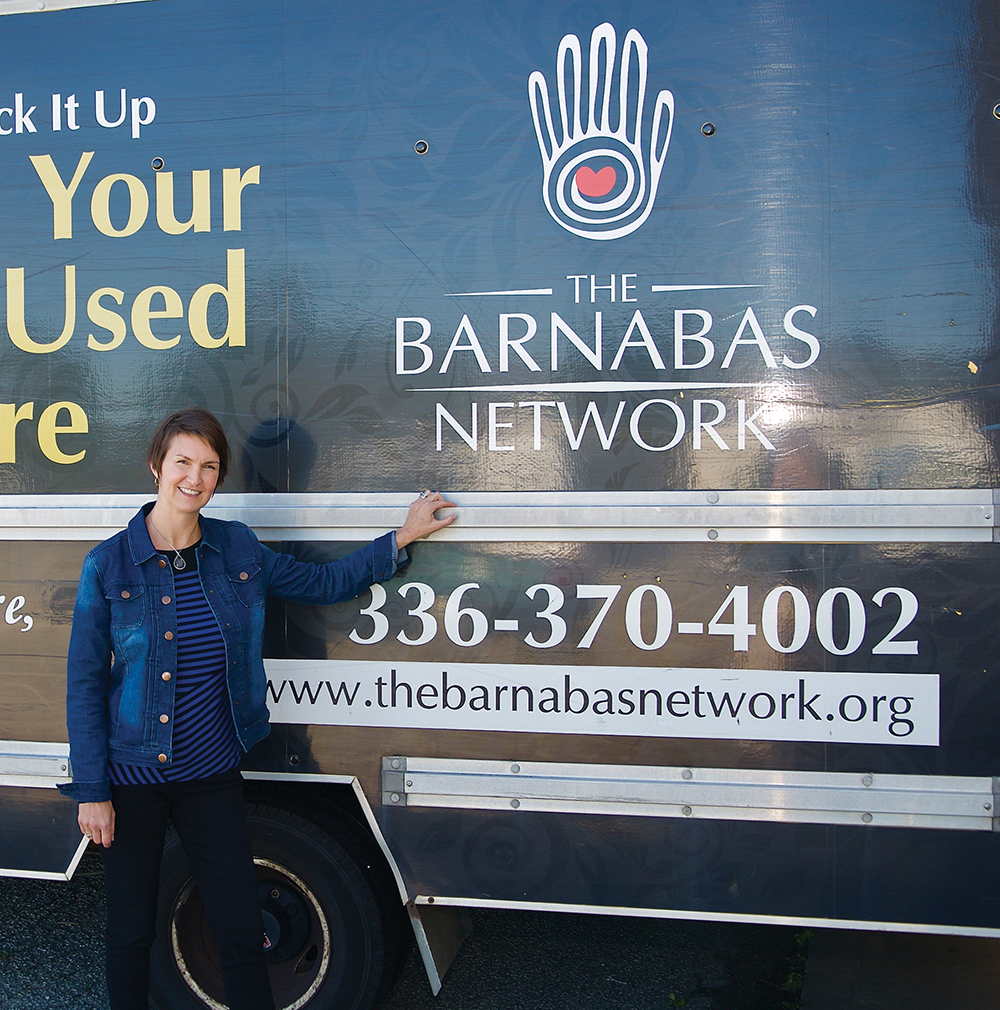
In essence,” says Erin Stratford Owens, executive director of the Barnabas Network, “we are simply an example of neighbors helping neighbors achieve something so important in life — a home with proper furnishings, the basics that will let them make a better life for themselves and their families.”

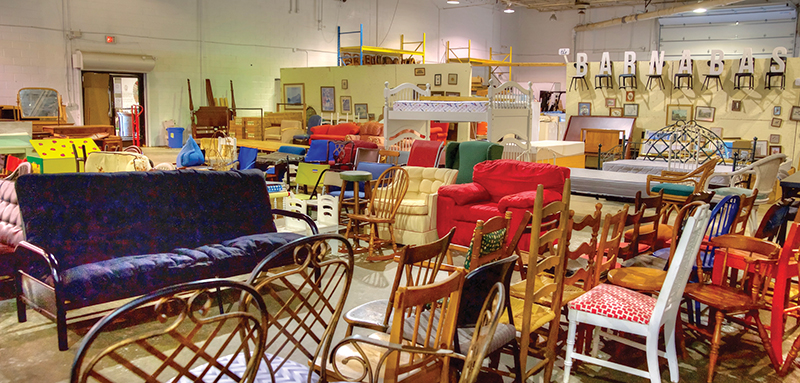
It’s opening time, a little after 8 a.m. on a chill and misty morning in late autumn, and already potential clients of the nonprofit organization that provides donated furniture and household items to families and individuals in transition have already begun to gather outside the organization’s 26,000-square-foot facility on 16th Street, the former battery and tire center of the late Montgomery Ward store that previously occupied the site.

Formed in late 2005 by a group of concerned parishioners at Holy Trinity Episcopal Church and quickly joined by other Gate City residents who shared the view that a key to rebuilding lives is having the stability of a decently furnished apartment or house, Barnabas last year has served more than 1,000 households and 3,000 individuals.
Version 2

In the spirit of Saint Barnabas, described in the Acts of the Apostles as Saint Paul’s missionary traveling partner who brought Christianity to the Hellenic world of gentiles in A.D. 59, the staff of two full-time and seven part-time employees operates on a budget of roughly $400,000 a year and relies on a network of 170 different coordinated local social service agencies to screen and refer a broad section of clients, including many who were formerly homeless or disabled. Upon the proper screening and assessment of a family or individual’s household needs, the household basics — everything from refrigerators to dishes, dining room tables to teapots — are matched to the client’s specific needs.  The organization’s motto is “Recycling Furniture, Restoring Lives.”

“Barnabas was known as the Son of Encouragement — and that’s the spirit in which we operate,” says Owens, who left a successful news service career in New York to enter the nonprofit world, joining Barnabas seven years ago. “Most of us can’t imagine what it’s like not to have a decent bed to sleep in or a home that is comfortable and secure, a place to begin the process of rebuilding a life. A table, a plate, even a set of chairs can change a life,” he says. Many of Barnabas’ clients come from rehab or are fleeing domestic violence: “The stories are as diverse as they are heartbreaking — and are starting over with little or nothing. Furniture is expensive.” Owens says that by providing good recycled furniture and household necessities, Barnabas hopes families “take the next steps to provide for their families and take care of themselves. Good home furnishings keep families together.”

The angels of the Barnabas Network are everywhere in the Gate City, Owens adds, manifest in the volunteer efforts of more than 100 volunteers and hundreds of residents who donate  furniture and every household item imaginable on a regular basis.  Tuesdays through Saturdays, staff members pick up donated items and deliver them to an average of six client households  per day on Tuesdays through Fridays.

Then there are folks like George Rettie, who came aboard on the heels of a 30-plus-year career at Guilford Building Supply. From a woodshop full of donated supplies that rivals his former domain, Rettie repairs, restores and even builds custom pieces for clients. “For me,” he says, “this is simply great karma — using my God-given skills to help others get back into life. I love bringing furniture back to life. That’s what this place does for people.”

“And the blessings  keep coming,” says Erin Owens. Supported by a recent fundraising campaign chaired up by Greensboro philanthropist Bobby Long and wife Kathryn, Barnabas will soon move to a permanent home at 838 Winston Street, a gift from Mary Hart Orr and Katie Rose, daughters of the late John Ellison. The building formerly housed machinery that served the textile industry.

“The new building is roughly half the size of our current one,” notes Owens, “but the way it is set up will enable us to process goods even quicker and serve many more people. This year we helped secure more than 1,000 families. Next year we’re aiming for 1,300. It’s true neighbor helping neighbor.”  OH

For more information (336) 370-4002 or visit Info@thebarnabasnetwork.org

The Art of Healing

The medicinal value of arts and gardens at the Cone Health Cancer Center

By Cynthia Adams
light5

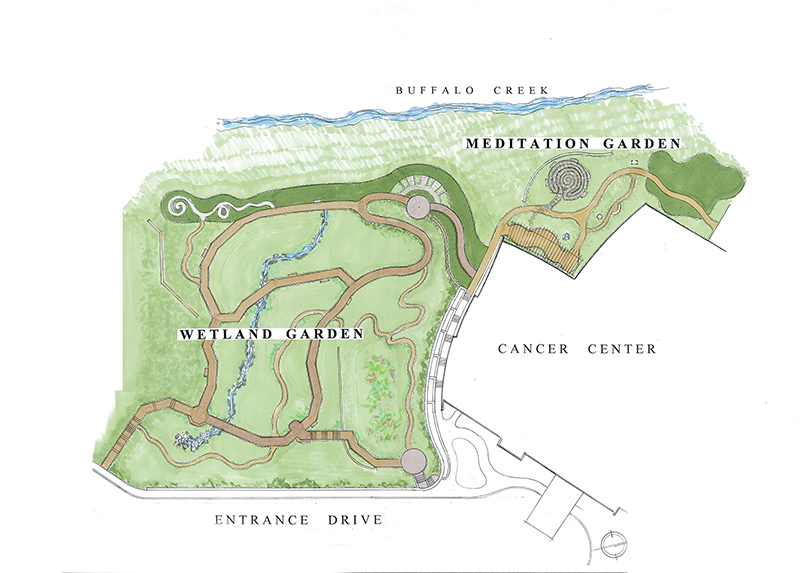
landscape artist and a philanthropist stand in a former eyesore in the autumn sun at the Cancer Center at Wesley Long Hospital.  The last time I was here was with my mother, a breast cancer patient at the Cancer Center. (Breast cancer brings the largest number of patients to the facility.) The wetlands abutting Buffalo Creek were once hidden by a concrete wall on purpose — they were an afterthought, scruffy and forgotten. 

Sally Pagliai, landscape architect, and Pam Barrett, senior philanthropy officer for Cone Health, talk in a rush about the transformation of a forlorn place into a biodiverse healing garden.

Getting out into nature and onto the rambling paths of the garden helps patients and families cope with the stress of catastrophic illness. Beforehand, families of patients were resigned to the lobby’s stiff-backed chairs and dog-eared magazines as they waited for their loved ones to endure radiation or chemotherapy. In 2006, Pagliai’s husband was treated here when he developed cancer. After his death, a phlebotomist sent her a message. What did she think about designing a healing garden? 
light6

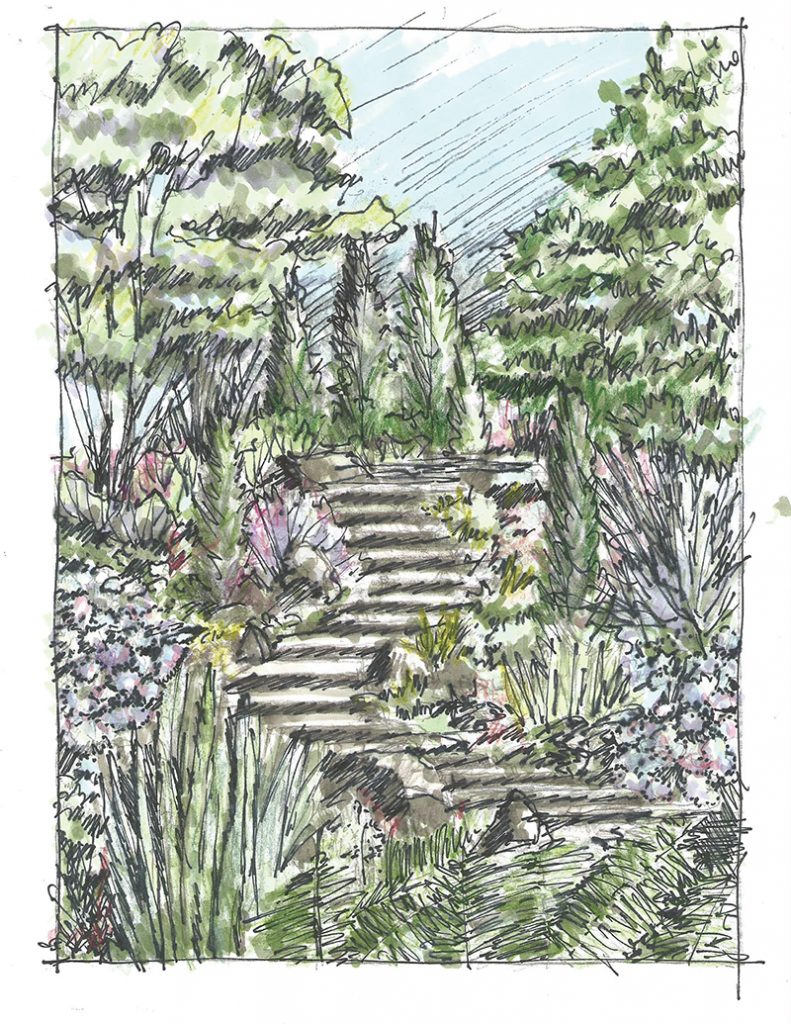
The lanky California transplant knew what she thought. She wanted to do it. Pagliai created beautiful renderings. Like many others who enlisted, she worked for free.  Administrators were eager to help. “One kind soul donated $10,000 to kick start it,” Barrett says. “We did $30,000 worth of work with it,” Paglia adds. 

The ideas rooted and sent up shoots. A nursery owner donated trees. Volunteers helped plant one hundred of them. Foundations and individuals donated planting beds. “The community stepped up,” Barrett says, “and we have nearly met the $1.3 million goal.” The garden opened in June of 2015. There are spaces for rest, reflection. Walkways provide easy (wheelchair-friendly) access to overlooks, patios and benches. There are balconies and patios for cancer patients.

Families donated meaningful plants, such as hellebores, from loved one’s gardens. Somebody provided a gardening shed and supplies. “Gloves, clippers, loppers,” says Pagliai. Twenty-five volunteer gardeners queued up to help keep the pathways. “We were here yesterday, weeding.”

A Japanese maple garden, arbor and new labyrinth are to come. A meditation garden will be constructed near the chemotherapy and radiation treatment areas.

The city, both women say, was incredibly supportive. They helped restore Buffalo Creek’s far bank, removing fallen trees and shoring up the other side. The creek is now a rippling ribbon through the wetland garden. 

Indoors, there is a second aspect, Healing Arts.  Now families can noodle, doodle, color, paint and draw as they wait for patients. Hallways are hung with permanent and temporary artworks. (A photo exhibition is currently on display.)

The program’s reach is almost frightening: In 2014 alone, 69,000 cancer patient visits occurred, and 127,000 visited the adjacent Wesley Long and Emergency Room.  There are 1,475 employees. Then there are the many caregivers, themselves in need of the healing art and green space . . . a riparian scene that is as beautiful as Paglia’s renderings promised.  OH

To donate: ConeHealth.com/HealingGardens
To volunteer: (336) 832-9450.

Royal Flush

Hands For Hearts started as a gamble — and beat the odds

By Nancy Oakley    photographs by Amy Freeman

light7

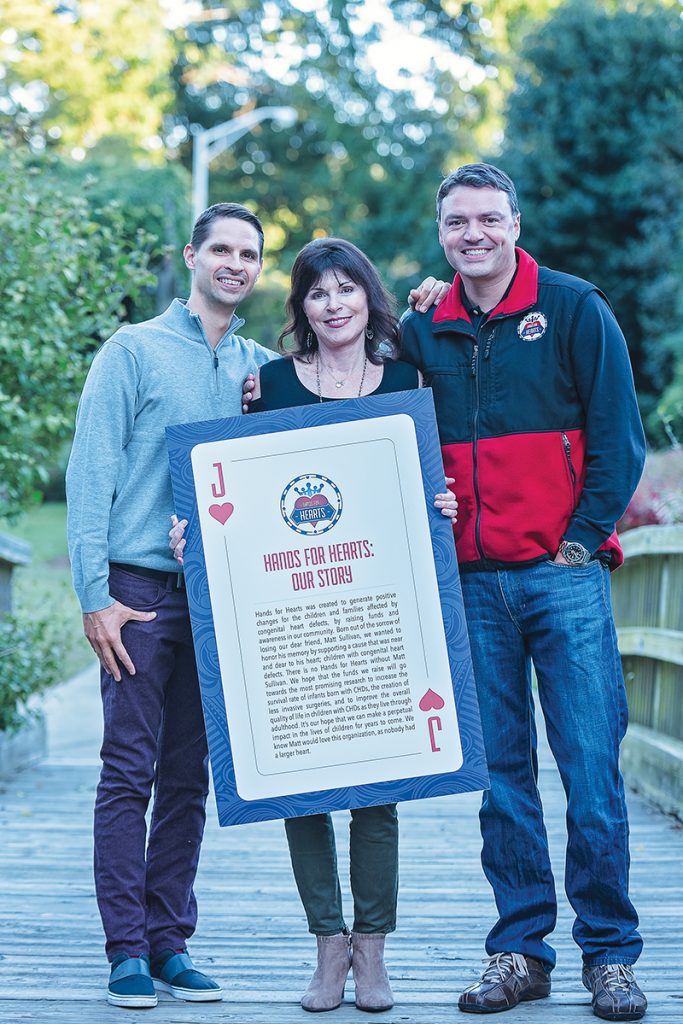
“His smile was sparkling,” says Kathleen Little of her son, Matthew Sullivan. “He loved people and people loved him.” Skotty Wannamaker, a friend of her son’s, agrees. “Matthew was one of those guys who probably had twenty best friends, and I was one of those,” he says. The two met when Wannamaker, a new kid at Page High School, was shooting hoops the second day of school, “and formed a bond immediately,” Wannamaker recalls. One that lasted twenty years — through college, marriage, careers. “Matthew had a heart that went for days,” he adds, reflecting on the friend who would drop whatever he was doing to assist or simply be with his pals. “I don’t know when he slept.”

And Sullivan had a similarly tight bond with his 2 1/2-year-old nephew, Nicholas LaRose. Born with a multiple heart defects — a missing pulmonary artery and a large hole in his heart — Nicholas was in and out of the hospital in his hometown of Charleston, South Carolina, Little says. “Matthew was there for the first open-heart surgery, and just adored him.”

But Matthew Sullivan would leave an irreparable hole in everyone’s hearts and lives in January of 2014. Rounding a curve on his Kawasaki ZX-10R (or Ninja), he went off-road; perhaps because the motorcycle’s kickstand engaged when it shouldn’t have, the 34-year-old was catapulted into mid-air and into a “massive church sign,” says Little. Wannamaker and another close friend, Jeff Fusaiotti, among others couldn’t accept that their friend was gone.  “The only thing we felt we could do,” says Wannamaker, “was to keep him alive by helping kids like Nicholas.”

Where to begin?

Through Nicholas’ mom Nicole LaRose, an occupational therapist at University Medical College of South Carolina, Wannamaker and Fusaiotti started chatting with top surgeons. Fusaiotti also suggested talking with a neighbor, Dr. Greg Fleming, a pediatric cardiologist who worked at Duke Children’s Specialty Services in Greensboro. The same Dr. Fleming had treated Wannamaker’s daughter, Charlotte, who had been born with a heart murmur. The three had a dinner meeting. Then came more meetings with professionals from Duke. “We understood about 15 percent of what they were telling us,” says Wannamaker, a wealth advisor for DHG in High Point.

“But the parts we understood were mind-blowing,” he says. Such as: Congenital heart defects (CHDs) are the No. 1 birth defect in the United States and the world. They can range from a hole in the heart that ultimately closes (as Charlotte Wannamaker’s did), or they can be more severe, such as the multiple defects that Nicholas suffers from. And most are difficult to detect, whether they occur in utero or shortly after birth, sometimes a day or two later. But the encouraging tidbit Matthew Sullivan’s friends learned was that “in the last ten years the mortality rate of CHD kids has decreased 30 percent,” Skotty Wannamaker says. “So the research of the last ten years has trumped the research of the last forty.”

Through another connection of Fusaiotti’s the two discovered Children’s Heart Foundation, a national organization that approves and funds research on CHDs. It was just the vehicle they were seeking for their fledgling nonprofit, Hands For Hearts. The Foundation serves as a “matchmaker,” to use Wannamaker’s term: It approves research projects, which can cover everything from valves to catheters. It also funds studies on conditions such as ADHD, that sometimes accompany CHDs. Hands For Hearts chooses which of the grants to support. Operating as an independent 501(c) (3) with no overhead, Wannamaker says, “We know the scientists, we know the project, we know the timetable, we get updated results. We become a part of the process.”

But Hands For Hearts also has a mission to enhance the lives of local children with CHDs. This summer, the organization partnered with Camp Weaver to do a test-run sending kids to camp. “So 10-year old little girls or boys who have scars running down their chests and worry when they get out of breath have the ability to have an experience in a safe environment with medical professionals where they get to meet other kids just like them,” Wannamaker explains.

To raise the money, Wannamaker, Fusaiotti and Little came up with the idea of a Casino Night held on the last Saturday in February at Greensboro Country Club. The reason? “Matthew loved to gamble,” says Wannamaker, adding, “But he was the worst gambler! I think what he loved more than the gambling, was the camaraderie that came from it.” The event seeks to create the same, with prizes as stakes rather than money, and a King and Queen of Hearts: two local children with CHDs coronated as the charity’s reigning monarchs for a year. Wannamaker credits Little with organizing, spreading the word. “She’s our rock star,” he says, pointing to a recent concert at her home for Hands For Hearts sponsors. He also credits the generosity of the community for stepping up: In just two years Hands For Hearts has raised over $200,000.

As for Little, “I’m just so amazed at what they’ve done,” she says of Matthew’s friends. “They’re two young guys with children and professions who have poured their heart and soul into this,” she says. “They’re such a gift to our family.”

Nicholas, she says, is doing well after surgery in July — possibly his last for another ten years. And Little has started her own healing process, facilitating groups of bereft parents at Beacon Place, and learning Healing Touch, a holistic approach to medicine that is gaining wider acceptance. “Matthew has sent me people,” she says of her overwhelmingly gratifying interactions with the bereaved and the afflicted.

A truly winning hand for the gambler with the lion’s heart.  OH

For information on Hands for Hearts go to handsforhearts.org.

Sustainably Happy

Whitsett’s Peacehaven Farm lives up to its name for
adults with disabilities and for their families

By Annie Ferguson    photographs by Lynn Donovan

light8

Jeff Piegari had just finished a yoga session when asked what he liked about living at Peacehaven Farm. “It’s calm,” he replied.

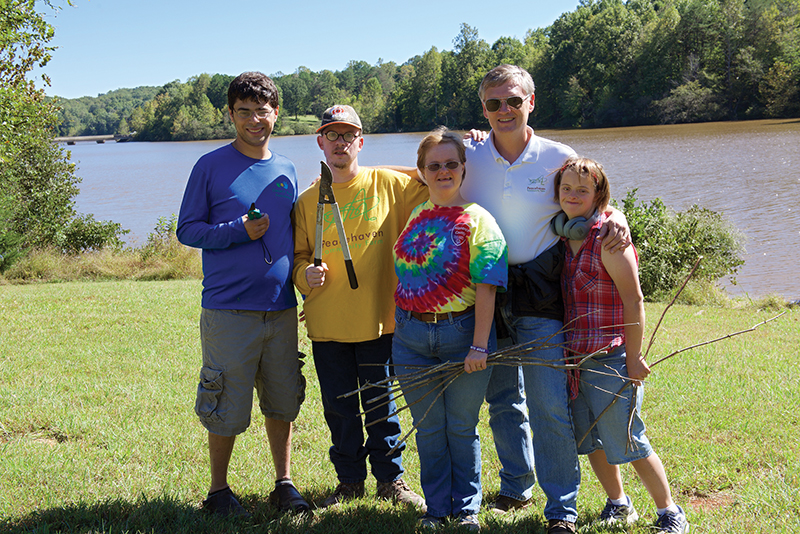
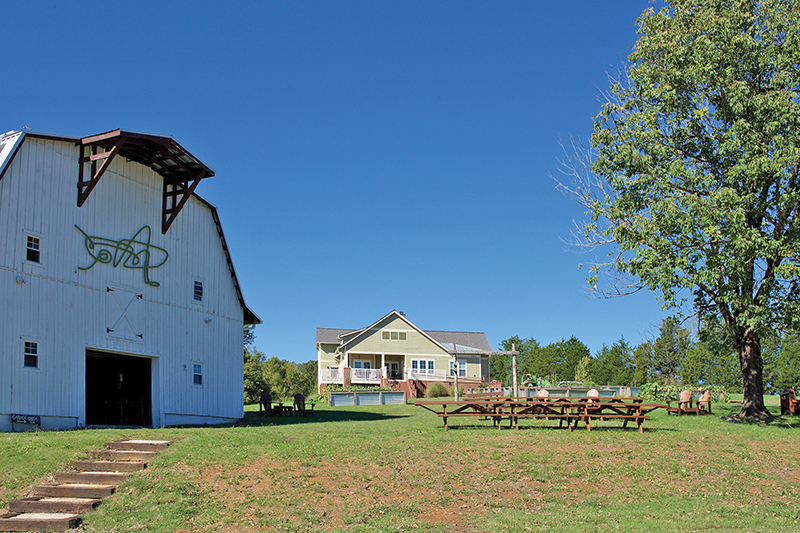
Piegari lives with three other adults who have disabilities (aka core members), along with three resident assistants and a golden retriever named Maverick. The sustainable, 89-acre farm in Whitsett is a place where people of all abilities live and work together. Modeled after the well-known L’Arche Communities, Peacehaven was founded in 2007 by Tim and Susan Elliott along with Buck and Cathy Cochran, two couples familiar with the challenges of raising children with disabilities, who wanted to see their offspring have meaningful adult lives as well.

“I’ve always been open to learning about the challenges and struggles for individuals with disabilities and their families,” says Buck Cochran, Peacehaven’s executive director, a United States Navy veteran and a former associate pastor of Westminster Presbyterian Church in Greensboro. “As a pastor I saw in a larger way how individuals and families can struggle. Their lives can be so isolated. I was interested in finding support — to increase their connection with the larger community, with housing and vocational training, and opportunities to be with people.”

The Elliotts had been his parishioners when they approached him about starting Peacehaven. After the land for it was cleared, construction started on the first group home in 2012, thanks to help from partner Habitat for Humanity of Greensboro. Sadly, Susan Elliott lost her battle with cancer three years prior, but in 2014, her legacy blossomed when the first group home, called Susan’s View, opened. 

“We modeled it after L’Arche Communities, which have been around for more than sixty years. The closest one to us is in Washington D.C.,” Cochran explains. “The idea is that people with disabilities are teachers, too, and that we can help them develop their talents becoming everything they’re created to be.” Plans for additional homes and a community center are in the works with the aim of housing thirty adults with disabilities. Right now the farm has a tremendous need for housing, so Cochran and other staff are doggedly pursuing funding.

In 2015, more than 1,000 people of all ages volunteered at the farm, and many have become regulars. Volunteers come out for Saturday work days, tending to various outdoor projects including the plants — tomatoes, cucumbers, watermelon, peppers, asparagus, sweet potatoes, blueberries and more — all grown sustainably with no chemicals and an eye on water and energy conservation and sustenance for the residents and the community.
light9

Cochran says the biggest surprise in running Peacehaven has been the number of college students who give of their spare time. Nearby Elon University is one school that has been a major support network. “The first couple of years I drove the college students crazy asking why they’re here,” he says. “It’s a generational thing, these folks are really interested in the community and how they can connect what they’re learning in school with real-life stuff.”

Volunteers also offer classes in which residents learn to create. One of the most popular is the fiber arts class using sheep’s wool. “It’s an activity that everyone can find something to be a part of regardless of disability,” Cochran says. “The stuff they make is awesome — a nativity set, soap with felted covers, dryer balls and more.”

Developing talents, relationships and community is the lifeblood of the farm, and Cochran likens it to the area’s Quaker roots. “Quakers have this notion of letting your life speak, and I like to think that we’re doing that as an organization,” he says, “letting the life of the organization speak to the community about important things.”  OH

For more information on Peacehaven Farm, go to peacehavenfarm.org.

On the Road Again

How Wheels4Hope transformed a family’s life

By Maria Johnson    Photographs by Charles Hartis

light10

Here’s what Kasie Hunt’s mornings looked like before she had a car.

She woke up at 6 a.m.

She got her three sons ready for school.

She got herself ready for work.

She hustled the two older boys to their elementary school bus stop by 7:10 a.m.

She ushered her youngest son to his preschool bus stop by 7:45 a.m.

Then, depending on the job and the shift she was working, Kasie, who did not own a car, negotiated a patchwork of transportation.

Sometimes, she caught a city bus that took her downtown, where she transferred to another bus. A one-way trip to work usually ate up an hour-and-a-half.

Other times, Kasie caught a ride with someone who had a car.

“My mom, friends, family, taxis — whoever’s schedule permitted them to help me, and sometimes no one could,” she says.

On Sundays, Kasie and the boys relied on a friend for a ride to church.

There were no spontaneous trips.

The boys had no after-school activities.

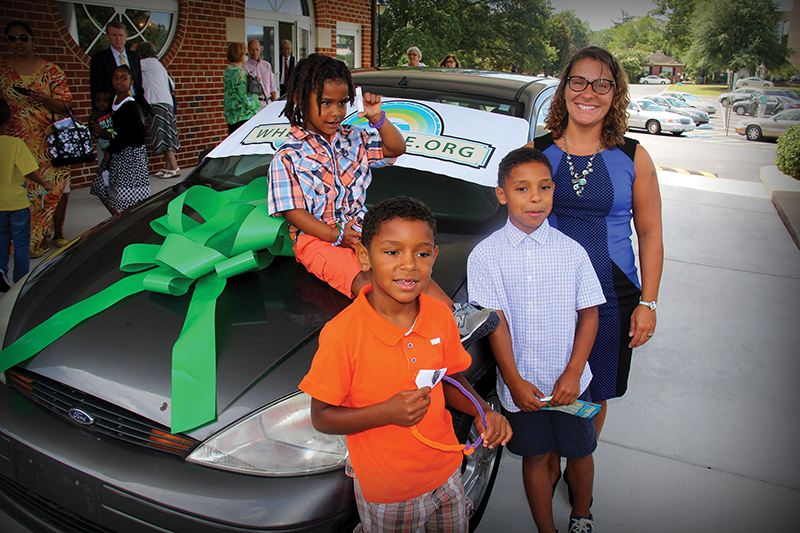
All of that changed in August, when Wheels4Hope made Kasie independently mobile again.

Wheels4Hope is a nonprofit organization that pairs donated cars with people who qualify. Founded in Raleigh in 2000, W4H opened an office and garage in Greensboro in 2012. There’s another location in Asheville.

The Greensboro hub, at 4006 Burlington Road, has matched more than 130 cars with drivers who were referred by local agencies that help people become self-sufficient.

Kasie’s referral came from Partnership Village, a Greensboro Urban Ministry community for formerly homeless people. Kasie has lived there with her sons for the last year-and-a-half. She got sober more than two years ago and started rebuilding her life.

She worked in a school cafeteria for a while. Then, she regained her status as a licensed practical nurse — a privilege that she gave up voluntarily when addiction overwhelmed her — and she started working at a rehabilitation center.

She earned her driver’s license back. The next step was to get a reliable car.

A friend told her about Wheels4Hope.

Like all W4H car recipients, Kasie had to meet several conditions, including the ability to pay $500, plus title and transfer fees, and to show proof of insurance.

Kasie explained, on her W4H application, what having a car would mean to her.

“I think I wrote a page and a half,” she says.

She received her vehicle at a “car blessing” at First Baptist Church in Greensboro.

“Oh man, it was really a good feeling,” she says. “You should have seen the smile on my face.”

Now, she scoots around town in a dark green 2002 Ford Focus. It’s nothing fancy, but it’s a game-changer for Kasie and her family.

“I don’t know anything about the person who gave the car, but you can tell they took really good care of it,” Kasie says.

Her boys play football in after-school leagues now. They go to the public library. And the Greensboro Children’s Museum.  And the PlayPlace at McDonald’s.

“It’s such a good feeling, not to be a burden on someone and to be able to do things for my kids,” says 29-year-old Kasie. “It’s easy to take things for granted, you know?”

People who donate cars to W4H can feel good, too.

When their cars go to people who have been referred by W4H’s partner agencies, donors can claim a tax credit equal to the car’s fair market value, typically between $2,000 and $4,000.

W4H sells the more valuable donated cars on its retail lot. In those cases, donors can claim tax credits equal to the sale prices of the vehicles.

Cars that cannot be driven or that need extensive repair are sold to dealers. Donors can claim at least a $500 tax credit, more if their car sells for over $500.

W4H plows the revenue back into the goal of getting dependable cars to struggling families.

“It’s wonderful to see how excited the recipients are when they receive the keys to their vehicle and a new life,” says W4H spokeswoman Deborah Bryant.  OH

Learn more about Wheels4Hope at wheels4hope.org. The Greensboro office number is (336) 355-9130.

How Their Garden Grows

With faith, hope, love and hundreds of Out of the Garden Project volunteers
all in a (proverbial) row, Don and Kristy Milholin feed the hungry

By Annie Ferguson    photographs by Lynn Donovan

light11

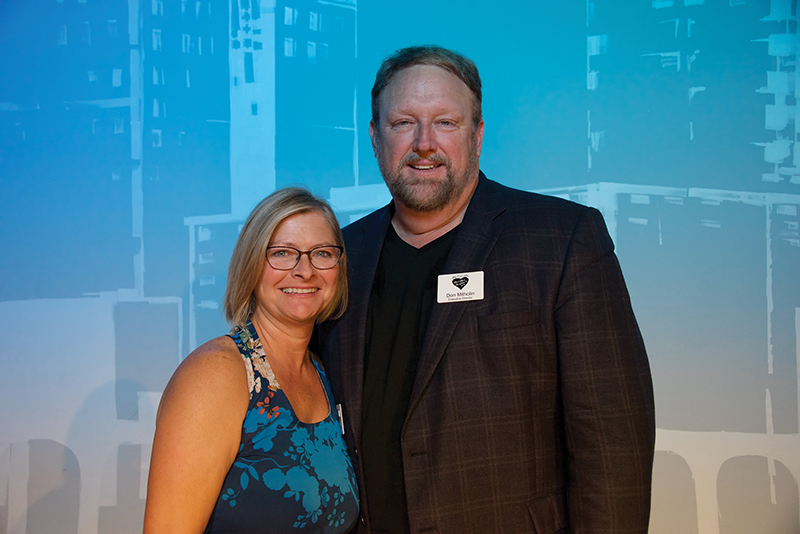
The year 2009 was a tough one for Don and Kristy Milholin. Like so many others, Kristy, a hairstylist, and Don, a church music director, were feeling the crunch of the Great Recession. “But there were people who had it worse,” says Kristy. Therein lay the couple’s mindset and thus the impetus for Out of the Garden Project, the largest organization whose mission is combating childhood hunger in Guilford County. “We learned of six families at Morehead Elementary who needed extra food, so we started packing food for them around our small dining room table,” Kristy explains. “Two or three years before, I kept telling my husband that I felt this aching. I knew I needed to do something, and I didn’t know what it was.”

It turns out the couple found that something and then some. With the help of volunteers, their operation quickly grew. When people started donating money, the Milholins filed for a 501(c)(3) nonprofit organization. “It takes longer than you’d expect,” says Don, the organization’s executive director. “I took a nonprofit management course at Duke, and there I learned it takes about ninety hours to get everything in order.”

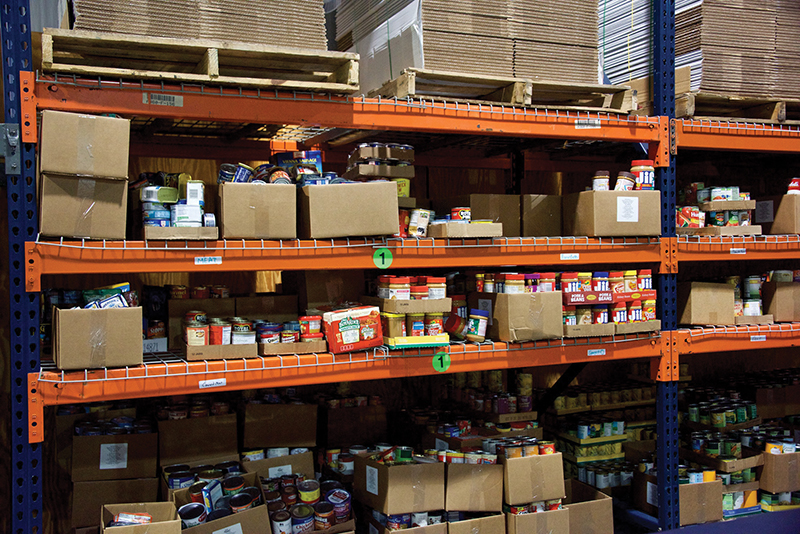
The time-intensive effort has paid dividends by way of the sheer number of meals the project now provides hungry children and their families. Through its various programs operating from a donated warehouse space at C3 Greensboro, Out of the Garden Project yields 100,000 meals a month with the help of 800 volunteers, and by the end of this year it will reach its 5 millionth meal.
light12

“It’s the community that’s built around our tables that’s changing the world, not just a bag of food,” Don says. “One friend comes in, and I always thank him. He says, ‘You know Don, I’m not doing this for you.’ He’s there because he has the feeling that he needs to do something. They all have that heart.”

The fresh food program gets to the heart of Kristy’s calling to feed the hungry. “Fresh Mobile Markets — now our biggest program — sends trucks go out to twenty-two different locations.” Some of them are food deserts, neighborhoods where there’s a shortage of grocery stores for those without cars. Other locations target those who simply don’t have the money to buy groceries. “We include donated produce, meat products, pizza and breads,” Kristy explains. “I find comfort knowing the children don’t have to worry if they’re going to have a meal or not tonight,” says Kristy.

For Kristy, the seed was planted long ago: “Growing up, there was a time when my three siblings and I only had rice and gravy to eat. When my mom landed a better job, we could finally go to the store and pick out what we wanted. I remember getting a cantaloupe. We hadn’t had one in such a long time. When something like this happens to you, you empathize when you get older.”

Don and Kristy host summer camps and started a food reclamation program that saves leftover food from school cafeterias to give to families in need. “Don’s been the innovative thinker in getting food out to children in these unorthodox ways,” Kristy says.

Don explains, “My brain doesn’t function on a linear line. When we see a need and when we think how we can fill a need, often the world thinks of why we shouldn’t do that.” Then the Milholins show everyone why they should.  OH

For more information about Out of the Garden Project and its programs, or how to donate time and money, visit outofthegardenproject.org.

Editor’s note: Out of the Garden was recently selected as a partner with the City of Greensboro, awarded a $470,000 Local Food Program Implementation grant from the federal government.

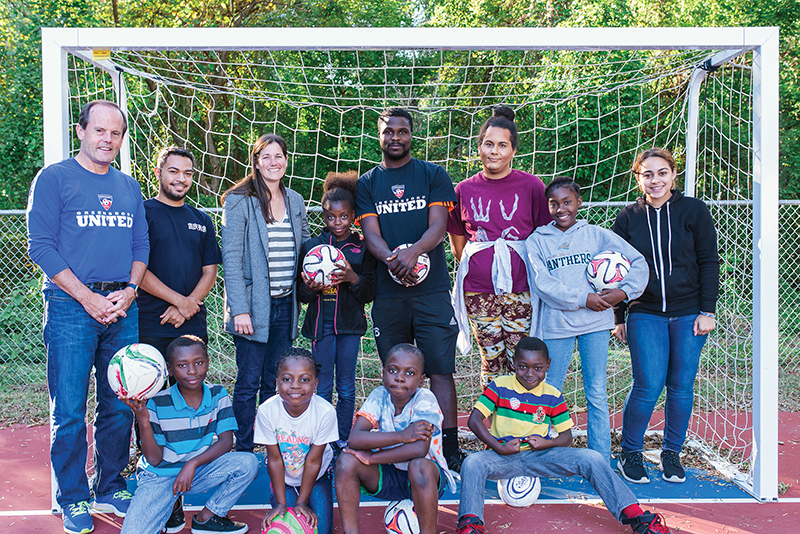
Leveling the Playing Field

How Sari Rose uses soccer to teach the disadvantaged life skills

By Ross Howell Jr.    photographs by Amy Freeman

light13

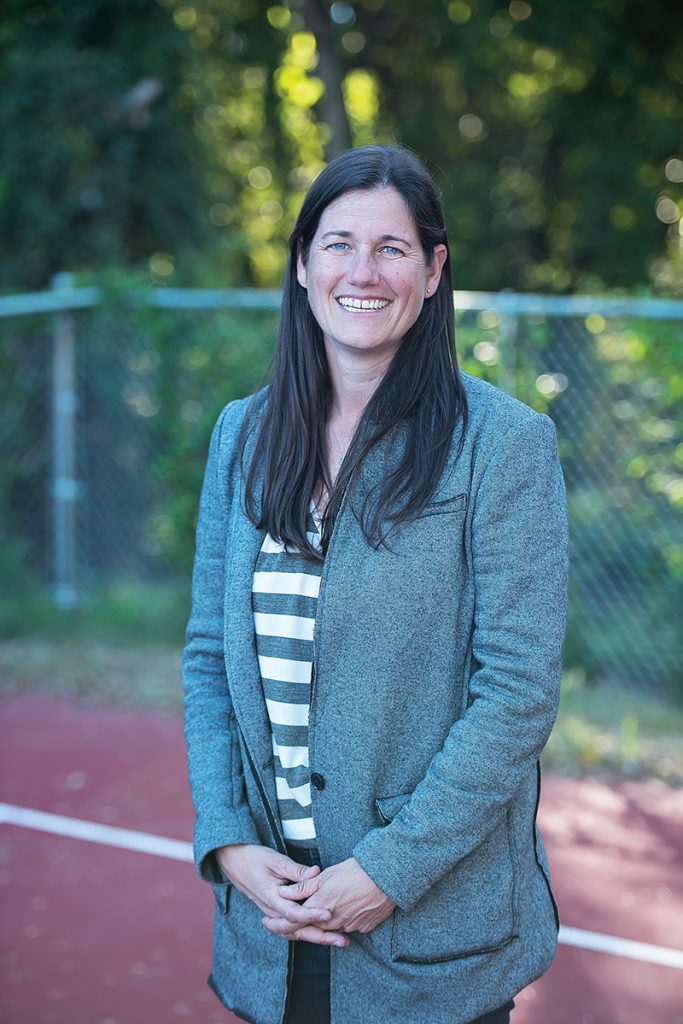
“The reason I left collegiate soccer may sound cheesy,” says
Sari Rose, director of the Greensboro United Soccer Foundation (GUSF). “I played at Wake Forest, then coached. But with double majors — politics and religion — I found myself wanting to work with kids in need.”

The first step was graduate study at UNCG. There, Rose met Thomas Martinek, a professor in the School of Health and Human Sciences. Martinek coordinates graduate pedagogy in the Kinesiology Department and oversees the Community Youth Sports Development program.

“I helped Dr. Martinek run Project Effort and the Youth Leaders Corps [YLC],” Rose says. “Project Effort is an after-school program for elementary and middle school students using physical activity to promote personal and social responsibility. YLC is for high school students.”

“As I was finishing my studies,” she continues, “I approached Pete Polonsky, executive director of the Greensboro United Soccer Association (GUSA), about my idea for a nonprofit. I wanted to work with kids in physical activity and youth leadership from elementary school all the way through high school. Often high school kids have after-school jobs, so the usual activities schedule is out. They can get lost.”

With coaches already working in the community, Polonsky asked Rose if she’d consider running her program through GUSA’s foundation. “What’s funny is that I’d always said my ideal job would be directing a nonprofit using sport to impact the lives of kids and the community in positive ways. Pete was offering me my dream!” Rose recalls.
light14

“Some of the kids in our program are great athletes and some aren’t. So we talk about life skills, success skills. Say we’ll do a drill to improve dribbling and passing. Then we’ll ask, ‘OK, what if you worked that hard on your math at school?’”

The program also offers paid referee positions to kids who need incomes. “We get kids to think about sport as a way to earn income, whether as a referee or coach. We also help them get on track for community college or college, since some of our practice venues are campuses.”

But for many children in need, transportation is a problem. Rose’s solution? “We found a 30-year-old church bus in Hendersonville and raised money to purchase it. An individual donated new tires. So now we drive kids to events in this neon-green bus with purple wheels. They love it!” She smiles. “Well, not everybody is crazy about the purple rims.”

Currently the (GUSF) runs weekly programs in six different schools and the Boys and Girls Club. There is a Saturday Soccer program at Presbyterian Church of the Cross, where Guilford County Police Department officers work with the children.

This past summer, in addition to a Boys and Girls Club camp and a Soccer Nights camp with Cross Fellowship Church, GUSF offered a free soccer camp for refugee children.

“People in the community were incredibly generous,” Rose says, “with food, clothing, hygiene items, shoes, jerseys, caps, gear. Coaches from all over North Carolina donated their time. The kids were so appreciative. Those gruff coaches would be running drills, next thing you know, they’re hugging the kids, encouraging them.”  OH

To learn more about Greensboro United Soccer Foundation, go to
gusafoundation.org.

Makin’ It Happen

From bookbinding to oyster shuckers, Greensboro’s Mini Maker Faire makes its debut

Photographs by Amy Freeman

Wood, wire, metal, plastic, paper . . . Against the whirr and buzz of machinery, and the hum of enthusiastic onlookers, a group of inventors, artists, artisans and entrepreneurs gathered earlier this fall at the Forge in downtown for Greensboro’s first Mini Maker Faire. One of a growing number of communal workspaces, the Forge offers classes in woodworking, metalworking and electronics, all highlighted in various incarnation at the Faire. Call them lost tradecrafts or vocational skills; they were once the stuff of high school curricula and science clubs. Now they’re making a resurgence in the D.I.Y. wave of post-Recesssion, 21st-century America. Below, a few examples of creativity, innovation and skill, which the Gate City obviously has in spades.

minimakerfair3

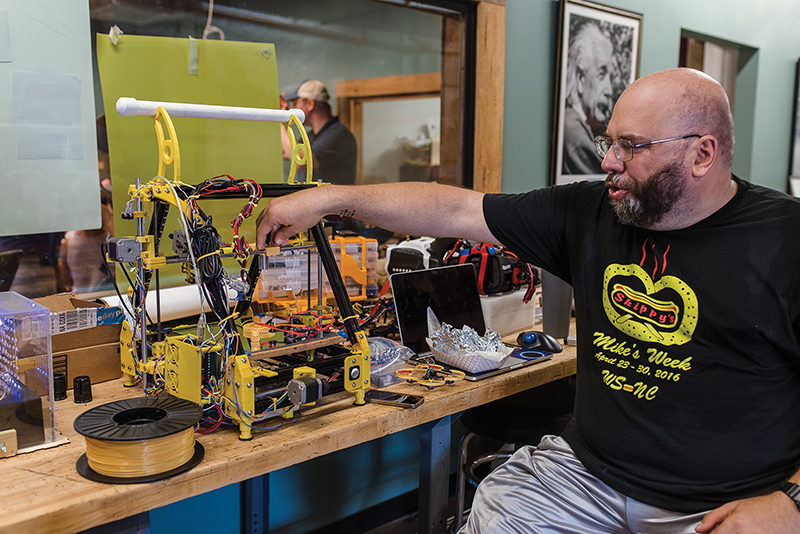
No, this contraption is not an Erector Set, but a 3-D printer. Usually filled with a plastic powder or coils, these machines emit fully sculpted objects that have been plotted on all axes by a computer.

minimakerfair8

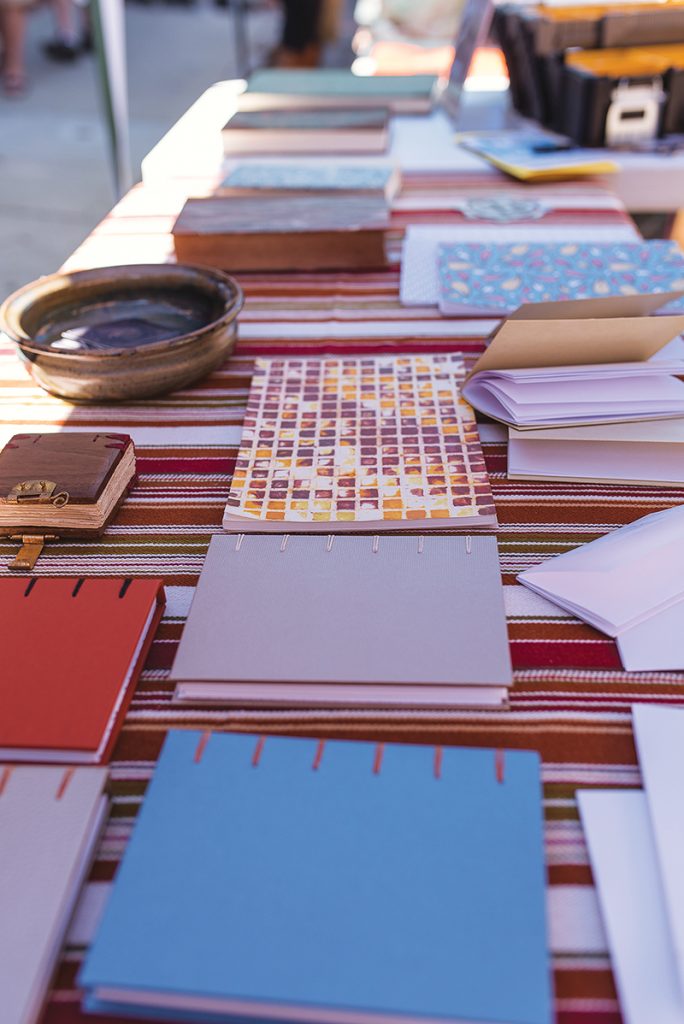
So much for e-books claiming the life of paper and print. Bookbinding is alive and well in the world of Gerald Ward (bibliopathologist.com). The artisan with a B.A. in English and a Masters of Library and Information Science from UNCG fashions journals and sketchbooks for sale, and works as a book and paper conservator. Ward also offers workshops in the traditional craft, including a recent session at Gibb’s Hundred Brewing Company, “Bookbinding and Beer.”

minimakerfair2 minimakerfair1

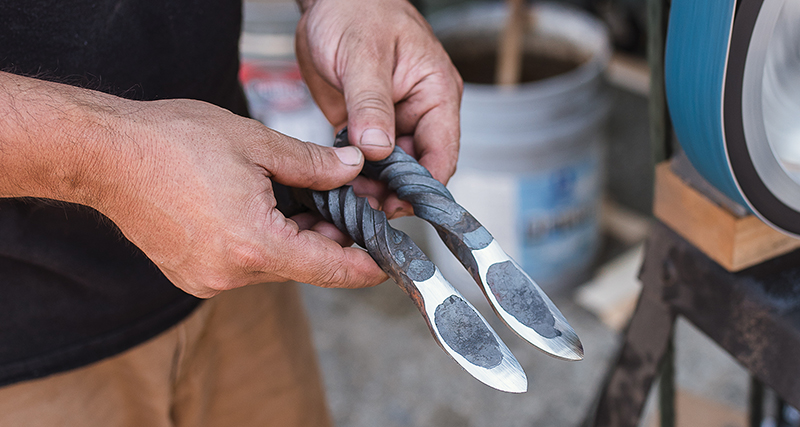
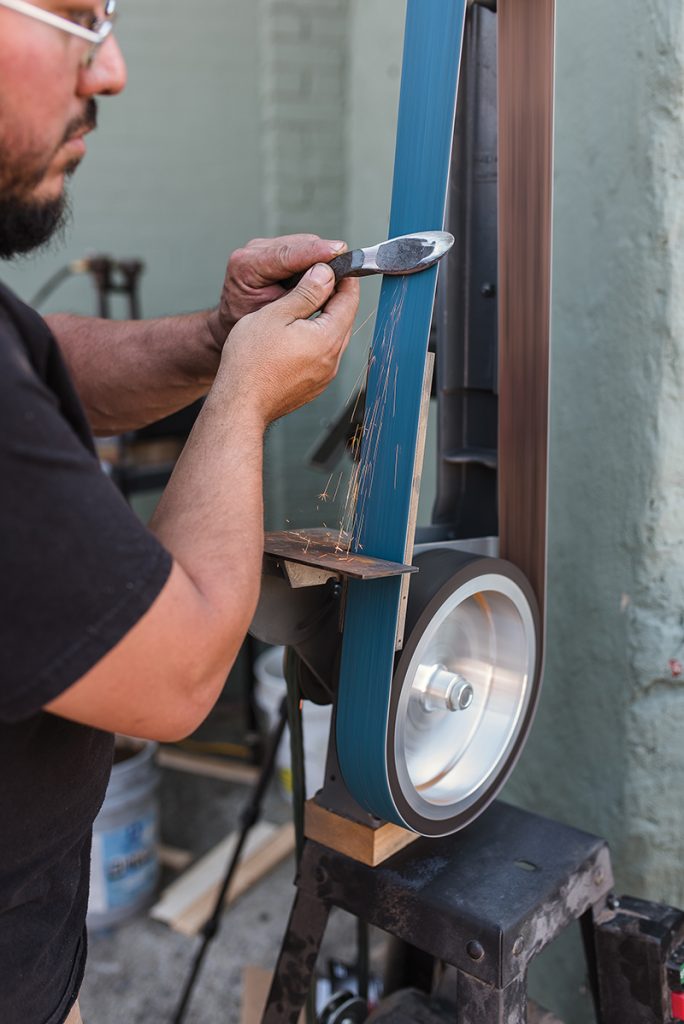
It doesn’t matter whether you pronounce them “oysters” or “ersters.” What does matter is that you can crack their shells. Thanks to Phillip Fuentes, you’re in luck. Though he considers himself a cabinetmaker, the Greensboro resident learned blacksmithing to make the tools of his trade. He is shown here “blacksmithing” his elegant oyster shuckers. Check out Fuentes’ Etsy page at www.etsy.com/people/PFCabinetmaker.

minimakerfair7

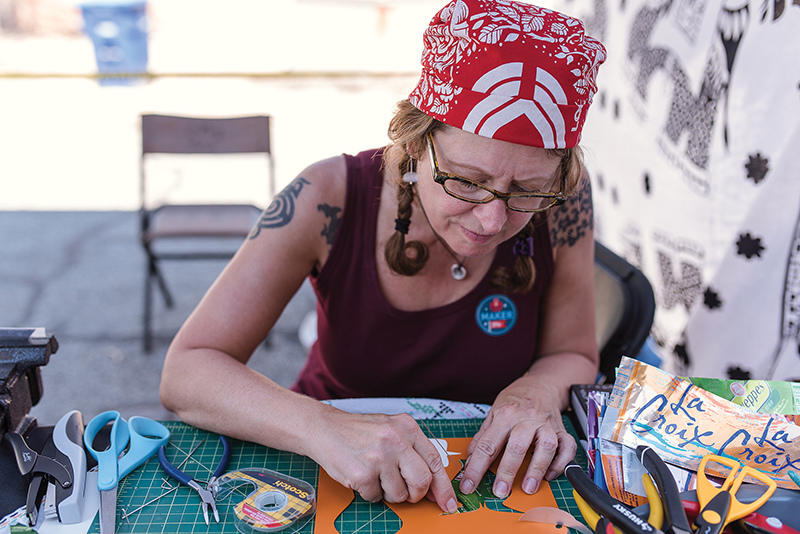
That pinwheel shape you see will be hung aloft as a part of a mobile, those mesmerizing airborne sculptures that move with the air currents. Made from cans, the mobiles are the work of Michelle Folkman (michellefolkman.com), an instructor in digital media and design at Davidson County Community College.

minimakerfair6

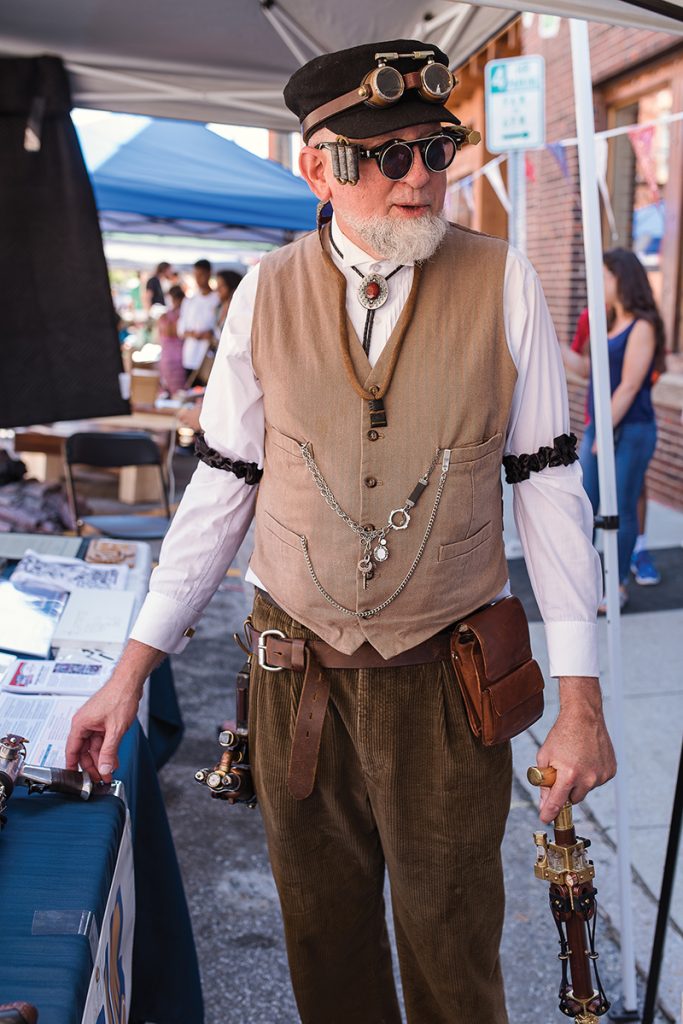
Billing himself as “an author, a scholar, an inventor, an artisan,” Stephen Chapman is an engineer by day and an “enganear” in his spare time. An enthusiast of Steampunk (a subgenre of science fiction incorporating technology and design), Chapman exhibits the inner workings of guns and his novel, The Stonehenge Rift, about a weapons master for a secret organization in 1890s England.

minimakerfair5

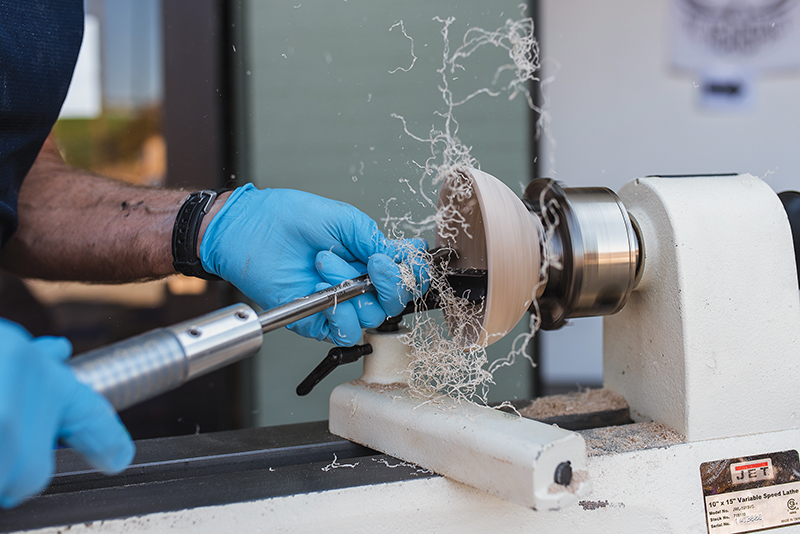
The fine ribbons of wood fiber fly, as Barry Walker turns a bowl into a smooth, fine work of art.

minimakerfair4

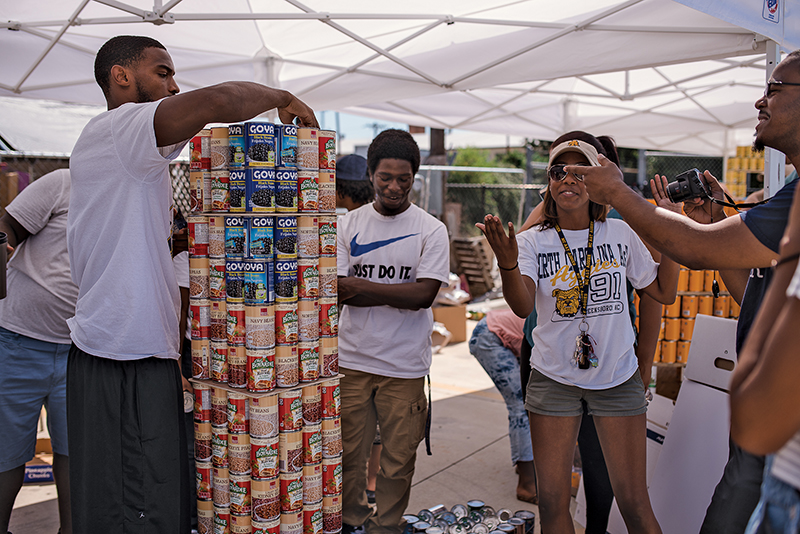
The AIA (American Institute of Architects) hosted a “canstruction” competition, in which participants build structures from cans of food, which are then donated to local food shelters — part of AIA’s mission of “deCANstructing hunger.”

O.Henry Ending

The Lawn Goodbye

One writer’s yard work is never done

By Jeff Paschal

Two deer drinking down at the creek sealed the deal for us. And I suppose many decisions that shape our lives rest on just such thin, unlikely coincidences.

My wife, Beth, and I had moved to Greensboro in 2011, rented awhile, and then began house-hunting around the area. We wanted the following: an affordable place with several bedrooms on the first floor to entice mobility-challenged family to visit, a front porch big enough for multiple rocking chairs, an attached garage because that’s what my Northerner wife expected and a yard expansive enough to entertain our overgrown, brown-and-white shelter mutt, Zoe. 

We toured homes in Greensboro, Summerfield and Browns Summit. All nice places, but in each case there was something that made us keep looking. Then on our first visit to a house out in the country near Oak Ridge, we spied two deer drinking from the creek at the bottom of the property, and that did it. Sold! Not exactly a rational decision, right? We got part of what we wanted in the deal — several first floor bedrooms, a small front porch with a decent-sized back deck, a detached garage and a yard big enough to amuse a pack of hounds.

And like me, the yard itself could be described as ornery and rough around the edges. Actually, it’s also rough in the front, middle and back. Wander around and you’re liable to trip over the occasional half-buried boulder, slip on red-clay bare patches, tromp through weeds (some that bear a disturbing resemblance to red-leafed lettuce), a wealth of wildflowers, a sprinkle of rebellious kudzu, and you may even encounter a little real grass I “planted” by throwing grass seed on the dirt spots before rain storms.

Our country-fried North Carolina yard is a far cry from the lot we left in northeast Ohio. There we were situated in a tidily packaged neighborhood with houses just a few feet apart and tennis court–size yards. Practically all the neighbors had lawns they fussed over with fertilizer, weed-killer, electric driveway edgers and even leaf blowers to neaten up the cut grass after they had mowed. Meanwhile, I was happy just to mow our yard and let the grass go au naturel. Whatever grew, grew. On the other hand, our next-door neighbors actually entered their yard in a beautiful yard contest and got second place. When Beth congratulated them on their award they noted that they would have gotten first place, but somehow a stray dandelion (an apparent escapee from an untnamed neighbor’s unkempt grass) had been found growing in their yard.

Oops.

On another occasion, I was mowing our yard, but the grass kept clogging the mower. A neighbor walked over to assist. He adjusted the angle of the grass chute. That helped a tiny bit, but the problem persisted. Another neighbor joined us. We set the cutting blades a little higher. A wee bit more improvement. Yet another neighbor joined us and we turned the mower upside down for a closer look, the four of us hovering over it like concerned physicians examining a patient afflicted with some exotic disease. But the cure eluded us. A few days later, Beth took the mower to the shop. The repairman took a quick look and asked, “Has your husband recently tried to sharpen the cutting blades himself?” “Yes,” she said. “Well, he’s put the blades back on upside down.”

Ensconced in pastoral Guilford County, I’ve definitely figured out the right way to sharpen and replace mower blades — nowadays for our small lawn tractor. In fact, I’ve even learned how to operate a chainsaw and a 1976 Gravely Commercial 8 Bush Hog. Using the bush hog, I’ve managed to clear away the undergrowth along the creek so you can actually walk along the water. Now frogs, turtles, snakes, fish, beavers, raccoons, all manner of critters, creatures great and small, make appearance and send me straight back to childhood days playing in the woods and by the dairy pond behind my South Carolina boyhood home. And there’s something primal, something calming and healing about walking near water that gurgles and flows in a stream, isn’t there?

Of course, life has its seasons, and there will come a time when the computer keys don’t click in front of me and the lawn equipment has long been silent. I wouldn’t be too surprised to hear the Keeper of the Garden say, “Oh, you’re here. Still rough around the edges, I see. Ah well, I suppose you can come in. What’s one more dandelion?”  OH

When he isn’t doing second rate yard work, Jeff Paschal enjoys feeding spoiled rotten hummingbirds.

The Accidental Astrologer

Laid-back Libra

Don’t let October become “Rocktober” under the sign of the scales

By Astrid Stellanova

There just ainít no pigeon-holing a Libran.
Bridgette Bardot is a Libran. So is Simon Caowell, Julie Andrews. Sting. And Jesse Jackson. The Libran likes the better things in life, likes taking to a public stage, likes being given lots of room to develop their fine talents, but doesn’t much care for grunt work. The Librans I know also don’t like for people around them to kick up a lot of dust and make a fuss.  Ad Astra — Astrid

Libra (September 23–October 22)

You got a hand stuck out, being friendly, wanting to make nice with someone who has tested your last nerve — and they think you stuck your hand out for a gimme. They don’t have the class you do, my well-balanced friend, so the first order of business is to keep your hand to yourself and enjoy the jingling of all that silver that is filling your pocket. You have got a lot of prosperity in the stars waiting for you this year.  And you also have more friends than a body could ever need, so square your shoulders and go enjoy a big ole slice of birthday cake.

Scorpio (October 23–November 21)

There was a time when keeping secrets worked for you. This, however, is not that time. You need a strong shoulder to cry on, and given your natural magnetism, plenty will offer one. The pleasure of a kind word can go further than the deep pleasure you take from maintaining personal mystery—so purge, Honey, and let somebody be a good pal to you.

Sagittarius (November 22–December 21)

A big idea you incubated some time ago is ripe and ready. Don’t hesitate to share it and find the support and dollars you need.  Also, this is a good time to look at all your investments (I call this rooting and hunting under the sofa cushions) and see how much you have on hand to back yourself. Your idea is a good one; you weren’t crazy when you claimed you are this close to Making Good, as Grandpa Hornblower says.

Capricorn (December 22–January 19)

Summer was discombobulating for you, wasn’t it Sugar?  And the fall is looking a little dicey.  But cheer up; you are just going to love the year end. But first, there are two matters that need to be addressed before you have the personal freedom to move on from something that keeps tripping you up. Darling, they are not going away without you putting down the Fritos bag (and getting up off the sofa) in order to show these two matters the door.

Aquarius (January 20–February 18)

Whaa-whaa-whaa . . . That, whaa-whaa sound, Honey Child, is your disillusionment when the happy went right out of your red balloon. You have been killing yourself trying to make someone you care for care for you in the same way. There is nothing more you can do. This person is not as giving, generous, nor nearly as much fun as you are.  And they are never going to be as demonstrative. You got invested, for sure, but do you love them?

Pisces (February 19–March 20)

There, there, there. Feel better?  Did you take to your bed after Sugar Booger left your heart busted into two big pieces?  Well, nobody would have blamed you one bit if you had. They seem to have a contractual obligation to darken your world while you are playing Mary Poppins and trying for sweetness and light. Sweet Thing, shake it off and look for a different type.

Aries (March 21–April 19)

You are about two Alka-Seltzers away from driving your friends and families crazy as a bat in the basement. It is true that you can be entertaining and the life of the party, but right now everybody who knows you wishes you could spend at least one day a week boring the crap out of them. Quiet is not a four-letter word. It’s five, Darling.

Taurus (April 20–May 20)

Someone close to you is convinced you are having a breakthrough just at the very time you feel you are having a breakdown. The other person is right. You have developed a creative genius for seeing a new way to approach a very old problem. It could bring you closer to a dream if you don’t back away. See it through.

Gemini (May 21–June 20)

A mysterious person — somebody you’ve known for some time but never well — has a connection to you that will soon become clear.  This will require you to be open, gentle, pliant and honest in order to enjoy the full benefit of a special revelation. Honey, I know that’s a tall order, but for your own sake, try.

Cancer (June 21–July 22)

Thankfully, you took old Astrid’s advice about last month and stopped borrowing money and began making your own. Now, Sugar, I want you to stop thinking you can borrow time. This ain’t a dress rehearsal — it’s your life you have been blowing like you were on the easy credit life extension plan. Do. Not. Waste. One. More. Second. You aren’t about to die but you also won’t get endless chances to take care of business.

Leo (July 23–August 22)

You’ve had a funny feeling about a loved one that actually is your deepest intuition talking to you.  Trust it. Rely upon it. You have considerable intuitive abilities that have been building since early adulthood. This is not lottery winning-type information, and doesn’t require a Ouija board, but it sure is about expanding your world, happiness and friendships with others. That, Dearie, is the real jackpot.

Virgo (August 23–September 22)

Something started for you last month that you might not secretly trust but that you should.  It was an unusual gift — and you were deeply puzzled at first. This gift is going to change you, change your life and even change your mind about who you are. Honey, it is going to be a crazy ride for you but there is no question it is your destiny to follow the Yellow Brick Road. Get hopping.  OH

For years, Astrid Stellanova owned and operated Curl Up and Dye Beauty Salon in the boondocks of North Carolina until arthritic fingers and her popular astrological readings provoked a new career path.

Almanac

October

The Feast of Trumpets

a shrunken apple head is sitting next to a ripe red apple on a wooden table.

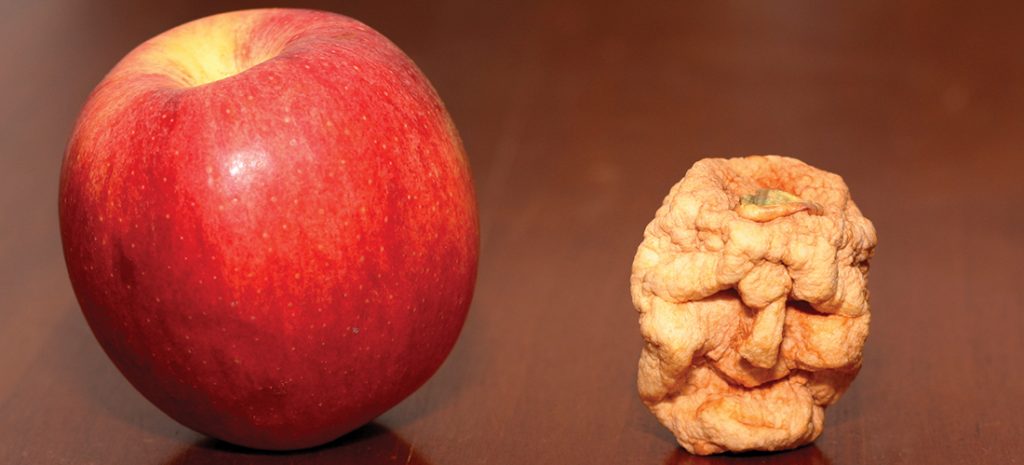
Rosh Hashanah begins at sundown on October 2. Also called the Feast of the Trumpets, this two-day Jewish New Year celebration includes the ritualistic sounding of the ancient shofar (ram’s horn) and foods to evoke shana tova u’metukaha good and sweet year. Since now is the time of the apple harvest, what sweeter way to celebrate than with a Red or Golden delicious, fresh from the tree? By dipping said fruit in honey, of course. Consider this tasty Jewish custom when your neighbor presents you with a basketful of local apples, but don’t let it stop you from experimenting with cobblers and crisps, cinnamon-laced ciders, and in the spirit of Halloween, perhaps even shrunken apple heads. Granny Smiths work well for this — best if cored and peeled.

Using the tip of a pen, make indentions to guide your carvings. Cut hollows for the mouth and eyes, and carve away the apple flesh around the nose. Exaggerate the features. Your second apple will be better than the first, et cetera, but failed carvings spell homemade pie, so you might flub a few just for fun. Next, soak the carved apple heads in a mixture of lemon juice (1 cup) and salt (1 tablespoon) for a few minutes to help keep the fruit from molding. Pat dry. Now all that’s left to do is wait. A food dehydrator is the fastest and easiest way to dry out — aka shrink — your apple head, but a warm, well-ventilated area should also work. Since the drying process can take over a week, you’ll want to entertain yourself with other projects. In the spirit of carnival season, how about apple juggling?

Speaking of carving, did you know that the first jack-o’-lanterns weren’t made out of pumpkins? Named for the Irish folktale of Stingy Jack — a man who twice fooled the devil yet unknowingly doomed his soul to roam the Earth until the end of time — the tradition of carving grotesque faces into turnips and potatoes to scare off evil spirits is centuries-old. According to legend, Jack’s ghost carries a hollowed turnip aglow with an ember from the fires of Hell. Bet you can guess what happened when Irish immigrants came across their first pumpkin patch.

“Corn and grain, corn and grain,

All that falls shall rise again.”

–Harvest Chant

National Runner-up

Marigolds are the birth flower of October. Known as the ‘herb of the sun’, these vibrant yellow, red and orange flowers were carried as love charms in the Middle Ages. Although Victorian flower language experts believe them to be symbols of grief, many associate marigolds with optimism. Burpee president David Burpee must have been among them. In the late 1960s, the seed salesman launched a spirited campaign for marigolds to be named the national flower. We chose the rose.

“Autumn is the hardest season. The leaves are all falling, and they’re falling like they’re falling in love with the ground.”

― Andrea Gibson, poet

Herbs to Plant this Month:

Dill – Aids with digestion and insomnia.

Oregano – Used to treat skin conditions.

Sage – Increases recall ability.

Fennel — Improves kidneys, spleen,
liver and lungs.

The Best Planting Time

Tulip and daffodil bulbs will color your spring garden brilliant if you plant them before the ground freezes. Allow yourself to dream. Imagine your home nestled in a grove of golden flowers, fringed blooms spilling out of planters, window boxes, busted rain boots. The more bulbs you plant the better — and plant them at random. Save pumpkin seeds to plant in spring. 

Two vibrant  spring  fancy yellow and orange tulips arranged against a white background.

The Queen of Wild Ginger

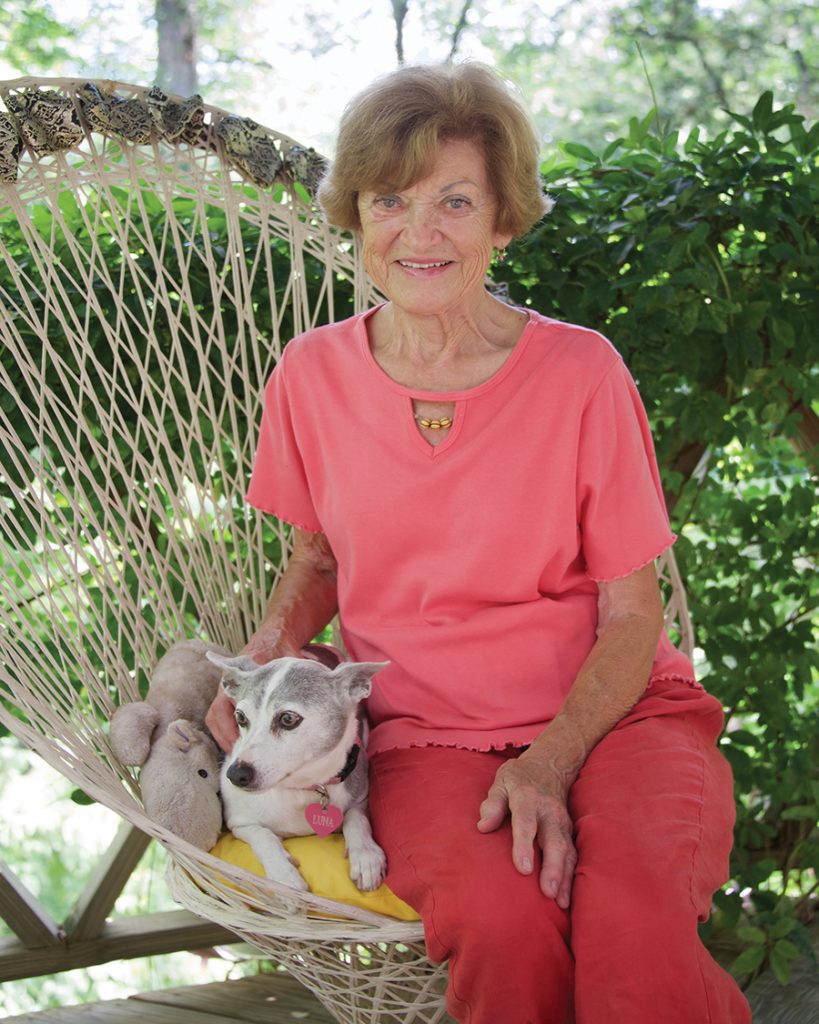
The life and times and gardens of Professor Peyton Hudson

By Ross Howell Jr.     Photographs By Lynn Donovan

ginger3

If you enjoy adventurous spirits, then you need to meet Peyton Hudson.

Hailing from Maryland, she began her college studies at the University of Delaware. Though her father, a physician, wanted her to study medicine, she found her passion in textiles and fashion.

After a divorce in 1968, Hudson moved cross-country with two young daughters, Adrienne and Peyton, to Nevada, where she taught, worked as an extension agent and began working on a doctorate in textiles.

“I don’t know how I did it,” she said in a News & Record interview years ago. “I’m working on a degree, I’m teaching all the time, I’m putting a hot meal on the table every night, and it’s not out of a box.”

Hudson came to UNCG in 1971 to complete her Ph.D. A popular professor at the university, she later accepted a position at the N.C. State School of Textiles, now the College of Textiles.

She was something of a pioneer, one of just three women in that program. She wrote a textbook on manufacturing apparel and cowrote a textbook on the science of textiles. In 1995, she left academics to launch a successful consulting business.

ginger1

Perhaps her most adventurous decision was made in 1975 when Hudson decided to purchase the main house and a 6-acre tract of land in Guilford College that was part of the old Guy M. Turner estate. Built in 1939, the big house had been added onto when Turner’s wife, Ida, was still living.

“Ida was from Virginia and she was a real gardener with true imagination,” Hudson says. “We’ve been able to reclaim most of her beds. You can still feel her spirit here, even though she passed away long before I bought this property. She must have seen herself as an FFV [First Family of Virginia], since she always had a cook and a maid to keep house — not to mention a full-time gardener.”

Hudson would have no such help. Worse, the property had been left vacant for three years. The house had mold problems and the gardens were choked with vines and weeds.

But Hudson was undaunted.

“I wanted to have a place where my daughters could ride their horses,” she says. “I could only get together enough financing for half the purchase price. So my parents signed a note for the other half.”

And then came a job offer in Raleigh: “I still had one daughter in high school in Greensboro,” she recalls. “It just didn’t seem right to try to go back and forth to work with a teenage daughter at home.” But she says her daughter, Peyton, insisted that she take the job. “Lo and behold,” Hudson says, “she was one of the students selected for the first group to study at the North Carolina School of Science and Math in Durham.”

Enter Howard Coble. The basement of the house was empty but had a huge fireplace and Hudson often used it for entertaining. “Well, one evening Howard Coble was over,” she says, referring to late U.S. Congressman (a UNCG scholarship was recently established in his memory.) “He was an officer in the Coast Guard then, still living at home with his parents,” Hudson continues. “He said he thought the basement would be a great place for him to live. So I said, ‘Well, I’ll fix up an apartment for you, Howard, but it will take a while, because I don’t have much money.’” Over time she added a bathroom, refrigerator, cook stove . . . “everything anybody would need to live there, and in 1978, Howard started renting it from me for $225 a month.”

After a number of years, Coble decided to run for Congress and was elected. “I decided since his situation and finances had improved, I’d raise his rent,” Hudson says. “Howard was very frugal, you know, and when I told him I was going to raise his rent to $250, he said he thought that was an absolutely outrageous amount to pay. So he bought a nice condominium in Guilford College.

“I think, too, he felt he’d reached a stage in his career where he believed some people would think it unseemly for him to be living in a basement apartment in somebody else’s house.”

Later, an assistant district attorney for Guilford County, Susan Bray, rented the apartment, which had come to be known as the “Congressional Suite.” Bray later bought a house nearby and is now the Resident Judge, North Carolina Superior Court, Eighteenth Judicial District.

“When Susan was living in the basement apartment,” Hudson says, “she used to joke that we should call it the ‘Congressional and Judicial Suite.’”

Hudson is telling me all this over the phone, as she prepares for yet another adventure, this time in the Midwest.

“I have so many things to take care of today, I think it would be just too rushed for us to get together now,” she says.

If Hudson is feeling rushed, you’d never know it. Her speech is measured, enthusiastic, confident. She’s booked tickets for a nine-day excursion on the Mississippi River aboard a paddle-wheeler sailing from Minneapolis (Red Wing), Minnesota, to St. Louis (Alton), Missouri — to celebrate her 81st birthday.

“Mark Twain has always been one of my favorite authors,” she says. “My daughter Peyton and I are sailing on a part of the river he used to navigate as a steamboat captain.” She pauses. “But you must have a look at the gardens. Just get in touch with Jim while I’m away. I’ll give you his number.”

And that brings us to the current basement apartment occupant, retired Greensboro police officer James Crabtree.

“When Jim moved in the apartment, Susan Bray said we should just call it ‘Law and Order,’” Hudson says. “She’s so clever! Anyway, Jim’s a great help with the gardens. But you know men. They won’t weed. And they never seem to think they’re accomplishing anything unless they’re making a lot of noise with something with a motor attached.”

That she’s sharing this view on the phone with a male gardener gives her no pause.

I express her sentiment to Crabtree after I park my car in the drive of Hudson’s home. The day is humid. He’s been working outside and his brow is sweaty. He listens, pursing his lips, so his moustache rises on one side.

“Seems like ladies always sing from the same hymnal,” he says. “I’d say I’m pretty good about the weeding. As for the motors, I always tell Peyton if she doesn’t keep her equipment in working order, then it won’t be there for her when she needs it.”

In Crabtree’s defense, there’s a lot to maintain.

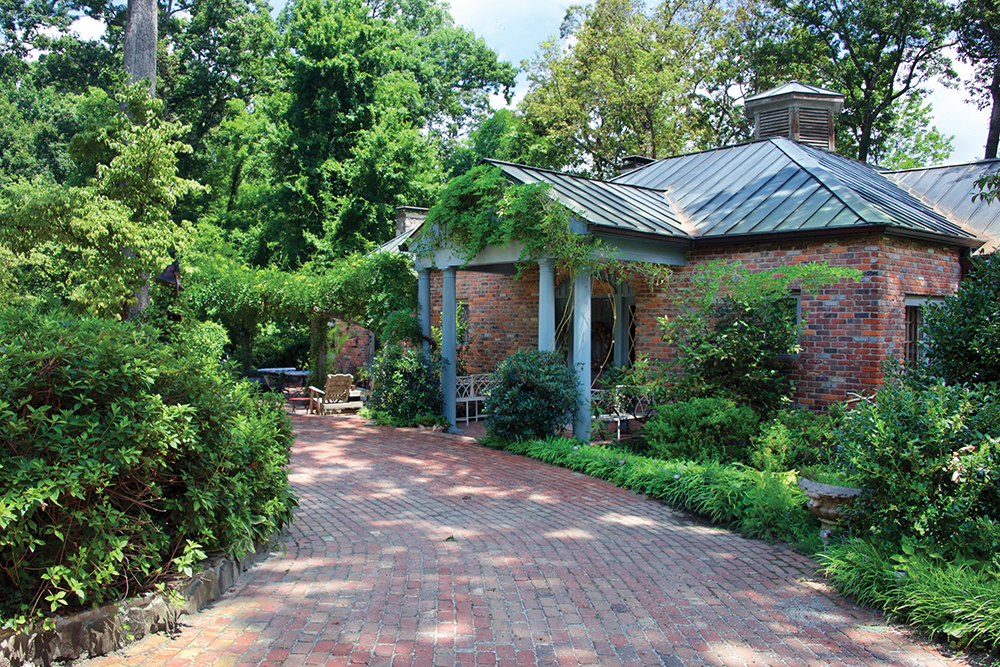
Hudson’s beds start with plantings at the entrance, continuing down a long brick circular drive. There’s a profusion of Japanese maples, elephant ears, hydrangeas, coreopsis, cone flowers, wisteria, and many other plants and shrubs under a canopy of oaks, maples, magnolias, tulip poplars and mimosa.

In front of the house is a massive bed of old azaleas. In our conversation Hudson had told me to look for a post in the bed. I see it. Facing me, nearly covered with clematis, is a black metal plate in the shape of a steam locomotive with a number and the name, “Guy M. Turner.” A Chesapeake & Ohio locomotive bell, removed by a previous owner, had been mounted atop the post. Before Turner, the original owner of the property, started his own business, he had worked for the C&O Railway.

Near the post is a big owl statue, carved from cypress by an artist in Colfax. There are smaller forest creatures carved in the wood, including a terrapin and a frog. Near the owl statue is a garden where water spills over stone steps into a pool with water hyacinths boasting spectacular purple blossoms.

Next to the house is a bed of Queen Anne’s lace and dill, and at the foundations, a bed of ferns. Chocolate vine, trumpet vine, and wisteria festoon a bower beside the house and railings along the deck at the side all the way to the back of the house.

There are plants growing everywhere, not all of them invited. Bamboo grass and ragweed peek from some of the beds, and here and there, a poplar or oak sprouts. The sheer volume of vegetative life is comforting, and nearly overwhelming.

Oak sprouts sparked considerable consternation a few years back.

“Peyton just hates acorns,” Crabtree says, “because they’ll sprout in her beds. Well, one of her business clients wove these wide swaths of fabric on special machines — imported from Italy, I think.” Crabtree explains how the fabric was stretched on cables from tree to tree. “It was real shimmery, used mostly to make women’s underclothes and nightgowns, that kind of thing. ‘Nylon tricot’ is what Peyton calls it.

“Well, the canopies kept the acorns out of the beds like a charm,” Crabtree explains, “but the neighbors wondered what the heck was going on, with all this pink and blue stuff hanging in the trees. Some got pretty worked up about it.”

Crabtree grins, looking at me over the rims of his glasses.

“And Peyton hadn’t thought about Google,” he says. “You go to Google Maps and search the neighborhood, you’ll see a picture with big patches of pink and blue in the woods!”

I grin too, thinking about unintended consequences, and look across the brick drive to a vegetable garden with an electric fence to dissuade deer. Beyond is a garage with a small greenhouse attached. From there the land falls toward a lake, with a variety of plants under a continuing canopy of hardwoods.

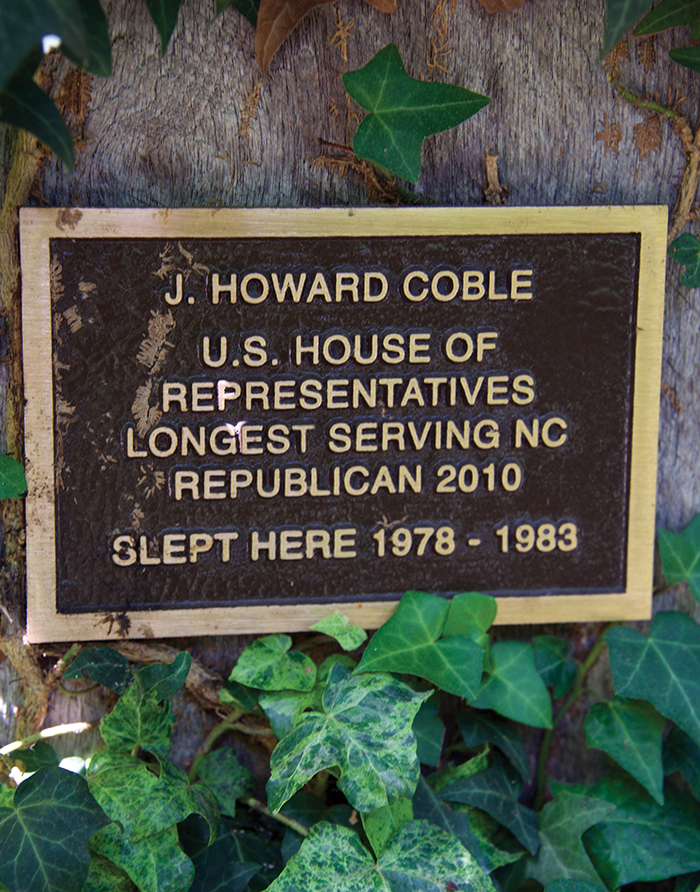
We walk along the deck to the back of the house. There’s a door, the entrance to the basement apartment. By it is a plaque that reads, “J. Howard Coble U.S. House of Representatives Longest Serving N.C. Republican 2010 Slept Here 1978–1983.”

ginger

“I’d show you inside,” Crabtree says, “but I’m not much of a housekeeper.” He’s carefully weaving chocolate vine runners into the mass of foliage along the deck railing. I peer over the side, looking toward the lake. Directly below us is a gleaming white terrace, mulched with oyster shells.

“Before she decided on the brick,” Crabtree says, “Peyton was going to put in a tabby drive. I hauled those shells in a trailer from the old Green’s Supper Club. I was grinding them for the tabby, but then the grinder gave out, so Peyton decided to use them on the terrace.”

Crabtree explains that bamboo had invaded the area. “We were able to get rid of it using a formula of vinegar and salt. But a few stalks still volunteer. Peyton paints them with weed killer by hand.”

I notice little pink flags scattered on the bank near the lake.

“Oh, Peyton’s very careful to mark the wild ginger,” Crabtree says. “She says it’s common in the mountains, but here in the piedmont, it’s rare.”

The wild ginger hugs the earth, its heart-shaped, dark green variegated leaves glistening in the sunlight. A hummingbird whirs toward a flower bed beside the house, where yellow swallowtail butterflies are sampling blooms. Cicadas drone in the trees.

“People don’t realize all this is here,” Crabtree says. “Right here in Guilford College.”

The cicadas fall silent for a moment, as if breathless for the return of the lady of the house.

And in a few days, return she does. With a tale of adventure greater than a mere excursion on the mighty Mississippi. On her flights back from Missouri, a computer system failure left her stranded in the Atlanta airport for nearly twenty hours.

“They didn’t even offer us a cup of coffee,” Hudson says. “Just a cheap red polyester blanket! I haven’t slept in twenty-four hours. Did Jim show you the wild ginger?”

She’s chatty, articulate, funny, as we speak on the phone. If she’s tired, you’d never know it.

Peyton Hudson — professor, businesswoman, passionate gardener.  OH

Ross Howell Jr. is at work on the project he wrote about in “So Delightful an Occupation,” an essay about Jefferson’s gardens in last month’s O. Henry, and, with a lone leaf clinging to a single stem of the Carolina allspice given him by a friend, hoping for a miracle.

The Nutty Professor

Meet the man responsible for saving and spreading chestnut trees

By Maria Johnson

nutty

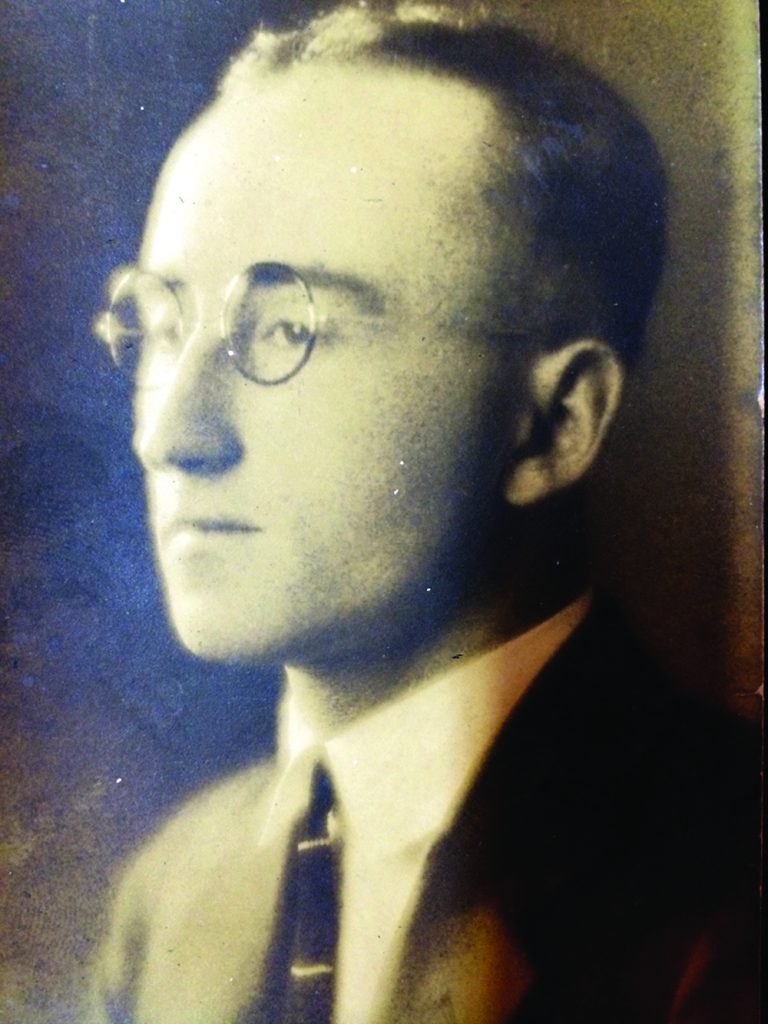
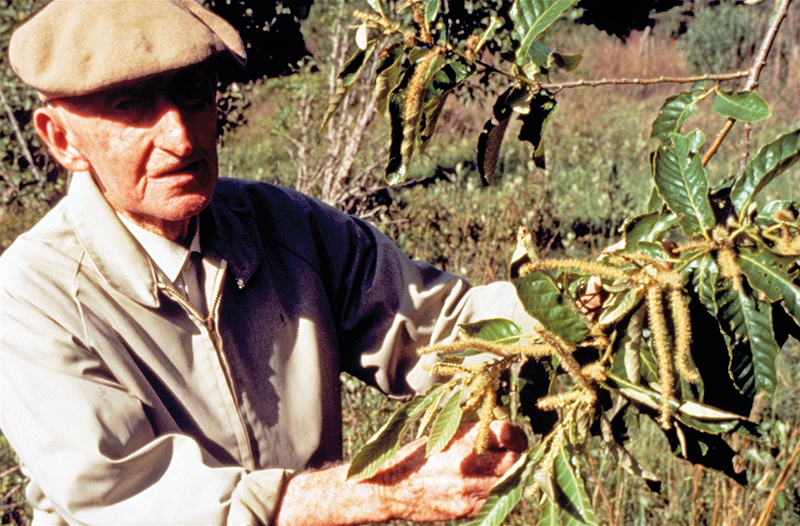
This harvest season, if you find yourself sipping wine or enjoying dishes made with chestnuts, you might toast Robert Dunstan, a wiry little man whose brilliant backyard tinkering revived chestnut trees in the United States and helped to save thousands of acres of French wine grapes.

Dunstan was a professor of Romance languages at Greensboro College from the late 1920s to the early 1960s.

When he wasn’t teaching or grading papers, Professor Dunstan, who lived on two acres near present-day Interstate 40 and Four Seasons Town Centre mall, played in his yard.

An amateur plant breeder, his passion was creating hybrids. He dabbled mostly in trees and grapes.

He made his first mark with grapes.

In the late 1930s, Dunstan plant-sat for a friend, a Duke University professor who left his roses in Dunstan’s care while he was on sabbatical in France. As a gift for tending the roses, the friend brought Dunstan some French grape plants.

Dunstan tucked the plants into Piedmont soil. The grapes struggled and withered.

“Grandpa became interested in why the grapes died,” says his grandson, Robert Wallace of Alachua, Florida.

Dunstan had grown up in Windsor, North Carolina, on the lip of Albemarle Sound, where native muscadine grapes flourished.

nutty2

Dunstan, too, had come from hardy stock. His father, H.V. Dunstan, a Civil War surgeon, walked 500 miles from a Confederate hospital in Georgia to his home in Windsor, when the war ended.

Family lore holds that U.S. General William Sherman, whose campaigns ravaged the South, had spared H.V. Dunstan’s home while he was away because of the Masonic symbol over the fireplace; Sherman was a Freemason, too.

When H.V.’s wife died after the war, he remarried and fathered a second round of children. Born in 1901, Robert Dunstan was among them.

“Grandpa was the runt pig of the last litter,” says Wallace.

Dunstan almost died of whooping cough in infancy.

“Great-grandfather gave up on him,” says Wallace. “His black nanny painted his chest with tar and he survived.”

Small but sparky, Dunstan spent his childhood navigating the swamps and sounds around his home in a dugout cypress canoe. He trapped and hunted. He sold thousands of pelts to pay his way through Trinity College (now Duke University), where he discovered a knack for language.

“He had the gift of his ear,” says Wallace. “He could hear and learn language very easily.”

Dunstan earned a doctorate in Romance languages at the University of Wisconsin, where he met and married his wife.

“In 1927, at age 26, he became the youngest department head, the baldest and the most popular teacher at Greensboro College, a liberal arts Methodist girls’ college, where he stayed, still the baldest and most popular teacher for thity-six years. At home, for fun, he spoke French with his wife Katherine, an artist, and two little girls,” according to a family history written by Dustan’s daughter Aurelia Wallace, who died in 2011.

Former Greensboro College students remember Dunstan as a spritely, mustachioed man who dressed the part of a college professor.

“He always wore a bow tie and a beret. He was a short little fellow. He just scooted along campus. We all thought he was kind of cute,” says 80-year-old alumna Gene Jones, from the class of 1958.

“He didn’t let any grass grow under his feet,” she says.

At home, though, Dunstan was all about cultivating green.

In 1929, he bought a house and two acres on Pinecroft Road, off of what was then High Point Road. During the Great Depression, when his professor’s salary was cut in half, he grew a bountiful garden. His family feasted on tomatoes, greens, potatoes, peaches, apples and a novelty in the Piedmont, white cherries.

“Nobody in this neck of Carolina had even seen such things!” his daughter Aurelia wrote in the family history.

In the late summers, neighbors gathered around Dunstan’s arbors, heavy with muscadine grapes.

When Dunstan’s professor friend from Duke went on sabbatical, Dunstan had the perfect place for his former teacher’s roses. Dunstan went to Durham, dug up the plants, and transplanted them to his yard, where he tended them for a year. 

His friend returned with a present: thirty French grape plants, which were rare in this country.

To Dunstan’s disappointment, the French grapes began to die of Pierce’s Disease, a bacterial infection. The hardy native muscadines in his garden were not affected. The professor-horticulturalist tried to cross the French grapes with the muscadines to get a resistant variety. 

Dusting pollen among his plants, Dunstan, who often had a twinkle in his eye and dirt under his nails, joked that he was “pimping grapes.”

Dunstan’s first attempts at hybridizing failed because the two grape species had different numbers of chromosomes.

So he used a mutagenic chemical called colchicine to double the number of chromosomes in each species. This enabled successful crossbreeding with fertile seed. 

On a trip to a national grape conference at Cornell University, Dunstan met U.S. Department of Agriculture cytologist Dr. Haig Dermen.

They hit it off because as a linguist Dunstan knew how to pronounce his name — DARE-men instead of DER-min, as most people said, rhyming his name with vermin.

Dunstan sent his new friend the European-American mixes, and Dermen confirmed the hybridization. Dunstan published his findings in the Journal of Heredity and in its French equivalent.

French grape growers guzzled the news. Dunstan’s hybrid was also resistant to a root fungus that was crippling French vineyards.

The French grafted their wine grapes onto rootstock of Dunstan’s hybrids.

“It saved thousands of acres,” says Dunstan’s grandson, Wallace.

Back home, vineyard owners in the Southeast started using Dunstan’s hybridization techniques to make their wine and table grapes resistant to fungus.

Dunstan’s friends took to calling him “grape-nut,” probably a play on the Grape- Nuts breakfast cereal, which goes back to 1897.

But Dunstan didn’t confine his curiosity to vines.

For years, he’d been tinkering with trees, crossing pecan trees with native hickory trees to produce “he-can” trees.

At times, his matchmaking resulted in a sideshow.

“On one tree, with a hammock slung under it, he grafted thirty-seven varieties of nuts, a neighborhood’s “seventh wonder of the world,” according to his daughter.

In the 1940s, one of Dunstan’s nut-growing friends was on a pheasant-hunting trip in Ohio when he stumbled across a lone healthy chestnut tree in a grove of dead trees.

Since slipping into a New York harbor in 1904, the chestnut blight, a fungus transmitted by airborne spores, had ravaged chestnuts in the Eastern United States, erasing the sprawling hardwood trees as a source of shade, lumber and food for both people and wildlife.

Unlike most nuts, chestnuts are high in carbohydrates.

“Nutritionally, they’re like brown rice that grows on trees,” says Dunstan’s grandson, Wallace.

By 1940, the chestnut blight had killed nearly every native tree in the United States, one of the biggest botanical catastrophes in the country’s history.

The surviving tree that Dunstan’s friend found in Ohio probably contained a natural a genetic mutation that enabled it to survive.

The friend tried to infect the tree by inoculating it with blight, but the tree shrugged it off.

Then he shipped some of the magical budwood to Dunstan, who got to work. He grafted the cuttings to Chinese chestnut rootstock. He groomed those to flowering, harvested the seed, grew those seeds to maturity and then, once again playing pollinator, back-crossed those trees to the Chinese-American parents.

The result, which Dunstan created in Greensboro, was the blight-proof Dunstan Chestnut.

In 1963, Dunstan retired and moved with his wife to Florida to be near their daughter Aurelia and her husband, Alvin Wallace, who’d received the first doctorate in statistical plant genetics from N.C. State. He later became the head of agricultural research at the University of Florida at Gainesville.

When Dunstan left Greensboro, he took some of his hybrid grape vines, along with the second generation of his hybrid chestnut seedlings. He planted again in Florida.

He left behind the trees and vineyards that he’d tended near High Point Road.

Dunstan sold the land to Joe Koury, who developed Four Seasons Town Centre and the nearby Sheraton hotel.

Wallace said his father-in-law squeezed a little more money out of Koury by selling his house separately, a fact that delighted Dunstan.

A city directory from 1963 lists Dunstan’s address as 2129 Pinecroft Road. Aerial maps show the address is now covered by parking lots and buildings around Four Seasons Town Centre.

Robert Wallace said his grandfather’s home was on a hillside. He believes the site is occupied by a hotel. He doubts that any of Dunstan’s trees and vines survive.

Florida is another story.

When Wallace graduated from college, his grandfather took him aside and shared a business idea: Sell the hardy chestnut trees.

“He said, ‘This was the most important tree in the Eastern U.S. Here’s something you can sell to orchardists to create an industry and replace the American chestnut in the forests.’”

“My grandfather was very influential in my thinking at that time. I had coffee with him every morning until he died in 1987. He was a really engaging conversationalist. He had a great sense of humor,” says Wallace, who in the 1980s patented the Dunstan Chestnut, the only chestnut to receive a U.S. plant patent.

Wallace now lives in his grandfather’s old house and runs Chestnut Hill Nursery & Farms, a 300-acre fruit, nut and flowering tree business in the north central part of Florida, near Gainesville.

“Eighty to ninety percent of chestnut trees in North America right now have come from our trees. No one has ever had one to die of blight — unless you count tractor blight,” says Wallace, who inherited his grandfather’s wit.

Wallace sells most of his chestnut trees to hunters, who plant them to attract deer. There are very few commercial chestnut farms in United States, but one of them is in Rockingham County, just north of Guilford County.

Richard Teague owns High Rock Farm, which is home to 500 Dunstan Chestnut trees.

Teague planted his first Dunstan trees in 1991, a year after buying the farm, which included a home built by U.S. Senator John McCain’s fourth great-grandfather, Joseph McCain, in 1807.

The agricultural extension agent in Rockingham County recommended chestnuts trees as a way for Teague to diversify a nut crop.

Teague was shopping for trees from Wallace’s tree farm in Florida when he learned of Dunstan’s connection to the area.

“I thought the most interesting thing was that he was a professor of Romance languages,” says Teague. “That’s quite a step from horticulture.”

Dunstan kept his two passions separate. He rarely talked about plant breeding with his education colleagues. But in a 1984 letter to his friend Fred Jones, a former administrator at Greensboro College, a retired Dunstan wrote about finishing radiation treatment for cancer and getting back to his second hobby of plant breeding.

“I say second hobby because teaching languages, altho [sic] it was our bread and butter, gave me (except for quizzes and exams) a lot of pleasure,” Dunstan said.

In his final years, he focused on finding the correct answers to botanical questions.

“There is still so much to be done in that field, especially for our Southeast,” Dunstan wrote.

His legacy grows strong

Teague says the Dunstan trees have flourished on his land.

“They’re well suited for both the climate and the soil. They’ve been the most successful nut trees we’ve tried here,” he observes.

After the chestnut harvest, which is going on now, Teague sells whole chestnuts — he says the nutmeat has a mild flavor — as well as chestnut flour, a low-gluten alternative to wheat flour.

His favorite recipes include Italian desserts made with chestnuts, chestnut soups and chestnut ice cream.

Teague says chestnut ice cream is very popular in France, despite the nut’s historical association with peasants.

“There was a famous saying after the French Revolution: ‘The aristocrats are so poor, they’re eating chestnuts,’” he says.

If you want to see what a Dunstan Chestnut tree looks like, check out High Rock Farm’s annual Chestnut Roasting Festival on Sunday, November 6, from noon to 5 p.m. (www.high-rock-farm.org).

There, you can buy whole chestnuts and chestnut flour, get a tour of the historic home, and nibble on Dunstan Chestnuts that have been roasted on an open fire — just 30 miles from where Dunstan created the hardy nut on a knoll sixty years ago.

If there’s wine in heaven, Dunstan is no doubt raising a glass to Teague.

Wallace, Dunstan’s grandson, recalls a conversation that he had with his grandfather right before he died.

Dunstan, who had been in a coma, awoke, sat upright in bed and talked to Wallace about what a great future he would have with the chestnuts.

“Those were the last words he spoke,” says Wallace. “I think that he would be incredibly pleased today to see all that has come to pass, not just with the High Rock chestnut orchard, but with all of the Dunstan Chestnuts planted all over the nation, literally hundreds of thousands of trees. His vision has become reality: bringing chestnuts back to America.”  OH

Maria Johnson is a contributing editor of O.Henry.

Long Live the Kings

Gale Byers’ mission to save the monarch butterfly

Photographs and Story by Lynn Donovan

monarchs

From March to October, you’re likely to catch sight of Gale Byers in the fields of southeast Guilford County as she searches the roadsides, hoping to find milkweed to feed her brood of monarch caterpillars. She also rescues any eggs and caterpillars already feeding on its leaves. Byers brings the plants back home, puts the larger caterpillars in her butterfly cages built for her by her husband Bob, and carefully arranges the leaves with eggs and smaller larvae on a table in her sunroom. It’s just one of many forays to gather milkweed, given that one caterpillar consumes an entire leaf in less than five minutes. Because of weed-resistant chemicals, herbicides and development of grasslands, the once abundant supply of native milkweed is dwindling, and along with it, 90 percent of the monarch population. Milkweed is the only food caterpillars eat and without it monarchs will disappear. So Byers not only searches the fields for milkweed but also plants it and nectar flowers in her certified Monarch Waystation to assure that hundreds of her released monarchs will survive the amazing 2,000-plus mile migration to Mexico, where they will winter until their return next spring.

There are four stages in the monarch life cycle. The eggs are laid on the milkweed leaves and hatch in three to four days. The caterpillars (larvae) eat milkweed for 10 to 14 days, molting their skin five times before transforming into pupae, then chrysalises. The chrysalis stage also lasts ten to fourteen days as the larva inside goes through metamorphosis emerging as an adult butterfly. 

It takes four generations of butterflies to complete a life cycle. From February through March, the first generation comes out of hibernation and migrates from Mexico to the East coast of the United States to mate and begin laying eggs. In March and April, caterpillars become butterflies of the second generation; they feed for two to six weeks, lay eggs and then die. These eggs become the third generation from May to June and complete the life cycle, living just fifteen to fifty days before dying. The fourth and final generation emerges in September and October, filling the autumn air with wings, before migrating to Mexico to hibernate until the cycle begins again in February.  OH

monarchs1 monarchs2

Lynn Donovan is a contributing photographer to O.Henry

The Garden Guys

gardenguys

A few revealing — and hilarious — moments with 

the South’s most beloved garden designers

By Jim Dodson     Photograph by Amy Freeman

Greensboro residents Chip Callaway and Randy McManus aren’t just two of America’s most beloved garden designers but close friends for more than two decades, not to mention pals of O.Henry magazine.

Having designed more than 1,000 gardens ranging from classical estates to backyard patios, landscape architect Chip Callaway — based in a pair of Fisher Park, Mission Style bungalows — has been called “The Garden Artist” by Garden & Gun Magazine.

Greensboro native Randy McManus’ innovative floral designs have made him one of the South’s leading special event designers with encomiums from the likes of Southern Accents, This Old House and many other  leading home and garden publications.

On a recent balmy Indian summer evening, we invited Greensboro’s Garden Guys for a little wine and garden talk in Chip’s garden. A lot of laughter ensued — and no small amount of  green wisdom was shared.

OH: So, how exctly did you guys meet?

CC: How else? In somebody’s garden. Mary Hart Orr had a fantastic garden here in town, and I was helping her with some of my ideas. Randy showed up with some flower arrangements for a party she was giving and we just hit it off, a great friendship right off the bat. Not long afterwards I invited him up to my house in the mountains, and soon he had to have his own mountain house — with a sodded roof, no less, absolutely amazing. We’ve been good friends ever since.

OH: Speaking of mountain houses, Randy, how is your amazing  house [near Floyd, Virginia] with its gorgeous roof garden?

RM:  As a matter of fact, I sold it to another friend not long ago. I found that when I was up there I was always working on the gardens and playing maintenance-man, never quite relaxing. When Chip was there, on the other hand, he was always relaxing.

CC:  Now he comes to my house. Randy’s the best houseguest you could ever have. He’ll come to visit and wind up working on your yard for free.

RM: Actually, Chip hates to invite me over to his house, because he says I drink up all his mixers.

CC: It’s true. He does. I have all the liquor you can imagine, but when Randy leaves, there’s not a lick of club soda or mixers in the house.

RM: Plain tap water isn’t good enough for Chip. He says fish do a lot of things in water you just don’t want to know about.

CC: Oh, indeed they do. It’s horrible. I strictly advise using tap water only on your garden.

OH: They say you never forget your first love. What about first gardens?

CC:  I sure remember mine. I was 8 years old and ordered a dozen roses for a dollar from the Sunday rotogravure magazine. This was up in Mount Airy.
My daddy had hunting dogs in a run that was full of  waste. I planted those roses in that area and you can’t believe how they grew. I sold the blooms for a nickel apiece to my mama’s friends and got amazingly rich. One day I came home to find that some lunatic had cut them all down for a wedding party and I nearly had a breakdown and had to be carried off. There went my Popsicle money!

RM:  My story’s not quite as dramatic. I made a little area at the back of my family’s farm south of Greensboro. I relocated some maples and cedars, and mowed the grass, creating a little park. I was about 9. Mowing grass was how I started my business by the 12th grade. Both sets of my grandparents were people who grew their own food, very self-sustained. They put up vegetables for the winter. I always liked that. I started rooting everything in sight and built my own green houses and started selling plants to people. That’s how I got started.

CC: [Laughing] On the contrary, your story is so totally inspiring. Sex and the single plant!

OH: So what is it about gardening that grabs us so deeply — whether young or old?

RM: Gardening is great therapy — whether you’re making a garden or just enjoying one someone else built. [Gardens] take you somewhere calmer and settle the mind. If working with plants pleases you, you’re probably a gardener.

CC: Randy’s right. Most of my clients are high-energy folks with demanding jobs who, when they get home in the evening, just want to chill in the garden, like disappearing into Eden, away from their working lives. That’s an ancient instinct in everyone. A garden brings it alive.

OH: I read somewhere that all gardeners are show-offs at heart — and very generous. True?

CC: Absolutely true. Gardeners are some of the most generous people on Earth. They love sharing their knowledge and plants. I think it’s a genetic thing, something in our DNA. We hail from an earlier time when we had to share wisdom about growing plants and food or else the tribe would fail.

RM:  If you grow it and give it away, it’s almost like knitting someone a sweater, an act of simple kindness. Kindness and humor are strong personal traits of gardeners. For a lot of us, gathering and sharing seeds from our plants is even more fun. Gardeners love to share their favorite plants with you.

CC: Especially if they’re invasive!

RM: I love invasive plants. You can always contain an invasive plant. I can’t stand plants you have to pray over — like roses of any kind.

CC: Amen! I told a client who asked me what she should do with all her roses, as I was finishing up her garden: Dig them up and put them on the curb for the trash man on Thursday. Wouldn’t you know, I drove by her house the next week, and she had this man digging up those sorry tea roses and planting them along the border of her driveway. Some people just don’t listen.

RM: The clay and humidity here make roses such a challenge. All the spraying, mold, bugs. We shouldn’t even grow roses in North Carolina. So much work for so little reward.

OH: Wow. So you guys don’t like roses, eh? Where should one grow them?

CC: In someone else’s garden! Preferably in a galaxy far, far away or at least some place where there are sandy soils and not so much heat and humidity. Maine? Michigan? England? Take your pick.

OH: So what garden plants in the Piedmont are you keen on? What’s hot for late summer or even early fall?

CC: I don’t really like clematis that much but I have a hardy clematis called Starlight that I just let go around Fourth of July and it goes wild with gorgeous blooms. I’m also keen on Confederate Jasmine, which people now politely call Madison Jasmine. Incredible smell and beautiful green foliage.  I’m also a believer in using companion vines like moon vine and morning glories, too.

RM: I love moon vine. When I was restoring the Ayers estate in Sedgefield [the project that launched Randy’s career] I needed something to cover up a chain link fence around a swimming pool. I soaked the seed of moon vines and planted a seed every foot. In almost no time, those vines completely covered that fence, putting out a wall of green and putting out the loveliest perfume when they opened at dusk. They had a wedding there in the fall that year. People loved it.

CC: Moon vines attract an amazing moth too — these huge, gorgeous hummingbird moths that look like Walt Disney created them. They put on a show.

OH: How about favorite trees for this area? Fall being a great time to real plant them . . .

RM: Magnolias. I know some people realy despise them. But I love magnolias. Their waxy green leaves and creamy blooms make such a beautiful background to a garden. Also, they stay green through winter which gives you color in a garden through the year.

CC: I like magnolias, too — as long as they’re in my neighbor’s yard. I’m terribly high on Autumnalis cherries. They bloom twice a year — spring and sometimes into mild winter in these parts — and are more heat-tolerant and hardy and long-lived than other varieties of cherry trees. Wonderful trees.

OH: What about bluebells? I have a friend in Fisher Prk who gave me a bunch of English bluebells. Where should I plant them?

RM: They like to have damp feet and some sun and shade. Like a union worker, you have to give ‘em a break in the middle of the day.

OH: Speaking of trees, Randy, how are your banana trees doing?

RM:  [Laughing] Just great.  I love my banana trees. I  once took a chain saw and cut them off and they came back bigger and better than ever the next summer. I even stopped mulching them. They’re so excotic and growing in popularity around here. They make my house [a restored Mid-Century bungalow in Browntown] look like the home of an elderly Miami Jewish lady.

CC:  I dislike their big leaves. They hide the entire garden. Besides, I’m a great believer in growing what is natural to your zone. I’m big into historic garden plants, too.

RM: That’s what I like about banana trees. Mine give me great privacy.

CC: Maybe you just need to have great privacy. Banana trees wouldn’t work in my home garden because I change things constantly. I had some elephant ears that were very pretty this year, but they won’t be back next summer. On the other hand, some things just get better with time I love summer phlox. They’re beautiful and smell delightful. Also, obedient plant, which is really not obedient at all and will run like crazy everywhere if you don’t keep an eye on it like an unruly child.

RM: You have great moss in your garden, too. My garden went from being a sun garden with grass to a shade garden with moss. If you keep the leaves off it and slightly watered, moss  will do beautifully over the winter and come back like crazy when the winter sun hits it.

OH: So how about some basic tips for local gardeners as we transition from fall into winter?

RM: To be a gardener you really have to be prepared for change. A garden doesn’t stand still. It grows and changes with time. Planning ahead for a garden that will change, for instance,  from sun to shade is very important. So is irrigation. Knowing when and how to water is something even many experienced gardeners fail to understand. Some automatic sprinkling systems just waste water and never do the job properly. Everyone should read their irrigation manual and watch how it waters their gardens.

CC: I totally agree. That brings us back where we started — talking about water. If you water your plants long and deep at least once a week, especially as autumn shifts to winter, they will put down deeper, better roots. That results in much healthier plants.

OH: So what do you guys do over winter?

CC: Besides going some place insanely warm and sunny? 

RM: I love gathering seeds from my plants. That’s going on now. I’ll gather seeds all fall and winter. I’d rather have seeds from a seed swap than from a catalogue, because you know exactly where they came from and can talk to the people who grew the parent plants. I just wish there were more seed swaps like there used to be.

CC: Randy is brilliant at gathering and rooting seeds. My seeds tend to come up in the parking lot of my business, unfortunately. But this is the time to divide and conquer your perennials and mulch your garden and start thinking about what you want to do next year. I’m already doing that for my customers now.

OH: So 2017 will be the year of moss yards and banna trees?

RM: Moss is very primal. And you don’t have to mow it!

OH: Is it true you can you can make moss by blending pieces of it with buttermilk in a blender and spreading it on a surface.

CC: Yes you can. But you have to throw away the blender. There are better uses for a good blender, I must say.

OH: Have you guys ever thought of doing your own radio call-in show? You could be the plant world’s answer to Click and Clack.

RM: [With a coy smile] What a frightening thought.

CC: Don’t kid yourself. He’d love it.  OH